



Managing a team gets messy fast, especially when schedules change, time-off requests pile up, and no one’s quite sure who’s supposed to be where.
That’s where workforce management software comes in. Depending on the platform, it can cover scheduling, time tracking, payroll prep, HR workflows, compliance, analytics, and day-to-day coordination.
I tested five options that serve different buyer models, so I wouldn’t treat this as a one-to-five ranking. Connecteam is geared toward frontline and shift operations; Rippling and BambooHR cover broader HR and workforce needs; UKG Ready and Workday HCM are built for more complex enterprise workforce management. Here are the five options I evaluated:
- Connecteam
- Rippling
- UKG Ready
- Workday HCM
- BambooHR
How I Evaluated Workforce Management Software
To compare these workforce management tools, I focused on real operational needs, not just surface-level features. I kept the same core criteria across the products, but used them to understand where each platform fits best rather than to assign a universal ranking.
Here’s what I looked for:
Core features I looked for:
- Smart scheduling: I wanted tools that automate shift planning, handle time-off requests, and prevent coverage gaps. Bonus for conflict alerts and templates.
- Time tracking: Accurate mobile time clocks were essential. Clocking in should be quick, with GPS or geofencing to verify location.
- Payroll-ready timesheets: I looked for platforms that generate digital timesheets you can edit and export or sync directly to payroll.
- Task management: Managers should be able to assign tasks, set deadlines, and track completion without chasing people down.
- Team communication: Built-in messaging and shift updates help keep everyone on the same page, without group texts or emails.
Ease of use
- Mobile-first experience: Employees and managers need full access on the go, no desktop-only features, no workarounds.
- Low learning curve: Good tools don’t need handbooks. Everyone should be able to use it from day one.
Additional capabilities I considered
- Real-time reporting: I looked for tools that turn hours, labor costs, and attendance into actionable insights.
- Integrations that work: Payroll, POS, and HR system integrations should actually save time, not create more friction.
- Built-in compliance features: Whether it’s break rules or overtime limits, the app should help you stay compliant automatically.
5 Workforce Management Software Options for Different Buyer Needs
Connecteam: Frontline and Shift-Based Workforce Management Software
Connecteam is an all-in-one workforce management solution designed for on-site and field teams. It includes scheduling, time tracking, task management, and communication in one clean, easy-to-use app. Whether you’re managing five people or five hundred, Connecteam helps keep everything running smoothly.
Here’s where it fits: I liked how Connecteam brings scheduling, time tracking, task management, and communication into one mobile-first app. That combination is especially useful for teams working across shifts, job sites, or multiple locations.
Smarter scheduling
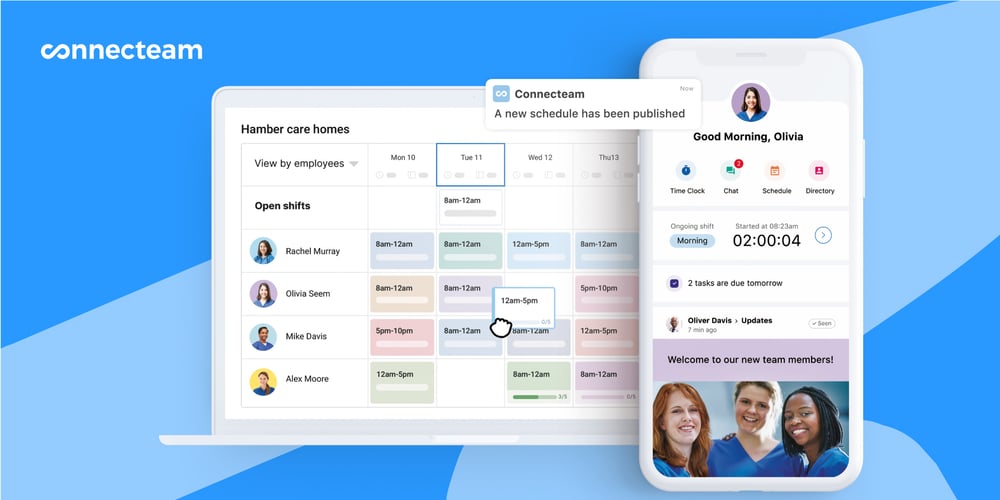
Connecteam’s employee scheduling tools are easy to use and easier to learn. I liked the drag-and-drop editor, which let me set up shifts in a way that worked for me. It was also great being able to copy weekly templates and assign roles in just a few clicks. Connecteam flags conflicts, which helps identify overlapping shifts or missed coverage.
Plus, the auto-scheduler is a huge time saver. It fills shifts based on employee availability, preference, role, and skill. When you make a change to the schedule, employees receive instant notifications on their mobile devices, so you’re not left wondering if they saw the update.
Employees can also request time off or swap shifts right in the app, and I liked that managers can approve the changes instantly. It makes finding shift coverage less stressful by giving employees the responsibility of finding their own replacements.
GPS-enabled time clock
Time tracking in Connecteam is smooth and mobile-friendly with the employee time clock. I appreciated that you can clock in and out from the desktop, mobile, or kiosk app. You can enable GPS tracking to know exactly where employees are when they’re on the clock. If you want, you can even set up geofences around one or more sites to ensure that employees only clock in when they’re physically on location.
I also liked how easy it was to track attendance. You can see who has clocked in, and send automatic reminders to employees who haven’t. Attendance tracking is also a good way to spot patterns for absenteeism and tardiness.
Reviewing and approving timesheets for payroll was simple and straightforward. I could make changes without having to chase people down and sync everything straight to my payroll provider at the end of the pay period.
Integrate with your existing tools
Connecteam offers an API integration and connects with payroll and POS systems, including:
Keep track of tasks
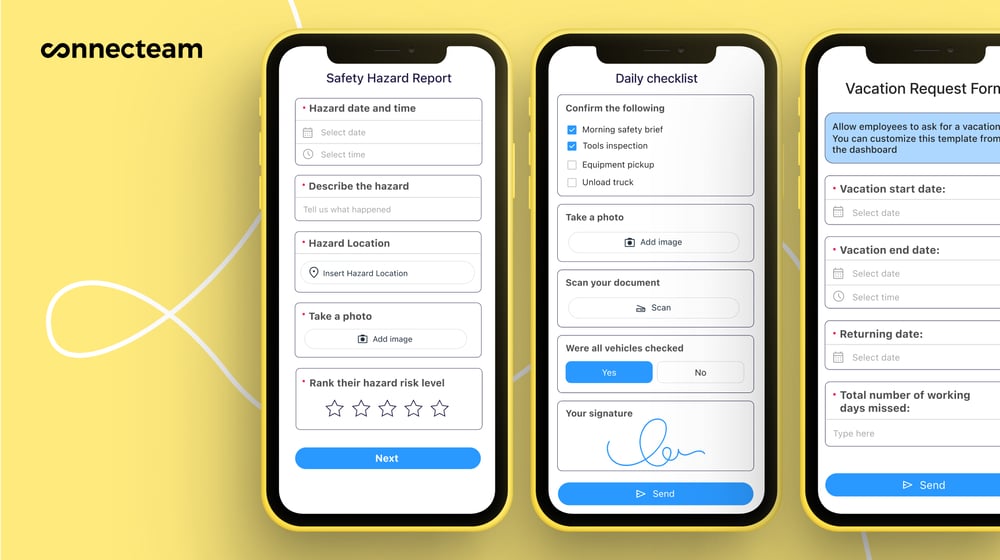
With Connecteam’s employee task tracking, you can assign tasks to individuals or teams, set clear deadlines, and track progress in real time. I liked that you can add notes, media, and subtasks, so employees know exactly what to do and when to do it. You can see task completion at a glance, which saves you from constant follow-ups.
Team communication
With Connecteam’s online team chat, there’s no reason to rely on texts or emails. You can message individuals or create group chats. Plus, you can send company updates to the whole team. With read receipts, you always know who has seen the message. If you’re sharing a policy update or new protocol, you can require employees to confirm they’ve read it, so nothing slips through the cracks.
And so much more…
Connecteam also includes training and onboarding tools, document storage, an employee directory, and automated reports. That makes it a strong fit for frontline businesses that want day-to-day workforce operations and employee management in the same app.
Key Features
- Smart scheduling
- Task management
- GPS time clock
- In-app chat
- Digital timesheets
- Drag-and-drop editor
Pros & Cons
- All-in-one platform
- Intuitive and easy to use
- Friendly for all budgets
- Mobile first design
- More integrations in development
Price:
- Starts at $29/month for up to 30 users
- Free 14-day trial
- Free plan available
Rippling – Good for HR, IT, and Payroll
Rippling is a unified solution that combines traditional workforce management with components to support HR, IT, and payroll.
Why I chose Rippling: I was impressed at how Rippling brings scheduling and time tracking together with broader HR and IT functions, and that it supports 600+ integrations.
Time tracking and attendance
Rippling’s time tracking system is built around a 1-click time clock that employees can access from mobile or desktop. I liked that it includes geofencing, so employees can only clock in at approved locations.
There are also built-in anti-time theft measures to prevent buddy punching, which adds a layer of security. Once employees clock in, the system automatically generates timesheets that connect directly to payroll.
However, I found it limiting that only admins can contact customer support. I could see that being a challenge for frontline managers, especially when they have urgent questions about time or attendance issues.
Scheduling and Workforce Management
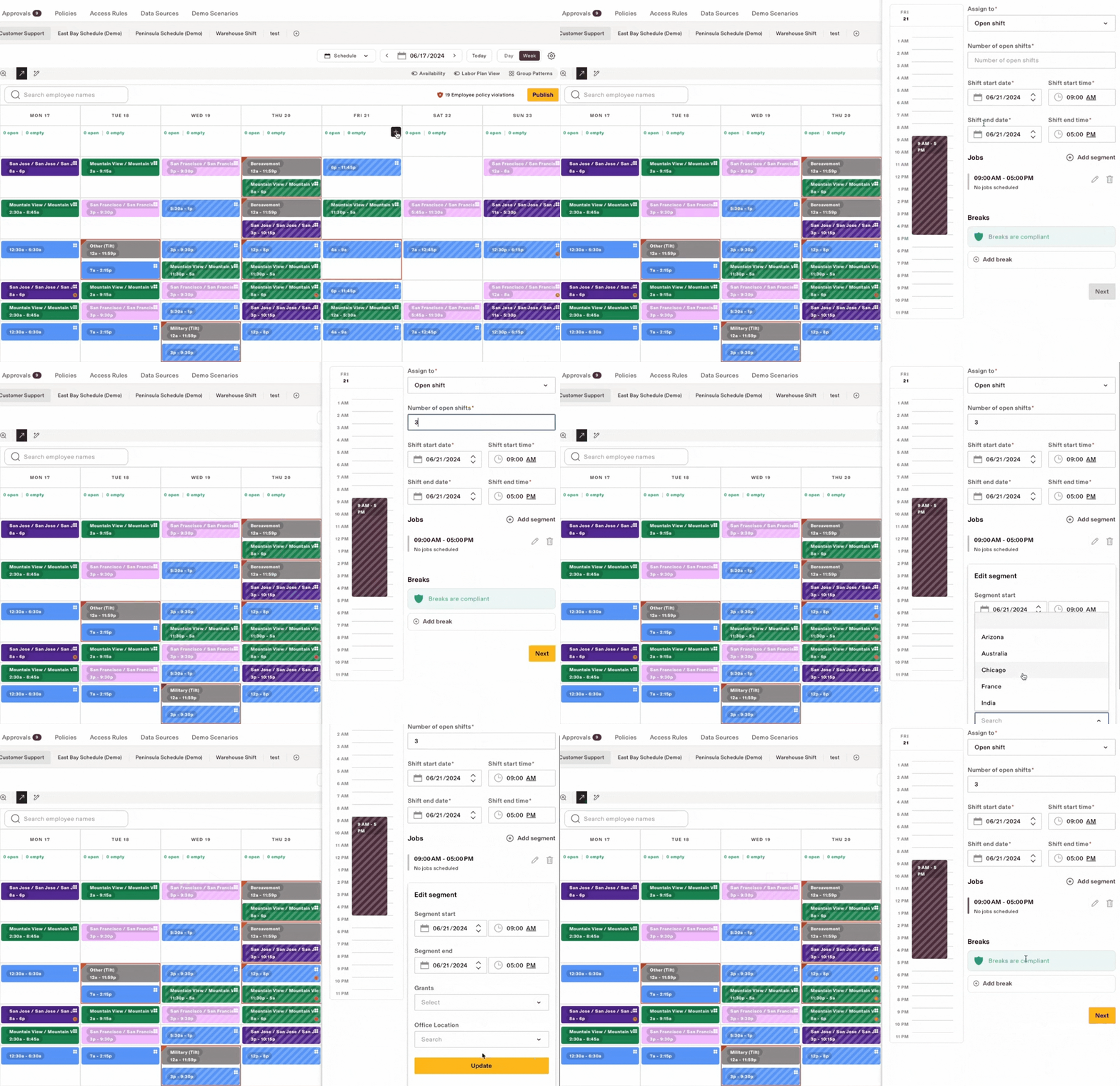
I liked that the drag-and-drop scheduler is clean and functional. I could easily assign shifts, move employees between time slots, and the system flagged potential overtime issues and compliance risks.
That said, I noticed it’s missing an auto-scheduling feature, which I would have liked to see. Rippling doesn’t suggest shifts based on employee availability, skill sets, or coverage needs. If you’re building large or complex schedules, that lack of automation makes the process more manual than it needs to be.
Reporting and sales process
Rippling’s reporting tools are strong. I liked that the custom report builder let me track labor costs, attendance trends, and overtime through sleek dashboards. It pulls data from across time tracking, scheduling, and payroll, giving a complete view of workforce activity in one place.
While Rippling is an overall strong workforce management solution, I found the sales process difficult to navigate. Getting a demo or pricing info required multiple steps, which felt excessive and drawn out. For businesses comparing solutions, that kind of barrier could add unnecessary friction.
What users say about Rippling
What I particularly like is the ease of clocking in/out, the clear reporting features, the mobile app, and its free tier for our needs.

It is a little cumbersome to change clock in an clock outs. Especially if they forget to clock in and then clock out 18 hours later. it is not the easiest fix.
Key Features
- Time clock with geofencing
- Drag-and-drop scheduling
- Digital timesheets
- Custom report builder
Pros & Cons
- Mobile app for employees and admins
- Strong integrations
- Lacks auto-scheduling
- Limited customer support access
Price:
- Contact vendor for price
- Free trial available: No
- Free plan: No
UKG Ready – Good for Comprehensive Time and Attendance Solutions
UKG Ready (formerly Ultimate Kronos Group) is an enterprise-grade workforce and human capital management platform built for large organizations with complex labor, compliance, and scheduling needs.
Why I chose UKG Ready: I liked that UKG can handle complex scheduling and time tracking at scale, especially in industries with strict labor compliance and large shift-based workforces. The automation tools are powerful, and there’s a lot of room for customization, especially for companies with detailed operational needs.
Scheduling and time off management
UKG’s scheduling is one its strongest features. The system automatically generates schedules by factoring in employee availability, preferences, qualifications, labor rules, and budget constraints. I liked that I could build shift templates and save them as reusable “patterns,” which made recurring scheduling easier. The drag-and-drop interface helped me adjust shifts without rebuilding the entire schedule from scratch, and I could add shift notes, cost centers, and overtime rules directly to each shift.
I also liked that employees can set their own availability, claim open shifts, and request swaps directly from the mobile app. You can use the time-off management tools to handle leave balances and accruals, and there are even automated approval workflows you can set up.
While there was a lot to like, one downside for me was that the interface seemed cluttered (too much data, too many screens). When I just wanted to make a quick change, it slowed me down.
Time tracking and attendance
I thought it was interesting that UKG combines hardware and mobile tracking through its InTouch DX physical time clocks and mobile apps. The system supports geofencing by using “known places,” which are preset locations where employees can clock in or out from. For fixed-location settings, it worked fine, but there’s no live GPS tracking, which could be difficult for teams that work in the field or travel between sites.
I liked that time entries are automatically converted into digital timesheets. You review, edit, and approve them, in addition to labor cost data. It’s a lot of detailed information, but I didn’t think that the layout was super intuitive. In fact, I found myself searching through multiple menus just to find basic shift data.
Reporting and Analytics
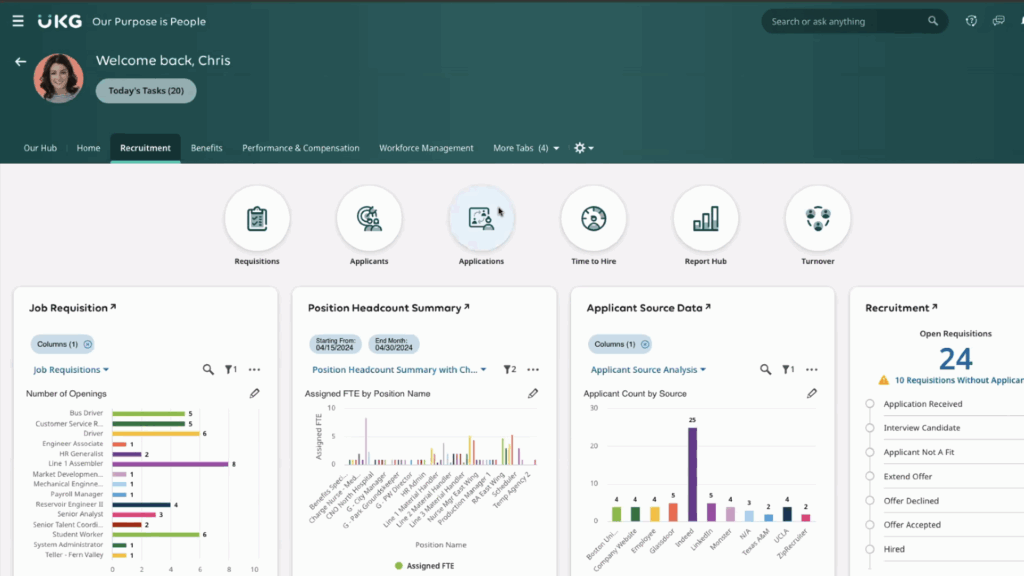
UKG has a wide range of reporting and analytics tools. I liked that I could generate detailed reports on labor costs, overtime trends, attendance, and workforce productivity. The reports pull data directly from across scheduling, time tracking, and payroll, giving a full view of your operations.
Still, I found the reporting interface overwhelming. Each screen is filled with graphs, dashboards, and tables. While the data is useful, the amount made it harder to focus on key metrics without spending extra time customizing the layout. For a larger enterprise with a dedicated team or data analyst, I can see this being a strong fit. For smaller teams, I don’t know if they would be able to get the same level of value without the resources to manage it fully.
Mobile app and usability
The mobile app covers most core functions, including clocking in, checking schedules, and requesting time off, but it’s not a replacement for the desktop version. I couldn’t add new employees, access training tools, or manage system settings from the app. Also, you need an internet connection to access most features, which might be limiting for some teams.
Aside from that, it’s worth noting that UKG’s setup process takes up time and resources. The full implementation can take months, and you usually need dedicated HRIS staff or third-party support to use it fully. For smaller teams or businesses without IT resources, I imagine this type of complexity would be a dealbreaker.
What users say about UKG Ready
When I log in to do my timesheets, UKG Ready has my projects I’ve been working on pre-filled and I just have to tally the hours and make sure everything adds up.
The learning curve for new users can be steep and certain features like time off tracking or benefit enrollment sometimes feel less intuitive than others and could use a more streamlined design.

Key Features
- Smart scheduling with conflict prevention
- Physical and mobile time clock
- Digital timesheets
- Time-off management
Pros & Cons
- Enterprise-level features
- Advanced reporting and analytics
- Busy interface with steep learning curve
- Expensive with complex pricing
Price:
- Contact vendor for price
- Free trial available: No
- Free plan: No
Workday HCM – Good for Enterprise-Level HR Management
Workday HCM is a human capital management platform built for enterprises. It combines workforce management with HR, payroll, and financial tools and is powered by AI, ideal for larger organizations.
Why I chose Workday HCM: I appreciate Workday’s AI-powered approach to workforce management and how it centralizes scheduling, time tracking, and analytics in one system.
AI-Powered scheduling
Workday’s scheduling uses artificial intelligence through its Workday Illuminate engine to automate shift planning and optimize labor deployment. I could match employee availability, skills, preferences, and certifications to open shifts automatically, while the system factored in business rules, compliance, and budget limits. I also liked that employees could set their preferences or pick up shifts on their own through the self-service tools.
Time tracking and attendance management
Workday’s time tracking tools have versions for mobile, web, and a physical time clock. I liked that you can see real-time calculations of hours, overtime, and labor costs, which gave me a clear picture of staffing throughout the day.
The tools handled basic time tracking well. But for mobile or field-based teams, the platform felt more like an HCM system than a true frontline workforce management solution.
Workforce analytics and reporting
Workday really stood out to me for its analytics. You can pull together data from time tracking, scheduling, and payroll to give you a high-level view of labor costs. Plus, I could build custom dashboards to track attendance trends, overtime patterns, and compliance risks, and set up automated reports.
That said, the analytics tools were not as intuitive as I would have liked. I found them to be pretty complex, and I imagine most teams would need a data specialist or HRIS analyst to really get the most value out of the reporting.
What users say about Workday HCM
It’s easy as a user to input time and submit timesheets for approval. Also easy to submit time off requests.
It can be cumbersome at times at the number of steps in order to clock in. There’s also challenges, correcting an inaccurate punch for the employees.
Key Features
- AI-powered scheduling
- Time tracking
- Workforce analytics
- Real-time labor cost calculations
Pros & Cons
- Enterprise-grade features
- AI-powered automations
- Lengthy implementation process
- Not built for frontline teams
Price:
- Contact vendor for price
- Free trial available: Yes – 30-day
- Free plan: No
BambooHR – Good for Small to Mid-Sized Businesses
BambooHR is a comprehensive HR platform built for small to mid-sized teams. It focuses on employee records, performance tracking, and benefits administration.
Why I chose BambooHR: BambooHR stood out to me for its strong emphasis on employee data, hiring, and performance reviews. For growing companies that want to build out their HR infrastructure, BambooHR is a solid choice.
HR data management and employee self-service
BambooHR’s employee data system is the core of the platform. It keeps everything organized and makes it easy to find what you need, including employee profiles, documents, contact info, and job history. I liked the employee self-service portal, which lets your team update personal details, view pay stubs, and check their benefits without needing to go through HR every time.
I appreciated that you can customize permissions for employees, managers, and admin roles. This helps keep sensitive data secure while still giving people access to what they need.
Performance management and onboarding
I liked that you could create review cycles, set goals, and track progress over time with the performance management tools. It wasn’t too complicated, which I appreciated.
I also found the onboarding features pretty useful. I could automate forms, build a simple onboarding checklist, and make sure new hires weren’t left guessing during their first few days.
Time tracking, scheduling and payroll (add-ons only)
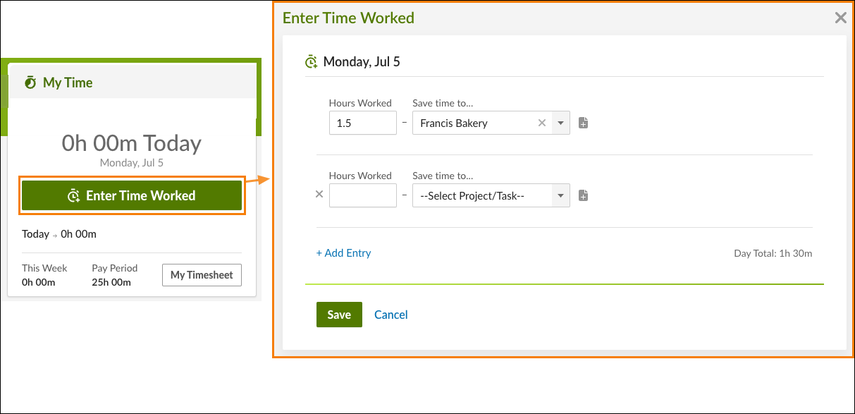
Here’s where I hit some roadblocks. BambooHR doesn’t include workforce management features in its core platform. Time tracking is only available as a paid add-on. While the add-on includes useful features, like mobile and desktop time clocks, project-based tracking, and automated approvals, it’s not integrated by default.
Scheduling isn’t built in either, which I found frustrating. If you need to assign shifts or manage rotating teams, you’ll need to use a third-party integration. That could be a major gap for businesses looking for an all-in-one workforce management solution.
Even payroll is an add-on, with tools like direct deposit and tax filing, but again, it’s separate and adds to the total cost. For such a well-rounded platform, having to add key features separately felt limiting.
Reporting and mobile accessibility
BambooHR’s reporting tools shine when it comes to HR data. I could pull reports on turnover, demographics, headcount, and other metrics. However, these reports only cover HR insights, so you won’t find operational metrics like labor cost trends, shift coverage, or scheduling efficiency out of the box.
On another note, BambooHR’s interface is very clean. The layout is modern, intuitive, and uncluttered. I found the mobile app helpful for employees; it allowed them to view time off balances and company announcements.
Still, some key admin functions aren’t available on mobile, such as approvals, adding new employees, and accessing in-depth reports. For managers on the go, that can be pretty limiting if they rely on mobile access.
What users say about BambooHR
I’m able to manage employee onboarding and offboarding, set task lists for each, complete performance reviews for employees, including 360 reviews, survey staff, track time off, etc.
I wish there was a scheduling feature in BambooHR to schedule my staff. Right now I have to use excel sheets instead.
Key Features
- Employee data management
- Applicant tracking system
- Time-off management
- Comprehensive HR reporting
Pros & Cons
- Clean user interface
- Strong HR functionality
- Time tracking and scheduling are add-ons
- Pricing is not transparent
Price:
- Contact vendor for price
- Free trial available: Yes – 7-day
- Free plan: No
What is Workforce Management Software?
Workforce management software (WFM software) helps businesses plan, track, and manage employee operations more efficiently. It usually includes tools for scheduling shifts, tracking time and attendance, managing time off, assigning tasks, and ensuring compliance with labor laws.
Many platforms also offer features for payroll, communication, and training. WFM software is especially useful for teams with hourly or shift-based workers, helping managers stay organized and employees stay informed.
How Does Workforce Management Software Work?
Workforce management software works by bringing together operational tasks into one digital system. This makes it easier for managers and teams to stay organized and efficient. Most tools start with employee input, such as availability, qualifications, or time-off requests, and use that data to help build optimized schedules. Some systems even automate shift assignments based on rules like skill level, location, or labor laws.
Employees typically interact with the software through a mobile app or desktop portal to clock in and out, receive updates, view tasks, or request changes to their schedules. Managers can track attendance, monitor task progress, and approve timesheets in real time. The software logs data on hours worked, time off, and performance, which can be turned into reports for payroll, compliance, and decision-making. The goal is to reduce manual admin work, prevent errors, and give both managers and employees better visibility into the day-to-day flow of work.
The Benefits of Workforce Management Software
Here’s how workforce management software can benefit your business:
Streamline day-to-day operations
Managing teams manually can mean juggling spreadsheets, texts, and scattered time-off requests. Workforce management software centralizes scheduling, time tracking, and communication, by removing chaos and bringing order to your daily operations.
Save time and labor costs
Automating repetitive tasks like shift planning, timesheet approvals, and payroll prep reduces how many hours you spend on admin work. It can also minimize costly errors like accidental overtime or overstaffing, which helps you control labor costs and improve overall efficiency.
Schedule smarter with less effort
With a full view of employee availability, roles, and skills, assigning the right person to the right shift gets easier. Workforce management tools help prevent double-booking, reduce last-minute shift scrambles, and ensure every shift is properly staffed.
Stay compliant and reduce risk
Workforce management solutions often have or let you add compliance rules so that you can easily manage regulations and comply with labor laws. It lets you accurately keep track of hours worked, approvals, and employee actions.
How Much Does Workforce Management Software Cost?
Workforce management software pricing varies widely based on the provider, number of users, and the features you choose. Most platforms follow a per-user pricing model, with rates ranging anywhere from $2.50 to $72 per user per month. That can add up fast, especially for businesses with larger teams or multiple locations.
It’s important to note that higher prices don’t always mean better tools or a smoother experience. Some platforms charge extra for essentials like scheduling or time tracking, forcing you to pay more just to use core features.
Connecteam’s Small Business Plan is free for up to 10 users. Paid plans start at a flat $29/month for up to 30 users and include features such as time tracking, scheduling, and task management.
FAQs
What is the best workforce management software for small businesses?
The best option depends on what the business needs to manage. For small businesses with frontline, mobile, or shift-based teams, Connecteam is a strong fit because it combines scheduling, time tracking, task management, and communication in one app. HR-led businesses may prefer a broader HR suite such as BambooHR or Rippling.
What are the top workforce management tools in 2026?
The five workforce management tools in this comparison are Connecteam, Rippling, UKG Ready, Workday HCM, and BambooHR. They serve different buyer needs rather than forming a universal one-to-five ranking.
Connecteam is a strong fit for frontline and shift-based operations; Rippling and BambooHR are broader HR-focused suites; UKG Ready and Workday HCM are geared toward more complex enterprise workforce management.
What’s the best employee management software for hourly teams?
For hourly and shift-based teams, Connecteam is a strong fit. It combines scheduling, time tracking, and team communication while helping managers handle time-off requests and payroll prep in one place.
Is workforce management software the same as HR software?
Not exactly. Workforce management (WFM) software focuses on day-to-day operations—like scheduling, time tracking, and attendance.
HR software often focuses on hiring, employee records, and benefits. Some platforms, like Connecteam, combine both to give small businesses a complete solution.
What is the difference between CRM and workforce management software?
CRM software manages customer relationships, sales pipelines, and service interactions.
Workforce management software helps businesses schedule employees, track hours worked, manage payroll, and streamline internal operations.
They’re used for different purposes—CRM is customer-facing, while WFM is employee-facing.
How much does workforce management software cost?
Pricing varies widely. Some providers charge $5–$15 per user/month, while others offer flat-rate plans.
Connecteam offers a free plan for up to 10 users and starts at $29/month for 30 users.
Which WFM software is easiest to use?
Ease of use depends on the role and workflow. For frontline and shift-based teams, Connecteam’s mobile interface, drag-and-drop scheduling, and built-in chat can make it straightforward for managers and employees to get started.
What industries benefit most from workforce management software?
WFM software is especially useful in industries like construction, field services, hospitality, security, retail, and healthcare, where employees work shifts or across multiple job sites.
Connecteam is designed with these industries in mind and offers GPS time clocks, mobile task management, and real-time scheduling updates.
Is workforce management software only for large businesses?
No. While some tools cater to enterprises, Connecteam is built for small and mid-sized businesses that need simple, powerful tools to manage operations and frontline teams, without breaking the bank.
The Bottom Line on Workforce Management Software
If you’re still using spreadsheets, texts, or outdated systems to manage your team, it’s costing you time, money, and control. Modern workforce management software helps you streamline scheduling, track time accurately, and stay on top of tasks and communication, without all the manual busywork.
There isn’t one workforce management platform that is the best fit for every business. Connecteam is a strong fit for frontline and shift-based teams that want scheduling, GPS time tracking, digital timesheets, task management, and in-app chat in one place. Rippling and BambooHR make more sense for HR-led needs, while UKG Ready and Workday HCM are better suited to complex enterprise workforce management.
For smaller frontline teams, Connecteam also offers a free plan for up to 10 users and a flat-rate paid option that covers up to 30 users. If that matches your operating model, you can try it free.
👉 Try Connecteam for free and see the difference for yourself.
