

Automated time tracking app for project-based businesses, but poor usability holds it back.
Verdict: 7.2/10
Timely is primarily a timekeeping solution that offers automatic time tracking, timesheets, reporting, and more. It captures workers’ activities and GPS locations and lets them submit their chosen entries for timesheet approval.
In theory, it’s a great solution for both desk-based and dispersed teams with hourly or project-based tasks. Plus, with support for 50+ currencies, it works for businesses worldwide.
That said, Timely has major usability flaws. The platform is pretty difficult to navigate, the mobile app is glitchy, and some features don’t integrate with each other as they should. Timely also lacks a proper scheduling tool and payroll integrations, which could be a deal-breaker for businesses looking for an all-in-one solution. And given its relatively high price point, I wouldn’t even recommend it for small businesses or those on a tight budget.
Key Features
- Manual time tracking. Create a manual time entry on Timely by logging hours and adding associated projects, tags, and notes.
- Memory time tracker. Let Timely capture your workers’ activities and GPS locations so they can add these entries to their timesheets with an easy drag-and-drop tool.
- Timesheets. View, filter, edit, and export employee timesheets from your reporting dashboard.
- Projects. Create multiple projects that users can add to their time logs. Customize project budgets, billable rates, and more as needed.
- People dashboard. Invite users and see team members’ logged hours, missed hours, capacities, overtime hours, and more.
- Reporting. Choose from existing reporting templates, such as employee hours and monthly project reports, or create your own dashboard. Create custom company-branded reports to send to clients.
- Invoices. Create invoices with a few clicks and integrate them with accounting software like QuickBooks.
- Integrations. Connect Timely with third-party communication, project management, accounting, and other software.
Pros
- Automatic time tracking
- Multiple currency support
- Many third-party integrations
- Branded reports for clients
Cons
- Task management available only as an add-on
- No scheduling tools or payroll integrations
- 1-click timer difficult to find
- Usability issues across most features
How I Tested Timely
I signed up for Timely’s free 14-day trial, invited 6 users, and set up permission levels, projects, and tasks for each. I tested all of Timely’s key features, including its automatic time tracker, timesheets, task planning, and invoicing tools. I even checked how the platform syncs across its web, desktop, and mobile apps, and handles real-life edge cases, such as missed time entries.
Timely Pricing
Timely offers 3 pricing plans, summarized below.
| Starter | Premium | Unlimited | Enterprise |
|---|---|---|---|
| $9/user/month billed annually $11/user/month billed monthly | $16/user/month billed annually $20/user/month billed monthly | $22/user/month billed annually $28/user/month billed monthly | Custom pricing |
| Max 5 users | Max 50 users | Unlimited users | Unlimited users |
| 20 projects | Unlimited projects | Unlimited projects | Unlimited projects |
| Everything in Starter, plus:
| Everything in Premium, plus:
| Everything in Unlimited, plus:
|
I appreciate that Timely’s plans are transparent, but I wasn’t a fan of the prices or the pricing structure. Unlike Toggl Track, which lets you pick a plan based on the features you need, Timely’s plans are largely based on team size.
Read my full Toggl Track review here.
While smaller teams with fewer than 5 users can choose any of the plans, teams of more than 5 have no choice but to upgrade to more expensive options. They must pay at least $16/user/month for the Premium plan, and they still won’t have access to multiple currencies, overtime indications, and other essential tools.
Further, the task planning tool must be purchased as an add-on regardless of your plan. Starting at $5/user, this adds heavily to your cost.
Here’s how Timely’s monthly premium plan checks out against competitors’ pricing.
| Team size | Timely (Premium) | Deputy(Core) | Clockify (Pro) | Connecteam(Advanced) |
|---|---|---|---|---|
| View pricing | View pricing | View pricing | View pricing | |
| 10 Users | $160 | $65 | $79.90 | Free for life—all features and dashboards |
| 20 Users | $320 | $130 | $159.80 | $49 |
| 30 Users | $480 | $195 | $239.70 | $49 |
| 50 Users | $800 | $325 | $399.50 | $99 |
| Read our full Deputy review | Read our full Clockify review | Learn more about Connecteam | ||
| * All prices show the monthly cost when billed annually as of June, 2026. | ||||
While Timely doesn’t offer a free plan, I appreciate that it offers a 22% discount if you pay annually. It also has a 14-day free trial with access to all of Timely’s tools and features. This way, you can properly explore the platform before committing to a plan.
Verdict: 4/10
Timely Usability and Interface
Signing up
Setting up a free trial with Timely was very straightforward. I simply added my company’s name, industry, and team size (no credit card details required) to get started. I could also download Timely’s “memory app,” sync my calendar, and select from a list of sample project templates. The whole process was 4 steps and took under a minute.
That said, I would have liked the option to add team members when signing up. I could invite team members and even add custom permissions when I signed up for another platform (Homebase), and honestly, it was a real time-saver.
Read my full Homebase review here.
I could do all this from the “People” tab once I accessed my workspace. But it took much longer than I’d have liked. I had to invite employees 1 at a time by:
- Providing their personal details
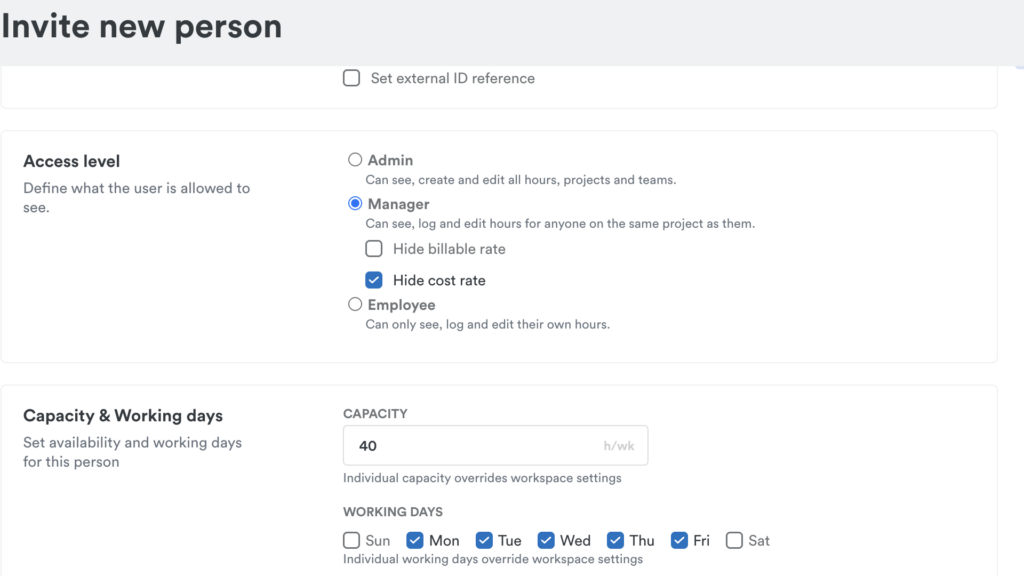
- Setting permission levels (admin, manager, or employee)
- Assigning their billable rates and labor costs
- Adding their availability and capacity
- Giving them project access (I couldn’t add new projects from here, creating another step if that was needed)
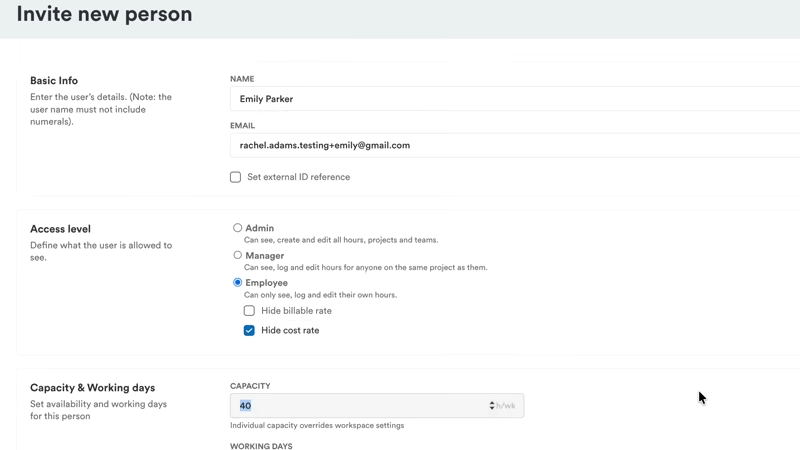
This process took me about 3 minutes per employee. I wish there were a faster way to do it in bulk. Also, I found it strange that I couldn’t add my employees’ job titles while inviting them.
User set up
Once I invited team members, I switched hats and tried accepting the invite as a user. I clicked on the link in the invite email, created my password, and clicked “Go to Timely,” only to be greeted with a 404 error page. I tried this through multiple user accounts, multiple times, and failed.

Design
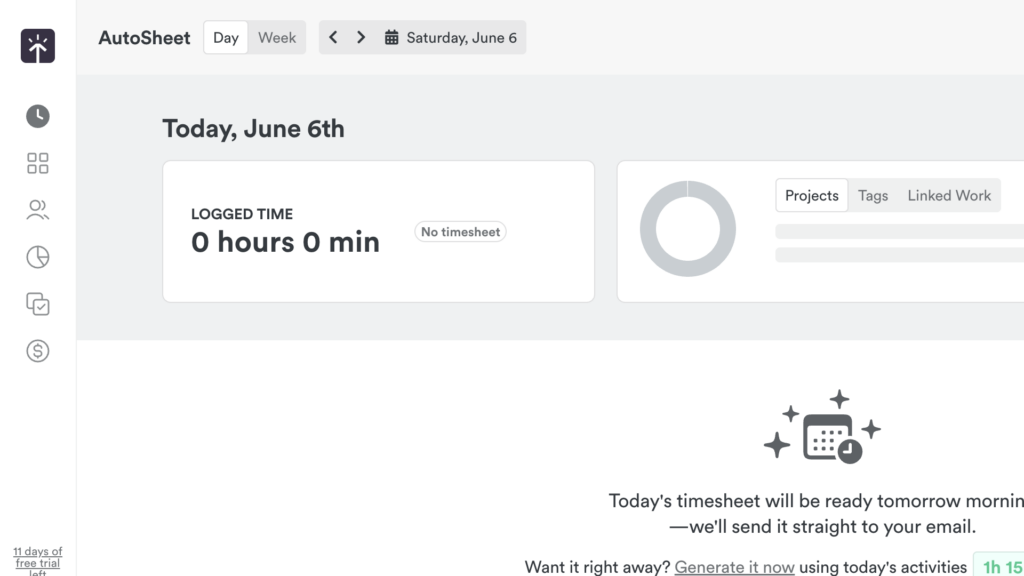
Once inside, I encountered a clean and modern user interface. But I found the white and grey color theme pretty bland (it almost looked like I was seeing an inactive screen). While Timely’s key features were neatly displayed in the left sidebar, I didn’t like that they were displayed only as icons, with no text to indicate what they were. I had to hover over them for the feature label to show. Not as intuitive as I’d have liked.
User experience
Before I get into the details, it’s important to understand how Timely works. Timely has a “memory app” which records:
- Activity-based memories by tracking a user’s web/URL activity on the desktop app
- Location-based memories by tracking a user’s location on the mobile app
All memories serve as potential time entries, showing how long the user worked on that activity or in that location. Users can view these memories and decide which ones to submit for their timesheets.
In theory, this process can reduce missed punches, timesheet errors, and even instances of time theft in both desk and field jobs.
But I faced a major practical problem. As a user, I found the process of editing and submitting entries complicated, to say the least. As an admin, I also struggled to figure out how to view and edit timesheets, which were confusingly nested under the “People” tab.
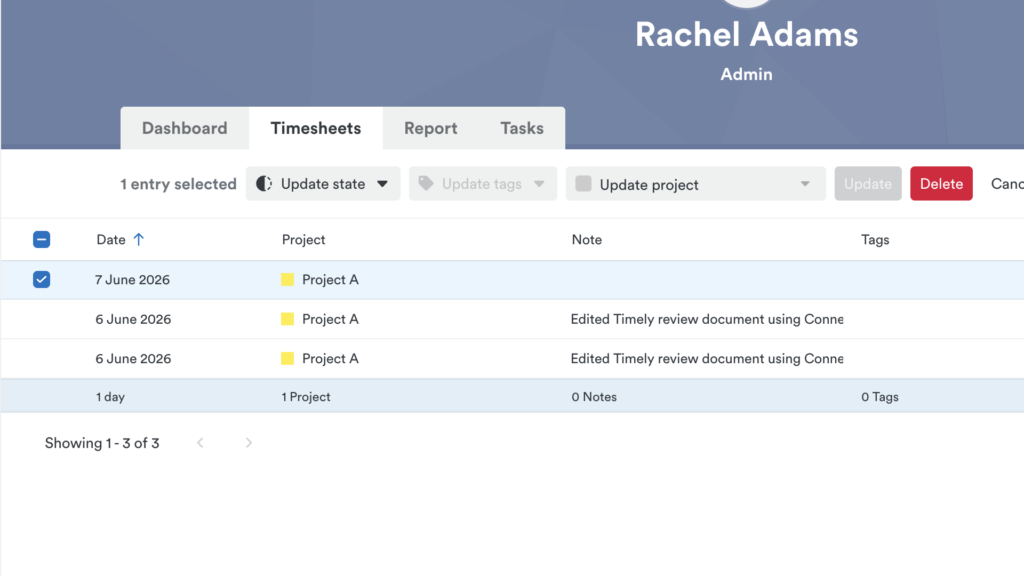
Another issue I had was with how features integrated with each other. For example, I couldn’t work out how to link time entries to specific tasks. Without this, the “Tasks” feature is essentially pointless.
As I dug deeper, I discovered that Timely recently redesigned and switched from its old version (called Classic time tracking) to a newer version (called Autosheets). The upgrade seems to introduce several bugs and usability problems since I last tested it a few years ago. The website and chatbot still give guidance from the old version, which isn’t helpful.
Overall, the learning curve was much steeper than expected, and I can see this being challenging for everyone, let alone less tech-savvy workers and managers.
Finally, Timely lacks accessibility options for those with visual, hearing, or other impairments, which was slightly disappointing.
Verdict: 4/10
Mobile and desktop apps
The desktop app has a single purpose: recording activity-based memories. It was easy to navigate, and I was impressed by how it updated in real time.
The mobile app was more feature-rich. Like the desktop app, it captures memories, but it also has other features, similar to the web portal.
Here’s how the mobile app compares to the web portal.
| Menu Item | Admin | Employee | ||
| Website | Mobile App | Website | Mobile App | |
| Core Features | ||||
| Hours dashboard | ✅ | ✅ | ✅ | ✅ |
| Memories | ✅ | ✅ | ✅ | ✅ |
| Manual time tracker | ✅ | ✅ | ✅ | ✅ |
| Task planner | ✅ | ❌ | ✅ | ❌ |
| Option to add new projects | ✅ | ✅ | ❌ | ❌ |
| Option to add new clients | ✅ | ✅ | ❌ | ❌ |
| Team management | ✅ | ❌ | ❌ | ❌ |
| Invoices | ✅ | ❌ | ❌ | ❌ |
| Integrations | ✅ | ✅ | ✅ | ✅ |
| Analysis Features | ||||
| Projects dashboard | ✅ | ✅ | ✅ | ✅ |
| People dashboard | ✅ | ❌ | ✅ | ❌ |
| Reporting | ✅ | ✅ | ✅ | ✅ |
| Timesheets | ✅ | ✅ | ✅ | ✅ |
| Management Features | ||||
| Option to edit timesheets | ✅ | ❌ | ❌ | ❌ |
| Notifications | ✅ | ✅ | ✅ | ✅ |
| Settings | ✅ | ✅ | ✅ | ✅ |
| Subscriptions | ✅ | ❌ | ❌ | ❌ |
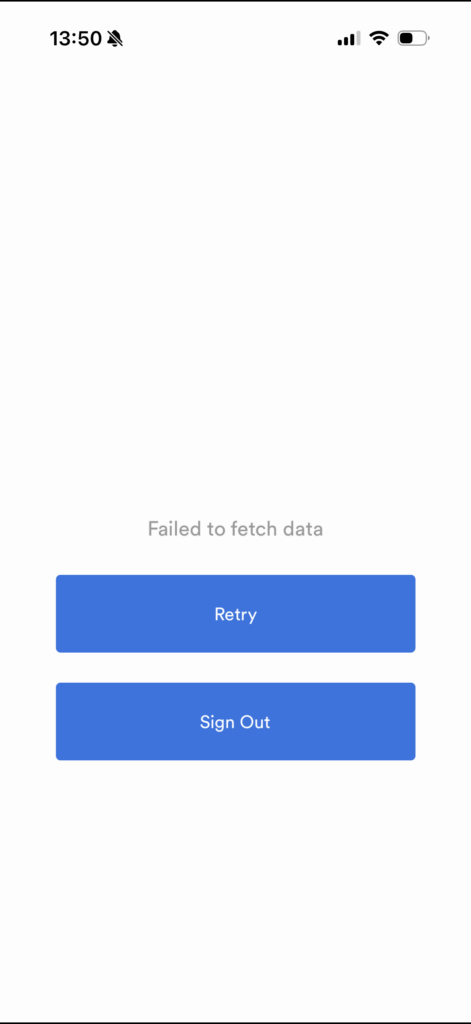
Overall, I was pleased with the mobile app’s design and features. But I found it was glitchy. It didn’t update and sync memories as quickly as the desktop app did. Pages took ages to load, and I encountered multiple error messages while trying to activate location tracking and load memories.
My other complaint is that Timely doesn’t offer offline time tracking. It doesn’t capture activities or locations without an internet connection. This had me questioning whether Timely is good for businesses on the move, such as construction, mining, or agricultural teams operating from remote locations.
Verdict: 6/10
Timely Core Functionalities
Time tracking
Automatic time tracker
Timely prides itself on its automatic time tracker. Here’s how it’s supposed to work:
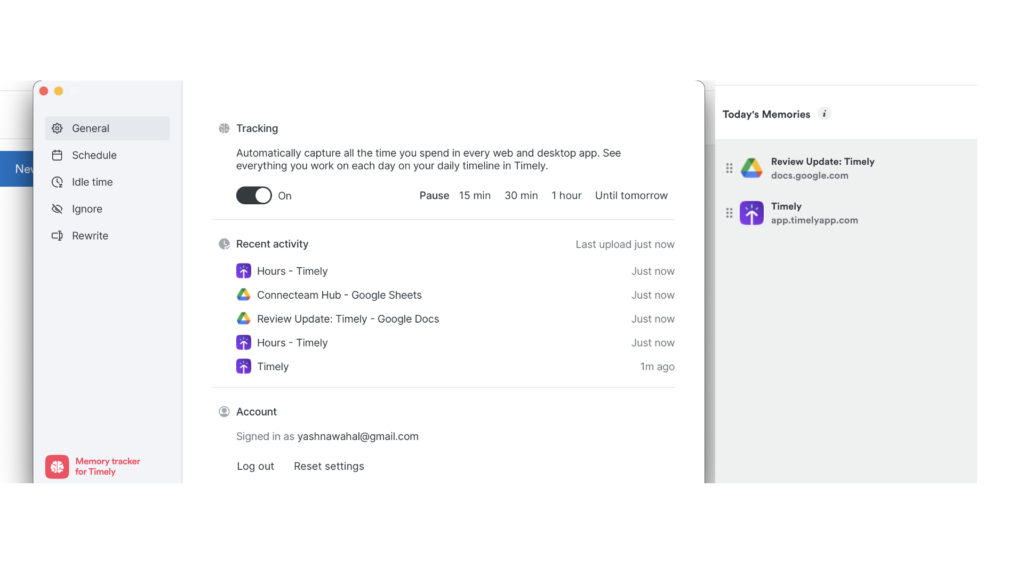
- Users can download the desktop and mobile apps, which track their locations and background activities. They can adjust settings, such as idle time detection, ignoring certain websites or apps, or setting time windows for activity tracking.
- These activities appear as memories in users’ private “Hours” feature.
- Users can drag and drop the memories they want to log as hours worked into their timesheets.
- Over time, Timely’s AI tool will predict which memories should be logged versus ignored.
In my opinion, this can be extremely useful. In the real world, workers often forget to log hours or make errors in estimating how long they’ve spent on their tasks. This tool does all the memorizing for them, keeping time entries accurate and ensuring nothing is missed.
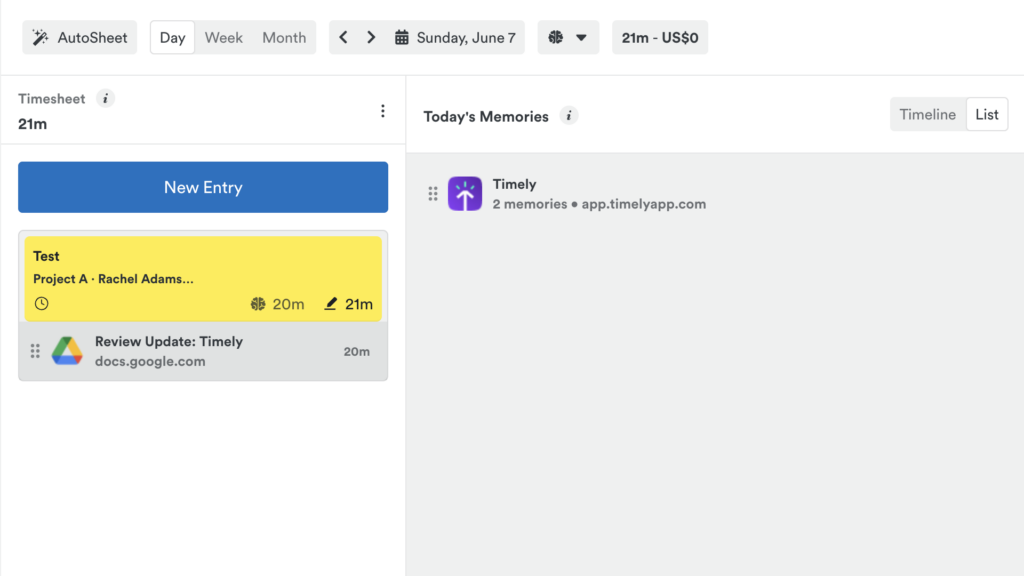
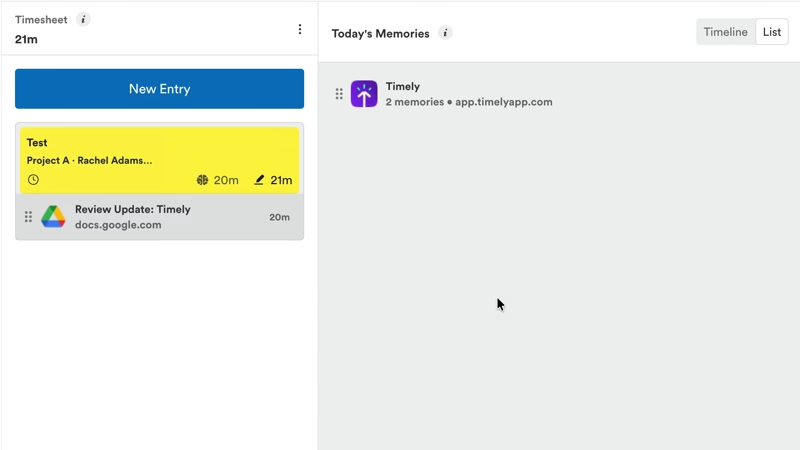
That said, the feature didn’t work as smoothly as I’d have liked when I tested it. My desktop app updated my activities in real time, but they took a long time to appear as memories in my web portal (from where I’m meant to submit them as time entries).
This lag isn’t ideal. In reality, if workers must wait long after their work hours to submit their time logs, it’s more likely they’ll put it off and forget to do it later. This defeats the purpose entirely.
Manual time tracker
In addition to automatic tracking, Timely lets you create manual time entries. This is especially useful for teams that work offline or aren’t comfortable with the Memory app tracking their activities or locations (for instance, in highly regulated or sensitive sectors or when dealing with confidential client data).
Timely vs. Harvest time tracking comparison
Timely also has a stopwatch-like timer tool, though it was located in a strangely complicated place and very difficult to find.
Unlike most apps, where you can easily spot and use it with a single click, with Timely, I had to create a time entry to find the timer hidden within the edit fields. This causes unnecessary friction in the real world. For instance, if a construction worker wants to track time for different on-site tasks, it’s more likely they’ll rely on using the timer than location-based memories.
Verdict: 6.5/10
Digital timesheets
You can supposedly view your team members’ time entries at any time from the “Hours,” “People,” or “Reports” tabs in the app. But I found the “Hours” tab extremely confusing and frustrating to navigate. I couldn’t figure out how to get a real-time view of team members’ timesheets (or even my own).
My preferred method was using the timesheets tab in the “Reports” dashboard, where I could build a custom timesheet view. Here, I could choose a day, month, or year and filter by people, projects, tags, or timesheet status (e.g., billed, logged, invoiced).
Annoyingly, there was no option to see start and end times. While total time matters for payroll, start and end times are important for calculating overtime rates, checking compliance with rest breaks, and more, so I think this is a missed opportunity.
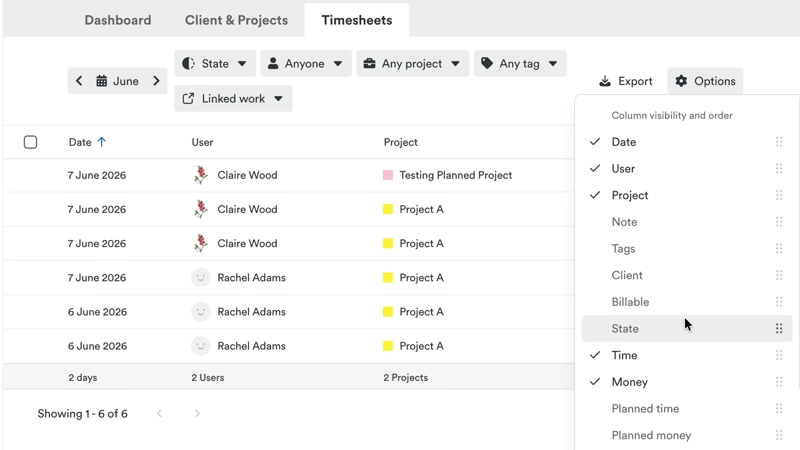
As an admin, I could also click into time entries from this timesheet and edit them, which was useful. Not all platforms let admins edit timesheets, but I like it because it avoids unnecessary back-and-forth with team members. Again, I could only update the total logged time, not the start and end times.
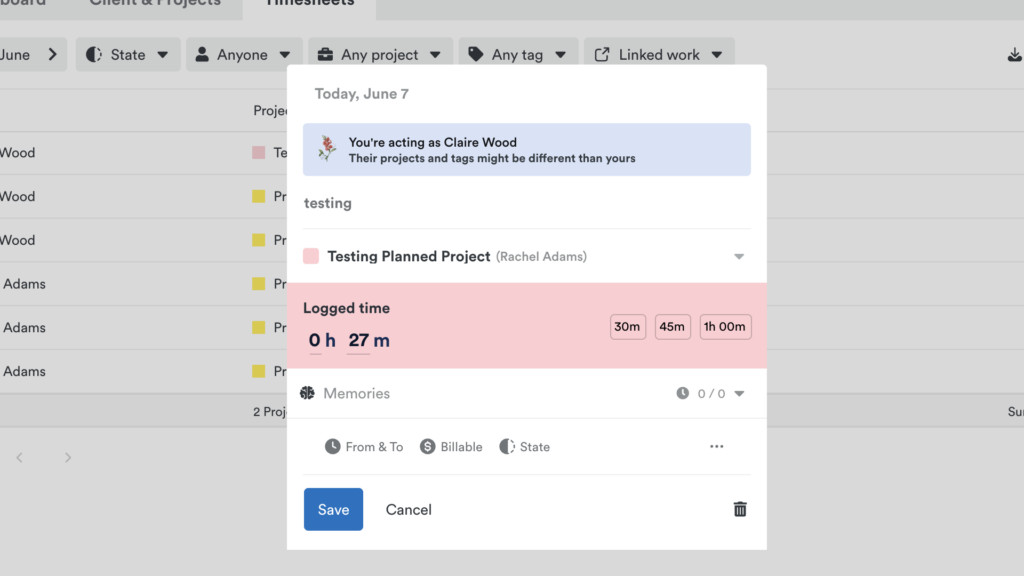
Finally, I could export timesheets as a CSV file. While Timely doesn’t have a native payroll solution, these exports make it easier to process payroll with third-party software.
Verdict: 7/10
Task planning
Timely’s task planning functionality was easier to use than the other features. I could create new tasks individually or in bulk, assign them to team members, add expected hours, start and due dates, and track progress from the task planning dashboard.
It was also handy to see whether employees had more capacity for a task before assigning it to them. In the real world, this likely helps prevent overworking and burnout and ensures a fair workload distribution.
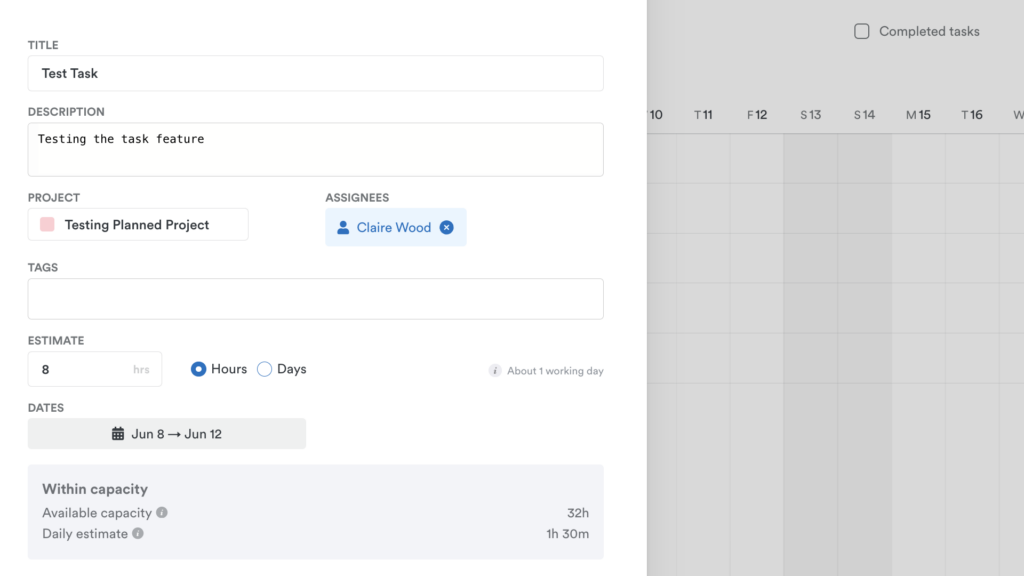
Employees are notified of their tasks via email or push notifications in their mobile apps. They can also view their scheduled work in a timeline or list view on the web or in the mobile app.
My major complaint, however, was that as an employee, I couldn’t work out how to link tasks to time entries. Without this, admins can’t properly track task progress or check time spent versus time estimated for a task. This problem is less about the specific feature and more about Timely’s usability issues, so I haven’t cut points from the feature itself.
Verdict: 8.5/10
Projects
Timely’s “Projects” tool was one of its most customizable features. It lets you organize and manage multiple projects simultaneously. From here, I could create new projects, assign them to clients, choose team members, and set project-specific billable rates that apply to any work done. I could even color-code projects, which helped visually separate them across all dashboards, views, and reports.
The tool also allowed me to set time tracking rules, for instance, requiring team members to use tags or add default project tags for all time entries tied to a project. In addition, I could set both money and time-based budgets for projects. I could also set maximum time limits for internal administrative projects, for example. I hadn’t seen this on many other platforms, so I gave Timely extra points for this.
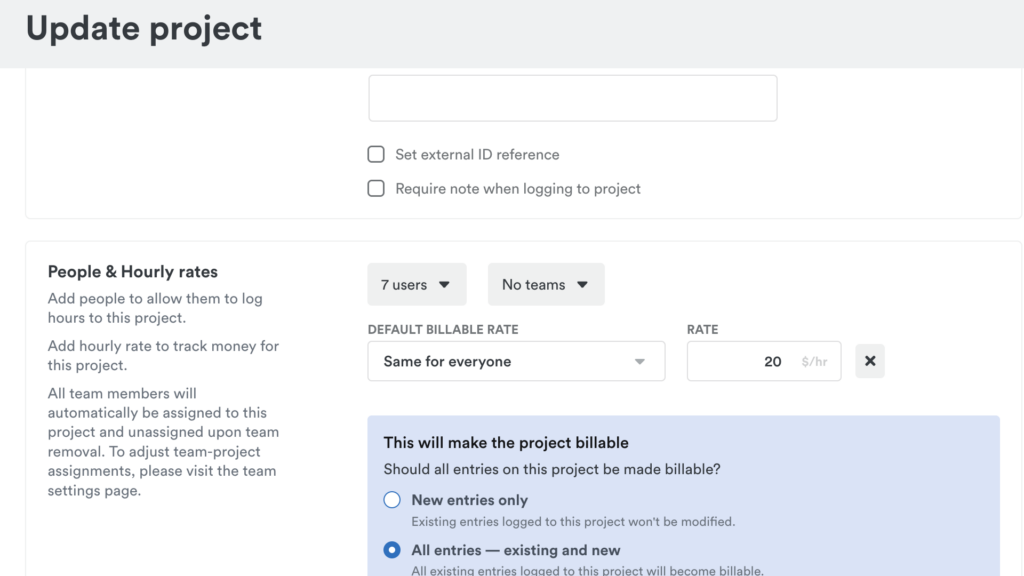
Finally, the “Projects dashboard” showed me exactly how much time and money were spent on each project. This is a clever way to optimize work and avoid exceeding budgets. Once again, my main concern with the project tool was with its usability. The charts in the dashboard referenced “planned hours,” which doesn’t appear to exist in Timely’s newer version. This seems like a labeling issue.
Verdict: 9/10
People and team management
This feature provides everything you need to manage your employees. From here, I could add new users, set access levels, establish working days and hours, set custom billable rates and labor costs, and even categorize users into teams. If you don’t have teams set up already, you can create a new team and add team members, plus a team lead.
My main complaint with the labor cost and billable rates fields was that I couldn’t set different currencies for different team members’ rates. Timely auto-assigns the workspace or project currency. With remote work on the rise and teams becoming more global, this is a missed opportunity.
The “People dashboard,” also part of this feature, gives you a snapshot of your team’s logged hours, capacity left, overtime, and more. It also shows planned hours despite being linked to the old version of Timely and, confusingly, uses the same color shading for both planned hours and tasks.
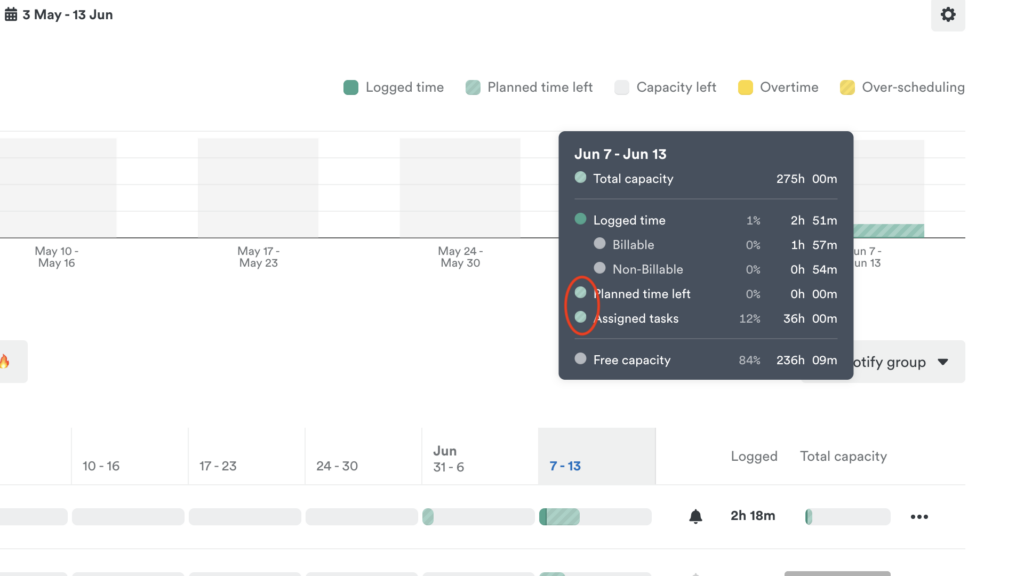
That said, I thought it was useful that the dashboard also lets you see instances of overtime or missed punches. I intentionally skipped submitting time entries for a few users, and the dashboard correctly summarized the missed hours.
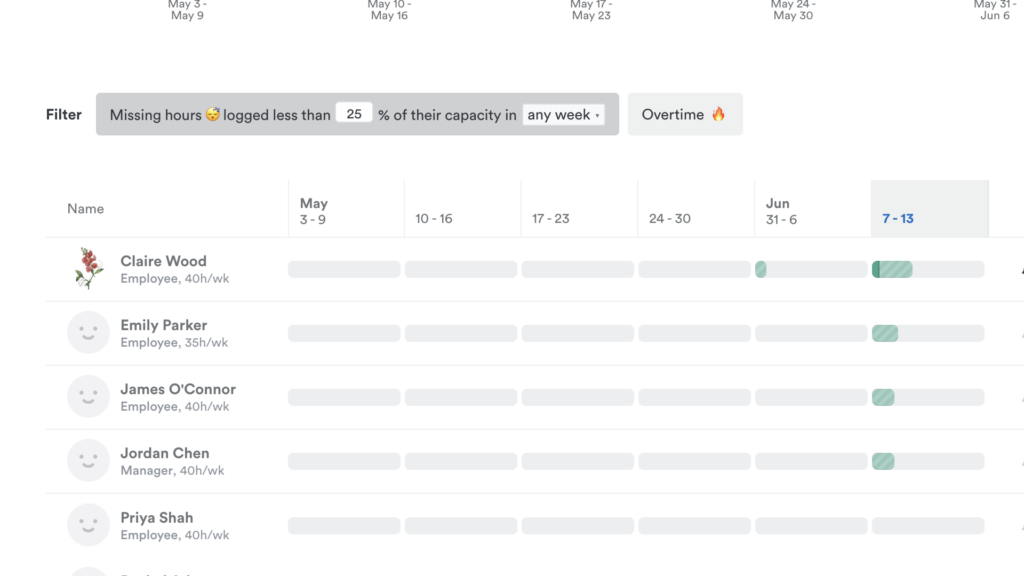
Finally, I liked the small icon on the right side of the dashboard that lets you remind all employees to log their hours, but I was confused about why it was placed there. It would make more sense to see this option in the “Hours” tab.
Verdict: 8/10
Invoices
Creating an invoice on Timely was quick and straightforward. I just input key details like date range and my chosen line items, such as “People,” “Tags,” or “Teams.” Strangely, though, I couldn’t add “Tasks” as line items on the invoice, which, in my opinion, is the most useful and descriptive information to share with clients.
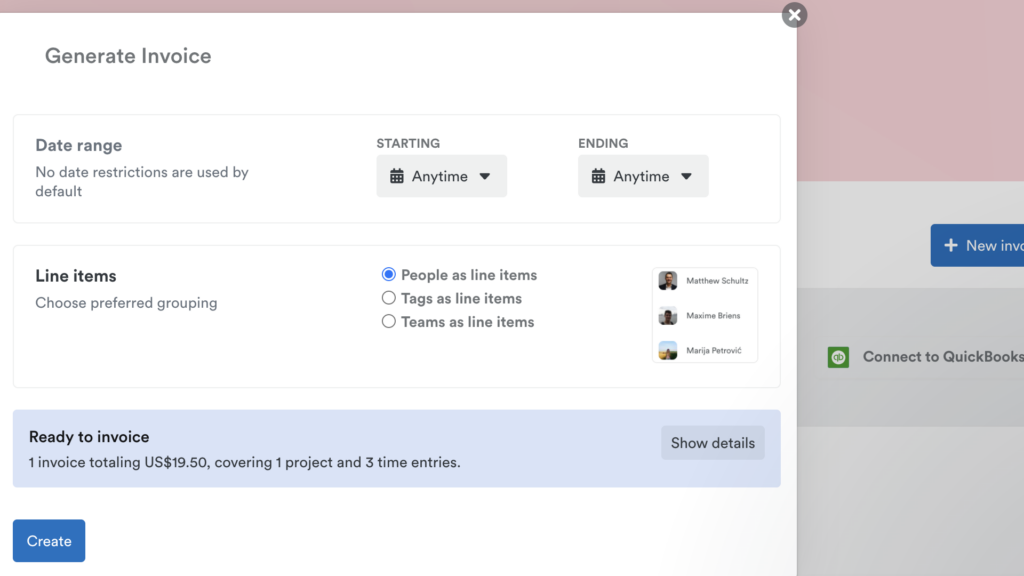
Also, once created, I had only a few options. I could either view the invoice, void the invoice, or integrate it with QuickBooks. This is useful for QuickBooks users, but with no way to export invoices, the feature seems pointless for anyone else.
Verdict: 3.5/10
Integrations
Timely offers several third-party integrations. I was impressed to see the option to connect with many popular time tracking, project management, and scheduling tools.
Here’s a summary of Timely’s integrations.
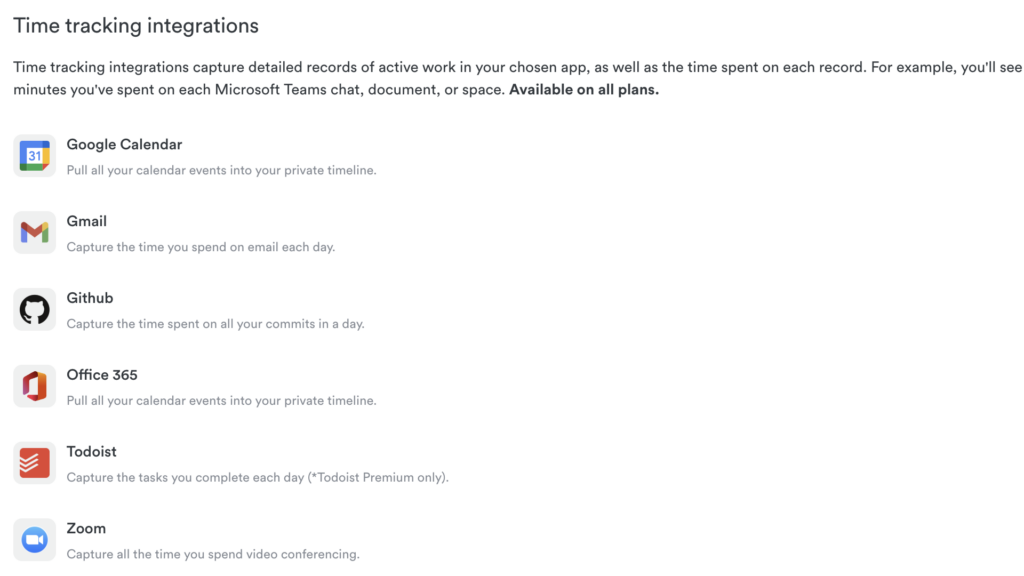
- Timely’s time tracking plug-in with apps like Google Calendar, Office 365, GitHub, Zoom, and more captures your active work while you’re using these apps and creates detailed records, including time spent. These are available on all plans.
- Sync integrations, available on the Premium or Unlimited plans, transfer information between Timely and other tools, such as Toggl, QuickBooks, ClickUp, Monday.com, and more.
- Timely’s API and webhooks tools let you connect it and transfer real-time data to other software. Timely’s support team can help you understand what is and isn’t possible.
- Integrations with automation tools like Zapier and Make let you create and automate your workflow between Timely and other apps. I think this differentiates Timely from other apps since many don’t offer this.
My key concern with Timely was a lack of payroll integrations. To me, a good time-tracking app makes it effortless to sync timesheets with payroll, saving time and reducing manual errors. Many competitors with time-tracking features, like Deputy and Connecteam, offer this.
Verdict: 7.5/10
Timely Security Features
Here’s what Timely does to ensure its data is private and secure.
- Timely is ISO 27001:2022-certified and hosted on Amazon Web Services, which is SOC 2-compliant. Its security infrastructure meets the gold standard.
- Timely’s Memory app collects basic information only, such as the titles of the pages users visit and their active timestamps.
- Memories are strictly private to the user unless they share them on their public timesheets.
- AI timesheet entries are never shared without users’ review and approval.
- Users can delete their information and data whenever they want.
- All data is encrypted in transit and at rest to prevent leaks in the case of hacking or other cyberattacks.
- Credit card information is processed using Stripe’s bank-level security encryption.
- Backend engineers access data after securing user consent and on a need-to-know basis only.
- Admins can set custom permission levels for team members, ensuring only authorized personnel can access sensitive data.
- Timely’s data protection officer regularly reviews its privacy policies and procedures, such as staff training, reporting and escalation processes, and incident response plans.
- Timely’s dedicated emergency response team has quality assurance, support, backend, and operations team members ready to go in the event of a system incident or data breach.
Timely is fully compliant with GDPR laws, which is great for companies operating in the EU and the United Kingdom.
However, Timely is not HIPAA-compliant and clearly states that it’s not designed to handle protected health information (PHI). US-based healthcare companies might benefit from other HIPAA-compliant solutions like Connecteam. I would’ve also liked to see additional user-level security controls, such as the ability to set 2-factor authentication or mandate stronger passwords.
Verdict: 7.5/10
Timely Reporting & Analytics
In addition to the “Project” and “People” dashboards already discussed, I could generate detailed reports, such as employee hours, unbilled hours, and monthly project reports, for deeper insights into workforce planning and financial analysis.
I also liked the full workspace report, which showed me all the data from the different reports in a comprehensive dashboard. It’s handy for broad overviews and presentations.
However, I would have liked to see how my team was performing against their tasks, but I didn’t have this option in the “Reports” or “Tasks” tab.
Exporting reports
All reports in the “Reports” tab were easily exportable in CSV or PDF formats. I also had the option to create a custom reporting template (like a dashboard) that I could tailor with my desired charts and tables and then export.
Customizing report settings
Timely’s workspace settings tool lets me customize how my exported reports would appear. I could adjust the report column order, making it easy to prioritize information that matters most to me.
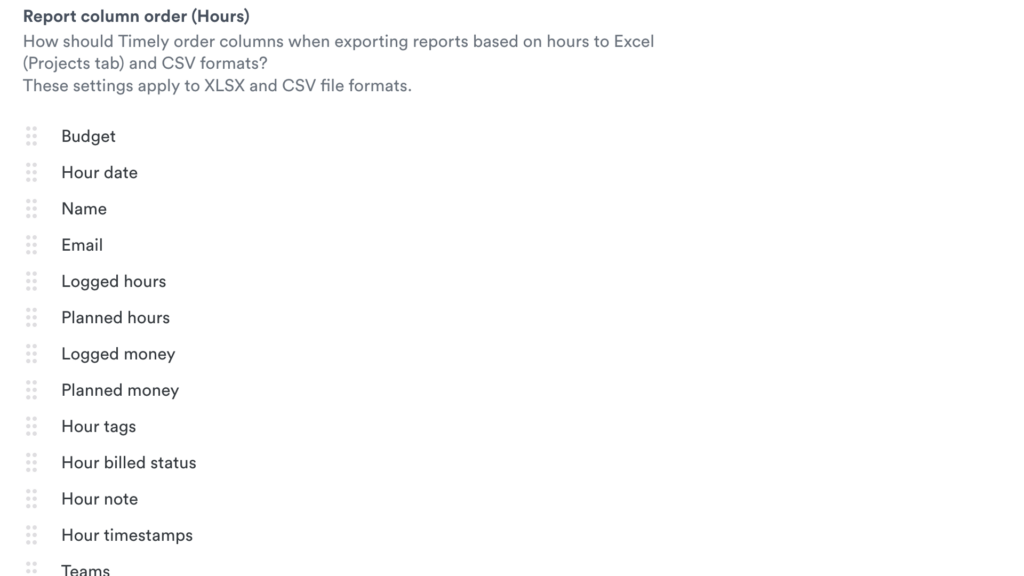
And, I could even add my company branding, such as colors or a logo, to reports. I think this is a great way to maintain a professional appearance in client and stakeholder communications.
Verdict: 9/10
Timely Customer Support
Timely offers in-app customer support, available as a permanent widget on the bottom right corner of your web app. From here, I could access Timely’s Help Center, as well as the first line of support, the AI chatbot.
I used the chatbot a few times while exploring the platform, and unfortunately, I didn’t find it helpful. Most of the guidance was tied to Timely’s older version. While it answered questions for the new version, the instructions didn’t match what I saw in the interface.
I asked to be connected with a human agent, and luckily, someone replied in the chatbot within 15 minutes. I think that’s speedy compared to a few other platforms I’ve tested.
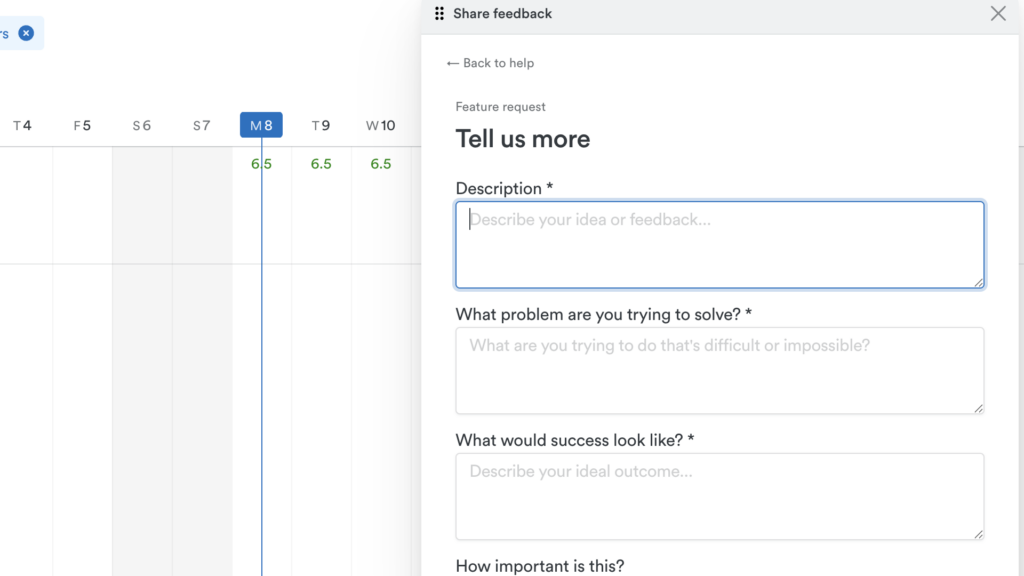
I also liked Timely’s help center, which answered questions about its key features and tools. And I really liked that I could share feedback and even submit a feature request. I haven’t seen this in other solutions, and it made me feel more valued as a customer.
Finally, while Timely’s “Contact us” page lists an email address, it doesn’t specify how long a response will take. I would have also liked a phone number I could call for urgent support.
Verdict: 7/10
What Are Timely’s Review Ratings From Review Sites?
(As of June 2026)
Timely App Review
Timely is primarily a time tracking solution for hourly or project-based businesses. Compared to other platforms, it takes automation to the next level by tracking users’ activities and locations in the background to ensure time entries are accurate to a tee. I was also impressed with its project management, team management, and custom reporting features.
Unfortunately, while its offering was good, Timely really fell short in its usability. The platform was unintuitive and glitchy, and the customer support chatbot still offered guidance based on Timely’s older version. Until these problems are solved, I wouldn’t recommend Timely even if it were free.
Connecteam: The Better Timely Alternative
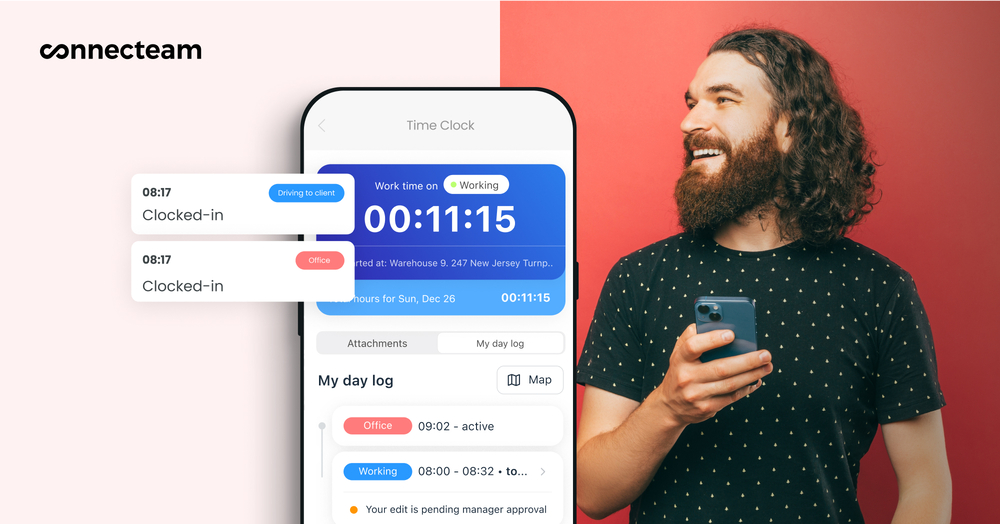
Connecteam is an excellent solution for hourly, project-based, or shift-based teams of any size. It offers several smart and automated features, but it really outshines Timely in terms of user experience. Both the web and mobile apps are clean, intuitive, and function smoothly.
Here are Connecteam’s key features:
- Employee time clock: Workers can clock in and out from any device (including a shared kiosk) in 1 click. It works well for teams in the office, on a job site, or on the move. Unlike Timely, the timer is front and center. Workers can mark individual time entries as billable or non-billable, link time entries to tasks, and even clock in from their scheduled shifts.
- Real-time GPS tracker: Connecteam offers real-time location tracking during work hours, so you can always ensure your employees are in the right place. I like this more than Timely’s offering, which lets workers choose which location-based memories to submit, leaving room for unauthorized getaways during the workday. And I could set geofences that restrict time tracking to specific job locations.
- Timesheets for payroll: It was so easy to view, edit, and approve timesheets on Connecteam. I could also sync timesheets directly with any of its integrated payroll partners or export them to use with a partner of my choice.
- Employee scheduler, employee task tracking, and more: Perhaps one of the most standout aspects in my eyes, Connecteam offers full-featured scheduling, task tracking (included in the cost, unlike Timely), and time off management. I also loved the online team chat, which made it so easy to communicate with my team instantly.
- Value for money: Given its broader range of features at a much lower cost, you get a better bang for your buck with Connecteam. It also has a free-forever plan for teams of fewer than 10, which is the cherry on top for small businesses and startups.
Yes, Timely offers a 14-day free trial with no credit card details required.
No, Timely is not HIPAA compliant. Its website explicitly mentions that it’s not designed to handle protected health information (PHI).
