

Excellent scheduling and time tracking for shift-based teams, but key features require costly add-ons.
Verdict: 7.3/10
Deputy is an all-in-one time tracking and scheduling platform for shift-based businesses. It also offers communication, task management, HR tools, analytics, payroll, and a growing AI layer.
I appreciate that Deputy offers plans for businesses of all sizes—so you can continue using it as you scale. In my testing, scheduling and timesheets felt polished, and the onboarding process is smooth, but other features like news feeds, tasks, AI assistance, and parts of the admin experience still need work.
Key Features:
- Scheduling: Create and assign shifts from scratch with Deputy’s drag-and-drop tool—or use the smart auto-scheduler to save time and reduce errors.
- Time clock: Let employees punch in and out shifts from their web browsers, smartphones, or central kiosks using PINs or biometric facial recognition.
- Timesheets: View, edit, and approve employee timesheets from your web or mobile app. Export these to the integrated payroll software for swift and accurate payments.
- Leave management: View employees’ leave balances, approve or deny leave requests, and track employee availability when scheduling shifts.
- Newsfeed: Post announcements for your whole team or send messages to individual employees in real time.
- Task management: Create and assign tasks to a location, a department, or team members. Share notes and due dates, and allow employees to set their own tasks.
- Compliance support: Schedule mandatory break times, track overtime hours, and more to comply with labor laws.
- Integrations: Connect Deputy with supported payroll, point-of-sales (POS), and HR systems to manage your business from a single platform.
Pros
- Availability across multiple countries
- Touchless clock-in with biometric facial recognition
- AI-powered auto-scheduler
- Mobile app that can be accessed from anywhere
Cons
- Advanced admin controls only on Pro plan
- Many features don’t work offline on the mobile apps
- Built-in payroll is region-dependent
How I Tested Deputy
I signed up for Deputy and created a complete cleaning business setup that mirrors a real-world company with 6 users in different roles. I assessed how Deputy handled this during live testing, evaluating features such as time tracking, tasks, and announcements across desktop, Android, and iOS.
I did my best to engineer hypothetical situations that could cause scheduling and timesheet software to trip up, such as overlapping shifts, complex timesheets, and integration issues. I also contacted customer service, tested on several devices, and tried edge cases. This way, I evaluated how Deputy can be used in the real world.
Deputy Pricing
In October 2025, Deputy entirely changed how its pricing plans were structured. It now uses a 3-plan lineup: Lite, Core, and Pro:
| Lite | Core | Pro | |
|---|---|---|---|
| Price | $5.50/user/month billed monthly | $7.25/user/month billed monthly | $10/user/month billed monthly |
| Scheduling | Basic | Advanced | Advanced |
| Timesheets | Basic | Auto approval | Advanced |
| Time clock | Basic | Biometrics | Location hierarchies |
| Labor law compliance | Basic | Advanced | Advanced |
| Auto scheduling | No | Yes | Yes |
| Reporting | Basic | Demand forecasting | Audit reporting, automated report-sharing |
| PTO and leave management | Included | Included | Included |
| News feed | Included | Included | Included |
| Messaging | Available | Available | Included |
| Deputy Payroll | Available | Available | Included |
| HR hub | Available | Available | Included |
A 10% discount is afforded if you pay annually instead of monthly. I like that charity pricing and a Flexible Weekly Plan are also available, but you’ll need to talk to sales for exact pricing on these.
If I were handling operations for a 20-person company, I’d shortlist Core first. Lite is fine for straightforward scheduling and clock-ins, but Core is where Deputy starts earning its keep with auto-scheduling, biometric verification, and labor-budget controls. On monthly billing, Core would cost $145/month for 20 users. On annual billing, that drops to about $130/month.
Add-ons raise the real cost of the Lite and Core plans. HR is $2/user/month, Messaging+ is $1.95/user/month, and Analytics+ is $1.50/user/month if you buy them separately instead of choosing the Pro plan, which bundles them in. Deputy Payroll starts at $8/user/month plus a $49 monthly base fee.
Features like HR and Analytics+ are baked in pretty heavily in the Deputy user interface, so if you choose not to opt for them, you might feel you’re missing out. For many businesses, I feel these features will be so important that the Pro plan is the only sensible option.
However, let’s see how Deputy’s most popular Core plan checks out against its competitors.
| Team size | Deputy (Core) | Clockify (Pro) | Homebase (Plus) | Connecteam (Basic) |
|---|---|---|---|---|
| View pricing | View pricing | View pricing | View pricing | |
| 10 Users | $65.00 | $79.90 | $56.00 | Free for life—Small Business Plan |
| 20 Users | $130.00 | $159.80 | $112.00 | $29.00 |
| 30 Users | $195.50 | $239.70 | $168.00 | $29.00 |
| 50 Users | $325.00 | $399.50 | $280.00 | $45.00 |
| Read our full Clockify review | Read our full Homebase review | Learn more about Connecteam | ||
| All prices show the monthly cost when billed annually as of June 2026. Homebase is priced per location; our table assumes 10 employees per location. | ||||
I think Deputy lands in the middle tier for value. It’s cheaper than Clockify and can be very attractive for multi-location teams compared with Homebase, but Connecteam is still much more budget-friendly for small and midsize teams and includes many of the features Deputy charges a premium for.
While Deputy doesn’t offer a free plan like Clockify and Connecteam, it offers a 30-day free trial with access to its full range of features without requiring credit card information. This is more than most other platforms and gives you ample time to explore the offering before committing to a paid plan.
Verdict: 8/10
Deputy Usability and Interface
Getting started with Deputy was, for me, a smooth process. You can tell that a lot of thought has gone into removing friction for managers when first signing up—there are several steps that ask you a few questions at a time, and you’re not forced to enter details like your phone number or payment info to proceed.
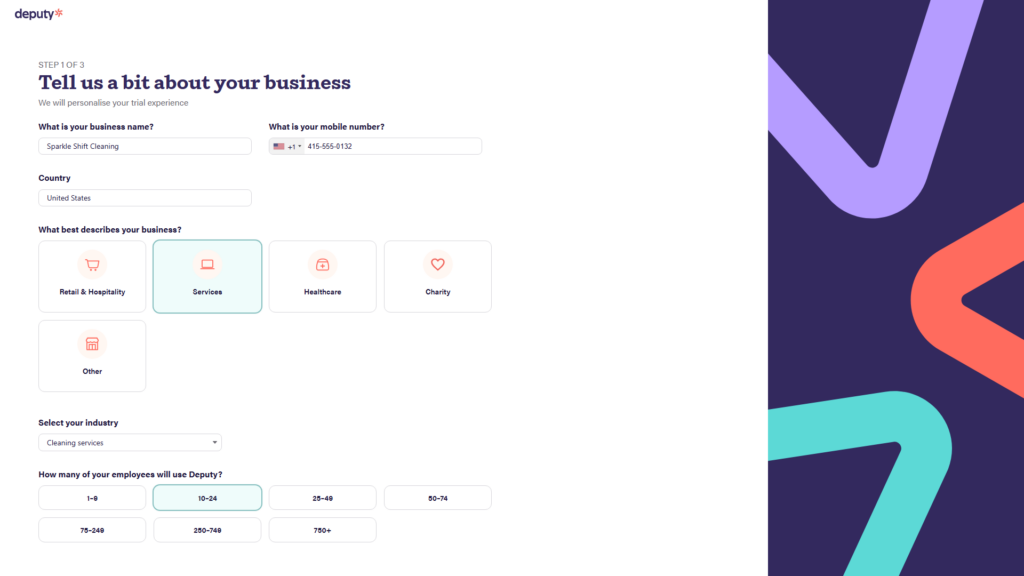
If you sign up using Google, you’re not asked to create a password to log in to Deputy. Later, this became a bit of a snag for me, as the Deputy time tracking app requires you to enter your password. In the end, I had to go through the typical “Forgot your password?” routine to create a password I could use to log in to the app.
Overall, it took me about 5 minutes to set up my account. Once you reach the dashboard, you’re incentivized to go through several additional setup steps, such as adding team members and creating a schedule. Performing these tasks extends the length of your free trial.
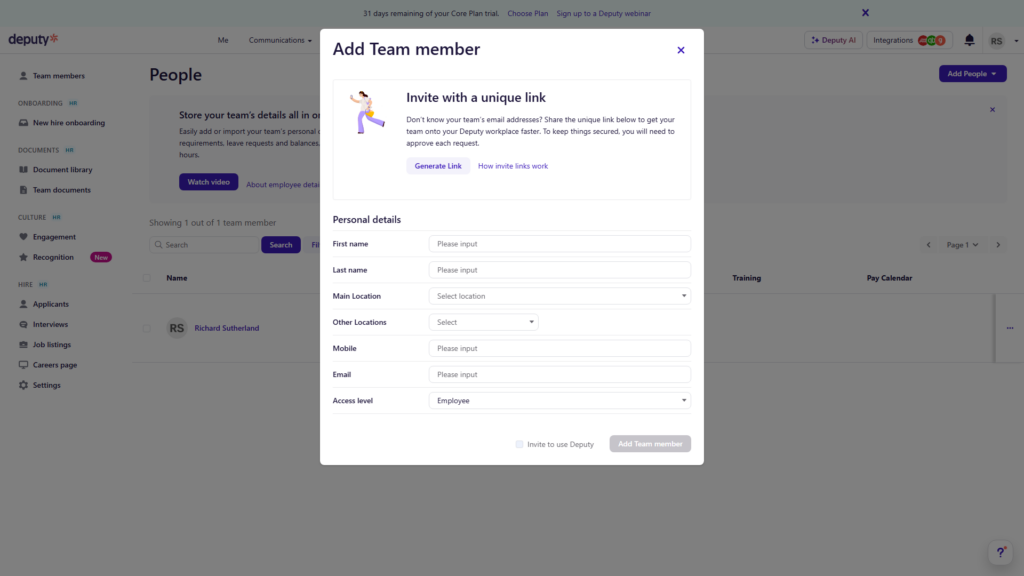
Again, I like how adding team members doesn’t require you to enter an email address for them at this point, allowing you to quickly get started. If you do have their email address, you can send them an invite immediately.
Deputy’s user interface is, overall, inoffensive and without too much bluster. It uses blue and purple colors sparingly, a big font, and well-spaced text that’s easy on the eyes. The desktop interface arranges the software’s different sections in a menu along the top.
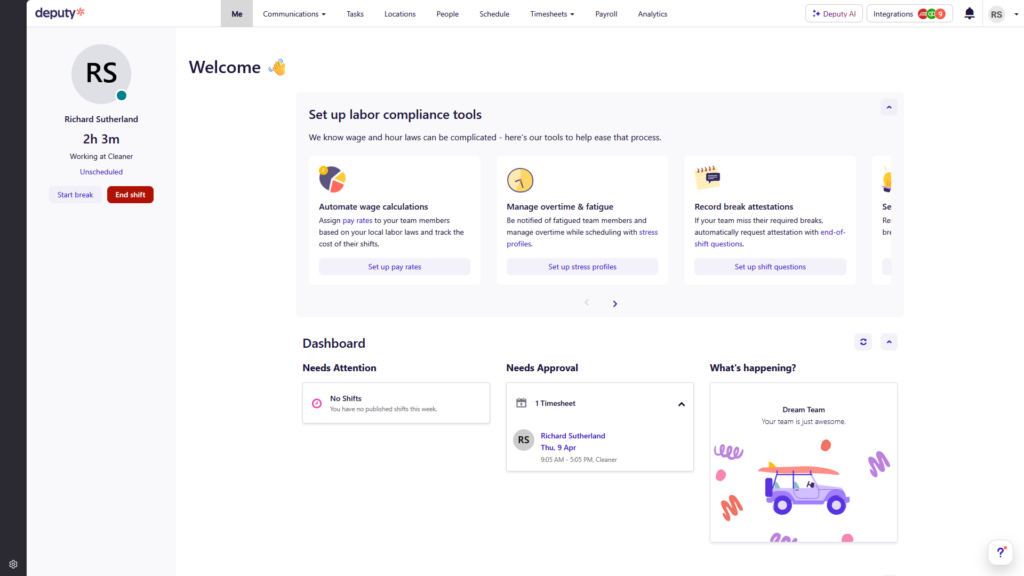
Each day when you log in, you’ll land on the manager dashboard. This is where you’ll find pending tasks and things that need approval—for example, shift schedules or timesheets.
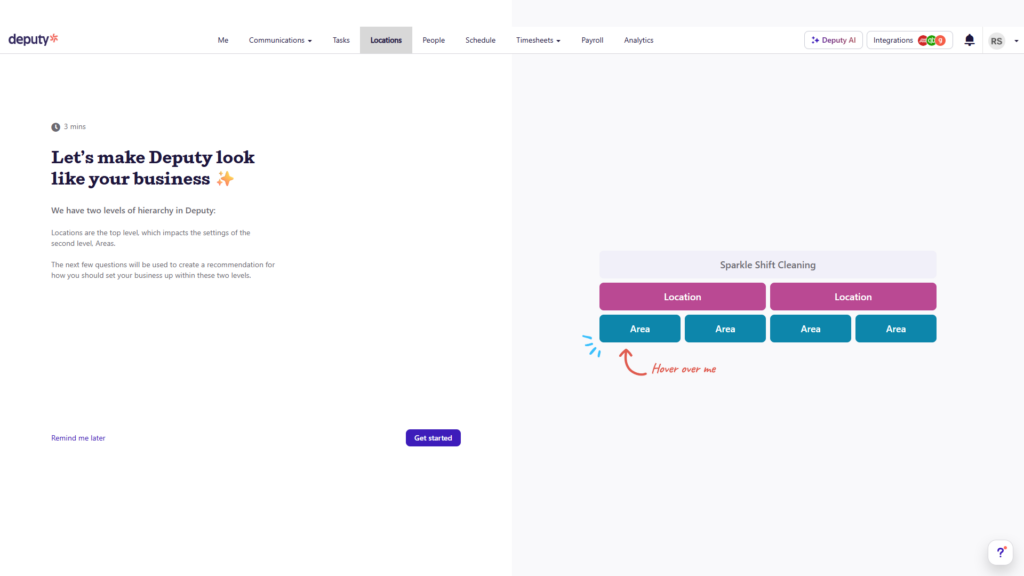
I hit an issue here, though. After I went into the Locations tab and set up several locations for my business, each time I returned to that tab, it kept redirecting me to a full-screen setup wizard to create my locations again. Only if I refreshed the page would the wizard be gone, and this persisted over multiple days and logins.
Apart from this, the user experience was fine. Unfortunately, Deputy didn’t seem to have accessibility features like screen reader compatibility or customization options to accommodate disabilities. However, the touchless clock feature works through biometric facial recognition, making it friendly for individuals with certain impairments.
Verdict: 8/10
Mobile app
Deputy has 2 mobile apps—the main Deputy Scheduling app, which has most of the functionality you’ll find in the web version, and a new stripped-down Time Clock app, which lets employees clock in and out only when they’re online. Deputy is compatible with iOS and Android, with an Android tablet app, a shared kiosk app for the iPad, and support for the Apple Watch to clock in and out of shifts.
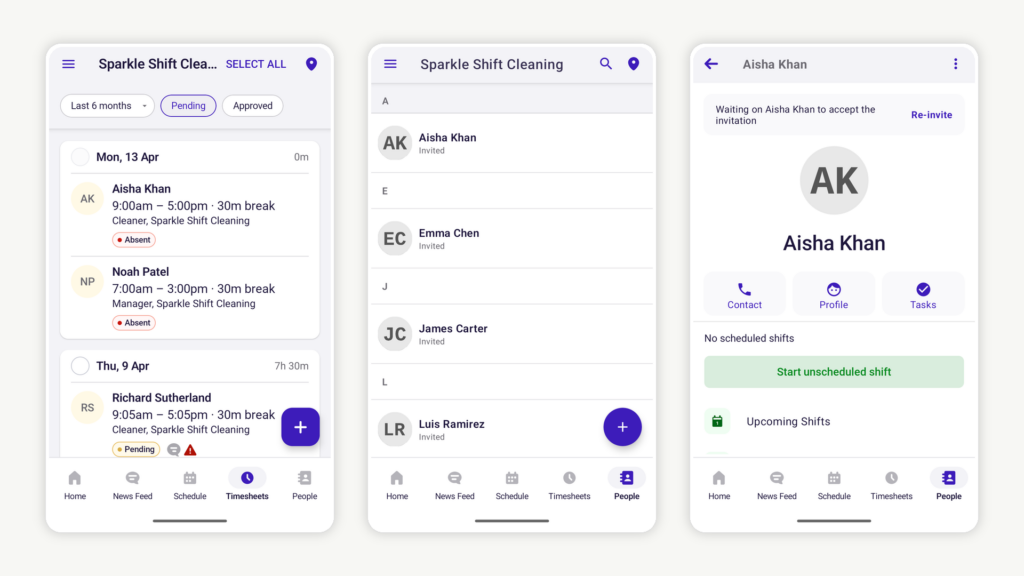
I checked out the iOS app, the main Android Deputy Scheduling app, and the Time Clock app (on Android). All of these worked fine on several devices, except for the Time Clock app, which refused to start up on my Huawei device. It did load on 2 other Android devices, but this type of compatibility issue could be problematic when your staff all use their own devices.
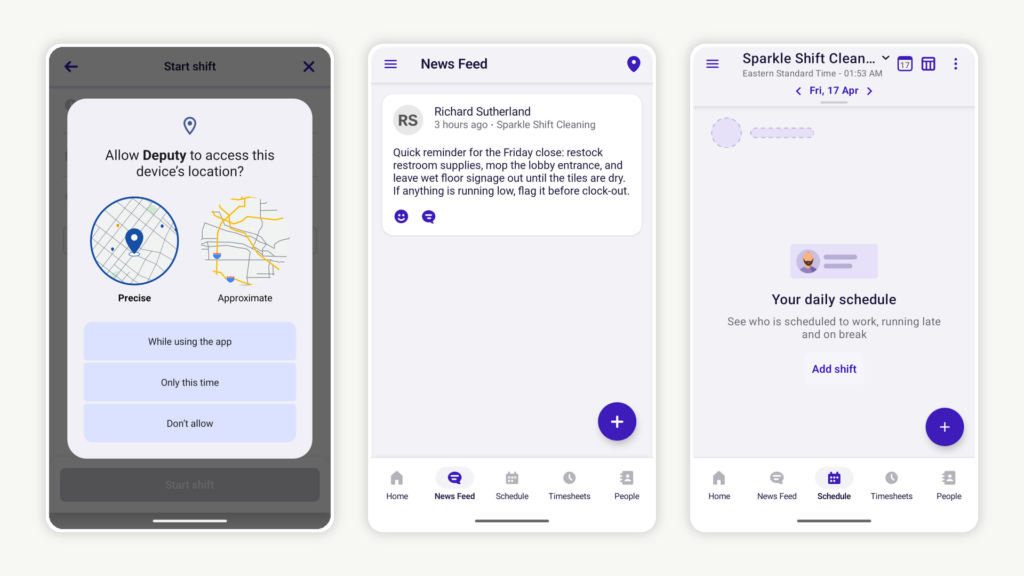
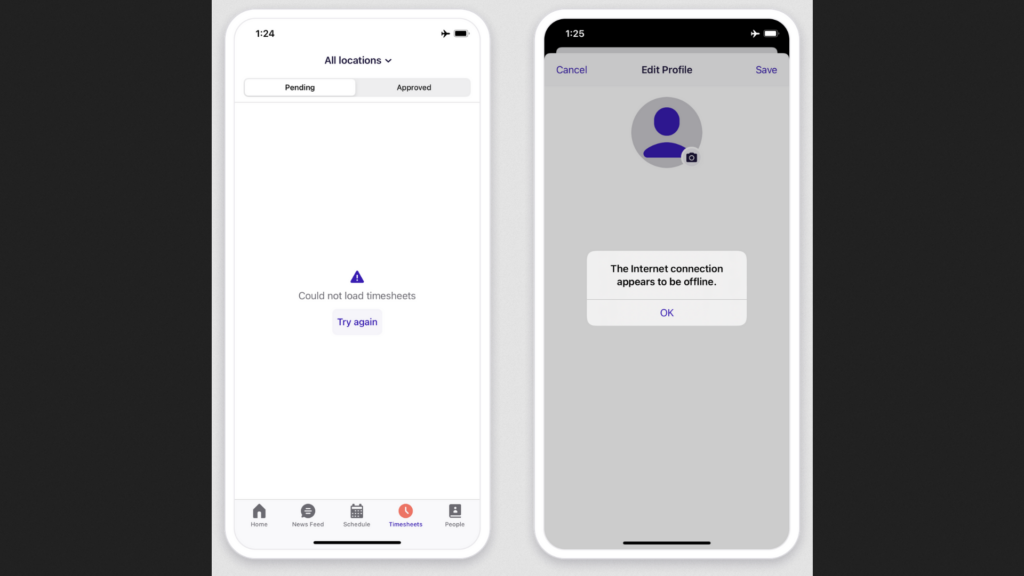
Most features of the main web version are available on mobile, but some, like drag-and-drop functionality, are missing. When you’re offline, the apps essentially operate in “read-only” mode, which means you can’t update schedules, timesheets, or draft announcements. For this reason, I don’t think Deputy is the best option for businesses that operate from remote locations without stable internet connections.
Here’s how Deputy’s features work across different devices:
| Menu Item | Admin | Employee | ||
| Website | Mobile App | Website | Mobile App | |
| Core features | ||||
| Time tracking | ✅ | ✅ | ✅ | ✅ |
| Timesheets | ✅ | ✅ | ✅ | ✅ |
| Schedule | ✅ | ✅ | ✅ | ✅ |
| Leave and unavailability | ✅ | ❌ | ✅ | ❌ |
| News Feed | ✅ | ✅ | ✅ | ✅ |
| Task Manager | ✅ | ✅ | ✅ | ✅ |
| Team view | ✅ | ✅ | ✅ | ✅ |
| GPS location capture | ❌ | ✅ | ❌ | ✅ |
| Geofencing | ❌ | ✅ | ❌ | ✅ |
| Shift feedback/engagement | ❌ | ✅ | ❌ | ✅ |
| Analysis | ||||
| Reporting | ✅ | ❌ | ❌ | ❌ |
| Management | ||||
| Team management | ✅ | ✅ | ❌ | ❌ |
| Location and area settings | ✅ | ✅ | ❌ | ❌ |
| Timesheet approvals | ✅ | ✅ | ❌ | ❌ |
| Scheduling management | ✅ | ✅ | ❌ | ❌ |
| Integrations and business settings | ✅ | Limited | ❌ | ❌ |
Verdict: 6/10
Deputy Core Functionalities
Here are Deputy’s key features and functionalities.
Shift scheduling, time off, and compliance
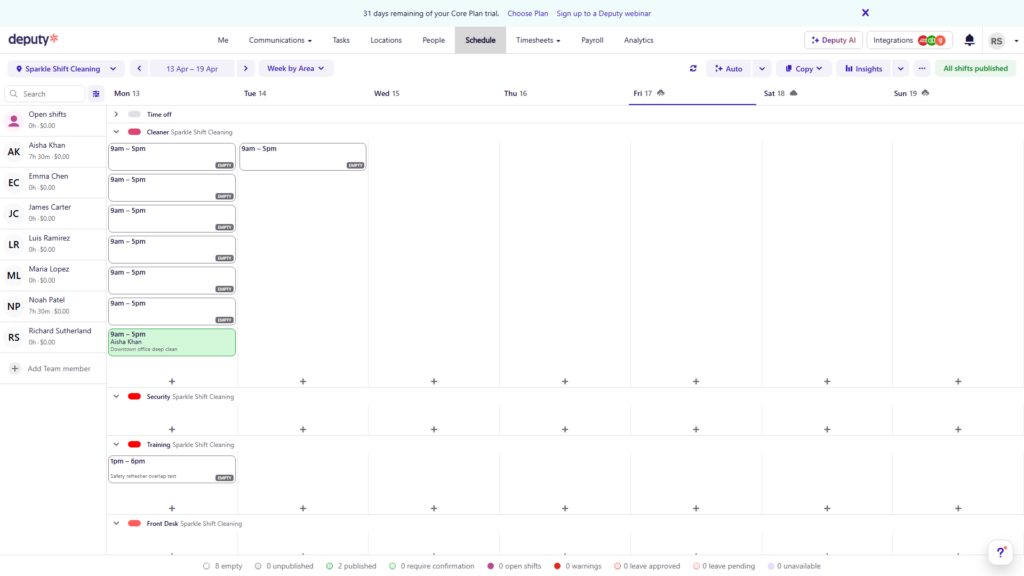
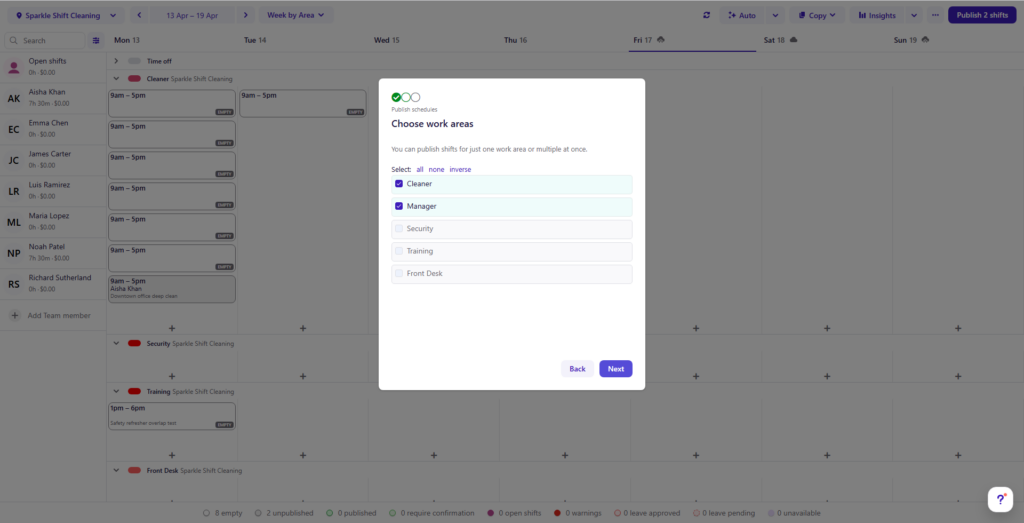
Scheduling is one of Deputy’s stronger modules. In my test workspace, I built a real weekly roster, assigned staff to different work areas, and published the schedule without any friction. I could create shifts from scratch by using the drag-and-drop tool or ready templates—or by copying previous shifts. I could also add notes to inform my employees what needs to be done.
The published roster reads cleanly, with shifts grouped by area, and I could see at a glance who’s working when and where. For everyday rota management, the whole flow felt well-considered in my opinion.
I like that you can manually assign shifts to specific team members or leave them as open shifts that team members can grab with or without approval. Deputy will check the availability of team members based on approved leave and availability, which can be requested and approved on the same platform. This way, I could track everyone’s availability at all times and avoid assigning someone a shift on their day off.
The publish step itself isn’t a single click. Deputy walked me through choosing which work areas to publish and how to notify staff, which could be useful if you’re managing a business with several departments or locations and only want to push out part of the schedule at a time instead of a huge blast.
I also like that Deputy can check employees’ certifications or qualifications, so you don’t mistakenly assign someone to the wrong shift. Deputy also lets you set breaks and overtime rules into schedules to ensure you provide your team with the downtime they need, stay compliant with local labor laws, and keep your costs in check.
One thing I noticed: when I deliberately created overlapping shifts for the same team member across 2 areas, Deputy didn’t flag a conflict, and the schedule footer showed 0 warnings. Additionally, the shift scheduler doesn’t warn you when you assign shifts to employees who have requested leave that hasn’t been reviewed or approved yet. I’d expect overlap detection to be tighter for a scheduling-first product.
So, routine schedule building works well. The weekly view, area grouping, and publish workflow are all strong, but schedule conflict detection could be better.
Verdict: 8/10
Time clock and timesheets
Deputy turns desktops, tablets, and phones into time clocks. You can let employees clock in and out of shifts with a single click from their web browsers or smartphones/devices. Or, have your team track time using shared kiosks with web browsers or iPad and Android tablet apps.
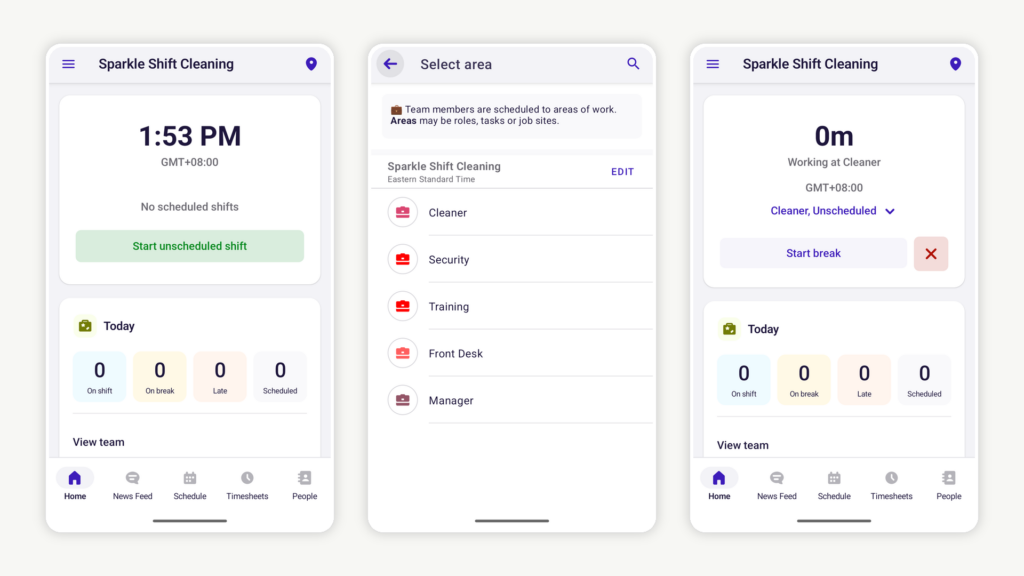
I tested it on desktop and Android by starting unscheduled shifts, checking how entries appeared in timesheets, and ending shifts early to see how Deputy handled short or questionable records.
Starting a live unscheduled shift was straightforward, and the interface switched into an active working state with clear break and end-shift controls.
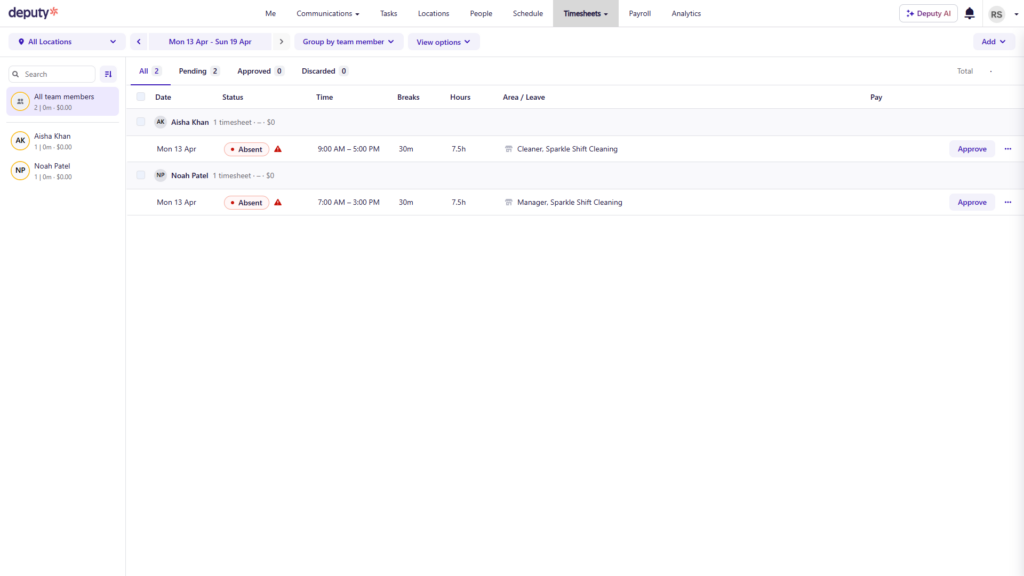
Timesheets hold up just as well. Staff who were scheduled but did not clock in appeared as “Absent,” while approval actions and hours remained visible in the same table. That made it easy to spot problems without hopping across multiple screens.
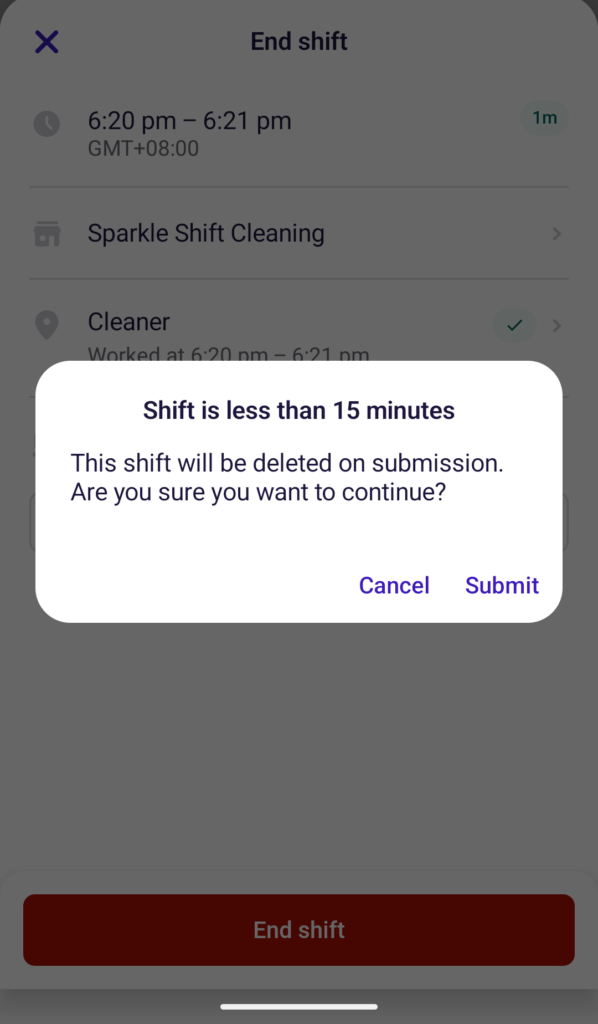
Guardrails were better here than in scheduling. When I ended a test shift too early, Deputy refused to keep the entry and warned that it wouldn’t be submitted. The mobile interface did the same, explaining that a shift under 15 minutes would be deleted upon submission.
I liked how I could keep tabs on workers’ GPS locations at clock-in or clock-out when they tracked time on their mobile devices. Plus, I could set virtual boundaries, called “geofences,” around job sites to prevent workers from clocking in unless they’re within a certain distance of their work location.
Shared kiosks let me capture employees’ photos when they punched in and out of shifts, and I could set these up with touchless biometric facial recognition to prevent issues like buddy punching.
Verdict: 8/10
Newsfeed
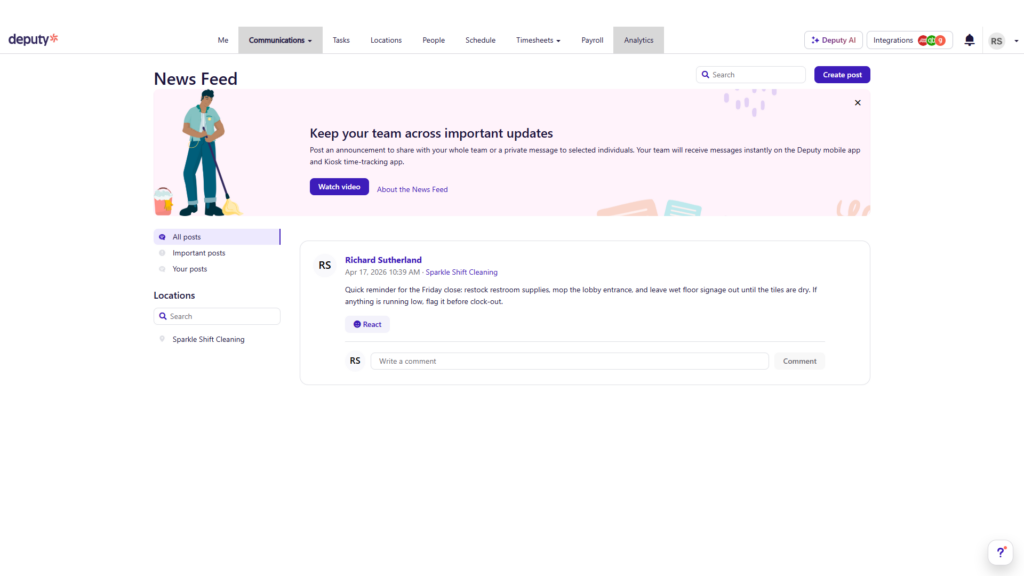
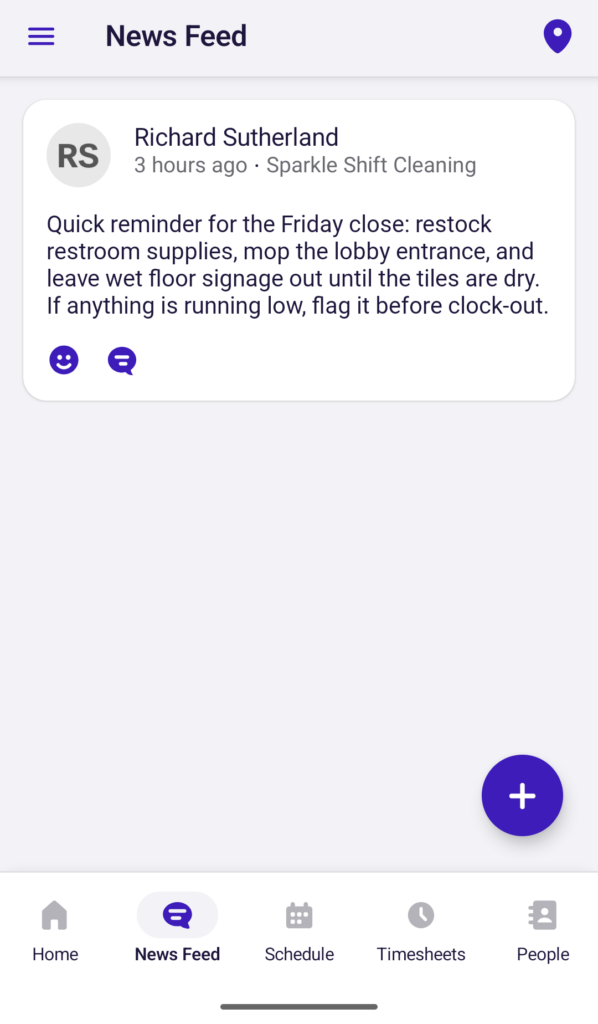
Deputy offers a News Feed tool to support internal communications. I could post a message to an individual or an entire location or department to reach everyone. What’s more, the platform lets you add PDF, image, and video attachments to your message. My team could comment on and react to the message with emojis, and confirm they’ve read it.
Something missing for me is the ability to send messages to a custom group of people. Most in-app communication tools let you do this. And there’s very little formatting you can add to your News Feed posts, so they’re typically pretty bland, if functional.
Verdict: 6/10
Task management
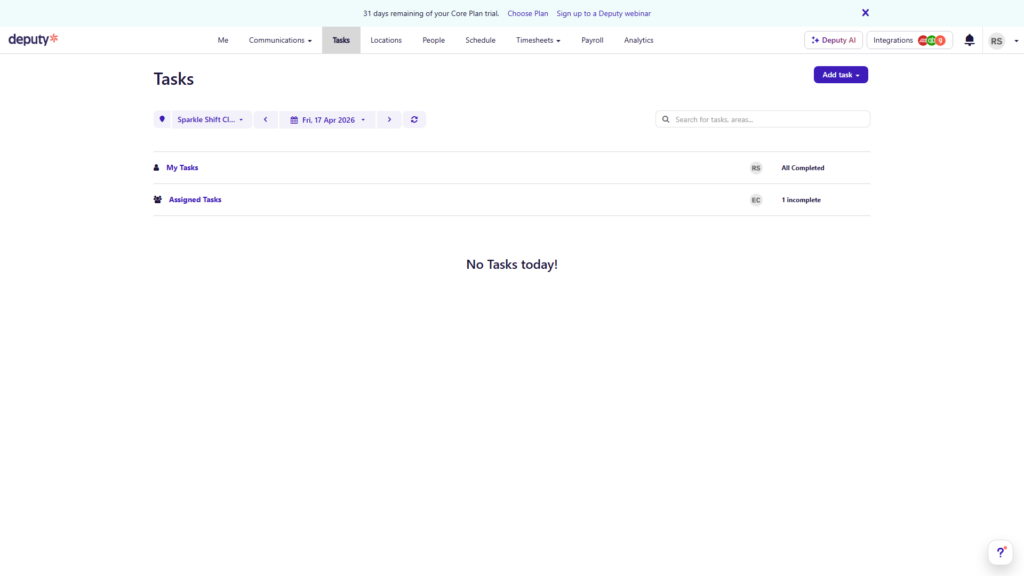
Deputy also has an easy-to-use task management system. You can create and assign tasks and subtasks, add due dates and start times, and set tasks to repeat if needed. You can also view task progress in real time through the app.
In my testing, Deputy’s task tool handled simple operational jobs well enough. The Assigned Tasks view showed the basics I expected: task title, due date, assignee base, and quick action icons. For routine jobs and one-off reminders, it’s functional.
The limits show when you need more. I would have liked to add detailed notes and attach images, videos, and audio files to tasks to ensure employees know what they must do, and I would have liked to customize the assignment of recurring tasks rather than be limited by the daily, weekly, or monthly repetition that Deputy supports.
Still, despite its shortcomings, it’s a useful feature for virtually any team.
Verdict: 6/10
Deputy HR (US, UK, and Australia only)
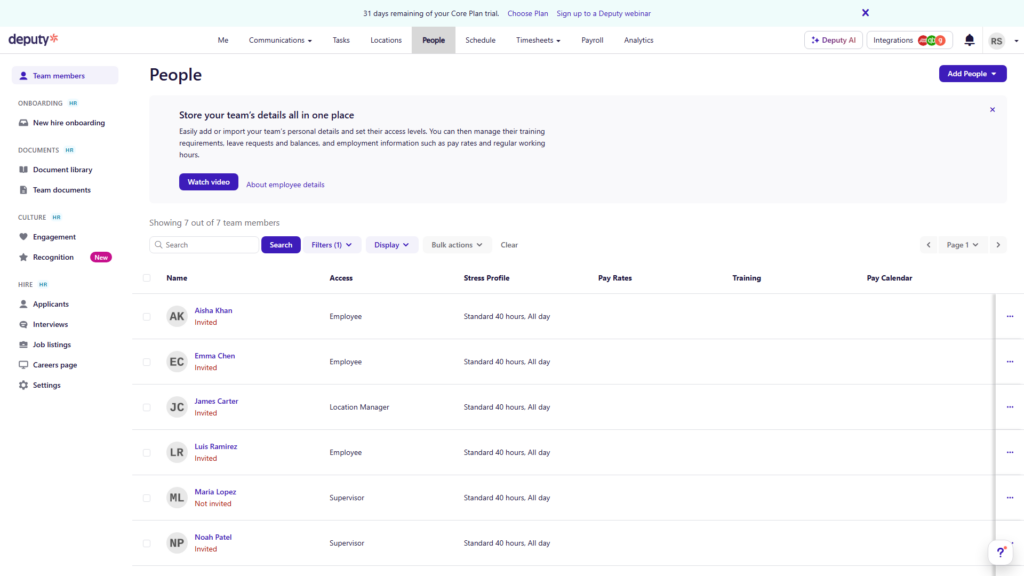
As of February 2026, Deputy’s US, UK, and Australia platforms also offer HR tools for hiring, onboarding, and document management, at an additional cost of around $2/user/month. You’ll find most of these features in the People section of Deputy’s interface.
For hiring, I like how much candidate context Deputy keeps in an applicant panel. In the sample hiring data, I could open a candidate video, contact details, screening answers, an attached PDF, interview scheduling, and notes without leaving the applicant view.
The job listing details page also shows applicant counts, source tracking, pay, and required experience. I think for shift-based businesses that hire a lot of hourly staff, it’s much better than tracking candidates in email threads or a spreadsheet.
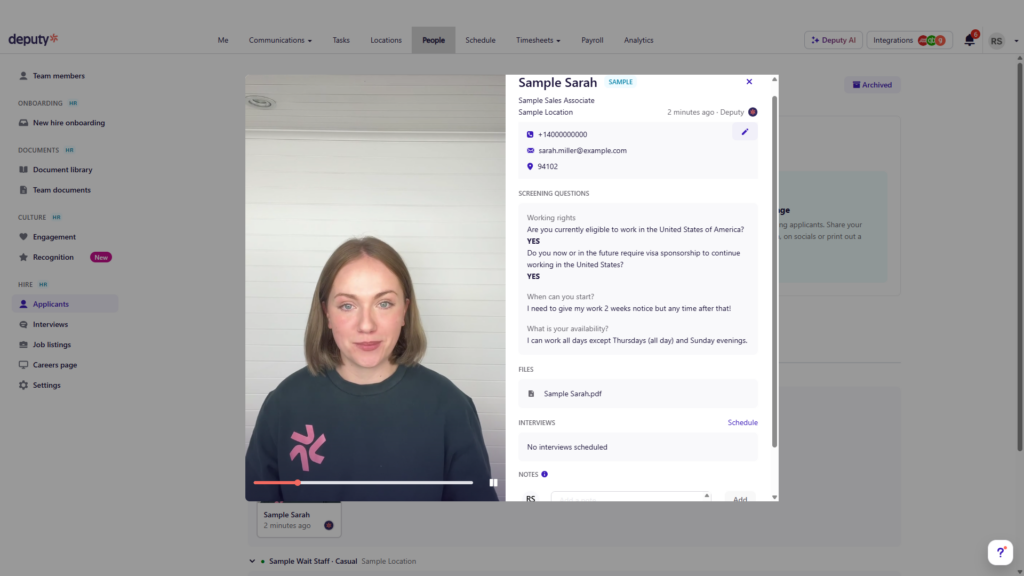
Deputy leans hard into video-led screening. Adding a video question isn’t optional; I had to select 1 video question before I could publish a listing. Not everyone likes video interviews, so this feels like an odd restriction. Similarly, the Documents feature didn’t work sequentially, so I couldn’t get an employee to sign a form followed by a manager in the same workflow. It’s these types of little issues that make Deputy HR feel potentially useful but inflexible.
Verdict: 6/10
Deputy Security Features
Here’s how Deputy complies with ISO 27001, SOC 2, and PCI DSS standards.
- Deputy runs annual reviews of its security features, which are checked by internal stakeholders, senior management, and external auditors.
- It shares security best practices to help you keep your accounts safe and protected.
- Deputy’s web application supports 2-factor authentication.
- Customers on the Pro plan can opt for a single sign-on (SSO) integration with platforms like Oracle and Azure.
- You can also set custom role-based permissions on the Pro plan to control view and edit access for team members and ensure information is accessible only to authorized users.
- Deputy encrypts information, including employees’ passwords, customer data, and other private information.
- Finally, Deputy stores customer data separately to limit data overlap and loss in the event of unforeseen breaches.
Overall, I think Deputy’s security features are very impressive, especially if you’re on the Pro plan. But they seem to be geared more toward UK and EU regulations. For example, Deputy complies with data protection laws such as the European General Data Protection Regulation and its UK equivalent, GDPR.
While it also adheres to the California Consumer Privacy Act (CCPA), it isn’t HIPAA-compliant like some of its competitors, including Connecteam.
Verdict: 7/10
Deputy Reporting & Analytics
Deputy lets you view and export several reports for better oversight, control, and decision-making.
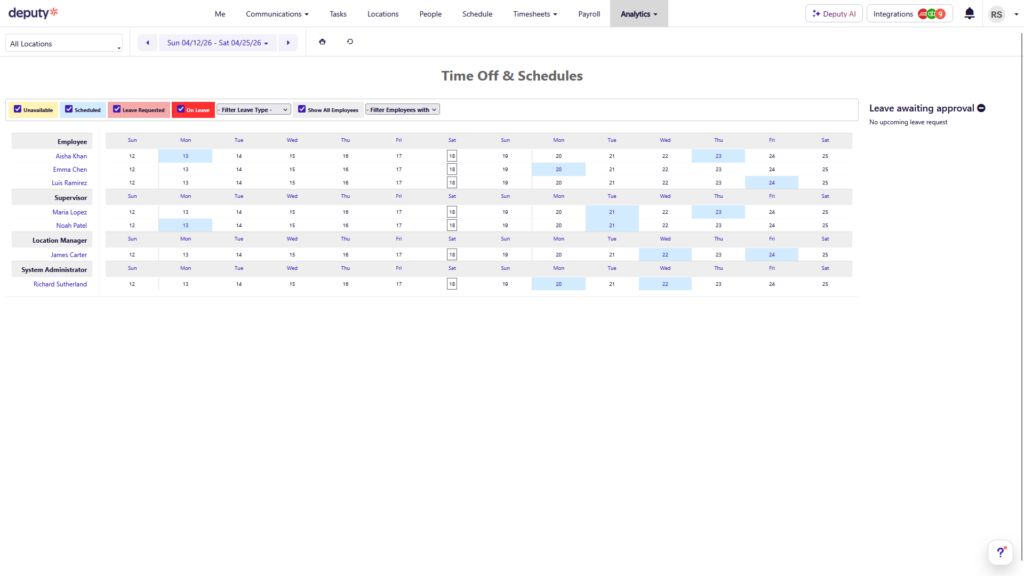
Here are some of its key reports.
- Schedule vs. timesheets vs. sales: Compare employees’ scheduled hours, actual hours worked, and sales data. This can help you assess staffing efficiency and adjust schedules based on business needs and sales performance.
- Attendance reports: View attendance data by employees or by location. This is a great way to monitor punctuality, absences, and compliance with work schedules so you can spot and address issues before they escalate.
- Leave management: See employees’ leave entitlements, approved leave, and remaining balances. You can use this data to approve or deny leave requests and ensure compliance with time-off regulations.
- Time off and schedules: Get real-time insights into who’s scheduled to work versus who’s taken time off. This way, you can quickly identify and address any staffing gaps.
- Timesheet locations: View your workers’ geographic locations when they clock in and out to confirm they were at their assigned locations during work hours.
Additionally, you can view staff feedback, contact tracing, employee contact details, and other reports on the dashboard. You can also use Deputy’s report builder to create custom reports. I appreciate this, especially since platforms like Homebase lack this feature.
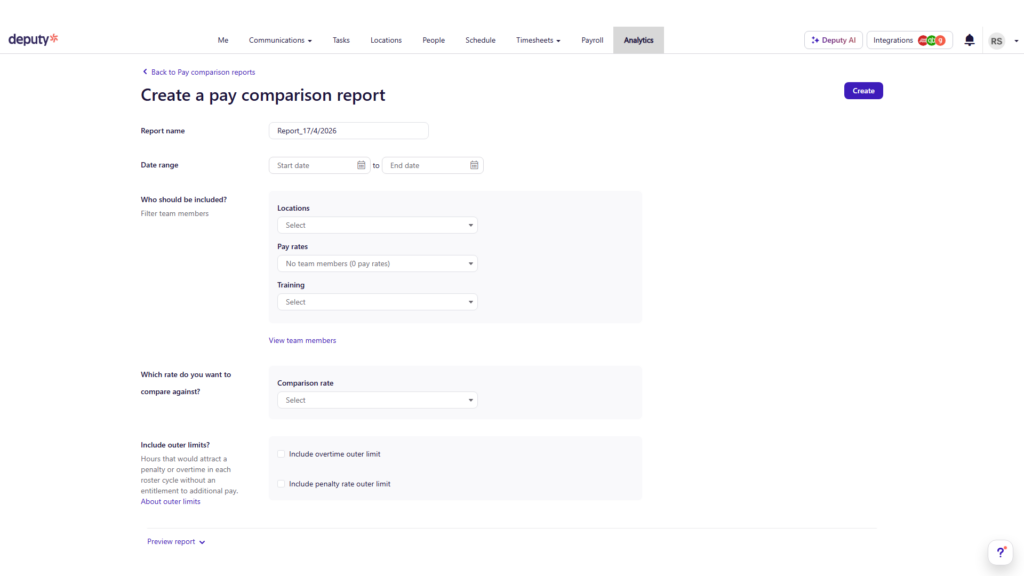
I have a few gripes about the reporting. Again, most of the reports are locked behind an add-on, this time Analytics+. I also found the reports visually unexciting. The example above is one of the most dynamic; most reports are just basic tables that you can export to spreadsheets.
The Deputy AI assistant isn’t that useful here, as it can’t create reports for you. It can only advise you on where to find a certain report, making it more of a glorified help system. I expect this to improve over time.
Verdict: 8/10
Deputy Customer Support
Deputy offers reasonable levels of customer service, but they vary by plan. Here’s the support you can expect:
| Support | Lite | Core | Pro |
|---|---|---|---|
| Help center with guides, instructions, and FAQs | 24/7 | 24/7 | 24/7 |
| Learning center with video tutorials | 24/7 | 24/7 | 24/7 |
| Email support | 24/7 | 24/7 | 24/7 |
| Live chat | N/A | First 90 days only | 24/7 |
| Phone support | N/A | Outbound only | Outbound only |
| Customer success manager | N/A | Pooled, 50 users minimum | Dedicated, 250 users minimum |
Live chat is only available on more expensive plans, and there’s no way to call Deputy support on any plan.
On the plus side, Deputy’s customer support is extremely responsive. I raised 3 customer support tickets and received helpful responses within an hour every time.
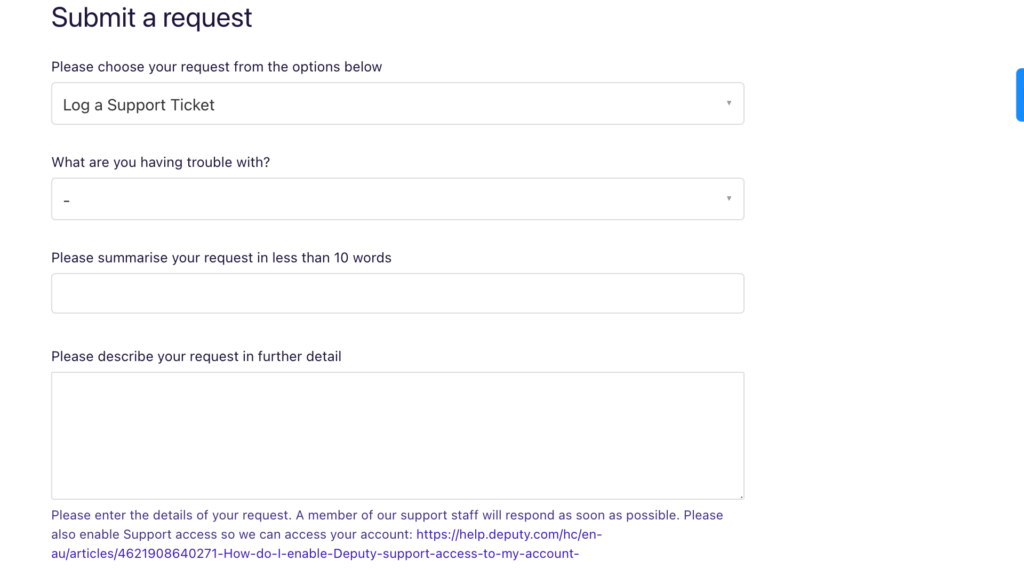
Additionally, while the live chat starts with a chatbot, it’s easy to connect with a customer care specialist if you can’t find what you’re looking for.
Verdict: 8/10
What Are Deputy’s Review Ratings From Review Sites?
(As of June, 2026)
Deputy App Review
Deputy is a strong pick for shift-based businesses that mainly need scheduling, clock-ins, and timesheet management. If you need more from the platform, though, the surrounding tools are noticeably lighter in features, and important functionality like messaging, HR, and proper analytics sit behind add-ons. Teams that want communications, task management, and HR tools built in rather than bolted on should look elsewhere.
Connecteam: The Better Deputy Alternative
Connecteam is the stronger choice if your business needs more than rostering and attendance. It covers the same scheduling and time-tracking ground but offers much more for the rest of the workday, with richer task management, in-app chat and updates, digital forms, training courses, time-off management, and better document storage inside the same mobile-first platform.
Deputy was at its best during my testing when I was building the schedule, clocking staff in, and reviewing timesheets. That core loop is polished. But once I moved into news feeds, tasks, locations admin, and people management, the platform felt more fragmented, like these were all afterthoughts. Communications were basic, task depth was limited, and some of the features touted as strengths are separate add-ons.
Connecteam also addressed some of the specific gaps I ran into with Deputy. Its scheduling tools call out double-booking warnings and overtime controls, and its time clock includes auto clock-out and GPS-based restrictions, which is exactly the kind of guardrail I wanted to see when I tested Deputy. For deskless businesses, Connecteam makes a stronger all-around case.
FAQs
Yes, Deputy offers a free trial with no credit card required. New accounts start on a Core trial, and you can unlock extra trial days by completing onboarding tasks inside the product.
No, Deputy is not HIPAA compliant. You’ll need to look at other tools, like Connecteam, to ensure compliance with healthcare regulations.
Deputy can be set up to capture your live location or photo when you clock in and out. It doesn’t monitor your location or keep your video on throughout the day.
Deputy counts all users, including administrators and supervisors, in your total user number—regardless of whether you’re tracking their time or creating shift schedules for them.
Deputy integrates with over 58 payroll, POS, and HR systems. Some of its popular integrations include ADP, Shopify, Bamboo HR, and Dropbox.
Deputy has a high rating of 4.6 on Capterra and has received plenty of positive reviews on other websites like G2. For example, one user noted that they find it easy to use Deputy for scheduling.
However, there’ve been complaints, too. For instance, one customer shared that they dislike Deputy’s reliance on an internet connection.
