


When you don’t know where your employees are during the workday, small gaps turn into scheduling chaos, missed jobs, and payroll disputes. You’re left dealing with the consequences.
I reviewed 7 employee location tracking apps and ranked them by accuracy, ease of use, and real-time visibility.
Use these picks to stay in control, keep your team accountable, and prevent mistakes before they cost your business.
| App | Best for | Starting Price | Key Considerations |
| Connecteam | Businesses needing reliable real-time employee location tracking | $29/month (up to 30 users) | Provides reliable proof of where work happened and accurate attendance reporting |
| ClockShark | Construction crews tracking location by job site | $40/month + $9/user/month | Strong GPS tracking and offline functionality, but lacks route history and optimization |
| QuickBooks Time | Teams linking GPS tracking with payroll workflows | $20/month + $8/user/month | Flexible geofence customization with seamless payroll integration |
| Workyard | Contractors needing precise GPS tracking with job costing | $50/month + $6/user/month | Responsive GPS tracking and accurate mileage detection even without internet |
| Timeero | Teams tracking routes and mileage for mobile work | $3.66/user/month | Suggested mileage feature with route comparison helps reduce travel costs |
| Hubstaff | Remote teams that need location and activity tracking | $4.99/user/month | Powerful activity monitoring for comprehensive oversight, limited to desktop use only |
| Jibble | Teams using GPS tracking with attendance controls | $2.49/user/month | Facial recognition with AI-powered biometric verification with basic GPS route tracking |
What’s New in This Update (April 2026)
- Replaced Clockify, BuddyPunch, OnTheClock, and TimeTracker by eBility with ClockShark, Workyard, Timeero, and Jibble.
- Re-verified all pricing, core features, and limitations across all 7 apps as of April 2026.
- Expanded evaluation criteria to focus on location tracking capabilities and compliance tools.
- Added positioning hooks tailored to specific use cases for each competitor.
Our Top Picks
-
1

Best for businesses needing reliable real-time employee location tracking
-
2

Best for construction crews tracking location by job site
-
3

Best for teams linking GPS tracking with payroll workflows
Why trust us?
Our team of unbiased software reviewers follows strict editorial guidelines, and our methodology is clear and open to everyone.
See our complete methodology
How I Ranked the Best Employee Location Tracking Apps
Here are the features I focused on to rank the best apps for tracking employee locations.
Must-have features for employee location tracking apps:
These are the key features every employee tracking app needed to have to make the list.
I prioritized:
- Accurate real-time GPS tracking: Location data needs to be precise and consistently updated. I prioritized apps that give managers a clear, real-time view of where employees are throughout the workday, not just at clock-in.
- Live location visibility: Managers should be able to see who’s working, where they are, and how teams are distributed in the field without digging through menus or reports.
- Geofencing controls: You should be able to set job-site boundaries and receive alerts when employees enter, leave, or attempt to work outside approved locations.
- Location history and route tracking: It should be easy to review where employees have been during their shifts to verify work, resolve disputes, and optimize routes.
- Privacy controls: Tracking should only happen during work hours. The best apps clearly separate on-duty and off-duty tracking to protect employee privacy.
I also looked each tracking app’s everyday performance:
Beyond the essentials, I considered how practical each app is for real teams to use.
- Mobile-first design: The app needs to run smoothly on mobile with an interface employees can actually use without confusion or delays.
- Role-based permissions: Admins, managers, and employees should have clear access levels to prevent unauthorized changes and keep data reliable.
- Ease of adoption: If your team can’t figure it out quickly, it won’t get used. The app needs to be intuitive and require minimal training.
- Battery-efficient: The app should balance accurate tracking while keeping battery usage minimal so it doesn’t drain employees’ phones.
Finally, I checked for features that give you more control over your operations:
These features help you manage your team better and keep your operations running smoothly.
- Attendance tools: Features like clock-in reminders, missed punch alerts, and location-based restrictions help prevent time theft and reduce buddy punching.
- Route optimization: Some apps go beyond tracking and help identify ways to save time and fuel costs while your team is on the move.
- Simple reporting: Reports should be easy to generate and share for payroll, compliance, or business reviews, without extra formatting or manual work.
The 7 Best Employee Location Tracking Apps of 2026
-
Connecteam — Best for businesses needing reliable real-time employee location tracking
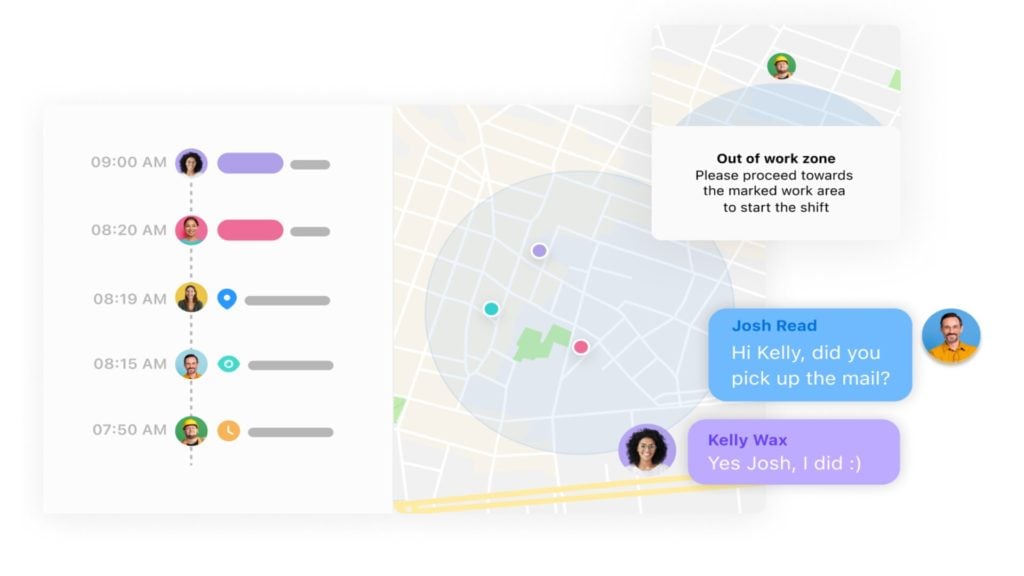
Connecteam is the best choice for distributed field teams because it brings together real-time location tracking and flexible verification methods into one clear, reliable record. It’s especially strong for teams that need complete visibility into where work happened without the setup headaches and data gaps.
Why I chose Connecteam: I ranked Connecteam #1 because it was the most complete option for employee location tracking, especially in areas like live GPS tracking, geofence controls, and real-time accuracy.
Here’s why Connecteam made it to the top of our list:
GPS time clock
Connecteam’s real time GPS tracker makes it easy to see where work is actually happening. Employees can clock in from their mobile devices, and each entry is automatically tied to a GPS location. That gives you a clear record of where shifts start, end, and change throughout the day.
What stands out is the flexibility. You can require GPS for clock-ins, keep it optional, or disable it entirely depending on your policies. I also liked that you can capture location when employees switch between jobs, helping you track movement across multiple sites without needing constant check-ins.
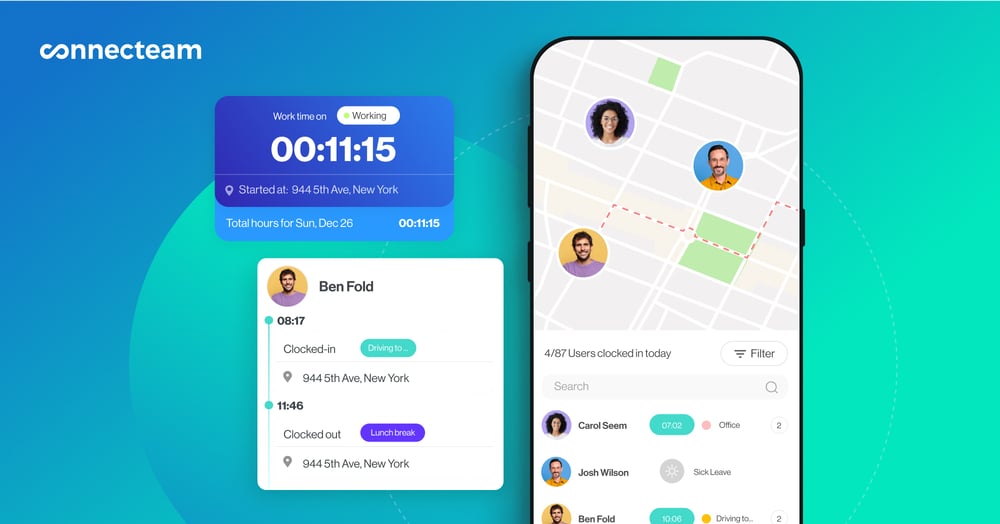
You can track your team’s route throughout the work day with Connecteam. Live location tracking
For real-time visibility, Connecteam uses breadcrumb tracking to map employee movement while they’re on the clock. Instead of just seeing start and end points, you get a timeline of where employees have been throughout their shift.
Updates are sent every few minutes while employees are moving, giving you a reliable live view without draining their device’s battery. This makes it easy to confirm job visits, spot delays, and quickly locate team members when you need them, all without relying on manual updates.
What I appreciated most is that location tracking only runs during active shifts, so employees aren’t monitored when they’re off the clock.
Geofencing controls
Connecteam’s geofence time clock gives you another way to ensure employees are where they’re supposed to be before work begins. You can set virtual boundaries around job sites and require your employees to be physically inside the area to clock in.
Employees can be automatically clocked out when they leave a job site, and geofenced reminders can prompt them to clock in as soon as they arrive. I appreciated that this helps reduce missed punches and keep time records accurate.
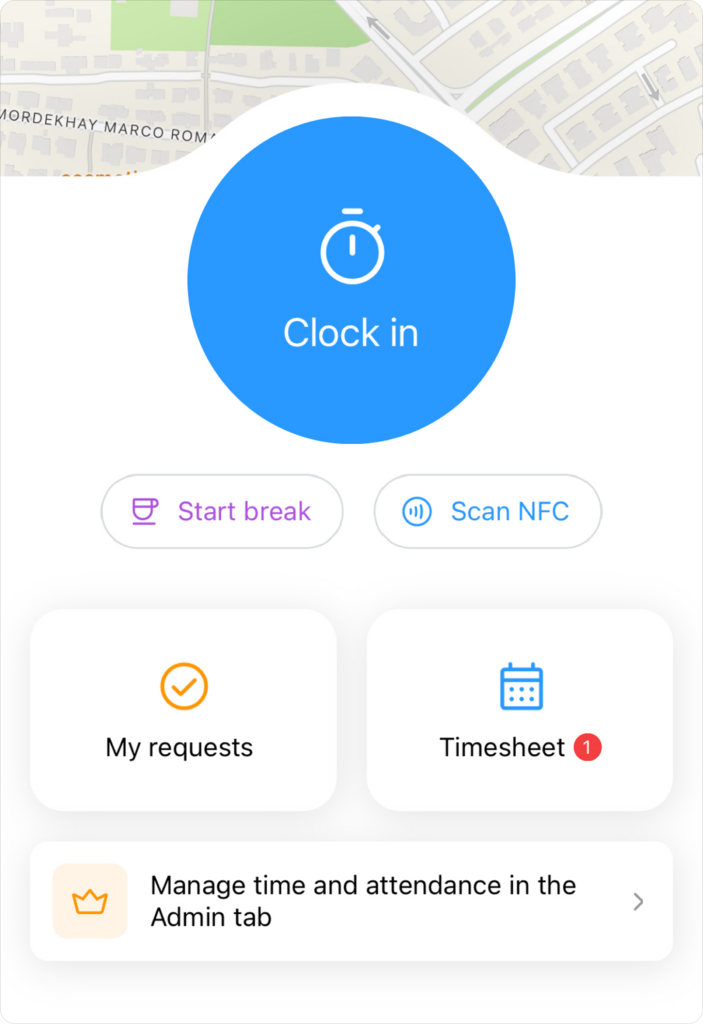
Use Connecteam’s NFC time tracking to clock in and out with just a tap. Physical location verification
Connecteam’s NFC time tracking adds an extra layer of certainty to employee location tracking by requiring a physical tap at the job site. Instead of relying only on GPS, employees can clock in by scanning an NFC tag placed at a specific location to confirm they’re actually there. This helps eliminate buddy punching, inaccurate clock-ins, and any doubt about where work started.
It’s especially useful for teams that need precise, on-site verification. For example, managers can place NFC tags at job sites, equipment, or checkpoints, and require employees to scan them throughout their shift. Each scan creates a clear, time-stamped record, making it easy to confirm work was completed, track routes, and catch missed stops without relying on guesswork.
Attendance reporting
Employee activity is turned into clean, organized timesheets for payroll, giving you a clear breakdown of hours by employee, job, and location. Employees can review and submit their hours in the app, and conflicts are automatically flagged for managers before they become larger issues. When it’s time to run payroll, everything is ready to export or sync with tools like ADP, QuickBooks, or Xero.
And so much more…
Connecteam offers more than just location tracking to help you manage your business:
- Employee scheduling: Plan schedules in seconds with the drag-and-drop editor or try the AI-powered auto-scheduler to fill shifts based on availability, roles, and qualifications.
- Time off management: Set up custom PTO policies for vacation, sick, or personal leave, and let your employees submit requests directly in the app.
- Online team chat: Communicate with your team while they’re on the clock in the same app, and share updates, files, and shift details in one-on-one or group chats.
- Employee task tracking: Assign recurring or one-off tasks to your team members, add subtasks, and monitor progress in real-time.
When Connecteam isn’t the right fit
Connecteam doesn’t offer route optimization features. If your business depends on automatically planning the most efficient routes to save time and fuel costs, you’ll likely need to pair Connecteam with a dedicated routing tool. Connecteam shows you where your team went, but it won’t suggest better routes for you.
The same goes for dispatching. Connecteam isn’t designed for assigning jobs in real-time or optimizing who should go where. If your workflow relies heavily on job allocation and dispatch, you’ll want a dedicated field service management platform to handle that side of operations.
0Key Features
- Real-time GPS tracking
- Custom geofence controls
- Breadcrumb trail tracking
- NFC tags for physical verification
- Attendance reporting with timesheets
- Automatic clock-outs and reminders
Pros
- Battery-efficient tracking
- Tracking only runs during work hours
- Multiple location verification methods
- Full mobile app access
Cons
- Lacks route optimization
- Not built for job dispatching
Pricing
Free-for-life plan availablePremium plans start at $29/month for 30 users
14-day free trial, no credit card required
Start your free trial -
ClockShark — Best for construction crews tracking location by job site
Key Features
- GPS location tracking
- Project-based job costing
- Geofencing controls
- Map-based employee visibility
Pros
- Location spoof detection
- Efficient battery usage
Cons
- Lacks advanced analytics
- No route optimization
What’s new with ClockShark
As of mid-2026, a 3-year contract term applied to all ClockShark plans.
ClockShark is a time and field employee tracking app built for construction and service teams.
Why I chose ClockShark: I chose ClockShark because it offers precise GPS location tracking with automatic job costing calculations.
GPS tracking and location verification
In our full ClockShark review, we tested the platform’s location features. ClockShark captures employee location at clock-in and clock-out, and updates every 15–20 minutes while employees are on the clock. We found that the battery usage is pretty efficient, consuming 15–25% of battery over an 8-hour shift.
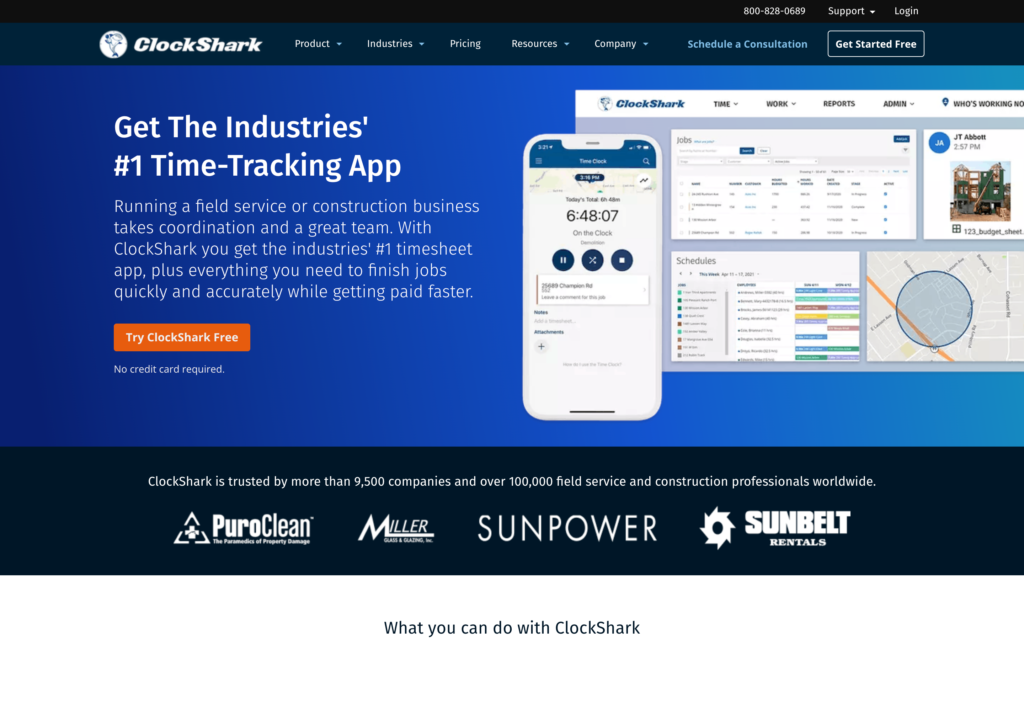
Impressively, there’s location spoofing detection to prevent employees from faking their working location. I also liked the “Who’s Working Now” dashboard, which gives you a live map view of your team, so it’s easy to see who’s active and where they are at a glance.
ClockShark offers geofencing, which ties activity to specific job sites and automatically clocks employees out when they leave. That said, tracking only shows where employees started and ended their shifts, but not the full route they took throughout the day.
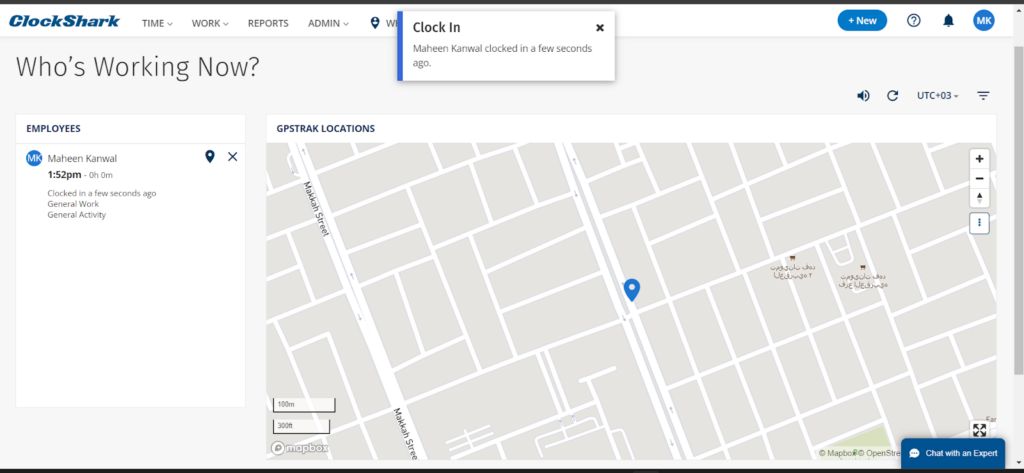
We could see where clocked-in employees were on a map from the “Who’s Working Now” dashboard. Job management
ClockShark is strong when it comes to job costing and tracking profitability against projects. Employees can clock in to specific jobs, and the system automatically assigns time and expenses to each project. It’s a good way to give managers clear visibility into labor costs.
Reporting and calculations
ClockShark lets you set custom overtime rules or use pre-built ones, with calculations applied automatically and conflicts flagged in timesheets. Employees can edit their hours, and managers can quickly review and approve timesheets, either in bulk or individually, before running payroll.
On the reporting side, ClockShark does a good job organizing data into clear, exportable reports for payroll, job costing, and compliance. You can quickly see hours worked and how time is allocated. However, during testing, we found that reporting is mostly for recordkeeping. It shows what happened, but doesn’t offer deeper insights or recommendations to help improve operations.
What users say about ClockShark
Our crews are able to clock in from the field, since we don’t have them come to the office they clock in at a job site and being able to have them do that is amazing!

I thing the mobile app does have some bugs and issues which delays loading, syncing and makes GPS inaccurate. however, it is not frequent and can be solved using help of customer service.
0Pricing
Starts at $40/month + $9/user/month. Trial: Yes — (14-day) Free Plan: No
-
QuickBooks Time — Best for teams linking GPS tracking with payroll workflows
QuickBooks Time is a time and location tracking app designed to help field and mobile teams that already use QuickBooks accounting tools.
Why I chose QuickBooks Time: QuickBooks Time offers a range of ways to keep track of employee locations, including GPS tracking, geofencing, and mileage tracking. It also integrates seamlessly with the broader suite of QuickBooks products, making it a good fit for businesses that already use QuickBooks for payroll or invoicing.
GPS location tracking
In our full QuickBooks Time review, we tested the app’s real-time GPS location tracking. I liked that the “Who’s Working Now” dashboard shows managers the live location of all clocked-in employees on a map. It’s a clear way to maintain visibility and respond quickly when priorities change.
Tracking only runs while employees are clocked in, which helps protect privacy and stay compliant with GPS tracking regulations. I was impressed that the app also continues tracking when offline and syncs data once the connection is restored.
The same location data is recorded directly into timesheets, helping tie hours to where work actually happened. Managers can review and approve everything in one place, then sync seamlessly with the native QuickBooks Online Payroll integration.
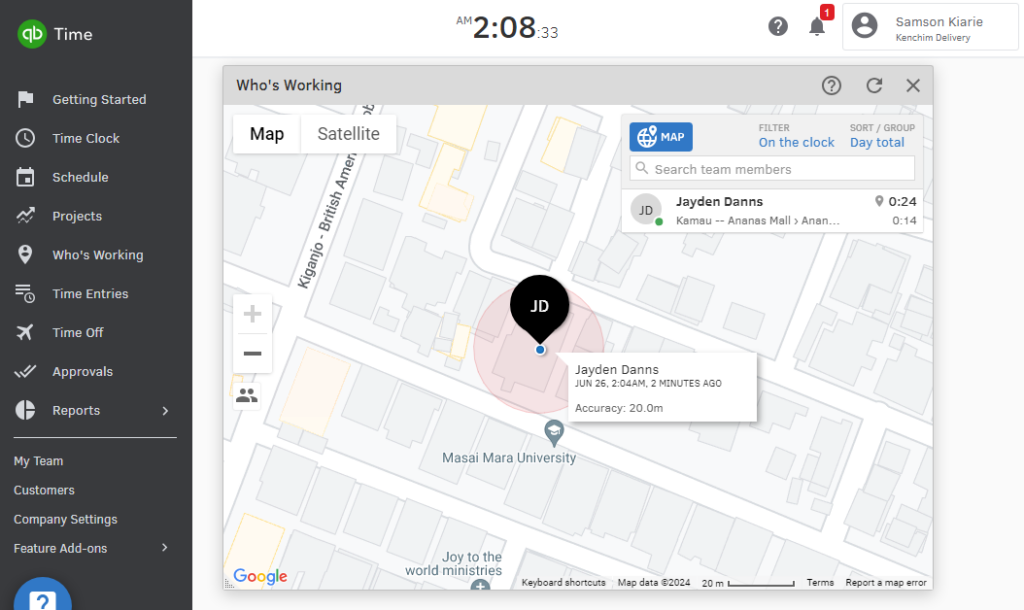
It was simple to track employee locations with QuickBooks Time Custom geofence controls
QuickBooks Time’s geofencing is one of its stronger features. Managers can set custom boundaries around locations with flexible radius options (100–1,000 meters), making it easy to match different site sizes. The setup is simple: enter an address, adjust the radius, and the system handles the rest.
Once it’s in place, employees are prevented from clocking in outside the approved area. They can either wait until they arrive or, as we found during testing, clock in with a note explaining why. While all exceptions are clearly flagged for manager review, the system still allows manual overrides. That means that instead of strict blocking, you’ll still need to rely on manager oversight and clear policies to prevent misuse.
Mileage tracking
QuickBooks Time’s mileage tracking is another option for businesses that need accurate records of employee travel. It automatically logs miles while employees are on the clock, helping ensure only work-related travel is captured for reimbursement or tax purposes. In our testing, mileage was accurate, with a few small differences due to filtering out slow or stationary movement.
What makes it especially useful is the added route visibility. Managers can see the exact path employees took, with breadcrumb trails and a replay feature that shows the full journey. This makes it easy to verify trips, confirm time spent on the road, and spot any deviations. It gives you a clear picture of field activity.
What users say about QuickBooks Time
It tracks the location of employees when they are clocked in, allowing us to further break down the labor totals for specific jobs. This was especially important for determining our profit margins.
One small downside is that some features can take a little time to fully learn, especially when setting up more detailed tracking or admin settings.
0Key Features
- Real-time GPS location map
- Geofencing with flagged exceptions
- Mileage tracking and route history
- Direct QuickBooks payroll sync
Pros
- Route mapping and breadcrumb trails
- Offline tracking with reliable sync
- Clear real-time location visibility
Cons
- Geofence rules can be bypassed with notes
- Value depends on QuickBooks ecosystem use
Pricing
Starts at $20/month + $10/user/month Trial: Yes — (30 days) Free Plan: No
-

Workyard — Best for contractors needing precise GPS tracking with job costing
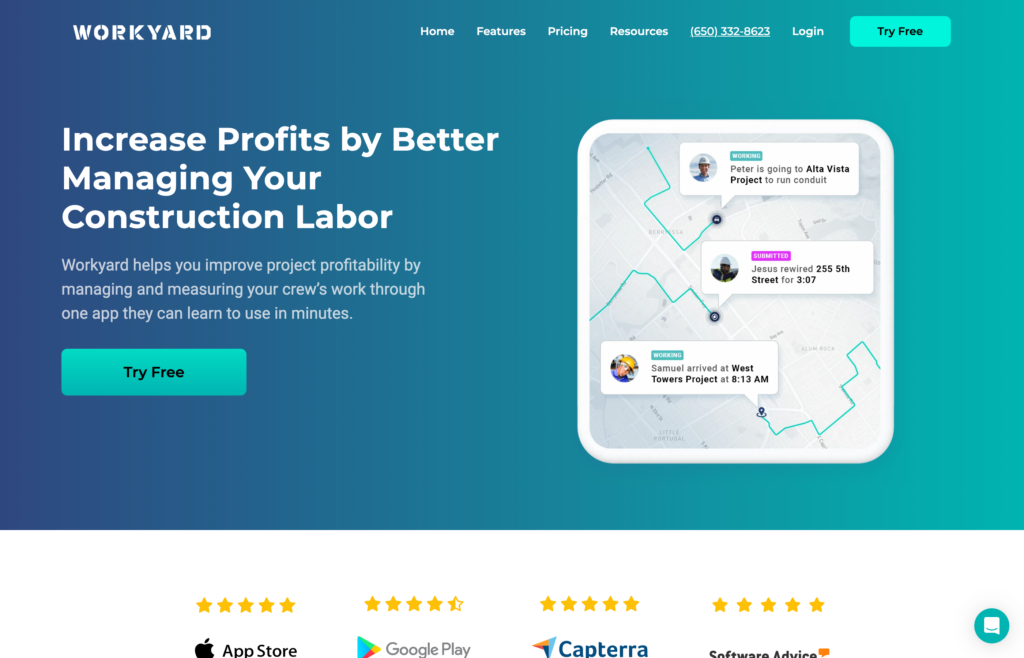
Workyard is a workforce management app that helps construction companies with employee location tracking, job costing, and mileage tracking.
Why I chose Workyard: I chose Workyard because it combines reliable GPS tracking, geofencing, and job costing with an offline mode that keeps time and location data accurate for crews, even when they’re working in remote locations.
GPS tracking and geofencing
In our full Workyard review, we tested the GPS tracking, which offers location updates every five minutes. It gives managers visibility into where their team is and where they’ve been throughout the day. You can view employee locations on a map with detailed activity logs, which show clock-ins, job visits, and time spent at each site. It works on both mobile and desktop, and tracking continues offline, syncing automatically once reconnected.
Workyard also has geofencing, which blocks off-site clock-ins and prompts clock-ins upon arrival. However, we found that the geofence radius isn’t adjustable, which could be limiting for larger job sites. There are also no automatic alerts when employees leave a location, so managers need to check manually.
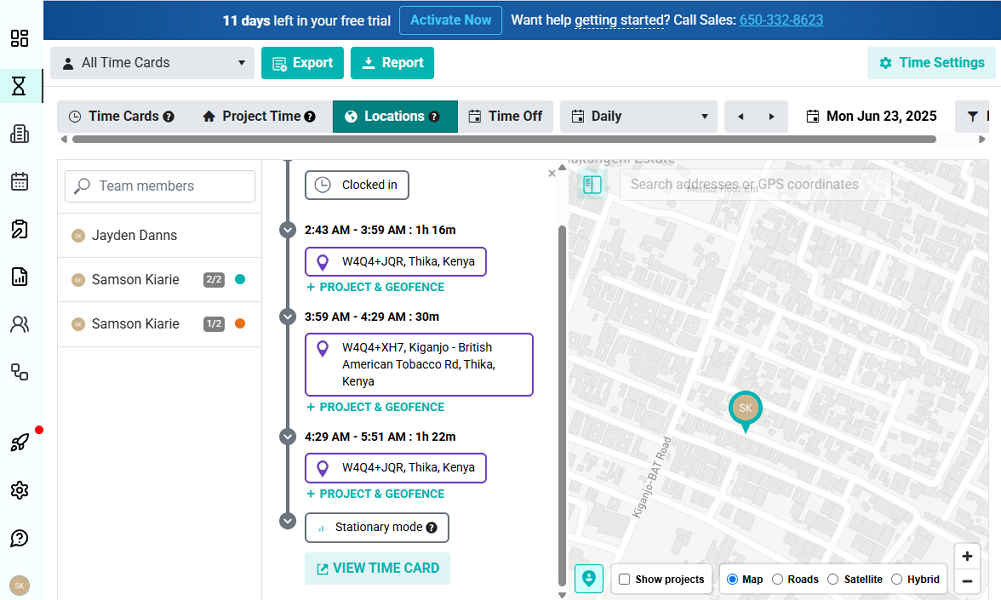
With Workyard, we could view employee location and time spent at each stop. Mileage tracking and route visibility
Workyard’s mileage tracking is one of its standout features, especially because it automatically captures drive time in the background while employees are on the clock. It clearly separates time spent driving from time on-site, giving managers a more accurate picture of how the workday is actually spent, without requiring any manual input.
You also get detailed route visibility, which I appreciated. It includes turn-by-turn paths, breadcrumb trails, and time spent at each location. This makes it easy to verify trips, support reimbursements, and spot inefficiencies. That said, while Workyard does a great job documenting routes, it doesn’t offer route optimization.
Job costing and project tracking
Workyard includes built-in job costing that helps crews track labor costs by task and project in real time. Managers can assign cost codes to different types of work and link projects to specific customers, so it’s easy to see exactly where time (and budget) is going. As employees log hours, those costs are automatically tied to the right tasks, giving you a clear view of project profitability as work happens.
What users say about Workyard
I like the real-time GPS location and the accurate clock in and out times with Workyard. The initial setup was easy, and everything works great.
I wish that if I miss a clock in, when I enter the clock in time and location, the app could extrapolate the distance traveled and update time and mileage.
Key Features
- Real-time GPS location tracking
- Mileage tracking
- Geofence clock-ins
- Job labor costing
Pros
- Tracks time, location, and miles offline
- Smart drive detection
Cons
- Limited geofence customization
- Lacks route optimization
Pricing
$50/month + $6/user/month Trial: Yes — 14 days Free Plan: No
-

Timeero — Best for teams tracking routes and mileage for mobile work
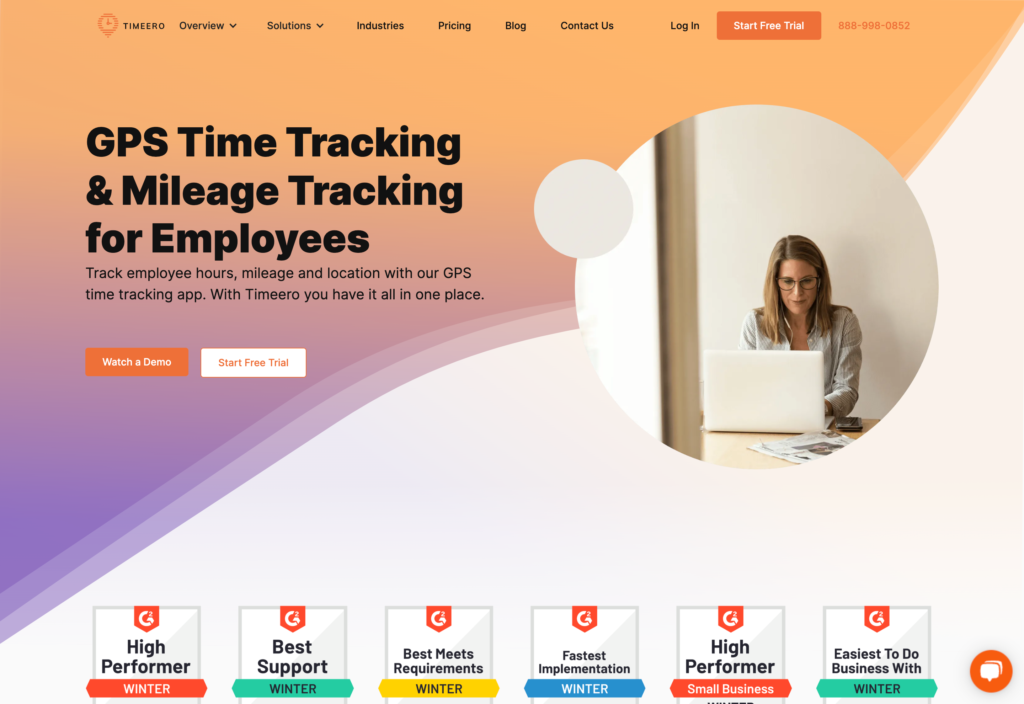
Timeero is a time tracking app with GPS tracking and mileage logging, built for businesses with mobile or distributed teams.
Why I chose Timeero: What I liked about Timeero is that it combines GPS tracking and smart mileage features, including its ability to compare actual routes against suggested ones.
GPS tracking and location visibility
In our full Timeero review, we tested its location tracking capabilities. GPS tracking makes it easy to see employee locations in real-time through a clean, map-based dashboard. Tracking only runs while employees are clocked in, maintaining privacy while still giving managers clear visibility into field activity. Employees clock in through the mobile app, and their location is logged throughout the workday.
While I liked Timeero’s GPS features, there are a few limitations to keep in mind. GPS accuracy can vary depending on device settings, and time tracking is mobile-only, so you can’t start or stop the timer from a desktop. Some advanced features, like break tracking, are also locked behind higher-tier plans, which could be frustrating for small teams with strict compliance needs.
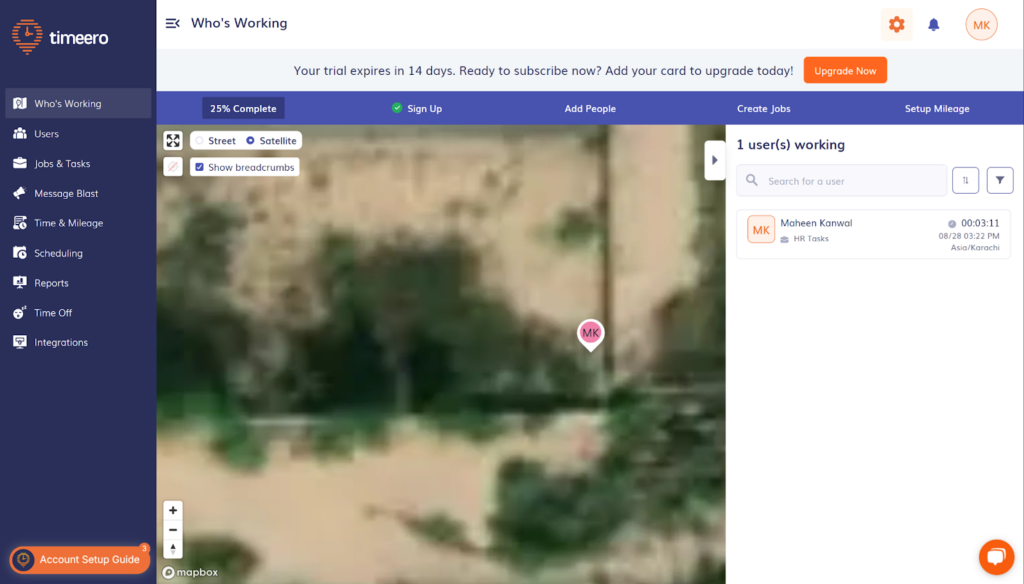
Timeero’s dashboard showed us who was working where on a live map. Geofencing and verification
Timeero’s geofencing helps ensure employees are where they’re supposed to be by automatically clocking them in and out as they enter or leave job sites. This reduces missed punches and prevents off-site clock-ins without requiring manual action from employees.
For added accountability, the platform also offers a kiosk mode with facial recognition to help prevent buddy punching, which I appreciated. Combined with a detailed activity log that records all timesheet changes, managers have a clear audit trail to verify attendance and resolve any disputes if needed.
Mileage tracking and route insights
I really liked Timeero’s mileage tracking. It runs automatically in the background, even offline, and logs accurate travel distances for reimbursement or billing. You also get detailed reports and route visibility, making it easy to see where employees have been and how long they spent on the road.
What stands out more is the suggested mileage feature. It recommends the shortest route and lets managers compare it against the route actually taken, helping identify inefficiencies and keep travel costs under control. While it doesn’t offer full route optimization or real-time rerouting, it’s still a useful insight into how your team moves in the field.
What users say about Timeero
Breadcrumbs option is elite! The MPH in breadcrumbs is extremely beneficial. Overall Breadcrumbs is my favorite part! Works with Quickbooks. Time tracking is on point with the seconds, if staff don’t accidentally force close the app.
It always asks to verify location. I see the need for some, but there should be an on/off switch.
Key Features
- GPS-based time tracking
- Automated geofence clock-ins
- Mileage tracking
- Facial recognition
Pros
- Suggested mileage for shortest route
- Location tracking works offline
Cons
- Can only access timer on mobile app
- No live route optimization, only insights
Pricing
Starts at $5/user/month Trial: Yes — 14-day Free Plan: No
-

Hubstaff — Best for remote teams that need location tracking with activity data
What’s new with Hubstaff
February 2026: Hubstaff previously offered a free plan for individual freelancers; it appears this plan has been discontinued.
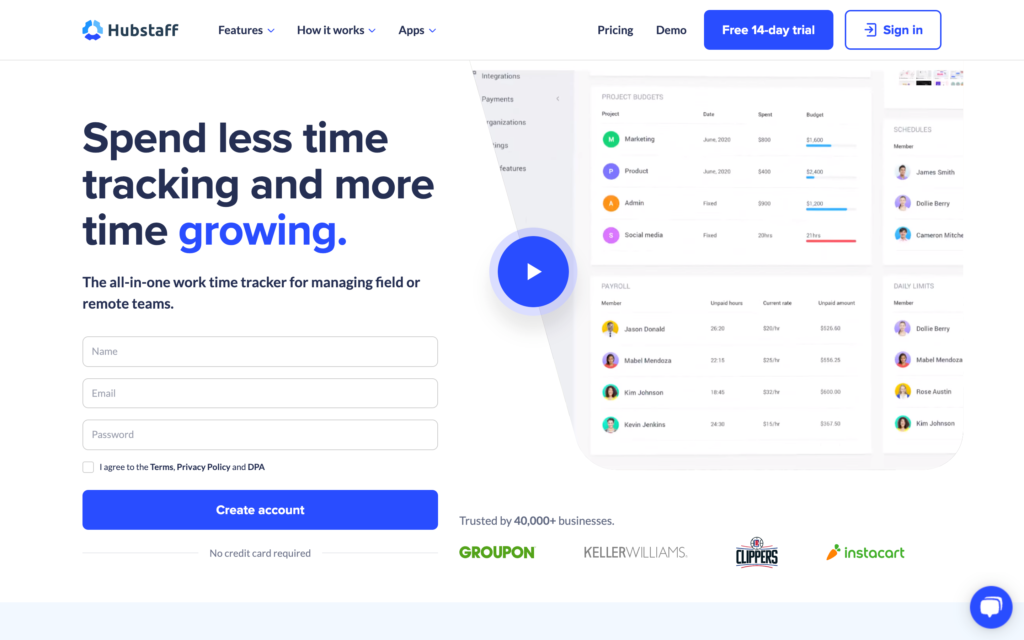
Hubstaff is an employee time and location tracking platform with built-in employee activity monitoring, intended primarily for remote and hybrid teams.
Why I chose Hubstaff: I chose Hubstaff for its strong time tracking and productivity monitoring features, especially for remote and hybrid teams that need visibility into employee activity and desktop work.
GPS tracking and geofencing
In our full Hubstaff review, tested the app’s geofence, which automates clock-ins and clock-outs based on employee location. When employees enter a job site, the app can start their timer automatically, and clock them out when they leave. You can also set it to send reminders instead, giving teams a bit more flexibility and responsibility.
This works well for tracking time at specific locations, but we found that employees can still clock in outside a job site, since geofencing just automates actions rather than blocking them. There’s also no built-in identity verification like facial recognition, and the mobile tracking experience is fairly basic, which could limit its usefulness for field-heavy teams.
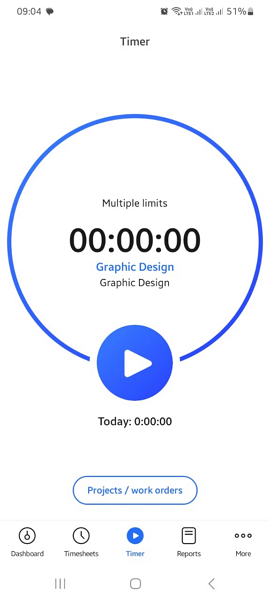
We found the Hubstaff mobile app basic and easy to navigate. Time tracking and compliance
Hubstaff offers flexible time tracking across mobile, desktop, web, and browser extensions. Managers can control which apps employees use and set basic rules for tracking hours, breaks, and overtime. Break reminders help employees stay on schedule, and overtime is calculated automatically based on set policies.
However, compliance features are somewhat limited. Breaks can be ended early without restriction, and overtime rules only support weekly thresholds, not daily ones. You also can’t combine overtime and double-time policies, which may be a drawback for businesses in regions with stricter labor laws.
Activity monitoring and productivity insights
Hubstaff stands out for its activity monitoring. On desktop, the platform can capture screenshots, track app and website usage, and measure activity levels to give managers a clear view of how time is being spent. Screenshots are only taken while employees are clocked in, and can be blurred to protect sensitive information.
It also provides insights, like weekly productivity summaries and alerts for unusual activity. That said, these features are limited to desktop only and there’s no equivalent on mobile, which makes it much less useful for field teams that rely on mobile-first tracking.
What users say about Hubstaff
I like that it’s very detailed in the record keeping. I like the interface because it’s easy to use. I appreciate that the reports are very customizable and provide a lot of information and insights.
Hubstaff could improve its UI, make reports more customizable, and reduce occasional tracking glitches.
 0
0Key Features
- Automatic geofenced clock-ins
- Activity monitoring
- Flexible time tracking methods
- Geofence clock-in reminders
Pros
- Offline time tracking
- Activity visibility for remote teams
Cons
- Geofence doesn’t block off-site clock-ins
- Compliance features are limited
Pricing
Starts at $4.99/user/month Trial: Yes — 14 day Free Plan: No
-

Jibble — Best for teams using GPS tracking with attendance controls
What’s new with Jibble
In March 2026, Jibble raised its paid plan prices, with Premium increasing from $2.49 to $4.49 per user/month on annual billing and Ultimate rising from $4.99 to $7.99. That represents an increase of about 80% for Premium and 60% for Ultimate, making Jibble significantly more expensive than before.
Jibble is a time and location tracking app with attendance management for field and office-based teams.
Why I chose Jibble: Jibble is great for teams that need tight control over attendance, especially since it combines facial recognition technology with geofencing and GPS tracking.
Geofencing and verification controls
In our full Jibble review, we tested how the platform prevents time theft through built-in verification tools. Its facial recognition requires employees to take a selfie when clocking in, which is then matched against their stored profile. If it doesn’t match, the system blocks the clock-in as a way to prevent buddy punching. The kiosk app also supports NFC clock-ins, which I appreciated.
Geofencing restricts clock-ins and clock-outs to approved job sites. Employees can see how close they are to a valid location, and managers can enable automatic clock-ins or reminders when entering a geofence. I thought that these features work well together to make it easier to enforce location-based attendance without constant supervision.
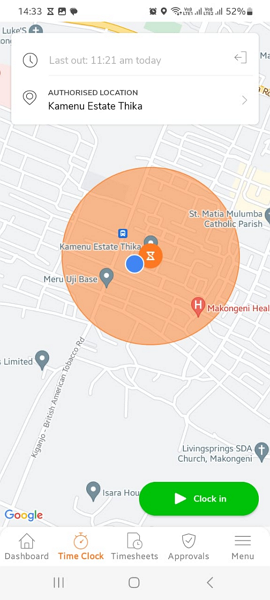
Jibble prevented us from clocking in outside the set geofence. GPS tracking and route visibility
Jibble offers real-time GPS tracking with a live map view of where employees are, what they’re working on, and how long they’ve been on the clock. During testing, location tracking was accurate and reliable, making it easy to confirm employees are where they’re supposed to be.
It also includes route tracking to show employee movement throughout the day. However, we found that routes are displayed as straight lines between stops rather than detailed paths. While it’s useful for general oversight, this limits visibility into the exact route taken, making it less helpful for analyzing travel patterns or improving route efficiency.
Break and overtime compliance
Jibble’s compliance tools are flexible and built to handle complex labor requirements. I liked that you can set up break policies that align with specific regulations, including rules for meal and rest breaks, and the system helps ensure employees don’t exceed allowed break times.
Overtime tracking supports daily, weekly, double time, and other rule types. Once configured, overtime is calculated automatically, and managers receive alerts when employees reach thresholds. This makes it a good option for businesses that need to stay compliant with labor laws without manual tracking.
What users say about Jibble
One of the best options if clock in/out based on location, it helps a lot for people that constantly have issue with remembering to clock in/out.
It is a little confusing to set up at first. The geofence shrinks once an employee clocks in, so they have to exit the app to clock out. It often glitches, requiring you to close the app or turn your phone off and back on for it to work properly.
 0
0Key Features
- Geofence clock-ins/outs
- Live location tracking
- GPS route tracking
- Facial recognition
Pros
- Multiple verification methods
- Kiosk app with NFC clock-ins
Cons
- No turn-by-turn route tracking
- Lack route optimization
Pricing
Starts at $4.49/user/month Trial: Yes — 14 days Free Plan: Yes
Compare the Best Apps to Track Employee Location
| Topic |
 Start for free
|
|
|
|
|
|
|
|---|---|---|---|---|---|---|---|
| Reviews |
|
|
|
|
|
|
|
| Pricing |
Starts at
|
Starts at $40/month + $9/user/month.
|
Starts at $20/month + $10/user/month
|
$50/month + $6/user/month
|
Starts at $5/user/month
|
Starts at $4.99/user/month
|
Starts at $4.49/user/month
|
| Free Trial |
yes
14-day
|
yes
(14-day)
|
yes
(30 days)
|
yes
14 days
|
yes
14-day
|
yes
14 day
|
yes
14 days
|
| Free Plan |
yes
Free Up to 10 users
|
no
|
no
|
no
|
no
|
no
|
yes
|
| Use cases |
Best for businesses needing reliable real-time employee location tracking
|
Best for construction crews tracking location by job site
|
Best for teams linking GPS tracking with payroll workflows
|
Best for contractors needing precise GPS tracking with job costing
|
Best for teams tracking routes and mileage for mobile work
|
Best for remote teams that need location tracking with activity data
|
Best for teams using GPS tracking with attendance controls
|
| Available on |
What are Employee Location Tracking Apps?
Employee location tracking apps are software tools that allow businesses to see where their employees are during the workday using GPS technology. They’re often used by field teams, in industries like construction, cleaning, delivery, or service businesses, where employees don’t work from a single location.
These apps give managers real-time visibility into their workforce, helping them understand who’s on-site, who’s on the way, and how work is progressing across different locations. Instead of relying on calls, texts, or guesswork, managers can quickly check employee locations and stay informed without constant check-ins.
How Do Employee Location Tracking Apps Work?
Employee location tracking apps use the GPS technology built into smartphones or tablets to capture and share location data while employees are on the job. Once employees start their shift or enable tracking, the app begins recording their location in real-time or at set intervals throughout the day.
Managers can view this information through a central dashboard, where they can see live maps, employee statuses, and movement between job sites. Many apps also store route history, making it easy to review where employees have been, verify completed work, and resolve any disputes about time or attendance.
Most tools include controls to ensure tracking only happens during work hours, helping maintain clear boundaries and employee trust. Combined with mobile-friendly interfaces, these apps make it easy for both managers and employees to use the system without disrupting daily operations.
The Benefits of Employee Location Tracking Apps
Employee location tracking apps can help your business in multiple ways, including:
Better control
When you can see where your team is, you stop worrying and relying on assumptions. Instead of chasing updates or reacting to surprises, you can make quick decisions, adjust schedules on the fly, and keep jobs running smoothly, even when plans change.
Less mistakes
Without visibility, minor delays or miscommunications can escalate. Location tracking helps you catch issues early, like an employee running late or heading to the wrong site, so you can fix them before they impact customers or timelines.
Better accountability
Clear visibility naturally increases accountability. Employees know their work is transparent, which reduces corner-cutting and misunderstandings—without you needing to constantly check in or follow up.
Improved experience
When your team shows up on time and at the right place, customers notice. Location tracking helps ensure jobs are completed as promised, reducing complaints, missed appointments, and last-minute excuses.
Reduced stress
Not knowing where your employees are creates constant uncertainty. With real-time visibility, you spend less time worrying and more time focusing on running and growing your business.
Boosted confidence
With a clearer picture of how work happens in the field, you can spot delays, improve planning, and use resources more effectively, which leads to better performance across your operations.
How Much Do Employee Location Tracking Apps Cost?
Employee location tracking apps typically use a subscription-based pricing model, combining a monthly base fee with a per-user charge. Most providers start around $20–$50 per month for the base platform, plus an additional $6–$9 per user per month. Some tools offer simpler, per-user-only pricing, usually starting between $2.49 and $4.99 per user per month.
Connecteam’s Small Business Plan stands out by being completely free for up to 10 users, with full access to all features. Paid plans start at $29 per month for up to 30 users. Higher-tier plans start at $49/month for Advanced and $99/month for Expert, both also covering up to 30 users.
The Bottom Line on Employee Location Tracking Apps
Employee location tracking apps are built for businesses managing field teams, mobile workers, or multiple job sites. What matters most is real-time visibility, ease of use, and tools that help you prevent issues from happening again.
Connecteam stands out as the #1 choice by combining accurate tracking with powerful controls, all in a simple, mobile-first platform your team will actually use. If you want full visibility without the headaches, start with Connecteam.
Take control of your operations—try Connecteam for free today!
FAQs
Yes, employers can track employee location during work hours using GPS-enabled apps, typically with employee consent. While no federal law in the U.S. specifically restricts GPS tracking, you should review employee GPS tracking laws by state laws and ensure clear policies are in place to remain compliant.
Most apps provide accuracy within a few feet, depending on signal strength and device quality. Reliable platforms like Connecteam offer consistent, real-time tracking that’s accurate enough for verifying job sites and employee movement throughout the day.
Common challenges include battery drain, privacy concerns, and employee resistance if tracking isn’t clearly communicated. Poorly designed apps can also be confusing or inaccurate, which is why choosing a user-friendly, transparent solution is critical.
If handled poorly, they can feel intrusive. But when used transparently, with clear boundaries, tools like Connecteam actually improve trust by setting expectations, reducing disputes, and creating a fair, accountable work environment for everyone.