


When team communication breaks down, missed updates turn into duplicated work, delayed deadlines, frustrated employees, and a team that feels disconnected, overwhelmed, and difficult to manage.
I reviewed 6 team management apps across real-time communication, task and project coordination, visibility into daily work, scheduling, and day-to-day usability.
Use this comparison to see which app best fits how your team works, from project collaboration and communication to shift-based operations.
| App | Good match for | Starting Price | Key Considerations |
| Connecteam | On-site and mobile teams managing daily operations across shifts or locations | $29/month (up to 30 users) | Works best for on-site and mobile teams that need coordination, scheduling, and oversight |
| Slack | Teams organizing communication in channels | $8.25/user/month | Organizes conversations, external collaboration, and app-based workflows |
| Microsoft Teams | Businesses managing communication within Microsoft 365 | $4/user/month | Provides Microsoft 365 users with chat, meetings, and file collaboration |
| ClickUp | Teams managing tasks and workflows across projects | $7/user/month | Flexible project planning and customizable workflows |
| Asana | Teams managing structured projects and task planning | $10.99/user/month | Offers strong task and workflow tools, plus flexible project views |
| Deputy | Teams managing scheduling and shift coordination | $5/user/month | Strong scheduling, flexible time clock options, and compliance controls |
What’s New in This Update (August 2026)
- Replaced numbered rankings with recommendations based on team needs.
- Restructured article framing to focus on a broader team management software comparison covering communication, project coordination, and workforce oversight.
How I Evaluated Team Management Software
To compare these tools consistently, I looked at the capabilities and day-to-day experience that matter most across different team setups.
Core team management capabilities:
I looked at how well each platform supports the core functions that teams use management software for.
I prioritized:
- Real-time communication: It should be easy to share updates, send announcements, message teammates, and keep conversations organized so work doesn’t get lost.
- Task and project coordination: I prioritized software that helps teams assign tasks, track progress, manage deadlines, and keep everyone aligned on priorities.
- Clear visibility: The software should provide a clear view of team activity, so managers can see who’s working on what, identify bottlenecks, and keep projects or daily operations on track.
- Flexible work organization: The software should support how teams actually work, whether that’s projects, recurring tasks, shift-based work, daily checklists, or cross-team collaboration.
- Notifications and alerts: The software should send timely reminders and updates so nothing gets missed and teams can react quickly to changes.
Day-to-day usability:
Beyond core capabilities, I evaluated how each app works in real team environments.
- Ease of use: The tool should be simple enough for managers and employees to use without a steep learning curve or too much setup.
- Mobile accessibility: Employees should be able to use the software from their mobile devices to stay connected, update work, and respond quickly from anywhere.
- Customization and flexibility: Teams need to be able to tailor workflows, fields, and processes to match how they work.
Manager visibility and control:
- Reporting and insights: Managers should be able to track progress, spot issues early, and understand team performance through reports, dashboards, or other visibility tools.
- Permissions and control: The software should have admin settings and role-specific permissions so managers can decide who can see, edit, or approve what.
- Integration with other tools: The app should connect with other business tools to keep data consistent and avoid duplicate work.
6 Team Management Software Options for Different Types of Teams
Connecteam
A Good Match for On-Site and Mobile Teams Managing Daily Operations

Available on: Web, iOS, and Android
Pricing: Free-for-life Small Business Plan for up to 10 users. Premium plans start at $29/month for the first 30 users.
Trial: 14 days
Ratings: Capterra 4.6/5; G2 4.6/5; Software Advice 4.6/5; TrustRadius 9.4/10; Google Play 4.7/5; App Store 4.9/5.
Connecteam is designed for businesses managing on-site or mobile teams that need communication, task management, scheduling, and workforce oversight in one platform. It’s especially relevant when managers need visibility into daily work across locations or shifts.
Why I chose Connecteam: Connecteam brings communication, task coordination, scheduling, and workforce oversight together, making it a strong fit for teams whose work happens across shifts, job sites, or locations.
Task coordination and execution
With Connecteam’s employee task tracking, managers can assign tasks to individuals or groups, and add detailed instructions, attachments, labels, and even locations. Subtasks help break down larger projects, and it’s easy to set deadlines, reminders, and recurring tasks to keep work on track.
Task progress is tracked automatically, so managers have a clear view of what’s open, in progress, or overdue.
I liked that each task has built-in chat, so updates, questions, and context stay tied to the work itself instead of getting buried in a separate conversation. That makes it a lot easier to keep projects moving forward.
Team communication and updates
Connecteam’s online team chat keeps communication organized and focused on work. Managers can message individuals or create group chats by team, project, or department, all accessible from the desktop and mobile app. You can send files, images, videos, locations, links, and even tag specific team members. Conversations are fully searchable, so it’s easy to find the information you need.

I also liked that managers have full control over how the chat is used. Admins can set who can start conversations, allow or restrict direct messaging, and manage push notifications to ensure important updates are seen.
The company update feed is also really useful for sharing announcements. Managers can target updates by role, team, or location, and even require employees to confirm they’ve read a post, so nothing gets missed.
Scheduling and time tracking
With Connecteam’s employee scheduler, managers can build schedules with the drag-and-drop editor across locations and departments, add shift notes and attachments, and instantly notify employees when updates go live. You can also use the AI-powered auto-scheduler to assign shifts based on availability, roles, and qualifications.
Beyond planning, Connecteam’s employee time clock lets teams clock in and out via mobile, desktop, or kiosk. Managers can track hours and approve timesheets before sending them directly to payroll. I really like that geofencing, location stamps, and the real time GPS tracker help managers verify attendance and promote accountability.
Connect with your favorite tools
Connecteam offers an API integration and connects with the tools you already use, including:
And so much more…
Connecteam is full of other features to help you manage your team, including:
- Digital forms: Create custom forms or turn existing ones into digital workflows using AI. Capture photos, voice notes, and attachments, and keep all submissions in one place.
- Company knowledge base: Store SOPs, guides, and policies in a single, searchable hub. Use the built-in AI agent to get instant answers based on your content.
- Training and onboarding: Build structured training programs in minutes with the AI Course Creator, helping new hires get up to speed quickly.
- Internal help desk: Manage employee requests with a built-in ticketing system. Create custom help desks by department, route issues to the right people, and track every request from submission to resolution.
What users report
G2 reviewers praise Connecteam’s straightforward interface and the convenience of managing schedules, time tracking, tasks, and communication in one app. Some reviewers say the range of customization can increase initial setup time and that notification settings may require adjustment.
Key Features
- Task management
- Admin permissions and controls
- One-on-one and team chats
- Company updates newsfeed
- Drag-and-drop shift scheduling
- Time clock with GPS and geofencing
Pros
- Strong visibility into daily operations
- Powerful API and integration network
- Mobile-first platform design
- Time-saving AI-powered tools
Cons
- Not built for fully remote teams
- Lacks full document collaboration
Slack
A Good Match for Channel-Based Team Communication
Available on: Web, desktop, iOS, and Android
Pricing: Starts at $7.25/user/month billed annually.
Trial: 30 days (by request)
Free plan: Yes
Ratings: Capterra 4.7/5; G2 4.5/5; Software Advice 4.7/5; TrustRadius 9/10; Google Play 4.6/5; App Store 4.1/5.
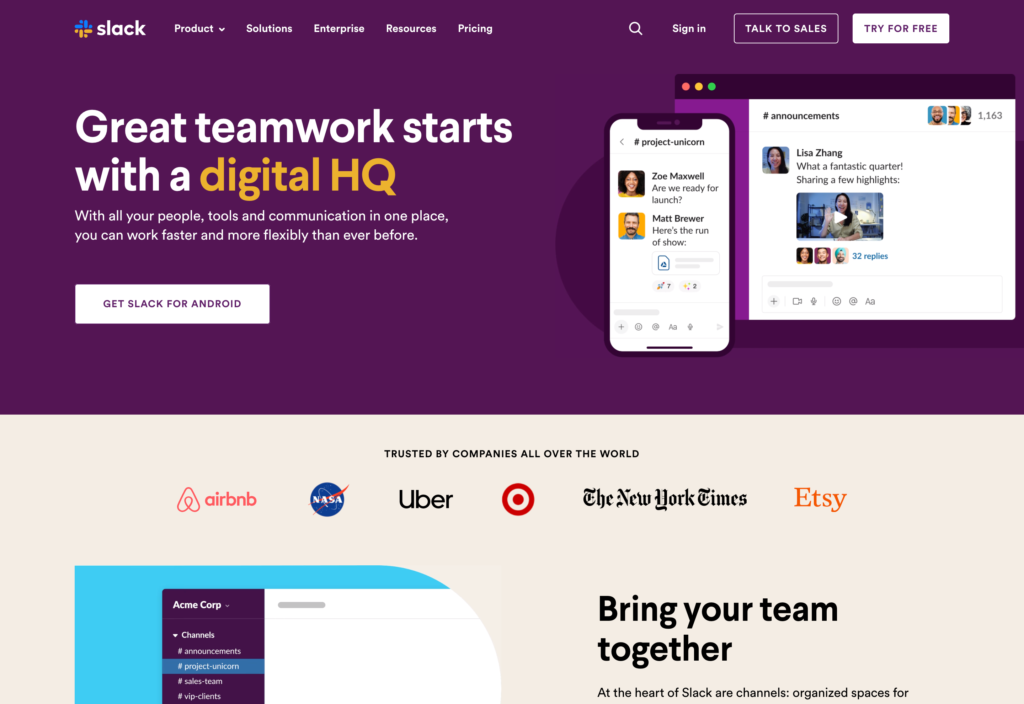
Slack is a team management software focused on communication through channels, meetings, and messaging.
Why I chose Slack: I liked that Slack keeps conversations, external collaboration, and app-based workflows in one place.
Channels and messaging
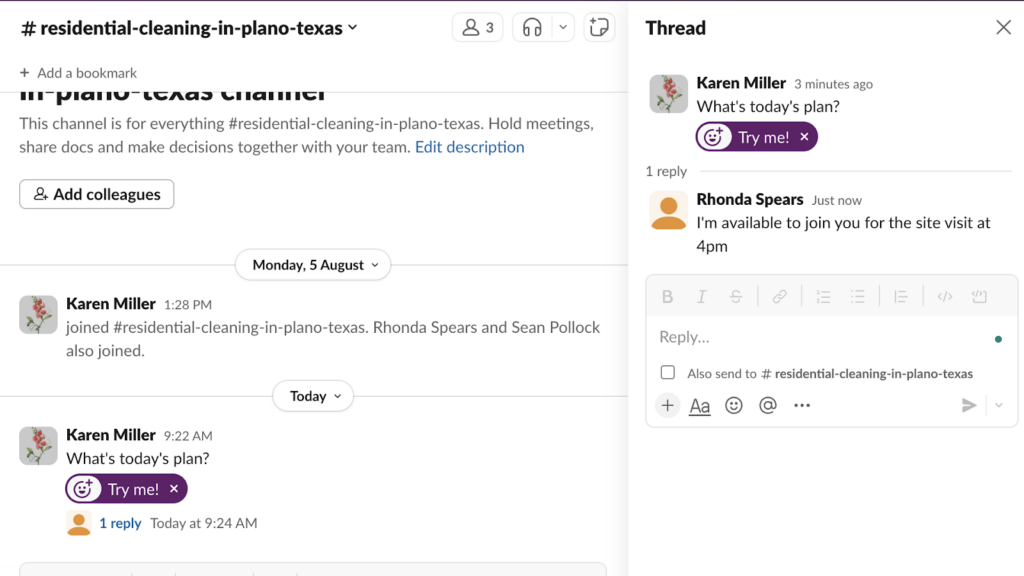
In our full Slack review, we tested the platform’s communication features. Slack organizes communication into direct messages and dedicated channels for teams, projects, topics, or locations. Channels can be public or private, and you can collaborate with external partners without leaving the platform.
Messaging is pretty consistent, and I liked that you can send formatted text, files, audio, and video, and use @mentions to notify the right people. You can also use threads to keep replies tied to a specific message instead of cluttering the main channel.
Slack’s customization is also strong. Team members can set statuses, schedule messages, pin important content, mark items as unread, set reminders, and control notifications by channel. There are also AI summaries to help you keep up with all the information.
The big limitation we found is that admins can’t override personal notification settings or do not disturb. This could make it difficult to reach someone in urgent situations.
Voice and video calling
Slack offers built-in voice and video calls through Huddles, which are designed for quick, informal conversations. Instead of setting up links or meetings, you can jump into a call with a single click, making it feel more like a quick office chat than a scheduled meeting.
Team members can join instantly to ask questions or talk things through, and you can share screens, files, and messages directly within the Huddle. Live captions are also available, which is helpful, but they’re currently only available in English.
It’s important to mention that Huddles can’t be recorded, and they’re capped at 50 participants. While this might not be an issue for every team, it probably isn’t the ideal setup for larger, company-wide meetings.
Workflows and canvas
Slack’s Workflow Builder helps you automate routine tasks such as onboarding messages, approvals, or form submissions. You just choose a trigger and add actions by dragging and dropping them into place. I was impressed that it connects with external tools, so workflows aren’t limited to only Slack and you can handle more complex processes.
Beyond workflows, there’s also Canvas, which works as a flexible space for brainstorming, notes, and shared content. It supports tables, checklists, files, and templates, and you can share canvases with individuals or channels, controlling edit access as needed. While it’s not as advanced as full document tools, it still works well for quick, real-time collaboration without too much complexity.
What users report
User reviews praise Slack’s channel organization, fast communication, and broad integration options. Other reviewers mention that search can be inconsistent and thread replies are not always intuitive.
Key Features
- Channels and direct messaging
- Video and voice calls
- External collaboration
- Workflow automations builder
Pros
- AI search, summaries and recaps
- Extensive integration ecosystem
Cons
- Some admin controls limited
- Can get noisy and overwhelming at scale
Microsoft Teams:
A Good Match for Microsoft 365 Collaboration
Available on: Web, desktop, iOS, and Android
Pricing: Starts at $4/user/month, paid yearly.
Trial: 30 days
Free plan: Personal use only
Ratings: Capterra 4.5/5; G2 4.4/5; Software Advice 4.5/5; GetApp 4.5/5; Google Play 4.4/5; App Store 4.8/5; TrustRadius 8.2/10.
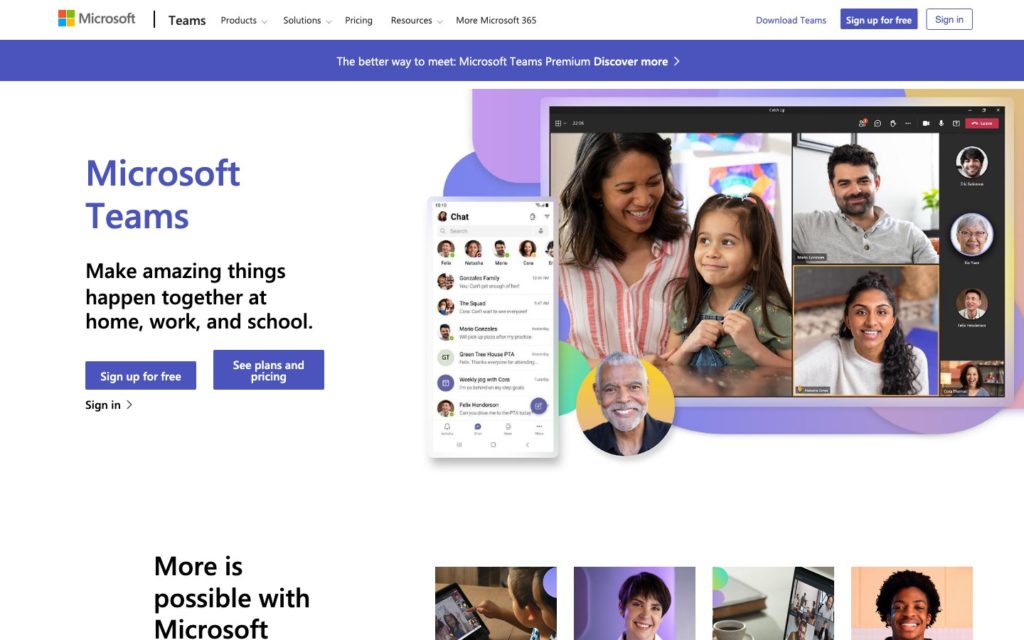
Microsoft Teams is a team management app that offers messaging, meetings, file collaboration, and team coordination within the Microsoft 365 ecosystem.
Why I chose Microsoft Teams: Microsoft Teams brings chat, channels, meetings, file sharing, and scheduling tools into one platform, making it especially relevant for businesses that already work inside Microsoft 365.
Chat and channels
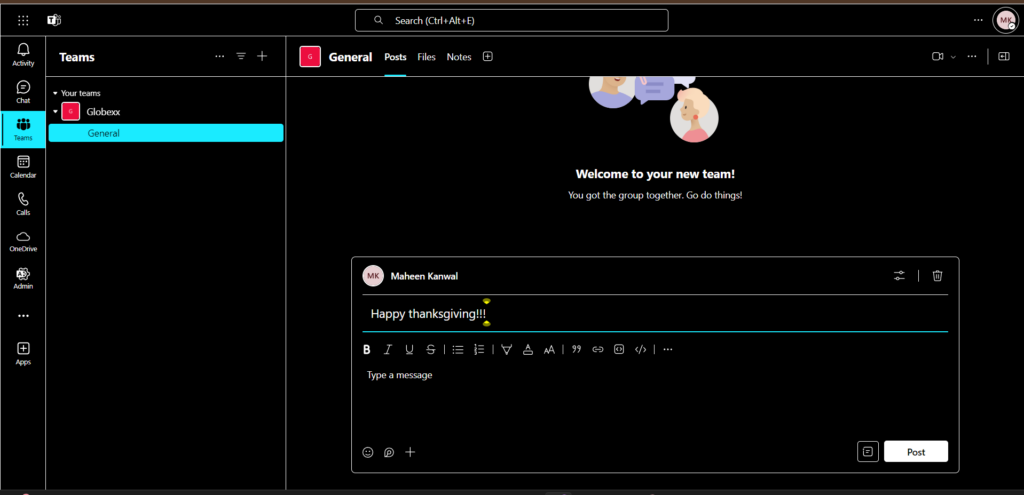
In our full Microsoft Teams review, we found that communication is spread across direct chats, group messaging, and channels. You can share files, emojis, and schedule meetings directly within chats. I also liked that you can organize discussions by team, project, or topic, keeping conversations, files, and updates in one place.
For sensitive work, it’s easy to create a private channel. Posts within channels act as structured updates, so users can format messages, attach files, and edit or delete content as needed.
Microsoft Teams also has a built-in calendar for scheduling meetings, managing attendees, and setting recurring sessions, along with an activity feed that highlights mentions, invites, and key updates across the platform. Plus, there’s video conferencing with screen sharing, virtual backgrounds, and breakout rooms.
File sharing and collaboration
Microsoft Teams makes it easy to share and manage files across chats and channels. Upload a file to a channel, and it’s instantly accessible to the whole team. There’s also real-time co-authoring, so team members can work on documents together, see live edits, and leave comments or @mentions without switching tools.
I appreciated that version history lets you track changes or revert to earlier versions. Combined with centralized document libraries, it keeps files organized and easy to manage. The search is also pretty strong, and helps you quickly find files across teams and channels using keywords, with filters for team, channel, file type, last editor, or date.
Scheduling and time tracking
With Microsoft Teams, you can build shifts and use the time clock for basic time tracking. The schedule lets managers create and assign shifts, color code items, post open shifts, and manage time-off or swap requests. Employees can view schedules and track request statuses for added visibility.
On the mobile app, employees can clock in and out, track breaks, and edit timesheets for managers to review and approve.
While these features cover the basics, we found them pretty limited. There’s no support for recurring shifts, drag-and-drop scheduling, or one-click scheduling. The time clock also lacks advanced tools like geofencing, biometric clock-ins, and automated break reminders. Plus, there are no direct payroll integrations, which adds extra steps, manual data entry, and room for errors to every pay run.
What users report
User reviews praise Microsoft Teams’ tight Microsoft 365 integration, especially for sharing and co-editing files. Other reviewers say the interface can feel clunky or confusing, particularly when navigating its many options.
Key Features
- One-on-one and group messaging
- Video conferencing
- Document collaboration
- Scheduling and time clock
Pros
- Great fit for Microsoft 365 users
- Strong collaboration tools
Cons
- Limited scheduling and time tracking
- No payroll integrations
ClickUp
A Good Match for Customizable Project and Task Workflows
Available on: Web, desktop, iOS, and Android
Pricing: Starts at $7/user/month billed annually.
Trial: Free trials available
Free plan: Yes
Ratings: Capterra 4.6/5; G2 4.7/5; Software Advice 4.6/5; GetApp 4.6/5; Google Play 3.8/5; App Store 4.7/5; TrustRadius 8.6/10.
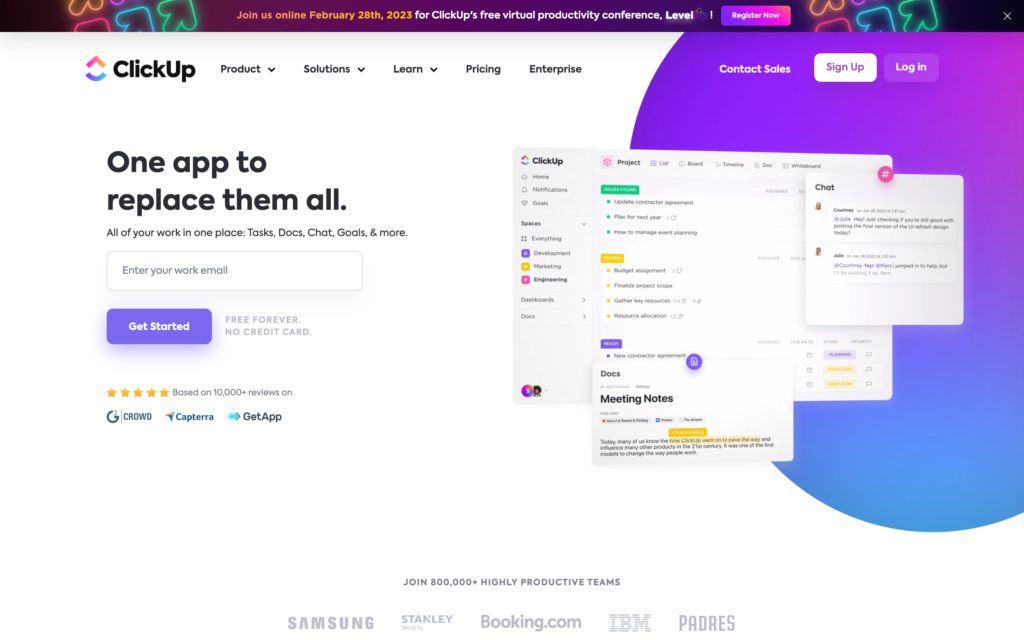
ClickUp is a team management software for project planning, task management, reporting, and collaboration.
Why I chose ClickUp: ClickUp stands out as a strong project and task management platform with flexible reporting, workload views, and useful collaboration tools.
Task management and scheduling
In our full ClickUp review, we found that while ClickUp positions itself as a full shift scheduling tool, it’s really a task management platform. You can assign dates and times to tasks, but it’s not built for planning shift schedules or managing coverage.
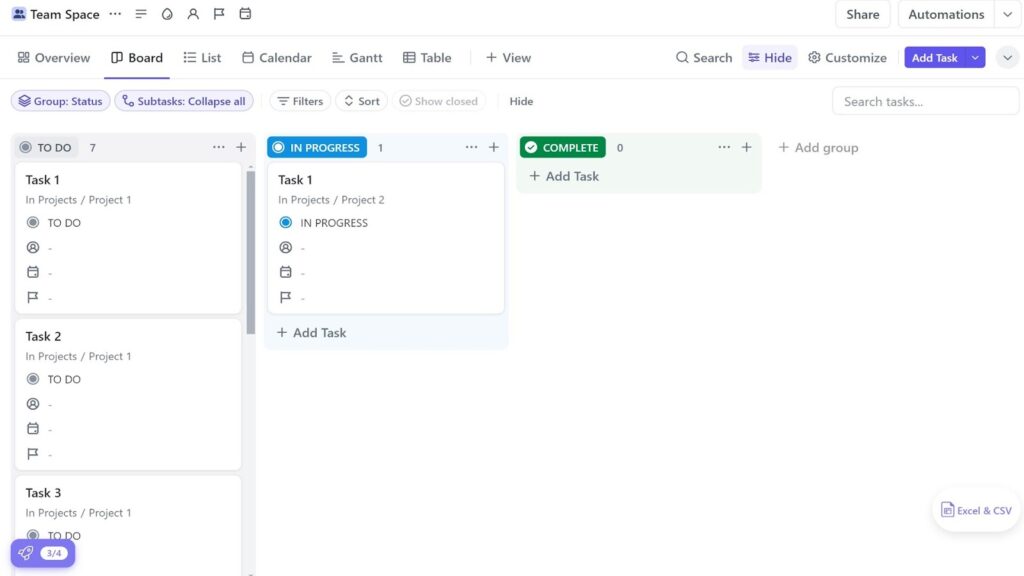
That said, I liked that you can add time estimates to tasks and use goals to group work together around milestones, deadlines, or targets. There are also multiple views to help you visualize work in different ways, including kanban boards, Gantt charts, and calendars. It’s helpful for organizing projects in a way that works best for your team.
Another feature that really stood out was the workload view. It shows each employee’s availability by day and helps managers decide how to split work across the team.
Time tracking and timesheets
ClickUp offers built-in time tracking and timesheets. Team members can track time for tasks, organize entries with tags, and view or edit timesheets. Managers can see timesheets for all employees and get a quick understanding of how hours were spent on work.
I liked that time entries can be filtered by billable status, tag, and duration, and that timesheets are easy to review.
The main issue we found is that actually starting the timer was more complicated than it needed to be. It takes multiple clicks to reach the time tracker, and you can’t start a timer without first assigning a task. It’s also difficult to navigate back to the timer once you leave the timesheets window, which could lead to employees forgetting that it’s still running.
AI capabilities and reporting
ClickUp’s AI assistant, ClickUp Brain, acts like a built-in ChatGPT for your workspace. It’s helpful for quickly pulling insights, like upcoming deadlines or which employees are available on a given day. It can also guide you with step-by-step instructions when it can’t complete actions directly.
When it comes to reporting, there’s a centralized module with pre-built and custom dashboards. Time reports are fairly basic, but task-based reports give clearer insights into team workload and capacity. What I really liked is the level of customization. You can build dashboards around your key metrics and create tailored reports, making it pretty flexible.
What users report
User reviews praise ClickUp’s flexibility and deep customization across departments and workflows. Other reviewers say maintaining the setup can take work and the interface can sometimes feel difficult to stay on top of.
Key Features
- Project views with lists, kanban, and Gantt
- Time tracking and timesheets
- Workload view for task planning
- Custom reporting dashboards
Pros
- Strong project and task management tools
- Flexible dashboards and workload reporting
Cons
- Doesn’t offer true shift scheduling
- Interface can be confusing for new users
Asana
A Good Match for Structured Project Planning
Available on: Web, desktop, iOS, and Android
Pricing: Starts at $10.99/user/month.
Trial: 30 days
Free plan: Yes
Ratings: Capterra 4.5/5; G2 4.4/5; Software Advice 4.5/5; GetApp 4.5/5; Google Play 4.2/5; App Store 4.7/5; TrustRadius 8.5/10.
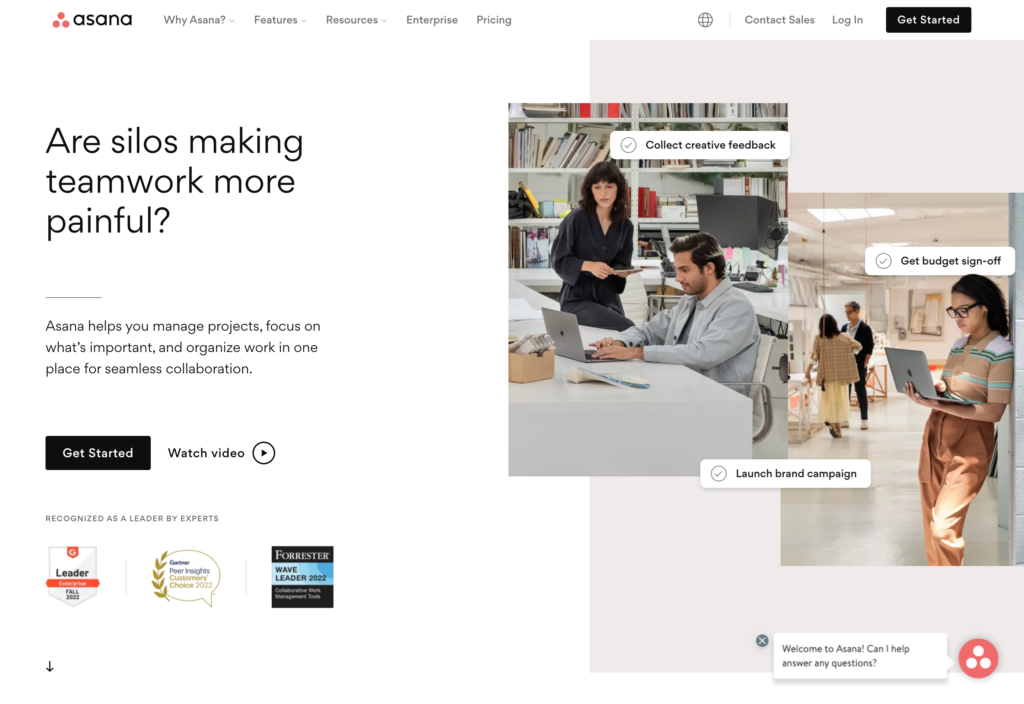
Asana is a team management app for organizing tasks, projects, workflows, and team collaboration.
Why I chose Asana: I liked that Asana offers a clean interface, strong task and workflow tools, and flexible project views, making it a good choice for teams that need structured planning.
Task management and project organization
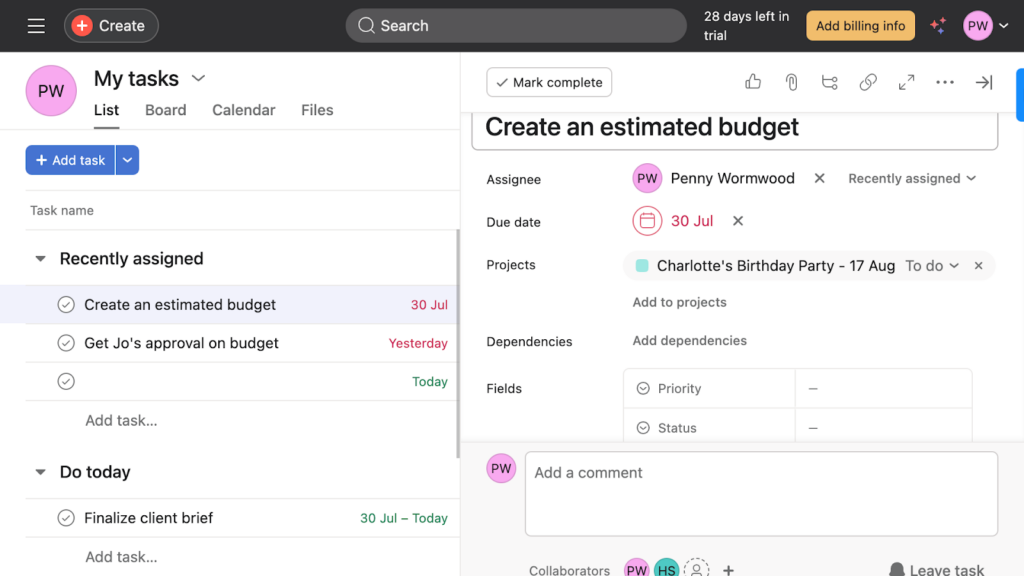
In our full Asana review, we were able to create tasks and subtasks and assign employees. You can also add due dates, descriptions, files, comments, dependencies, and priority levels, and then view work in list, board, calendar, and Gantt formats.
I also like that you can drag and drop tasks into custom sections like “Do today” and “Do tomorrow,” which makes day-to-day planning feel simple.
On the project side, there are overviews, dashboards, milestones, portfolios, and linked company goals, giving managers a better sense of how projects are progressing.
The one issue we found is that project status doesn’t update automatically unless you change it manually or rely on AI, which just adds an unnecessary extra step.
Workflows and portfolios
Asana’s workflow tools are pretty impressive. I liked that you can set up rules to trigger actions automatically, like moving a task to the next phase or assigning new work once something is completed. You can also connect workflows to external apps to automate complete processes.
In addition, Asana offers a portfolio tool that lets you group multiple projects together and track them from one place. You can also create goals at the team or individual level and link them back to projects or tasks. However, we found it difficult to figure out how to delete a portfolio, and the workload view felt confusing because it focused on task counts rather than work hours.
Time tracking and collaboration
Asana’s collaboration tools allow team members to leave task comments, tag coworkers with @mentions, format text, attach files, and use the Inbox for updates and direct messages. I liked that collaboration stays close to the work itself, since comments are left within the task rather than in a separate thread.
When it comes to time tracking, we ran into some difficulties. You can either use integrations or Asana’s native tracker on higher tier plans. Setting up the time tracker wasn’t super intuitive and took a few steps involving project customization. Plus, it had to be added to each project separately. The controls were also not as strong as I would have liked, making the tool less ideal for hourly teams.
What users report
User reviews praise Asana’s clear task and project organization and relatively easy navigation. Other reviewers mention friction around document handling and say established workflows can be difficult to change.
Key Features
- Task and subtask management
- Project, portfolio, and goal tracking
- Custom workflows and automations
- Comments, inbox, and team collaboration
Pros
- Multiple project views and dashboards
- Strong workflows with integrated apps
Cons
- Limited time tracking for hourly teams
- Some software settings not intuitive
Deputy
A Good Match for Shift Scheduling and Workforce Coordination
Available on: Web, iOS, and Android
Pricing: Starts at $5/user/month, with a $30 monthly minimum.
Trial: 31 days
Free plan: No
Ratings: Capterra 4.6/5; Software Advice 4.6/5; TrustRadius 8.4/10; Google Play 4.8/5; GetApp 4.6/5; G2 4.6/5; App Store 4.7/5.
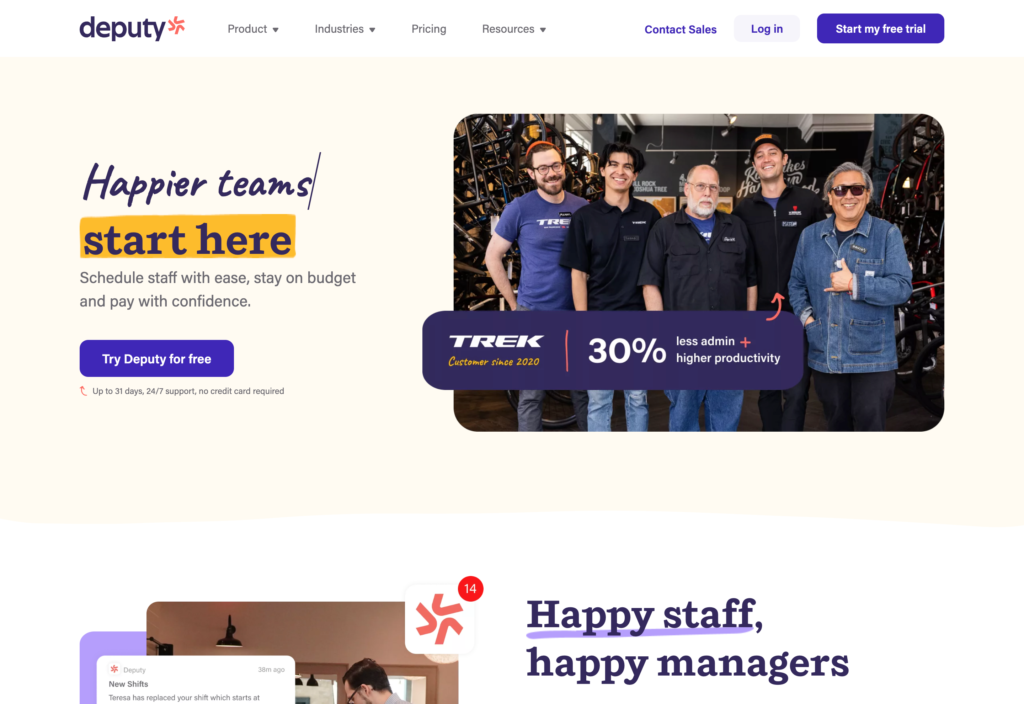
Deputy is a team management software built for employee scheduling, time tracking, team communication, and compliance support.
Why I chose Deputy: I chose Deputy because it offers strong scheduling tools, flexible time clock options, and useful compliance controls.
Scheduling, time off, and compliance
In our full Deputy review, we were able to build shifts with the drag-and-drop scheduler, use templates, copy past shifts, leave shifts open for team members to claim, and add notes so employees know what needs to be done. There’s also AI-powered auto-scheduling, which checks approved leave, availability, and employee qualifications before assigning shifts.
Deputy also offers strong compliance tools. You can set break and overtime rules directly in schedules, and the platform gives you coverage insights so you can see whether you’re properly staffed.
One limitation we found is that the scheduler doesn’t warn you if someone has requested leave but it still hasn’t been approved yet, which could create avoidable scheduling mistakes.
Time clock and timesheets
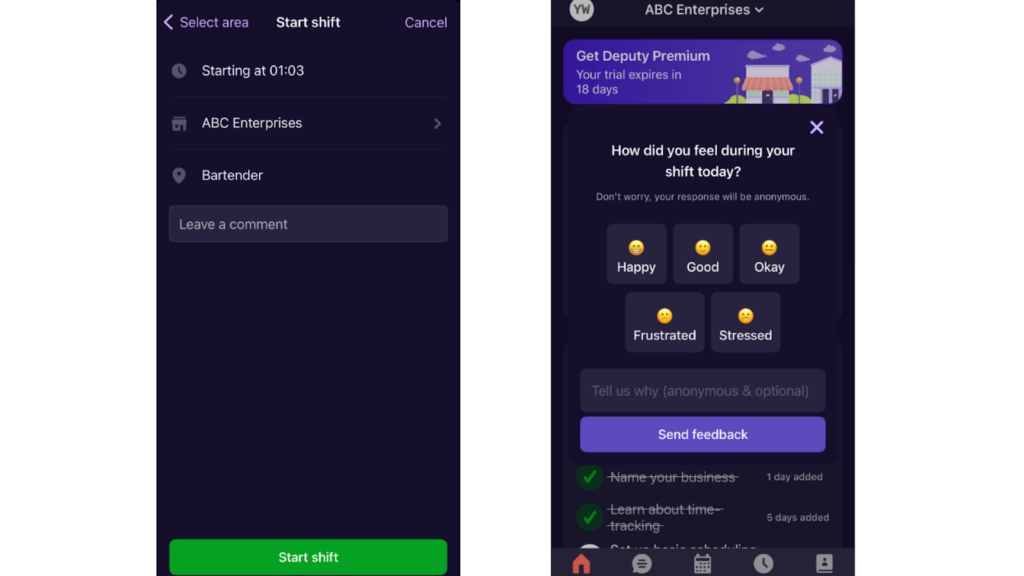
With Deputy’s time clock, team members can clock in and out from desktops, smartphones, shared kiosks, and tablets. You can also configure GPS tracking, geofences, photo capture, or touchless biometric facial recognition, depending on the level of control you need for attendance.
I also liked that you can stop employees from clocking into unscheduled shifts and set overtime rules to keep time tracking more accurate. Employees can add shift notes at clock out, but we found that there’s no way to flag if something is urgent or high priority.
Deputy automatically turns entries into timesheets that managers can review, edit, and approve from the web or mobile app. Timesheets show wages, premium rates, and overtime, and managers can add private notes for future performance discussions.
Newsfeed and task management
With Deputy’s newsfeed, managers can post updates to a whole location, department, or individual employee. You can also attach files like PDFs, images, and videos, and ask employees to confirm that they’ve read a message. Team members can also comment and react with emojis, which makes the tool feel more interactive.
For task management, you can create tasks and subtasks, assign them, add due dates and start times, repeat tasks, and track progress in real time. That said, tasks felt a bit lacking, especially when it came to customization.
What users report
User reviews praise Deputy’s simple interface and straightforward shift offers and swaps. Other reviewers mention occasional slowness, glitches, and features that take time to understand.
Key Features
- Drag-and-drop scheduling
- Biometric time clock
- Digital timesheets
- Task management
Pros
- AI-powered auto-scheduler
- Strong compliance tools
Cons
- Schedule doesn’t show leave requests
- Limited task customization
What is Team Management Software?
Team management software is a business tool that helps managers organize work, guide employees, and keep teams aligned. Instead of relying on scattered emails, spreadsheets, and separate tools, it brings key parts of teamwork into one place. These platforms often offer a mix of communication, task tracking, scheduling, project coordination, file sharing, and progress visibility.
It acts as a central system for how work gets done day to day. Some tools focus more on collaboration and project planning, while others are built for daily operations and workforce coordination. The goal is to help teams stay organized, productive, and connected.
How Does Team Management Software Work?
Team management software gives managers and employees a shared workspace where work can be planned, assigned, and tracked. Managers can create tasks, assign ownership, set deadlines, share updates, and monitor progress. Team members can see what’s expected, respond to changes, and move work forward without getting bogged down in constant back-and-forth.
Most platforms also organize work visually through dashboards, task lists, calendars, chats, schedules, or project boards. Managers get real-time visibility into progress, workload, and delays as updates happen, while employees stay clean on priorities and next steps.
The Benefits of Team Management Software
Team management software can help your business in multiple ways, including:
Better team alignment
When everyone works from the same system, it’s easier to keep people on the same page. Teams spend less time chasing updates, asking for clarification, or working from outdated information. This creates a smoother workday and helps the whole team move in the same direction.
Faster execution
A strong team management platform helps work move forward with fewer delays. Clear ownership, visible deadlines, and shared priorities make it easier for employees to act quickly and for managers to keep momentum going. As a result, teams can complete work faster without creating more chaos.
Fewer mistakes
When work is tracked clearly, there’s less room for tasks to slip through the cracks. Teams are less likely to miss deadlines, forget follow-ups, or duplicate work. This prevents small communication gaps from turning into much bigger operational problems.
Stronger accountability
Team management software makes it easier to understand who owns what and what still needs attention. That clarity encourages follow-through and makes performance conversations more straightforward. Instead of guessing where progress stalled, managers can see where support, coaching, or action is needed.
Clearer oversight
For managers, one of the biggest benefits is having a clearer picture of team activity without constantly checking in. Better oversight helps leaders spot delays, rebalance workloads, and make better decisions before problems grow. That can reduce stress and create a more stable experience for the team as a whole.
How Much Does Team Management Software Cost?
Team management software usually uses a per-user, per-month subscription model. Basic plans can start between $4–$5 per user per month and go up to between $7–$10.99 per user per month. Most platforms offer tiered plans to accommodate different team sizes and feature needs.
Connecteam takes a different approach to pricing, and offers a Small Business Plan that is completely free for up to 10 users. Paid plans start at $29 per month for up to 30 users, with higher-tier options at $49/month for Advanced and $99/month for Expert, both also covering up to 30 users.
The Bottom Line on Team Management Software
Team management software helps businesses that need to keep their staff aligned, work organized, and operations running smoothly. The most important factors to consider are communication, visibility, task coordination, and ease of use.
The best fit depends on the work your team needs to manage. Connecteam is a strong option for on-site and mobile teams that need communication, tasks, scheduling, and workforce oversight in one place. If that matches your team, try Connecteam for free.
FAQs
Common challenges include low adoption, resistance to change, and poor setup. If workflows aren’t configured properly or the tool is too complex, teams probably won’t use it.
It centralizes communication, tasks, and updates in one place. Remote teams can stay aligned through real-time messaging, shared task boards, and clear visibility into progress without relying on separate tools.
Look for role-based permissions, data encryption, secure logins (like 2FA), and compliance standards. These help protect sensitive company information and ensure only the right people access specific data.
It reduces confusion by clarifying tasks, priorities, and deadlines. Tools like Connecteam also combine communication, scheduling, and task tracking, helping teams work more efficiently without switching between multiple apps.
