


When every shift change triggers a chain of messages, coverage fixes, and timecard edits, managers spend more time fixing the schedule than running the team.
I reviewed 7 Deputy alternatives and compared their scheduling, time tracking, employee self-service, and workforce controls.
Use these picks to find a replacement that fits your locations, keeps hourly employees informed, and gets accurate timesheets to payroll without unnecessary extra work.
| App | Best for | Starting Price | Key Considerations |
| Connecteam | Best overall for frontline shift teams | Just $29/month for the first 30 users | Connects scheduling with frontline operations. Advanced features split across paid hubs. |
| Homebase | Small hourly businesses | $24/location/month | Scheduling and attendance for a single shop. Payroll costs extra. |
| When I Work | Straightforward employee scheduling | $2.5/user/month | Strong employee shift self-service. Location rules need careful setup and review. |
| Humanity by TCP Software | Complex scheduling | $2.75/user/month | Skills-based planning and detailed rules. Pre-built rules are US-specific. |
| 7shifts | Sales-driven restaurant scheduling | $39.99/month | Sales-aware staffing and restaurant integrations. Mobile punches require a separate app. |
| Sling | Affordable scheduling and communication | $1.70/user/month | Free scheduling for up to 30 employees. Time tracking requires an upgrade. |
| Rippling | Scheduling with broader HR and payroll | Contact vendor for price | Connects staffing with wider employee data. Requires the core platform plus selected modules. |
What’s new in this update (September 2026)
- Expanded the shortlist from five to seven options focused on hourly and shift-based teams.
- Removed OnTheClock and Hubstaff, adding Homebase, When I Work, Humanity by TCP, and Rippling.
- Added clearer plan limits, team-size pricing examples, and mobile time-clock findings.
Our Top Picks
-
1

Best overall for frontline shift teams
-
2

Best for small hourly businesses
-
3

Best for straightforward employee scheduling
Why trust us?
Our team of unbiased software reviewers follows strict editorial guidelines, and our methodology is clear and open to everyone.
See our complete methodology
What is Deputy?
Deputy is a workforce management platform for shift-based businesses, with core tools for scheduling, time and attendance, leave, and timesheet management. Managers can build and publish schedules, review availability, monitor attendance, and approve hours for payroll. From the mobile app, employees can check shifts, request leave, and clock in.
Payroll, POS, and HR integrations help connect staffing with pay and sales data.
Deputy offers three main plans: Lite at $5.50 per user per month, Core at $7.25, and Pro at $10 when billed monthly. Annual billing includes a 10% discount.
There’s no permanent free plan, but Deputy offers a 30-day free trial. Add-ons can raise the total cost on Lite and Core: HR costs $2 per user per month, Messaging+ $1.95, Analytics+ $1.50, and Deputy Payroll starts at $8 per user per month plus a $49 monthly base fee.
Why Are People Moving Away From Deputy?
Deputy is a strong choice for scheduling, clock-ins, and timesheets, so switching is usually about the surrounding workflow no longer fitting your business.
Some reviewers point to usability and reliability issues. One Capterra user said new managers can find Deputy confusing to learn, with slower loading on some phones. Another reviewer reported slow and unhelpful customer support, while a G2 user found the new interface more complicated, especially when filtering locations and importing jobs.
Larger businesses may run into different limits. One reviewer described managing many locations and time zones as difficult and reported issues with the Gusto integration and time-off balance visibility. Another said freezing and location errors sometimes prevented clock-ins.
Deputy’s add-ons and plan structure also matter if you need messaging, HR, advanced analytics, or more detailed task workflows. Some buyers may instead want industry-specific labor planning, deeper scheduling rules, or simpler administration.
How I Ranked the Best Deputy Alternatives
To narrow down the best Deputy alternatives, I looked for direct scheduling and attendance replacements.
Here’s what I prioritized:
- Building and adjusting schedules: Managers should be able to reuse recurring patterns, spot coverage gaps, and make changes without rebuilding the week from scratch.
- Handling employee availability: Employees need simple ways to submit availability, request leave, claim open shifts, and swap shifts with manager approval where needed.
- Tracking time accurately: Time clocks should create clear records and include safeguards like location checks, photos, or other punch controls.
- Managing labor rules: Managers need tools for breaks, overtime, and scheduling rules that help catch issues before payroll.
- Connecting payroll and POS systems: Integrations should reduce manual data entry by syncing hours, pay, and sales information between systems.
- Supporting mobile teams: Both employees and managers need practical mobile access, with any offline or connectivity limits clearly outlined.
The 7 Best Deputy Alternatives
-
Connecteam — Best overall for frontline shift teams
Connecteam brings scheduling, time tracking, communication, and daily work tools into one mobile app for frontline teams.
Why I chose Connecteam: I ranked Connecteam #1 because it connects an assigned shift with the instructions, checklists, and conversations employees need to complete it.
Scheduling and shift coordination
Connecteam’s employee scheduler helps managers plan shifts across locations, departments, and time zones with a drag-and-drop editor. They can post open shifts, assign jobs and tasks, attach notes or files, and require specific roles or certifications. Employees submit availability, request time off, and find qualified replacements, with approval controls in place.
Conflict detection flags overlaps and double-bookings, and reminders and notifications help teams keep up with changes. Managers can compare scheduled and actual labor costs, with POS integrations syncing sales and hours to track labor percentages and plan coverage.
Repeating shifts and templates start on the Operations Advanced plan, while the AI auto-scheduler is available on Expert. It assigns shifts based on availability, qualifications, custom rules, and fairness.
Mobile time clock and attendance controls
Connecteam’s employee time clock works across mobile, desktop, and shared kiosk apps. GPS stamps record punch locations, and NFC tags add another way to verify on-site clock-ins. Geofencing can restrict punches to approved worksites on Operations Advanced or above.
Managers can compare scheduled and worked hours, track breaks, and receive alerts before employees exceed approved overtime. Automatic clock-out is also available.
All recorded hours are logged into timesheets for employee and manager review, complete with automatically calculated overtime. Once approved, timesheets sync directly to popular payroll providers.
Communication and frontline work tools
Managers can attach files, checklists, and notes directly to shifts, so employees get the details they need in the same place they view their work.
Connecteam also has an online team chat for quick questions and last-minute coordination, an updates feed to handle broader announcements, and training and documents to help with onboarding and ongoing guidance.
It’s important to note that paid hubs are sold separately, so Operations doesn’t include every Communications or HR & Skills feature.
0Key Features
- Scheduling with availability and replacements
- Mobile time clock and location controls
- Shift instructions, forms, and task checklists
- Chat, announcements, and employee training tools
Pros
- Connects assigned shifts with work instructions
- Keeps frontline coordination in one employee app
Cons
- Advanced scheduling and geofencing on higher plans
- Paid hubs are subscribed to separately
Pricing
Free-for-life plan availablePremium plans start at $29/month for 30 users
14-day free trial, no credit card required
Start your free trial -
Homebase — Best for small hourly businesses
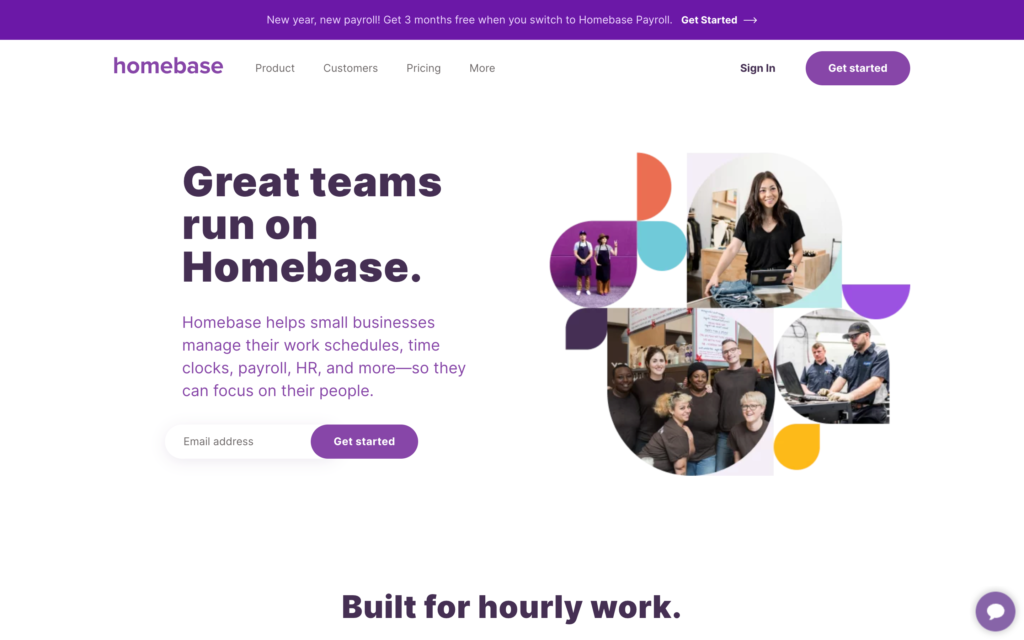
Homebase combines scheduling, attendance, communication, and hiring tools for small hourly businesses.
Why I chose Homebase: Homebase brings shop-floor staffing and small-business hiring administration into the same workspace.
Scheduling, availability, and coverage
Homebase lets managers build schedules around availability, time off, and labor budgets. Open shifts and swaps give employees ways to arrange coverage, and shift notes help explain what needs to be done. In testing, Homebase caught every scheduling conflict we created.
The Essentials plan adds more advanced scheduling and time tracking, with AI-powered scheduling available on Plus, which is important if you need automation.
For a single-location business, the main benefit is keeping schedules and attendance records together instead of managing them in separate systems.
Mobile time clock and payroll
Homebase turns phones, tablets, and desktops into time clocks. GPS location capture helps managers review where employees punch in, and timesheets bring together regular hours, breaks, overtime, and paid time off.
During testing, we couldn’t clock in offline on an iPhone. If your team works in low-signal areas, test offline clock-ins on the devices they’ll actually use.
Communication and business connections
Homebase’s messenger lets you create private and group conversations, announcements, and polls. Managers can add notes to published shifts, keeping instructions close to the schedule. Connections to payroll platforms and POS systems also help move records between staffing and business administration.
Payroll is a paid add-on, even on the highest plan, so factor in that extra cost if you need payroll processing rather than just reports or integrations.
0Key Features
- Scheduling with availability and time-off
- Phone, tablet, and desktop time clocks
- Payroll reports and POS integrations
- Team messaging and announcements
Pros
- Attendance combined with small-business staffing tools
- Paid plans support unlimited employees per location
Cons
- Offline clock-in failed during testing
- Payroll is a paid add-on
Pricing
Starts at $24/location/month Trial: Yes — (14-day) Free Plan: Yes — (one location and up to 10 employees)
-
When I Work — Best for straightforward employee scheduling
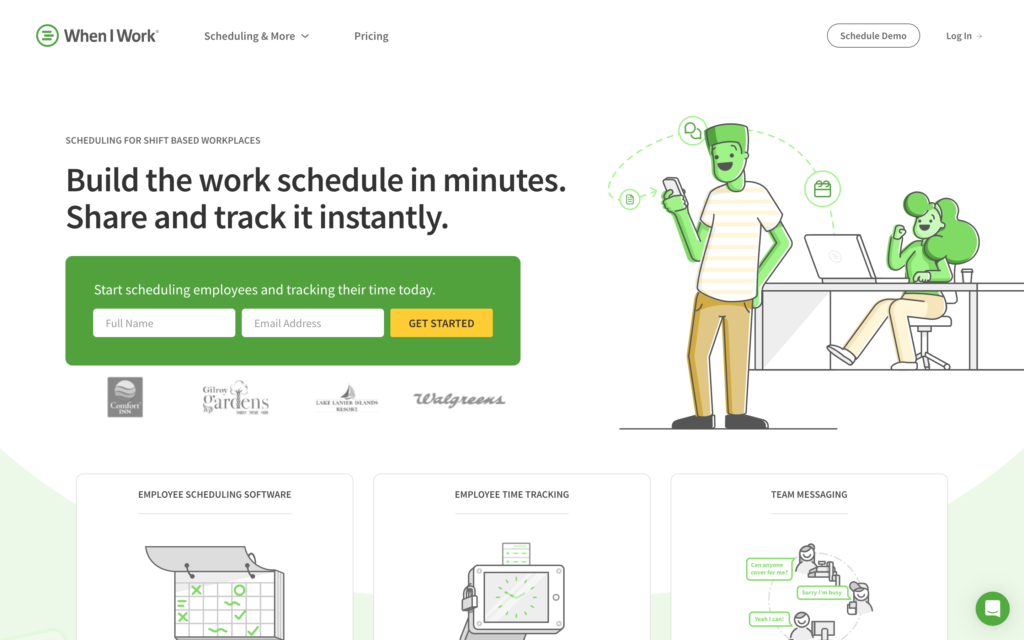
When I Work is scheduling and attendance software for shift-based teams, with employee messaging and payroll connections.
Why I chose When I Work: When I Work is on the list because it lets employees pick up, drop, and trade shifts, and helps managers keep coverage in a central schedule.
Schedule builder and employee self-service
Managers can use When I Work’s drag-and-drop editing, templates, and auto-scheduling, then publish shifts employees can view on their phones. Workers can request time off and arrange shift changes without relying entirely on calls to a supervisor.
The scheduler also shows scheduled versus actual hours and labor costs. These controls make it a practical step up from spreadsheets without requiring a broader HR system. Multi-location plans add labor sharing, multiple schedules, and time-zone management for businesses coordinating several sites.
Mobile time clock and operational limits
When I Work’s attendance settings control which devices employees can use to punch in and out. Geofencing is available, but its setup needs checking. During testing, we weren’t asked for a worksite address when we enabled it, and it let us clock in offsite.
During testing, we couldn’t see a live timer in the web app after clocking in on mobile. Timesheets still synced, but we had to refresh to check live attendance.
Time records and team communication
Timesheets and downloadable reports help prepare payroll, and payroll and HR integrations connect records with other systems. There are also overtime controls and labor reports to give managers more visibility into staffing costs and coverage.
When I Work’s built-in messaging includes direct chats, group conversations, and announcements.
0Key Features
- Templates, auto-scheduling, and employee self-service
- Mobile and computer attendance settings
- Timesheets, labor reports, and payroll connections
- Direct messages, group chat, and announcements
Pros
- Keeps routine scheduling and coordination together
- Supports labor sharing between multiple locations
Cons
- Could clock in offsite during testing
- Web clock needed repeated refreshing
Pricing
Starts at $2.5/user/month Trial: Yes — 14 days Free Plan: No
-

Humanity by TCP Software — Best for complex scheduling
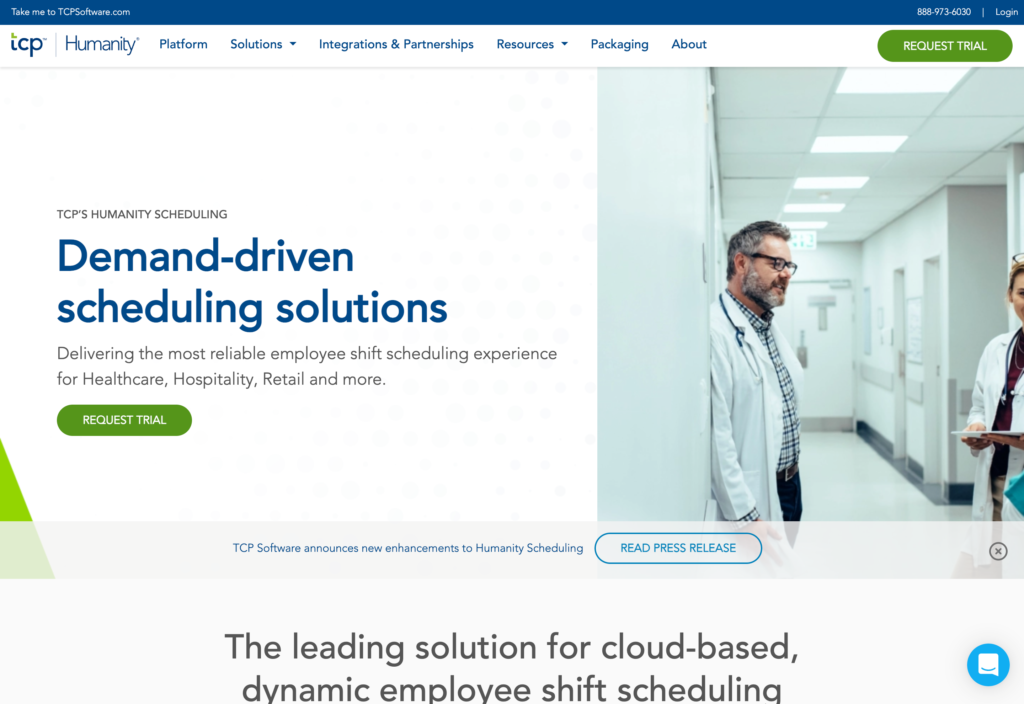
Humanity by TCP focuses on detailed staffing requirements across larger workforces and multiple locations.
Why I chose Humanity by TCP: Humanity by TCP pairs skills-based assignment with custom scheduling rules and demand forecasting.
Shift planning and demand forecasting
Managers can copy schedules, reuse templates, and auto-assign shifts around skills and availability with Humanity. Employees submit leave requests, claim open shifts, and trade shifts with manager approval.
Humanity’s AI forecasting uses inputs such as sales, customer numbers, and ticket volumes alongside previous schedules to inform staffing. It’s a paid add-on, so keep that in mind if demand-based planning is your main reason for replacing Deputy.
Scheduling rules and compliance support
Pre-built rules cover mandatory breaks and other scheduling restrictions. You can add custom rules for maximum hours, overtime limits, minimum rest between shifts, and consecutive-day limits.
The pre-built rules are US-specific, so teams in other locations need to configure their own requirements. These tools support labor compliance rather than guaranteeing it. Managers still need rules that match their locations and must review exceptions instead of treating every generated schedule as legal and complete.
Mobile access and payroll records
Employees can access schedules and clock in through mobile, desktop, or Apple Watch apps. Mobile GPS records punch locations. Timesheets include approval workflows, payroll exports, and custom overtime or double-pay rules.
The app is read-only offline, so employees can still view schedules but can’t make changes until they reconnect. Payroll, forecasting, and reports also require desktop access, which can be limiting to managers working from the floor.
Key Features
- Skills-based scheduling, templates, and shift trades
- Custom scheduling rules and rest limits
- Demand forecasting through an optional add-on
- Mobile clock-ins, timesheets, and payroll exports
Pros
- Supports detailed staffing and scheduling requirements
- Employee skills combined with demand-based planning
Cons
- Pre-built compliance rules US-specific
- Offline mobile access is read-only
Pricing
Starts at $2.75/user/month Trial: Yes — 30 days Free Plan: No
-

7shifts — Best for sales-driven restaurant scheduling
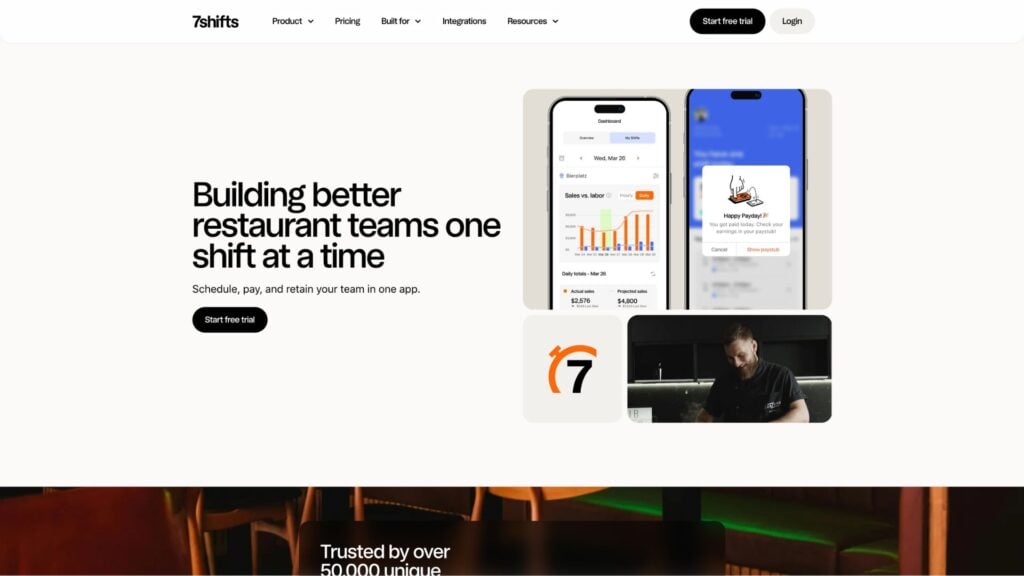
7shifts offers restaurant scheduling, attendance, communication, and sales-conscious labor planning.
Why I chose 7shifts: I chose 7shifts because its staffing forecasts connect restaurant demand and sales patterns with labor targets.
Restaurant scheduling and labor planning
7shift’s scheduler lets managers repeat shifts and set labor targets against projected sales. The machine-learning auto-scheduler considers past schedules, availability, time off, and labor costs to suggest coverage.
Employees can use the Shift Pool to offer, request, or trade shifts, with optional manager approval. Availability requests and notice periods help managers handle changes before a busy service. Mobile access also lets managers approve requests and update staffing on the go.
Time clock and break controls
Employees can clock in and out through a connected POS system or the separate 7punches app. Mobile punches require a separate app, adding another tool for employees to manage, though 7punches doesn’t cost extra.
Geofencing, overtime alerts, and break verification give managers more control over attendance. During testing, the geofence blocked our offsite punches. But the main app returned a connection error without internet.
Tips, communication, and integrations
7shift’s POS connections include Toast, Square, Clover, and Lightspeed. Payroll integrations are available on Pro and Premium plans, and payroll processing, tip management, and the manager log book are offered as add-ons.
Team messages and targeted announcements handle service updates, and tip tools save time on manual calculations. More advanced labor controls sit on higher tiers, so restaurants should compare plans based on their full clocking, tips, and payroll workflow, not scheduling alone.
0Key Features
- Scheduling and machine-learning staffing forecasts
- Employee shift requests and availability management
- Geofencing, break verification, and overtime controls
- POS connections and optional tip tools
Pros
- Aligns restaurant staffing with projected sales
- Service-specific communication and tip workflows
Cons
- Mobile time clock uses a separate app
- App doesn’t work without internet access
Pricing
Starts at $39.99/month Trial: Yes — 14 days Free Plan: Yes — up to 15 users, 1 location
-

Sling — Best for affordable scheduling and communication
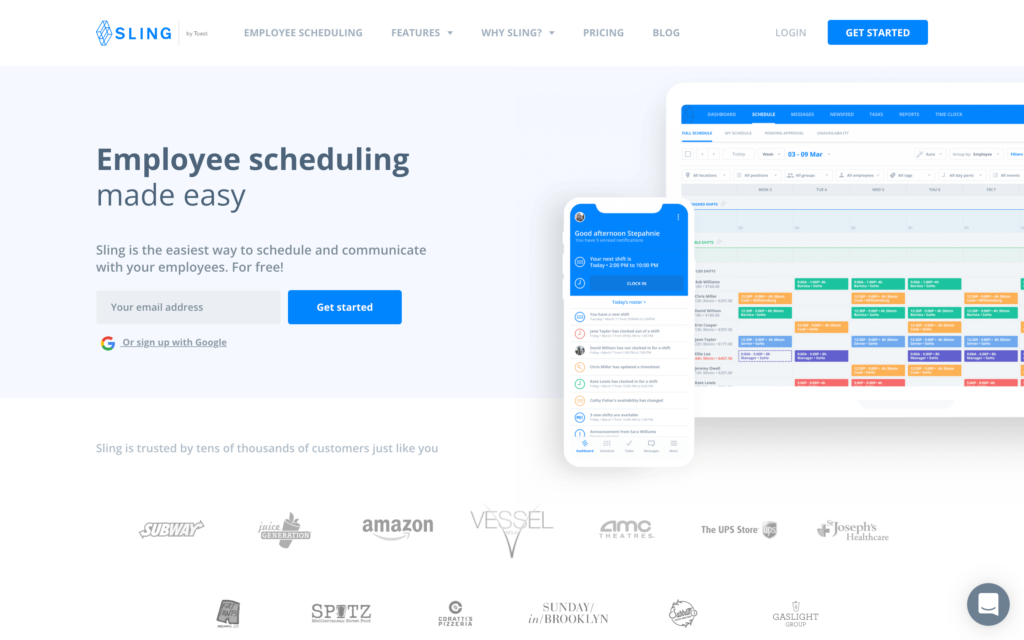
Sling combines shift scheduling and communication, with attendance and management tools on paid plans.
Why I chose Sling: Sling lets teams start with free scheduling across locations, then add time tracking as their needs grow.
Scheduling, availability, and communication
Sling’s free tier covers scheduling, availability, time-off requests, available shifts, and news sharing. Premium adds templates and shift swaps, and Business adds auto-assignment and deeper reporting.
During testing, Sling showed us conflict warnings immediately when we assigned overlapping shifts and conflicting roles. We could still publish the schedule, so the warnings are more for judgment than a hard block. That flexibility helps with legitimate exceptions but still requires a final schedule check.
Paid time tracking and guardrails
Paid plans add mobile punches, overtime tracking, and labor-cost controls. The free plan excludes time tracking, so a business needing both employee scheduling and attendance must compare paid plans.
Sling can restrict early clock-ins. During testing, it blocked our early punch for a scheduled shift. The Business plan adds kiosk attendance and payroll reports, making it the better fit for shared-device clock-ins and payroll reporting.
Mobile access and business connections
Employees can check their schedules, manage availability, and communicate from Sling’s mobile app. The mobile app requires an active internet connection, and you still need the desktop to access reporting and employee document management fully.
Sling integrates with Toast, Square, and Gusto. There’s also private messaging, group conversations, and news sharing. For growing teams, it’s worth checking how the integrations work and which manager tasks are desktop-only.
0Key Features
- Scheduling, availability, and time-off requests
- Templates, shift swaps, and auto-assignment
- Mobile attendance and overtime controls
- Messaging and payroll or POS connections
Pros
- Free scheduling supports multiple work locations
- Offers a low-cost route into attendance tracking
Cons
- Free plan excludes time tracking
- Warnings don’t block scheduling conflicts
Pricing
Starts at $1.70/user/month Trial: Yes — (15 days) Free Plan: Yes — (for up to 30 users)
-

Rippling — Best for scheduling with broader HR and payroll
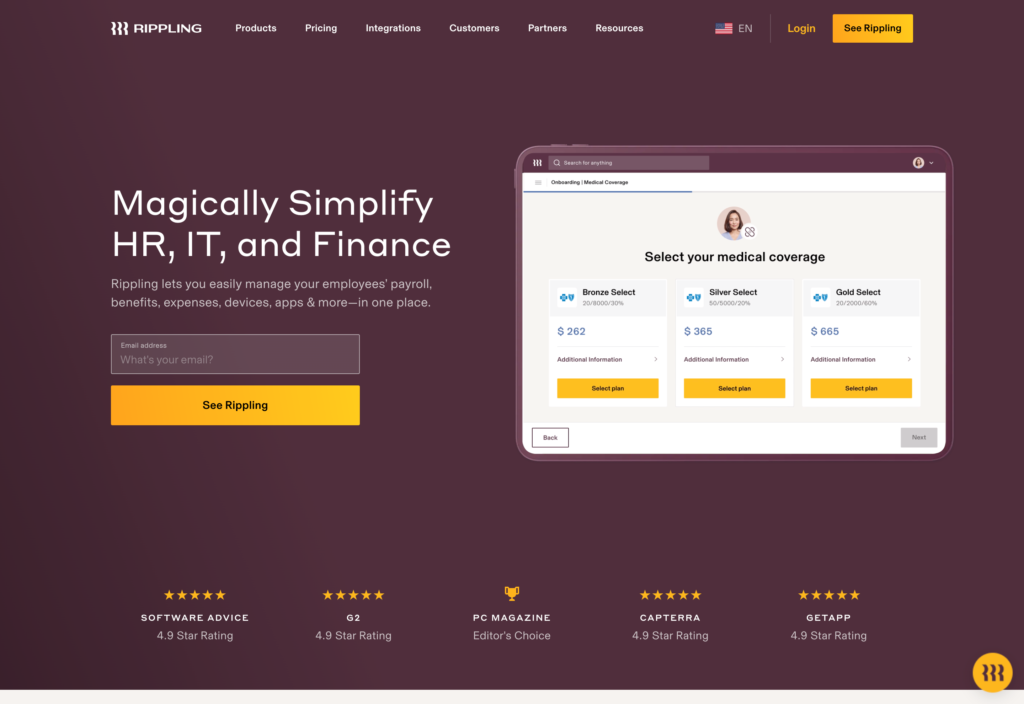
Rippling connects workforce management with HR, payroll, IT, and other business systems.
Why I chose Rippling: Rippling connects scheduling with the same employee, job, and payroll data used across HR.
Scheduling and employee self-service
Rippling uses prompts, templates, or past schedules to generate AI-assisted drafts, factoring in availability, certifications, time off, overtime rules, and labor costs. Managers can then review and publish the schedule.
Employees can update their availability, swap shifts with eligible coworkers, and handle schedule changes from the mobile app. Managers can also message staff, monitor attendance, and approve requests.
Time records and payroll
Rippling’s timesheets flag missed punches, overtime, job-code errors, and break issues before payroll. Managers can edit and approve entries with a full change history, and approved hours move right into Rippling Payroll when it’s included in your plan.
Scheduling and attendance are separate products, so make sure to confirm that your quote includes both. Adding a time clock doesn’t automatically mean you get the scheduler needed to replace Deputy.
Broader HR and workflow automation
Rippling’s integrations, permissions, and workflow tools connect staffing with employee records and other systems. That’s useful when a business wants common data and automated approvals across departments, rather than another standalone roster.
You need Rippling’s core platform before adding other products, and some tools may come with an extra monthly fee. Ask for a clear price breakdown so you know exactly what you’re paying for.
Key Features
- AI-assisted schedules from shared workforce data
- Availability, shift swaps, and manager approvals
- Timesheets connected to payroll
- HR integrations and automated workflows
Pros
- Connects staffing decisions with employee data
- Sends approved hours directly to included payroll
Cons
- Core platform required with add-on products
- Scheduling and attendance sold separately
Pricing
Contact vendor for price Trial: No Free Plan: No
Compare the Best Deputy Alternatives
| Topic |
 Start for free |
|
|
|
|
|
|
|---|---|---|---|---|---|---|---|
| Reviews |
  |
|
|
|
|
|
|
| Pricing |
Starts at just $29/month for the first 30 users
|
Starts at $24/location/month
|
Starts at $2.5/user/month
|
Starts at $2.75/user/month
|
Starts at $39.99/month
|
Starts at $1.70/user/month
|
Contact vendor for price
|
| Free Trial |
yes
14-day
|
yes
(14-day)
|
yes
14 days
|
yes
30 days
|
yes
14 days
|
yes
(15 days)
|
no
|
| Free Plan |
yes
Free Up to 10 users
|
yes
(one location and up to 10 employees)
|
no
|
no
|
yes
up to 15 users, 1 location
|
yes
(for up to 30 users)
|
no
|
| Use cases |
Best overall for frontline shift teams
|
Best for small hourly businesses
|
Best for straightforward employee scheduling
|
Best for complex scheduling
|
Best for sales-driven restaurant scheduling
|
Best for affordable scheduling and communication
|
Best for scheduling with broader HR and payroll
|
| Available on |
FAQs
Connecteam offers its Small Business Plan for up to 10 users. Homebase includes basic scheduling and attendance for 10 employees at one location. Sling supports free scheduling for up to 30 employees, but time tracking requires a paid plan.
Not automatically. Some apps export timesheets or integrate with payroll; others offer payroll processing as a separate product. Confirm whether your chosen plan calculates and pays wages or simply supplies approved hours to another system.
The Bottom Line
When considering Deputy alternatives, focus on what your team needs most. A single-site business may want simpler staffing and attendance, a restaurant may need sales forecasts and tip workflows, and larger employers may need skills-based assignments or more detailed scheduling rules. A broader HR platform can make more sense if you’re replacing several employee systems at once.
For frontline teams, look for an alternative that keeps scheduling connected to the work employees actually perform. Prioritize clear mobile workflows, reliable time records, and pricing you understand. Your trial should show that managers can handle a normal week, plus the inevitable exceptions, with less manual work than Deputy.
Try Connecteam’s frontline scheduling and time tracking for free today.
