


When booking, completing, and billing jobs doesn’t run smoothly, staff spend more time fixing handoffs than helping customers.
I reviewed 7 Jobber alternatives and ranked them by their customer management, dispatch, technician workflow, and invoicing and payments.
Use these picks to find a replacement that covers the whole service cycle without losing the tools your office and field teams rely on.
If you don’t have the time to read through our research, jump down to our quick comparison table.
| App | Best for | Starting Price | Key Considerations |
| HouseCall Pro | Best overall Jobber alternative for end-to-end field service management | $59/month billed annually | Covers the full customer-to-payment workflow. Offline access is view-only. |
| FieldPulse | Growing small field-service businesses | Contact vendor | Custom job stages can trigger customer updates. Accounting sync excludes some operational data. |
| Service Fusion | Established SMB field-service operations | $208/month billed annually | Core dispatch and billing without per-seat charges. Some operational tools are add-ons. |
| Workiz | Service businesses prioritizing dispatch and communication | Contact vendor | Customer calls and messages sit alongside dispatch. Service plans require Ultimate. |
| ServiceTitan | Larger home-service companies | Contact vendor | Customer and location-level history support larger operations. |
| Kickserv | Smaller service businesses wanting core FSM features | $60/month for 5 users | Straightforward job tracking and billing. Dispatch mapping and GPS check-ins require Run or higher. |
| ServiceM8 | Small mobile service teams | $29/month | Paid plans include unlimited users. Android now covers most core workflows but still lacks some iOS-only tools. |
What’s new in this update (September 2026)
- Rebuilt the ranking around 7 complete field-service-management alternatives.
- Removed JobNimbus, FieldEdge, and ServiceTrade, adding FieldPulse, Workiz, Kickserv, and ServiceM8.
- Included clearer distinctions between dispatch, routing, and technician location tracking.
- Updated pricing, accounting integrations, and mobile-device and offline limitations.
Our Top Picks
-
1

Best overall Jobber alternative for end-to-end field service management
-
2

Best for growing small field-service businesses
-
3

Best for established SMB field-service operations
Why trust us?
Our team of unbiased software reviewers follows strict editorial guidelines, and our methodology is clear and open to everyone.
See our complete methodology
What is Jobber?
Jobber is a field service management platform for small and midsize businesses such as cleaning companies, landscapers, and HVAC contractors. It brings customer records, estimates, scheduling, job documentation, invoicing, and payments into one system.
Approved quotes can become jobs without re-entering details, and customer profiles store service history, property photos, and multiple contacts. Technicians can also update jobs and document work from the mobile app.
Pricing starts at $29 per month for one user on Core when billed annually. Connect costs $149 per month for up to five users, Grow $299 for up to 10, and Plus $529 for up to 15, with additional users costing $29 each per month. There’s no free plan, but Jobber offers a 14-day free trial for up to two users.
Because Jobber covers the full customer-to-payment workflow, a replacement needs to do more than schedule employees. It should also handle customer details, job history, field documentation, invoicing, and payments.
Why Are People Moving Away From Jobber?
Jobber covers the core service workflow well, but some businesses start looking for other options when their reporting, routing, or workforce needs become more complex.
Several reviewers point to limits in reporting and customization. One Capterra user wanted more advanced reporting and automation options, while another said larger exports and client-tag management take too much manual work. A separate reviewer found it difficult to drill into data in enough detail, and another described Jobber as better suited to simpler workflows than specialist businesses.
Routing and recurring work can also create friction. One reviewer wanted better routing and recurring-schedule tools, while another wished there was more client-level control over automated messages and payment settings. During our own testing, Jobber also allowed an overlapping assignment after flagging the technician as unavailable.
Other gaps depend on what you need from the platform. Jobber’s labor controls are plan- and integration-dependent. Plus includes break tracking, while its Gusto integration can automatically calculate configured overtime rules. Its quoting workflow still lacks native change-order management for ongoing jobs. Businesses with more complex labor requirements should check whether their exact break, overtime, and payroll workflows are covered before switching. The right alternative depends on whether you need stronger customer-service workflows, deeper field operations, or more complete workforce management.
How I Ranked the Best Jobber Alternatives
I ranked these field service management alternatives around end-to-end field service management rather than employee scheduling alone. Connecteam publishes this article, but I didn’t rank it because it doesn’t replace Jobber’s customer CRM, quoting, invoicing, payments, and end-to-end field service workflow.
Here’s what I prioritized:
- Managing customer records: The platform should keep service history, property details, contacts, and job context together.
- Turning quotes into work: Estimates and quotes should connect directly to booked jobs without re-entering the same information.
- Scheduling and dispatching jobs: Managers need tools for assigning technicians, adjusting schedules, and planning routes for field work.
- Supporting technicians in the field: The technician mobile app should make work orders, forms, notes, photos, and job updates easy to complete.
- Handling billing and recurring work: Invoicing, payments, and recurring service agreements should connect smoothly with completed jobs.
- Keeping customers and accounting in sync: Customer notifications should keep customers informed, and the QuickBooks integration should clearly define what financial data moves between systems.
The 7 Best Jobber Alternatives
-
HouseCall Pro — Best overall Jobber alternative for end-to-end field service management
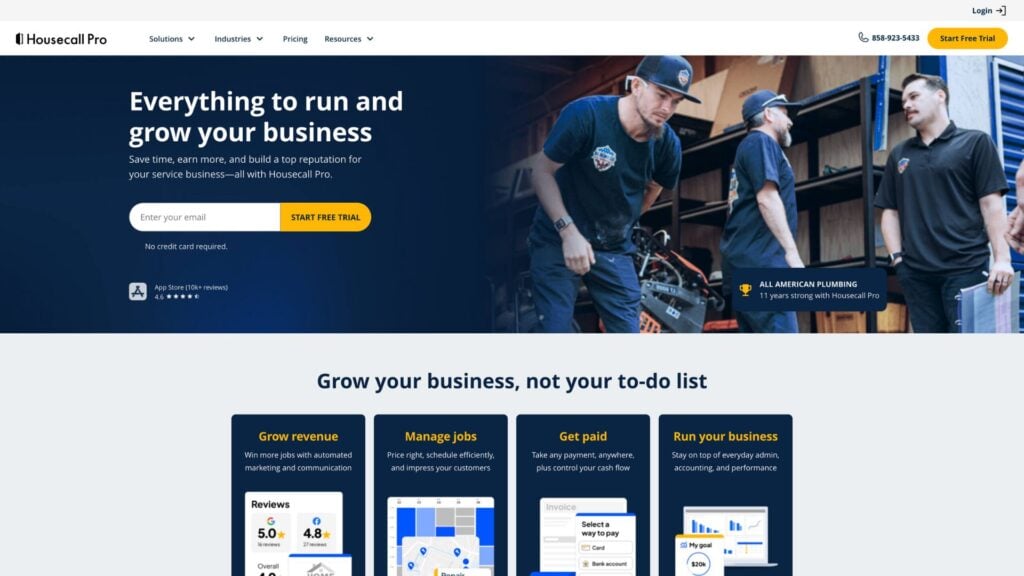
Housecall Pro provides jobs, online booking, dispatch, estimates, invoicing, and payments for service businesses. Capterra rating: 4.7/5 (2,746 reviews).
Why I chose Housecall Pro: I ranked Housecall Pro #1 because it’s the best overall alternative to Jobber, with the Basic already covering the core workflow from booking a job to getting paid.
Customer records, jobs, and recurring visits
With Housecall Pro, each job keeps customer contact details, the service address, line items, technician assignments, notes, and files. The checklists and job fields give crews more specific instructions than just a calendar entry, and the price book helps keep services consistently priced.
Online booking also gives the office control over preparation time. During testing, a two-day minimum notice setting successfully blocked bookings inside that window. Recurring jobs support daily, weekly, monthly, yearly, or custom schedules, but job inputs don’t carry over between visits.
Dispatch and routing
Housecall Pro’s scheduler assigns technicians to jobs, and the Essentials plan adds phone-based employee GPS tracking and tools for grouping and sequencing the day’s stops. That’s useful when dispatchers need location context without installing vehicle hardware.
For automatic drive-time optimization, you’ll need the Max plan. It only reorders stops within one technician’s existing day. It won’t move jobs to another day or reassign them to someone else, so managers still need to decide who handles each job and when.
Mobile work and accounting
Technicians can create jobs on the mobile app, open the relevant invoice, and record travel or job time when the right settings are enabled. Offline access is view-only. Assigned jobs for today and the next two days download automatically, subject to Housecall Pro’s offline limits, but technicians still can’t edit records until they reconnect.
The QuickBooks Online integration is only available on Essentials and Max, not Basic. Also, some QuickBooks customer records won’t transfer if they’re nested too deeply, and their invoices won’t come over either. Check those accounts before migrating.
Key Features
- Customer-linked jobs with checklists and attachments
- Online booking, estimates, invoices, and payments
- Phone-based technician GPS on Essentials
- QuickBooks Online sync on eligible plans
Pros
- Core commercial workflow included in Basic
- Flexible frequencies for recurring service visits
Cons
- Offline access limited to viewing saved jobs
- Route optimization limited and requires Max
Pricing
$59/month billed annually Trial: Yes — for 14 days Free Plan: No
-
FieldPulse — Best for growing small field-service businesses
Available on
- Web
- iOS
- Android
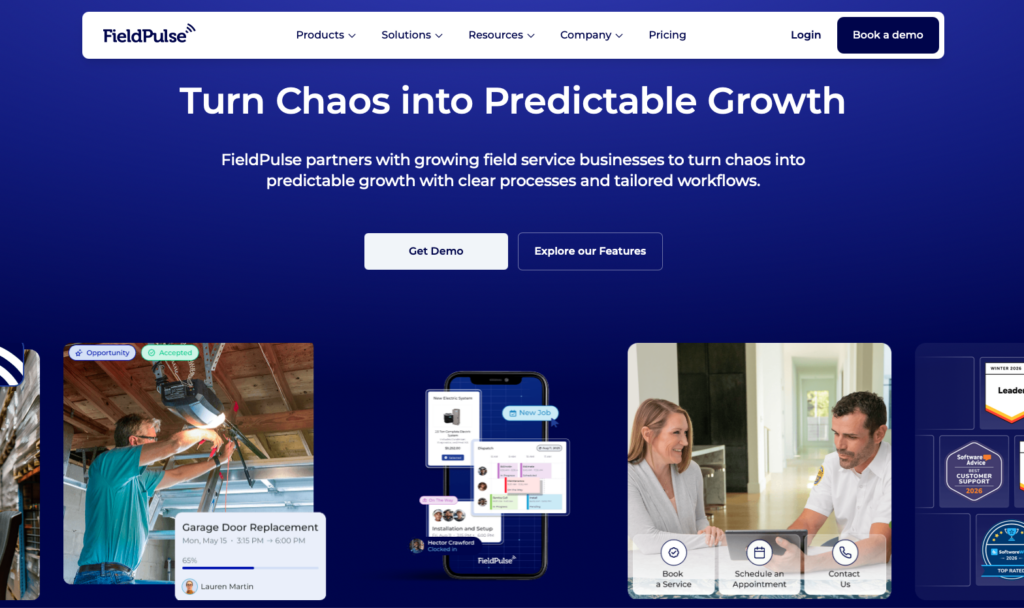
FieldPulse connects customer records, jobs, estimates, invoices, and customer communications for service teams building more structured processes. Capterra rating: 4.6/5 (498 reviews).
Why I chose FieldPulse: FieldPulse’s custom job stages can track travel or work time and trigger customer updates, helping growing teams standardize how jobs progress.
Customer records and job stages
FieldPulse keeps notes, files, jobs, estimates, and invoices together in each customer profile. Teams can also separate leads, opportunities, and active customers, giving the office one shared record before work is scheduled.
Job statuses track stages like Travel Time and In Progress, with email or SMS notifications triggered at selected points. Technicians can also send customers a live trip-tracking link with their location and estimated arrival time, which stays active for one hour.
Mobile work and offline limits
FieldPulse’s Offline Mode saves supported changes locally and syncs them when connectivity returns. It’s available to Admins, Team Managers, and Service Agents, but not Limited Agents. That role difference matters when you’re assigning mobile access to a growing crew.
New offline estimates can’t be previewed, converted into invoices, or signed until the device reconnects. Payments also need a connection, so offline recordkeeping isn’t the same as completing a sale. For dispatch visibility, the Team Members map shows each worker’s last recorded app location, not continuous live tracking.
Recurring billing and QuickBooks
Recurring billing generates repeat invoices and requests or collects payments through the web or mobile app once it’s enabled. This gives regular customers a repeatable billing process instead of a fresh manual invoice each time.
The QuickBooks Online integration supports two-way sync for customers, line items, estimates, invoices, and payments in the United States, Canada, and Australia. But it excludes additional contacts and locations, custom fields, files, and FieldPulse jobs and projects. Keep detailed job records in FieldPulse because your accounting system may not be able to match them exactly.
Key Features
- Customer profiles with job records
- Custom statuses with customer-message triggers
- Offline record changes
- Recurring billing and accounting synchronization
Pros
- Job stages adapt to different services
- Customer messages can follow job progress
Cons
- New offline estimates can’t be finalized
- Limited custom and job sync with accounting
Pricing
Contact vendor Trial: No Free Plan: No
-
Service Fusion — Best for established SMB field-service operations
Available on
- Web
- iOS
- Android
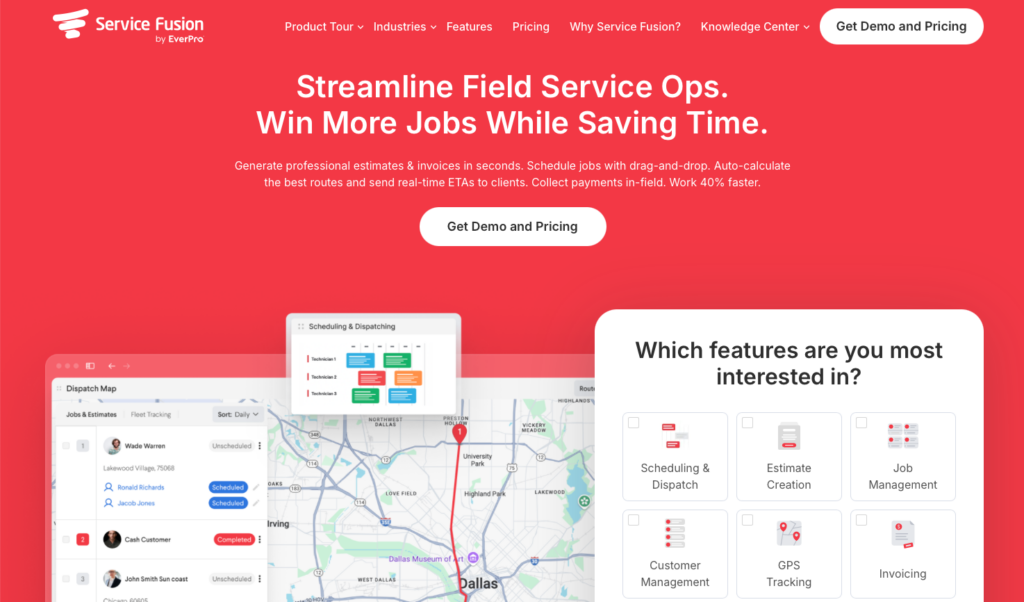
Service Fusion by EverPro offers customer management, estimating, dispatch, invoicing, and payments for small and midsize field-service operations. Capterra rating: 4.3/5 (308 reviews).
Why I chose Service Fusion: I included Service Fusion because its shared customer history, visual dispatch board, and estimate-to-invoice workflow are a good fit for an established office coordinating multiple technicians.
Customer records, estimates, and billing
Service Fusion has customer profiles that support multiple contacts and service locations, with past jobs, payments, and notes available together. Approved estimates can become jobs and then invoices without re-entering the same information, which keeps the office’s commercial records connected to completed work.
The Starter plan includes QuickBooks Online integration, invoicing, and payments. It syncs invoices, recorded payments, and customer records between Service Fusion and QuickBooks Online. Recurring invoicing, the customer portal, and e-signatures cost extra, so factor those add-ons into the full price.
Job scheduling and dispatch
Dispatchers can work from a visual grid or calendar, drag job cards onto technicians, adjust times, and send job information to the field by text or call. Jobs and estimates appear in the same view, helping office staff coordinate both visits and work already approved.
Dispatch is manager-led, so technicians can’t claim open jobs themselves. If your team relies on self-assignment, test that workflow before switching.
Mobile app and offline work
The iOS and Android apps let technicians access customer information, document work, update progress, and collect payments. Offline access supports tasks, notes, photos, and documents for enabled features, and some, including photo uploads, are Starter add-ons.
Current job and estimate records are view-only offline, and unassigned, past, and future records aren’t available. Those limits can interrupt schedule changes away from coverage.
Key Features
- Customer history across multiple service locations
- Estimate-to-job-to-invoice conversion
- Visual dispatch grid and calendar
- QuickBooks invoice and payment sync
Pros
- Connected customer and commercial job records
- Core plans include unlimited users
Cons
- Offline job records have viewing limits
- Several operational tools require add-ons
Pricing
$208/month billed annually Trial: No Free Plan: No
-

Workiz — Best for service businesses prioritizing dispatch and communication
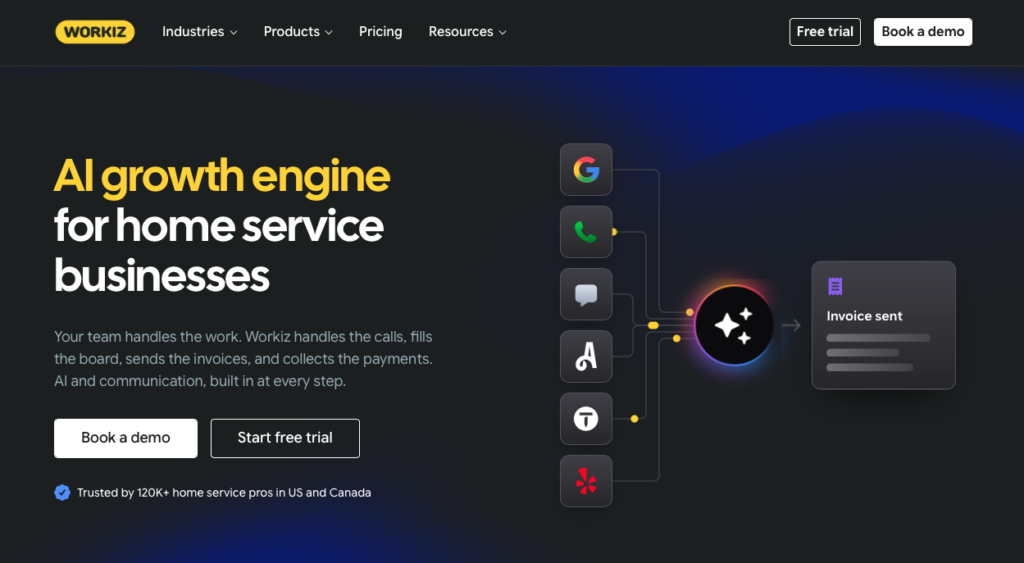
Workiz is a field-service platform that offers dispatch, customer records, estimates, payments, and customer conversations. Capterra rating: 4.4/5 (218 reviews).
Why I chose Workiz: With Workiz, calls, emails, and texts sit inside the customer CRM, giving dispatchers communication context alongside job assignments.
Dispatch and technician mobile access
Dispatchers can assign jobs by availability, service area, and skills using Workiz’s drag-and-drop calendar. You can identify someone for the next job by using technician and truck location visibility. This helps with assignment decisions, but location tracking isn’t the same as automatic route optimization.
On mobile, you can use quick actions to contact customers, attach files, and add payments. There’s also a separate Calls tab for Workiz Phone.
Customer communication and estimates
The Workiz CRM shows current opportunities, customer details, past jobs and files, and overdue payments together. Centralized calls, emails, and SMS give office staff context when a customer calls about an appointment or an unpaid balance.
You can send estimates to customers by email or text through a client-portal link. For credit card deposits, you need an activated Workiz Pay account and a deposit request. Arrival notices also let customers and the office know a technician is coming, with a technician photo and professional bio available to identify the person arriving.
Service plans and accounting
You can use service plan templates to set maintenance intervals, visit frequency, and billing schedules, so recurring work is easier to manage without rebuilding jobs each time.
Service plans, checklists, inventory management, and multi-day jobs require the Ultimate plan, so maintenance-heavy businesses may need a higher tier. The QuickBooks Online sync also isn’t fully two-way. Clients and non-inventory items can sync both ways, but invoices only move from Workiz to QuickBooks.
Key Features
- Dispatch by location, availability, and skills
- Calls, emails, and texts within customer records
- Client-portal estimates and deposit requests
- Recurring service plans
Pros
- Customer conversations stay close to job context
- Arrival updates identify the assigned technician
Cons
- Invoices sync one way to QuickBooks
- Service plans and several advanced tools require Ultimate
Pricing
Contact vendor Trial: Yes — 7 days Free Plan: No
-

ServiceTitan — Best for larger home-service companies
Available on
- Web
- iOS
- Android
- Windows
- Mac
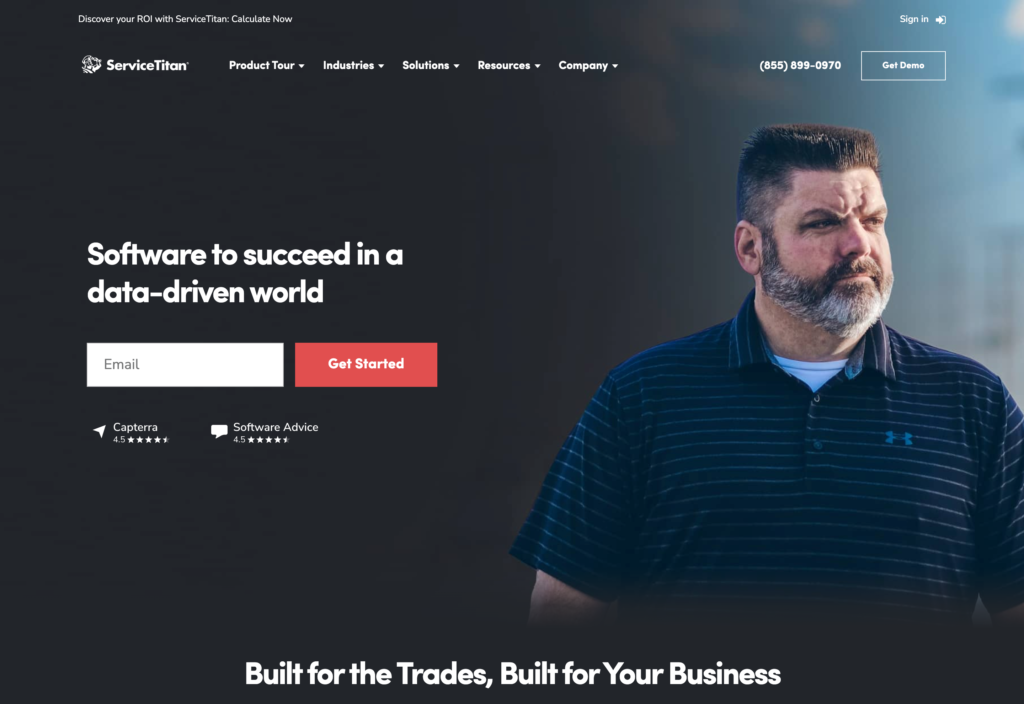
ServiceTitan links customer and location records with dispatch, recurring services, field documentation, invoicing, and payments. Capterra rating: 4.3/5 (341 reviews).
Why I chose ServiceTitan: I chose ServiceTitan because it separates customer-level history from property-level jobs and equipment, giving larger operations a clearer record of work across service locations.
Customer records and recurring service
ServiceTitan keeps customer accounts, service locations, jobs, equipment, history, and financial details connected. Each location has its own records, which is useful for customers with multiple properties or different equipment at each site.
Memberships can set recurring services, dates, and preferred technicians for each location. Those services then create events that staff can schedule as jobs, keeping ongoing agreements tied to actual visits.
Dispatch and customer notifications
ServiceTitan’s Dispatch Board shows jobs, technicians, and appointment times in a real-time grid or map. Dispatchers can manually assign work, drag appointments, and adjust the day as plans change. Advanced capacity management, skill matching, and zone-based booking rules are available on the separate Scheduling Pro add-on.
Customer notifications can include confirmations, reminders, arrival alerts, and follow-up surveys. Rescheduled appointments need a new confirmation sent manually, and GPS arrival tracking depends on the location and notification settings.
Mobile closeout and accounting
Technicians can complete required forms, present invoices, collect signed payments, and add job photos or notes. The QuickBooks Online integration syncs invoices, payments, expenses, and sales tax once it’s enabled.
Offline mode covers forms and job closeout, but pricing, directions, location history, and automated timesheets still need internet access. The newer Field Mobile App is also still adding features, so check that your key workflows are available before switching.
Key Features
- Customer and property-level job history
- Real-time dispatch grid and map
- Recurring-service events linked to locations
- Required forms and signed mobile payments
Pros
- Equipment history stays tied to service locations
- Field documentation connects with financial closeout
Cons
- Some pricing and history functions don’t work offline
- Advanced scheduling tools require Scheduling Pro
Pricing
Contact vendor Trial: No Free Plan: No
-

Kickserv — Best for smaller service businesses wanting core FSM features
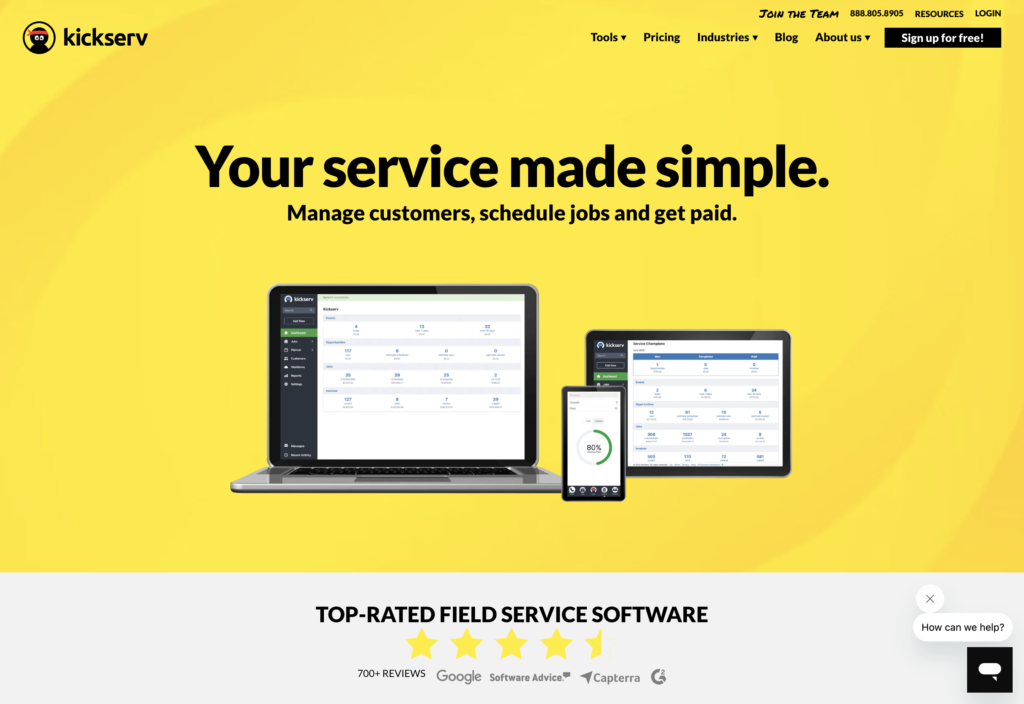
Kickserv by EverPro offers customer records, estimates, jobs, invoices, and payment tools for smaller service businesses. Capterra rating: 4.4/5 (387 reviews).
Why I chose Kickserv: Kickserv made the list because its simple job workflow and map-based dispatch tools help small offices keep customer work, technician activity, and billing organized without adding unnecessary complexity.
Customer records, estimates, and billing
Kickserv keeps customer requests, estimates, jobs, invoices, and payments connected, so teams can follow work from the first inquiry through to getting paid. Its Start plan also includes an embeddable contact form, automated email and text reminders, more than 20 business reports, time and expense tracking, and a QuickBooks Online integration.
QuickBooks Online is available on Start, but QuickBooks Desktop requires Run or Scale and costs an extra $50 per month. Businesses already using Desktop should factor that added cost into their comparison.
Scheduling, dispatch, and job progress
Kickserv gives managers schedule, calendar, and dispatch views to plan upcoming jobs. The dispatch view adds a map and timeline, making it easier to assign work based on where technicians are.
You need the Run plan or higher for dispatch mapping, GPS check-ins, custom fields, and custom reports. Jobs also move through five simple stages, so managers can quickly see what’s scheduled, in progress, on hold, or completed.
Time, expenses, and field controls
Employees can track hours and job-related expenses directly in Kickserv, keeping labor and job costs connected to the work itself. GPS check-ins are also available on higher tiers for added visibility into field activity.
I didn’t find dedicated overtime or break controls in Kickserv’s current public documentation, so businesses with stricter labor rules should confirm whether their workflow is supported.
Offline functionality isn’t clearly documented publicly, so teams working in low-connectivity areas should confirm what the mobile app supports before switching.
Key Features
- Customer records, estimates, invoices, and payments
- Five statuses for tracking job progress
- Map-and-timeline dispatch
- Job-based time and expense records
Pros
- Straightforward job stages for small teams
- Location context for proximity-based assignments
Cons
- Offline functionality isn’t clearly documented publicly
- Dedicated overtime and break controls aren’t clearly documented
Pricing
$60/month for 5 users Trial: Yes — 30 days Free Plan: No
-

ServiceM8 — Best for small mobile service teams
Available on
- Web
- iOS
- Android
- Windows
- Mac
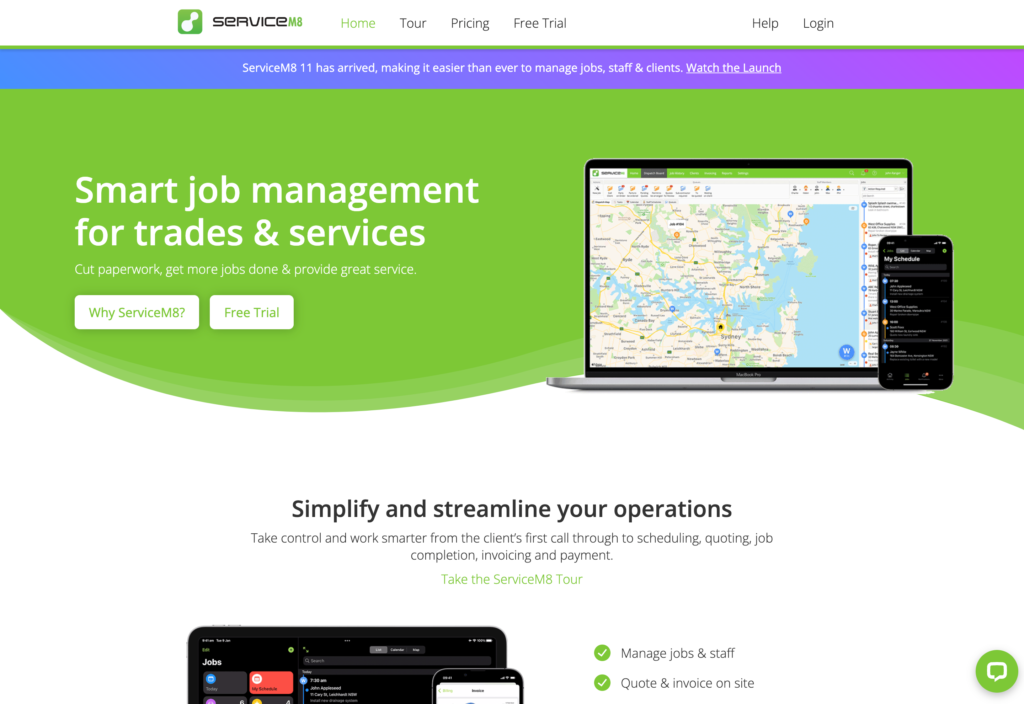
ServiceM8 is a mobile-focused service platform that offers client history, job cards, quotes, work orders, invoices, and payments. Capterra rating: 4.5/5 (311 reviews).
Why I chose ServiceM8: With ServiceM8, accepted quotes become work orders, and recurring jobs automatically recreate repeat visits so teams don’t have to set them up each time.
Client history and quote-to-job workflow
ServiceM8’s client history stores notes, photos, emails, and messages. Quotes can go out by email or SMS, and customer approval changes the job status to a work order. Scheduling, invoices, payments, and accounting integrations are included among the essentials across plans.
That keeps quoting and billing tied closely to the job.
Mobile devices and offline work
The ServiceM8 mobile app lets technicians create and schedule jobs, view team schedules and customer history, complete forms, send quotes and invoices, take payments, manage assets, scan documents, and track travel and on-site time.
The mobile app can work offline when job and client details have already synced. Technicians can view and update jobs and save notes and photos offline, then sync those changes after reconnecting. Final PDF quotes, invoices, forms, email, and text messaging still require an internet connection.
Android now supports almost all the same workflows as iOS, but it still lacks some iOS-only tools such as Room Scan/AR measurement, diagram creation, and PDF editing from attachment previews.
Scheduling and accounting handoff
Dispatchers can drag work onto employees’ schedules, while recurring jobs can recreate and schedule themselves. Staff receive push notifications for assignments or changes.
The QuickBooks Online sync is also one-way for invoices. Approved ServiceM8 invoices move to QuickBooks, but invoices created in QuickBooks don’t sync back. Employee records don’t sync either, so payroll still needs a separate workflow.
Key Features
- Client history with photos and messages
- Accepted quotes become work orders
- Recurring jobs with automatic scheduling
- QuickBooks Online invoice and payment integration
Pros
- Core field-service tools included across plans
- Paid plans include unlimited users
Cons
- A few tools remain iOS-only
- Limited workforce management and labor controls
Pricing
$29/month Trial: Yes — 14-day Free Plan: Yes — (one user and 30 new jobs/month)
Compare the Best Jobber Alternatives
| Topic |
|
|
|
|
|
|
|
|---|---|---|---|---|---|---|---|
| Reviews |
  |
|
|
|
|
|
|
| Pricing |
$59/month billed annually
|
Contact vendor
|
$208/month billed annually
|
Contact vendor
|
Contact vendor
|
$60/month for 5 users
|
$29/month
|
| Free Trial |
yes
for 14 days
|
no
|
no
|
yes
7 days
|
no
|
yes
30 days
|
yes
14-day
|
| Free Plan |
no
|
no
|
no
|
no
|
no
|
no
|
yes
(one user and 30 new jobs/month)
|
| Use cases |
Best overall Jobber alternative for end-to-end field service management
|
Best for growing small field-service businesses
|
Best for established SMB field-service operations
|
Best for service businesses prioritizing dispatch and communication
|
Best for larger home-service companies
|
Best for smaller service businesses wanting core FSM features
|
Best for small mobile service teams
|
| Available on |
Web, iOS, Android
|
Web, iOS, Android
|
Web, iOS, Android, Windows, Mac
|
Web, iOS, Android, Windows, Mac
|
FAQs
ServiceM8 has a confirmed free plan for one user and up to 30 new jobs per month. A free trial is different: it gives temporary access rather than an ongoing plan. Where a provider doesn’t publish free-plan availability, ask instead of assuming the software is free or paid-only.
Not necessarily. Job-based time tracking and technician dispatch don’t automatically include overtime calculations, break controls, or employee shift management. Keep those requirements separate when comparing alternatives to Jobber, especially if your team works across several jobs in one shift.
The Bottom Line
If you’re looking for a Jobber alternative, think about what features your team rely on most. Small mobile teams may need straightforward job records and billing, while dispatch-heavy businesses should prioritize assignment visibility and customer communication. Larger operations often need deeper property history, recurring-service controls, and clearer financial handoffs.
Before choosing an alternative, test a real job from booking through payment. Make sure the mobile workflow works for your team, the features you need are included in your plan, and the accounting sync handles your records correctly.
