


If fixing schedules becomes your entire job, pressure, complaints, and understaffed shifts quickly lead to frustration and burnout.
I reviewed 6 work schedule makers and compared them by how quickly you can build schedules, how easily changes are shared, and how reliably shifts stay covered.
Use these picks to build schedules faster, eliminate shift confusion, and run every shift with confidence instead of chaos.
| App | Best for | Starting Price | Key Considerations |
| Connecteam | Deskless and field teams managing shifts alongside daily operations | Just $29/month for the first 30 users | Gives frontline teams access to scheduling, time tracking, and communication in one platform. Mobile-first design makes it easy for employees to claim open shifts. |
| Deputy | Shift-based businesses needing auto-scheduling and built-in labor compliance | $5/user/month | Strong AI-powered auto-scheduler and strong compliance features for breaks and overtime. The mobile app can feel cluttered for simple use cases. |
| ClockShark | Construction and field service crews tracking schedules by job site | $40/month + $9/user/month. | Offers job costing and GPS tracking for field teams. Lacks AI-assisted scheduling and open shift claiming. |
| Homebase | Retail and hospitality teams that need a free plan for a single location | $24/location/month | Includes generous free plan for up to 10 employees at one location. Payroll is an expensive add-on, and multi-location pricing adds up quickly. |
| QuickBooks Time | Businesses already using QuickBooks that need simple schedules tied to payroll | $20/month + $10/user/month | Seamless integration with QuickBooks Online streamlines payroll. Lacks auto-scheduling and shift swapping, and is pricey for small teams. |
| Sling | Small businesses focused strictly on budgeting labor costs and overtime | $1.70/user/month | Offers a free plan for up to 30 users for basic scheduling. The mobile app lacks some reporting functionality, and time tracking requires a paid upgrade. |
What’s New in This Update (August 2026)
Our Top Picks
-
1

Best for deskless and field teams managing shifts alongside daily operations
-
2

Best for shift-based businesses needing auto-scheduling and built-in labor compliance
-
3

Best for construction and field service crews tracking schedules by job site
Why trust us?
Our team of unbiased software reviewers follows strict editorial guidelines, and our methodology is clear and open to everyone.
See our complete methodology
How I Ranked the Best Work Schedule Maker Apps
Here are the key features I looked for when reviewing the top staff schedule maker apps:
Building schedules without hours of admin
- Avoiding rebuilding schedules from scratch: The software should let managers drag, drop, copy, and reuse shift templates so that scheduling is a fast, repeatable task.
- Updating the schedule without confusion: When a shift changes, the app should update the schedule and notify the right employees instantly.
- Reducing the time spent making schedules: The software should auto-generate schedules based on employee availability, roles, and coverage rules.
Avoiding coverage gaps and double-bookings
- Filling last-minute gaps without chasing people down: Employees need to be able to claim open shifts or request swaps on their own.
- Catching conflicts before the schedule goes live: The software must verify approved time off and availability before shifts are built, and flag conflicts.
- Preventing no-shows before they happen: The app should send automatic shift reminders ahead of time.
Keeping teams aligned and compliant
- Keeping everyone on the same version: Updates, new open shifts, and last-minute changes must push instantly to employees’ phones so no one shows up at the wrong time.
- Spotting compliance issues before they hit payroll: The software should flag overtime risks, required break windows, and compliance issues as the schedule is being built.
- Putting the right person on every shift: The app should support role and certification requirements to shifts so the wrong person can’t be assigned.
The 6 Best Work Schedule Maker Apps
-
Connecteam — Best for deskless and field teams managing shifts alongside daily operations
Connecteam is the best choice for deskless and field teams because it combines a powerful drag-and-drop schedule maker with time tracking and communication in one platform. It’s especially strong for teams that need to handle last-minute shift changes and open shifts without the headache of chasing people down over text.
Why I chose Connecteam: I ranked Connecteam #1 because it was the most complete option for frontline teams, especially in areas like fast schedule creation, shift swapping, and real-time mobile notifications.
Smarter scheduling
Connecteam makes employee scheduling easy by letting managers quickly build and adjust schedules with a drag-and-drop editor. I like that you can manage shifts across teams, locations, and time zones. Plus, Connecteam lets you add important details like notes, tasks, and attachments to each shift, so employees have clear expectations before they even clock in.
Templates are also a big time-saver. I find it really helpful that you can store recurring shift patterns and reuse them in one click. Copying and pasting successful schedules across weeks is another great way to make ongoing scheduling faster and consistent.
Once you publish a schedule, employees are notified instantly and can view their shifts right from their mobile device. Last-minute changes update automatically, so teams stay aligned without extra follow-ups.
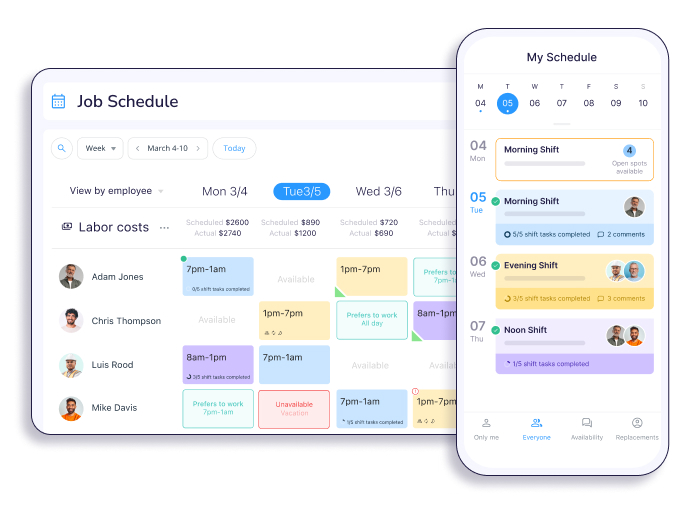
Connecteam shows labor costs, staff availability, and conflicts as you make your work schedule. Time off and availability
I like how Connecteam approaches time off management and availability. Employees can set their availability, preferred hours, and request PTO directly in the app, so managers have a clear view of who can work before building schedules. You can also create custom PTO policies for vacation, sick, or personal leave, and balances update automatically as time accrues.
When someone submits a request, managers are notified instantly and can approve or deny in a few clicks. This gets rid of the usual back-and-forth to speed up the approval process and ensure that schedules stay accurate.
AI-powered auto-scheduler
Connecteam lets you create custom scheduling rules, like requiring specific roles, certifications, or manager coverage for certain shifts. Setting these rules helps keep schedules compliant.
Once those rules are set, the AI-powered auto-scheduler uses them to fairly assign open shifts based on employee availability and qualifications. It also flags issues like overlapping shifts or double-bookings, so you can catch problems before schedules go out.
Shift replacements
With Connecteam, shift swaps and replacements are easy to manage without losing control of the schedule. When an employee can’t make a shift, they can release it in the app for other qualified teammates to pick up. Managers can require approval before a replacement is confirmed, ensuring coverage stays accurate and intact.
If there’s an open shift, managers can let employees claim it on a first-come, first-serve basis. Plus, to prevent scheduling conflicts in the first place, Connecteam sends employees shift reminders ahead of time to reduce no-shows and last-minute crises.
And so much more…
Connecteam is more than just a powerful schedule maker app. It offers built-in tools that help you manage your daily work all in a single platform:
- Employee time clock: Track time for both on-site and field teams, and use the geofence and real-time GPS tracker to see where and when work is happening.
- Online team chat: Keep work-related conversations organized and easy to manage. Search messages, share files, and start one-on-one or group chats.
- Training and onboarding: Use the AI Course Creator to build custom training materials in seconds, and get employees up to speed quickly.
- Employee task tracking: Assign recurring or one-off tasks to team members, add subtasks, and monitor completion progress in real-time.
When Connecteam isn’t a good fit
Connecteam’s scheduler is built around shifts and teams, so it’s not the best fit for businesses that need job-based dispatching. Small office teams with salaried employees and fixed schedules also might not get the most value from the platform.
Connecteam also offers a free for life plan – Get Started Now!
0Key Features
- Drag-and-drop editor
- AI auto-scheduler
- Recurring shifts
- Shift swaps
- Notes and attachments
- Automated conflict detection
Pros
- Employees can claim open shifts
- Built-in time off and availability
- Scheduling connected to time tracking and payroll
- Flat-fee pricing keeps costs predictable
Cons
- Requires active internet connection
- Not built for job-by-job dispatch workflows
Pricing
Free-for-life plan availablePremium plans start at $29/month for 30 users
If you’ve made it this far, we must be right
Start Scheduling Now -
Deputy — Best for shift-based businesses needing auto-scheduling and built-in labor compliance
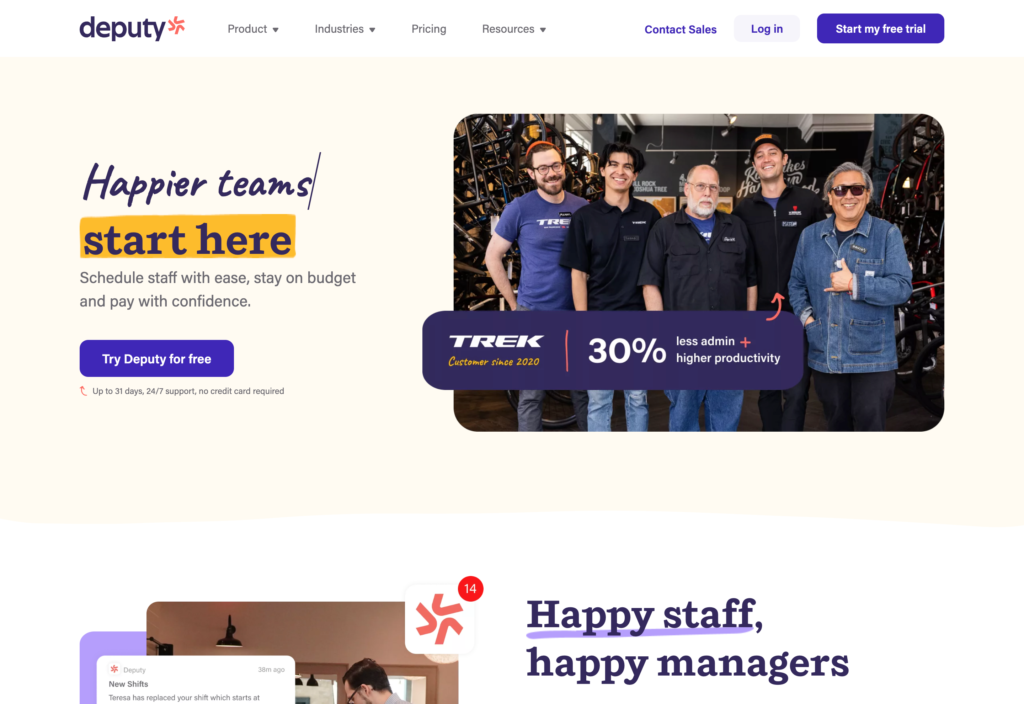
Deputy is a workforce scheduling platform that helps teams plan employee schedules, manage shift coverage, and track labor compliance.
Why I chose Deputy: Deputy’s AI-powered auto-scheduler builds rosters based on demand, sales trends, and labor budgets to keep coverage tight and compliant.
Shift scheduling and automation
Deputy’s scheduling feature is impressive. Managers can create schedules using drag-and-drop tools, templates, or past schedules, add notes to shifts, and assign work directly or leave shifts open for employees to claim.
The platform tracks employee availability, approved leave, and certifications, helping ensure the right people are scheduled for the right shifts. You can also set rules around breaks, overtime, shift length, and fairness to stay compliant and control labor costs. Deputy’s AI-powered auto-scheduling is another standout feature, automatically building schedules based on demand, sales trends, labor budgets, and employee qualifications.
However, during testing, we deliberately created overlapping shifts for the same team member across two areas, and Deputy didn’t flag a conflict. The shift scheduler also doesn’t warn you when assigning shifts to employees who have requested leave that hasn’t been reviewed or approved yet.
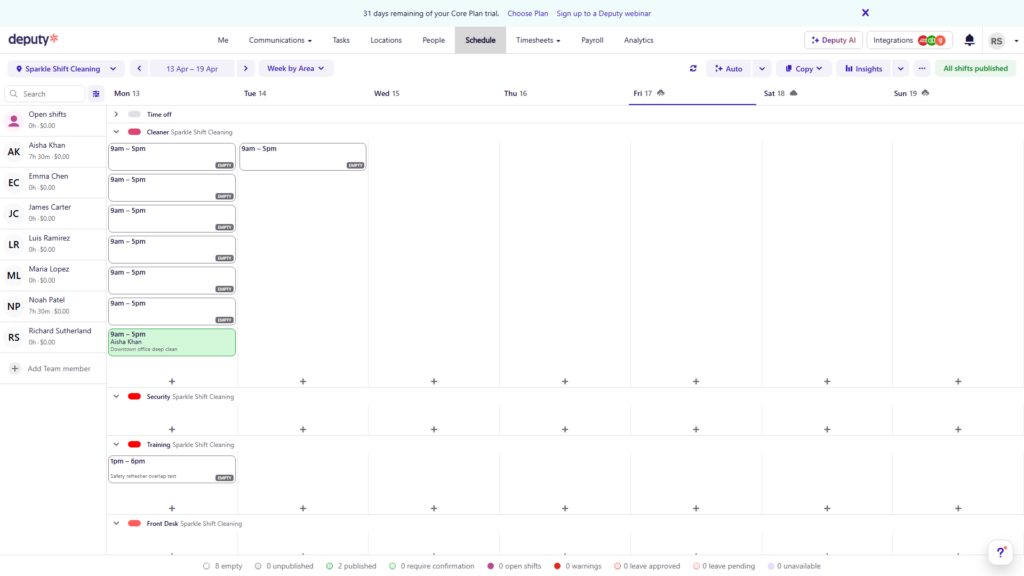
Deputy’s schedule clearly displays work areas, shifts, and the publication status. Employee experience and usability
I appreciate that employees can manage their own availability, request leave, sync shifts to personal calendars, and request shift swaps directly from the app. These self-service options make schedule changes easier to handle. Managers also get visibility into coverage levels to avoid understaffing.
That said, the mobile scheduling interface felt cluttered to me. Deputy also has limited offline functionality, so employees without an internet connection may be able to view information but not update schedules or timesheets.
Time clock and compliance
When it comes to time tracking, Deputy offers a flexible and secure option that lets employees clock in and out from web browsers, mobile devices, or shared kiosks. I like its biometric facial recognition, which allows for touchless clock-ins and helps prevent buddy punching. Built-in compliance tools support mandatory breaks, overtime tracking, and labor law requirements across different regions.
What users say about Deputy
I appreciate Deputy for being user-friendly, which makes managing employee schedules much easier. It effectively takes care of notifying employees about their schedules, which is incredibly helpful.
Some advanced features and reports could be more customizable, especially for larger or more complex teams. Occasionally, the mobile app can feel a bit slow, and certain integrations could be smoother.
0Key Features
- Schedule maker
- Leave management
- Shift replacements
- Task tracking
Pros
- Auto-scheduler
- Strong compliance features
Cons
- No offline mode
- Misses overlapping shift conflicts
Pricing
Starts at $5/user/month Trial: Yes — 30 days Free Plan: No
-
ClockShark — Best for construction and field service crews tracking schedules by job site
What’s new with ClockShark
As of mid-2026, a 3-year contract term applied to all ClockShark plans.
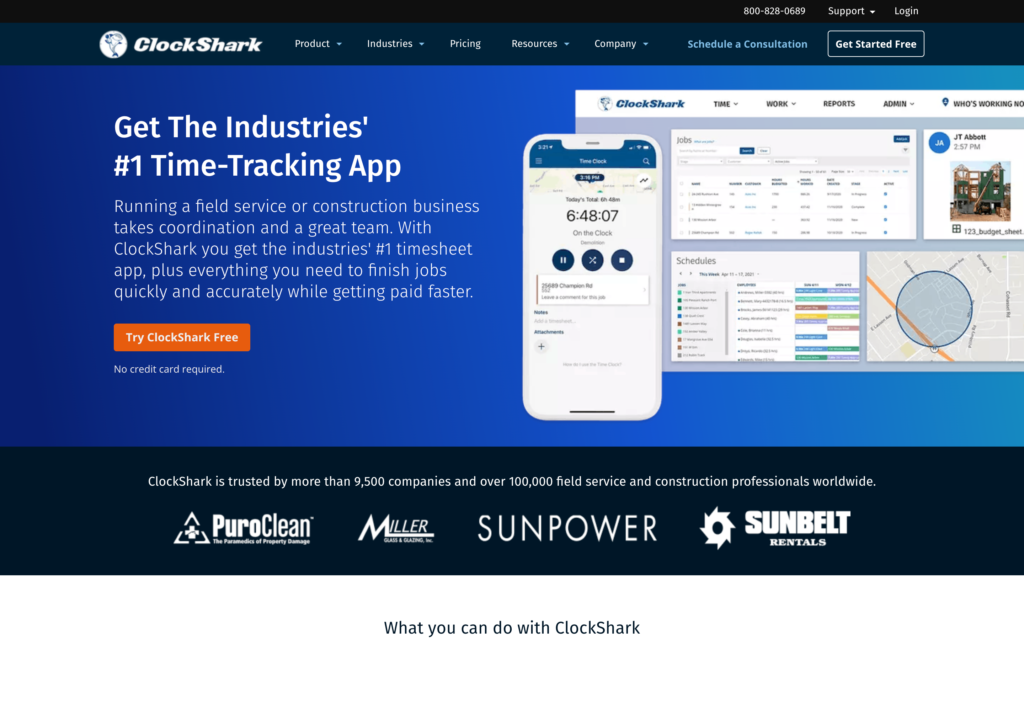
ClockShark is a job schedule and time tracking app built for field service and construction teams.
Why I chose ClockShark: I included ClockShark because it ties schedules directly to job costing, making it easy to track profitability at a project level while dispatching workers.
Schedule creator
ClockShark offers a standard drag-and-drop scheduler that makes it easy to create and assign shifts. Using the tool feels pretty intuitive, especially when it comes to moving shifts, reassigning employees, and setting up recurring work. The visual layout is practical, with clear color-coding that makes it easier to understand at a glance.
Employees can view job details, documents, and directions within each shift, and schedule updates are sent instantly to their phones. However, in our testing, we found that the shift assignment was entirely manual. There’s no AI-assisted scheduling or smart suggestions based on availability.
The scheduling tools in general seem pretty basic, with limited support for complex setups like split or rotating shifts. There’s also no automatic conflict detection, and no open shifts employees can claim, which puts more manual work on managers.
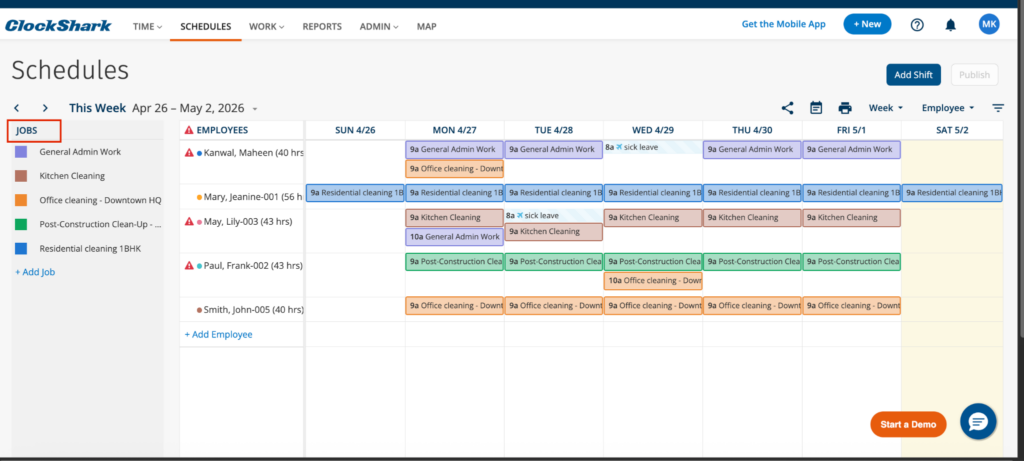
ClockShark’s schedule maker is structured around specific jobs, not shifts. Job costing and reporting
Job costing is where ClockShark really stands out. The platform makes it easy to assign labor hours to specific jobs and tasks, which is especially useful for teams that need to track profitability at a project level.
I also like the reporting features, which give you detailed insights into time, attendance, and job costs to support better planning and budgeting decisions. However, there aren’t that many customization options for reporting, which may be a drawback for businesses with more specific or complex reporting needs.
Integrations and pricing
ClockShark’s integrations are centered around payroll and accounting, which makes sense with its focus on time tracking and job costing. It connects with tools like QuickBooks, Xero, ADP, and Paychex, and also supports Zapier for basic workflow automation. Despite this, its integration ecosystem seems a bit limited to me. I was surprised that there were no native integrations with project management tools, CRMs, or HR systems.
Pricing is another consideration, as ClockShark uses a base fee plus per-user model that can add up quickly for smaller teams. While the feature set (especially job costing) may justify the cost for businesses in its core industries, the lack of a free plan makes it less accessible for startups or teams on a tighter budget. It’s also worth noting that ClockShark now requires a 3-year contract commitment, which is a significant ask for teams that aren’t sure if the platform is the right long-term fit.
What users say about ClockShark
The best thing about ClockShark is that it has accurate time tracker with the support of GPS and a great security level. The scheduling and payroll is very simple to set up and works well.
ClockShark can be pricey for larger teams, and it needs internet or GPS access to work properly. Some users may find the setup or mobile app a bit tricky at first.
0Key Features
- Schedule maker
- Job costing
- Detailed reporting
- GPS time tracking
Pros
- Mobile access
- Intuitive navigation
Cons
- 3-year contract commitment
- Manual shift assignment
Pricing
Starts at $40/month + $9/user/month. Trial: Yes — (14-day) Free Plan: No
-

Homebase — Best for retail and hospitality teams that need a free plan for a single location
Homebase is a work schedule maker that helps businesses create employee schedules, track hours, and manage shifts in a single platform.
Why I chose Homebase: Homebase offers a free plan that covers basic scheduling and time tracking for up to 10 employees at a single location.
Scheduling and shift management
Homebase’s scheduling is built around a weekly calendar view, which makes it manageable to create and assign shifts. I like that you can build schedules from scratch, copy past ones, or use templates for recurring shifts to save time. Plus, I appreciate that employees can pick up open shifts or swap shifts when they need to.
There’s an auto-scheduling feature that builds shifts based on availability, sales forecasts, and labor targets. However, during testing, we couldn’t access this tool even after contacting Homebase support. Availability rules also worked inconsistently. When we set up a recurring availability preference to start on a future date, it took effect immediately and didn’t repeat correctly.
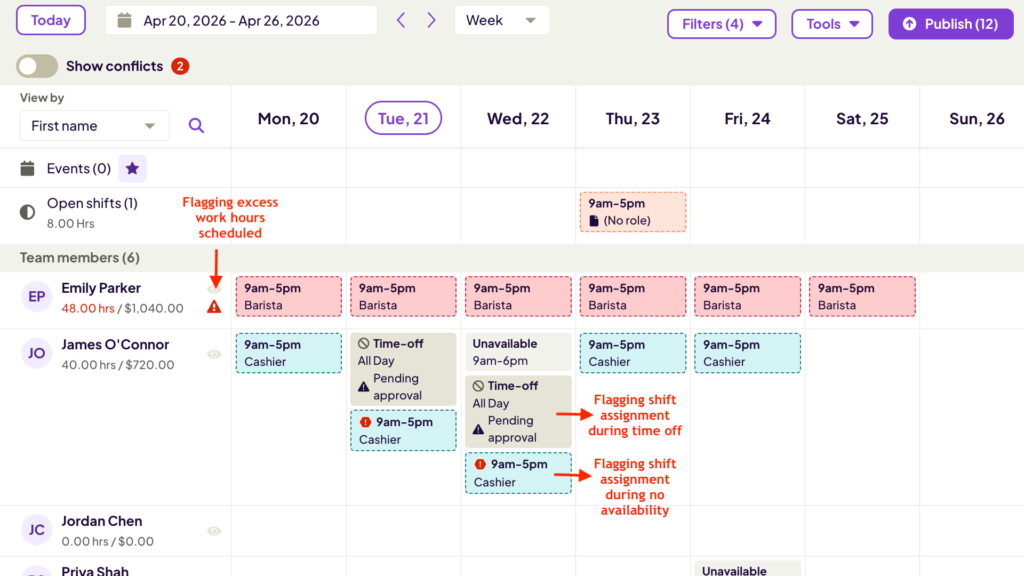
Homebase flags shift conflicts as you build your schedule. Time tracking and compliance
Homebase offers a flexible time clock that works across mobile devices, tablets, desktops, and POS systems. For accurate time tracking, the platform captures GPS location and supports geofencing, which is helpful. There’s also built-in tracking for overtime and breaks to support labor law compliance, which I really liked.
Some of the more advanced compliance features, like alerts for late clock-ins or automatic clock-outs, are limited to higher-tier plans. While it’s not a huge problem, it’s something to consider for teams that need tools with stronger enforcement features. Also, when we tried to clock in without internet access, the advertised offline mode didn’t work.
Payroll and integrations
Homebase offers its own payroll solution, which allows approved timesheets to flow directly into payroll without much effort. There’s also an option to set up automatic payroll runs, which seemed super helpful.
That said, payroll comes at a higher cost. Pricing starts with a monthly base fee plus a per-employee charge, which can add up fast for larger teams. For businesses that prefer more flexibility, Homebase also integrates with external payroll providers like Paychex and Gusto, so teams can use their preferred payroll system while still using Homebase’s scheduling and management tools.
What users say about Homebase
I really like how easy Homebase makes scheduling and tracking time. It’s simple to set up shifts, and everyone can clock in or check their schedule right from their phone.
While I do like scheduling- when I am building schedules sometimes things change- when I add a note to the shift and want to apply that note to other shifts already scheduled, it’ll add a new shift instead of adding it to the existing one. It makes having to edit my published schedule VERY annoying.
0Key Features
- Staff schedule maker
- Shift swapping
- Time tracking
- Shift templates
Pros
- Generous free plan
- HR integrations
Cons
- Payroll is a paid add-on
- Offline mode didn’t work in testing
Pricing
Starts at $24/location/month Trial: Yes — (14-day) Free Plan: Yes — limited to 1 location and 10 employees.
-

QuickBooks Time — Best for businesses already using QuickBooks that need simple schedules tied to payroll

QuickBooks Time is a scheduling and time-tracking software with tools to assign shifts, track hours, and manage employee schedules.
Why I chose QuickBooks Time: I chose QuickBooks Time because it is part of the QuickBooks ecosystem, allowing schedules, tracked hours, and payroll data to flow together with minimal manual work.
Scheduling and shift management
QuickBooks Time’s drag-and-drop scheduler makes it easy to create and adjust schedules as needed. I found it pretty straightforward to build basic schedules, and I like that managers can make changes without too much hassle.
That said, I was a bit surprised by the schedule maker’s limited capabilities. For example, it doesn’t support auto-scheduling or employee-led shift swapping. Instead, managers have to build schedules manually and handle all shift change requests themselves. I can see this being a major drawback for businesses with complex scheduling needs, especially since it can add ongoing admin work, rather than reduce it.
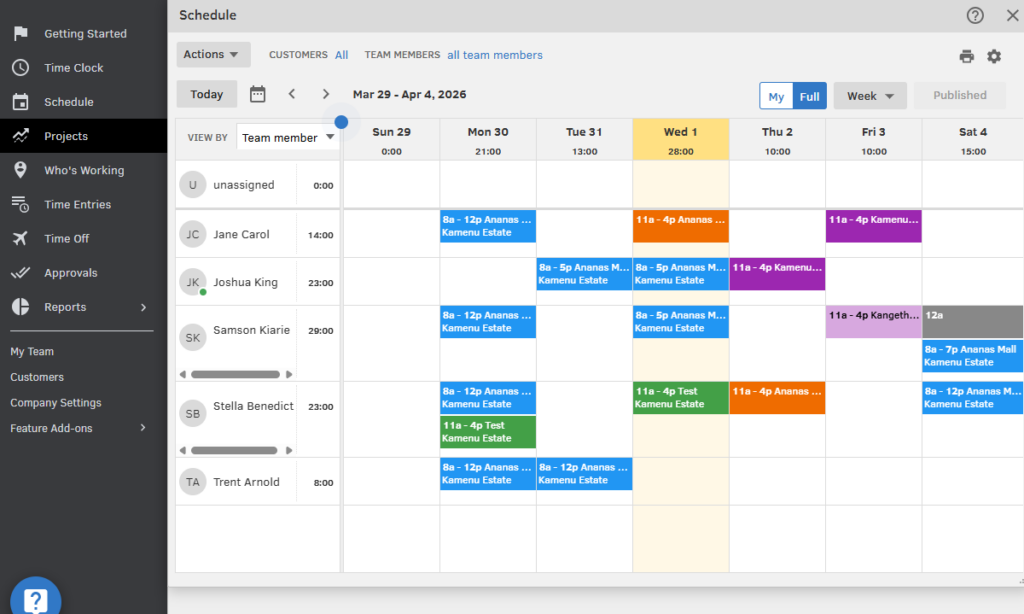
You can color code different shift types with the QuickBooks Time schedule maker app. Time tracking and compliance
Time tracking is where QuickBooks Time really excels. I like that the platform includes solid tools like geofencing, which helps ensure employees clock in only from approved job sites. There’s also flexible break tracking to support labor law compliance.
QuickBooks Time’s obvious selling point is its seamless integration with QuickBooks Online. It streamlines the entire payroll process by eliminating exports and manual data entry. In our latest testing, the overtime tracker accurately recorded overtime and double time, which was a significant improvement since our last review.
Where it falls short
QuickBooks Time is priced higher than many similar tools, especially once you factor in the per-user fees. Costs increase quickly as your team grows, and accessing features like mileage tracking or job costing usually requires upgrading to a higher plan. For larger teams, that can make the monthly price add up pretty quickly.
I also noticed that several useful features are locked behind the top-tier plans, which may not feel ideal for small or growing teams that need flexibility as they scale. It can be frustrating to realize you need an upgrade just to access tools that feel basic.
What users say about QuickBooks Time
This product is a great value for your money and has great scheduling and payroll options. The great calendar helps to keep track of everything.
QuickBooks time is too costly for the our needs and the number of employees we have. Also, our employees like having an app
0Key Features
- Drag-and-drop editor
- Time-off management
- Mileage tracking
- Project & job costing
Pros
- QuickBooks Online integration
- Mobile access
Cons
- Lacks auto-scheduling
- Pricier than most competitors
Pricing
Starts at $20/month + $10/user/month Trial: Yes — (30 days) Free Plan: No
-

Sling — Best for small businesses focused strictly on budgeting labor costs and overtime
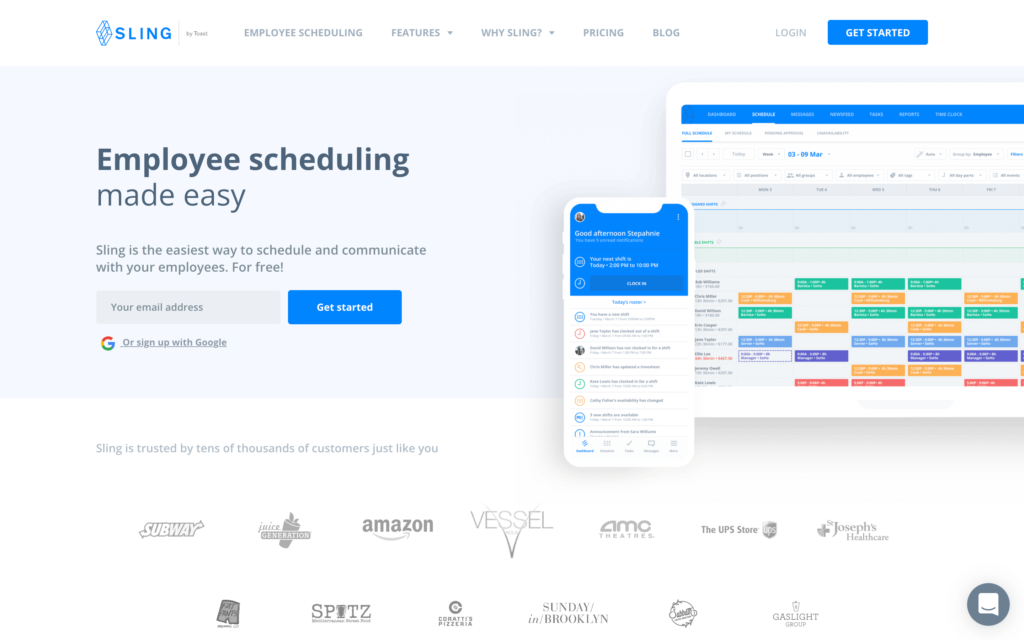
Sling is a schedule maker software that supports shift scheduling, task tracking, and labor cost management in one platform.
Why I chose Sling: I chose Sling because of how generous its free plan is and its affordable per-user pricing options.
Employee scheduling
It is easy to use Sling’s schedule maker thanks to its clean interface and simple drag-and-drop function. I especially like how the platform automatically flags short turnarounds to avoid “clopening issues” and ensure that employees get proper rest between shifts. Managing overtime, shift changes, and time-off requests is also pretty straightforward, and the built-in labor cost insights are helpful for balancing coverage while keeping an eye on payroll expenses.
While the system works well, I noticed a few limitations. For example, it doesn’t support day rates alongside hourly pay, which may be a drawback for some teams. And while shift templates are useful for recurring schedules, I ran into some syncing issues on the mobile app. I also wish there were more customization options, especially when it comes to sorting employees beyond just role or location.
During testing, we created overlapping shifts and assigned conflicting roles to the same employee. Sling flagged both issues but still let us publish the schedule. Just be aware of this limitation if you need a schedule maker with strict compliance safeguards.
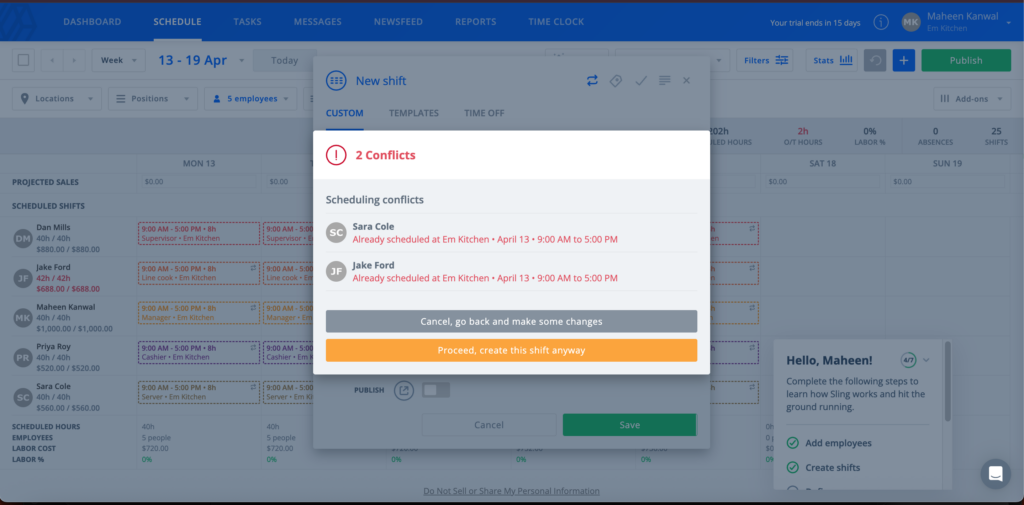
Sling shows conflict warnings when you’re making a schedule. Time tracking
Sling’s mobile time clock lets employees clock in and out from their devices while tracking hours, overtime, and paid time off. It also offers tools to support compliance with labor laws around scheduling and breaks.
The platform also includes geofencing, which restricts clock-ins to approved locations. During testing, attempting to clock in from the wrong location with restrictions enabled was blocked as expected. Sling also prevents early clock-ins, and can automatically clock employees out at the end of their shift to prevent overtime from accruing unnoticed.
Task management
Sling’s task management tools let managers assign tasks and subtasks directly to shifts or individual employees, with detailed checklists that make expectations clear. I like that you can create task templates for recurring work and set reminders.
That said, you can’t easily match tasks to employees based on specific skills or expertise. For me, offering this feature would just make assignments more precise and reduce manual decision-making for managers.
What users say about Sling
The most useful about Sling is that you can create different shifts at different times but also you can also leave notes when you want to let someone know that you couldn’t take lunch time or you had to leave earlier.
Views of schedule get a little wonky when you try to look longer than week. Some functions like call-ins can be cumbersome to go back to roster view.
0Key Features
- Automatic scheduling
- Labor costing
- Shift swapping
- Task management
Pros
- Comprehensive free plan
- Advanced scheduling features
Cons
- Limited customization
- Conflict detection not enforced
Pricing
Starts at $1.70/user/month Trial: Yes — (15 days) Free Plan: Yes — (for up to 30 users)
Compare the Best Work Schedule Maker Apps
| Topic |
 Start for free
|
|
|
|
|
|
|---|---|---|---|---|---|---|
| Reviews |
  |
|
|
|
|
|
| Pricing |
Starts at just $29/month for the first 30 users
|
Starts at $5/user/month
|
Starts at $40/month + $9/user/month.
|
Starts at $24/location/month
|
Starts at $20/month + $10/user/month
|
Starts at $1.70/user/month
|
| Free Trial |
yes
14-day
|
yes
30 days
|
yes
(14-day)
|
yes
(14-day)
|
yes
(30 days)
|
yes
(15 days)
|
| Free Plan |
yes
Free Up to 10 users
|
no
|
no
|
yes
limited to 1 location and 10 employees.
|
no
|
yes
(for up to 30 users)
|
| Use cases |
Best for deskless and field teams managing shifts alongside daily operations
|
Best for shift-based businesses needing auto-scheduling and built-in labor compliance
|
Best for construction and field service crews tracking schedules by job site
|
Best for retail and hospitality teams that need a free plan for a single location
|
Best for businesses already using QuickBooks that need simple schedules tied to payroll
|
Best for small businesses focused strictly on budgeting labor costs and overtime
|
| Available on |
How to Choose the Right Work Schedule Maker App
Selecting the right schedule maker app depends on your organization’s specific needs. Before you make a decision, ask yourself these questions:
- Are you scheduling for a small team of 10 or a growing enterprise?
- Does a flat-fee pricing model make more sense for your budget than paying per user?
- Are you looking for a tool that offers a permanent free plan?
- Do your employees work in a single location, or are they spread across multiple job sites?
- Do you need to track labor costs and profitability against specific client jobs?
- Will your team need to swap shifts frequently on their own?
- Does the software need to flag compliance issues like missed breaks and overtime?
- Is it important for the app to function offline if your team works in areas with poor cell service?
What Is A Work Schedule Maker?
A schedule maker is software that helps businesses plan, organize, and manage employee work schedules. Instead of relying on spreadsheets, paper sheets, or last-minute messages, schedule maker apps centralize shift planning in one system that managers and employees can access easily.
These tools are usually used by teams with hourly workers, rotating shifts, or multiple locations, where scheduling manually can quickly become time-consuming and error-prone. At a basic level, a schedule maker helps make sure the right people are scheduled at the right time while reducing confusion, missed shifts, and coverage gaps.
How Do Schedule Maker Apps Work?
Schedule maker apps work by collecting key information such as employee availability, roles, and work preferences. Managers then build schedules using visual tools like drag-and-drop calendars or shift templates. This makes it easier to plan weeks in advance or adjust coverage when needed. Many tools also support recurring schedules, so managers don’t have to rebuild the same shifts every week.
Once a schedule is published, employees are notified automatically and can view their shifts from desktop or mobile apps. If changes come up, updates are shared in real-time so everyone can stay aligned. More advanced schedule makers may also handle shift swaps, time-off requests, and scheduling rules, helping teams stay flexible without losing control.
The Benefits of Schedule Maker Apps
Here are some of the ways an employee schedule creator can benefit your business:
Reduced Stress
One of the biggest benefits of using a schedule maker is that it replaces the need for manual scheduling. Instead of juggling spreadsheets, messages, and last-minute changes, managers can plan shifts in one place and make updates without chaos. This creates a sense of control and predictability, helping you focus on leading your team, not putting out fires.
Better Reliability
Clear, accessible schedules help employees know exactly when and where they’re expected to work. With schedules shared in real-time and updates communicated instantly, there’s much less room for confusion. This leads to fewer missed shifts, stronger accountability, and more reliable coverage.
Saved Time
Building schedules from scratch every week is a major time drain. Schedule makers streamline the process by reusing patterns, adjusting shifts quickly, and avoiding common errors like double-booking. The time saved adds up fast, relieving managers from repetitive admin work and allowing them to focus on higher-value tasks.
Improved Morale
When employees can see schedules early, request time off, or swap shifts when needed, work feels more manageable. This flexibility reduces frustration and helps teams feel respected and supported. As a result, better morale often leads to stronger retention and fewer last-minute scheduling issues.
More Consistency
Accurate scheduling leads to smoother operations. Teams show up prepared, managers know coverage is handled, and businesses operate with fewer disruptions. Over time, this consistency reduces costly mistakes, improves service quality, and builds trust across the organization.
How Much Do Schedule Makers Cost?
The cost of schedule maker software depends on the pricing model used, including simple per-user fees, flat monthly plans, or a combination of a base subscription plus a per-user charge. At the lower end, some tools start around $1.70 – $5 per user per month or a flat $24 per month for basic scheduling. More full-featured plans may start around $20 – $40 per month with additional per-user fees.
Connecteam stands out as the most affordable option, especially with its Small Business Plan that is completely free for up to 10 users. Connecteam’s paid plans start at just $29 per month for up to 30 users. Higher-tier plans start at $49/month for Advanced and $99/month for Expert, both also covering up to 30 users.
FAQs
Set up time depends on the software, but most tools offer quick-start templates, drag-and-drop interfaces, and onboarding guides to streamline setup.
Schedule maker apps help ensure compliance with labor laws by tracking hours, breaks, and overtime automatically. They enforce legal rules and alert managers to potential violations.
Schedule maker apps increase employee satisfaction and retention by providing transparency, shift flexibility, and mobile access. Workers feel more in control and experience fewer scheduling conflicts.
The Bottom Line On Schedule Maker Apps
Scheduling shouldn’t be a constant source of stress, missed shifts, and panic. When schedules are unclear or hard to manage, managers feel the pressure, employees get frustrated, and operations suffer. The right app depends on what you’re actually trying to solve, and whether you need simple templates, complex auto-scheduling, or a way to tie shifts directly to job costs.
Connecteam combines a powerful drag-and-drop schedule maker with time tracking, task management, and team communication in a single app. Between its affordable flat-fee plans and mobile-first design, it gives managers total control while keeping the entire team aligned.
Start your free Connecteam trial today.