

Small timekeeping mistakes add up fast for small businesses. If you’re not careful, they can lead to payroll errors, overtime surprises, and stressful disputes that drain your time and money.
I looked at seven small business time clocks, comparing them by their clock-in accuracy, overtime and break settings, and payroll process.
Use these picks to control your labor costs, avoid payroll mistakes, and get a better idea of what’s going on day to day.
If you don’t have the time to read through our research, jump down to our quick comparison table.
| App | Best for | Starting Price | Key Considerations |
| Connecteam | Growing small businesses that need GPS tracking and payroll-ready hours | Just $29/month for the first 30 users | One platform handles time tracking, scheduling, forms, tasks, and team communication. |
| Buddy Punch | Small teams that want a simple online time clock they can set up in a day | $19/month + $4.49/user/month | Quick setup and facial recognition prevent buddy punching, but requires constant logins. |
| QuickBooks Time | Businesses that want time tracking tightly connected to QuickBooks payroll | $20/month + $10/user/month | Seamless QuickBooks integration eliminates manual exports, but pricing is steep. |
| Homebase | Retail and restaurants that want scheduling and time tracking together | $24/location/month | Combined scheduling and time tracking with per-location pricing, but payroll is only an add-on. |
| Clockify | Very small businesses that need a free time tracking tool for basic hour logging | $3.99/user/month | Built-in job costing and supervisor-led crew clock-ins, but extended breaks aren’t automatically flagged. |
| ClockShark | Construction and trade crews that track hours by job site | $40/month + $9/user/month. | Excellent fingerprint punching and state-specific overtime rules; no offline mode. |
| OnTheClock | Small businesses managing PTO inside a straightforward time clock | $5/month + $4/user/month. | IP, device, and browser authorization, GPS tracking and geofencing, Pre-built state-specific overtime rules, PTO tracking with accrual and allotment. |
What’s New in This Update (August 2026)
- Re-verified all pricing structures, free trials, and tier limits across all seven featured platforms to reflect the latest 2026 market standards.
- Integrated OnTheClock as a dedicated top pick for small businesses looking for straightforward PTO management and robust biometric fingerprint punching.
Our Top Picks
-
1

Best for growing small businesses that need GPS tracking and payroll-ready hours
-
2

Best for small teams that want a simple online time clock they can set up in a day
-
3

Businesses that want time tracking tightly connected to QuickBooks payroll
Why trust us?
Our team of unbiased software reviewers follows strict editorial guidelines, and our methodology is clear and open to everyone.
See our complete methodology
How I Ranked the Best Small Business Time Clock
Here are the features I thought were most important for a small business time clock:
Time tracking essentials
For small teams, these timekeeping capabilities are non-negotiable:
- Accurate hours without missed punches: Employees have to be able to clock in/out from their phone or a shared device in seconds. I ranked apps lower if the process felt confusing or disjointed.
- Payroll without manual calculations: Regular hours, breaks, and overtime should calculate automatically, so managers aren’t stuck correcting totals before every pay run.
- Timesheets managers can trust: You need a clear review and approval process with visible edit histories so you can fix mistakes and disputes quickly.
- Leave that stays aligned with payroll: PTO, vacation, and sick leave should sync with worked hours automatically so balances and payroll remain accurate.
- A clean handoff to payroll: Approved timesheets should export cleanly or connect with the payroll provider without spreadsheet fixes or repeated data entry.
Real-world use
I also looked at how well each tool fits into a busy manager’s workday:
- Easy for employees and managers to use: Most small teams rely on their phones, so the mobile experience should be fast, responsive, and actually work for clock-ins, timesheet reviews, and approvals.
- Fast to set up: Managers should be able to invite employees and work out the essentials without spending hours on setup or training.
Protecting your bottom line
I looked for tools that help small businesses control labor costs:
- Proof that hours match the work location: GPS tracking and geofencing should verify or restrict where mobile teams clock in.
- Overtime caught before it reaches payroll: Alerts should warn you before employees enter overtime, giving you enough time to adjust schedules or approve the extra hours.
- Quick visibility into labor issues: You should have access to reports that clearly show total hours, overtime, and attendance problems without complex dashboards.
7 Best Time Clocks for Small Businesses
-
Connecteam — Best for growing small businesses that need GPS tracking and payroll-ready hours
As a Connecteam employee, I have the most experience and knowledge about our time clock. I use it to clock in and out, request time off, and submit my timesheets so my manager can approve them (and I can get paid on time).
The time clock connects to my schedule, lets me log breaks, calculates my overtime, and tracks where I am when I’m on the clock.
Here’s more about the time clock to help you see if it’s a good fit for your small business:
Clocking in and out
Connecteam’s employee time clock is simple to use. Every morning, I open up the app, go to the time clock, and just tap the “clock in” button to start tracking my time.
If I’m not in the mood to pull the app up on my phone, I can also clock in on the web version or use the shared kiosk at our front desk. If I forget to clock in, Connecteam sends me a reminder that I can’t miss.
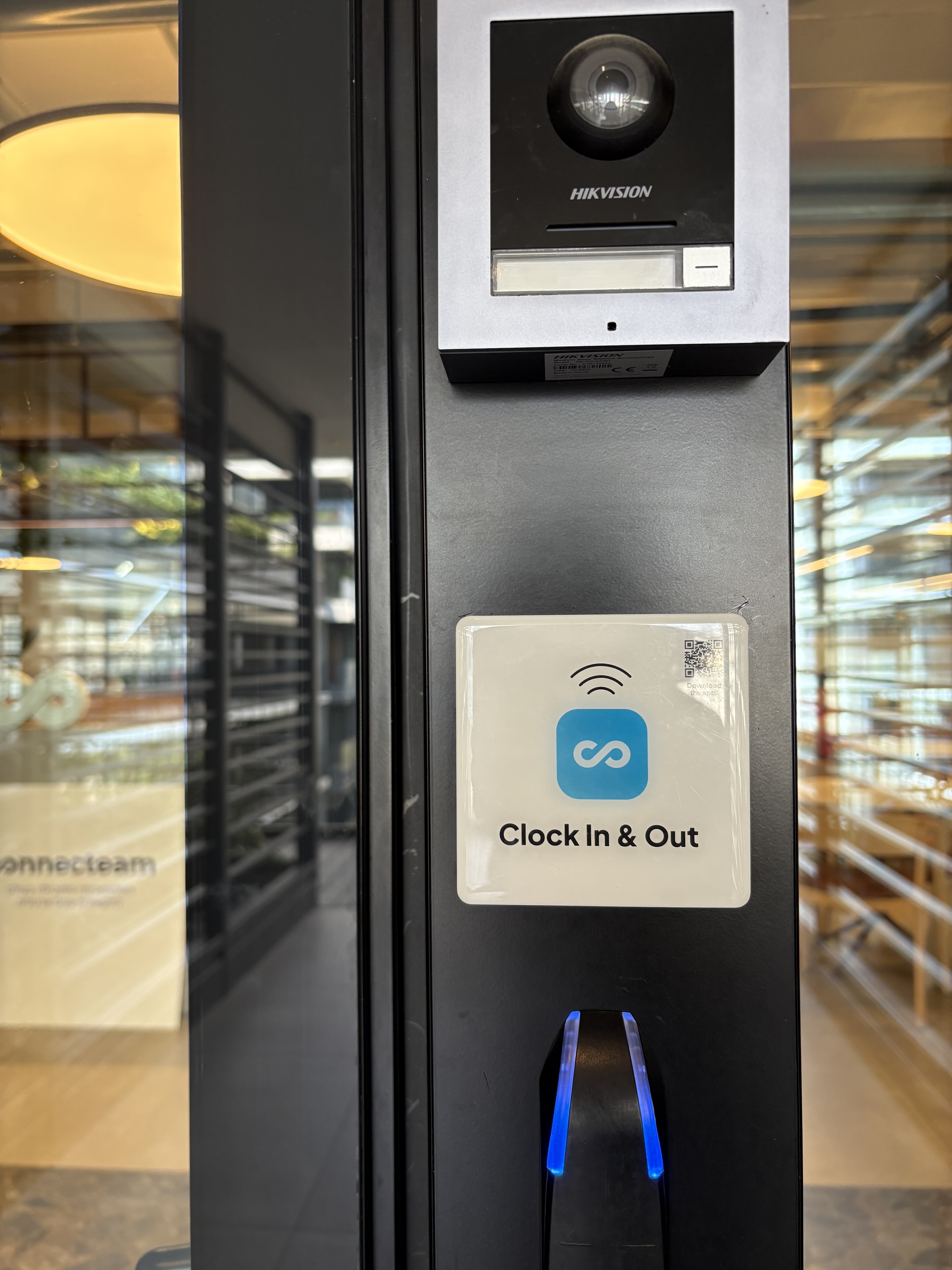
Lately, I’ve been clocking in with the NFC sticker. Instead of just using the normal button, I press “scan NFC” and hold my phone next to the NFC tag at our building’s entrance to clock in. That way, I can confirm that I’m physically on site.
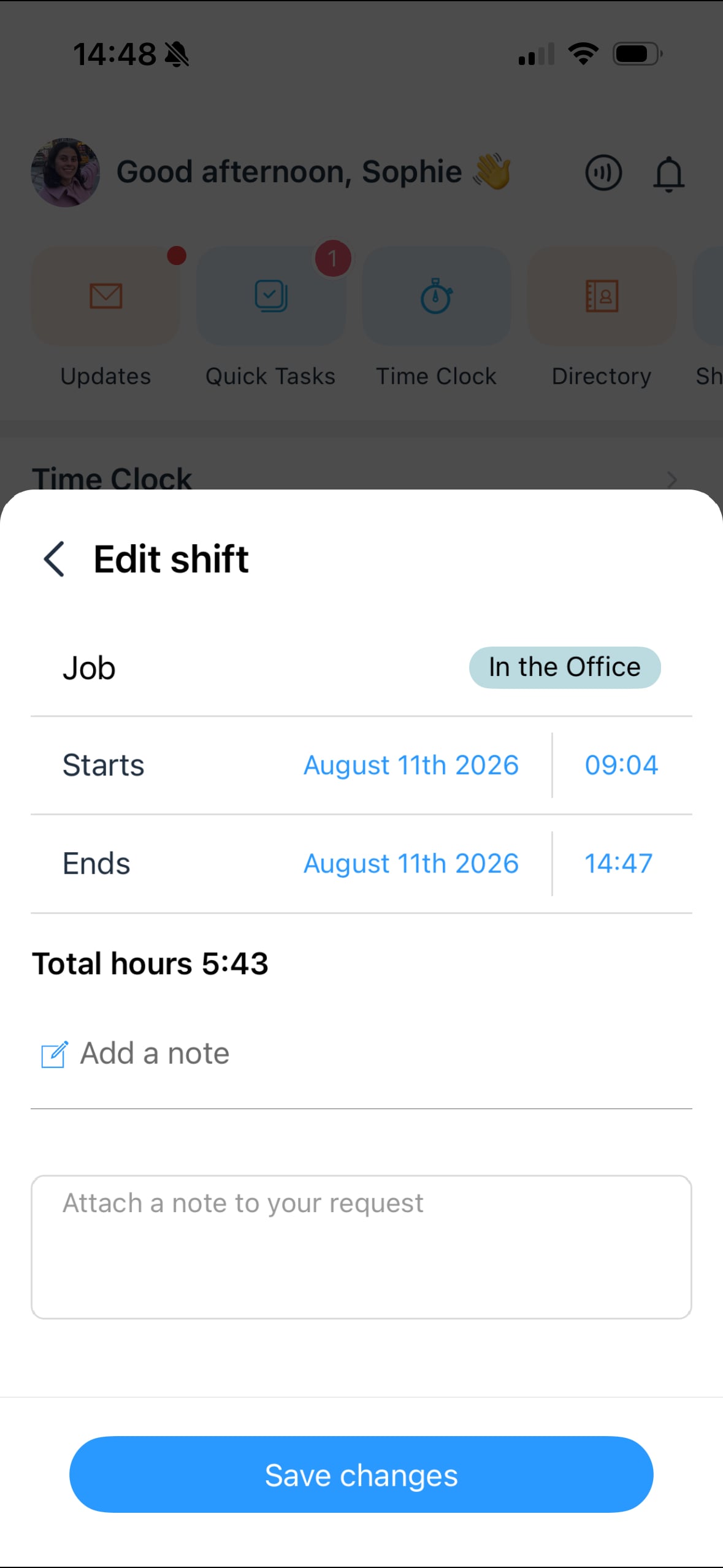
At the end of the day, I end my shift from the app (or NFC, web, kiosk, etc…), add a note, and edit my hours if I need to.
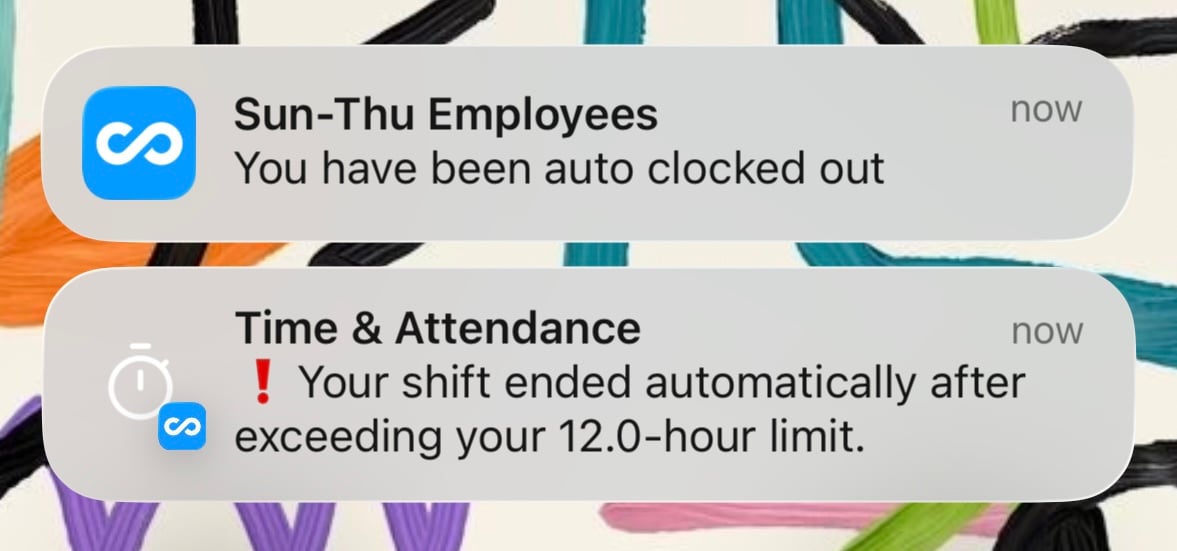
I have a lot of flexibility with the time clock, but you can also add stricter rules, like not letting your employees change their recorded hours or only allowing them to clock into their scheduled shifts. Plus, you can control how early employees clock in and set up automatic clock outs at the end of their shift or when they hit a daily hour limit.
GPS tracking and the geofence
Let’s get into every manager’s favorite feature: the real-time GPS tracker. This is a really useful feature, especially if you have field teams or work across multiple job sites.
When I clock in, the app takes a location stamp so my manager can verify that I’m at work. The GPS feature also tracks my location while I’m on the clock.
For added control, you can set up a geofence, which is basically a clock-in zone. Employees can only clock in once they’re in the geofence, and you can set up automatic clock-outs if they leave the zone.
Overtime and breaks
When it’s time for lunch, I can start my break, or if I forget, the time just gets deducted from my total hours. If you’re worried about compliance, you can set up paid or unpaid breaks, stop employees from returning early, and send them break reminders.
You get the same level of oversight with overtime. You can block extra hours that you didn’t approve beforehand, and get notifications when an employee gets close to overtime.
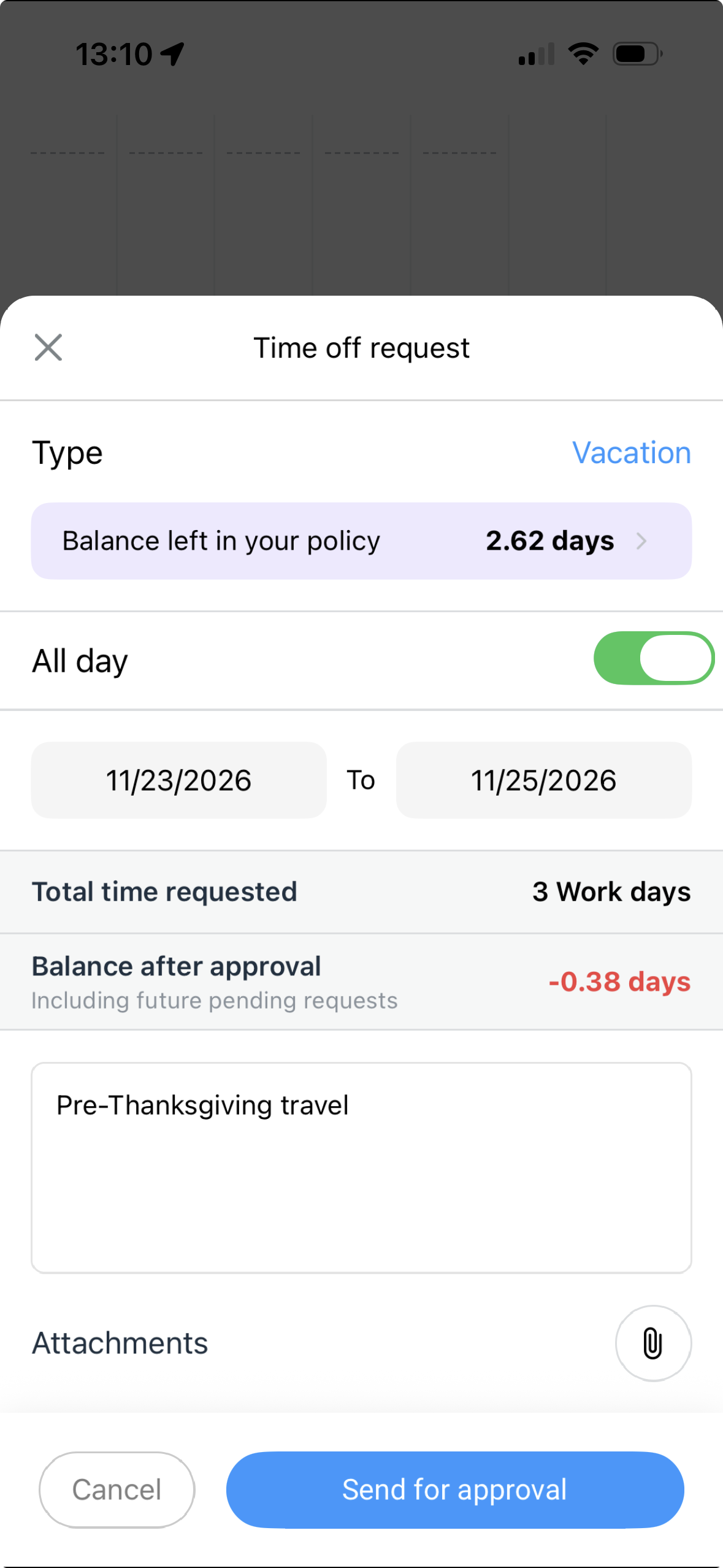
Paid time off
Time off management is as easy as opening the Connecteam app (web, kiosk, etc.) and submitting a request. My manager gets notified immediately, and can approve or deny it in a tap. I can view my remaining accrual balance, and see any approved time off on my timesheet.
Attendance reports
If you’re a small business owner, your top priority probably isn’t digging through data just to figure out who clocked in and who’s late. Luckily, Connecteam offers attendance reports that show you attendance patterns, overtime trends, and potential payroll issues before they become (expensive) problems. My manager has automatic reporting set up, so he gets the attendance info sent to him everyday at the same time.
Timesheets and payroll
All my hours are logged into timesheets for payroll. Before payday, I check my timesheet to make sure all my hours look correct, request changes if I need to, and then submit my timesheet for my manager to approve.
Edits are tracked, so there’s an audit-ready trail if you ever need it. Managers can assign employees custom pay rates, and export timesheets or sync them directly with RUN Powered by ADP®, QuickBooks, Xero, or one of our other payroll integrations.
And so much more…
Connecteam is built to support small business operations with employee scheduling, in-app messaging, mobile training, and a whole lot more.
When Connecteam isn’t a good fit
Let me point out some of Connecteam’s flaws, starting with the top of the list: internet. If your team works in remote areas without cell reception or spends a lot of time in elevators, the app won’t work for you. Also, if you’re looking for more oversight into your team’s productivity (think: screen monitoring), we can’t help with that.
Connecteam also offers a free for life plan – Try Connecteam here!
0Key Features
- Mobile, web, kiosk, and NFC clock-ins
- Real-time GPS tracking and geofencing
- Automated timesheets with edit tracking
- Custom break and overtime rules
- PTO tracking and leave accruals
- Digital timesheets and payroll integrations
Pros
- Prevents unapproved overtime with custom alerts
- Mobile app is really easy to use
- Reduces manual timesheet corrections
- Supports teams across multiple locations
Cons
- Requires an internet connection for real-time syncing
- Lacks screen monitoring tools for productivity tracking
Pricing
Free-for-life plan availablePremium plans start at $29/month for 30 users
14-day free trial, no credit card required
Start your free trial -
Buddy Punch — Best for small teams that want a simple online time clock they can set up in a day
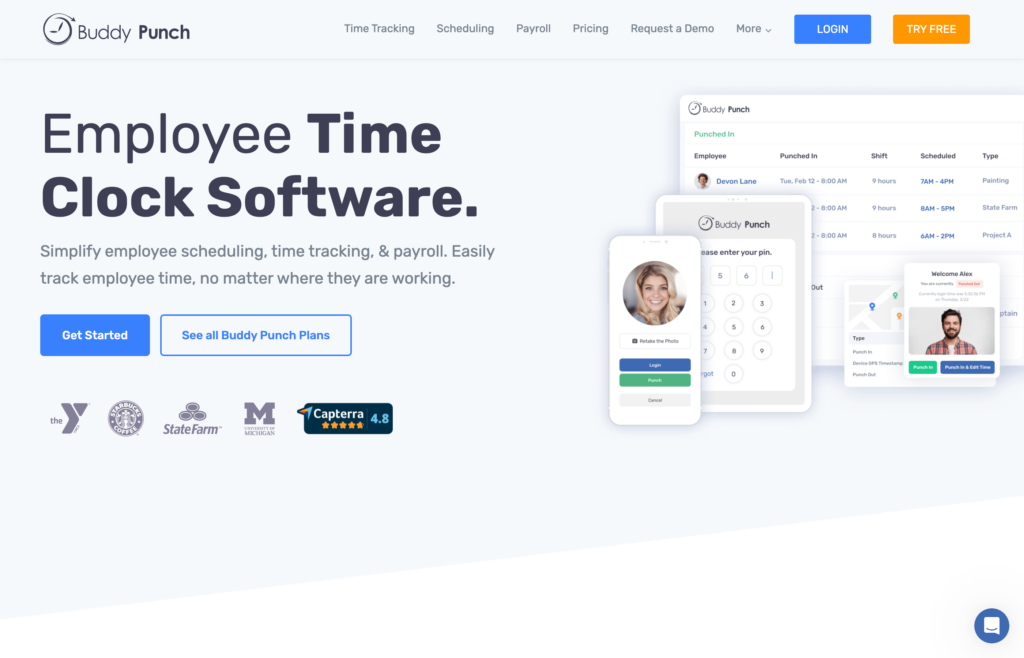
Buddy Punch is a software company that has a time clock for small businesses, helping teams monitor and verify employee hours, breaks, and location.
Personally, I didn’t test Buddy Punch, but I did read our full Buddy Punch review, written by one of our trusted product testers.
I included Buddy Punch on this list because it pairs straightforward time tracking with facial recognition and geofencing, all at a pretty affordable price. Plus, the setup is simple enough for small teams to get started without too much support.
Time clock
Like Connecteam, Buddy Punch offers a time clock that employees can use from their phone, tablet, or a shared kiosk. Employees can also punch in with a QR code or by texting. There’s no complicated set up or learning curve, which is a huge plus if you’re a small business owner without the time for a long, complicated rollout process.
Clocking in and out works like you would expect it to, and Buddy Punch automatically calculates regular hours, breaks, and overtime based on whatever rules you have in place. You can also automatically clock out employees after they’ve hit a set number of hours, which worked great during our test. Managers just have to approve the clock-out for the time to show up on the timecard, which seems pretty reasonable.
Also like Connecteam, Buddy Punch’s mobile app needs an internet connection to work.
The one thing that’s a bit strange, but not a deal breaker, is that Buddy Punch doesn’t show a running timer on the mobile app. You can see when you clocked in, but without doing the mental math there’s no easy way to know how long it’s been.
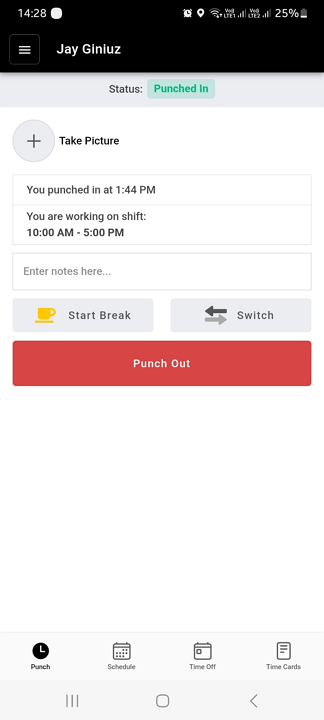
There’s no running timer once you clock into the Buddy Punch mobile app. Facial recognition
As their name suggests, Buddy Punch offers features to prevent, you guessed it…buddy punching (!), which is basically when one employee tries to clock in for another. One of the ways they do this is through facial recognition.
If you use this feature, then your employees are going to be asked to take a selfie whenever they punch in or out, like we were during testing. The thing is, those selfies are attached to each employee’s timecard, which means that instead of automatic verification, you’re the one sorting through photos and making sure you recognize each employee’s face.
Now, this might not sound like a big deal for a small team. But think about checking a selfie for every clock-in and clock-out, every day, for every employee. To me, that seems like a little bit more effort than I’d like to be making pre-payroll.
Location-based clock-ins
Buddy Punch lets you set up geofences, which restrict off-site clock-ins. The feature worked well during our testing, and even showed us how far we were from a geofence. We also got a notification to clock in when we entered the area and a reminder to clock out when we left.
Managers can access GPS tracking, which records employees’ locations at clock-in and follows their movement while they’re on the job. Just know that this costs extra. You’ll either need the Advanced plan, which is priced at $12.99 per user per month (plus the $19 per month base fee) or the GPS add-on, which comes in at an extra $2 per user per month.
Paid time off
Buddy Punch has a pretty standard paid time off setup. Employees can submit PTO requests through the app, which go straight to managers to approve or deny. The biggest plus for me is that time off is automatically added to employee timesheets.
PTO types like holidays, sick leave, vacation, etc. are default, so you don’t have to build them into the system yourself. Accrual policies are also flexible (fixed and hourly) and you can block employees from taking time off on specific dates.
The main gap we found during testing was that you can’t set a minimum notice period for time off requests. That means there’s nothing stopping employees from making last-minute requests, no matter how strict the policy is in your employee handbook.
What users say about Buddy Punch
Overall, it’s been very easy to use and accurate with keeping everyone’s time entries up to date and the PTO feature is the favorite of the employees

My only issue with Buddy Punch is that it does not communicate hours with Quickbooks Online very well. I have to manually make edits to overtime because they don’t communicate well.
 0
0Key Features
- Mobile, web, and kiosk time clock
- Photo capture with facial recognition
- GPS tracking and geofencing
- PTO requests and approval tracking
Pros
- Quick setup and low learning curve
- Photo capture adds accountability
Cons
- Manual verification of clock-in photos
- Mobile app requires constant login credentials
Pricing
Starts at $19/month + $4.49/user/month Trial: Yes — a 14-day free trial is available. Free Plan: No
-
QuickBooks Time — Businesses that want time tracking tightly connected to QuickBooks payroll
QuickBooks Time is a time clock program for small businesses that need to sync employee hours directly with QuickBooks Online Payroll.
The draw to QuickBooks Time is in its name: it’s part of the QuickBooks ecosystem, which means no need for manual CSV exports, which is a huge time-saver for small businesses…already using QuickBooks for accounting and payroll.
Our full QuickBooks Time review goes more into detail, but here’s what stood out to me:
Time tracking clock
Clocking in from QuickBooks Time worked great across web, mobile, and kiosk apps. There’s facial recognition, which, like Buddy Punch, just attaches an employee’s selfie to the timesheet, along with regular hours, breaks, and time off. Employees can clock into an assigned task, so it’s easier to track time against the right project.
QuickBooks Time also sends clock in and out notifications, but you can only see them inside the app. This kind of defeats the purpose of the nudge, which is supposed to remind employees to check the app.
Live location tracking
QuickBooks Time’s location visibility features are pretty strong. There’s a “Who’s Working” map that shows the real-time GPS locations of all your clocked-in employees, so you can keep tabs on where they are throughout the workday.
Beyond that, you can set up geofences around your job sites to prompt employees to clock in and out at the start and end of their shifts. When we tested the geofence, it blocked our off-site clock-ins, but it still let us clock in by adding a note. The notes are flagged for managers to review, but from my perspective they cancel out the advantage of a restriction like a geofence.
Overtime and compliance controls
With QuickBooks Time, you can set up overtime rules for daily, weekly, or double-time. There’s pre-built “California rules” to help small businesses comply with the state’s uniquely strict labor laws.
Managers can edit timesheets in bulk and view a full audit log of any changes, which helps for resolving disputes and keeping your records clean and compliant.
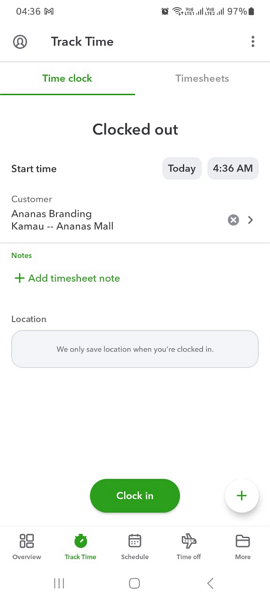
During testing, we could clock in and out of the QuickBooks Time mobile app, add entries, and leave timesheet notes. Seamless QuickBooks integration
The biggest selling point of QuickBooks Time is, of course, its native connection to QuickBooks Online Payroll.
Once timesheets are approved, they sync instantly with your payroll in just a click. No more downloading, formatting, or uploading CSV files every time you need to run payroll. For a small business owner, that’s a big win.
Now, if you don’t use QuickBooks for payroll or accounting, you probably won’t get the same value out of the time clock. QuickBooks Time supports manual exports to other payroll providers, but the platform is built to integrate with QuickBooks. If you use a different payroll provider, it might make more sense to consider one of the more affordable time clocks for small businesses on this list.
What users say about QuickBooks Time
We really like how easy it is to integrate QB Time with QB Desktop. It is easy to to sync and transfer time clock data over to QB for payroll.
What I like the least about QuickBooks Time is the fact that some struggle to clock-in via the mobile app, while others can do it with ease.
0Key Features
- Mobile, web, and tablet kiosk clock-ins
- Native, one-click QuickBooks payroll sync
- Geofencing and location-based tracking
- Detailed timesheet audit logs
Pros
- Seamless integration with QuickBooks Online Payroll
- Strong real-time location visibility for field teams
Cons
- Overtime calculations can be inconsistent
- Expensive compared to other small business tools
Pricing
Starts at $20/month + $10/user/month Trial: Yes — (30 days) Free Plan: No
-

Homebase — Retail and restaurants that want scheduling and time tracking together
Homebase is a workforce management app that combines a time clock, shift scheduling, and team communication in a single platform.
What I appreciate about Homebase is that it offers a single-location free plan for up to 10 employees. For small businesses, that can really give you a sense of the tool before you commit. We cover more of that in our full Homebase review, where we tried the software ourselves.
Here’s what Homebase can do for your small business:
Time clock with kiosk
Homebase keeps retailers and restaurants front of mind, even when it comes to clocking in. Employees can use the time clock on the mobile app, or managers can turn a shared tablet or POS system into a time clock kiosk.
Employees don’t have to keep logging in and out of the kiosk because each team member gets their own PIN code. It’s a good way to speed up the clock in/out process, so you’re not dealing with a line of employees trying to remember their login credentials at the start of a shift.
The other advantage of the kiosk is that it captures photos of employees at clock in/clock out. I was surprised that you can’t do the same thing on the mobile app, which leads me to my next point: the mobile app.
The mobile app was less impressive when we tested it. It’s advertised as offering offline mode, but when our tester turned the internet access off on their phone, the time clock didn’t work. Because of Homebase’s free plan, at least you can test this yourself before committing.
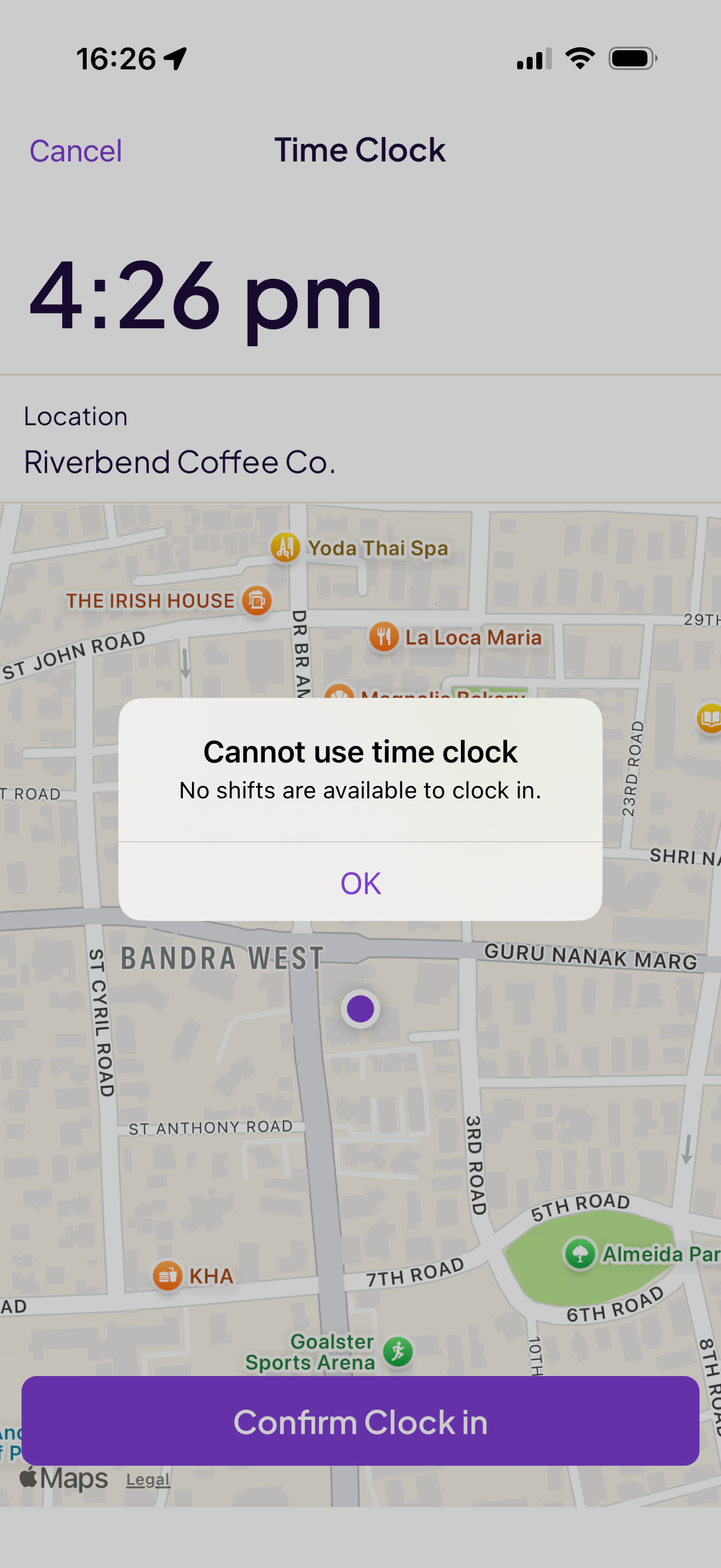
We couldn’t clock in offline when testing Homebase’s mobile app. Clock-in guardrails
Homebase takes GPS stamps at clock in, and you can create a geofence around your job site. Beyond that, Homebase is supposed to alert you about early and late clock-ins or overtime, so you’re not surprised when it’s time to run payroll. We tested this by clocking in late and letting the timer run into overtime. But from the manager’s account, there were absolutely no alerts. The overtime also wasn’t flagged as an issue on the timesheet. From a manager’s
We tried to test Homebase’s overtime alerts by leaving a timer running overnight on an employee profile. Unfortunately, as a manager, we received absolutely no alerts, and the overtime entry wasn’t flagged as an issue on the timesheet, which could lead to unexpected labor costs if managers don’t manually review timesheets daily.
Timesheets and payroll
Punches are logged right into Homebase’s timecards, which are easy to edit, approve, and export. Each timecard includes an employee’s worked hours, breaks, overtime, and wages. From there, you can run payroll with one of Homebase’s partners, including Paychex, Gusto, and ADP.
Homebase also has a built-in payroll, which is available as an add-on even on its highest tier plan. It costs $39 a month plus $6 per user per month, on top of your standard monthly subscription. It’s expensive, so I’d use Homebase’s free plan first to make sure the platform works for your small business before adding payroll.
What users say about Homebase
More good things, than bad, overall a great way to keep track of your hours, especially for works that need to clock in on the road, and you need to have a precise location for the clock ins.
Notifications not coming through consistently remains an issue periodically but has significantly reduced compared to before. The only other issue is that the clocking in feature on a mobile device can be a little inconsistent and not always work.
0Key Features
- Mobile, web, tablet, and POS time clock
- PIN-based clock-in with photo capture on tablets
- GPS location tracking and geofencing
- Integrations with major POS and payroll systems
Pros
- Built-in payroll available as an add-on
- Combines scheduling and tracking
Cons
- Offline mode didn’t work during our testing
- Location-based pricing adds up for multi-site teams
Pricing
Starts at $24/location/month Trial: Yes — (14-day) Free Plan: Yes — (one location and up to 10 employees)
-

Clockify — Best for very small businesses that need a free time tracking tool for basic hour logging
What’s new with Clockify
April 2026: Clockify capped its free plan at 5 users, replacing its previous unlimited-user model.
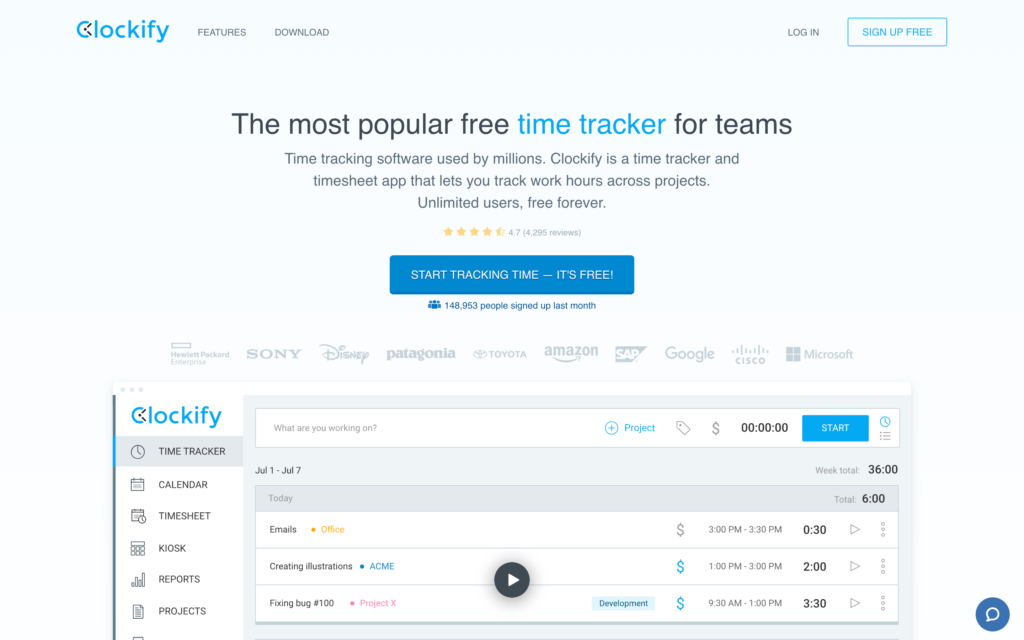
Clockify is a time tracking app for small businesses that offers basic time clock features, timesheets, and project reporting.
Tracking time with Clockify is straightforward. The main draw for me is its free plan, which supports up to 5 users. If you manage a very small team and only need to log hours without heavy scheduling or location controls, Clockify might be a good fit.
Our full Clockify review covers what we learned during testing, but here’s a bit about the time clock:
Basic timer and project logging
You can use Clockify’s timer across web, mobile, and desktop apps. Alternatively, you can use a shared kiosk and have employees clock in and out with a PIN and selfie. If that doesn’t fit with your workflow, employees can always add time entries manually at the end of the day.
Clockify is big on categorizing time. Employees can mark entries as billable or non-billable, and categorize time into specific clients, projects, or tasks. For more detail, you can add descriptions, tags, and custom fields, like text, numbers, links, multiple-choice, etc. It’s a good way to capture information while it’s still fresh and give you a sense of where your team’s hours are actually going.
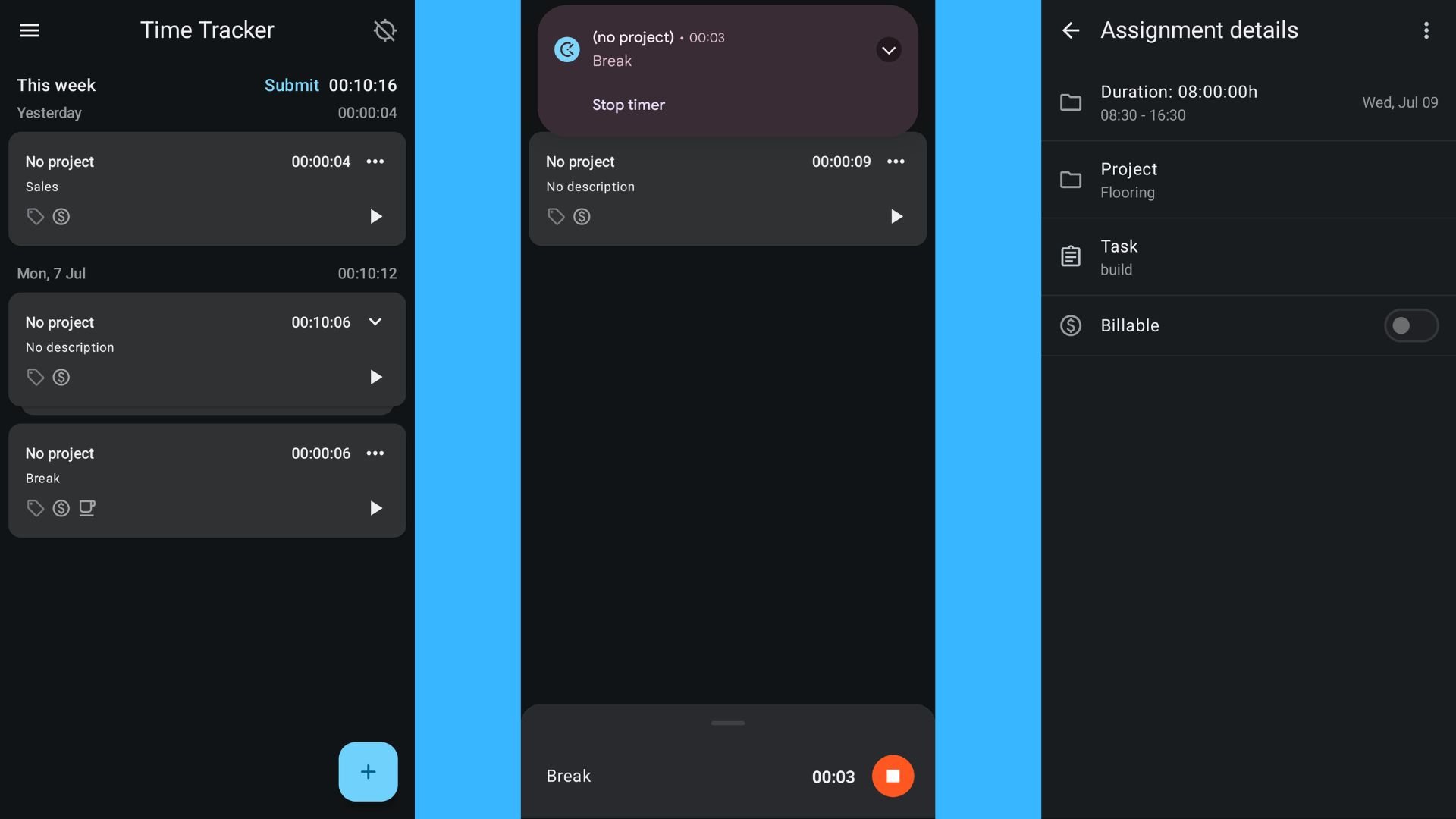
Clockify’s mobile timer lets us clock in and out and track projects. Location and oversight controls
Clockify offers GPS tracking on mobile and screenshot monitoring on desktop. These are locked behind paid plans. What’s interesting is that Clockify doesn’t automatically stop tracking hours after a set amount of idle time. We learned this during testing when we kept the timer running for a few hours and weren’t alerted.
The auto-tracker solves this, because it keeps track of when employees are idle, but you can only use it on the desktop app, not the mobile or web versions.
The bigger issue for me is that Clockify doesn’t support geofencing, which is a letdown if you rely on that type of restriction to confirm employees are on site when they clock in.
Timesheets and payroll
Timesheets aren’t Clockify’s standout feature, at least for me. During our test, there were a few issues we ran into. To start, we could see our daily time divided by project in the employee view. But on the manager’s side, all we saw was an employee’s total time tracked during a pay period.
When we created an overlapping time entry, Clockify didn’t flag it. The conflict also wasn’t visible as a manager because time entries are grouped by project and date. You can check employee profiles for more detail, but it’s a lot of work to do that regularly just to spot inconsistencies.
Managers also can’t review or approve timesheets from the mobile app, which is just inconvenient if you don’t usually work from a desk.
Running payroll also isn’t super smooth. Clockify integrates directly with QuickBooks and Xero for accounting and invoicing, but not for payroll. What that means is that you’ll need to download your timesheets as a CSV, Excel, or PDF file and then manually upload them into your payroll provider’s system. For a small business owner on a deadline, this is the last thing I’d want to worry about before payday.
What users say about Clockify
What I liked most about Clockify is that it is simple to use and makes tracking work hours very easy. It also helps organize tasks and projects clearly.
While it’s improved, some parts of the interface can still feel a bit clunky when managing a high volume of projects or making bulk edits.
0Key Features
- Play/pause timer on web, desktop, and mobile
- Shared kiosk clock-in with PIN codes
- Project, client, and task-based time tracking
- GPS location tracking
Pros
- Free plan supports up to 5 users
- Strong project-based billable hours tracking
Cons
- Lacks geofencing and advanced location controls
- No timesheet approvals on the mobile app
Pricing
Starts at $3.99/user/month Trial: Yes — a 7-day free trial is available. Free Plan: Yes — limited to 5 users.
-

ClockShark — Best for construction and trade crews that track hours by job site
What’s new with ClockShark
As of mid-2026, a 3-year contract term applied to all ClockShark plans.
ClockShark is a digital time tracking and job management platform designed for construction, landscaping, and field service small businesses.
What sets ClockShark apart from the others on this list is that aside from being an industry-specific tool, it connects hours to specific jobs and tasks. That leaves you with precise job costing and project budgeting that you can trust in real-time.
Before I dive into the details, I’ll say that ClockShark did just apply a 3-year contract term to all its plans. Read our ClockShark review for our full testing experience, so you can be even more informed before making such a big business commitment.
Time tracking
ClockShark tracks time across mobile, web, and kiosk apps, and the timer was accurate when we tested it. If an employee doesn’t clock in when they’re supposed to or goes into overtime hours, managers are alerted. The platform even flags missed clock-ins against scheduled shifts on the timesheets, so it isn’t difficult to catch attendance gaps.
Even though ClockShark can send employees clock-in and out reminders, I’m surprised it doesn’t notify you when a timer has been running for a long time. We learned this by leaving the timer running for over 15 hours, without receiving any alerts.
Notifications aside, ClockShark has a bulk clock-in feature that lets managers or supervisors clock in the whole crew at once. It’s a huge help for small businesses (think: construction or event management) that start and end work at the same time.
Breaks and overtime
I wasn’t very impressed with ClockShark’s break enforcement. In our test, we let the break timer run for over an hour, and the system didn’t alert us as an employee or manager. Sure, managers can still catch and correct these issues when they review timesheets, but that still leaves a lot of space for human error.
Overtime worked much better in our testing. You can create rules based on your company policy or use the pre-built California overtime rule. ClockShark can handle daily and weekly thresholds, in addition to standard overtime and double-time rates.
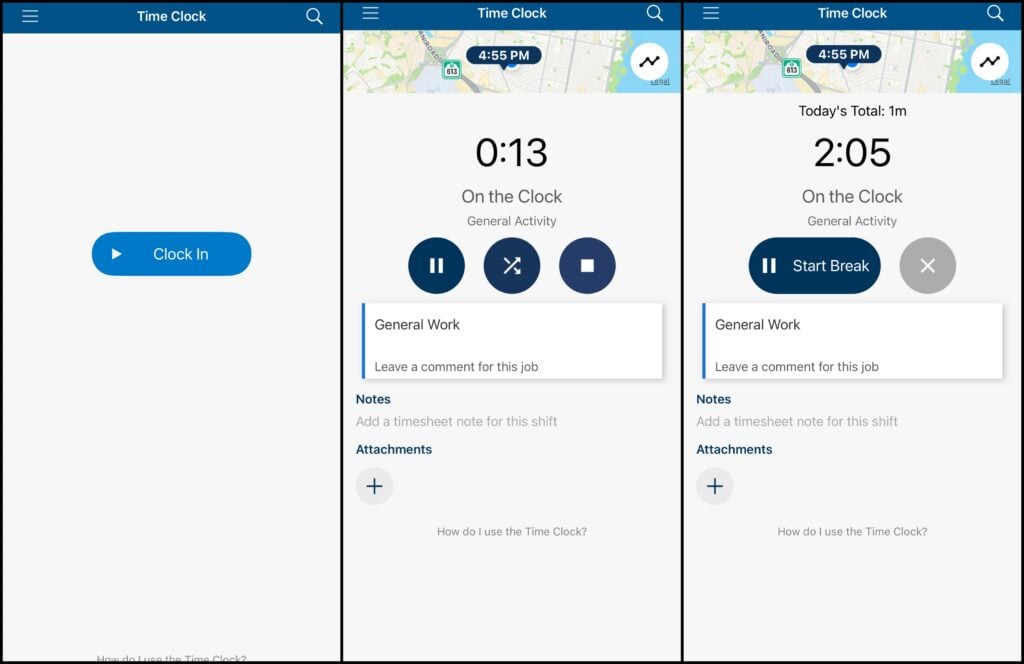
When we clocked in with ClockShark, the app let us start and stop breaks, add notes, and include attachments. Location services
GPS tracking and geofencing are both built into ClockShark’s time clock. Every clock-in and out records GPS data, and the geofence worked as expected in our test. There’s also a map dashboard that shows a live view of all employee locations, so you can see who’s working, where they are, and what job they’re clocked into.
Job costing and timesheets
ClockShark’s job costing lets employees track time against customers, jobs, and tasks. It gives small business owners instant visibility into labor costs and project profitability, which is really valuable.
All that information is logged into timesheets, which employees can edit before submitting them to managers for approval. Once timesheets are finalized, they’re good to sync with one of ClockShark’s payroll integrations.
What users say about ClockShark
The best thing about ClockShark is that it has accurate time tracker with the support of GPS and a great security level.
What I like least about clock shark is that there’s not any extra features to it other than just tracking peoples time and location. I wish there was a feature where I could show people their PTO that they have accrued or I could upload documents for them to see.
0Key Features
- Mobile and kiosk time tracking
- GPS tracking and geofencing
- Job costing and labor cost allocation
- Supervisor-led bulk team clock-ins
Pros
- Strong real-time location tracking and job costing
- Multiple clock-in methods for field crews
Cons
- Limited reporting depth
- No guardrails for preventing extended breaks
Pricing
Starts at $40/month + $9/user/month. Trial: Yes — (14-day) Free Plan: No
-

OnTheClock — Best for small businesses managing PTO inside a straightforward time clock
OnTheClock is an employee time clock for small business owners who want accurate hours, state-specific overtime rules, and simple PTO management.
What I like about OnTheClock is its focus on secure clock-ins. Instead of presenting facial recognition as a real clock in barrier, OnTheClock uses biometric fingerprint punching and IP authorization, which is impressive. Plus, the PTO tracking system is simple, which just gives managers peace of mind.
You can read more about what we found in our OnTheClock review, but here’s my take:
Time tracking
Starting with the basics, employees can track their regular hours, breaks, and overtime with OnTheClock’s mobile, web, desktop, and kiosk apps. The kiosk lets employees punch in with a PIN, and I thought it was cool that you can add a time clock widget to your website for easy access.
I found it a bit unexpected that the auto-clock-out feature only works for employees with fixed schedules. That leaves shift-based teams on the hook (and on the clock) for when they reach daily hour limits or overtime.
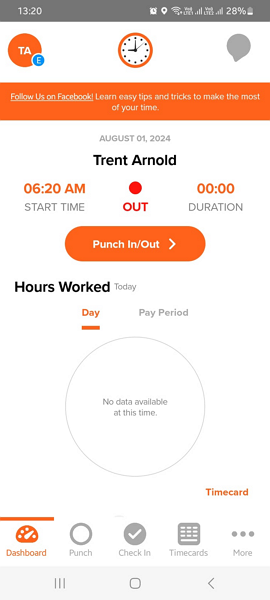
We clocked in and out from the OnTheClock mobile app and viewed our hours worked. Clock-in restrictions
As I already mentioned, OnTheClock offers strong clock-in restrictions.
OnTheClock lets you assign geofences to shifts, which blocks employees from clocking in outside approved locations. But you can’t assign geofences to specific jobs or employees. We also figured out during testing that employees can clock in from any geofence, not just the one for their assigned shift. That means someone could be at the completely wrong site and still clock in without raising any flags.
The other restrictions worked better. You can restrict clock-ins to a specific IP address, like your company’s network. If you want to invest in the hardware or already have it at the ready, OnTheClock syncs with biometric data like fingerprint scanning.
For less of an investment, there’s also device and browser authorization, which worked well during testing. If an employee tries to clock in from an unauthorized device, OnTheClock blocks the punch and asks for manager approval.
Overtime and break tracking
OnTheClock doesn’t let you build your own overtime policies, but it does have a library of pre-built, state-specific (!) overtime rules. We tested the California rule, and it accurately calculated daily, weekly, and double-time hours.
But beyond its California overtime setting, OnTheClock can’t track daily, double-time, and weekly overtime at the same time, which is an issue for states with multiple overtime requirements. It also can’t split time at midnight, apply holiday and seventh-day overtime, weighted averages, or time off in lieu. In short, there’s plenty of room for improvement.
For break tracking, OnTheClock gives you one automatic break deduction. You can’t create your own custom break rules or enforce additional meal and rest breaks. For small businesses in regions with strict break-tracking laws like California, this doesn’t really help.
PTO management
OnTheClock’s PTO tracking system is pretty flexible, and I was glad to see that it supports both accrual and allotment-based policies. Employees request time off from their phones, and managers receive instant notifications to approve (or reject) requests. It’s a smooth workflow.
The drawback here is that there are only four default PTO categories supported: vacation, holiday, sick, and personal. You can rename these, but you can’t add any new categories, which is a letdown.
There’s also no way to prevent employees from requesting time off at peak times or set a minimum notice period.
What users say about OnTheClock
I have found the application pretty easy to use. The user interface is great and I understood immediately how to use it.
Wish there was a separate button for “lunch/breaks”. Would also be nice to see meal times logged separately.
0Key Features
- IP, device, and browser authorization
- GPS tracking and geofencing
- Pre-built state-specific overtime rules
- PTO tracking with accrual and allotment
Pros
- Strong security controls to prevent buddy punching
- Accurate California overtime calculations
Cons
- Mobile app doesn’t support offline clock-ins
- Limited advanced customization options
Pricing
Starts at $5/month + $4/user/month. Trial: Yes — a 30-day free trial is available with no credit card required. Free Plan: No
Comparison of the Best Time Clocks for Small Businesses
| Topic |
 Start for free
|
|
|
|
|
|
|
|---|---|---|---|---|---|---|---|
| Reviews |
 |
|
|
|
|
|
|
| Pricing |
Starts at just $29/month for the first 30 users
|
Starts at $19/month + $4.49/user/month
|
Starts at $20/month + $10/user/month
|
Starts at $24/location/month
|
Starts at $3.99/user/month
|
Starts at $40/month + $9/user/month.
|
Starts at $5/month + $4/user/month.
|
| Free Trial |
yes
14-day
|
yes
a 14-day free trial is available.
|
yes
(30 days)
|
yes
(14-day)
|
yes
a 7-day free trial is available.
|
yes
(14-day)
|
yes
a 30-day free trial is available with no credit card required.
|
| Free Plan |
yes
Free Up to 10 users
|
no
|
no
|
yes
(one location and up to 10 employees)
|
yes
limited to 5 users.
|
no
|
no
|
| Use cases |
Best for growing small businesses that need GPS tracking and payroll-ready hours
|
Best for small teams that want a simple online time clock they can set up in a day
|
Businesses that want time tracking tightly connected to QuickBooks payroll
|
Retail and restaurants that want scheduling and time tracking together
|
Best for very small businesses that need a free time tracking tool for basic hour logging
|
Best for construction and trade crews that track hours by job site
|
Best for small businesses managing PTO inside a straightforward time clock
|
| Available on |
How to Choose the Right Time Clock Software
There are a lot of factors that go into choosing the right time clock for your small business. To get it right, think about your team’s work environment, how your payroll is set up, and what your budget is. Here are a few areas to consider to help you narrow down your search:
Your Team’s Work Environment
- Office, retail, or restaurant: Single location with employees working from a central hub
- Mobile or field-based: Employees work across multiple job sites or service areas
- Distributed team: Mix of office, remote, and field workers in different locations
- Rural or low-connectivity areas: Employees work in areas with unreliable internet service
Your Current Payroll Setup
- QuickBooks user: You need seamless integration with QuickBooks Online Payroll
- ADP or Gusto: You need direct sync to avoid manual timesheet uploads
- Custom or legacy system: You need flexible export options (CSV, Excel, PDF)
- No payroll software yet: You may want a time clock with built-in payroll features
Your Business Size and Growth Plans
- Under 10 employees: You may qualify for free plans or lower-cost options
- 10–50 employees: You need pricing that scales affordably without per-user charges
- 50+ employees or multiple locations: You need per-location or flat-fee pricing to control costs
- Rapid growth expected: Choose a pricing model that won’t become prohibitively expensive
Your Compliance and Labor Law Requirements
- Strict break laws: You operate in California or another state with strict break-tracking requirements
- Overtime-heavy business: You need proactive alerts before employees enter overtime
- Multi-state operations: You need software that supports different overtime rules by state
- Audit-ready records: You need detailed edit trails and compliance documentation
Key Questions to Guide Your Decision
Before choosing a time clock, ask yourself these questions:
- Where do most of my employees work (office, field, retail, or mixed)?
- What payroll software do I currently use, and does the time clock integrate with it?
- How many employees do I have now, and how many do I expect to have in 12 months?
- Do I need GPS tracking and geofencing, or is basic time logging sufficient?
- What’s my budget per month, and which pricing model makes the most sense for my team size?
- Do my employees work in areas with reliable internet connectivity?
- Do I need to comply with strict state break-tracking laws like California’s?
- Can I set up the software myself, or do I need vendor support?
- What’s the free trial period, and can I test it with my actual team?
How Much Do Time Clocks for Small Businesses Cost?
As a small business, your budget matters. If you’re going to spend money on a software, you should know how much it’s going to cost you.
Time clock software for small businesses ranges in price, usually depending on its pricing model. Most tools charge a base monthly fee plus a per-user cost. Base plans typically start from around $5 to $40 per month, with per-user fees between $3.99 and $9. Some platforms use location-based pricing, which can add up for multi-site teams.
I’m biased, but I think that Connecteam has one of the most fairing pricing models on the market. Its Small Business Plan is free for up to 10 users, and paid plans start at $29 per month for up to 30 users, which works out to less than a dollar per team member. For a genuinely useful time clock, that value is unbeatable.
FAQs
It depends on the software. Some platforms, like ClockShark, offer robust offline capabilities that record employee punches and GPS data locally on the device, automatically syncing the information with the cloud once a connection is re-established. Other platforms, like Homebase and OnTheClock, require a continuous internet connection to function, meaning the time clock will fail to work in remote areas with unreliable cellular service.
Geofencing allows managers to draw virtual boundaries around specific physical addresses or job sites. When enabled, the software uses the employee’s smartphone GPS to verify their location. If an employee attempts to clock in from home or outside the boundary, the system will automatically block the punch or flag it as “out of bounds” for manager review, ensuring employees are physically on-site before they can log hours.
Yes, GPS tracking is legal in most jurisdictions, provided it is used strictly for business purposes during active working hours. To ensure compliance and maintain trust, employers should always establish a clear written policy, obtain explicit employee consent, and ensure the software automatically disables location tracking as soon as the employee clocks out or goes on an unpaid break.
The Bottom Line
Small businesses don’t have time to deal with expensive payroll errors, unapproved overtime, or admin headaches. You need a reliable time clock that addresses your team’s unique needs and can handle your day-to-day challenges.
If you’re a growing small business that wants to protect labor costs, eliminate buddy punching, and clean up payroll, Connecteam is the top choice. Its flat monthly pricing, generous free plan, and all-in-one operations hub give you unmatched value and scalability.
Start your 14-day free trial with Connecteam today and take control of your business operations!