
Small timekeeping mistakes add up fast for small businesses, leading to payroll errors, overtime surprises, and disputes that drain time and money.
I reviewed six small business time clocks and evaluated them on clock-in accuracy, automatic overtime and break calculations, payroll readiness, and location controls.
Use this guide to choose a system that protects your labor costs and keeps payroll clean.
| App | Best for | Starting Price | Key Considerations |
| Connecteam | Growing businesses needing GPS-verified, payroll-ready hours | 100% free for up to 10 users
$29/month (up to 30 users) |
One platform handles time tracking, scheduling, and team communication |
| Buddy Punch | Small teams that want a simple online time clock | $19/month + $4.49 per user | Quick setup and facial recognition prevent buddy punching |
| QuickBooks Time | Businesses that want time tracking tightly connected to QuickBooks payroll | $20/month + $8/user/month | Seamless QuickBooks integration eliminates manual exports |
| Homebase | Retail and restaurant small businesses that want scheduling and time tracking together | $24/location/month | Combined scheduling and time tracking with per-location pricing |
| Clockify | Very small businesses that need a free time tracking tool for basic hour logging | $3.99/user/month | Unlimited users on free plan is generous but lacks geofencing |
| ClockShark | Small construction and trade crews that track hours by job site | $40/month + $9/user/month | Built-in job costing and invoicing for field service teams |
What’s New in This Update (February 2026)
- Re-verified all pricing, free plans, and tier structures.
- Rechecked GPS accuracy, geofencing enforcement, break automation, and overtime calculations.
- Refined “best for” positioning to reflect specific small business use cases.
- Replaced Jibble, Timecamp, and Deputy with Buddy Punch and ClockShark to better represent field and job-based time tracking needs.
Our Top Picks
-
1

Best for growing small businesses that need GPS tracking and payroll-ready hours
-
2

Good for small teams that want a simple online time clock
-
3

Good for businesses that want time tracking tightly connected to QuickBooks payroll
Why trust us?
Our team of unbiased software reviewers follows strict editorial guidelines, and our methodology is clear and open to everyone.
See our complete methodology
How I Ranked the Best Small Business Time Clock
Here are the key features I looked at when evaluating the best small business time clocks:
The must-haves:
For small teams, these time clock essentials are non-negotiable:
- Reliable clock-ins: Employees should be able to clock in from a phone or shared device in seconds. If it caused confusion, it didn’t rank highly.
- Automatic calculations: Regular hours, breaks, and overtime should be calculated instantly to avoid payroll mistakes.
- Clean, clear timesheets: Managers need a simple approval process with visible edits to prevent disputes.
- Time-off tracking: PTO, vacation, and sick leave should automatically reflect in worked hours so payroll stays accurate.
- Simple payroll export: Timesheets should export cleanly or connect directly to your payroll provider, without extra formatting or spreadsheet fixes.
If a platform missed any of these, it wasn’t included in my picks.
Day-to-day performance:
Beyond the basics, I looked at:
- Mobile-first design: Most small teams rely on phones, so everything needs to work smoothly on mobile.
- User friendly: If the system required heavy training, it was less likely to be used by employees.
Controls to protect small businesses:
For small businesses, advanced features matter if they reduce risk or save time.
- Location controls: Geofencing or GPS verification is especially important for mobile or field teams. These confirm employees are at the job site to help prevent time theft.
- Overtime alerts: Managers should receive early warnings to help prevent unplanned labor costs.
- Simple reporting: Small businesses don’t need enterprise dashboards, but they do need quick visibility into total hours, overtime, and attendance issues.
6 Best Time Clocks for Small Businesses
-
Connecteam — Best for growing small businesses that need GPS tracking and payroll-ready hours
Connecteam is the best choice for small businesses because it combines accurate time tracking with built-in scheduling and payroll-ready reporting in one easy-to-use platform. It’s especially well-suited for teams that need real-time visibility and overtime control without complex setup or enterprise-level pricing.
Why I chose Connecteam: I ranked Connecteam #1 because it was the most complete solution for small business time tracking, especially in ease of use, automatic hour calculations, and payroll-ready reporting.
Let’s take a closer look at how Connecteam can help small businesses track time accurately:
Employee time clock
Connecteam’s employee time clock is built specifically for small businesses that need accurate hours without added complexity. Employees can clock in and out from their phone, desktop, or a shared kiosk in one tap. Time is recorded down to the second, so you don’t have to worry about rounding or padded hours.
I also liked that you can set overtime rules, break policies, and custom pay rates once, and the system applies them automatically. That means fewer manual adjustments and cleaner payroll every pay period.
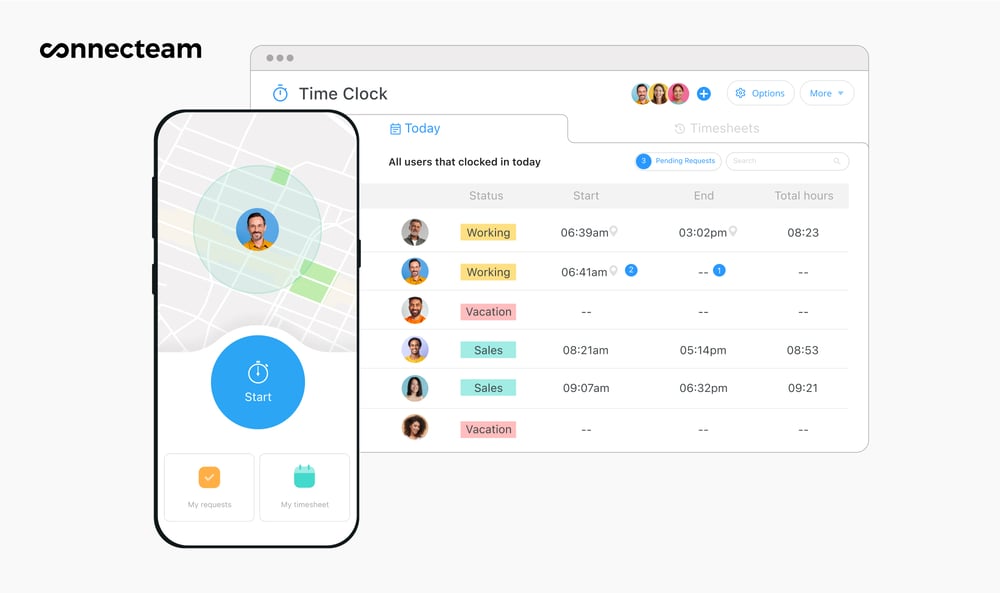
Employees can clock in with just a tap, while managers can monitor attendance in real-time. GPS tracking and geofencing
For small businesses with field teams or multiple job sites, Connecteam offers a built-in real-time GPS tracker. Each clock-in includes a location stamp, giving managers confidence that employees are where they should be.
The geofence time clock adds another layer of control. I appreciated that you can prevent early clock-ins, block punches outside approved locations, and send reminders when employees enter a job site. Instead of chasing missed punches later, you get accurate time data upfront.
Note: GPS and geofencing features may be regulated in some areas, so confirm compliance with state GPS tracking laws and employee consent requirements before enabling them.
Overtime, breaks, and time off
Connecteam helps small businesses control labor costs before they become unmanageable. Managers receive alerts when employees approach overtime, and you can even set custom rules to automatically block unapproved extra hours.
Break tracking is also flexible: you can require paid or unpaid breaks, prevent early returns, and send reminders to keep timesheets compliant. When it comes to time off management, you can handle PTO, vacation, and sick leave directly in the app. Balances update automatically and employee requests sent straight to managers for quick approval.
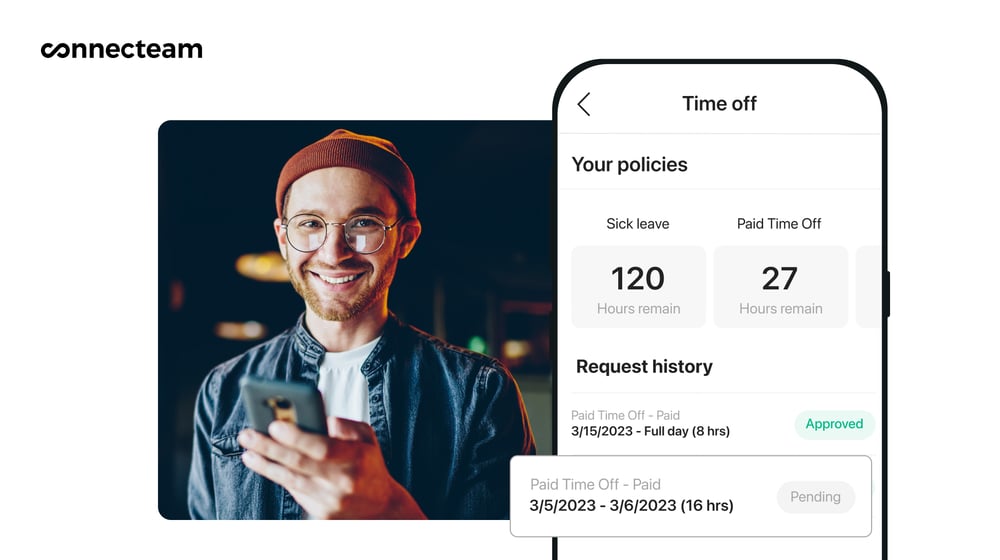
It’s easy for employees to submit time-off requests and track their leave accruals directly in the Connecteam app. Attendance reports
Small business owners need straightforward dashboards that show clear answers without much digging. Connecteam’s dashboard shows who’s clocked in, late, or absent in real time. Plus, you can set up automatic reporting that highlights overtime trends, attendance patterns, and potential payroll issues before they become expensive mistakes. I liked that you can choose how often reports run, once to receive the information you need, right when you need it.
Automated timesheets and payroll
Every clock-in is logged right into the timesheets for payroll. Employees can check their hours, request changes, and submit for approval directly in the app, while managers can quickly review and approve. I liked that all edits are tracked, so your records stay compliant and audit-ready. Custom pay rates are applied automatically, so you don’t have to stress about making manual corrections.
When it’s time to run payroll, timesheets export directly to providers like RUN Powered by ADP®, QuickBooks, and Xero. You can also download them in a ready-to-use format. Connecteam also offers API access and integrates with other business tools, such as PrismHR, Lightspeed, and Wix Bookings, to make your workflows that much smoother.
And so much more…
Connecteam makes it easy to run your business without juggling multiple tools. Beyond time tracking, Connecteam is a complete workforce management app designed to help you with your day-to-day operations:
- Employee scheduling: Build schedules with a simple drag-and-drop editor or use the auto-scheduler to assign shifts based on availability and roles.
- Online team chat: Keep work chats, updates, and files organized in one secure place.
- Employee task tracking: Assign daily or recurring tasks and track completion in real time.
- Training and onboarding: Use the AI Course Creator to create and deliver training materials quickly to get new hires up to speed.
Connecteam considerations
Connecteam is best suited for small businesses that want more than just accurate time management, since it combines time tracking, scheduling, and team communication in one platform. If you only need a basic time clock with simple payroll exports, this all-in-one approach may offer more than you need.
It’s also important to consider your work environment. If your team operates entirely from a fixed office, you likely won’t need GPS tracking or geofencing. And because Connecteam requires an internet connection, businesses working in remote areas with unreliable service may benefit more from a time clock with offline capabilities.
Connecteam also offers a free for life plan – Try Connecteam here!
0Key Features
- Mobile and kiosk time clock
- GPS tracking and geofencing
- Automated timesheets
- Break and overtime rules
- PTO tracking and accruals
- Payroll-ready exports
Pros
- Reduces payroll corrections
- Prevents unapproved overtime
- Strong visibility across locations
- Easy for employees to adopt
Cons
- Requires internet for real-time syncing
- May be more than needed for very small office teams
Pricing
Free-for-life plan availablePremium plans start at $29/month for 30 users
14-day free trial, no credit card required
Start your free trial -
Buddy Punch — Good for small teams that want a simple online time clock they can set up in a day
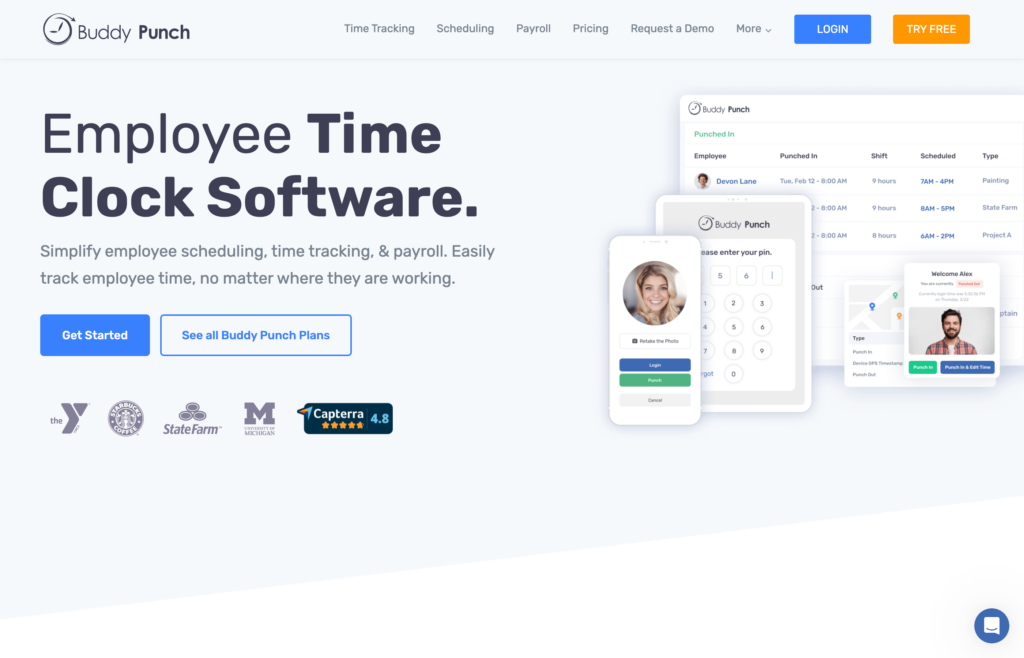
Buddy Punch is a time clock for small businesses that helps teams monitor and verify employee hours, breaks, and location.
Why I chose Buddy Punch: I liked that Buddy Punch offers straightforward time tracking with facial recognition and geofencing at an affordable price, with a setup simple enough for small teams to get started without much support.
Time clock setup
In our full Buddy Punch review, we were able to easily set up shifts, overtime rules, and break policies. Employees can clock in from their phone, tablet, or a shared kiosk, and there’s no real complicated configuration or steep learning curve. For small business owners who don’t have time for lengthy rollouts, this is a huge plus. Employees clock in with a tap, and the system automatically calculates regular hours, breaks, and overtime based on your rules.
That said, Buddy Punch’s mobile app needs an internet connection to work, which may not be ideal for field teams in low-coverage areas. We also found during testing that you have to log in every time you open the mobile app. For small, busy teams, that extra step could create unnecessary friction, especially when clocking in needs to be quick and smooth.
Facial recognition and geofencing
Buddy Punch offers a facial recognition feature, which requires employees to take a selfie before clocking in as a way to prevent buddy punching. However, while testing Buddy Punch, we realized that it doesn’t actually verify the employee’s identity. Instead, it just adds the employee’s photo to their timesheet. That means managers still have to manually confirm that the photo matches the employee.
For an additional $2 per user per month, managers can use GPS tracking to record employees’ locations at clock in and see their movement while on the job. There’s also geofencing, which lets managers set approved job sites and flag punches outside those areas. However, we found that it doesn’t automatically clock employees in or out when they enter or leave the geofence, which was a bit disappointing.
Note: GPS tracking and geofencing may be regulated in some areas. Always confirm compliance with local tracking and employee consent laws before enabling location features.
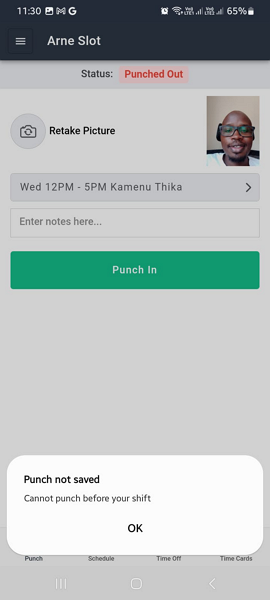
When testing Buddy Punch, we had to take a selfie before clocking in. Timesheets and payroll
Once employees clock in, Buddy Punch automatically calculates total hours, applies break rules, and flags overtime based on your settings. I thought timesheets were organized and easy to review, helping managers approve hours quickly.
Buddy Punch offers its own payroll as an add-on to paid plans for a base fee of $39 per month and $6 per user per month. But if you don’t want to use Buddy Punch’s service, they also offer a range of integrations with popular providers.
What users say about Buddy Punch
I like how fast, easy, and simple it is to use. I don’t have to click through multiple screens just to get to my punch in/out.

There aren’t a lot of major downsides, but some features could be more customizable. For example, reports sometimes feel a bit limited if you want very specific data. It would also be nice if a few actions required fewer clicks.
0Key Features
- Mobile and kiosk time clock
- GPS tracking and geofencing
- Facial recognition photo capture
- Configurable break and overtime rules
Pros
- Fast to set up
- Simple interface for small teams
Cons
- Requires internet connection
- GPS and payroll features cost extra
Pricing
Starts at $4.49/user/month + $19 base fee/month Trial: Yes — 14 days Free Plan: No
-
QuickBooks Time — Good for businesses that want time tracking tightly connected to QuickBooks payroll
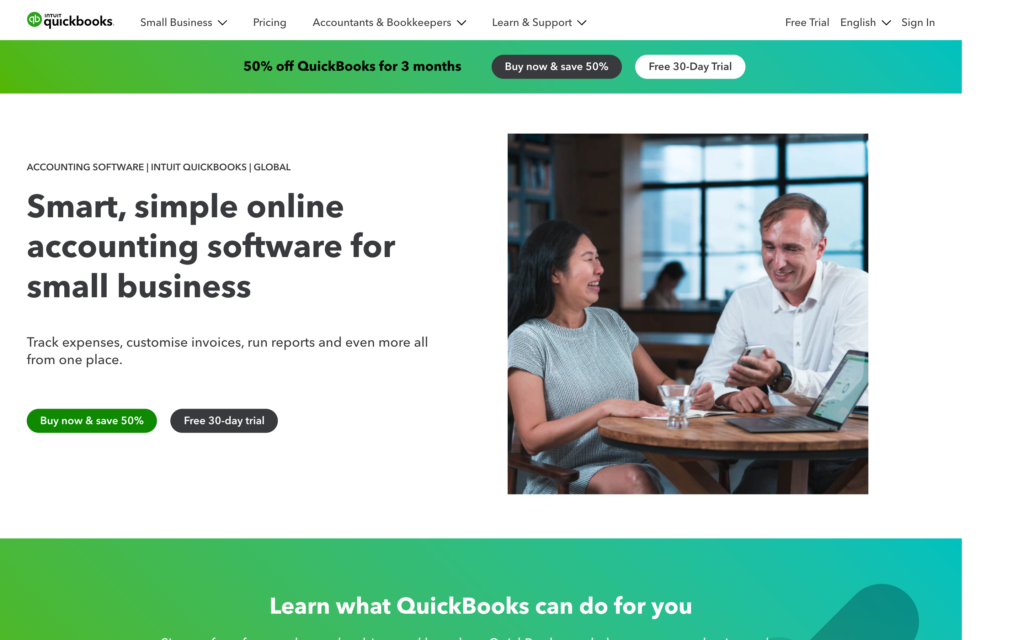
QuickBooks Time is a time clock solution designed to track employee hours and sync approved time with QuickBooks accounting and payroll.
Why I chose QuickBooks Time: QuickBooks Time makes the most sense for small businesses already running payroll through QuickBooks. The native integration removes the need for manual exports and reduces double entry.
Time tracking and location controls
In our full QuickBooks Time review, we discovered that employees can clock in and out from mobile, desktop, or a shared kiosk. The system records regular hours, breaks, and paid time off, and pushes everything into digital timesheets.
I was impressed by its verification features, including GPS tracking, geofencing, and facial recognition. During our testing, the app successfully blocked clock-ins outside approved job sites, but it still let us override the restriction by adding a note. Even though these clock-ins are flagged for manager review, this flexibility could still be taken advantage of without clear policies in place.
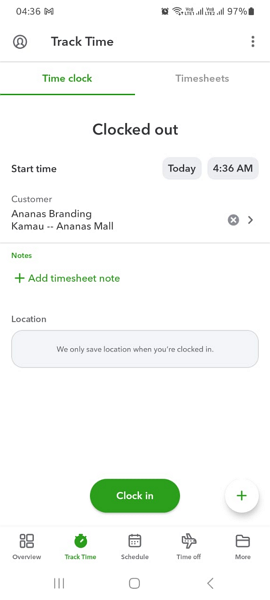
During testing, we were able to clock in and out of the QuickBooks Time mobile app, add entries, and leave timesheet notes. Breaks and overtime management
QuickBooks Time’s break tracking is customizable and pretty easy to set up. You can set paid or unpaid breaks, require full break durations, automate break placement, and even prevent employees from ending breaks early.
Setting up overtime was also pretty straightforward: you can set rules for daily, weekly, or double-time. There are even built-in “California rules” to cater to the state’s unique overtime laws. However, during our testing, the overtime tracker didn’t consistently calculate daily or double-time hours correctly. For small businesses that depend on precise overtime tracking, this could create serious payroll and compliance risks.
Timesheets and payroll
All recorded hours are organized into digital timesheets for manager review and approval. While detailed, the layout felt a bit cluttered, especially when making bulk edits. I thought that the job costing feature was a plus, since it lets employees track time against specific projects or customers. This gives small businesses clearer visibility into where labor costs are going.
Once hours are approved, they automatically sync with QuickBooks Online Payroll, which is definitely the platform’s biggest strength. That said, integration options outside of the QuickBooks ecosystem are limited. If you’re not already using QuickBooks, other small business time clocks may offer similar features at a lower cost.
What users say about QuickBooks Time
What I like best about QuickBooks Time is how user-friendly it is. It makes tracking hours simple and quick, especially with the mobile app.
I don’t like that QuickBooks Time does not automatically tally up the hours from a specific pay period, so we had to enter the daily amount of hours into a program when payroll hit and then add it up to actually pay the employees.

 0
0Key Features
- Mobile and kiosk time clock
- GPS tracking and geofencing
- Job and project tracking
- Payroll sync with QuickBooks
Pros
- Seamless QuickBooks payroll sync
- Strong job costing visibility
Cons
- Overtime calculations can be inconsistent
- Higher cost than most small-team tools
Pricing
Starts at $20/month + $8/user/month Trial: Yes — 30 days Free Plan: No
-

Homebase — Good for retail and restaurants that want scheduling and time tracking together
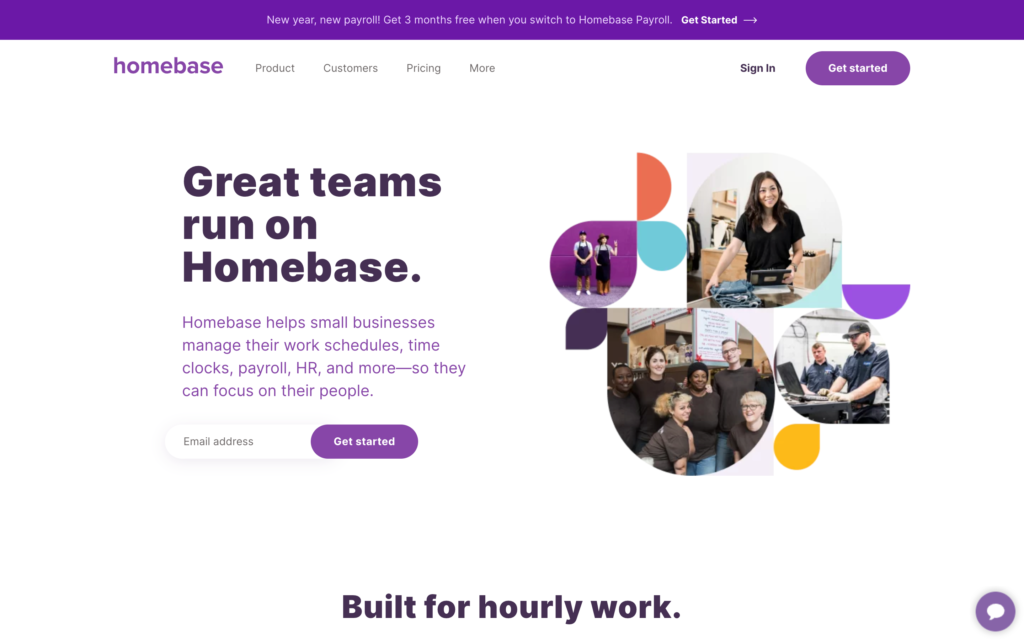
Homebase is a time tracking platform for small businesses that offers an in-app time clock, scheduling, and payroll.
Why I chose Homebase: Homebase has a clean interface and offers a free plan that lets small businesses access basic time tracking and scheduling tools.
GPS time clock
In our full Homebase review, we used the time clock from a smartphone and desktop, but you can also clock in from a tablet or POS system using a PIN. I appreciated that managers can choose between a live timer or manual time entries. Homebase captures GPS data at clock-in for added verification. Geofencing is also available to help confirm employees are at approved job sites when they start their shifts.
However, during testing, we did experience a few drawbacks. Time is recorded to the nearest minute rather than the second, which could definitely impact payroll accuracy over time. Photo verification is limited to tablets and POS systems, which may be an issue for small businesses that need that extra layer of security on mobile devices.
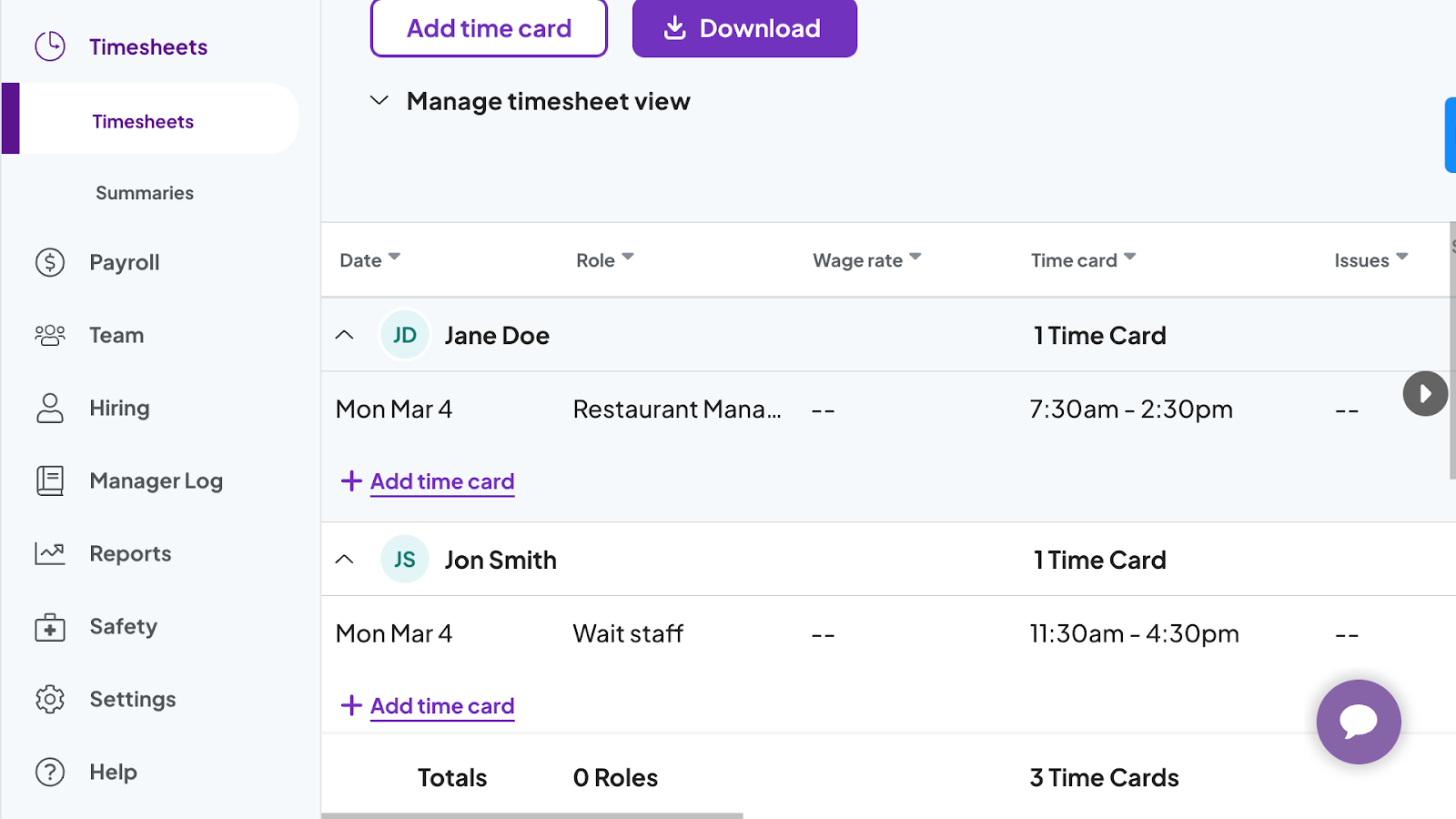
We were able to edit, add, and approve time cards during our testing. Timesheets and payroll
Once hours are recorded, they’re logged into digital timesheets for review and approval. Homebase offers built-in payroll, so managers can run payroll directly in the system after approving hours. Alternatively, you can enable automatic payroll to make the process even easier.
The main downside of payroll is cost. Payroll pricing starts at a base monthly fee of $49, plus a $6 per-employee charge, which can become pretty expensive as teams grow. If you use a different provider, Homebase integrates with services like Gusto and Paychex.
Scheduling and time-off
Beyond time tracking, Homebase has scheduling tools that work alongside the time clock. Managers can build weekly schedules, use templates for recurring shifts, and let employees swap or claim open shifts.
Time-off policies, overtime rules, and break settings are available, but you might need a higher-tier plan to access them. During testing, we also noticed issues with recurring availability settings not applying correctly, which could lead to scheduling errors if you don’t monitor them closely.
What users say about Homebase
It’s very user-friendly and provides plenty of options that I can use for my business, which makes it easy to tailor to what I need.
Employees are often confused about how to request their time off because they assume that vacation is a paid option. However, if you select vacation, it automatically falls under Unpaid time off rather than PTO.
0Key Features
- GPS-enabled time clock
- Geofencing by location
- Built-in payroll option
- Break and overtime rules
Pros
- Scheduling and time tracking in one system
- Built-in payroll available
Cons
- Core features locked behind higher tiers
- Location-based pricing adds up for multi-site teams
Pricing
Starts at $24/location/month Trial: Yes — 14 days Free Plan: Yes — For a single location & up to 20 employees
-

Clockify — Good for very small businesses that need a free time tracking tool for basic hour logging
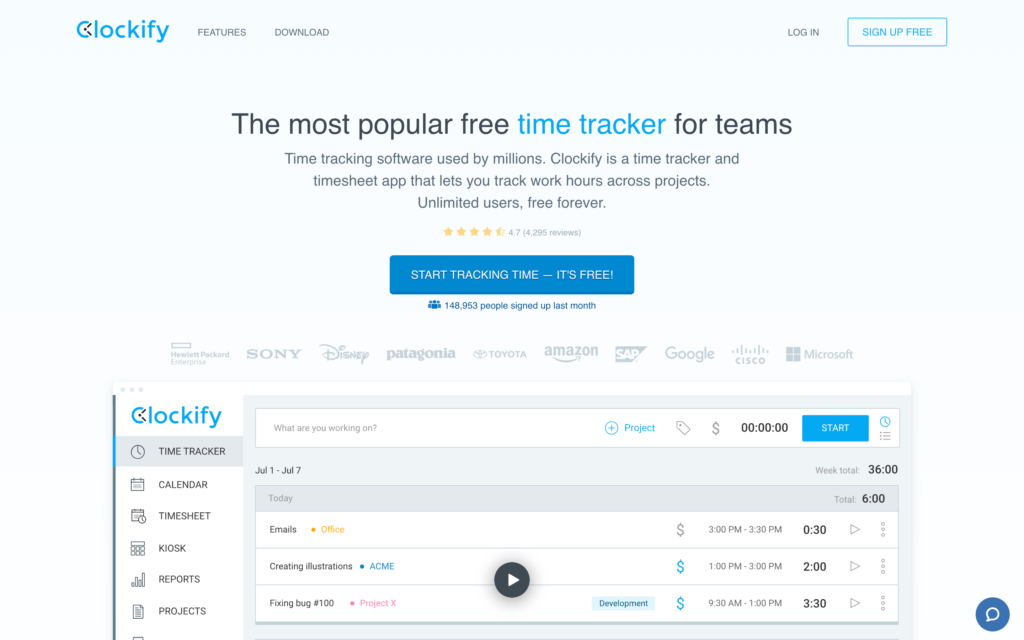
Clockify is a time clock app that offers basic time tracking, timesheets, and reporting for small businesses.
Why I chose Clockify: What interested me about Clockify is that it offers a generous free plan that supports unlimited users, making it a good option for small teams on a budget.
Time tracking
In our full Clockify review, we tested the time clock, which lets employees track hours using a timer on desktop or mobile. Employees can also clock in from a shared kiosk with a PIN or add time manually at the end of the day. For small businesses that want flexible time entry options, it’s helpful.
Clockify also has GPS tracking and screenshot monitoring for remote teams, but the features are only available on paid plans. Also, it doesn’t offer geofencing, which could be a limitation for small businesses that need stronger location-based controls rather than just visibility into where employees are.
Note: Screenshot monitoring and activity tracking may raise privacy concerns. Always ensure employee consent and compliance with local labor laws before enabling these features.

During testing, we were able to select a project, start the timer, and add breaks. Timesheets and approvals
Timesheets are straightforward to review. Managers can lock entries, leave comments, approve hours in bulk, and create templates for recurring work. Employees can also track time against specific clients, projects, or tasks, which I thought was pretty useful for service-based or project-driven businesses.
However, the interface feels pretty dated and heavily table-based. During testing, we also found that you can’t approve timesheets on the mobile app. You can access basic time tracking, but other reporting and admin tools are limited to the desktop. I can see this being frustrating for managers who need to handle approvals and oversight on the go.
Payroll and integrations
Clockify integrates with QuickBooks Online for accounting and invoicing, but not with QuickBooks Online Payroll. While it lists integrations with payroll providers like ADP and Paychex, these are manual exports.
What that means is that you have to download timesheets as CSV, Excel, or PDF files and upload them into your payroll system. For small businesses running tight payroll schedules, that extra step adds admin time and could increase the risk of errors.
What users say about Clockify
Read review here.It is the time control and tracking tool that we use in the company, and in my area, I use it to keep track of the activities and times of my team both in the main office and in the remote offices.
Read review here.Its rigidity can slow you down. When you need to correct entries, switch tasks quickly, or manage more complex workflows, it feels clunky. The interface gets the job done, but it’s not always intuitive, and small admin tasks can take more clicks than they should.
0Key Features
- Mobile and desktop time tracking
- Project-based time entries
- GPS tracking (paid plans)
- Timesheet approvals
- This reflects what actually differentiates
Pros
- Free plan supports unlimited users
- Strong reporting for project tracking
Cons
- No geofencing controls
- Admin tools limited on mobile
Pricing
Starts at $3.99/user/month Trial: Yes — 7 days Free Plan: Yes
-

ClockShark — Good for small construction and trade crews that track hours by job site
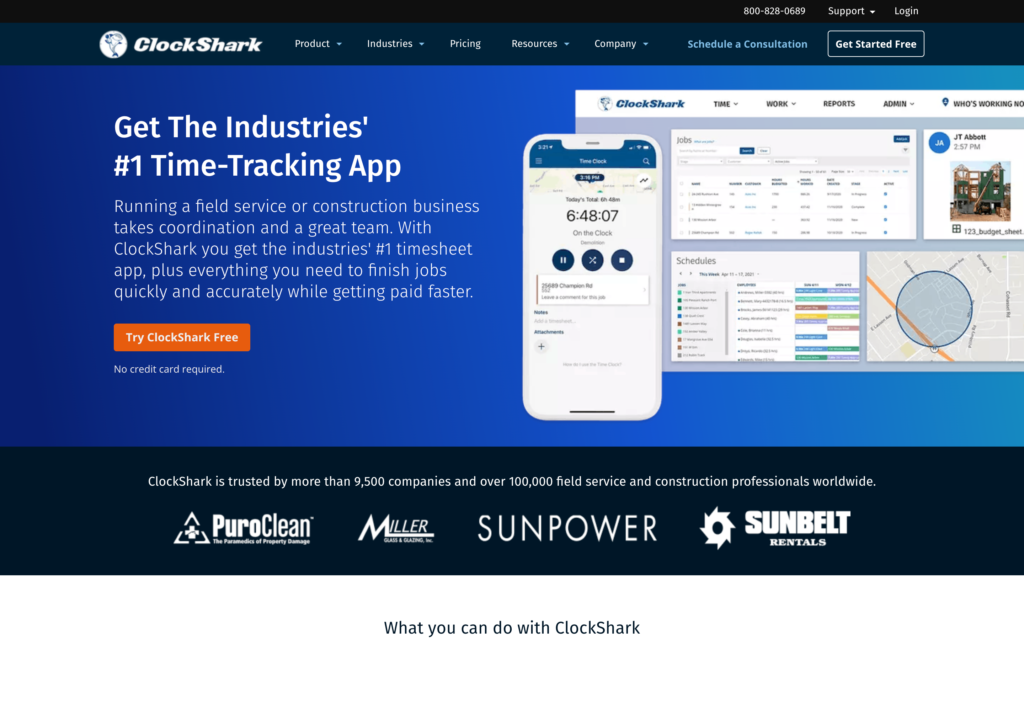
ClockShark is a digital time clock and job management platform built for construction and field service small businesses.
Why I chose ClockShark: I chose ClockShark because it ties employee hours directly to specific jobs, which can help small businesses better understand their labor costs.
Time tracking
In our full ClockShark review, we test how you can track time across mobile, web, and kiosk apps. There’s a timer that’s accurate and syncs across devices. Employees can clock in and out, pause for breaks, and I liked that all changes are tracked, so you can see who made edits and when.
You can set overtime rules based on your company policy or use pre-built rules like California’s overtime standards. Timesheets are clean and ready for payroll export, and you can approve timesheets directly from the dashboard or review individual entries for details.
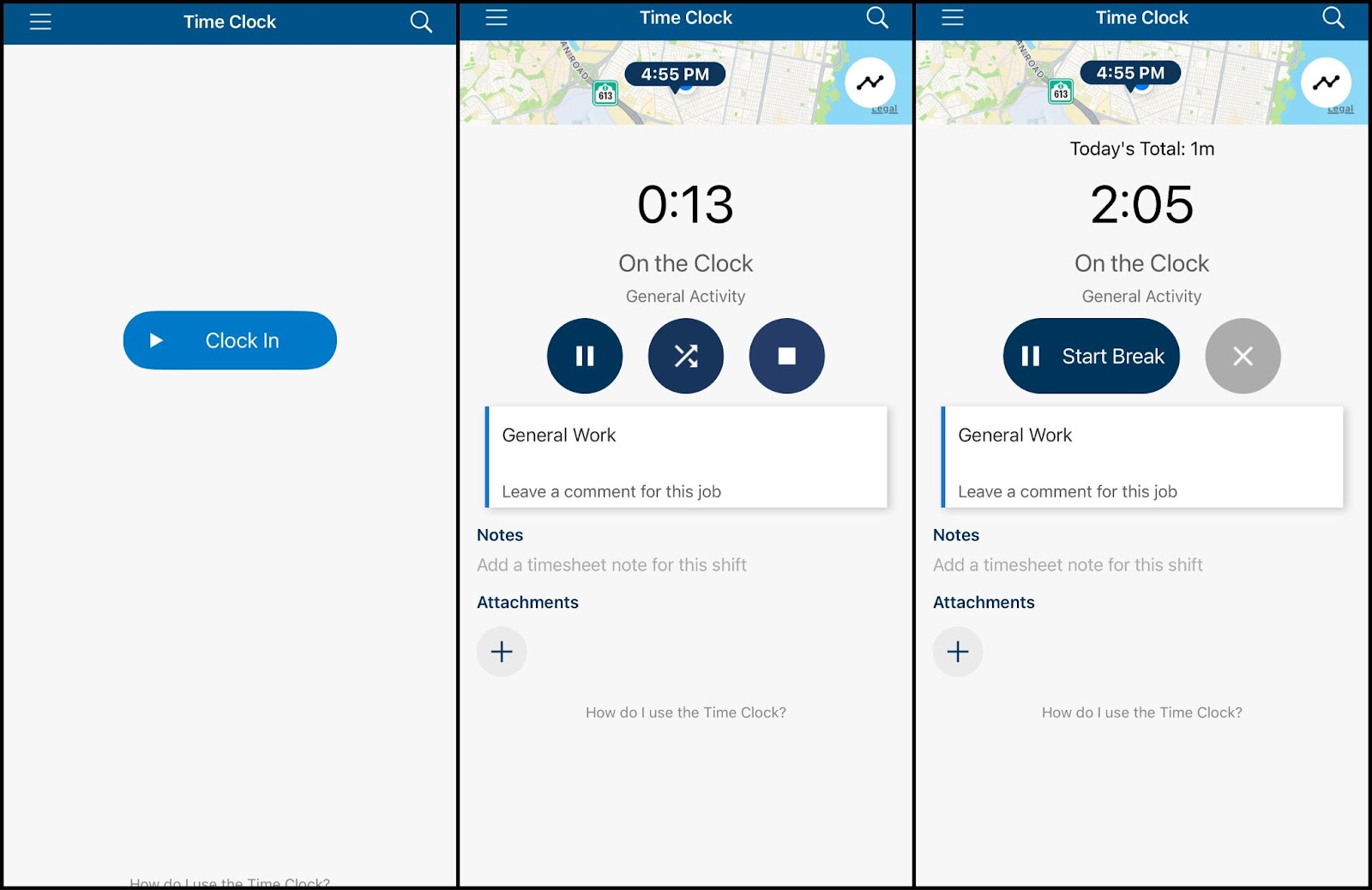
When we were testing ClockShark’s time clock app, we were able to clock in to a specific job and clock out for breaks. GPS tracking
ClockShark captures GPS data with each clock-in and clock-out, so small teams can confirm that employees are on-site. I liked that geofencing lets managers set approved job locations and restrict punches outside those areas. For teams constantly moving between job sites, this is a good way to add oversight without constant check-ins.
There’s also a kiosk option with photo capture and facial recognition to help reduce buddy punching and make sure the right employee is clocking in.
Note: Always confirm compliance with local privacy laws and employee consent requirements before enabling GPS or geofencing.
Job costing and reporting
One of ClockShark’s strengths is definitely job costing. Employees track time against specific jobs, giving small businesses real-time visibility into labor costs and project budgets. This is especially useful for businesses that need to monitor profitability as work progresses.
In terms of reporting, you can see hours worked, attendance, overtime, and job performance. It’s important to note that during our testing we found that ClockShark lacks deeper analytics and customization options, such as productivity metrics. While this may not be a deal breaker for every small business, it’s still something to consider.
What users say about ClockShark
I like being able to see on a map where my team members are, and that they can clock in and out for different jobs.
ClockShark can be pricey for larger teams, and it needs internet or GPS access to work properly. Some users may find the setup or mobile app a bit tricky at first.
0Key Features
- Mobile and kiosk time clock
- GPS tracking by job site
- Job costing and labor tracking
- Photo verification at clock-in
Pros
- Strong visibility into job-based labor costs
- Multiple clock-in methods for field crews
Cons
- Reporting depth is limited
- Pricing scales quickly with team size
Pricing
Starts at $40/month + $9/user/month Trial: Yes — 14 days Free Plan: No
Compare the Best Time Clocks for Small Businesses
| Topic |
 Start for free
|
|
|
|
|
|
|---|---|---|---|---|---|---|
| Reviews |
|
|
|
|
|
|
| Pricing |
Starts at just $29/month for the first 30 users
|
Starts at $4.49/user/month + $19 base fee/month
|
Starts at $20/month + $8/user/month
|
Starts at $24/location/month
|
Starts at $3.99/user/month
|
Starts at $40/month + $9/user/month
|
| Free Trial |
yes
14-day
|
yes
14 days
|
yes
30 days
|
yes
14 days
|
yes
7 days
|
yes
14 days
|
| Free Plan |
yes
Free Up to 10 users
|
no
|
no
|
yes
For a single location & up to 20 employees
|
yes
|
no
|
| Use cases |
Best for growing small businesses that need GPS tracking and payroll-ready hours
|
Good for small teams that want a simple online time clock they can set up in a day
|
Good for businesses that want time tracking tightly connected to QuickBooks payroll
|
Good for retail and restaurants that want scheduling and time tracking together
|
Good for very small businesses that need a free time tracking tool for basic hour logging
|
Good for small construction and trade crews that track hours by job site
|
| Available on |
What Are Small Business Time Clock Apps?
Small business time clocks are digital systems that track when employees start and end shifts, record breaks, and calculate total hours worked. They replace paper timesheets and spreadsheets with automated records that feed directly into payroll.
Employees clock in from a phone, computer, tablet, or shared kiosk. The system logs entries instantly and organizes them into timesheets managers can review and approve.
How Do Time Clocks for Small Businesses Work?
Employees clock in and out through an app or shared device. Many systems add verification tools such as GPS tracking, geofencing, PIN codes, or photo capture to confirm punches are legitimate.
Once time is recorded, the software calculates regular hours, overtime, and breaks based on company rules. Managers review flagged entries, approve timesheets, and export hours to payroll.
The main difference from manual tracking is automation. Hours are calculated automatically instead of being added up at the end of the week.
Benefits of Time Clock Apps for Small Businesses
Small businesses don’t implement time clock software to add another tool. They do it to fix payroll headaches, control labor costs, and create clear expectations between managers and employees.
More accurate payroll
Manual time tracking leaves room for small mistakes that quietly eat into profits. Missed clock-outs, early punches, rounding differences, and manual edits all create inconsistencies. Digital time clocks calculate regular hours, overtime, and breaks automatically based on your policies. That means fewer manual corrections and fewer surprises when payroll runs.
For businesses operating on tight margins, even minor overtime errors repeated across multiple employees can add up quickly.
Early visibility into overtime
Unplanned overtime is one of the most common ways labor costs drift out of control. Without real-time visibility, managers often discover the problem after payroll has already been processed.
With digital tracking, you can see who is approaching overtime during the week, not after it. That gives you time to adjust shifts, reassign work, or approve extra hours intentionally instead of reacting to them later.
Reduced time theft and buddy punching
Paper timesheets and shared PIN systems make it easy for employees to clock in for one another. Digital time clocks add verification tools such as GPS stamps, geofencing, or photo capture at clock-in. These features don’t create a surveillance environment, but they do create accountability.
For field teams and multi-location businesses, location verification alone can significantly reduce inflated hours and attendance issues.
Faster payroll processing
When time tracking is manual, payroll turns into a cleanup task. Managers spend hours chasing missing punches and correcting totals. With automated time clocks, hours flow directly into digital timesheets that can be reviewed and approved quickly.
Instead of rebuilding the week from scratch, you review, approve, and move forward.
Clear audit trail and dispute protection
Disputes often happen when records are unclear. A digital time clock keeps detailed logs of clock-ins, edits, and approvals. If questions come up, you can see exactly what was recorded and when.
In the event of a wage claim or audit, having centralized, time-stamped records makes a meaningful difference.
Better alignment between scheduling and payroll
When time tracking connects with scheduling, you gain visibility into how planned hours compare to actual hours worked. That makes it easier to spot:
- Recurring early clock-ins
- Unapproved shift extensions
- Ongoing attendance patterns
That alignment improves staffing decisions and helps prevent gradual labor cost creep.
Scalability without added admin
Manual systems might work for a handful of employees. As teams grow, complexity increases quickly. A digital time clock keeps processes consistent as you add locations, roles, and pay rules.
That structure allows small businesses to grow without increasing payroll administration at the same pace.
How Much Do Time Clocks for Small Businesses Cost?
Most tools charge a base monthly fee plus a per-user cost. Base plans typically range from $19 to $40 per month, with per-user fees between $3.99 and $9 depending on features. Some platforms use location-based pricing, which can become expensive for multi-site teams.
Connecteam offers a free Small Business Plan for up to 10 users. Paid plans start at $29 per month for up to 30 users, with higher tiers at $49 and $99 per month for expanded features.
>>Get started with Connecteam for free today!<<
The Bottom Line On Time Clocks for Small Businesses
A small business time clock should do more than record hours. It should prevent payroll errors, flag overtime before it becomes expensive, and give you clear visibility into who’s working and where.
If your priority is accurate time tracking with built-in controls and payroll-ready reports, Connecteam is the strongest overall option on this list. It handles clock-ins, overtime rules, scheduling, and location verification in one system, without requiring complex setup.
If you only need a basic timer for a small office team, a simpler tool may be enough. But for growing businesses that want fewer payroll corrections and better labor oversight, Connecteam is a practical place to start.
Start tracking time with Connecteam’s free Small Business Plan.
FAQs
Most small businesses see ROI through reduced payroll errors, lower overtime costs, and fewer admin hours spent fixing timesheets. Even preventing a few hours of unnecessary overtime per month can offset the software cost. Tools like Connecteam maximize ROI by automating calculations and reducing manual corrections.
Time clock software tracks hours in real time and sends alerts before employees hit overtime thresholds. Managers can adjust schedules early instead of reacting after payroll runs. Time clocks like Connecteam also lets you set overtime rules and automatic limits to prevent unapproved extra hours.
The best time clock for small businesses is one that’s simple, accurate, and payroll-ready. Connecteam stands out by combining time tracking, GPS controls, overtime alerts, and clean payroll exports in one easy-to-use platform.