


If your nursing staff is juggling confusing paper schedules, missed shifts can quickly turn into coverage gaps and compromised patient care.
I reviewed 5 nurse scheduling software options and ranked them by their core scheduling capabilities, compliance controls, and real-time communication tools.
Use these picks to build reliable schedules, maintain compliance, and keep your healthcare team fully staffed.
| App | Best for | Starting Price | Key Considerations |
| Connecteam | Managing staff schedules and daily operations across healthcare teams | Just $29/month for the first 30 users | Best overall for flexible scheduling, communication, and time tracking. |
| eSchedule | Healthcare teams managing complex, pattern-based nurse rotations | $900/year (up to 10 employees) | Strong pattern-based scheduling templates, but lacks explicit HIPAA compliance. |
| Shiftboard | Healthcare organizations managing rules-based shift scheduling and open-shift coverage | Contact vendor for price | Good for rules-based scheduling and open-shift coverage, but requires a minimum of 100 employees. |
| NurseGrid | Nurses managing and swapping shifts on mobile | $5/user/month | Great employee-facing mobile app for shift swaps, but no built-in time tracking or payroll features. |
| OnShift | Senior care providers managing staffing and labor costs | Contact vendor for pricing | Useful AI shift matching and biometric clock-ins, but no HIPAA compliance and transparent pricing. |
What’s New in This Update (August 2026)
- Replaced general scheduling tools (Sling, Deputy, MakeShift) with healthcare-specific options (Shiftboard, NurseGrid, OnShift) to better match nursing workflows.
- Rewrote the ranking criteria to focus strictly on healthcare needs like HIPAA compliance, credential tracking, and complex rotation patterns.
- Added a new “How to Choose” section to help healthcare teams narrow their search.
Our Top Picks
-
1

Managing staff schedules and daily operations across healthcare teams
-
2

Healthcare teams managing complex, pattern-based nurse rotations
-
3

Healthcare organizations managing rules-based shift scheduling and open-shift coverage
Why trust us?
Our team of unbiased software reviewers follows strict editorial guidelines, and our methodology is clear and open to everyone.
See our complete methodology
How I Chose the Best Nurse Scheduling Software
Here are some key features I looked for when evaluating nurse scheduling software:
Core Scheduling Capabilities
- Simple scheduling with conflict detection: The software must let managers easily build and adjust schedules while automatically flagging double-bookings, overlapping shifts, or overtime risks before publishing.
- Pattern-based rotation support: Managers should be able to create and save complex recurring shift patterns (like 12-hour shifts or 7-on-7-off rotations) to quickly populate future schedules.
- Open-shift management and swapping: The software must allow managers to post open shifts for qualified nurses to claim, and let staff request shift swaps with manager approval.
Compliance and Qualifications
- HIPAA compliance: The platform must provide secure, encrypted data handling so staff can safely discuss patient care and store relevant documents.
- Credential and certification tracking: Supervisors should be able to track nursing licenses and CPR certifications, with the system blocking unqualified staff from picking up specialized shifts.
- Break and overtime management: The software must track hours worked and enforce required rest periods to maintain labor law compliance and prevent nurse burnout.
Communication and Day-to-Day Operations
- Real-time mobile notifications: The app must instantly alert nurses on their phones when schedules are published, shifts change, or new open shifts become available.
- Integrated time tracking: Staff should be able to clock in and out directly from the mobile app, with GPS verification to ensure they are at the correct facility.
- Built-in team messaging: The software must include secure, role-based chat so managers can quickly reach available nurses to fill last-minute gaps without relying on personal text messages.
The 5 Best Nurse Scheduling Softwares
-
Connecteam — Best for managing staff schedules and daily operations across healthcare teams
Connecteam is the best choice for healthcare teams because it combines flexible scheduling with operational management in one platform. It’s especially strong for teams that need real-time visibility into staffing, time tracking, and team communication without juggling multiple tools.
Why I chose Connecteam: I ranked Connecteam #1 because it offers a complete, HIPAA-compliant solution designed specifically for frontline teams, featuring an intuitive drag-and-drop interface and an AI auto-scheduler.
Nurse scheduling software
Connecteam’s drag-and-drop employee scheduler makes it easy to build the complex schedules healthcare teams need. You can save recurring shift patterns as templates and reuse them instantly, which saves a ton of time when you’re managing rotating 12-hour shifts or 7-on-7-off cycles.
The AI auto-scheduler builds shifts in seconds using availability, skills, roles, and fairness rules. It also flags double-bookings and overtime risks before publishing, and lets you set shift-specific qualifications so only properly certified nurses are assigned to specialized units.
When a gap opens up, you can publish open shifts for staff to claim straight from their phones. Alternatively, let nurses swap shifts with qualified coworkers to keep coverage on track.
Time off management
Nurses can set their availability, mark preferred hours, and submit PTO requests directly in the app. Managers receive instant notifications to approve or deny requests from mobile or desktop, so nothing sits in an inbox for days.
Once approved, time off is reflected in the schedule automatically, making it much easier to plan coverage and stay properly staffed. You can also set custom time off policies, track accruals, and see everyone’s pending and approved leave on a shared calendar, which helps you spot coverage risks before they turn into last-minute scrambles.
Time tracking, breaks and overtime
Connecteam’s employee time clock is tied closely to scheduling, giving you live visibility into who’s working and where gaps are forming. Staff can clock in from their phones with the real time GPS tracker, and geofencing ensures they only clock in at the correct location, which is handy when nurses float across multiple facilities.
For breaks, you can offer manual or automatic ones, designate them as paid or unpaid, customize break lengths, and prevent nurses from clocking back in before their break is over. Automatic reminders also help staff take breaks on time, supporting labor law compliance and reducing missed or late breaks. Plus, supervisors can tailor break rules to different roles or shifts, making it easier to support varying schedules across departments.
All hours, breaks, and overtime flow directly into timesheets for payroll, creating a clear audit trail and helping reduce payroll errors. The system can automatically calculate overtime and flag staff approaching their limits, so you can rebalance shifts before you rack up unexpected labor costs. When it’s time to run payroll, just export the timesheets or push them straight to your payroll provider.
On-the-go communication
Connecteam’s built-in team instant messaging is HIPAA-compliant, keeping communication organized and secure instead of scattered across personal text threads. Role-based permissions control who can see what, which is critical in healthcare settings where you can’t have everyone seeing everything.
You can message individuals, specific units, or the whole team at once, which makes filling a last-minute gap as simple as a single broadcast. You can also attach documents directly to shifts, such as care instructions or handoff notes, and use read receipts to confirm staff actually saw an important update before their shift starts.
And so much more…
Beyond scheduling and time tracking, Connecteam brings together a full suite of operational tools that healthcare teams need:
- Training and onboarding: Use the AI Course Creator to quickly build training materials so new staff can get up to speed faster without lengthy classroom sessions.
- Staff documents: Store and manage employee records like certifications, licenses, contracts, and compliance documents, with automatic reminders for expirations so you never accidentally schedule someone with a lapsed credential.
- Digital forms: Create forms for patient care logs, incident reports, safety checks, or shift handoffs. Add photos, voice notes, and attachments, and store submissions securely.
- Company knowledge base: Keep SOPs, care protocols, and internal policies in one searchable place. Use the AI agent to get instant answers based on your organization’s guidelines.
When Connecteam isn’t a good fit
Connecteam is a general workforce management platform, not a highly specialized enterprise clinical system. It doesn’t have deep, out-of-the-box integrations with massive hospital Electronic Health Record (EHR) systems. Because of this, very large health networks looking for a scheduling tool that acts as a module within a broader clinical enterprise system may prefer a niche solution.
Connecteam also offers a free for life plan – Try Connecteam here!
0Key Features
- Drag-and-drop shift scheduling
- AI-powered auto scheduler
- Automated conflict detection
- Shift swapping and open-shift pickup
- Mobile time clock with GPS and geofencing
- Real-time notifications and team chat
Pros
- Strong fit for complex healthcare scheduling needs
- Helps maintain coverage with faster shift filling
- Good visibility into attendance and staffing gaps
- Mobile-friendly for staff across units
Cons
- Not ideal for highly specialized enterprise workflows
- Requires internet access to function
Pricing
Free-for-life plan availablePremium plans start at $29/month for 30 users
14-day free trial, no credit card required
Start your free trial -
eSchedule — Best for healthcare teams managing complex, pattern-based nurse rotations
Available on
- Web
eSchedule is a healthcare-centric scheduling solution that automates complex shift patterns while maintaining department-specific requirements.
Why I chose eSchedule: I chose eSchedule because its pattern-based scheduling system and robust certification tracking make it particularly valuable for healthcare teams managing complex rotating shifts and compliance requirements.
Pattern-based schedule creation
eSchedule’s pattern scheduling system is a strong fit for healthcare teams. You can create and save multiple schedule templates for different nursing units, accounting for various shift rotations like 3-2-2 or 7-on-7-off patterns.
Once a pattern is built, you can apply it across stations and departments, which saves significant time when managing several units on different cycles. Nurses can submit their availability and the AutoScheduler will help fill open shifts. The platform also lets you layer in custom recurrence rules and build templates around specific shift times, so the schedule reflects how each unit actually operates.
However, if you need to change the schedule’s format or layout, you have to contact support rather than making the change yourself. This could definitely slow you down when you just need to make a quick adjustment in a fast-moving emergency department or ICU.
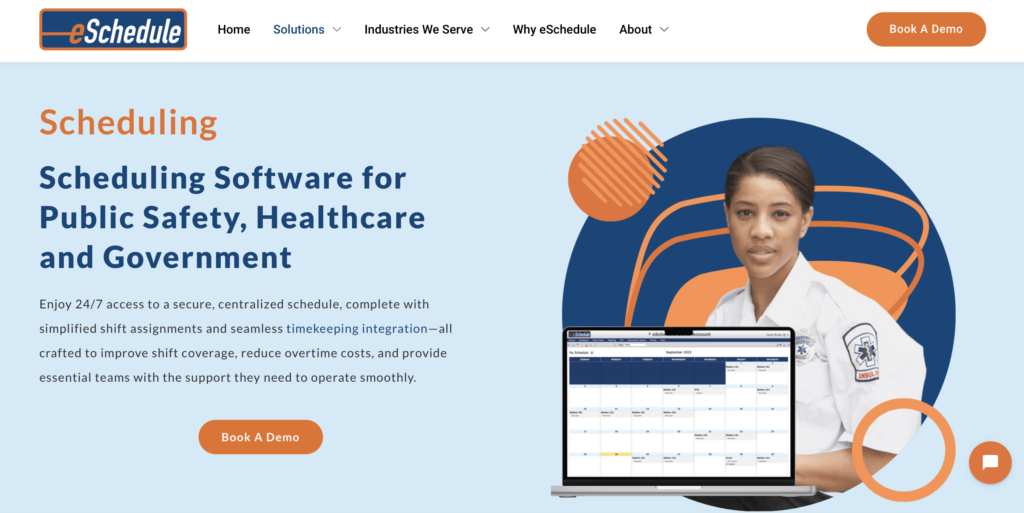
eSchedule supports scheduling for healthcare teams. Skills and certification management
eSchedule’s certification tracking is thorough. The system maintains detailed records of nurse certifications, specialties, and competencies, all tied to each employee’s profile. It automatically prevents scheduling conflicts by ensuring only qualified staff are assigned to specific roles, so you don’t end up with an uncertified nurse on a shift that requires a specialty credential.
The platform sends notifications when certifications near their expiration dates, and you can set up automated reminders to keep staff and managers aware before credentials lapse, which eliminates a lot of manual tracking work.
Rotations, swaps, and bids
eSchedule includes tools for equitable shift distribution and rotation management. You can set rules for weekend rotations, holiday distribution, and on-call assignments, which helps keep things fair across the nursing team.
The platform offers shift trading and bidding, allowing employees to bid on open shifts they’re qualified to work, while managers can choose between direct sign-on, manager approval, or a hybrid approach.
The system also supports shift swaps and can send out texts, emails, and department-wide messages to coordinate coverage, but there’s no built-in chat for quick two-way updates. I also noticed that eSchedule isn’t advertised as being HIPAA compliant, which is a significant limitation for healthcare environments where you need to protect sensitive patient information in schedules and notes.
What users say about eSchedule
The system is so user friendly. We have so many different schedules and eSchedule is capable of calculating all of the schedules.

Signs out too quickly. Would be nice to be able to move from one schedule to another without going to a different link. Messaging feature has several kinks.

Key Features
- Auto-scheduling
- Pattern-based scheduling
- Shift trading and bidding
- Skills and certification management
Pros
- Real-time shift tracking
- Fair shift distribution
Cons
- Software isn’t advertised as HIPAA compliant
- Lacks built-in two-way messaging
Pricing
Starts at $900/year (up to 10 employees) Trial: No Free Plan: No
-
Shiftboard — Best for healthcare organizations managing rules-based shift scheduling and open-shift coverage
Shiftboard is a staff scheduling software for mid-sized teams that need flexible shift planning, time tracking, and workforce coordination.
Why I chose Shiftboard: It offers flexible, rules-based scheduling and strong open-shift coverage tools, though its lack of a drag-and-drop editor can make manual adjustments tedious.
Shift scheduling and swaps
In our full Shiftboard review, we found that managers can create shifts from scratch, duplicate existing ones, or import them from spreadsheets, which is helpful when you’re moving off an old system.
You can post open shifts for staff to claim and require specific qualifications before someone picks them up, so coverage stays in qualified hands. The rules-based engine lets you build logic around skills, seniority, and availability to keep schedules compliant. Shiftboard also lets employees trade shifts through a built-in tradeboard, requiring manager approval first before another qualified worker takes the shift.
But one major drawback we ran into is the lack of drag-and-drop scheduling on the admin platform, which makes editing shifts unnecessarily complicated when you need to adjust things quickly.
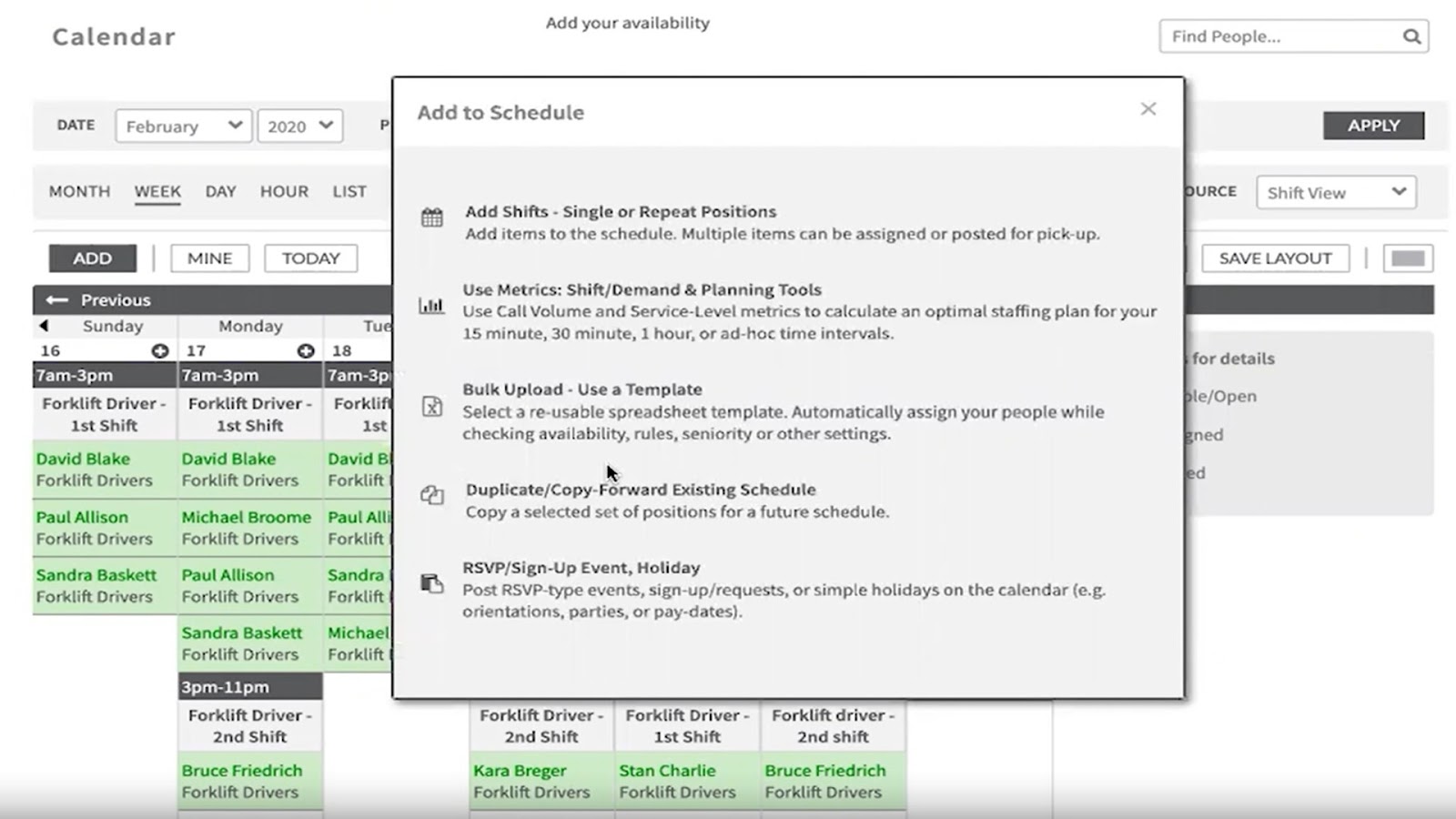
With Shiftboard, we could add shifts, calculate staffing levels, upload spreadsheets, and duplicate existing schedules. Time tracking and day-to-day use
Shiftboard includes a basic time clock that lets employees clock in and out through the mobile app and builds timesheets that feed into payroll. Staff can also request time off in the same place, and managers can approve those requests without bouncing between tools.
Still, in our testing, we found the time clock capabilities to be very limited. Location is only captured at clock-in and clock-out, with no geofencing or continuous GPS tracking, so you can’t confirm someone stayed on-site. Timesheets also lack support for multiple pay rates or flagged entries, and the time-off tracking doesn’t offer clear calendar views or leave balances, which makes it harder to plan coverage at a glance.
Messaging and reporting
Shiftboard offers a broadcast messaging tool to target specific employees, like staff without a scheduled shift, which helps fill gaps quickly. But the messaging is one-way only, meaning employees can’t reply or coordinate in real-time, so it works better for announcements than back-and-forth problem solving.
Permissions are also fairly basic, with limited room to customize roles. On the plus side, the reporting filters are strong, and you can break down data by team, date range, location, or role, and export everything as CSV files so you can build your own views in a spreadsheet. The reports themselves felt a bit clunky during testing, with limited built-in visualizations.
It’s important to note that Shiftboard requires a minimum of 100 employees, as our tester discovered. This makes it a poor fit for smaller clinics and practices.
What users say about Shiftboard
I love that I can go in and schedule my own hours and put up commits on the tradeboard if they cannot be honored. I also like that I can go into the tradeboard section and take commits if I want to work them at any time of day.
It is very particular in it’s functionalities – if any step (even as small as checking an optional box is not checked) in any given process is missed/incorrect, the entire schedule will be off, and you won’t know until you finish and look at the calendar. Then you have to go back in and figure out what went wrong.
Key Features
- Shift scheduling
- Open shift sign-ups
- Tradeboard for shift swaps
- Mobile clock-in/out
Pros
- Tools for open-shift coverage
- Strong reporting filters
Cons
- Lacks drag-and-drop editor
- Limited time tracking controls
Pricing
Contact vendor for price Trial: No Free Plan: No
-

NurseGrid — Best for nurses managing and swapping shifts on mobile
Available on
- Web
- iOS
- Android
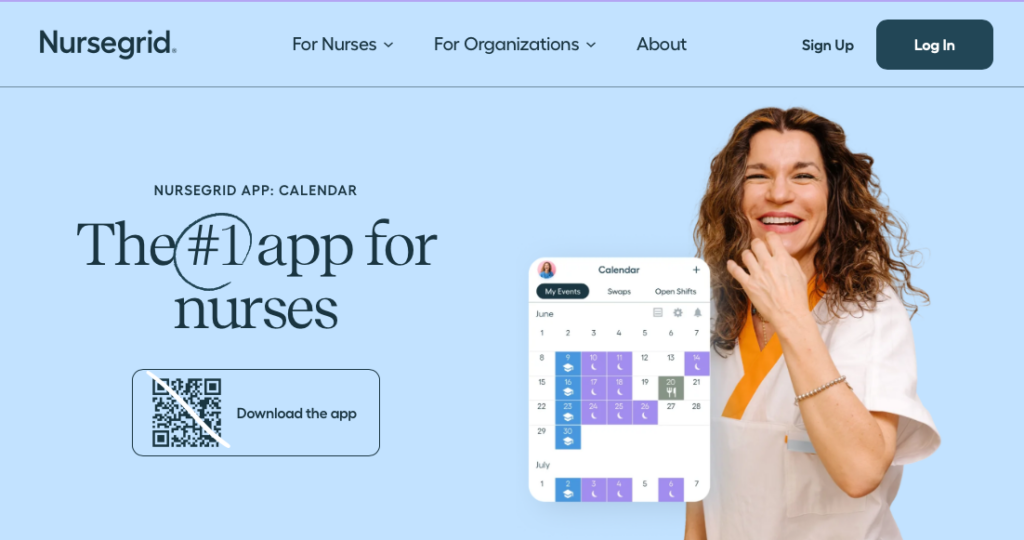
NurseGrid by HealthStream is a healthcare staff scheduling tool designed to help nurses and smaller care teams manage schedules, availability, and shift trades.
Why I chose NurseGrid: I chose NurseGrid because it’s designed as an employee-facing mobile app, making it incredibly easy for nurses to self-schedule, swap shifts, and coordinate directly from their phones.
Staff schedule creation
With NurseGrid, managers can plan schedules up to six weeks out, define shift types, and set coverage requirements by role and day. The platform provides a draft view, allowing managers to compare coverage against requirements using a clear visual grid, and you can filter by role, date, or team to zero in on specific gaps.
You can also control which shifts are open for self-scheduling and decide who can access them based on position or status, which keeps the right people in the right shifts. But I noticed that the process still requires manual oversight: the coverage rules don’t automate approvals, and draft settings can’t be edited once created, meaning you might have to start over if you need to make significant changes.
Self-scheduling and shift coverage
NurseGrid’s self-scheduling features stand out. Managers can open a scheduling period, allowing staff to submit requests in the app, then review everything from a dedicated view where approvals can be done one at a time or in bulk. After self-scheduling closes, managers can balance the schedule by assigning remaining shifts and publishing updates, so staff input and manager control work side by side.
I noticed that staff can pick up, swap, or give away shifts directly from their mobile devices, and the system even supports partial shift coverage and split shifts, which is great for covering odd gaps. While this collaborative approach is great for staff autonomy, the lack of auto-fill, overtime protection, and automated rebalancing means managers still have to manually handle overbooked shifts.
Mobile coordination and messaging
The NurseGrid mobile app is highly staff-friendly. I found that nurses can set their availability, manage shifts, compare schedules with coworkers, and sync their shifts to personal calendars or even share them externally. The app includes built-in messaging, allowing managers to contact staff by role or status without switching tools, which keeps coordination in one place.
While it excels at schedule coordination, one limitation I observed is that it lacks broader workforce management features like time tracking, payroll integrations, and compliance monitoring, so you’d likely need a separate tool for those tasks.
What users say about NurseGrid
I appreciate that nurse grid is able to show you who is working and when. I like that you can ask to switch shifts on the app and see when it happens.
Does not work well with androids. The texting function doesn’t work. Can’t clear the messaging inbox. Trades and give away are cumbersome. Qccidently scheduling shifts when I click on a day in the “schedule.”
Key Features
- Staff scheduling builder
- Split-shift management
- In-app messaging
- Open shifts, pickups, and swaps
Pros
- Strong self-service tools for nurses
- Calendar comparison and sharing tools
Cons
- Some workflows require manual work
- Lacks time tracking capabilities
Pricing
Starts at $5/user/month Trial: Yes — 30-day Free Plan: No
-
OnShift — Best for senior care providers managing staffing and labor costs
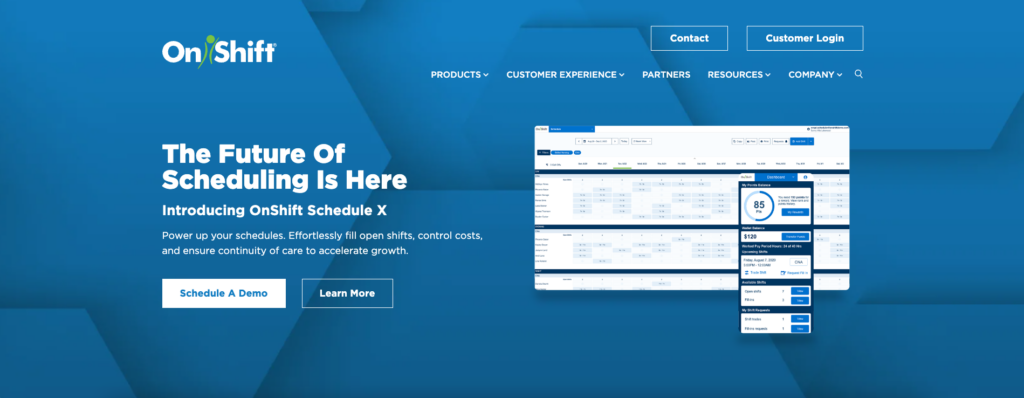
OnShift is a healthcare staff scheduling software that offers time tracking, hiring, and workforce management tools.
Why I chose OnShift: It offers useful AI shift matching and biometric clock-ins specifically tailored for senior care providers, but its lack of HIPAA compliance is a concern.
Scheduling and shift coverage
In our full OnShift review, we found that managers can drag and drop shifts into the schedule and use rules-based controls to help manage overtime, meet staffing requirements, and stay compliant. The open shift feature lets staff pick up shifts quickly, and managers get clear visibility into availability, overtime risk, and scheduling conflicts as they build the schedule.
The AI-powered shift recommendations suggest the best person to fill a gap based on qualifications and hours already worked, taking some guesswork out of last-minute coverage. But we noticed that customization options seem limited, as there’s no color-coding, annotations, or shift notes to help organize complex schedules visually, which makes a busy schedule harder to read at a glance.
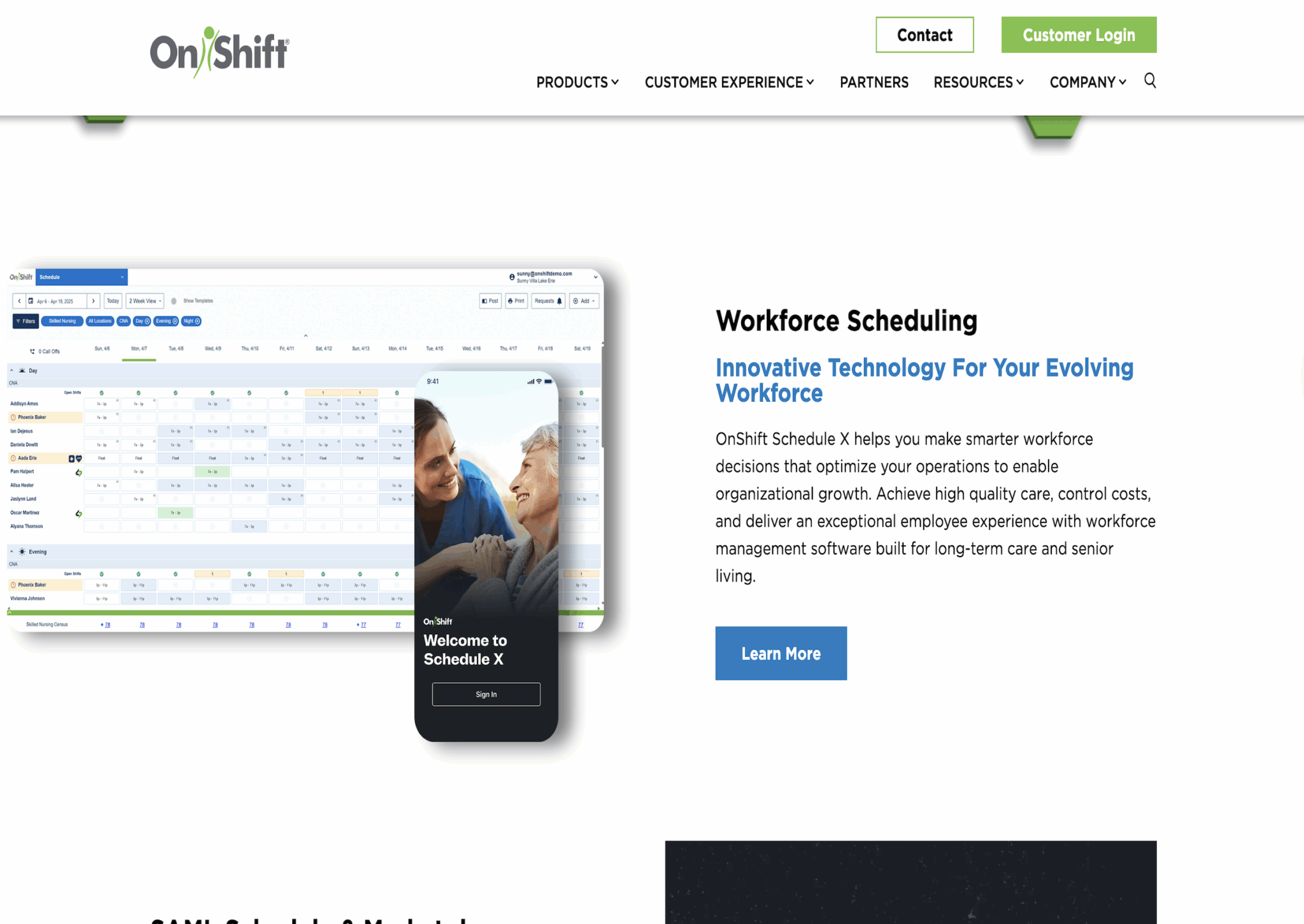
OnShift offers a web and mobile app. Time tracking
OnShift’s time tracking lets employees clock in from their phones or use a central kiosk, which works well for teams that share a station rather than carrying individual devices. We particularly liked the biometric clock-in feature, which uses timestamped selfies to help reduce buddy punching and improve accountability on the floor. That said, a few user reviews mention the time clock doesn’t always sync cleanly with the schedule, so managers may need to double-check punches before payroll closes.
Reporting and integrations
OnShift offers over 60 report options covering payroll, hours worked, labor costs, and even employee turnover, which gives senior care operators a solid view of where their labor budget is going. It integrates with over 25 tools across payroll, HR, background checks, and clinical systems, so it can sit alongside the other software a facility already runs.
Still, one critical limitation we noticed is that OnShift’s HIPAA compliance is unclear, which is a significant drawback for healthcare-sensitive environments. On top of that, it lacks integrations with several widely used payroll platforms like QuickBooks or Xero, which could frustrate teams with established systems already in place.
What users say about OnShift
OnShift is very easy to use and offers many updated, modern features. Their customer service is also great—quick to respond and genuinely helpful whenever I need support.
I would like to see it connected to our time clocks so that we can better track our hours and punches without having to take extra steps. The time clock and Onshift never seem to match up.
Key Features
- Drag-and-drop scheduling
- AI shift recommendations
- Biometric time clock
- Mobile and kiosk clock-ins
Pros
- AI scheduling tools
- Open shifts and overtime alerts
Cons
- HIPAA compliance is unclear
- Pricing is not transparent
Pricing
Contact vendor for pricing Trial: No Free Plan: No
Compare the Best Nurse Scheduling Softwares
| Topic |
 Start for free
|
|
|
|
|
|---|---|---|---|---|---|
| Reviews |
 |
|
|
N/A
|
|
| Pricing |
Starts at just $29/month for the first 30 users
|
Starts at $900/year (up to 10 employees)
|
Contact vendor for price
|
Starts at $5/user/month
|
Contact vendor for pricing
|
| Free Trial |
yes
14-day
|
no
|
no
|
yes
30-day
|
no
|
| Free Plan |
yes
Free Up to 10 users
|
no
|
no
|
no
|
no
|
| Use cases |
Best for managing staff schedules and daily operations across healthcare teams
|
Best for healthcare teams managing complex, pattern-based nurse rotations
|
Best for healthcare organizations managing rules-based shift scheduling and open-shift coverage
|
Best for nurses managing and swapping shifts on mobile
|
Best for senior care providers managing staffing and labor costs
|
| Available on |
Web
|
Web, iOS, Android
|
How to Choose the Right Nurse Scheduling Software
With so many options on the market, it helps to narrow things down by asking a few key questions before you commit. Here are the main areas to think through as you compare nurse scheduling tools for your team.
Team Size & Budget
- How many nurses and support staff do you need to schedule?
- Does the software charge a flat monthly fee, or does it charge per user?
- Are there minimum employee requirements that might price out smaller clinics?
- Does the platform offer a free trial so your team can test the interface first?
Industry & Use Case
- Do you need to manage complex, recurring 12-hour or 7-on-7-off rotation patterns?
- Are you scheduling for a single clinic, or do you need to float nurses across multiple hospital units?
- Does the software support open-shift bidding for staff to pick up extra hours?
- Is the platform explicitly HIPAA compliant for handling sensitive patient care notes?
Feature Requirements
- Can managers drag and drop shifts to build schedules quickly?
- Does the software automatically flag double-bookings or overtime risks?
- Is there a mobile app that lets nurses request shift swaps and time off?
- Do you need built-in time tracking with GPS verification, or just a scheduling calendar?
The Benefits of Nurse Scheduling Software
There are many benefits that come with using nurse scheduling software, including:
Improved Patient Coverage
In healthcare, being short-staffed directly impacts patient care. Scheduling software helps managers spot open shifts early and assign the right nurses faster. This leads to fewer last-minute scrambles and ensures that departments are always properly staffed with qualified professionals.
Lower Labor Costs
When managers can see schedules, overtime risks, and staffing levels in one place, it’s much easier to avoid unnecessary overtime or accidental double-booking. Automation also cuts down on manual administrative work, allowing nursing directors to spend less time on paperwork and more time supporting their teams.
Better Nurse Experience
Nurses are more likely to feel supported when they have control over their schedules. Mobile access allows them to check shifts easily, request swaps without confusion, and get quick updates. This transparency reduces frustration, helps prevent burnout, and gives nurses better control over their work-life balance.
Stronger Compliance
Healthcare scheduling requires strict adherence to labor laws and medical credentialing. Software helps track licenses and certifications, ensuring that only qualified nurses are assigned to specialized units. It also helps enforce mandatory rest periods between shifts, keeping facilities compliant and reducing the risk of costly errors.
How Much Does Nurse Scheduling Software Cost?
The cost of nurse scheduling software varies based on the features you need, your team size, and the pricing model. Some tools charge a flat monthly rate, while others charge a per-user fee. Simple, employee-facing apps might cost around $5 per user per month, while comprehensive enterprise systems often require custom quotes based on the facility’s scale.
Connecteam offers a highly affordable and transparent pricing structure. It starts at just $29 per month for the first 30 users, making it an excellent value for growing healthcare teams. The Small Business Plan is completely free and available for small teams of up to 10 users, allowing you to get started without any upfront investment.
The Bottom Line on Nurse Scheduling Software
Nurse scheduling software helps healthcare administrators, nursing directors, and clinic managers build reliable schedules, manage complex rotations, and ensure proper patient coverage.
When choosing a solution, the most important factors are flexible coverage, mobile accessibility for staff, and strong compliance controls to track credentials and prevent overtime. While enterprise hospitals might need highly complex clinical systems, most healthcare teams will benefit from a platform that balances powerful scheduling with the ease of use that gets nurses to actually adopt it.
Connecteam is the best choice for managing staff schedules and daily operations across healthcare teams, offering a HIPAA-compliant, all-in-one platform with an AI auto-scheduler, integrated time tracking, and secure team messaging.
FAQs
Connecteam is the best overall nurse scheduling software because it combines an intuitive drag-and-drop scheduler with HIPAA-compliant communication and mobile time tracking. It gives managers real-time visibility into staffing gaps while making it incredibly easy for nurses to swap shifts and check their schedules on the go.
Yes, most quality nurse scheduling platforms track credentials. Connecteam, for example, allows you to store nurse licenses and CPR certifications, automatically alerting you before they expire so you never accidentally schedule an unqualified staff member for a specialized shift.
Absolutely. Tools like NurseGrid and Connecteam feature mobile apps that let nurses request shift swaps or pick up open shifts directly from their smartphones. Managers can then review and approve these requests with a single click, keeping the schedule updated in real time.