


If you rely on manual pen-and-paper logs to track business miles, missed deductions and inaccurate reimbursements can quickly lead to financial headaches.
I reviewed 5 mileage tracker apps and ranked them by accurate mileage logging, trip classification, and IRS-compliant reporting.
Use these picks to automate your mileage tracking, ensure IRS compliance, and save time on administrative tasks.
| App | Best for | Starting Price | Key Considerations |
| Triplog | Teams with multiple vehicles and drivers needing flexible tracking methods | $8/user/mo | 6 mileage tracking modes, Unlimited automatic mileage tracking, Income and expense tracking, Custom business activities and mileage rates. |
| Everlance | Freelancers and self-employed professionals tracking mileage and expenses | $8/user/mo (Team plan) | Automatic and manual mileage tracking, Receipt photo capture and expense tracking, Accurate route mapping, Reimbursement management. |
| MileIQ | Busy professionals who want automatic, set-it-and-forget-it mileage tracking | $8/user/month (Team plan) | Automatic drive detection, Swipe-to-classify interface, Auto-generated IRS-compliant reports, Expense reimbursements. |
| Zoho Expense | Businesses integrating mileage tracking with broader expense management | $3/user/month | Swipe to convert rides to expenses, Work-hours auto-classification, Admin-defined custom mileage rates, Detailed downloadable mileage reports. |
| Motus | Mobile field teams needing automatic mileage tracking with compliance verification | Contact vendor | Automated mileage capture, Tax-free reimbursements (FAVR, CPM, TAAP), Automated commute deduction, Centralized admin portal. |
| Connecteam | Managing mobile teams beyond mileage tracking | Just $29/month for the first 30 users | Shift-based mileage collection with form customization, GPS breadcrumb verification and geofencing, Employee scheduling with shift templates, Time tracking with location verification. |
What’s New in This Update (September 2026)
- Replaced Hurdlr with Zoho Expense and Motus to better reflect the needs of growing businesses and field teams.
- Updated Everlance starting price from $10/user/month to $8.99/user/month.
- Updated MileIQ pricing from $50/driver/year to its current $8/user/month plan.
- Repositioned Connecteam as a complimentary operational solution that works alongside mileage tracking apps.
Top Picks
-
1

Best for teams with multiple vehicles and drivers needing flexible tracking methods
-
2

Best for freelancers and self-employed professionals tracking mileage and expenses
-
3

Best for busy professionals who want automatic, set-it-and-forget-it mileage tracking
Why trust us?
Our team of unbiased software reviewers follows strict editorial guidelines, and our methodology is clear and open to everyone.
See our complete methodology
How I Ranked the Best Mileage Tracker Apps
Here are some key features I looked for when testing and evaluating these apps. I focused on features that help businesses track mileage accurately, without chasing down logs or second-guessing reports.
IRS-compliant mileage logging and reporting
- Tracking modes: The software must support verifiable tracking modes, whether through automatic GPS detection or verifiable odometer photo capture.
- Compliant reporting: The app should generate clean, exportable mileage reports with all IRS-required fields, including date, time, distance, purpose, and destination.
- Route verification: Supervisors should be able to view real routes, locations, and timestamps to verify the authenticity of every logged trip.
Seamless trip classification
- Business vs. personal: Drivers need to be able to separate business miles from personal ones with zero confusion, either through a simple swipe interface or shift-based logic.
- Automated classification: The software must allow administrators to configure custom work hours or geofences to automate trip classification and reduce manual data entry.
- Custom mileage rates: The software must support custom mileage rates to handle different reimbursement methods, such as charity, medical, or moving trips.
Workforce compliance and safeguards
- Fraud prevention: The software must offer built-in fraud prevention safeguards, such as GPS breadcrumbs or mandatory odometer photo capture at the start and end of shifts.
- Custom reminders: Supervisors need to be able to set custom reminders to nudge employees to submit their logs or verify a trip before the payroll deadline.
- Payroll integrations: The app should connect with payroll and accounting tools like QuickBooks, ADP, and Gusto to streamline the reimbursement process.
5 Best Mileage Tracker Apps
-
Triplog — Best for teams with multiple vehicles and drivers needing flexible tracking methods
Available on
- Web
- iOS
- Android
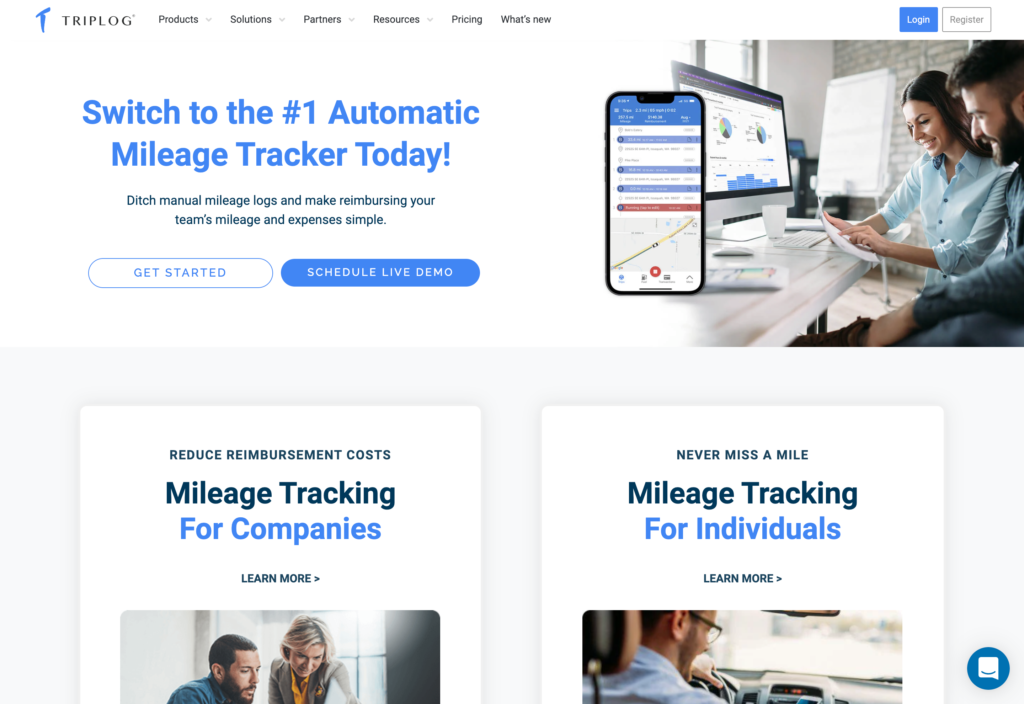
TripLog is a mileage tracking app for small and mid-sized businesses that need to create and enforce mileage tracking policies.
Why I chose TripLog: I ranked TripLog #1 because it offers the widest variety of tracking modes (GPS, Bluetooth, iBeacon, Plug-N-Go), making it highly adaptable for complex fleets.
Multiple mileage tracking modes
TripLog supports six mileage tracking methods, namely: semi-automatic, MagicTrip, iBeacon, Drive, car bluetooth, and Plug-N-Go. MagicTrip is only a fancy name for an automatic mileage tracker, which leverages drive detection technology to log miles. It’s not different from other automatic mileage trackers, but it lets you adjust the minimum speed threshold to your liking.
TripLog Beacon (iBeacon) is a unique USB device that connects to the mobile app via Bluetooth technology. Unlike the standard automatic mileage tracker, the iBeacon logs miles when the driver is in the designated car. TripLog Drive is also a plug-and-go device designed specifically for offline mileage tracking, and like iBeacon, it requires additional hardware.
However, iBeacon and Drive may require a hefty initial investment, especially for companies with a large fleet. Another issue is that employees have to classify trips manually, mainly if you are on the Team plan. But if you’re on the Enterprise plan (TripLog’s most-expensive plan) you can set default work hours to classify business trips automatically.
Mileage tracking rates and policies
TripLog also allows you to create and enforce mileage tracking policies. For instance, you can set it to automatically deduct employees’ commuting miles, which are not tax-deductible or subject to reimbursement. It also lets you stipulate a daily mileage cap to ensure employees are mindful of the distance they cover to save on travel costs.
TripLog also lets US-based businesses apply the standard mileage rates for business, moving, medical, and charity mileage with the click of a button. If you’re outside the U.S. you can configure custom rates to adhere to requirements in your region. All in all, setting mileage rates enables the app to calculate employee reimbursement accurately based on trip categorization.
Driving safety tracking
Another feature I liked was the driving safety tracking. It allows you to set a custom speed limit to get alerts about rapid acceleration, overspeeding, hard braking, and phone calls during driving. The alerts help curb unsafe driving habits to improve fuel economy and reduce vehicle wear and tear.
What users say about TripLog
Read review hereThis program saves me more time and money than any other app. You can set it to automatically turn on when you drive and it tracks business and personal miles automatically when setup.

.
Read review hereNo formal issuance of GPS Tracking Consent forms or authorizations from employees using the app for work.
.
Key Features
- 6 mileage tracking modes
- Unlimited automatic mileage tracking
- Income and expense tracking
- Custom business activities and mileage rates
Pros
- Flexible tracking modes for complex fleet scenarios
- Work-hours auto-classification on paid plans
Cons
- Hardware devices require additional investment
- Some tracking modes need hardware
Pricing
Starts at $8/user/mo Trial: Yes — 15-day Free Plan: Yes
-
Everlance — Best for freelancers and self-employed professionals tracking mileage and expenses
Available on
- Web
- iOS
- Android
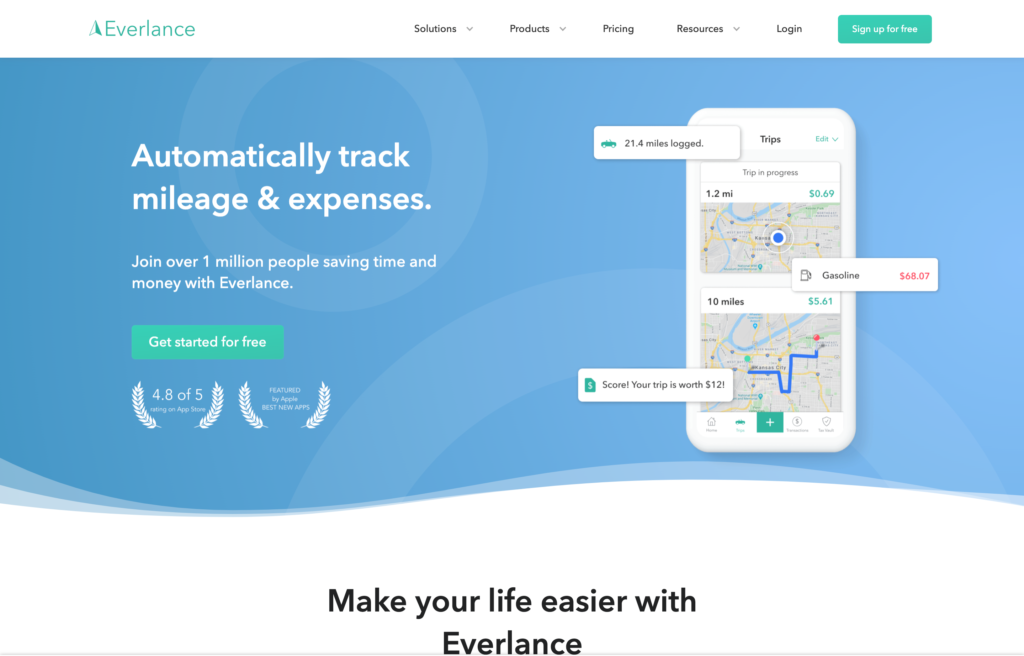
Everlance is a mileage and expense tracking app for self-employed drivers and small businesses looking to simplify reimbursements and tax deductions.
Why I chose Everlance: I ranked Everlance #2 because it is excellent at combining automatic drive detection with receipt and expense tracking in one app.
Automatic and manual mileage tracking
Everlance offers both automatic and manual mileage tracking. When you use the automatic mileage tracker, you get a premium feature known as “snap-to-road.” The algorithm ensures the app maps the exact route the driver took instead of taking the shortest path between the starting point and the destination.
I was impressed by the automatic drive detection mode. You don’t need to lift a finger to track my mileage. Instead, Everlance detects motion and starts logging mileage automatically once the vehicle exceeds a predefined speed threshold. My only minor grievance is that Everlance doesn’t let you stipulate the minimum tracking speed threshold.
Another issue is that while Everlance provides the route for every trip — with the start and stop locations — it doesn’t support breadcrumbs. For this reason, it might not be helpful if you want to monitor the driver’s behavior during the trip. On top of that, the automatic tracker presents privacy concerns as it automatically tracks a driver’s movement even outside working hours.
Trip classification and swiping
Besides privacy concerns, automatic drive detection creates another problem: manual trip classification. Employees must manually separate business trips from personal trips at the end of the work day. While trip classification is as easy as swiping the trip card to the right or left, it consumes vital hours that could be expended on other meaningful tasks.
It’s also worth noting that unlimited automatic tracking is reserved to the Starter and Professional plans. The free Basic plan limits you to 30 automatically detected trips per month, meaning heavy drivers will need to upgrade or rely on manual tracking.
Everlance work hours
Everlance allows you to add work hours when you upgrade to the Start or PRofessional plans. Work hours don’t aid time tracking or scheduling in any way, but they automate trip classification. The software classifies mileage logged during the work hours as business, saving you the manual hassle.
What users say about Everlance
Read review hereI find Everlance to be the easiest program to use, with an easy layout that is self-explanatory, so I didn’t need a class to learn. I’ve never had any issues with it. It keeps track of all my trips and mileage, which means I don’t have to do it myself. I just double-check at the end of the day and send it in twice a month to be paid.
.
Read review hereSometimes mileage app starts unannounced and you just have to go in there and delete it and start over but it seems to have gotten a lot better with the new updates.
.
Key Features
- Automatic and manual mileage tracking
- Receipt photo capture and expense tracking
- Accurate route mapping
- Reimbursement management
Pros
- Snap-to-road algorithm
- Favorite trip recognition and auto-classification
Cons
- Unlimited automatic tracking only on Professional plan
- No minimum speed threshold adjustment available
Pricing
Starts at $8/user/mo (Team plan) Trial: Yes — (7-day) Free Plan: Yes — (Team plan)
-
MileIQ — Best for busy professionals who want automatic, set-it-and-forget-it mileage tracking
Available on
- Web
- iOS
- Android
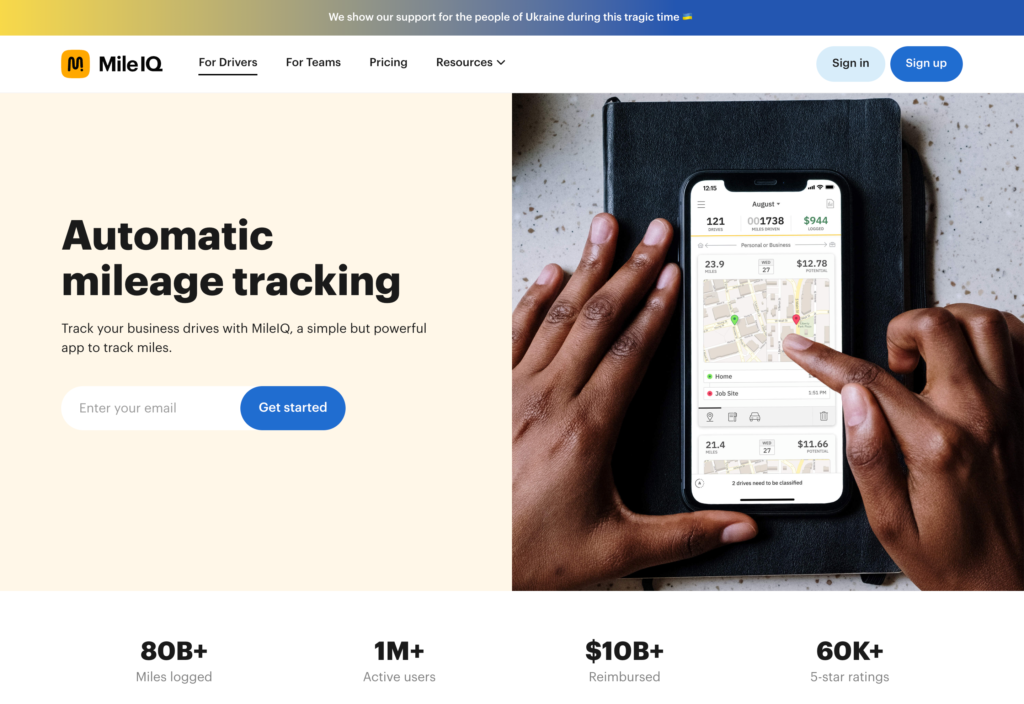
MileIQ is an easy-to-use automatic mileage tracker designed specifically for freelancers and small business owners in the U.S., Canada, and the U.K.
Why I chose MileIQ: I ranked MileIQ #3 because it is incredibly easy to use with a simple swipe-to-classify interface and reliable background tracking.
Automatic mileage tracker
Unlike TripLog and Everlance, MileIQ doesn’t have a semi-automatic mileage tracking option. Instead, the app uses automatic drive detection to track miles. The free plan is generous for light users, offering 40 free drives every month, while heavy users can upgrade for unlimited drives. While the automatic tracker eliminates the need to constantly tap the start/end button, it comes with a few quirks.
I noticed that the drive detection mode is set up differently. Instead of triggering the tracker when you hit a minimum speed threshold, it starts logging miles when you travel at least a mile.
MileIQ also doesn’t support offline tracking, and is ideal only for users in well-connected areas.
Trip classification
Classifying trips is an effortless task. On the mobile app, it takes a simple swipe to the right or left to classify trips as business or personal, respectively. On the other hand, it takes a couple of clicks to classify trips on the web app. Alternatively, you can set work hours to auto-classify trips.
Standard mileage rates and deductions
My only gripe is that U.S. businesses can’t apply the standard mileage rate for charity, moving, and medical trips. This is because MileIQ classifies charity, medical, and moving trips as personal by default, which is a mistake. These trip categories are tax deductible and subject to reimbursement per IRS regulations.
What users say about MileIQ
Read review hereMIleIQ has made our IRS mileage reporting and reimbursing a breeze to get done quickly and accurately. Our CPA is impressed and appreciative of our reports.
.
Read review hereIf your settings arent setup correctly or your battery is running low the app wont track your miles correctly. Sometimes you have to go in and add the trips manually
.
Key Features
- Automatic drive detection
- Swipe-to-classify interface
- Auto-generated IRS-compliant reports
- Expense reimbursements
Pros
- Simple swipe interface for trip classification
- Generous free plan for light users
Cons
- No semi-automatic or manual tracking option
- No offline tracking support
Pricing
Starts at $8/user/month (Team plan) Trial: Yes — 30-day Free Plan: Yes — (Individual plan)
-

Zoho Expense — Businesses integrating mileage tracking with broader expense management
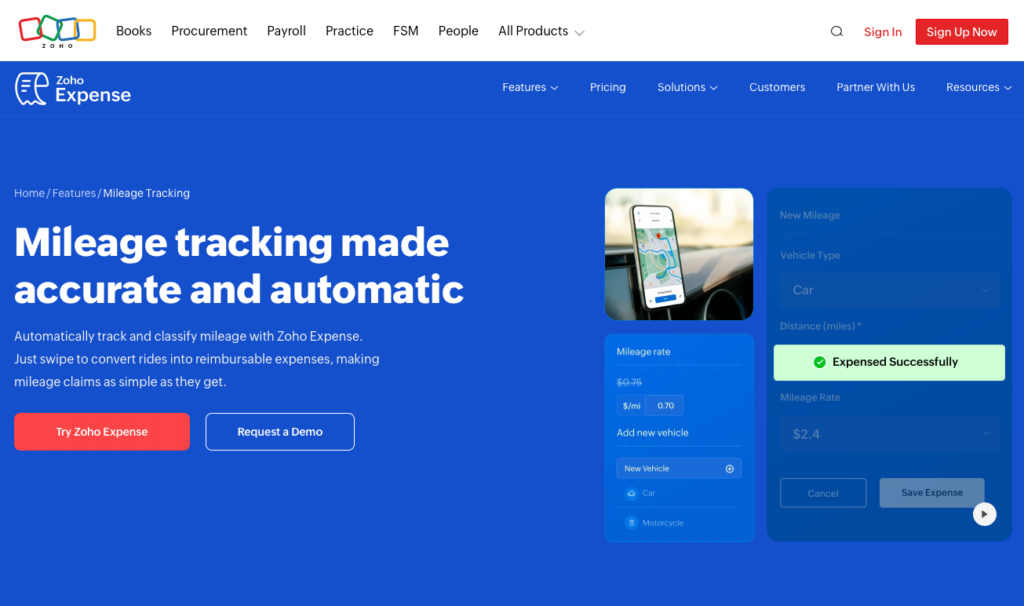
Zoho Expense is a travel and expense management platform with built-in automatic mileage tracking.
Why I chose Zoho Expense: I ranked Zoho Expense #4 because it provides an enterprise-ready platform that connects mileage logs with expense reporting and accounting software.
Automatic and GPS tracking
Zoho Expense offers several ways to track mileage. You can manually enter odometer readings, use map-based calculations by entering start and end locations, or use the mobile app’s GPS tracking to manually start and stop rides. It also supports Siri voice commands for hands-free tracking.
The auto mileage capture feature seems the most convenient. It detects drives in the background with minimal manual input. Once a ride is complete, you can convert it into an expense with a simple swipe. But, this automatic background capture is only available on the Premium plan, which might be a drawback if you’re on a tight budget.
Ride classification and rates
To help sort out your trips, Zoho Expense lets you configure your work hours. This puts ride classification on autopilot, automatically excluding personal rides from business ones without manual sorting.
Admins can also set personalized mileage rates to align with tax rules or company policies. It supports IRS mileage rates out of the box, which ensures compliance for every ride logged. Plus, the built-in mileage reimbursement calculator estimates amounts based on your organization’s rates or regional standards.
Expense management integration
The real power of Zoho Expense is how mileage tracking ties into its broader expense management ecosystem. You can generate detailed mileage reports anytime and share insights easily.
But because it’s built for broader travel and expense management, the platform can be complex. If you only need simple mileage tracking, the enterprise-oriented configuration and feature-gating might feel like overkill.
What users say about Zoho Expense
Read review hereReceipt submission is simple from both mobile and desktop, and the mileage tracking feature is practical and easy to use for employees who travel or drive for business.
.
Read review hereThat a couple of things you need the laptop to create like certain categories. Would be good if that part of it is a bit more accessible on the phone.
.
Key Features
- Swipe to convert rides to expenses
- Work-hours auto-classification
- Admin-defined custom mileage rates
- Detailed downloadable mileage reports
Pros
- Built-in IRS rate support
- Strong expense management integration
Cons
- Automatic tracking is feature-gated to Premium plan
- Can be overly complex for simple mileage needs
Pricing
Starts at $3/user/month Trial: Yes — 14-day Free Plan: Yes
-

Motus — Mobile field teams needing automatic mileage tracking with compliance verification
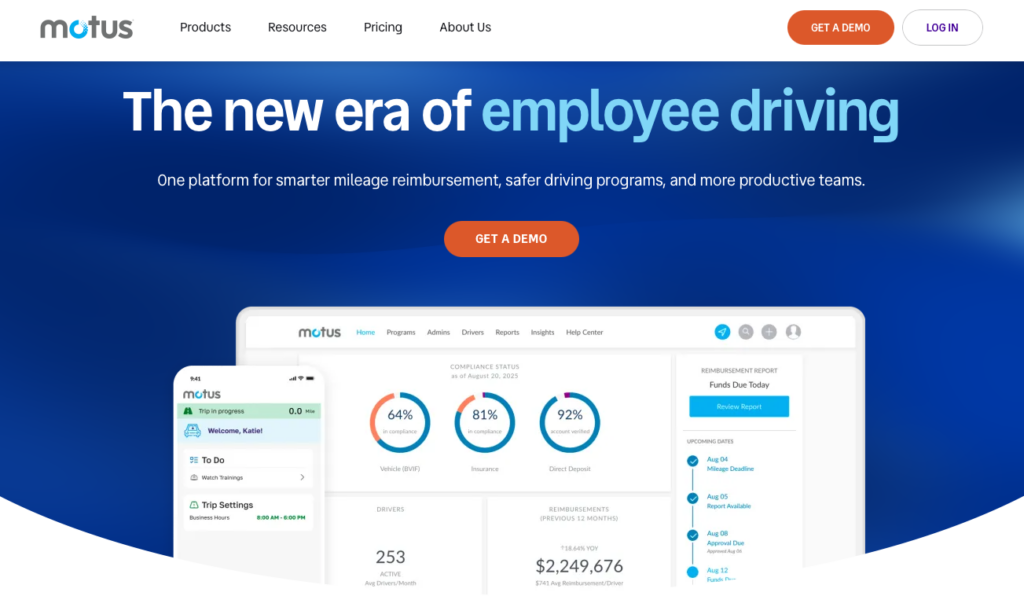
Motus is a vehicle reimbursement platform for companies with mobile and driving employees.
Why I chose Motus: I ranked Motus #5 because it has a strong focus on IRS compliance, accurate reimbursements (FAVR, CPM), and policy enforcement for field teams.
Reimbursement programs
Motus is built around specific reimbursement methodologies rather than just simple tracking. It supports Fixed and Variable Rate (FAVR) programs for high-mileage drivers, Cents-Per-Mile (CPM) for occasional drivers, and Tax-Advantaged Accountable Plans (TAAP) to optimize car allowances.
This flexibility allows businesses to align drivers to programs that fit them best. You can run multiple programs simultaneously, like FAVR for your sales team and CPM for occasional travel. I appreciate the flexible workflows that allow companies to run reimbursement programs that align with their organizational needs.
Automated mileage capture
The Motus driver mobile app offers GPS-verified mileage capture. It automates IRS compliance with detailed mileage logs and provides tax-free reimbursements for your employees. The app also handles automated commute deductions, simplifying mileage log submission.
While the app reduces manual mileage recording, it’s heavily geared toward enterprise use. This means it might be overkill and too expensive for solo freelancers or small teams who just need a basic tracker.
Administration and compliance
Motus has a centralized admin portal for program oversight, approval workflows, and compliance management. It offers weekly, biweekly, semimonthly, or monthly payment frequency options to align reimbursements to the needs of every driver group and company payroll practices.
One notable downside is the lack of public or transparent pricing. You need to contact sales for a custom quote, and implementation generally takes 6-8 weeks, which seems like a considerable commitment compared to other apps on this list.
What users say about Motus
Read review hereI like how easy it is to track trips and expenses in one place. It keeps everything organized and makes reporting simple.
.
Read review hereSome of the updates are filled with bugs. Sometimes you have to manually add your mileage, which is somewhat of a inconvenience.

.
Key Features
- Automated mileage capture
- Tax-free reimbursements (FAVR, CPM, TAAP)
- Automated commute deduction
- Centralized admin portal
Pros
- Strong focus on IRS compliance
- Flexible payment frequencies
Cons
- Enterprise-focused
- No public pricing available
Pricing
Contact vendor Trial: No Free Plan: No
Workforce Management Software for Teams on the Road
-
Connecteam — Best for managing mobile teams beyond mileage tracking
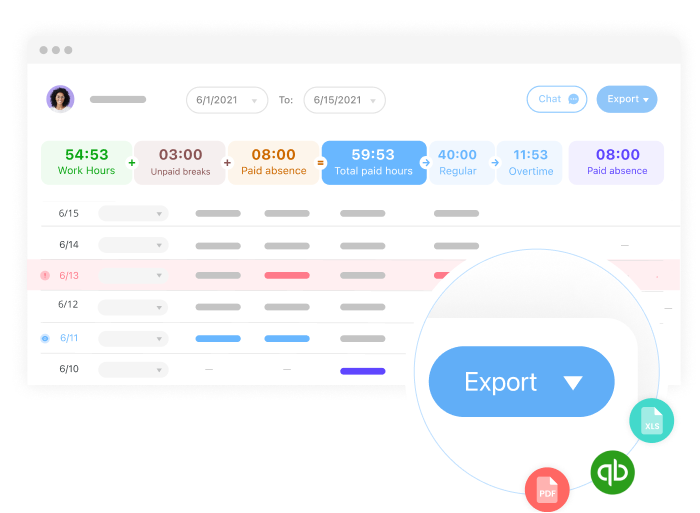
Connecteam is a workforce management platform for companies with mobile and field teams. It’s not a mileage tracker, so it doesn’t automatically detect or log miles. Instead, Connecteam is the operational backbone that teams use alongside a mileage tracker to schedule drivers, verify their work hours and locations, manage tasks, and integrate mileage reimbursement into payroll.
Why I chose Connecteam: I included Connecteam because field teams need more than just accurate mileage data. They need to schedule drivers efficiently, verify they’re working where they claim to be, track their hours, and seamlessly move mileage reimbursement data into payroll systems. Connecteam handles all of these workflows in one app, eliminating the friction of switching between scheduling tools, time clocks, GPS trackers, and accounting software.
Here’s what Connecteam has to offer:
Scheduling and GPS time tracking
Connecteam’s foundation is its employee scheduling and employee time clock, built specifically for teams that work away from a fixed office. You can assign drivers to specific jobs or routes using shift templates and drag-and-drop scheduling, then have employees clock in and out from the mobile app when they start and finish work.
The time clock includes a real time GPS tracker. The platform captures a location stamp at each clock-in and clock-out, and its GPS breadcrumb technology records employee locations at intervals throughout the shift. Geofencing lets managers restrict clock-ins to designated job sites and alerts you if an employee leaves a location unexpectedly.
For field teams managing multiple drivers across multiple sites, this gives you independent confirmation of where your people were and when, without relying on their word alone.
Shift-based mileage collection and verification
Because employees are already clocking in and out, Connecteam can collect mileage as part of that same workflow. Using shift entries, which are custom form fields attached to the time clock, you can require employees to log their mileage when they clock out. This ties mileage directly to paid work time, so employees naturally record only business miles, not personal trips.
You can require odometer start/end readings, destination, an odometer photo, and a signature on the form, creating an audit trail that satisfies IRS requirements. Since the time clock already captures GPS breadcrumbs, you can cross-reference an employee’s claimed mileage and destination against their recorded locations to confirm the trip actually happened.
This verification layer is the real advantage, and helps catch falsified logs that a standalone tracker relying on self-reported data might miss. You can also set reminders that prompt employees to submit mileage before clocking out, reducing the back-and-forth of chasing down incomplete logs.
Reporting and payroll integration
Once mileage is captured against each shift, Connecteam makes the data easy to act on. You can generate timesheets and shift reports that show mileage alongside hours worked and job assignments, with each entry tied to a specific shift so faulty logs are easy to spot and correct. From there, Connecteam integrates with QuickBooks Online, ADP, Xero, and Gusto, letting you push reimbursement data straight into payroll without manual re-entry.
When Connecteam is not the right fit
Connecteam isn’t the right choice if your main need is automatic mileage detection, tax mileage reports, FAVR reimbursement, or route-based mileage calculation. For those jobs, use a dedicated mileage tracker.
And So Much More
Connecteam rounds out a complete operations hub for field teams, including:
- Employee task tracking: Assign recurring or one-off tasks such as vehicle inspections, fuel log submissions, or trip record reviews, and track completion in real-time.
- Employee training software: Create and deliver custom training with the AI Course Creator to get employees up to speed quickly.
- Online team chat: Keep drivers, field employees, and managers connected in one place through one-on-one or group chats.
Connecteam also offers a free for life plan – Try Connecteam here!
0Key Features
- Shift-based mileage collection with form customization
- GPS breadcrumb verification and geofencing
- Employee scheduling with shift templates
- Time tracking with location verification
- Payroll and accounting integrations
Pros
- Unified platform eliminates app-switching for field operations
- GPS verification layer adds compliance confidence
- Flat-rate pricing is cost-effective for teams
- Real-time notifications and geofence alerts
Cons
- Mileage collection is manual, not automatic
- Requires internet/WiFi connectivity to submit forms
- Not suitable for solo freelancers or simple use cases
Pricing
Free-for-life plan availablePremium plans start at $29/month for 30 users
14-day free trial, no credit card required
Start your free trial
Compare the Best Mileage Tracker Apps
| Topic |
|
|
|
|
|
 Start for free
|
|---|---|---|---|---|---|---|
| Reviews |
 |
|
|
N/A
|
N/A
|
|
| Pricing |
Starts at $8/user/mo
|
Starts at $8/user/mo (Team plan)
|
Starts at $8/user/month (Team plan)
|
Starts at $3/user/month
|
Contact vendor
|
Starts at just $29/month for the first 30 users
|
| Free Trial |
yes
15-day
|
yes
(7-day)
|
yes
30-day
|
yes
14-day
|
no
|
yes
14-day
|
| Free Plan |
yes
|
yes
(Team plan)
|
yes
(Individual plan)
|
yes
|
no
|
yes
Free Up to 10 users
|
| Use cases |
Best for teams with multiple vehicles and drivers needing flexible tracking methods
|
Best for freelancers and self-employed professionals tracking mileage and expenses
|
Best for busy professionals who want automatic, set-it-and-forget-it mileage tracking
|
Businesses integrating mileage tracking with broader expense management
|
Mobile field teams needing automatic mileage tracking with compliance verification
|
Best for managing mobile teams beyond mileage tracking
|
| Available on |
Web, iOS, Android
|
Web, iOS, Android
|
Web, iOS, Android
|
How to Choose the Right Mileage Tracker App
There are multiple factors to consider when choosing the right mileage tracker app. To make your decision easier, think about these questions:
Team Size & Budget
- Are you a solo freelancer looking for a free or low-cost automatic tracker, or a growing business that needs to enforce mileage policies across a large fleet?
- Do you prefer a flat monthly fee, or are you comfortable paying a per-user subscription that scales as your team grows?
- Are you willing to invest in upfront hardware costs for tracking devices, or do you need a purely software-based solution?
Industry & Use Case
- Do you need a set-it-and-forget-it app that runs in the background, or do you require verifiable odometer photos to prevent mileage fraud?
- Are your employees driving in rural areas where an offline tracking mode is essential?
- Do you need to track mileage in the context of specific shifts, jobs, or clients, or are you just looking for a simple log of total miles driven?
Feature Requirements
- Does the app need to integrate seamlessly with your existing payroll or accounting software?
- Are you looking for a standalone mileage tracker, or do you want a platform that also handles operations?
- Do you need advanced compliance features like Fixed and Variable Rate (FAVR) reimbursements or driver safety monitoring?
What Is a Mileage Tracker App?
A mileage tracker app is a digital tool designed to help users track distance traveled, expenses, clock in and out times, and where they’re located. Mileage apps use GPS technology to automatically track the user’s location and calculate how far they’ve traveled, eliminating the need for manual tracking.
Users can usually categorize their trips and expenses as either business or personal, and the app keeps track of these details in a secure, cloud-based dashboard. Some apps include additional features, too, like scheduling and payroll.
How Do Mileage Tracker Apps Work?
A mileage tracking app uses GPS technology on a driver’s phone to measure their driving distances and converts the information into reports for financial purposes, such as tax deductions and reimbursements.
Some apps require users to start and stop the mileage tracker for each journey, while others actually run in the background, tracking mileage automatically even when users are not on their phones. Connecteam does not track your staff’s location when they are off the clock!
What Are the Benefits of a Mileage Tracker App?
Here are five key reasons why using a mileage tracker app can benefit your business in the long run:
Saves time and money
One of the main benefits of a mileage tracker app is that it can save you time and money in the long run. If you’re able to track fuel costs and mileage over a long period of time, you’ll have clearer oversight and be better prepared for scheduled vehicle maintenance.
Streamline your payroll and accounting processes
Digitally tracking your mileage on an app that integrates with your payroll software means your accounting processes will be much smoother. There’s no need to conduct manual data entry of mileage or expense reports because the software automatically inputs the information for you.
Always be aware of your drivers’ locations
Mileage tracker apps come with GPS technology, so you’re always aware of your drivers’ locations at all times. That way, you can better communicate and coordinate with them and rest assured that they are where they say they are.
It’s always accessible
As opposed to using a large, inconvenient laptop or tracking mileage manually, employees can easily use a mileage app on their mobile phones.
Ensures tax compliance
To claim mileage deductions and save on taxes, you need to keep detailed records. With a mileage tracker app, you can digitally upload documents, photos, and receipts into the software, and it will keep track of everything for you.
How Much Do Mileage Tracker Apps Cost?
There usually isn’t a drastic difference in pricing between mileage tracker apps. Pricing usually starts between $3–$4.99 per user per month, with more expensive platforms starting between $8–$9 per user per month.
But with Connecteam, you can access a suite of powerful employee management tools at a fraction of the cost. Connecteam’s Small Business Plan is completely free for up to 10 users, while paid plans start at just $29 per month for up to 30 users.
The Bottom Line on the Best Mileage Tracker Apps
Whether you’re a solo freelancer or managing a team in the field, the right mileage tracker app takes the guesswork out of IRS deductions and reimbursements. When choosing one, focus on accurate logging, easy trip classification, and clean, IRS-compliant reports that hold up at tax time.
If you manage employees on the road, you need more than just a mileage tracker to schedule drivers, verify their locations, track their hours, and move reimbursement data into payroll. That’s where Connecteam comes in. Pair one of the five trackers above with Connecteam’s scheduling, GPS verification, and payroll integration to build a complete field operations system.
FAQs
Most mileage tracker apps allow users to keep records of work travel in order to deduct business mileage easily. This takes the pressure off the user, providing automated reports in the process. When mileage has been deducted on tax returns, the IRS requires accurate business mile reports. Mileage tracker apps ensure that you keep track of destinations, dates, and reasons for each trip.
There are free mileage tracker apps on the market, but most have some limitations. Still, many of these apps do offer free trials, allowing users to test them out before purchasing.
Yes. Mileage tracker apps can record details such as business miles, trip dates, destinations, and business purpose, making it easier to maintain records for tax purposes. Some also support custom mileage rates and downloadable reports.
Look for accurate mileage capture, easy business and personal trip classification, clear reports, custom mileage rates, and a tracking method that fits how you drive. Businesses should also consider team controls, reimbursement workflows, integrations, offline needs, and how easily managers can verify submitted mileage.
