


Manual dispatching can sometimes break under pressure: one missed update about a delayed job can throw off an entire day, leaving technicians idle, customers waiting, and dispatchers stuck reacting and reorganizing.
I reviewed 31 service dispatch platforms and evaluated them on features like quick schedule adjustments, live job updates, mobile access, and automatic notifications. You’ll learn which tools stop missed updates from cascading into schedule chaos, as well as which ones help dispatchers coordinate instead of react.
Our Quick Picks
If you don’t have the time to read through our research, jump down to our quick comparison table.
| App | Best for | Starting Price | Key Considerations |
| Connecteam | Field teams that need mobile-first dispatch, schedule visibility, and workforce tools in one platform | Just $29/month for the first 30 users | Strong all-in-one mobile dispatch, but advanced route optimization is limited |
| HouseCall Pro | Same-day service businesses where response time and technician proximity drive customer satisfaction | $59/month billed annually | Excellent live tracking, but limited automation rules |
| Jobber | Home service businesses with recurring client schedules | $29/user/month | Great for repeat work, but requires manual workload balancing |
| FieldEdge | Home service businesses that focus on technicians upselling equipment replacement and service agreements | Contact vendor for price | Dispatch ties into revenue workflows, but pricing lacks transparency |
| Service Fusion | Small teams that need both dispatch and invoicing without per-user pricing | $208/month billed annually | Flat-rate billing with invoicing built in, but limited mobile admin options |
| Workiz | Growing service businesses that want automation to reduce coordinating time | Contact vendor | Modern interface and built-in messaging, but automation remains basic |
Updated September 2026:
- Expanded the list to include all tools we considered, tested and reviewed.
Updated February 2026:
- Revalidated pricing across all tools and adjusted tier details where needed.
- Updated the overtime and route optimization coverage for Jobber, Housecall Pro, and Workiz.
- Clarified the limits of offline functionality across platforms.
- Refined dispatch automation comparisons to reflect current workload balancing features.
Our Top Picks
-
1

Field teams that need mobile-first dispatch, schedule visibility, and workforce tools in one platform
-
2

Same-day service businesses where response time and technician proximity drive customer satisfaction
-
3
Jobber
Home service businesses with recurring client schedules
Why trust us?
Our team of unbiased software reviewers follows strict editorial guidelines, and our methodology is clear and open to everyone.
See our complete methodology
How I Ranked the Best Service Dispatch Software
To rank these tools, I focused on what happens when the workday goes sideways. Since dispatch issues can happen at various hours while workers are in the field, I weighted mobile accessibility and live job visibility higher than desktop-only features.
The must-haves:
At minimum, service dispatch software must let you assign jobs, track field activity, and adjust schedules mid-day without constant manual coordination.
I looked for:
- Quick schedule adjustments: Reassigning jobs when technicians call out or run late should take seconds, not require rebuilding the entire day. If one change meant manually updating five other assignments, the tool ranked lower.
- Live job status updates: You need to see which jobs are active, delayed, or complete without texting technicians.
- Mobile job management: Technicians must be able to handle the day from their phones.
- Centralized job records: Customer history, site notes, and job details should live in one place. If basic information required hunting through separate systems, the tool dropped in the ranking.
- Automatic assignment notifications: Schedule changes should reach technicians instantly without you sending manual updates.
If core dispatch controls were limited or required workarounds, the tool couldn’t rank highly.
I also screened for these dispatch limitations:
- Desktop-only controls: Tools requiring office access during active service days ranked lower.
- Per-user pricing escalation: Costs that multiply quickly with team growth hurt rankings for expanding businesses.
- Manual coordination dependency: Platforms needing phone follow-up for every change weren’t competitive.
Finally, I checked for features that reduce coordination work:
- GPS tracking: Live location visibility shows where technicians are during the workday, enabling location-based assignment decisions.
- Route optimization: Automated calculation of the most efficient driving order across multiple stops reduces travel time and fuel costs.
- Customer self-service: Booking portals eliminate back-and-forth scheduling calls.
- Job-tied invoicing: Payment collection happens right after completion.
- Field documentation tools: Digital forms and signatures are captured during visits.
These aren’t required, but they separate good dispatch software from great dispatch software.
Our Top Best Service Dispatch Softwares of 2026
-
Connecteam — Field teams that need mobile-first dispatch, schedule visibility, and workforce tools in one platform
Connecteam is a workforce management and field service dispatch platform that handles job scheduling, technician coordination, and real-time updates.
It’s especially strong for teams that need dispatch coordination to work smoothly without requiring constant manual oversight or desktop-only controls.
Why I chose Connecteam
I ranked Connecteam #1 because it delivered the strongest combination of mobile job management, live job status updates, and GPS-enabled time tracking tied directly to specific job sites. What separated it from competitors was handling dispatch, workforce management, and payroll prep in one system.
Efficient employee scheduling and task assignment tools
Connecteam’s staff scheduling software lets managers view time-off requests and scheduling preferences directly on the platform, which helps avoid conflicts. The drag-and-drop scheduler lets you include customer details when you assign jobs, so technicians see everything when they open their schedule. This means technicians arrive prepared instead of needing follow-up calls for addresses or job requirements.
I liked how it includes job scheduling templates for repeat work such as weekly cleaning routes or monthly HVAC maintenance. This helps you set up recurring service patterns quickly. Technicians also get push notifications immediately after you publish a schedule.
Connecteam’s task management feature is also straightforward, letting you create jobs in just a few clicks. You can add descriptions and break jobs into subtasks so technicians know exactly what needs to happen on site.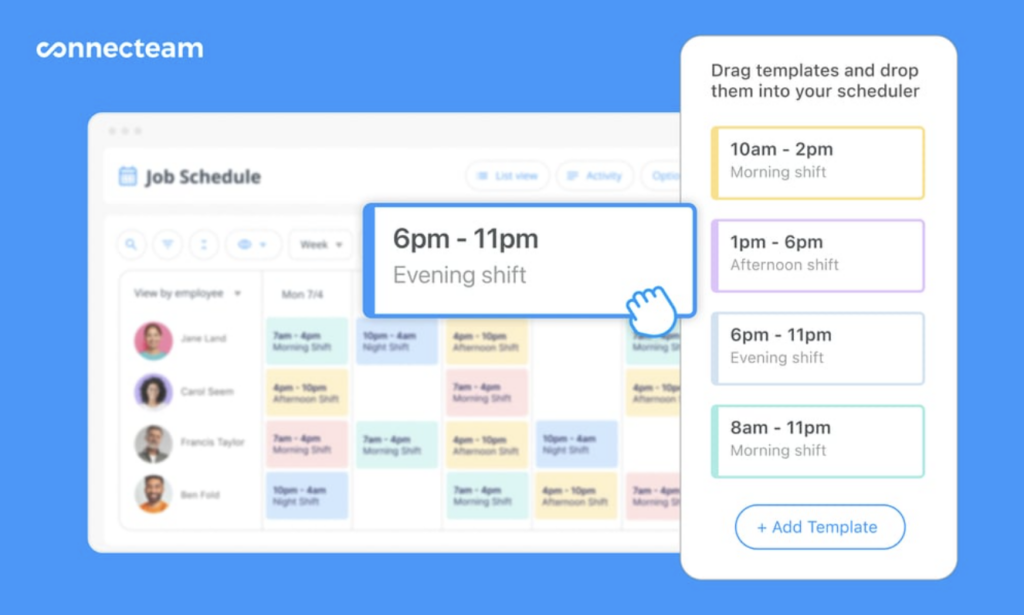
Live visibility with GPS time tracking
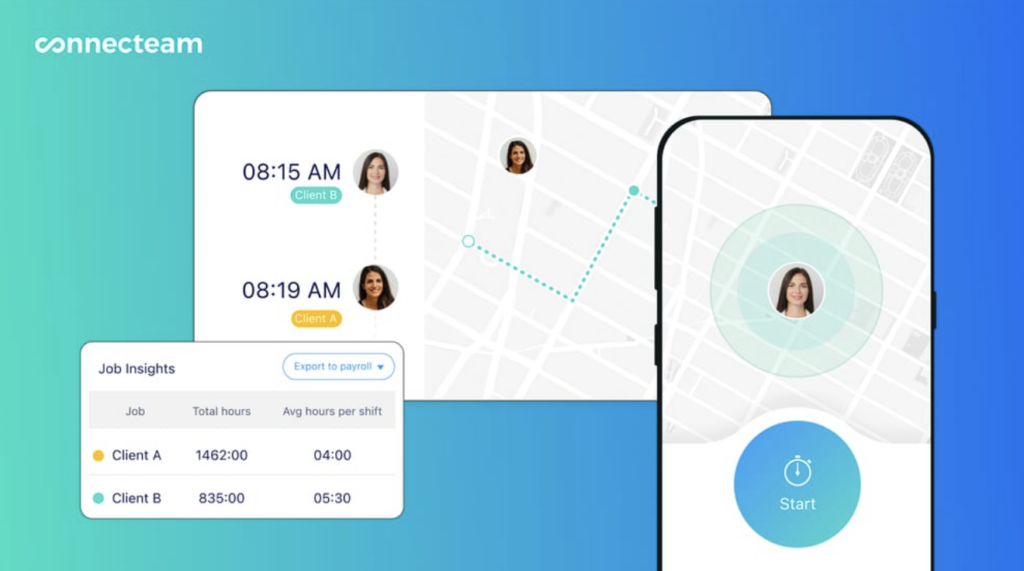
Connecteam’s employee time clock adds another level of visibility, as it lets technicians clock in from their phones. This gives you a real-time view of who has actually started work versus who is scheduled to start. When making mid-day reassignments, this is an especially helpful distinction. The only catch here is that technicians need internet connectivity for the GPS verification feature to work, so teams in areas with spotty cell coverage may have difficulties.
You can set geofences around job sites so clock-ins only register when someone is on location. For example, a technician assigned downtown can’t clock in from home 20 minutes away—the punch only registers once they arrive at the actual site. I found this prevented early clock-ins without needing manual verification.
Setting up geofences requires mapping each location once, but after that, the system handles verification automatically. When workers clock out, location tracking stops completely. In my experience, that’s usually the first thing employees ask about when GPS tracking gets introduced.
Job updates, team communication, and more
Connecteam lets technicians submit job updates, photos, and forms directly from the field, all attached to the specific job. For example, a technician can complete a safety checklist, upload before-and-after photos, and mark tasks complete while still on site.
Updates appear in real time. Instead of calling to ask “Did you finish that install?” you open the job and see the checklist is complete and photos are uploaded.
On top of that, Connecteam’s built-in online team chat keeps communication tied to jobs. If a schedule changes, you can message the technician directly in the job thread. When someone reviews the job later, they see the full history in one place, including chat messages, instead of piecing it together from texts.
Finally, Connecteam offers excellent customer service, a user-friendly interface, robust workforce management tools, and complete customizability. These benefits in addition to its service dispatch features make Connecteam the best choice for businesses looking for an all-in-one option.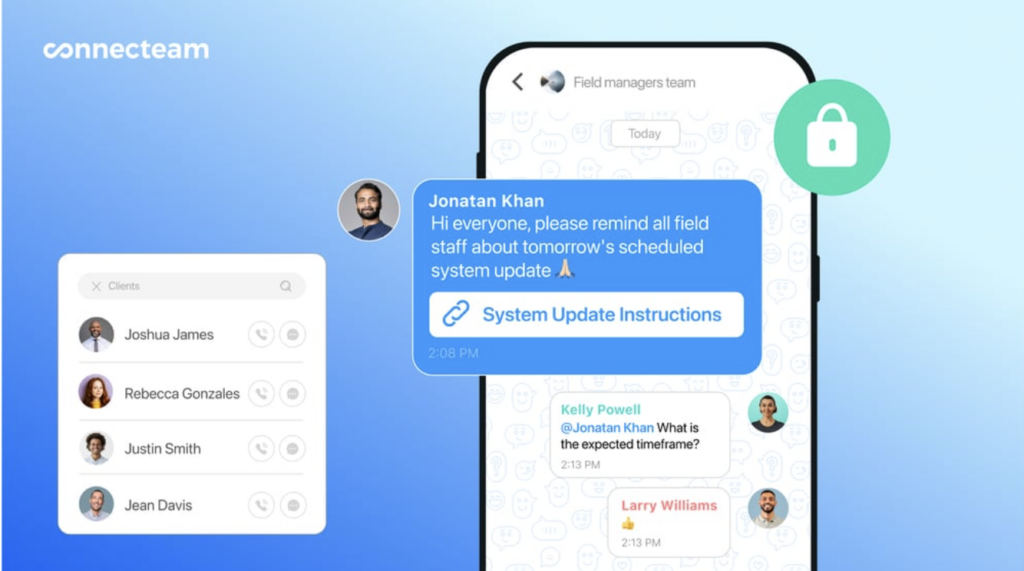
When Connecteam may not be the best fit
Connecteam may not be the best choice if route efficiency is your top dispatch priority. Teams running HVAC or plumbing where technicians handle 6–8+ stops per day should consider Housecall Pro or Jobber for their built-in route optimization instead.
It’s also not ideal if you need detailed vehicle fleet management beyond basic GPS tracking. In addition, while Connecteam offers basic integrations, teams with complex accounting workflows may find that other software integrates more tightly.
Connecteam also offers a free for life plan – Try Connecteam here!
0Key Features
- Employee scheduling
- Task management
- Information and file attachments
- GPS location tracking
- Task-specific communication
- Digital forms & checklists
Pros
- Dispatch and workforce tools work together without switching platforms
- Mobile-first design supports field teams better than desktop-heavy systems
- Flat pricing avoids per-user costs that grow with team size
- GPS-enabled time tracking ties hours worked to specific job sites
Cons
- Needs internet or wifi access to work
- Route optimization is more basic compared to specialized routing tools
Pricing
Free-for-life plan availablePremium plans start at $29/month for 30 users
14-day free trial, no credit card required
Start your free trial -
HouseCall Pro — Same-day service businesses where response time and technician proximity drive customer satisfaction
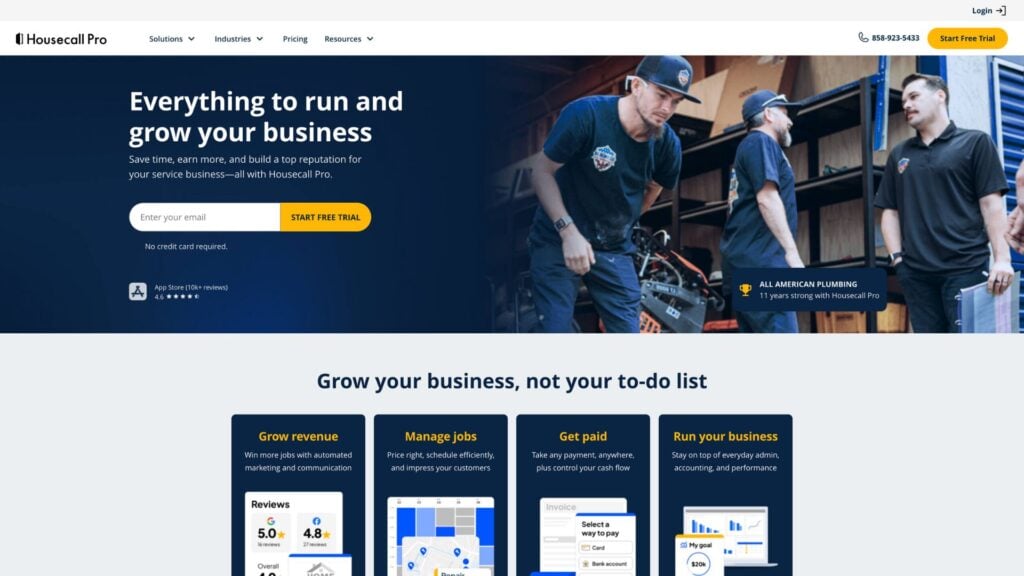
Housecall Pro is a dispatch service software that focuses on live technician tracking and proximity-based dispatch. It lets teams assign jobs based on real-time location rather than static schedules. Our hands-on review of Housecall Pro covered its GPS tracking, scheduling tools, and same-day dispatch capabilities.
Why I chose Housecall Pro
I included Housecall Pro because it delivered the strongest live job status updates and GPS tracking from my ranking criteria. It’s ideal for teams where proximity is the main factor for dispatch decisions and same-day schedule changes are frequent.
Scheduling and dispatching
Scheduling in Housecall Pro is structured around a centralized grid that supports both recurring services and one-off jobs. Job templates help standardize routine work, while private notes let dispatchers add internal instructions directly to a job that customers can’t see. For example, you might include gate codes, parking details, or special access instructions without displaying that info in customer-facing messages.
Live technician tracking and proximity-based assignment
Once work is underway, technician location becomes the main dispatch signal. Live GPS tracking shows where technicians are throughout the day, making assigning technicians to new jobs based on proximity much easier.
For same-day service businesses, proximity directly impacts response time and customer satisfaction. If an emergency HVAC call comes in at 2pm and you have 3 technicians in the field, seeing that one is 5 minutes away while the others are across town means you can promise the customer a 15-minute arrival instead of an hour. This turns location visibility into a competitive advantage when customers are choosing between service providers based on who can arrive fastest.
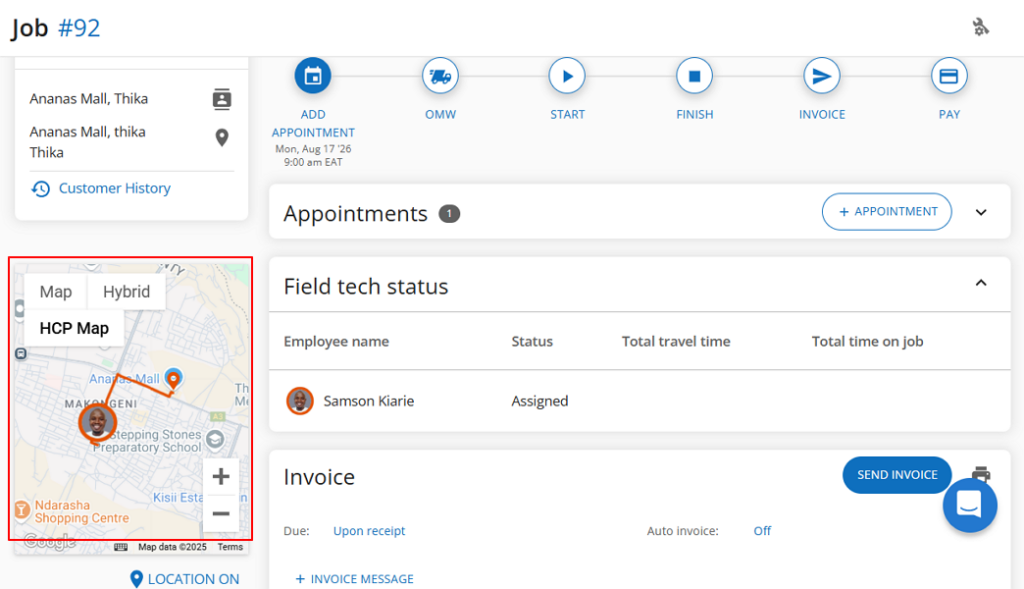
With HouseCall Pro, you can track how far a technician is from the customer’s address. Real-time job updates and technician alerts
When you assign a job in Housecall Pro, the technician gets a push notification and can update their status from the mobile app. In HouseCall Pro, status changes also trigger automatic customer notifications. For example, when a tech taps “on my way,” the customer receives an ETA without dispatch making a separate call.
Morning-of reminders and one-hour-before alerts also help reduce no-shows, especially for recurring service visits that are easy to forget. I wouldn’t call this advanced automation, but it does keep technicians, dispatch, and customers aligned during the day without constant check-ins.
Notable limitation
Housecall Pro shows you where technicians are in real time, but it doesn’t automatically suggest the best route or reorganize their stops based on traffic or urgency. You still need to figure out the most efficient order yourself.
What users say about Housecall Pro
Ease of use for management as well as technicians.

The reporting features are not the greatest.It is very easy to pull reports however getting the data you actually want can be a task.

Key Features
- Drag-and-drop scheduling
- Real-time dispatching
- GPS tracking
- Job updates and alerts
Pros
- Live GPS tracking enables location-based dispatch
- Push notifications and “on my way” alerts reduce manual check-ins
Cons
- No built-in route optimization
- Limited dispatch automation at scale
Pricing
$59/month billed annually Trial: Yes — for 14 days Free Plan: No
-
Jobber
Jobber — Home service businesses with recurring client schedules
Jobber specializes in repeat service scheduling and client relationship management, making it well-suited for businesses where the same customers book regular maintenance visits. This summary is based on our full review of Jobber, where I tested its scheduling tools, client communication features, and dispatch workflow.
Why I chose Jobber
I picked Jobber because it excelled at centralized job records and automatic notifications for recurring work, both must-haves from my criteria. It’s best for teams where job history and repeat client schedules matter more than same-day route flexibility.
Job scheduling and dispatching
Jobber centers dispatch work around a shared scheduling calendar where you create, assign, and adjust service jobs in one place. Like other industry software, job statuses update as work progresses. However, the system follows fixed scheduling rules and doesn’t automatically adjust based on technician location, availability gaps, or approaching overtime.
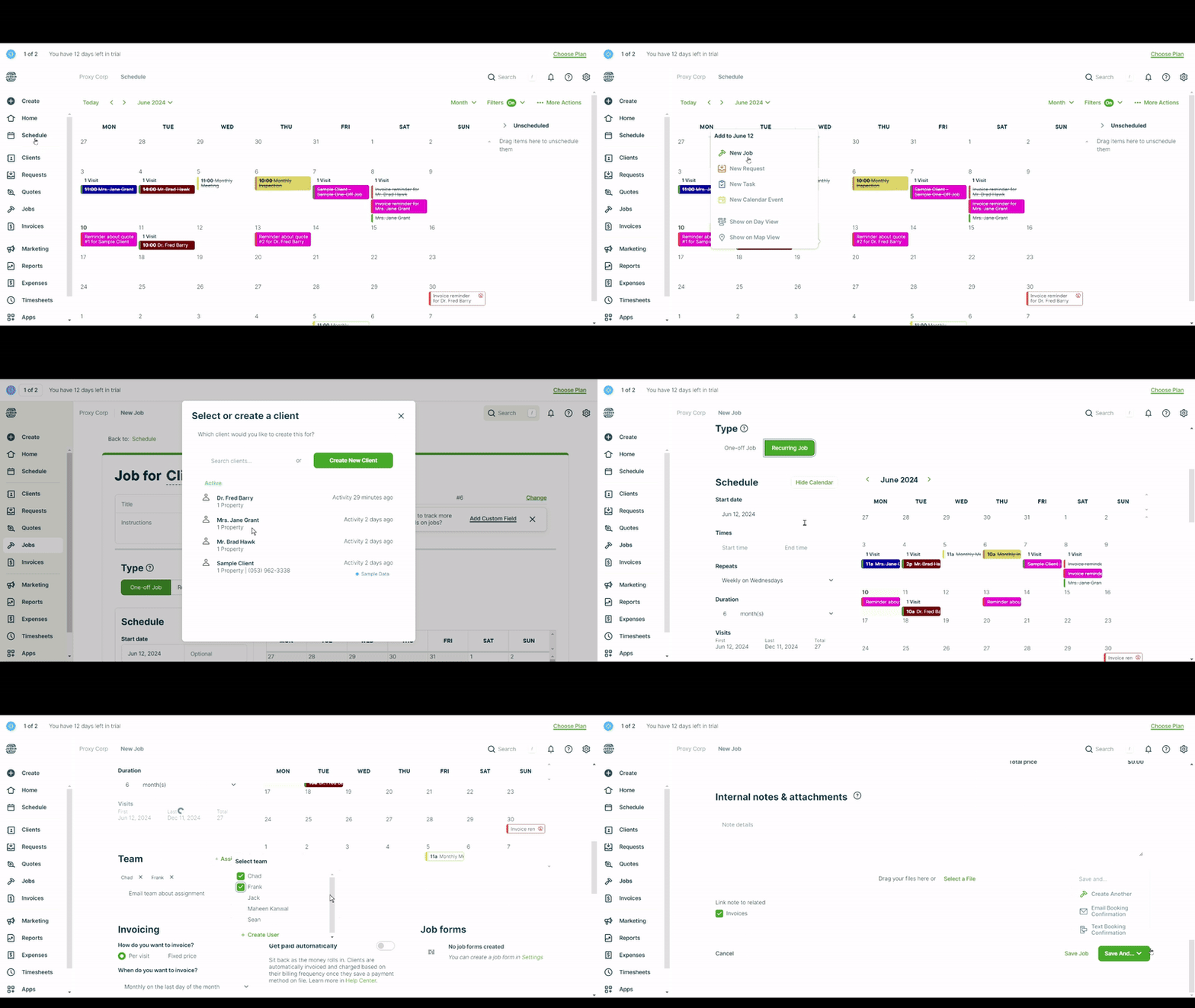
The Jobber scheduler’s color coding and drag-and-drop features make scheduling uncomplicated. Work order management with job tracking
Each service job in Jobber functions as a structured work order that carries notes, photos, and time entries from start to finish.
Because time is logged directly for each job, field service managers can use past service data to better estimate future work. For example, if a lawn care company sees that spring fertilization consistently takes 45 minutes for properties over half an acre, you can quote accurately for similar properties and schedule the right amount of time per stop. This is a definite upside for any team that prices jobs based on time estimates because it takes guesswork out of the equation.
Client hub and two-way communication
Jobber extends dispatch coordination to customers through its Client Hub, a secure online portal where customers can view upcoming appointments, invoices, and job details. Instead of calling the office, they can log in and check their service status directly.
Appointment confirmations and reminders help meet the transparency customers expect before visits. If a customer replies to a reminder text with a question or rescheduling request, that message appears inside the job record, and dispatch can respond from the same thread.
The portal also supports saved payment methods for automatic charging on recurring services. When a customer approves a monthly maintenance agreement, their card is processed automatically on each visit without requiring you to follow-up with an invoice.
Notable limitation
Jobber’s recurring service workflows work well when schedules stay predictable, but the system can struggle with exceptions. If a recurring client needs to skip a month, reschedule permanently, or switch between weekly and bi-weekly service, you have to manage those changes manually across multiple future appointments.
What users say about Jobber
I like Jobber for it’s vast offerings including full schedule management, invoicing, follow-up details.
I’ve noticed that most of my clients that I have on reoccurring schedule are not on my schedule when I know I put them on schedule.
Key Features
- Job scheduling calendar
- Work order management
- Client portal
- Two-way customer messaging
Pros
- Recurring job workflows reduce setup time
- Customer portal centralizes service communication
Cons
- Manual workload balancing required
- Per-user pricing scales quickly with team size
Pricing
Starts at $29/user/month Trial: Yes — for 14 days Free Plan: No
-

FieldEdge — Home service businesses that focus on technicians upselling equipment replacement and service agreements
Available on
- Web
- iOS
- Android
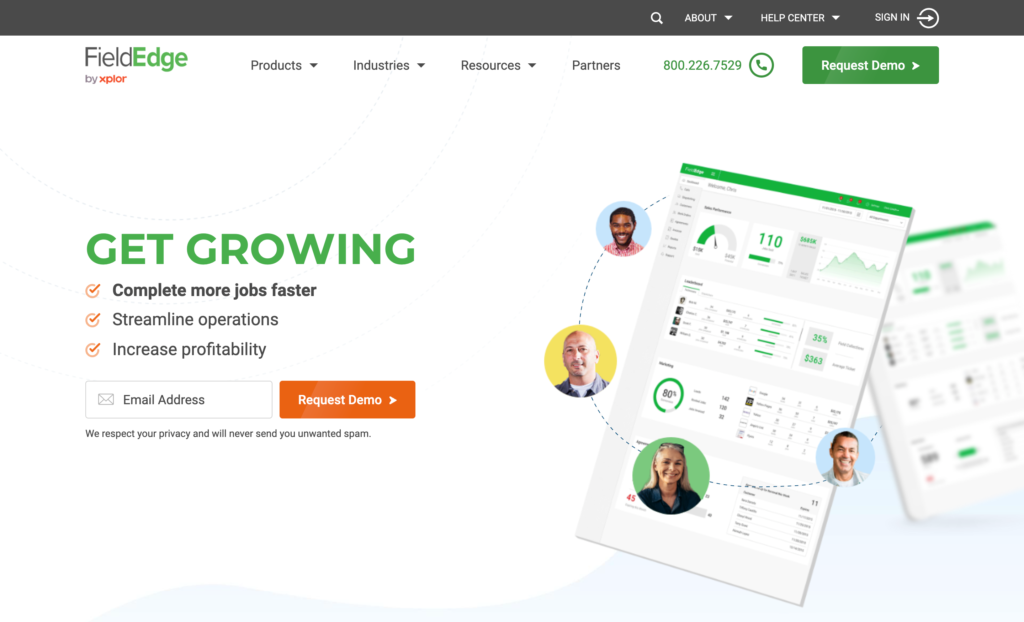
FieldEdge connects dispatch directly to revenue workflows, tying job assignments to quotes, pricing, and upsell opportunities for home service teams. We reviewed its skill-based assignment process, app for technicians, and invoicing features in our comprehensive FieldEdge review.
Why I chose FieldEdge
I included FieldEdge because it combined centralized job records with job-tied invoicing, addressing both a must-have and a key differentiator. It helps service teams (such as those in HVAC, plumbing, and electrical) where dispatch connects directly to quotes and upselling services rather than simple task completion.
Skill-based job assignment with visual matching
I appreciated that FieldEdge displays a gold star next to technicians who have the ideal skillset for a specific work order on the dispatch board. You assign skills to technicians—such as HVAC certifications, electrical licenses, or plumbing specialties—and the system automatically highlights which tech has the most relevant expertise.
For example, when an emergency HVAC call comes in requiring EPA certification for refrigerant work, the gold star shows you immediately which technicians are qualified without checking separate records or risking a costly truck roll with the wrong person.
Technician visibility and scheduling
FieldEdge uses a centralized calendar to manage assigned and unassigned jobs in one place. Dispatchers can assign work manually or lean on technician skills and location to guide assignments. I found that the built-in map adds helpful context by showing where jobs are clustered.
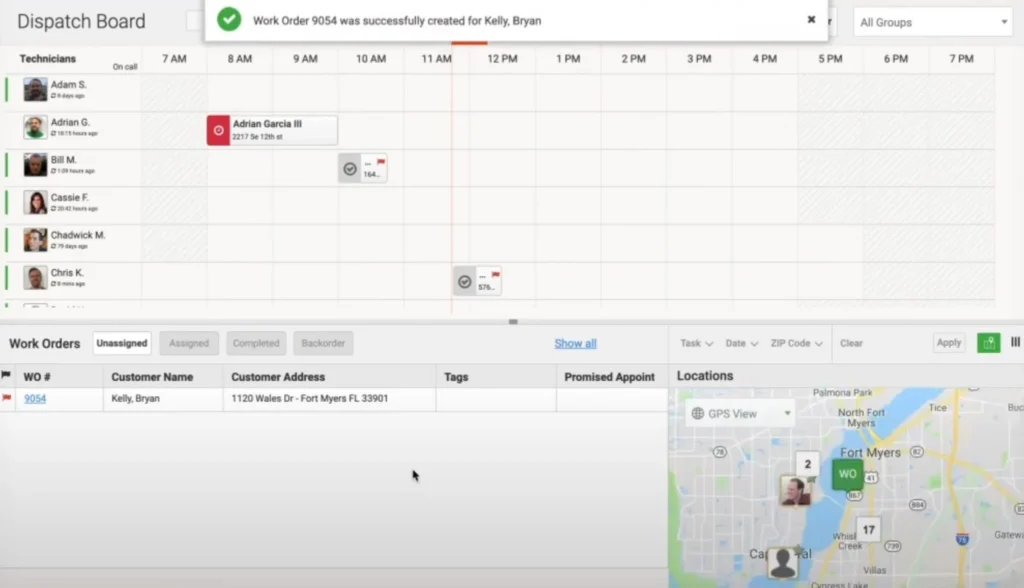
FieldEdge’s dispatch board shows technician schedules alongside a live map view to help manage job assignments throughout the day. As technicians update their status, changes appear on the dispatch board, and customers automatically receive notifications when a technician is on the way or when a visit is completed.
Job workflows linked to quotes and upselling
Work orders in FieldEdge connect directly to quotes, price books, and service agreements. When managers dispatch a job, technicians have access to pricing and equipment history while they are on site. That makes it easier to recommend additional work during the visit.
This changes how dispatch decisions get made. Instead of just “who’s available and nearby,” you’re also considering “who’s best at identifying upsell opportunities” or “who has the highest quote conversion rate.” The platform tracks sales performance alongside service completion, so managers can see which technicians turn service calls into revenue.
Notable limitation
FieldEdge requires contacting sales for pricing, which creates friction during the evaluation process. Beyond that, the platform tracks technician status and location but doesn’t flag when someone is approaching overtime or has unexpected gaps in their schedule. This can lead to increased manual oversight for larger teams.
What users say about FieldEdge
What i liked about FieldEdge the most is the easy to use design and functionality.
We got almost no support from field edge while using their software. We were often left to figure things out on our own.
Key Features
- Skill-based job assignment
- Live technician location tracking
- Proposals pricing and estimates
- Job status updates
Pros
- Dispatch integrates with quotes and upselling
- Assignment matches technicians to jobs based on qualifications
Cons
- Requires continuous workload monitoring
- Pricing is not transparent
Pricing
Contact vendor for price Trial: No Free Plan: No
-

Service Fusion — Small teams that need both dispatch and invoicing without per-user pricing
Available on
- Web
- iOS
- Android
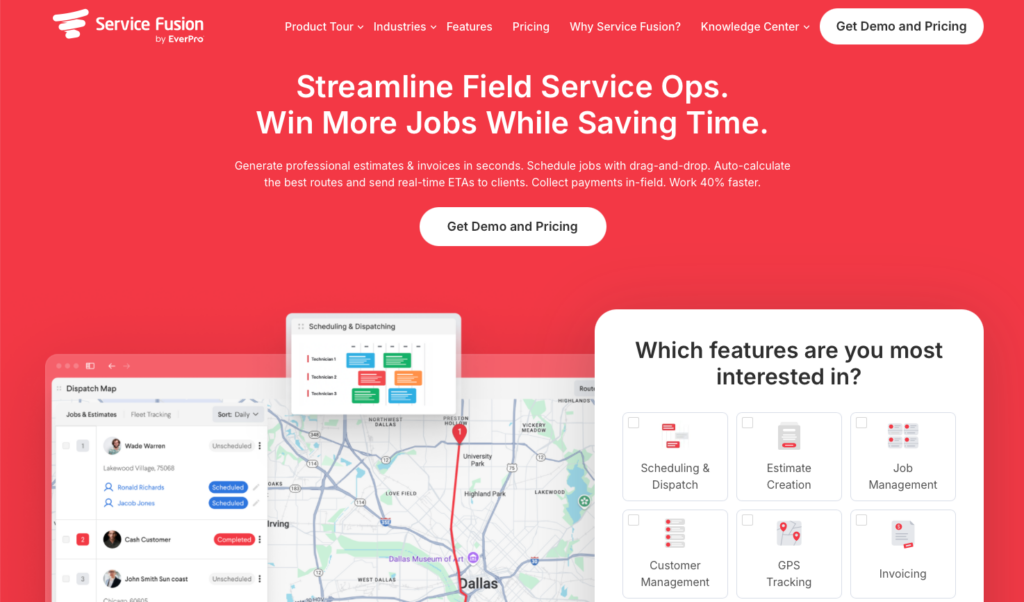
Service Fusion offers scheduling, invoicing, and customer portal access in one system with flat-rate pricing instead of per-user fees. In our full Service Fusion review, we tested its dispatch calendar, customer portal, and invoicing workflow.
Why I chose Service Fusion
I included Service Fusion as it addressed my dealbreaker around per-user pricing escalation with flat-rate billing, and it integrated invoices that are tied to jobs. It’s best suited for teams where predictable costs matter more than advanced mobile admin controls.
Flat rate pricing with unlimited office users
Service Fusion charges a flat monthly rate regardless of how many office users access the system. If you’re running six technicians with three people in the office handling dispatch and admin work, other platforms charge per user. Service Fusion includes all office staff in the base price.
I think this makes the most sense for teams with multiple coordinators or office-heavy operations where several people need system access. However, if you’re a solo operator or have just one dispatcher, the flat rate doesn’t offer the same advantage. At that scale, per-user pricing would likely be cheaper.
Job scheduling and invoicing workflow
Service Fusion uses a drag-and-drop calendar to create, assign, and reschedule jobs. Once a customer approves an estimate, it converts into a job and then into an invoice without re-entering details. Technicians can collect payments on-site, and the system sends automatic reminders if invoices go unpaid.
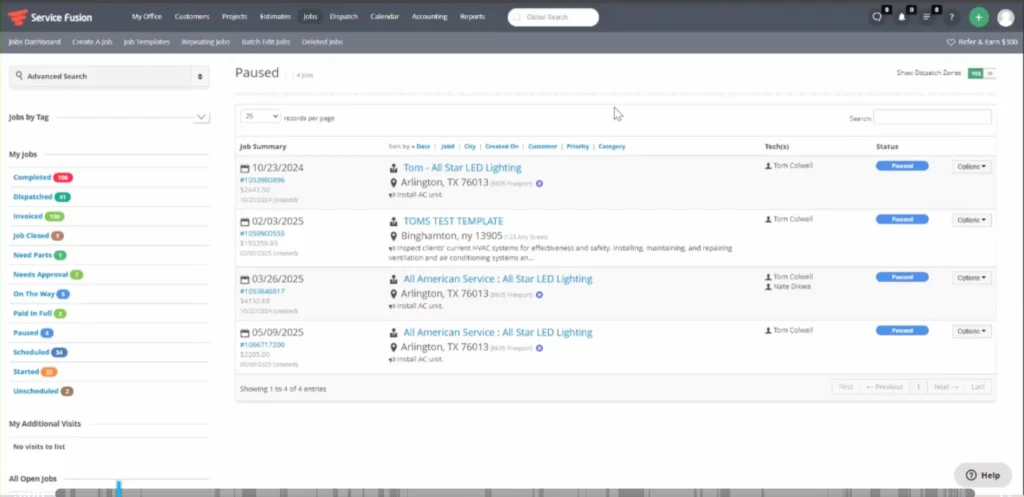
Service Fusion’s admin dashboard lists all jobs with their assigned technicians and current status for easy tracking. I think the estimate-to-invoice conversion is one of the strongest parts of the software. For teams that quote jobs before starting work, eliminating the step of manually creating invoices from approved quotes saves time during billing cycles. The customer portal lets clients view job history and pay invoices online, which reduces the back-and-forth of payment collection.
Built-in GPS fleet tracking on dispatch board
Service Fusion includes GPS fleet tracking as a native feature, not a third-party integration. Vehicle tracking devices connect directly to the platform, and truck icons appear on the schedule map in real time.
When customers call asking for ETAs, you can see the truck’s current location on the board and give a specific answer instead of calling the tech. The system works with hardwired or OBD plug-in tracking devices.
For emergency calls, this means you can assign jobs based on actual vehicle location rather than guessing where technicians might be between stops.
Notable limitation
Service Fusion’s mobile app performs efficiently for technicians managing their assigned jobs, but dispatch managers may feel limited when they need to make complex schedule changes from a phone or tablet. Reassigning multiple technicians at once, making bulk edits to the day’s schedule, or adjusting jobs across different service areas usually requires switching to a desktop.
What users say about Service Fusion
service fusion allows me to keep track of all my clients, material, labor etc. It really cuts down on wasted time.
Some fields, forms, and workflows aren’t customizable enough for unique service processes.
Key Features
- Job dispatch calendar
- Customer portal
- Invoices created from estimates
- Built-in GPS fleet tracking
Pros
- Flat pricing avoids per-user cost scaling
- Billing stays connected to dispatch workflow
Cons
- Flat-rate pricing less cost-effective for solo operators or very small teams
- Dispatchers may be tied to their desktops due to limited mobile admin controls
Pricing
$208/month billed annually Trial: No Free Plan: No
-

Workiz — Growing service businesses that want automation to reduce coordinating time
Workiz is another service industry dispatch software for growing teams that need more than a basic calendar but don’t want heavy enterprise software. Our complete review of Workiz examined its scheduling calendar, job intake features, and communication tools.
Why I picked Workiz
I included Workiz because it handled quick schedule adjustments and automatic notifications from my must-haves. It’s also on the list due to its AI-assisted schedule recommendations.
AI scheduling with proximity-based suggestions
Workiz uses a flexible calendar where you can create and assign jobs directly from open time slots. When plans change mid-day—a cancellation comes in or an urgent request needs immediate attention—you can drag jobs between time slots and technicians without rebuilding the schedule.
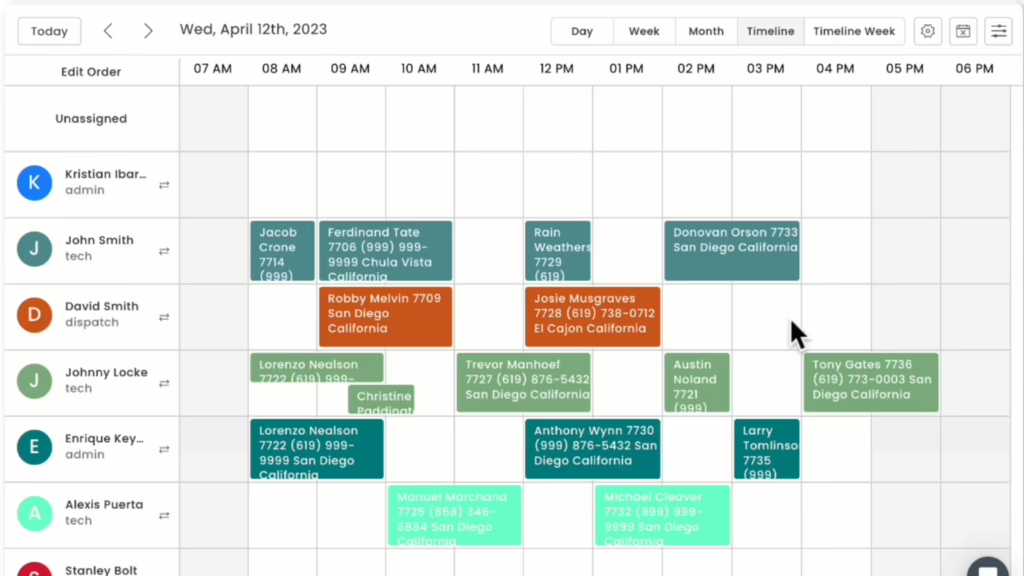
Workiz’s drag-and-drop calendar lets dispatchers quickly move and reassign jobs throughout the day. One differentiator is Genius Scheduling, which uses AI to consider availability, location, and workload when recommending assignments. When you create a new job, the software analyzes the service address and suggests optimal time slots based on proximity to existing jobs.
For example, if an emergency call comes in at 2pm on the north side of town, Genius might suggest “2:45 PM with Tech #3” because that technician is finishing a job ten minutes away. During chaotic periods when juggling multiple same-day requests, this reduces the mental work of calculating the best technician yourself.
Technician visibility and offline functionality
Location tracking logs GPS data when technicians clock in, and the mobile app supports offline work that syncs once reconnected. I found that offline functionality is a practical strength for teams working in low-signal areas such as remote field sites.
Built-in calling and SMS tied to jobs
Workiz also includes built-in calling and texting tools. Dispatch can create jobs directly from text message threads, and call recordings can be stored in the client profile.
Client tagging is another useful tool. Teams can label customers as VIP, commercial, residential, or frequent no-shows, which helps guide dispatch decisions. I find this useful for prioritizing urgent calls from VIP clients or flagging customers with a history of no-shows.
Notable limitation
Workiz’s built-in calling and SMS keep communication organized, but they also create dependency. If you’re already using a business phone system or VoIP platform, you’ll end up managing calls across two systems or migrating your entire communication setup into Workiz.
What users say about Workiz
Invoicing customers is very easy and can be sent via email and SMS texting which is a great feature.
Monthly fee expensive for a small business or sole proprietor.
Key Features
- AI-powered scheduling suggestions
- Multi-view scheduling calendar
- Job intake from calls and messages
- Technician’s visibility
Pros
- AI scheduling suggestions reduce coordination mental overhead
- Communication stays organized by job
Cons
- Dispatch still relies on manual oversight
- Limited integration options
Pricing
Contact vendor Trial: Yes — 7 days Free Plan: No
More Service Dispatch Software Options
These tools did not make the main shortlist, but each can fit a specific field-service, trade, or vertical dispatch use case.
ServiceTitan: ServiceTitan is a field-service platform for growing trade contractors, including HVAC, plumbing, and electrical businesses. It combines scheduling and dispatch with technician workflows, time, forms, and operations tools, but its broader system-of-record scope can be heavier than smaller teams need.
Simpro: Simpro is built for trade contractors that need scheduling, dispatch, mobile work, time tracking, job costing, forms, and reporting in one system. It is a strong fit for more complex service operations, but its midmarket and enterprise orientation may be more than smaller teams require.
Zuper: Zuper covers scheduling, timekeeping, work orders, field forms, chat, and operations for businesses such as HVAC, plumbing, electrical, roofing, facilities, and solar. It fits service-heavy organizations well, but it is more of a dedicated field-service system than a broader workforce platform.
Commusoft: Commusoft supports plumbing, HVAC, electrical, fire and security, and multi-location service businesses with scheduling, dispatch, mobile jobs, time, forms, communication, and reporting. It is a credible trade-service option, but its focus is narrower than the broader workforce needs covered by the main picks.
Service Autopilot: Service Autopilot is a field-service management option for service and maintenance businesses where scheduling and recurring work are central. It can suit teams that want a specialized service-operations system, but it is less relevant when broader workforce management and employee workflows matter.
ServiceM8: ServiceM8 is a field-service management platform for smaller service businesses that need scheduling and job coordination. It can work well for straightforward service operations, but it is narrower than the main shortlist for teams that also need wider workforce-management capabilities.
ServiceTrade: ServiceTrade focuses on service and maintenance operations, with scheduling and job management at the center of the platform. It can suit contractors that prioritize service delivery workflows, but it is less aligned with broader workforce management beyond field-service operations.
Synchroteam: Synchroteam is a field-service management tool for scheduling and coordinating mobile teams. It can fit service businesses that mainly need technician assignment and field job coordination, but its scope is narrower than platforms that also cover broader employee and workforce processes.
Kickserv: Kickserv is a field-service management platform for service businesses where scheduling and job coordination are the main need. It can suit smaller contractors, but it is more focused on service operations than the wider workforce-management coverage represented by the main picks.
Joblogic: Joblogic is a field-service management system for service and maintenance teams, with scheduling as a core workflow. It can fit businesses that need structured field coordination, but it is less aligned with broader workforce-management needs outside the service operation.
LMN: LMN is a field-service management option for service and maintenance teams that need scheduling and job coordination. It can suit specialty field businesses, but its vertical service focus is narrower than the broader dispatch and workforce-management needs covered by the main shortlist.
Yardbook: Yardbook is a field-service management tool for smaller service businesses, with scheduling and job coordination at its core. It can fit teams with straightforward field-service workflows, but it is less comprehensive for larger or more complex dispatch operations.
Skedulo: Skedulo focuses on dispatch and coordination for complex mobile workforces across field service, healthcare, utilities, and staffing. It is well suited to larger organizations with demanding mobile-work scheduling needs, but its enterprise and dispatch-centric approach can be more than SMB service teams need.
PestPac by WorkWave: PestPac by WorkWave is a vertical field-service platform for pest-control businesses, with scheduling and job management as core workflows. It is a strong fit for that industry, but its specialization makes it less relevant to service companies outside pest control.
FieldPulse: FieldPulse combines drag-and-drop scheduling, real-time dispatch updates, GPS technician visibility, job status tracking, and a mobile app for field teams. It is a strong choice for growing service businesses, but it is more focused on field-service operations than broad employee management.
Tradify: Tradify is built for trade businesses and connects scheduling and dispatch with job tracking, customer communication, quoting, and invoicing. It can be a good fit for smaller trades teams that want one operational system, but it is less suited to complex enterprise dispatch environments.
AroFlo: AroFlo is a job and field-service platform for Australian and New Zealand trade businesses, covering scheduling, GPS, job management, forms, invoicing, and field mobility. It is strong for trade workflows, but its regional focus makes it less universal than the main shortlist.
BigChange: BigChange combines field-service scheduling with mobile workforce tracking, job management, invoicing, reporting, and route optimization. It can suit businesses that want tighter links between dispatch and field operations, but its broader operational scope may be more than smaller service teams require.
Field Promax: Field Promax is aimed at trade and field-service businesses, with drag-and-drop scheduling, GPS tracking, work orders, estimates, invoices, and mobile access. It can fit small teams that want a straightforward service system, but it is less suited to complex enterprise dispatch operations.
GorillaDesk: GorillaDesk is built for pest control, lawn care, and cleaning businesses, with scheduling, dispatch, route optimization, GPS tracking, and customer communication. It is a strong vertical option for recurring route-based service, but its industry focus makes it less broadly applicable.
BuildOps: BuildOps is designed for commercial contractors and matches technicians to jobs by skill, availability, and distance. It connects dispatch with projects, service work, quotes, invoices, and job costing, making it powerful for complex commercial operations but heavier than many SMB service teams need.
Praxedo: Praxedo supports scheduling and dispatch, real-time work-order tracking, route optimization, customer notifications, and an offline-capable technician app. It is built for organizations managing from a few technicians to large field teams, making it a stronger fit for structured field-service operations than simple dispatch needs.
Zoho FSM: Zoho FSM uses a central Dispatch Console with Gantt, grid, map, and calendar views. It supports drag-and-drop scheduling, live agent locations, skill and proximity filters, and bulk dispatching, making it useful for service teams that want more structured assignment controls.
ServicePower: ServicePower focuses on automated field-service scheduling and contractor dispatch. It can rank and assign jobs using factors such as skills, coverage, availability, location, and contractor rules, which makes it especially relevant to organizations managing employed, contracted, or blended field workforces.
Vonigo: Vonigo combines online booking, scheduling, dispatch, work orders, invoicing, and payment collection in one field-service platform. It also supports multi-location operations, making it a credible option for larger service businesses and franchises that need more centralized control.
Compare the Best Service Dispatch Softwares
| Topic |
 Start for free
|
|
Jobber |
|
|
|
|---|---|---|---|---|---|---|
| Reviews |
 |
|
|
|
|
|
| Pricing |
Starts at just $29/month for the first 30 users
|
$59/month billed annually
|
Starts at $29/user/month
|
Contact vendor for price
|
$208/month billed annually
|
Contact vendor
|
| Free Trial |
yes
14-day
|
yes
for 14 days
|
yes
for 14 days
|
no
|
no
|
yes
7 days
|
| Free Plan |
yes
Free Up to 10 users
|
no
|
no
|
no
|
no
|
no
|
| Use cases |
Field teams that need mobile-first dispatch, schedule visibility, and workforce tools in one platform
|
Same-day service businesses where response time and technician proximity drive customer satisfaction
|
Home service businesses with recurring client schedules
|
Home service businesses that focus on technicians upselling equipment replacement and service agreements
|
Small teams that need both dispatch and invoicing without per-user pricing
|
Growing service businesses that want automation to reduce coordinating time
|
| Available on |
Web, iOS, Android
|
Web, iOS, Android
|
What Is Service Dispatch Software?
Service dispatching software is a type of management system that helps you simplify and automate fieldworkers’ scheduling and dispatching processes. This type of software is useful for all industries with service field workers, including construction, plumbing, HVAC, home and car repair, and carpet cleaning.
With field service dispatch software, you can streamline workflows, create and manage schedules, dispatch field workers for service tasks, and track their performance and location on the job. This improves your operational efficiency and productivity, as well as customer satisfaction.
How Does Service Dispatch Software Work?
Service dispatching software streamlines and automates processes for companies with service field workers. However, the specific processes the software can help you with depend on specific software features and which plan you opt for.
You can create job schedules based on your employees’ submitted availability and qualifications and publish and share these with your team members. It also allows you to quickly handle sudden schedule changes if someone calls out or is unavailable.
You can manage customer requests and assign these to your field workers based on essential factors, such as their availability, qualifications, and proximity. Your workers will then be notified that they have been assigned a task. You can attach all relevant information, such as the customer’s contact information and task details.
It often includes GPS capabilities to track your workers’ location while on the job and plan efficient routes.
What Are the Benefits of Service Dispatch Software?
The main benefits of using service dispatching software include:
Increased efficiency and productivity
Dispatch software improves efficiency by helping managers match the right technician to the right job based on skills, availability, and location, instead of relying on manual tracking or guesswork.
Real-time tracking
GPS tracking allows managers to track the real-time location of their technicians. This helps in rerouting them in case of urgent jobs or if they are closer to a particular job site. Managers can also make sure they aren’t clocked in to work if they aren’t working.
Enhanced communication
Service dispatch software facilitates better communication between the dispatch team, technicians, and customers. Technicians can receive instant updates or changes to their schedules, and customers can be notified about the technician’s estimated arrival time.
Reduced paperwork
Digital records replace manual paperwork, making the process more streamlined and reducing the chances of errors.
Data analysis and reporting
Field service dispatch software provides analytics and reporting features. Using performance metrics, managers can identify areas for improvement and make informed decisions.
Improved customer satisfaction
With more efficient dispatching and communication, customers are less likely to experience delays. They appreciate the transparency when they can track the technician’s arrival or receive timely updates.
Inventory management
Some software also includes inventory management features. Technicians can check the availability of parts or tools in real-time, ensuring they have everything they need before heading to a job site.
Cost savings
By optimizing routes and reducing idle time, companies can save on fuel costs. Additionally, with improved efficiency, businesses can handle more service calls without increasing their workforce.
Mobile access
Many dispatch service software offer mobile apps, allowing technicians to access their schedules, update job statuses, and communicate with the dispatch team from anywhere.
How Much Does Service Dispatch Software Cost?
Service dispatch software pricing varies widely. Most tools follow one of three models: a flat monthly fee, a per-user monthly price, or a base fee plus per-user costs. In practice, prices range from about $29 to $190 per month for small teams, with per-user pricing increasing quickly for larger teams.
Tools like Jobber and Housecall Pro have per-user pricing that starts around $29–$59 per user monthly. For a team of 15 technicians, this can reach $450–$900 monthly. Service Fusion uses flat-rate pricing at approximately $190 per month, which works better for larger teams but may feel steep for smaller operations. Finally, some vendors don’t publish pricing at all.
Higher pricing doesn’t guarantee better dispatch features. Some expensive tools still lack automated routing or require manual workload balancing. However, Connecteam’s premium plans start at a reasonable $29 monthly for 30 users, with a free plan for teams under 10 users.
FAQs
Dispatch software for service companies is used to assign jobs, track technicians, and manage schedules in real time. Tools like Connecteam, Housecall Pro, and Jobber help coordinate field teams by showing job status updates, technician locations, and customer communication in one place.
Common types include emergency dispatchers, service dispatchers, transportation dispatchers, and utility dispatchers.
Service dispatchers typically work in industries like HVAC, plumbing, electrical services, appliance repair, landscaping, cleaning services, and pest control, coordinating field service technicians throughout the day. These dispatchers may use tools like Connecteam to assign jobs, track progress, and manage daily operations.
Dispatchers need strong communication, organization, and decision-making skills. They must quickly assess availability, adjust schedules, and respond to unexpected changes while keeping employees and customers informed.
The Bottom Line On Service Dispatch Software
Field service dispatch software allows you to leave outdated, unorganized, and time-consuming dispatching processes and paperwork in the past. Instead, you will be able to manage your entire dispatch process from beginning to end with one simple tool, anytime, anywhere.
Fortunately, there are excellent service dispatching software options available for reasonable prices. For instance, our number one pick, Connecteam, brings scheduling, GPS time tracking, job updates, team communication, and compliance tools into one system, so dispatchers can assign work and monitor crews without juggling multiple apps.