
Payroll turns into guesswork and you lose trust in your numbers when missed punches, messy timesheets, and tight deadlines pile up.
I reviewed and evaluated 6 clock-in clock-out apps, ranking them by reliable time tracking, automatic calculations, GPS capabilities, compliance controls, mobile access, and real-time visibility and reporting.
Use this guide to choose a tool that fits your team’s needs and helps prevent payroll mistakes, overtime issues, and break violations before they become compliance problems.
| App | Best for | Starting Price | Key Considerations |
| Connecteam | Frontline and service teams that need to track employee hours, breaks, and overtime across multiple locations | 100% free up to 10 users $29/month (for the first 30 users) |
GPS tracking and real-time reporting let managers monitor who’s clocked in, where they are + live labor costs |
| Buddy Punch | Construction or field managers who need GPS verification and facial recognition to prevent time theft | $4.49/user/month + $19/month base fee | Multiple clock-in methods, including facial recognition, QR code, and PIN |
| QuickBooks Time | Businesses already using QuickBooks and want tight integration with payroll | $20/month + $8/user | Deep QuickBooks Online integration, but limited to the QuickBooks ecosystem |
| Clockify | Freelancers and large teams that need basic time tracking | $3.99/users/month | Unlimited free users, but lacks geofencing and has outdated interface |
| Jibble | Remote teams that need facial recognition and screenshot monitoring for accountability | $3.49/user/month | Facial recognition and geofencing, but limited break enforcement |
| ClockShark | Construction and field service teams needing job costing and GPS tracking | $40/month + $9/user | Works well for large field teams, but higher price point may limit smaller teams |
What’s new in this update (February 2026)
- Re-verified pricing, free plan limits, and plan structures for every app.
- Updated feature details to reflect offline limitations, facial recognition controls, and integration constraints.
- Added clearer compliance and privacy notes for GPS tracking, facial recognition, and activity monitoring.
- Replaced When I Work and Homebase with QuickBooks Time and ClockShark to better reflect the current focus on payroll-connected and field-ready clock-in tools.
Our Top Picks
-
1

Best clock-in clock-out app for multi-location frontline and service teams
-
2

Good for small field teams that want simple GPS time tracking without complex setup
-
3

Good for QuickBooks users that need seamless payroll integration
Why trust us?
Our team of unbiased software reviewers follows strict editorial guidelines, and our methodology is clear and open to everyone.
See our complete methodology
How I Ranked the Best Clock-In Clock-Out Apps
To rank these clock-in clock-out apps, I focused on what prevents payroll errors, reduces manual corrections, and keeps frontline teams accountable across locations during a normal workweek.
Must-have time tracking features
At a minimum, a clock-in clock-out app needs to track accurate work hours without creating extra admin work or manual payroll cleanup.
I prioritized:
- Reliable time tracking: Employees should be able to clock in and out quickly from their phones without confusion. If punches failed, duplicated, or required frequent corrections, the tool didn’t rank highly.
- Automatic hour calculations: Regular hours, overtime, breaks, and paid time off must calculate automatically based on clear rules. If managers had to manually adjust overtime or break deductions, the app lost points immediately.
- Timesheets and approvals: Managers need clear visibility into edits, approvals, and punch changes. If adjustments weren’t transparent, the app lost points.
- Live attendance visibility: Real-time insight into who’s clocked in, clocked out, or late is essential for frontline operations.
- Time-off management: PTO, vacation, and sick leave accruals should sync directly with time tracking so approved time off doesn’t create payroll discrepancies.
- Payroll integration: Clean exports or direct integrations with payroll providers are critical. If timesheets required heavy formatting or reconciliation before payroll, it wasn’t competitive.
If a tool lacked these fundamentals, it didn’t compete in this category.
Operational reliability
Beyond core time tracking, I evaluated how each app performs in day-to-day use.
- Mobile usability: Clocking in, editing punches, and reviewing hours should work smoothly from a phone without requiring desktop access.
- Real-time alerts: Managers should be notified about missed punches, overtime risks, or attendance issues before payroll runs.
- Ease of use: If employees require significant training to clock in correctly, adoption drops and teams revert to manual tracking.
Oversight and accountability features
Finally, I looked at features that strengthen control and visibility.
- Geofencing and GPS verification: Location-based punches help confirm employees are on-site and reduce time theft.
- Multiple job codes: Employees should be able to clock into different roles or tasks, especially in multi-role environments.
- Reporting tools: Clear visibility into overtime trends, attendance patterns, and missed punches helps managers make informed staffing decisions.
The 6 Best Clock-In Clock-Out Apps for 2026
-
Connecteam — Best clock-in clock-out app for multi-location frontline and service teams
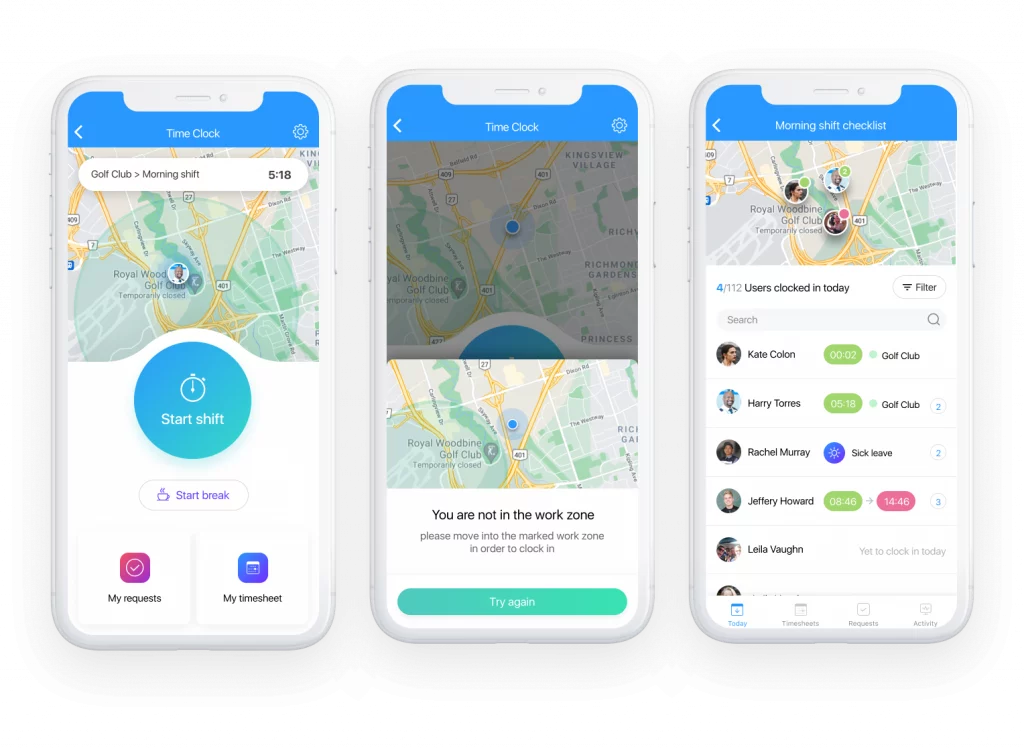
Connecteam is the best choice for frontline and service teams because it combines accurate time tracking with a simple, mobile-first experience in one platform. It’s especially useful for teams that need real-time visibility into hours worked without buddy punching, paper timesheets, or payroll guesswork.
Why I chose Connecteam: I ranked Connecteam #1 because it offers the most complete solution for clock-in accuracy, compliance automation, and real-time reporting. It’s especially useful for managers who rely on GPS verification and visibility to track teams in the field and ensure accountability across locations.
Let’s take a closer look at how Connecteam helps you track time with confidence:
GPS-enabled time clock
Connecteam’s employee time clock app makes tracking hours simple and reliable. Employees can clock in and out with a single tap from their phone, desktop, or a shared on-site kiosk. I liked that time is recorded down to the second, so there’s no rounding, guesswork, or padded hours.
The real-time GPS tracker attaches a location stamp to each clock-in and clock-out, adding an extra layer of accuracy. I liked that this gives managers confidence that time is logged from the right place. Plus, it’s a great way to verify time for field teams or employees working across multiple job sites.
If an employee arrives on-site but forgets to clock in, or tries to clock in before they’re at the job location, Connecteam’s geofence time clock steps in automatically. Employees can receive reminders when they enter the approved zone, be blocked from clocking in outside designated areas or too early, and even be clocked out when they leave. Instead of chasing missed punches or correcting timesheets later on, managers get cleaner, more reliable time data without constant follow-up.
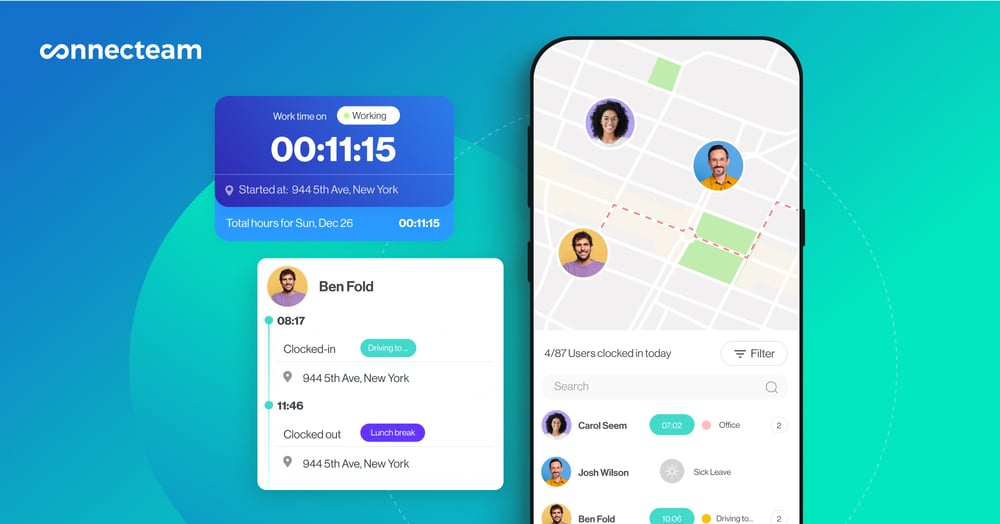
Connecteam’s GPS time clock records location data with every clock-in and clock-out to verify where employees are working. Note: Location tracking features like GPS and geofencing may be regulated in some locations. Confirm compliance with state GPS tracking laws and employee consent requirements before enabling them.
NFC clock-in
Connecteam also supports NFC-based clock-ins, which can simplify time tracking in fixed workplaces. Managers can place an NFC tag at a job site entrance, warehouse station, or office reception, and employees simply tap their phone against the tag to clock in or out.
This creates a clear, location-specific punch without requiring a shared kiosk or manual code entry. For teams that want fast, low-friction clock-ins while still controlling where punches happen, NFC offers a practical middle ground between GPS restrictions and fully open mobile clock-ins.
Overtime, breaks, and time off
With Connecteam, it’s really simple to manage overtime, breaks, and paid time off. You can set your own rules once, and the app handles the calculations for you, helping prevent mistakes that often come with manual overtime tracking. If an employee is getting close to unapproved overtime, managers are notified right away, and you can even set it so the app automatically clocks them out if needed.
There’s an option to track breaks manually or automatically, which I appreciated. You can set paid or unpaid breaks, control how long they last, prevent early clock-ins, and use reminders to keep timesheets and payroll accurate.
Time off management is also straightforward. You can create clear policies for vacation, sick leave, or personal time, and the balances update as employees earn time. Employees submit time-off requests directly in the app, managers are notified instantly, so approvals happen faster.
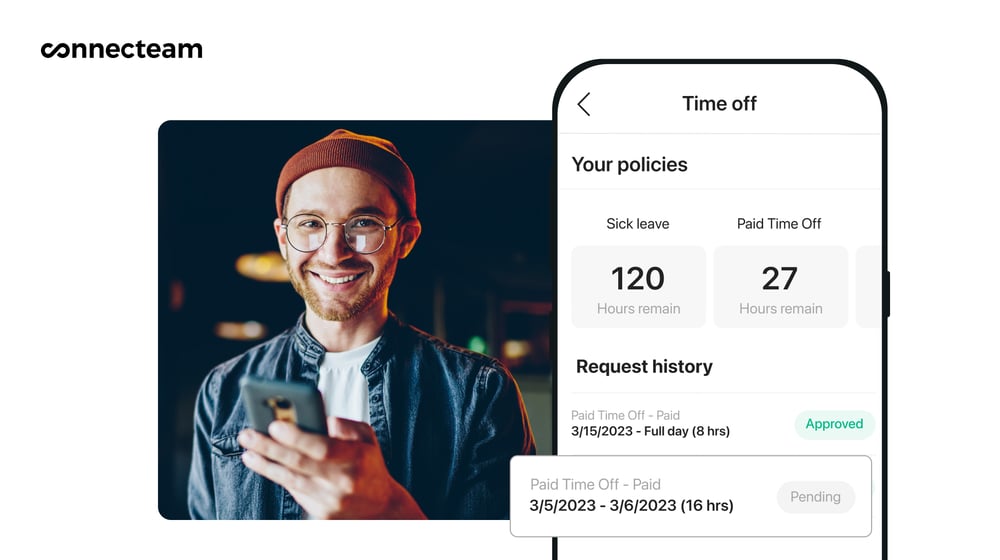
Employees can submit time-off requests and track their leave accruals directly in the Connecteam app. Attendance reports
Connecteam’s automatic reporting makes it easy to see what’s happening with your team at a glance. You can quickly check who’s working, who’s late, and who’s absent. I liked that you can just set up reports once, choose how often they run, and then get the right information as needed.
These reports also help you spot patterns early. It’s easy to see who’s usually on time, where lateness is becoming an issue, or if absences are starting to impact coverage. That turns time tracking into clear, useful insight and helps you manage attendance fairly and confidently.
Automated timesheets
Employee hours are automatically recorded into timesheets for payroll, giving you a clear, organized view of regular hours, overtime, breaks, and time off. You can filter timesheets by employee, job, task, or location to better understand how time is actually spent. Built-in warnings flag inconsistencies early, making it easier to catch and fix potential payroll errors ahead of time.
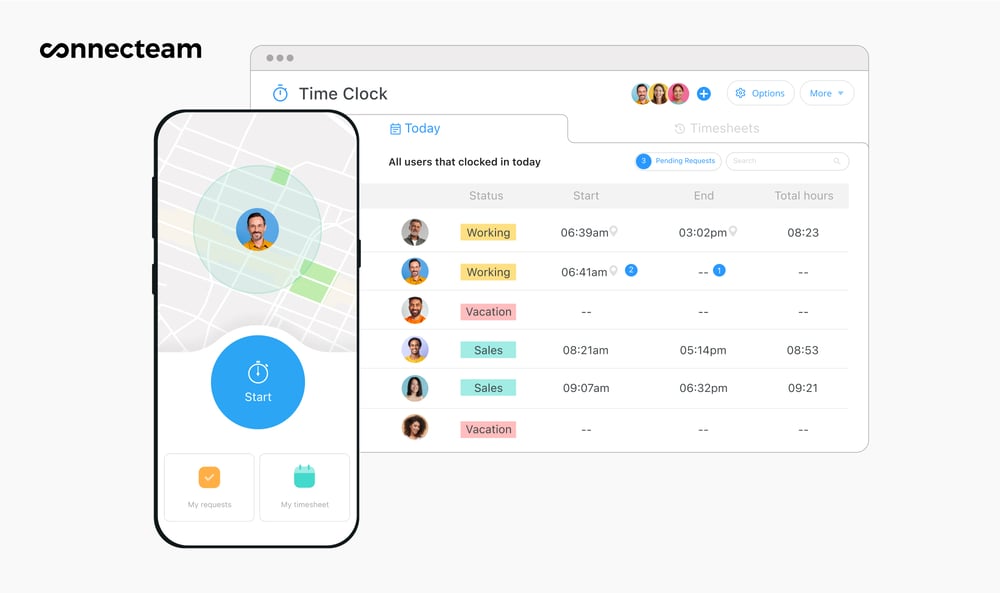
Connecteam’s manager dashboard shows real-time attendance status at a glance. I liked that you can assign custom pay rates by employee or role, so wages are calculated accurately without manual adjustments. Employees can review their timesheets, request edits, and submit them for approval directly in the app. Managers are notified about submitted timesheets and can review, comment, edit, and approve them.
Payroll and integrations
Once timesheets are ready, you can export data directly to top payroll systems, including RUN Powered by ADP®, QuickBooks, Xero. Connecteam also gives you the option to download your timesheet data in a format that works for your system.
In addition, Connecteam offers API access and integrates with the other tools your business already uses, including PrismHR, Lightspeed, and Wix Bookings.
And so much more…
Besides a mobile time clock, Connecteam is a complete employee management app with tools to manage your business from anywhere:
- Employee scheduling: Create schedules with the drag-and-drop editor or use the AI-powered auto-scheduler to fill shifts based on availability, roles, and qualifications.
- Online team chat: Keep work conversations organized and easy to manage. Share updates, files, and shift details in one-on-one or group chats.
- Employee task tracking: Assign recurring or one-off tasks to team members, add subtasks, and monitor completion progress in real-time.
- Training and onboarding: Use the AI Course Creator to build custom training materials in minutes, and get employees up to speed quickly.
When Connecteam may not be the best fit
Connecteam isn’t the best option if you need deep employee surveillance features such as keystroke logging, continuous screen recording, or automatic screenshot capture. It focuses on accurate attendance, GPS verification, and job-based time tracking, not productivity monitoring for desk-based teams.
It may also not be the right choice if your crews work almost entirely in remote areas with no cellular data for long stretches. In that case, you’ll need to evaluate how any cloud-based system performs in those conditions.
I had people that we would just schedule for work and hope and pray that they show up. And now, we have an average of a 90-95% attendance rate.
Connecteam also offers a free for life plan – Get Started Now!
0Key Features
- One-tap mobile clock-in
- GPS tracking and geofencing
- Automated timesheet calculations
- Real-time attendance dashboard
- PTO and leave tracking
- Overtime and break rule enforcement
Pros
- Reduces payroll corrections
- Aligns scheduled and worked hours
- Handles multi-location teams
- Consolidates time tracking and approvals
Cons
- Requires internet connectivity
- Initial setup needed for complex compliance rules
Pricing
Free-for-life plan availablePremium plans start at $29/month for 30 users
14-day free trial, no credit card required
Start your free trial -
Buddy Punch — Good for small field teams that want simple GPS time tracking without complex setup
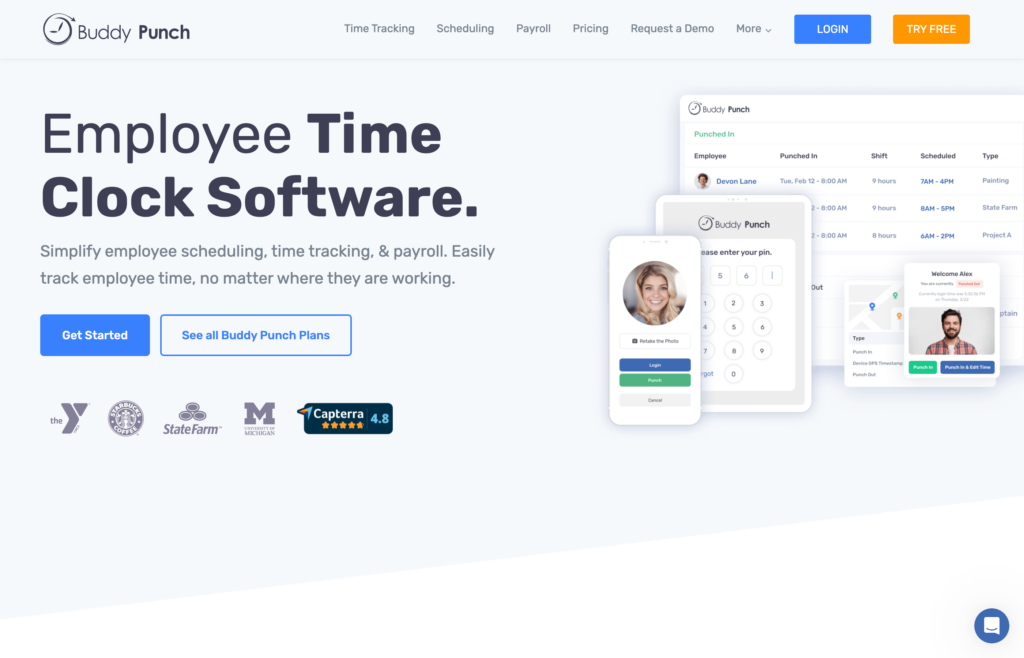
Buddy Punch is a time tracking and workforce management platform that helps businesses monitor employee hours, breaks, and location.
Why I chose Buddy Punch: I liked that Buddy Punch offers location-based time tracking, including GPS tracking and geofencing, along with security features like facial recognition and QR code scanning.
This breakdown is based on our in-depth review of Buddy Punch, where we tested its time tracking, facial recognition, geofencing, and offline limitations.
Time, overtime and break tracking
Buddy Punch gives employees several simple ways to clock in and out, including a PIN, facial recognition, QR code scanning, or a standard username and password. These options make clocking in easy while adding an extra layer of security. Employees can clock in and out from either the mobile app or the web.
I liked that you can set up break rules based on your local labor laws, with support for both automatic and manual breaks. However, you can only assign one automatic break per shift, so any additional breaks need to be taken manually. Overtime is tracked automatically, and employees receive alerts when they’re nearing or exceeding their regular work hours so they can clock out.
All time entries, edits, and approvals are logged, so managers have a clear audit trail.
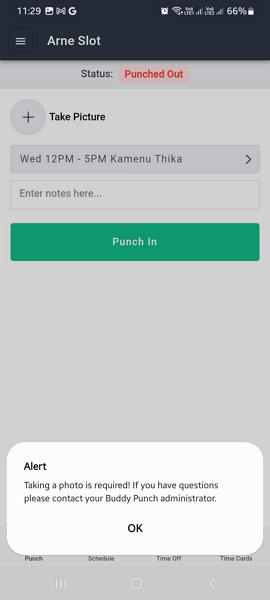
Buddy Punch’s facial recognition requires employees to take a picture of themselves in order to clock in. GPS tracking and geofencing
Buddy Punch’s GPS tracking records location data with every clock-in and clock-out. I can see this being especially useful for field-based teams. Geofencing lets you define approved job sites and flag punches that happen outside those areas.
While geofencing helps, it doesn’t automatically block punches. Instead, you still need to review and approve exceptions manually. It’s also worth noting that Buddy Punch doesn’t offer an offline mode, which may be limiting for teams working in areas without strong connectivity.
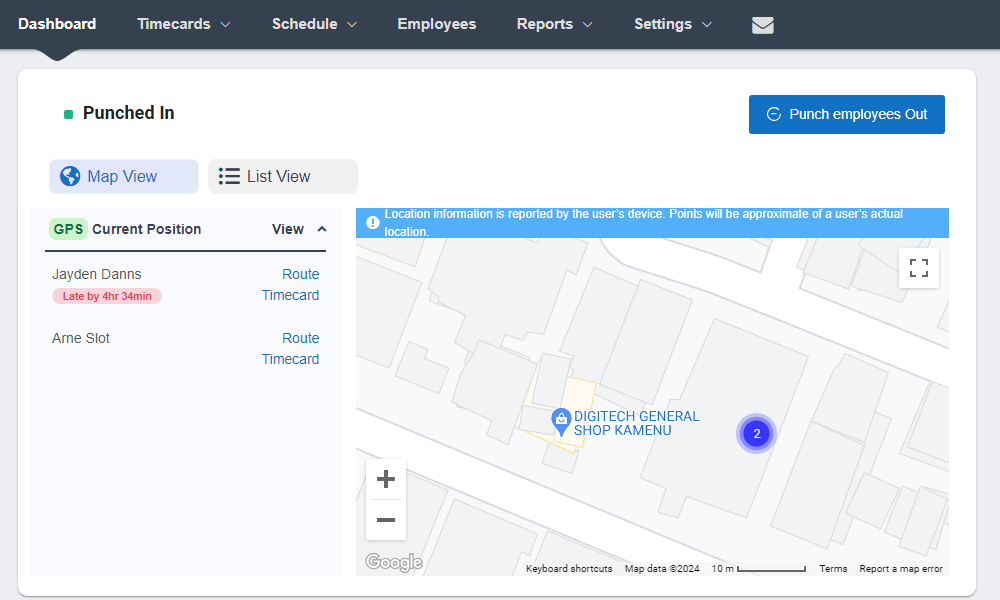
Once employees clock in, Buddy Punch’s GPS feature shows their location. Important: Geofencing can flag valid work outside approved zones. Always review flagged entries before making corrections to avoid inaccurate records or unfair penalties.
Job codes and reporting
Buddy Punch supports multiple job or department codes, so employees can track time against specific roles, projects, or clients. This makes it easier to understand where labor hours are actually going.
That same visibility carries over into reporting. Built-in reports show employee hours, attendance patterns, overtime, and missed punches. For businesses that need more detailed attendance insights, they’re available on higher-tier plans.
What users say about Buddy Punch
Very user-friendly. Clocking in and out only takes a few seconds, and it works smoothly whether you’re on desktop or mobile. I also appreciate the location tracking and approval features because it keeps time entries accurate and avoids confusion.

One of the main drawbacks of Buddy Punch was occasional technical issues, such as slow loading times or difficulty clocking in during periods of poor internet connectivity.
0Key Features
- Web and mobile time clock
- GPS tracking with geofencing
- Custom job codes
- Automatic overtime calculations
Pros
- Quick setup and clean interface
- Flexible time tracking policies
Cons
- No offline punch capture
- Limited payroll and third-party integrations
Pricing
Starts at $4.49/user/month + $19 base fee/month Trial: Yes — 14 days Free Plan: No
-
QuickBooks Time — Good for QuickBooks users that need seamless payroll integration
QuickBooks Time is an employee time clock app built to track work hours and sync time data with QuickBooks payroll and accounting software.
Why I chose QuickBooks Time: I chose QuickBooks Time for businesses already using QuickBooks, since it offers native payroll integration and job costing. However, it has limitations with overtime accuracy and a cluttered interface compared to other options.
Our full review of QuickBooks Time goes deeper into its payroll integration, overtime accuracy issues, and job costing features.
Time and location tracking
QuickBooks Time tracks employee hours, including regular time, breaks, and paid time off. Employees can clock in and clock out on the mobile, desktop, or kiosk app.
During our testing, we noticed that overtime tracking wasn’t as strong as it could be, as the system didn’t consistently identify overtime or double-time hours. This could create serious problems for businesses that rely on accurate overtime calculations for payroll and compliance.
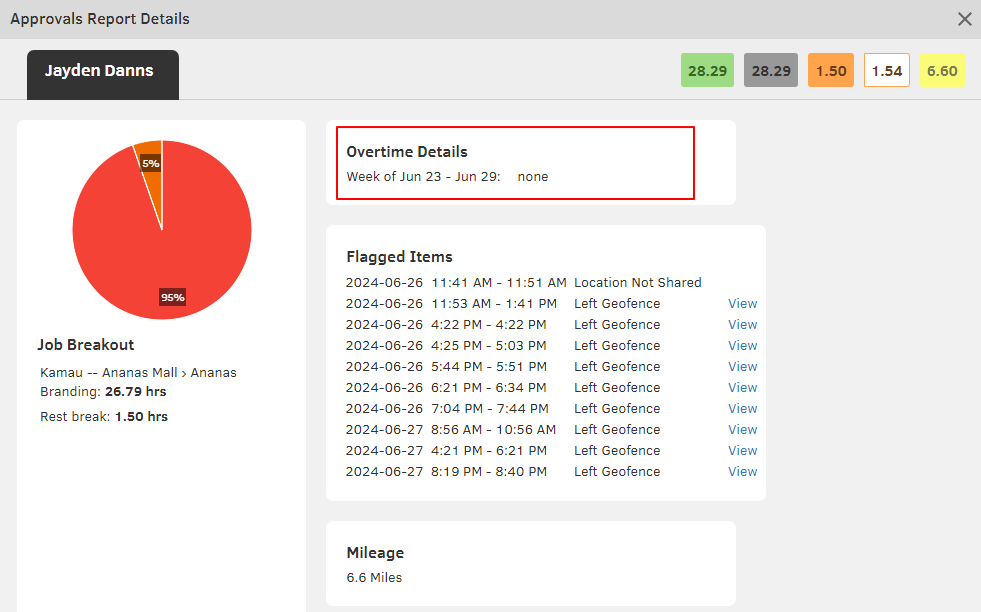
Our tester left the time clock running for 26 hours but QuickBooks Time reporter no overtime. Where QuickBooks Time performs better is location-based tracking. The app includes GPS tracking, geofencing, and facial recognition, adding extra verification around clock-ins. Managers can see where field employees are throughout the day, which is useful. Geofencing also works as expected, allowing you to set boundaries around approved locations.
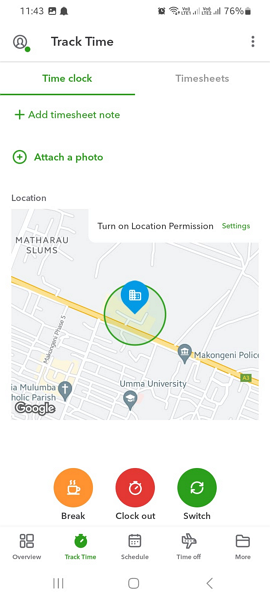
QuickBooks Time’s location tracking and geofencing help verify employee locations. Timesheets and job costing
All time entries automatically flow into digital timesheets, making it easy to review and approve hours before payroll. Timesheets are organized by job or shift, which helps with readability, but bulk editing was a bit of a hassle. There’s a lot of information to look at, which might feel cluttered for managers who prefer a simpler view.
I was also impressed by the job costing feature. It lets employees track time against specific projects or clients, so businesses can monitor budgets and labor costs as work progresses. This is a good way to assess project profitability in real-time.
Payroll and integrations
The biggest advantage of QuickBooks Time is obviously its native integration with QuickBooks Online Payroll. Once hours are tracked and approved, they sync directly into payroll without exporting files or re-entering data. This is a huge time-saver and a smooth way to minimize payroll errors.
That said, since the app only supports a few other integrations, it’s clear that the real value comes from being part of the QuickBooks ecosystem. For businesses already using QuickBooks, the clock-in clock-out app seems like a natural fit. However, if you use a different accounting system, the higher price may be harder to justify.
What users say about QuickBooks Time
Time tracking is simple for employees, and approvals are easy to manage. The integration with payroll tools saves time during processing.
I don’t like that QuickBooks Time does not automatically tally up the hours from a specific pay period, so we had to enter the daily amount of hours into a program when payroll hit and then add it up to actually pay the employees.

 0
0Key Features
- Web and mobile time clock
- GPS tracking with geofencing
- Payroll-ready timesheets
- QuickBooks Online integration
Pros
- Strong QuickBooks payroll integration
- Detailed reporting and job costing
Cons
- Higher starting price than most competitors
- Interface can feel busy for smaller teams
Pricing
Starts at $20/month + $8/user/month Trial: Yes — 30 days Free Plan: No
-

Clockify — Good for freelancers and remote teams on a budget that want basic time tracking
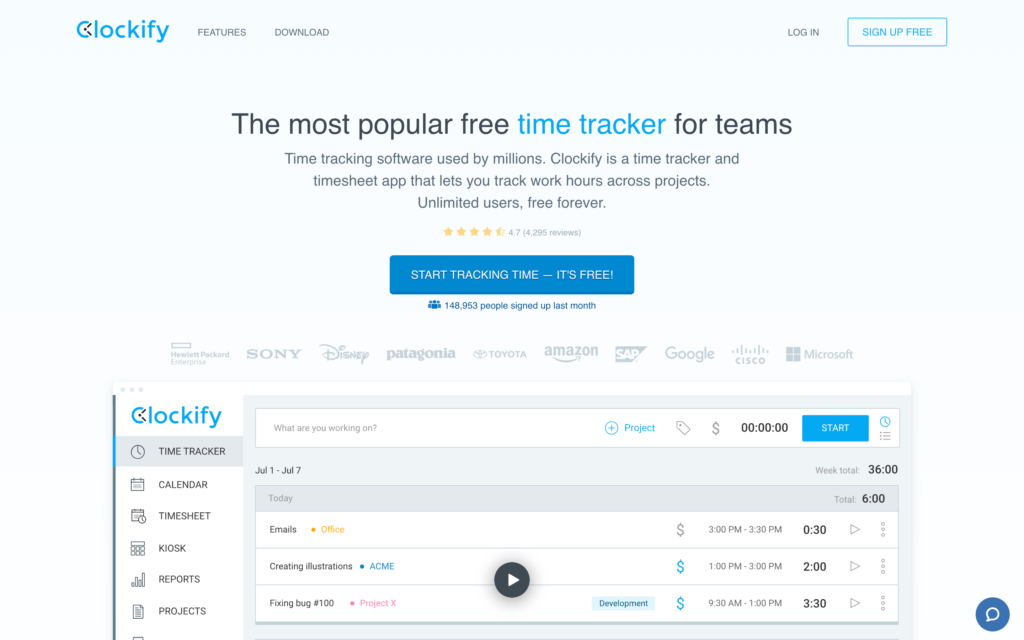
Clockify is a time clock app that offers time tracking, timesheets, reporting, and project management.
Why I chose Clockify: I chose Clockify because its free plan supports unlimited users, making it a practical option for teams that need basic time tracking without high costs.
Our full review of Clockify goes into more detail about its free plan, reporting capabilities, payroll integrations, and interface limitations.
Time clock
With Clockify’s time clock, employees can track their hours using a timer on the desktop or mobile app. You can also clock in and clock out from a shared kiosk by using a PIN, or enter time manually at the end of the day or week.
Clockify also offers GPS tracking and screenshot monitoring for remote or mobile teams. It’s important to note that these features are only available on paid plans. I also found it surprising that there’s no geofencing, which could be a drawback for businesses that need location-based controls, not just visibility.
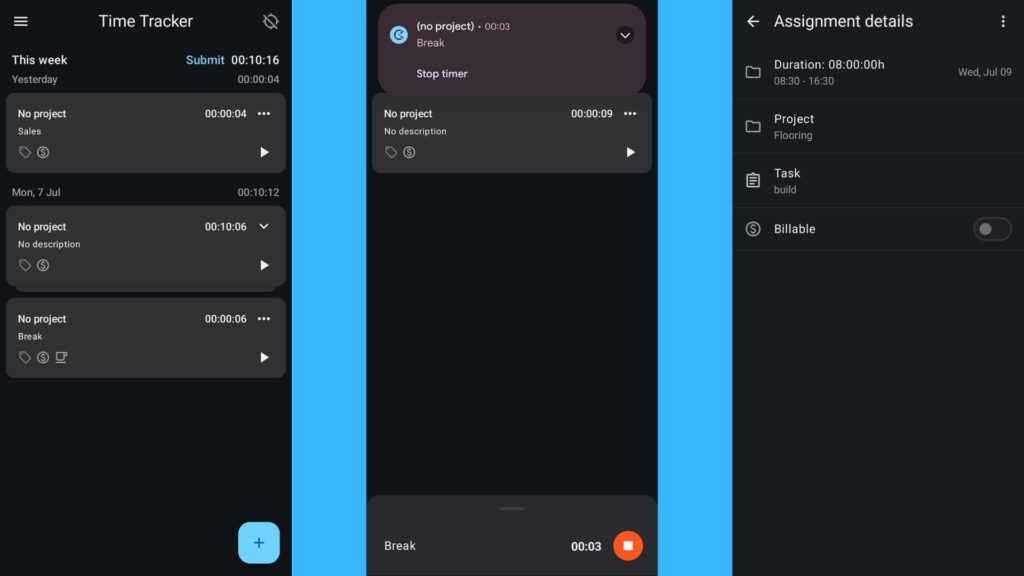
Clockify’s time tracking helps freelancers log their hours against their different projects. Note: Screenshot monitoring and activity tracking can raise privacy and legal concerns. Ensure employees consent to monitoring and comply with local labor laws before implementing these features.
Timesheets and approvals
I thought that it was pretty simple to review and manage Clockify’s timesheets. Managers can create templates for recurring entries, lock submitted timesheets, leave comments, and approve hours in bulk. Time entries can also be assigned to specific clients, projects, or tasks, which is helpful for project-based or client-facing teams.
The main drawback for me was the interface. It feels dated and heavily table-based, with few options to group or collapse projects. Finding specific details seemed to take extra scrolling and filtering. On mobile, admin functionality is even more limited: basic time tracking is available, but tools like reporting, scheduling, and advanced settings are only accessible on the desktop version.

Clockify lets you select a project and start a timer or add breaks. Integrations and payroll
When it comes to integrations, Clockify offers a two-way sync with QuickBooks Online for accounting and billing, but it doesn’t support QuickBooks Online Payroll, which I found strange. This integration is also only available on paid plans. While Clockify lists integrations with payroll providers like ADP and Paychex, these rely on manual exports rather than direct syncing.
What that means is that time data needs to be exported as a PDF, Excel, or CSV file and then uploaded into your payroll system. This adds extra admin work and increases the risk of errors, especially for teams running payroll on a tight schedule.
What users say about Clockify
Clockify keeps time tracking straightforward, reliable, and impossible to fudge. It forces accuracy, makes reporting painless, and gives you a clean view of where hours are actually going.
The interface isn’t as polished or visually appealing as some other time-tracking tools I’ve tried. It’s quite simple, effective, but not very customizable. You can’t personalize reports that much, but it’s not a big issue overall.
0Key Features
- Web and mobile time tracker
- Project and task-based tracking
- Timesheets and reports
- Basic GPS location tracking
Pros
- Generous free plan with unlimited users
- Strong reporting and analytics
Cons
- No geofencing for location enforcement
- Interface feels dated compared to newer tools
Pricing
Starts at $3.99/user/month Trial: Yes — 7 days Free Plan: Yes
-

Jibble — Good for remote teams prioritizing security and activity monitoring
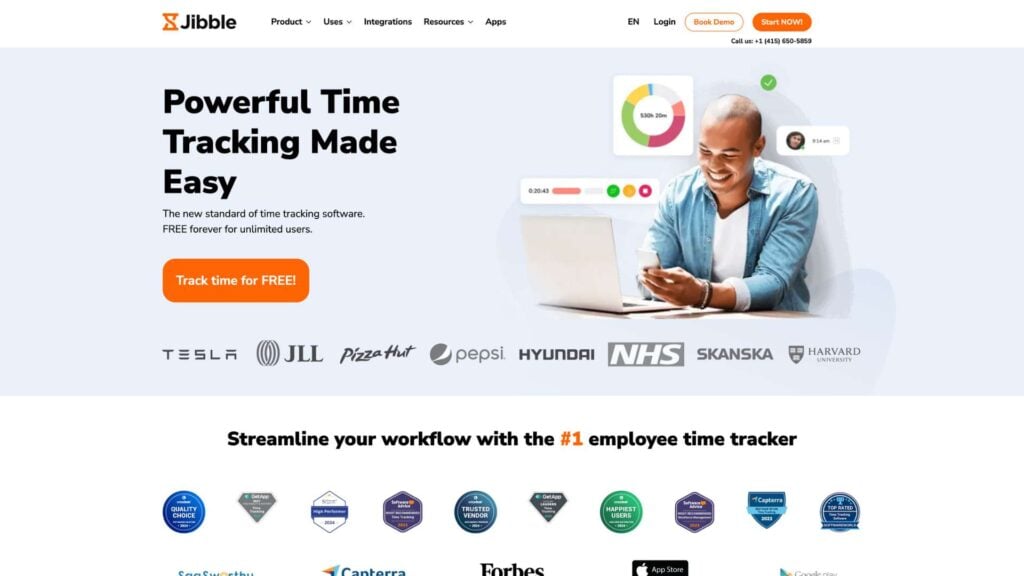
Jibble is a time tracking app that supports clock-ins and clock-outs, attendance tracking, and basic workforce management.
Why I chose Jibble: I liked Jibble’s flexibility, especially the options to track project hours, verify clock-ins, and control where time is recorded.
In our full review of Jibble, we cover its facial recognition, geofencing, activity monitoring, and break enforcement limitations in more detail.
Time tracking and verification
Jibble offers multiple ways for employees to clock in and out, whether they’re working from a desk, on-site, or in the field. The platform works across web, mobile, desktop, and kiosk apps, so it’s easy to track time across different work environments.
For clock-in verification, Jibble uses AI-powered facial recognition and geofencing. I liked that this lets you confirm employee identity at clock-in and restrict punches to approved job sites.
Jibble also has live GPS tracking, which allows managers to see where employees are working in real-time and review their location history throughout the day. Route tracking is available, but it’s pretty basic.
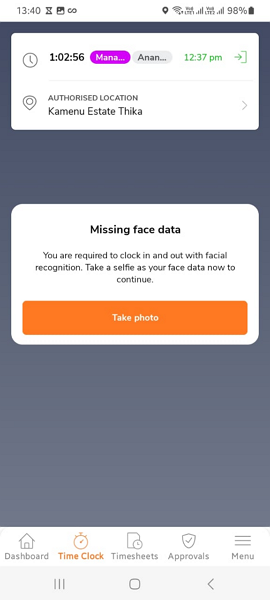
Jibble’s facial recognition verifies employee identity at clock-in. Break and overtime management
Jibble lets you customize break and overtime tracking to meet your business needs. Break rules were pretty easy to set up, but enforcement is limited. While you can define policies, Jibble doesn’t actively prompt employees to start or end breaks or confirm that breaks were taken, which may require more manual oversight from managers.
For overtime, you can set multiple rules, including daily overtime, double time, weekly overtime, public holiday, and rest day overtime. Thresholds and pay rates are easy to set and calculated automatically. I also liked that Jibble sends overtime alerts when employees approach or exceed overtime limits, so managers can take action before labor costs get out of hand.
Time off and activity monitoring
With Jibble, you can create multiple time-off policies using either accrual or allotment rules, and employees can submit requests directly from the app. Managers can review and approve requests from both desktop and mobile.
Jibble’s desktop app also includes light activity monitoring, capturing screenshots at set periods while employees are clocked in. It doesn’t track keystrokes or app usage, but it can offer a basic snapshot of activity for teams that want some visibility without heavy monitoring.
Note: Screenshot monitoring and activity tracking can raise privacy and legal concerns. Confirm that employees consent to monitoring and comply with local labor laws before implementing these features.
What users say about Jibble
Jibble has made payroll so much easier and much more streamlined. Employees love the ease of the app and it’s great having a way to track time in real time!
What I liked least about Jibble is that correcting or adjusting hours can sometimes be challenging. This may be due to user error, but the process is not always intuitive, and it can take extra time to ensure hours are updated accurately.
0Key Features
- Web and mobile time tracking
- GPS tracking with geofencing
- Facial recognition clock-in
- Activity monitoring tools
Pros
- Biometric and facial recognition options
- Generous free plan for small teams
Cons
- Limited advanced reporting
- Facial recognition may raise privacy concerns
Pricing
Starts at $4.49/user/month Trial: Yes — 14 days Free Plan: Yes
-

ClockShark — Good for field and construction teams that need job costing and project profitability tracking
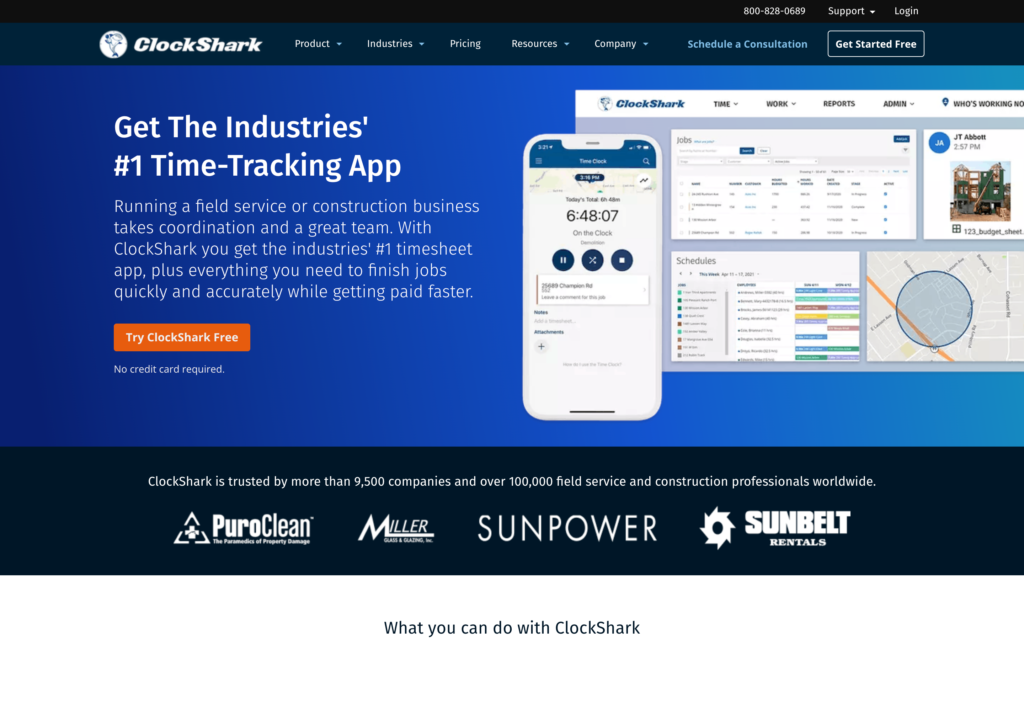
ClockShark is a time tracking and job management app designed for field service teams, construction companies, and mobile workforces.
Why I chose ClockShark: I liked that ClockShark clearly connects time tracking to specific jobs and that it works well for teams that don’t work from a single location.
In our full review of ClockShark, we dive into detail on its GPS tracking, job costing, field service capabilities, and pricing for small teams.
GPS time tracking
ClockShark captures GPS location data every time employees clock in or out. Hours and breaks are calculated automatically based on the rules you set, which helps keep payroll consistent. The GPS tracking helps manage field teams working across different job sites, without requiring constant check-ins.
I also liked that geofencing lets you limit clock-ins to approved locations, so employees can only punch in when they’re actually on site. There’s also a kiosk setup, which supports photo capture and facial recognition, which helps confirm the right employee is clocking in.
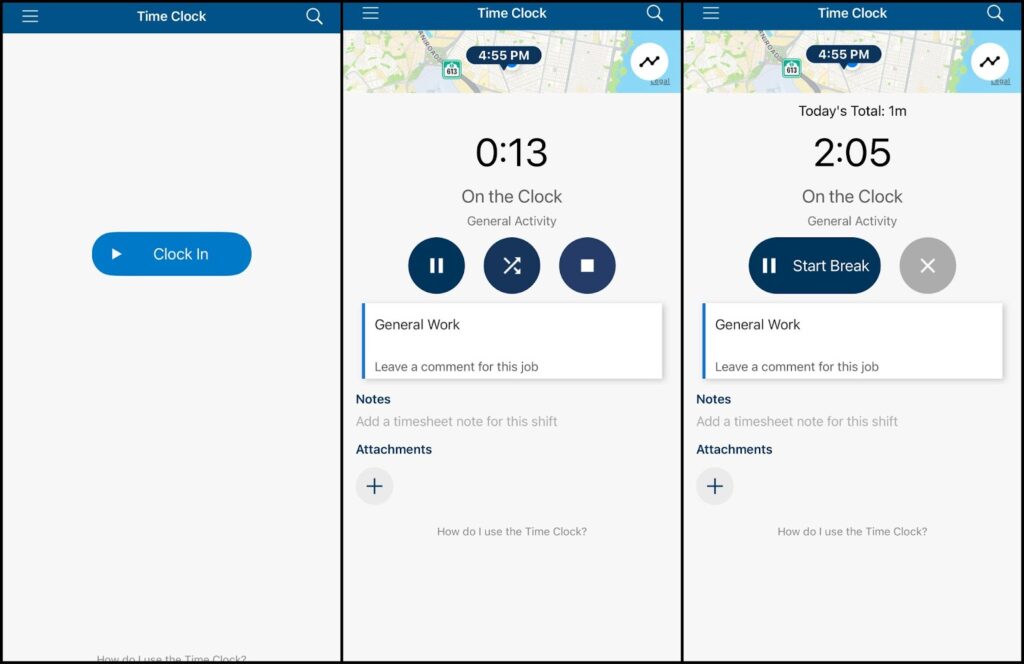
ClockShark’s time clock app tracks employee location and lets them clock in and out from jobs. Note: Before turning on facial recognition or GPS tracking, confirm you’re compliant with local privacy regulations and employee consent requirements.
Timesheets and overtime
It was simple to review timesheets. Managers can quickly approve hours in bulk or click into individual timesheets to review details and see any edits made. I liked that employees can adjust time entries when needed, and all changes are tracked, so records stay transparent and audit-ready.
I thought that overtime rules were also easy to set up, and I appreciated the built-in options for common regulations like California overtime laws.
Job costing and project management
ClockShark’s job costing lets you track time and expenses by job. I liked that this makes it easier to see how labor costs stack up against your budget as work progresses. I can see this being especially helpful for construction and field service businesses that need a clear picture of project profitability.
Reporting is flexible and detailed, with options to create custom reports for time, attendance, and job costs. I liked how easy it was to manage multiple jobs at once and quickly see which projects were on track and which needed attention.
What users say about ClockShark
The best thing about ClockShark is that it has accurate time tracker with the support of GPS and a great security level. The scheduling and payroll is very simple to set up and works well.
ClockShark can be pricey for larger teams, and it needs internet or GPS access to work properly. Some users may find the setup or mobile app a bit tricky at first.
0Key Features
- Mobile time clock for field crews
- GPS tracking with job-site tagging
- Job costing by project
- Timesheets and labor reports
Pros
- Strong job costing for construction teams
- Simple onboarding for field crews
Cons
- Higher starting price for small teams
- Limited customization outside construction use cases
Pricing
Starts at $40/month + $9/user/month Trial: Yes — 14 days Free Plan: No
Compare the Best Clock-In Clock-Out Apps
| Topic |
 Start for free
|
|
|
|
|
|
|---|---|---|---|---|---|---|
| Reviews |
|
|
|
|
|
|
| Pricing |
Starts at just $29/month for the first 30 users
|
Starts at $4.49/user/month + $19 base fee/month
|
Starts at $20/month + $8/user/month
|
Starts at $3.99/user/month
|
Starts at $4.49/user/month
|
Starts at $40/month + $9/user/month
|
| Free Trial |
yes
14-day
|
yes
14 days
|
yes
30 days
|
yes
7 days
|
yes
14 days
|
yes
14 days
|
| Free Plan |
yes
Free Up to 10 users
|
no
|
no
|
yes
|
yes
|
no
|
| Use cases |
Best clock-in clock-out app for multi-location frontline and service teams
|
Good for small field teams that want simple GPS time tracking without complex setup
|
Good for QuickBooks users that need seamless payroll integration
|
Good for freelancers and remote teams on a budget that want basic time tracking
|
Good for remote teams prioritizing security and activity monitoring
|
Good for field and construction teams that need job costing and project profitability tracking
|
| Available on |
What Are Clock-In Clock-Out Apps?
Clock-in clock-out apps are digital tools that record when employees start and end their work shifts. Instead of paper timesheets or physical punch clocks, employees clock in from their phone, tablet, or computer, whether they’re on-site, in the field, or working remotely.
Modern time clock apps do more than record punches. They automatically calculate regular hours, overtime, and breaks based on your pay rules, store detailed punch history, and create a clear audit trail for payroll and compliance. For businesses with hourly or shift-based teams, they replace guesswork with structured, real-time data.
How Does a Clock-In Clock-Out App Work?
Employees clock in and out at the start and end of their shifts using a mobile or web app. Depending on the tool, punches can include location data, job codes, or role selection to ensure hours are logged correctly.
The system automatically converts punches into timesheets. Overtime, break rules, and paid time off are calculated using your predefined policies. Managers can review flagged issues, approve hours, and export payroll-ready data. Instead of fixing errors after payroll runs, problems are caught earlier in the process.
Many apps also integrate directly with payroll systems, reducing manual data entry and lowering the risk of miscalculations.
The Benefits of Clock-In Clock-Out Apps
Clock-in clock-out apps improve accuracy, visibility, and control across your workforce. Here’s what that looks like in practice:
Fewer payroll errors
Manual time tracking leaves room for missed punches, incorrect overtime, and inconsistent calculations. A structured time clock system records hours consistently from the start and applies your pay rules automatically. That reduces last-minute corrections and increases confidence before payroll runs.
Better labor cost control
Labor is one of the largest operating expenses for most businesses. Time clock apps give you real-time visibility into regular hours, overtime, and attendance patterns. When you can see overtime trends or recurring coverage gaps early, you can adjust staffing decisions before costs escalate.
Less administrative work
Chasing down timesheets, correcting mistakes, and answering payroll questions takes time away from managing your team. Clock-in clock-out apps centralize punch data, automate calculations, and streamline approvals, reducing back-and-forth and manual cleanup.
Clearer accountability
Accurate time tracking creates transparency. Employees can see their recorded hours, managers can see edits and approvals, and every change is logged. This reduces disputes over hours worked and creates a clear record if questions arise later.
Easier labor compliance
As teams grow, compliance becomes more complex. Time clock apps help enforce overtime rules, apply break policies, and maintain accurate records. For businesses operating in states with strict labor laws, having consistent rule enforcement and audit trails reduces compliance risk.
How Much Do Clock-In Clock-Out Apps Cost?
Most clock-in clock-out apps use subscription pricing based on team size. Some charge a flat monthly base fee plus a per-user rate, while others charge only per user.
Basic time tracking plans often start around $2.49–$3.99 per user per month. More advanced platforms typically range from $19–$40 per month plus $4.49–$9 per user, depending on features like GPS tracking, geofencing, job costing, and payroll integrations.
Connecteam offers a free Small Business Plan for teams of up to 10 users. Paid plans start at $29 per month for up to 30 users, with Advanced and Expert tiers available at higher price points. Each paid plan includes up to 30 users, with additional users added as your team grows.
When comparing costs, it’s important to consider not just the subscription price but also the time saved on payroll corrections, compliance issues, and administrative work.
Get started with Connecteam for free today!
The Bottom Line on Clock-In Clock-Out Apps
When time tracking is inconsistent, payroll becomes harder than it needs to be. Missed punches, incorrect overtime, and manual timesheets create avoidable errors and extra work. Clock-in clock-out apps bring structure to the process, helping businesses track hours accurately and reduce payroll friction.
The right tool should record time reliably, apply pay rules automatically, and give managers clear visibility into attendance and labor costs. As teams grow, those controls matter even more.
Connecteam is the strongest overall option for businesses that need accurate time tracking connected to scheduling, communication, and day-to-day workforce management. It’s a practical choice for teams that want fewer payroll corrections and less administrative overhead.
If you’re looking for a clock-in clock-out system that scales with your team, Connecteam is a solid place to start.
FAQs
Clock-in and clock-out apps simplify payroll by automatically tracking when employees start and end their shifts, calculating total work hours, and flagging overtime. This removes the need for manual timesheets and helps ensure accurate, on-time pay. Many platforms, including Connecteam, offer payroll-ready exports and approvals, making it easy to close pay periods quickly and confidently.
Employees can clock in and out remotely using a mobile app. Most apps log the timestamp and location, and some allow workers to select a shift, task, or job site. With Connecteam, remote and mobile teams can even clock in offline, with all data syncing as soon as the device reconnects to the internet.
Look for ease of use, mobile support, accurate time tracking, payroll exports, GPS features, and responsive customer support. Small businesses especially benefit from tools that are easy to roll out and don’t require a steep learning curve. Connecteam is designed with field and shift-based teams in mind and includes scheduling, task tracking, and team messaging—all in one affordable platform.
Start small with a pilot group, offer training or short demos, and clearly communicate the benefits—like fewer payroll mistakes and faster approvals. Choose an intuitive tool like Connecteam that requires little technical setup and provides support during onboarding. Include employees in the process to build trust and get early feedback.
Be transparent. Let employees know exactly what’s being tracked, when, and why. Explain that features like GPS are only active during clock-ins and clock-outs—not constantly tracking their location. Use apps like Connecteam that offer granular privacy controls and avoid always-on tracking. Clear communication goes a long way in building trust and reducing resistance.
Yes. Keep the geofence radius wide enough to account for real-world GPS variability—typically 100–300 meters. Avoid making it too restrictive or employees may have trouble clocking in. Connecteam allows you to set specific geofences per site or shift, and you can monitor out-of-zone punches to catch issues early.
The best apps let employees select their job, role, or site when clocking in. This ensures hours are tracked correctly across locations or projects. With Connecteam, you can tag shifts by job or location and filter time data accordingly, simplifying payroll, client billing, or internal reporting.
Choose a platform that allows you to export timesheet data in standard formats like CSV or Excel. Connecteam offers payroll-ready exports and supports direct integration with tools like QuickBooks Online and Gusto. For unsupported platforms, you can often map the export fields to match your payroll provider’s import format.
Look for apps that let you filter and export time data by date range, location, or employee. Store backups securely in your internal systems or cloud storage. Connecteam allows one-click exports in multiple formats, along with built-in audit logs to maintain a verifiable time trail for labor law compliance or internal reviews.
Some apps offer better accessibility than others. Look for platforms with large buttons, intuitive navigation, multilingual support, and screen-reader compatibility. Connecteam is optimized for usability on all types of smartphones and is designed to minimize friction for employees at all levels of tech literacy.
Yes, most modern time clock apps allow employees to request edits to their shifts. These requests are reviewed and approved by a manager before finalizing the timesheet. Connecteam makes this process simple with in-app change requests, notes, and manager notifications, helping you fix issues without disrupting payroll.
Yes. In some regions, like Illinois (BIPA) or the EU (GDPR), there are strict rules about collecting and storing biometric data. You’ll need employee consent, secure storage, and clear policies. Connecteam lets you turn biometric features on or off per region or site and helps ensure your data usage aligns with local laws.
Yes, especially when combined with features like geofencing. GPS tracking confirms employees are where they say they are when clocking in. It helps prevent common issues like buddy punching or clocking in from home. Connecteam includes location stamps and optional geofencing, making it easier to keep things honest without micromanaging.
GPS features log a one-time location snapshot at clock-in and clock-out—so there’s no constant tracking. This keeps things privacy-friendly while ensuring that each punch is location-verified. Connecteam allows managers to set job-specific geofences and view real-time punch locations, while respecting employee boundaries.
The best app balances ease of use, pricing, and scalability. For small businesses, Connecteam is often the top choice—it’s affordable, works on any smartphone, and includes all the essentials like time tracking, scheduling, and team communication. Other solid options include Buddy Punch and Clockify, though they may require additional tools to handle tasks outside of timekeeping.
Look for an app with GPS stamping, offline mode, real-time syncing, and a clean interface. Connecteam checks all of those boxes, plus it includes mobile scheduling and job tagging. Other apps like QuickBooks Time and Hubstaff also offer mobile check-ins but are often geared toward project tracking or desktop-first workflows.
Employees open the app, select a job or task if required, and tap to clock in or out. Depending on your settings, they may also need to add a note, attach a photo, or confirm a location. Tools like Connecteam make the process smooth with mobile apps, kiosk modes, and even automated shift reminders to reduce missed punches.
Yes, and they should be taken seriously. Make sure your provider uses encrypted data storage, secure user permissions, and complies with local data laws. Connecteam only records GPS when needed, never tracks continuously, and lets employers configure privacy settings based on their policies and jurisdiction.
Be transparent about why you’re introducing the app—highlight benefits like accurate pay and simpler scheduling. Offer training, gather feedback, and use a user-friendly platform. Connecteam supports quick onboarding, has an intuitive interface, and lets employees view their own time records, which builds trust and reduces pushback.
Yes. Connecteam integrates directly with QuickBooks Online and Gusto, and offers payroll-ready exports for others. Buddy Punch connects with ADP, Paychex, and other major platforms. Even if your system isn’t natively supported, you can usually use CSV exports to streamline payroll and avoid re-entering data manually.
You’re responsible for tracking time in compliance with labor laws—this includes overtime, breaks, and accurate records. Some apps help automate this with alerts, custom rules, and audit logs. Connecteam supports compliance features like break enforcement, location-specific rules, and exportable time audits to help reduce risk.