

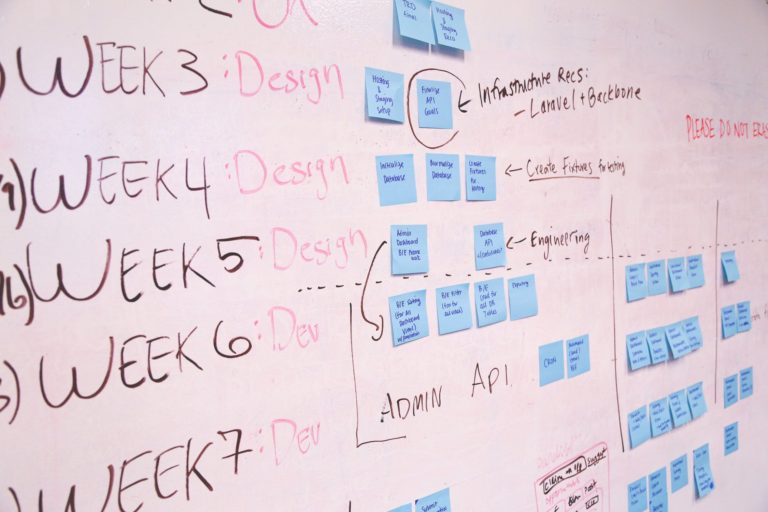
Managing projects across spreadsheets, chat threads, and disconnected task lists makes it harder to see what’s on track, what’s slipping, and who owns the next step.
I reviewed 4 timeline software options for building visual project plans, tracking dependencies, and sharing progress, plus 1 workforce management tool for businesses that need employee timelines instead of classic project timelines.
This list will help you choose the right tool based on the type of timeline you actually need.
Quick Picks: Best Timeline Software
|
Software |
Best for | Starting price |
Key considerations |
| TeamGantt | Collaborative project timelines requiring dependency tracking | $10/project/month | Strong task customization, but timeline limited to Gantt charts |
|
Asana |
Teams with task-heavy timelines | $10.99/user/month |
Top-notch reporting and integrations, but no timelines on free plan |
|
Notion |
Generalist teams needing timeline support with AI | $10/user/month |
Timeline flexibility and AI support shine, but limited reporting |
|
Office Timeline |
Teams that require timeline presentation (turning timelines into slides) | $9/user/month |
Great for presenting timelines on slides, but clunky interface |
| Connecteam | Teams that need employee timelines alongside scheduling and task management | $29/month for the first 30 users |
Strong for employee timeline tracking and workforce planning, but not a classic project timeline tool |
What’s New in This Update (May 2026)
- Re-verified pricing and free plan availability for Connecteam and Office Timeline
- Reviewed and added Asana, Notion, and TeamGantt to the shortlist
- Checked timeline availability on free and low-tier plans
- Added weight to task tracking functionality and customizability in software reviews
Our Top Picks
-
1

Good for collaborative project timelines requiring dependency tracking
-
2

Good for teams with task-heavy timelines
-
3

Why trust us?
Our team of unbiased software reviewers follows strict editorial guidelines, and our methodology is clear and open to everyone.
See our complete methodology
How I Ranked the Best Timeline Software
I shortlisted platforms that let you customize and track timelines in multiple scenarios, including tracking project stages, team tasks, and employee milestones. Their features should help your team use a single source of truth and coordinate team tasks more quickly.
Here are the factors I used to rank the 5 shortlisted.
First, they include these must-have timeline features:
- Customizable timelines: You should be able to drag-and-drop timeline items, track multiple elements (e.g., tasks and milestones), and edit layout and colors. Tools with reduced customization rank lower.
- Task dependencies: Confirming whether timescale elements depend on one another should be super-quick. No dependencies or clunky configuration bring scores down.
- Multiple timescales: You should be able to switch between daily, weekly, monthly, and yearly timescales. Tools with multiple timescales and a quick user experience (UX) rank higher.
- Employee timelines: You should see employees’ HR and in-app history, such as promotions, on-the-job achievements, and assigned tasks. Limited employee activity logs dampen ranking.
- Task tracking: Tools should let you view task status and add details such as descriptions, due dates, and assignees. Tools with less advanced task trackers lose points.
Then, they should also be:
- Intuitive: Whether you can manage timelines and tasks quickly, without mental gymnastics.
- Wallet-friendly: Whether you get value for money, relative to alternative products.
- Easy to integrate: Whether it’s easy to import data, such as employee details, from third-party software.
Finally, they stand out if they offer:
- Team collaboration: Comments on tasks, assigning team members, and co-working in real time are useful extras. Limited collaboration tools reduce ranking.
- Subtasks: Breaking down timeline tasks into subtasks with different deadlines and assignees supports complex workflows. This differentiator scores points.
- Reporting: Summarizing timeline data in stats, visuals, and exports helps you spot trends and blockages. Strong reporting earns points.
- Workflow automation: If you can automate actions based on triggers (e.g., adding timeline tasks), you save time—and platforms rank higher.
The 4 Best Timeline Software of 2026
-
TeamGantt — Good for collaborative project timelines requiring dependency tracking
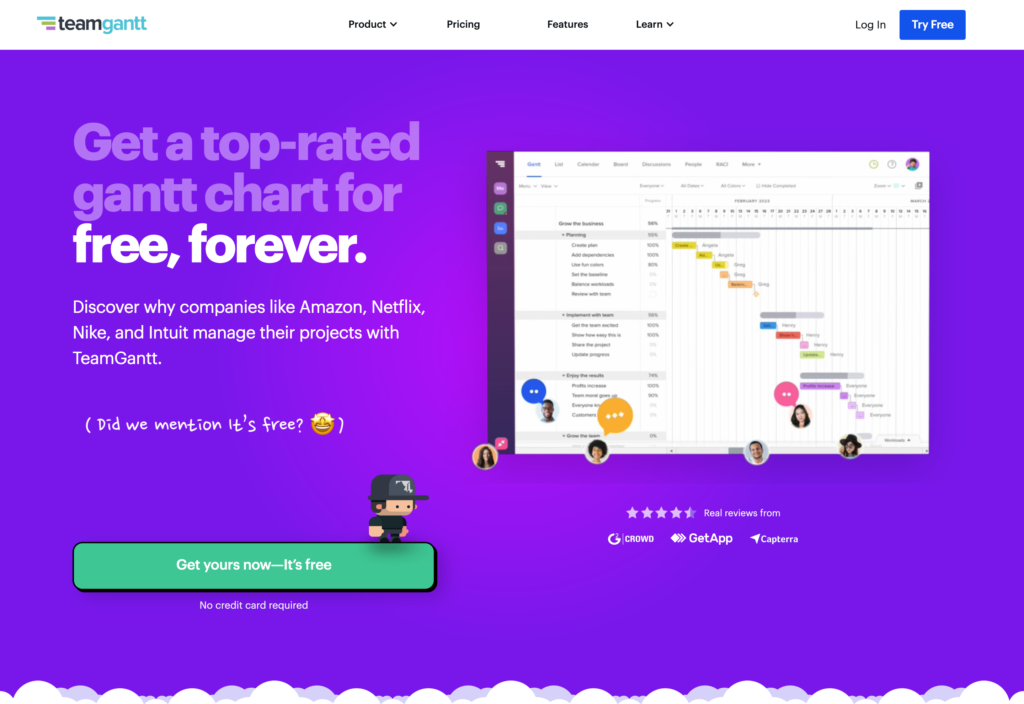
TeamGantt is a reliable project tracker with—you guessed it—Gantt timeline views.
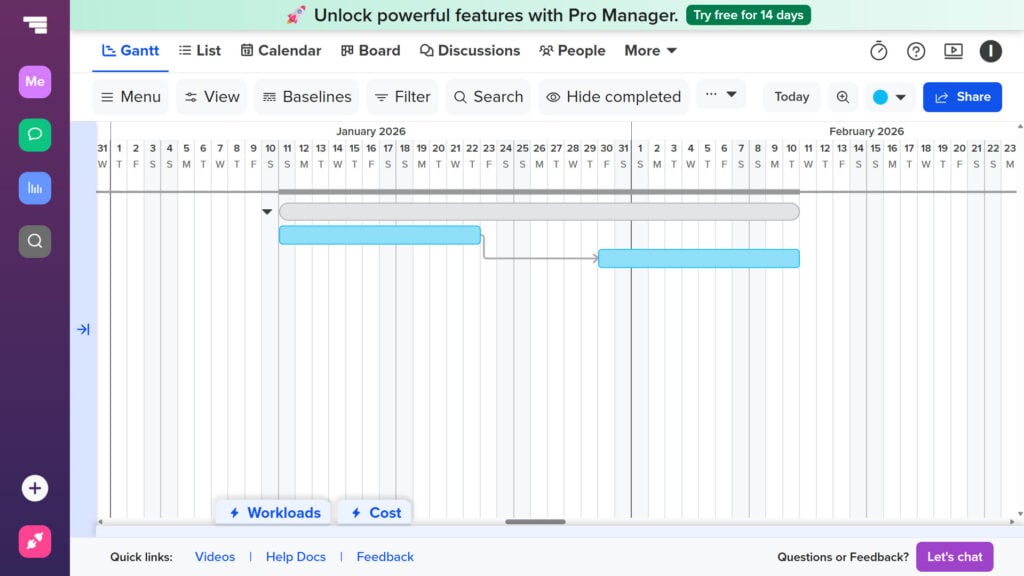
I found it easy to drag and drop tasks on TeamGantt. Why I chose TeamGantt: It offers great value for money. Unlike most timeline apps, it charges per project, not per user. For a bargain price, you get a customizable Gantt-style timeline, task tracking, and project templates, plus other operational features such as scheduling and financial forecasting.
Here are Team Gantt’s main tools.
Drag-and-drop Gantt timeline
TeamGantt offers an easy-to-use timeline view on all plans, including the free one. I could customize groups and tasks, and drag-and-drop items across the timeline. I also switched between the day, week, and month views and color-coded specific tasks and task groups.
Team members (“collaborators” on TeamGantt) can update the % completion field directly in the timeline for tasks they have been assigned. Sadly, that and time tracking are the only things “collaborators” can do on TeamGantt, which is limiting. They can’t, for instance, create tasks or adjust timelines.
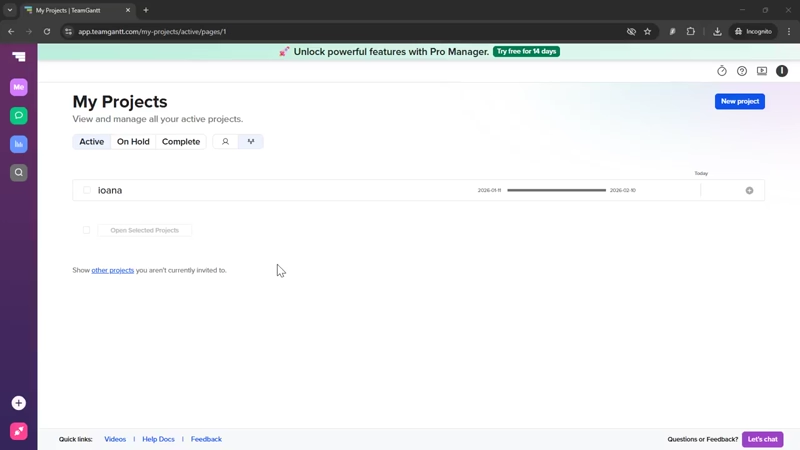
I found drag-and-drop and dependencies very easy to use in TeamGantt. You can also:
- Schedule team members and adjust planned to actual timelines
- Generate employee timesheets based on schedules and tracked time
- Use the critical path visibility tool to visualize the on-time delivery path on your timeline
Task tracking
You can add a lot of task details. First, I could drag-and-drop connectors between timeline tasks to create dependencies and set advanced dependency settings. I chose dependency types (e.g., “finish to start” or “finish to finish”) and customized lag times between tasks.
I liked that you can add subtasks to tasks, and even create to-do checklists. I could also add custom task labels, such as client names or locations. I was able to assign tasks to individuals or teams and check workloads, status, and team capacity. The RACI chart feature, which lets you track Responsible, Accountable, Consulted, and Informed stakeholders, adds an extra layer of control.
Reports and forecasts
TeamGantt’s reporting is basic but easy to manage. There are 2 main reports: project health and workloads, which I could filter by project, people, and task labels. The reports visualize stats such as % completion, color-coded status, and due dates. The workload report also shows tasks per person per day/week and remaining availability.
Outside the reporting feature, I could also compare actual vs. planned project progress. Separately, the “cost-loaded scheduling” tool forecasts project cash flows, but cost data such as labor and materials expenses will need to be uploaded.
What users say about TeamGantt
The features that I used most and liked the most with TeamGantt were the task scheduling. It works well and is reliable.


Even though it’s designed to be user-friendly, the sheer number of features and the complexity of Gantt charts were a bit overwhelming at first.
Key Features
- Customizable Gantt timeline
- Task tracking with dependencies
- Scheduling and time tracking
- Reports and forecasts
Pros
- Affordable for small teams with limited projects
- Timeline adapts to live schedules
Cons
- Limited to 20 projects and 500 tasks per project
- Basic reporting
Pricing
Starts at $10/project/month Trial: Yes Free Plan: Yes
-
Asana — Good for teams with task-heavy timelines
Asana is project management software with a robust timeline view.
Why I chose Asana: Task tracking is especially easy and comprehensive in Asana. You get subtasks, AI task summaries, and more. Outside of timelines, Asana also lets you view task boards, set team goals, create forms, and generate reports.
Here are its highlights.
Drag-and-drop timeline
The drag-and-drop timeline is user-friendly, but basic. I could add, customize, and reorder project categories (e.g., to-do and done, or research and analysis). I also added multiple timeline elements, including tasks, milestones, and approvals, and simply dragged-and-dropped connector lines to set dependencies. I liked being able to tap multiple elements and bulk-reschedule them in one go.
You can also bulk-color-code tasks on your timeline, and assign users to complete, approve, or answer questions in tasks’ comment sections. However, I would have liked a broader range of timeline breakdowns—currently, only weeks and months are available.
Also, if you want to explore timelines on a free-forever plan, Asana’s not for you. This view is only available on paid plans.
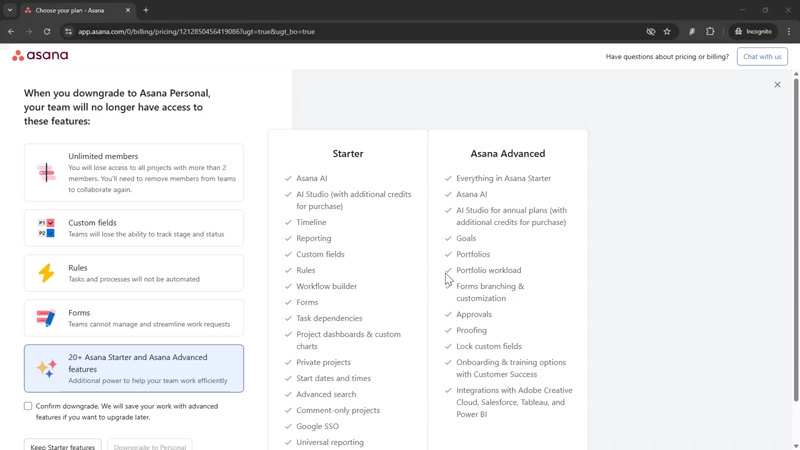
When I moved to the free Asana plan, timelines weren’t included… 🙁 Tasks and subtasks
I enjoyed tracking team tasks in detail. This included not just project, due date, and assignee, but also fields such as custom multiple choice (e.g., priority) and time tracking. Asana has an in-app time clock, but I didn’t find it very visible or easy to use. Other timeline apps are much better at time tracking.
I found Asana’s subtasks feature useful, since it lets you add more specificity to your timeline tasks. But, strangely, subtasks don’t automatically “inherit” the original project or assignee. You must manually select “parent” tasks, which is time-consuming.
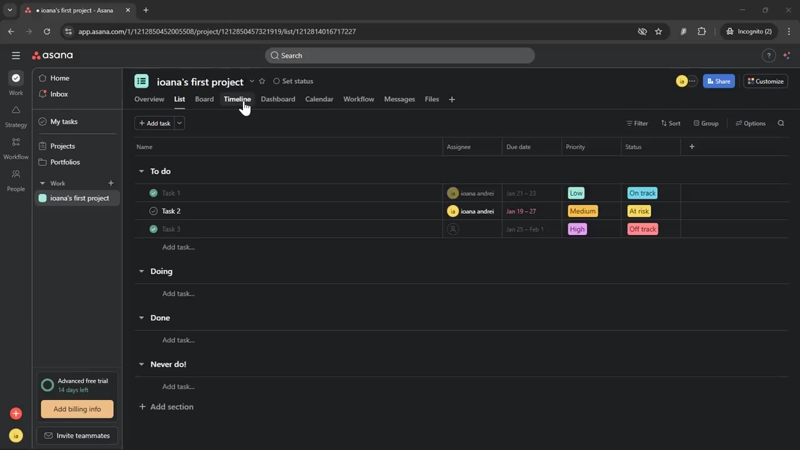
While testing, I found the overall Asana interface a bit overwhelming. However, creating tasks only takes a few simple steps. Meanwhile, with Asana forms, team members and clients can submit data and workflow requests. This sets Asana apart from similar timeline solutions. For example, client requirements in a form can automatically trigger a new project stage and task assignment.
Reporting
Timeline trackers don’t always offer robust reporting (they tend to only offer exports). But I’m glad to report that Asana is different, with ready-made dashboards such as “project by status” and “upcoming tasks by assignee this week.” I could also customize real-time charts based on fields, including assignee, completion status, task, and timeframe.
Integrations
Asana has hundreds of third-party integrations. Largely, these help you feed data easily into (and out of) Asana without manual exports. Examples include:
- Communication apps like Slack and Outlook
- Time trackers like Toggl Track and Harvest
- Finance apps like Xero and Stripe
What users say about Asana
Keep tasks organized and It allow easy tracking of progress and management of multiple projects.Has simple automation that help to save time and reduces human errors.
I think it can be quite expensive for a large team when you really want to customise it to make the most of the features.
Key Features
- Drag-and-drop timeline view
- Tasks and subtasks
- Automation via forms
- Robust reporting
Pros
- Easy to track multiple projects’ status
- Large integration library (300+ apps)
Cons
- Timeline view only on paid plans
- Accessing the time clock is difficult
Pricing
Starts at $10.99/user/month Trial: Yes — (30 days) Free Plan: Yes — (Personal plan for up to 2 users)
-
Notion — Good for generalist teams needing timeline support with AI
Notion is a flexible data and content organizing platform that lets you build team timelines.
Why I chose Notion: Its digital workspace has one of the most flexible user experiences among timeline software. You can create a timeline in just a few clicks or view existing databases on a timeline view. You also get benefits such as quickly browsing knowledge bases, breaking down tasks with Notion AI, and tracking meeting notes.
Here’s a closer look at Notion timelines.
Drag-and-drop timeline
I got a few timeline “cards” when I created my first project timeline on Notion. I could drag-and-drop them on the timeline itself or in the cards list. For ongoing projects, the “database” feature lets you update info such as tasks, goals, campaign stages, content items, deadlines, and requirements. Databases are also easy to create using Notion-made or community-made templates.
I found “properties” easy to customize. These are data fields you can add to cards, such as due date, assignee, status, and priority level. I could make some fields, like status or assignee, visible on the timeline itself. I also quickly created dependencies between cards, such as “Send report” after “Client call.”
Having said that, I thought Notion timelines could have more depth with tools like sub-swimlanes, time tracking, and robust reporting. (Note that you can use Excel-like “calculations” to get averages, sums, and more based on task property data.)
Flexible views
I was pleasantly surprised by the variety of timeline views: hourly, daily, weekly, bi-weekly, monthly, quarterly, yearly, and 5-yearly. Great for flexibility—for instance, you can plan a 1-day team social or a 5-year succession strategy in the same tool.
I could also switch from timeline to project views, including board, table, and calendar. I liked that you can add mini-timelines to pages containing other elements (e.g., tables, lists) and that you can access your data offline on the desktop and mobile app.
AI and automations
Notion AI is a pretty advanced chatbot. You can use it to brainstorm ideas, customize existing timelines, add data from third-party apps (such as Slack or emails), and more. I used it on the free plan, and it customized my timeline within seconds. I especially liked that it can assign users to tasks and browse the web for information.
Elsewhere, Notion’s automation tools help you cut repetitive admin, but I felt there was a learning curve. Useful automations include status-dependent team notifications, actions based on custom buttons (such as “Approve proposal”), and trigger-based new timeline elements (say, adding new users).
What users say about Notion
I like how flexible it is. You can organize notes, tasks, and projects all in one place.
Mmm the only con I can think about it’s their poor UX on their mobile app.
Key Features
- Drag-and-drop timeline cards
- Create dependencies and properties
- Build using AI
- Automate admin tasks
Pros
- Highly intuitive UX
- Automations and AI save time
Cons
- Lacks advanced project management features
- Free plan for individuals only
Pricing
Starts at $10/user/month Trial: Yes Free Plan: Yes
-

Office Timeline — Good for teams that require timeline presentations
Available on
- Web
- Windows
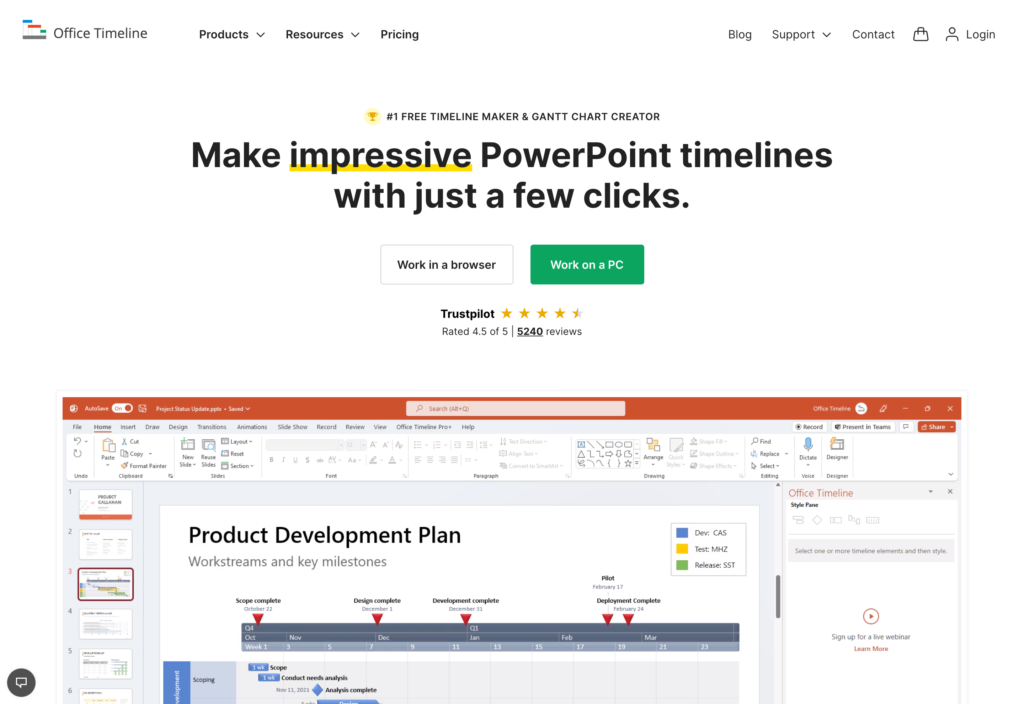
Office Timeline is a timeline app that helps teams build presentation-ready timelines, integrating directly with MS PowerPoint and Google Slides.
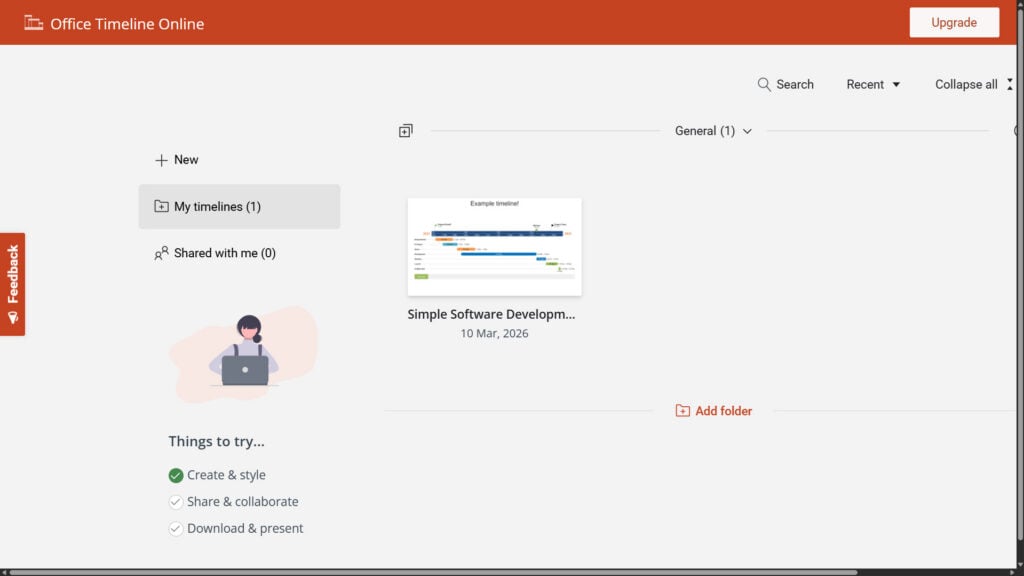
Office Timeline lets you create timelines directly on slides. Why I chose Office Timeline: Timelines are uber-customizable and include swimlanes, task bar shapes, and planned vs. actual timeline comparisons. It’s a treat, especially for project managers who need to update stakeholders, since it transposes timelines to MS PowerPoint or Google Slides in a couple of clicks.
Here are Office Timeline’s features in more detail.
Customizable timelines
I created timelines directly in PowerPoint with the Windows app and in the web version. There’s no macOS app (sorry, Mac users.) I could get started with a data import or by manually editing my timeline. I also had a choice of 40+ templates such as “Simple Planning Roadmap,” “Agile Product Release Plan,” and more.
The timeline customizability stuck out to me. Visually, you get swimlanes and sub-swimlanes, which let you layer multiple sub-processes within categories such as “Development” or “Launch.” You also have multiple shape options for tasks and milestones, on top of color-coding, which is especially useful for complex timelines.
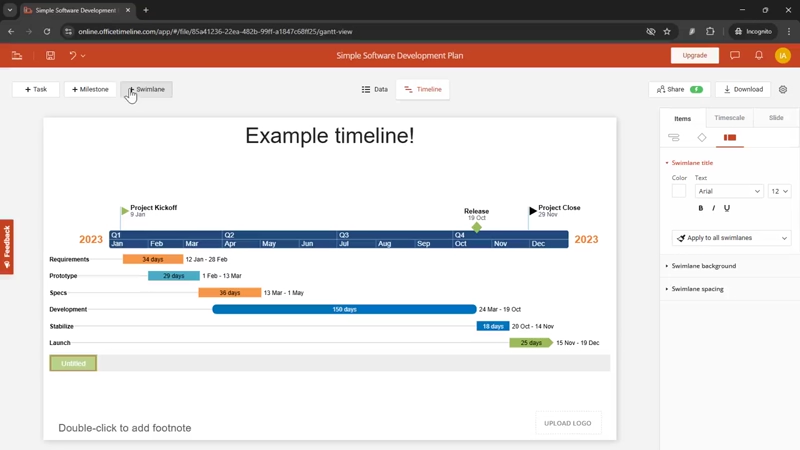
I could format different timeline elements, but the user experience wasn’t completely straightforward on the Office Timeline web. I could easily add tasks (with dependencies, dates, and descriptions) and manually update the % task completion. But I didn’t find task tracking easy outside the main timeline. Also, while I could reschedule or drag-and-drop tasks, the formatting on the Office Timeline slide got messed up for no reason.
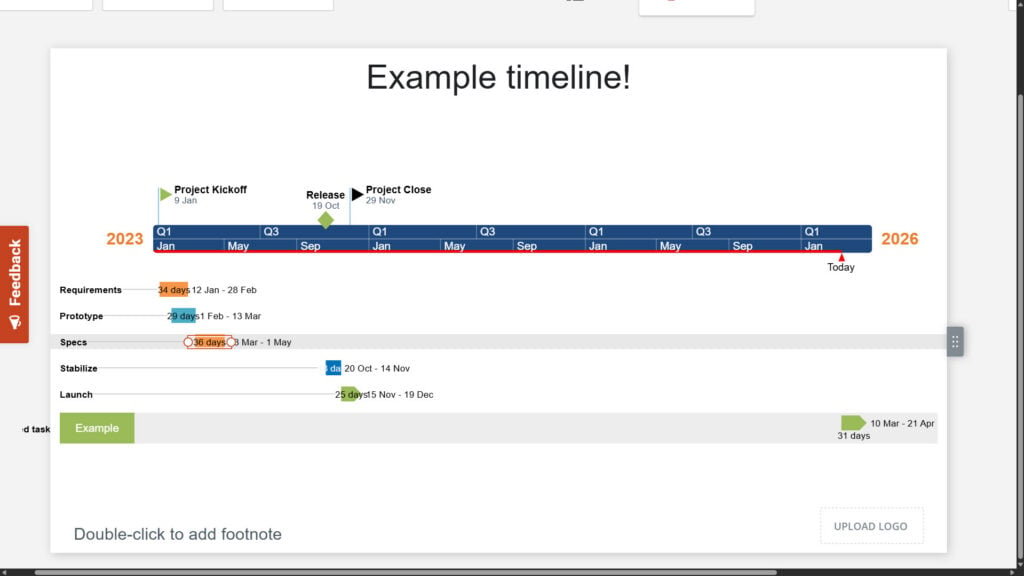
Strangely, some timeline elements and dates are misaligned and even off-slide. Unlike some competitor software, the timeline layout is fully customizable—for instance, you can have the timescale bar either at the top or bottom.
Integrations
Office Timeline’s most useful integrations are with MS PowerPoint and Google Slides. Here, the app is effectively another feature in your presentation program, and I could easily select data (including from Google Sheets, Jira, and others) and edit layouts. Office Timeline for PowerPoint was easy to install, but I had some issues using it in Slides. If I chose, I could also embed my timelines in Google Docs.
While slide-based timelines are great for boardroom updates, the limited size could make them unsuitable for long projects with hundreds of tasks. Also, I found that collaboration was only possible in real-time in the PowerPoint version. The web-based and Slides-based versions require a 1-click refresh.
What users say about Office Timeline
Office Timeline has given us the ability to provide our donors and stakeholders with a dynamic view of the projects that we are engaged in.
The tool doesn’t always update actual dates accurately when revisiting plans in PowerPoint, and it requires quite a bit of manual intervention to feed and maintain the data.
Key Features
- Drag-and-drop timeline
- Work directly in PowerPoint or Google Slides
- Customizable layouts
- Add swimlanes and dependencies
Pros
- Great for presentation- and report-heavy projects
- Generous free plan
Cons
- Limited collaboration and real-time updates
- No automation features
Pricing
Starts at $9/user/month Trial: Yes Free Plan: Yes
Also Consider: Workforce Management Software With Employee Timeline Features
-
Connecteam — Best for deskless teams needing comprehensive employee timelines
Connecteam isn’t classic timeline software for plotting project phases, Gantt dependencies, or stakeholder roadmaps. It’s workforce management software with employee timeline features, making it a better fit for businesses that need to track employee milestones, certifications, tasks, documents, and work history in one place.
Why I chose Connecteam: I included Connecteam because some businesses searching for timeline software are not trying to build a project roadmap. They need a reliable way to see what happened across an employee’s lifecycle, from onboarding and training to certifications, reviews, assigned tasks, and milestones.
Let’s take a closer look at Connecteam’s timeline features.
Employee timeline with milestones
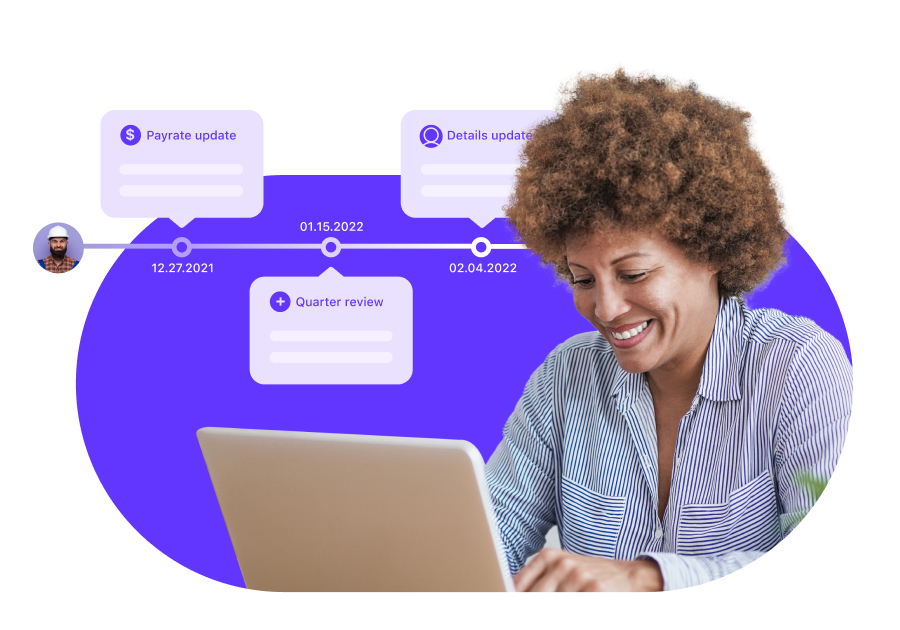
What I like about Connecteam’s employee timeline feature is that it gives me a clear overview of every employee milestone from day 1. For instance, I can see employee progression and actions, including:
- Salary changes
- Training progress
- Employee evaluations
- Certifications
- Project status
- Position changes
- Milestones and anniversaries
- Annual reviews
In the app, I can customize employee timeline elements like adding new items manually (including due dates or expiration dates) and color-coding different item categories. I can also track workers’ tasks, documents, and forms. Such information is great for determining raises, promotions, and project assignments.
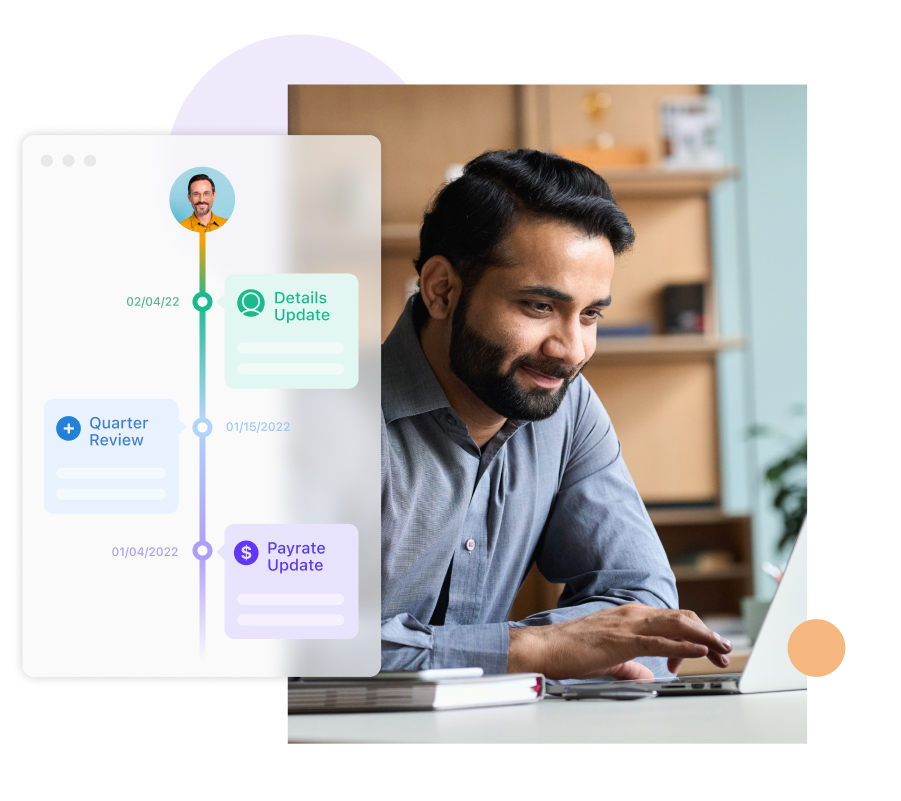
The employee timeline keeps you up to date on employee reviews, certificate expiries, and more. Task and time tracking
Connecteam offers a practical, results-based alternative compared with some other timeline platforms. Its task tracker allows you to create one-off or recurring tasks, add subtasks, assign pre-qualified team members, set deadlines, and attach important forms, checklists, videos, and images.
I was able to add project tasks to Connecteam shifts and track my time on specific shifts with just 1 click. You can’t currently track time on individual tasks. But, unlike on some timeline apps, you can grant regular users permission to create new tasks.
All projects and tasks sync with employee timelines, which let me check users’ progress and productivity. I also got a project-wide view of task completion and could export task progress reports. The downside? You can’t currently plot your tasks and subtasks on a timeline view.
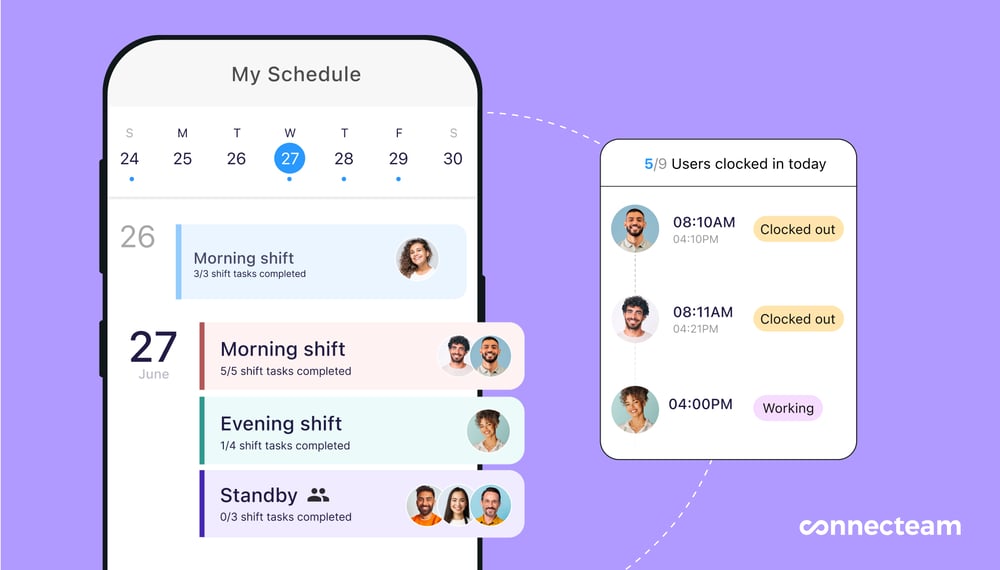
The app gives you a clear overview of your team schedules, tasks, and live attendance. Shift scheduling
While other timeline apps enable you to plan projects in “theory,” Connecteam lets you schedule real-world tasks in a team calendar. This is especially useful for frontline teams, since you can add job details including location, task instructions, forms, files, and more.
I easily scheduled new slots from saved templates and used Connecteam’s AI auto-scheduler to assign staff members in seconds—based on their availability, qualifications, and other factors. I also liked how easily I could switch between calendar views (daily to weekly, for instance) and filter schedules by shift types, teams, and more.
Remain compliant with regulations
Connecteam helps you ensure compliance with industry regulations. On my employee timeline, I could see expired or soon-to-expire employee certifications and mandatory training.
You can record when employees are issued certificates, when they need to be renewed, and keep an audit trail in one place. I was also able to toggle automatic notifications to employees and managers for certification renewals.
Recognize and reward employee milestones
I liked that I could reward and recognize employees for a job well done. Whether they’ve reached a work anniversary or done an exceptional job on a project, timeline notifications prompt you to take action based on milestones.
For instance, publicly acknowledge a worker on the company newsfeed, send them a digital badge of recognition, or even give them redeemable points they can use to get free gift cards.

Your employee timeline prompts you to reward top-performing staff members. When Connecteam may not be the best fit
If you need to plot tasks, milestones, and deadlines on a project timeline without scheduling or staff management, Connecteam may not be the best solution.
0Key Features
- Employee timeline
- Custom milestones
- Task tracking
- Team scheduling and time tracking
- Rewards and recognition
- Compliance tools
Pros
- Complete view of employee activity
- Labor cost management with scheduling and time clock
- Track on the go with mobile
- Great value for money
Cons
- No project timeline management
Pricing
Free-for-life plan availablePremium plans start at $29/month for 30 users
14-day free trial, no credit card required
Start your free trial
Compare the Best Timeline Software Solutions
| Topic |
|
|
|
|
 Start for free
|
|---|---|---|---|---|---|
| Reviews |
 |
|
|
|
|
| Pricing |
Starts at $10/project/month
|
Starts at $10.99/user/month
|
Starts at $10/user/month
|
Starts at $9/user/month
|
Starts at just $29/month for the first 30 users
|
| Free Trial |
yes
|
yes
(30 days)
|
yes
|
yes
|
yes
14-day
|
| Free Plan |
yes
|
yes
(Personal plan for up to 2 users)
|
yes
|
yes
|
yes
Free Up to 10 users
|
| Use cases |
Good for collaborative project timelines requiring dependency tracking
|
Good for teams with task-heavy timelines
|
Good for generalist teams needing timeline support with AI
|
Good for teams that require timeline presentations
|
Best for deskless teams needing comprehensive employee timelines
|
| Available on |
Web, Windows
|
What is Timeline Software?
Timeline software helps teams organize events, tasks, milestones, or project phases in chronological order. Instead of managing deadlines across spreadsheets, notes, and chat threads, teams can use a timeline to see what needs to happen, when it needs to happen, and who is responsible.
Most timeline tools are built for project planning. They help teams map out project stages, connect dependent tasks, adjust dates, and share progress with stakeholders. Some tools also support other types of timelines, such as employee timelines, content calendars, product roadmaps, or historical event tracking.
How Does Timeline Software Work?
Most timeline software starts with a date range. You choose the beginning and end of a project, campaign, employee lifecycle, or process, then add items to the timeline. These items might include tasks, milestones, deadlines, approvals, events, or employee records.
From there, you can usually customize the timeline by changing colors, grouping related items, assigning owners, adding descriptions, attaching files, and switching between daily, weekly, monthly, or yearly views. More advanced tools let you create dependencies, so one task automatically affects another when dates change.
The main value is visibility. A project manager can see whether a launch is slipping, a team lead can check which tasks are overdue, and an HR manager can review an employee’s training, certifications, reviews, and milestones in one place.
The Benefits of Timeline Software
Timeline software is useful because it turns scattered information into a clear sequence of work, events, or milestones. That makes it easier to spot delays, understand priorities, and communicate progress without digging through multiple tools.
Clearer project planning
A timeline gives teams a shared view of what needs to happen next. This is especially useful for projects with multiple stages, deadlines, or handoffs between team members. When everyone can see the sequence of work, it’s easier to avoid missed steps and last-minute confusion.
Easier task and milestone tracking
Timeline software helps managers track tasks, deadlines, milestones, and ownership in one place. Instead of checking separate task lists or asking for updates manually, managers can quickly see what is done, what is late, and what still needs attention.
Better communication with teams and stakeholders
Visual timelines make progress easier to explain. A project timeline can show clients where a project stands, a roadmap can help leadership understand upcoming priorities, and an employee timeline can give managers a clearer record of training, certifications, reviews, and achievements.
Faster schedule adjustments
When dates change, timeline software makes it easier to update the plan. Tools with drag-and-drop editing and task dependencies can help teams adjust deadlines, move related tasks, and understand the impact of delays faster than they could in a static spreadsheet.
More useful historical records
Timelines also create a record of what happened over time. That can help teams review project performance, understand where delays occurred, or track employee development across training, milestones, certifications, and reviews.
Stronger accountability
When timeline items have owners, due dates, and status updates, it’s clearer who is responsible for each step. This helps reduce confusion and gives managers a practical way to follow up without micromanaging.
How Much Does Timeline Software Cost?
Timeline software varies in price based on features, but it usually charges on a per-user basis. Exceptions include TeamGantt, which charges an affordable $10/project/month but has limited project and task options.
Notion and Asana plans start at $10/user/month and $10.99/user/month, respectively, which could get pricey for larger teams. Meanwhile, Connecteam pricing starts at $29/month for the first 30 users, and $0.8/user thereafter.
Many timeline platforms offer free plans, but the number of users, projects, and/or advanced features is usually limited. You can often trial vendors’ premium plans as well.
FAQs
The best program for creating a timeline for free is Connecteam if you’re looking for employee timelines and schedule management. You can track employees’ HR data, tasks, milestones, and more. Meanwhile, free alternatives for project timelines include Notion, Office Timeline, and TeamGantt.
Different free timeline platforms offer different tools. For example, the free Notion plan lets you add tasks, assign team members, and switch between timescales. With the free Connecteam plan, you get employee timeline features, including task and milestone tracking and scheduling.
How you make an online timeline will depend on the software you use and what you plan to use your timeline for. Once you select an online timeline maker, you can customize the timeline however you like with colors, images, videos, dates, and connecting lines. Then, you’ll want to make sure the timeline is in chronological order so you can use it to track projects and employee progress.
The Bottom Line on the Best Timeline Software
The best timeline software depends on what you need to track. TeamGantt is the strongest fit for dedicated project timelines, Asana works well for task-heavy project planning, Notion gives teams flexible timeline databases, and Office Timeline is best when timelines need to become stakeholder-ready presentations.
Connecteam is different. It isn’t built for visual project timelines, but it’s a strong option for deskless businesses that need to track employee milestones, certifications, assigned work, documents, and schedules in one workforce management platform.
If your timelines are really about your people and their work history, Connecteam is the better fit.