


When company information is spread across emails, shared drives, and chat threads, employees waste time searching and managers answer the same questions again and again.
I reviewed 5 company intranet apps and ranked them based on how easily employees can find what they need, how well content stays up to date, and how much work each platform creates for admins.
Use these picks to cut repeat questions, keep employees informed, and confirm that updates actually reach the right people.
| App | Best for | Starting Price | Key Considerations |
| Connecteam | Deskless teams that need mobile access to company information | Just $29/month for the first 30 users | Offers a free-for-life plan, with communication, knowledge, scheduling, training, and forms in one app. Requires an internet connection. |
| Simpplr | Keeping employees informed with personalized, measurable communications | Contact vendor for price | Brings AI search and sentiment analysis into one dashboard. There’s no browsable folder structure, and admins can’t publish new content from the mobile app. |
| Microsoft Sharepoint | Companies creating a central company hub in Microsoft 365 | Start at $5/user/month | Builds on Microsoft 365 documents and permissions. The mobile intranet runs through Teams, with premium SharePoint app features requiring additional Viva licensing. |
| Staffbase | Enterprise comms teams reaching frontline workers without company email | Contact vendor for price | Dedicated frontline pricing and a white-labeled app. Admins still need desktop for publishing, while employees can download selected pages for offline access. |
| Workvivo | Building culture across large, distributed teams | Contact vendor for price | Company communications feel familiar with a social feed, podcasts, and livestreams. Chat costs extra. |
What’s New in This Update (August 2026)
- Replaced Happeo with Staffbase for frontline communications.
- Updated vendor details, including that SharePoint Plan 1 has no free trial and Workvivo no longer publishes pricing.
- Added practical guidance on choosing an intranet based on access, content governance, and admin workload.
Our Top Picks
-
1

Best for deskless teams that need mobile access to company information
-
2
Best for keeping employees informed with personalized, measurable communications
-
3

Best for companies creating a central company hub in Microsoft 365
Why trust us?
Our team of unbiased software reviewers follows strict editorial guidelines, and our methodology is clear and open to everyone.
See our complete methodology
How I Ranked the Best Company Intranet Apps
Here are the problems I tried to solve with each app, and the features I looked for:
Creating a Trusted Source
- Finding answers without knowing the file name: The software must combine useful search with a clear folder structure. Employees should be able to find the same policy searching “time off” or browsing the HR section.
- Knowing the information is still up to date: Employees should be able to know they’re accessing the latest policy, while admins need tools to manage updates and remove outdated versions.
- Cutting down repeat questions: Employees should be able to find useful answers without asking a manager to explain the same policy or process again.
Day-to-Day Usability
- Giving employees one starting point: The app should bring policies, business systems, and everyday tools together.
- Making the mobile experience usable: Employees need to be able to access the company intranet from a phone and sign in quickly.
- Sending the right update to the right people: Admins should be able to target content by role, location, or department, then confirm who has read a critical update.
Saving Admin Time
- Keeping permissions correct: Access must change on its own when employees join, get promoted, or leave.
- Publishing timely updates: Managers need to be able to post announcements and check engagement from a phone.
- Launching without a months-long project: The software should be usable within days rather than after a long configuration.
- Knowing what’s working: The app should track views, read confirmations, and failed searches, so admins know what to improve.
The 5 Best Company Intranet Apps of 2026
-
Connecteam — Best for deskless teams that need mobile access to company information
Connecteam is an employee management app for deskless teams that need a mobile hub for company information and day-to-day work. It gives employees one place to find policies, receive company updates, communicate with colleagues, submit forms, and check schedules.
Why I chose Connecteam: Connecteam is the best choice for deskless teams that need company communication and operations in one mobile app. Its Smart Groups keep knowledge base access aligned with employees’ roles, which removes manual permission work as people join, move roles, or leave.
Company Knowledge Base
Connecteam’s company knowledge base gives managers one place to keep everything employees need to look up. It’s organized into sections, folders, and subfolders. If an employee doesn’t know the exact name of a document, they can still navigate to “Machinery,” then “Forklifts,” and find the manual, instead of typing keywords and hoping for the best.
Inside each folder you can write content directly, upload files, or link out to external resources. Admins can reorder content by dragging it, set permissions per knowledge base, and create separate ones by department or topic.
There’s also an AI agent connected to the knowledge base, so employees can ask a question in the app and get an answer directly from your own company content instead of digging through folders.
Engagement insights show who opened what, how often, and when, giving you a good sense of whether a new procedure is actually being read or quietly ignored.
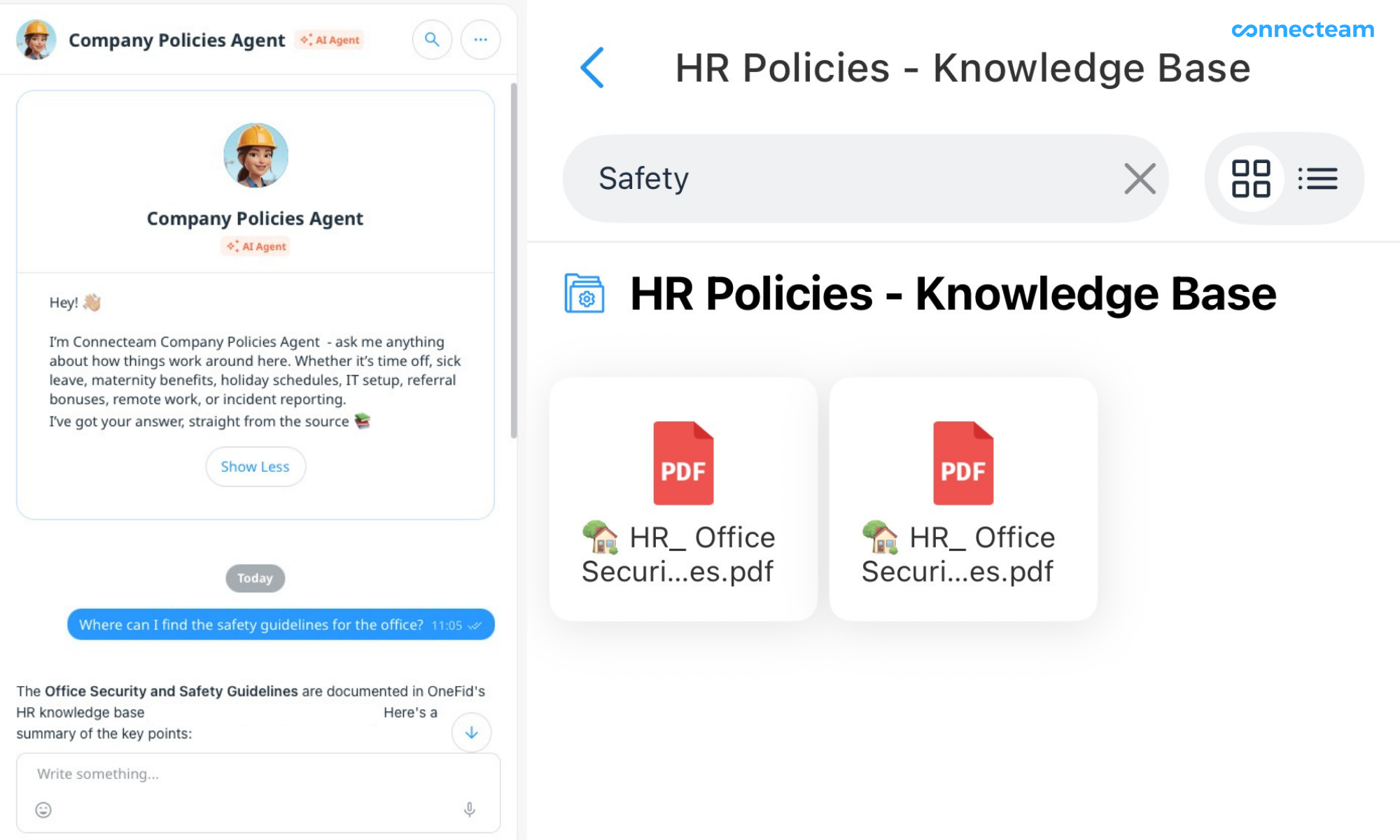
Search for company policies or ask Connecteam’s AI agent to find answers fast. Smart Groups and Automatic Permissions
Connecteam lets you share a knowledge base with individual users or with a smart group that clusters employees by role, department, or location. You can set conditions so employees are added to or removed from a group automatically based on their position, which means access management stops being a manual task.
New hires automatically join the right groups and gain access to the correct information. Access updates with promotions and closes when employees leave, helping businesses with high turnover or seasonal crews keep records accurate without manual spreadsheets.
Company Updates Feed
Connecteam’s company update feed is the first thing employees see when they open the app, which makes it the best place for announcements, safety notices, weather alerts, and company news. You can target updates by team, location, or role so people only get what applies to them, and admins can segment the feed by topic to keep it organized.
For updates that can’t be missed, you can publish a pop-up that appears when an employee opens the app and requires them to tap “confirm” or “remind me later.” You can also set recurring updates for things like quarterly refresher training, and schedule posts for when people are most likely to be on their phones.
Managers can track post views and require read confirmations, while employees can comment and react. Connecteam’s AI also improves messages and automatically translates them into each employee’s preferred language.
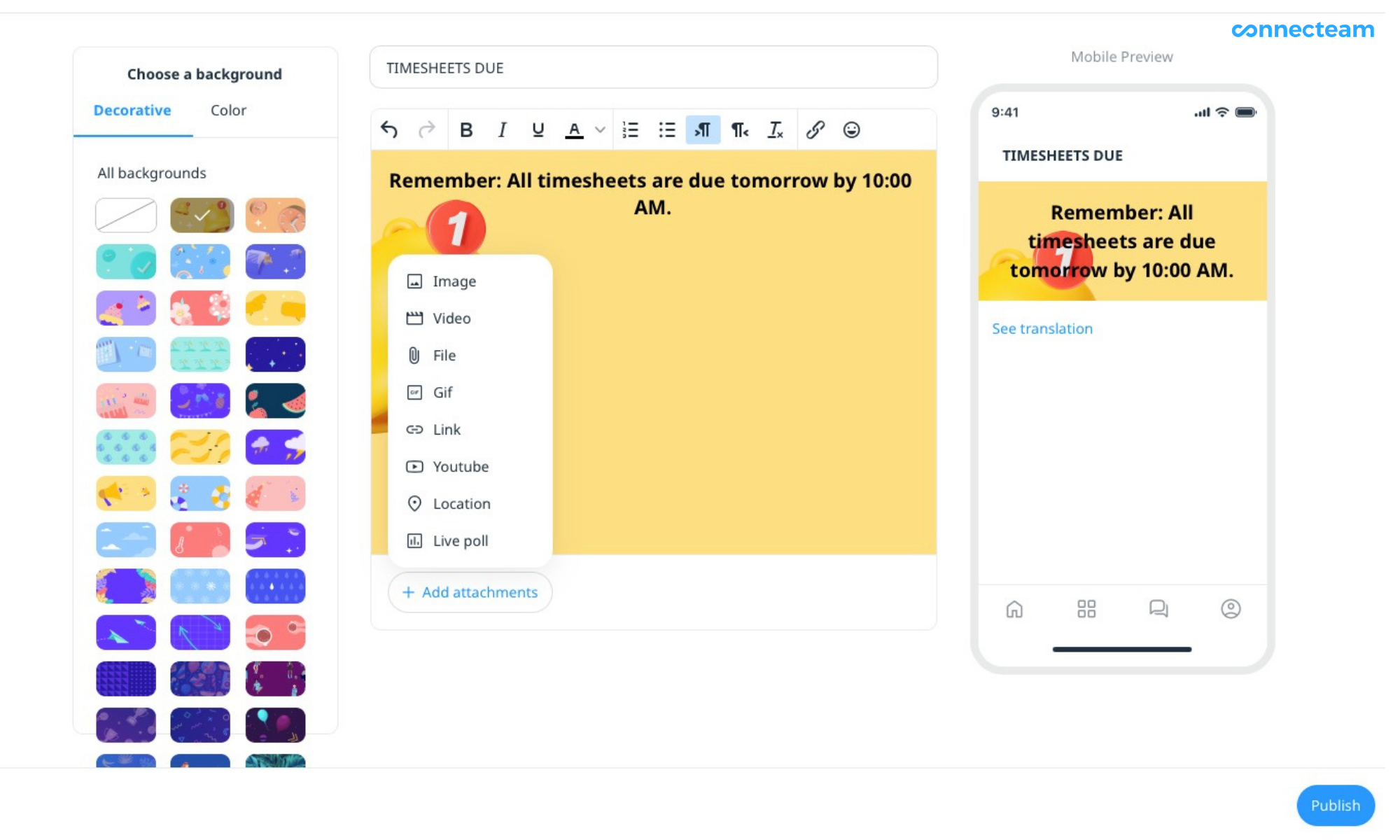
Create media-rich updates your team won’t be able to miss. In-App Chat and Employee Directory
Connecteam’s online team chat covers one-on-one and group messaging with file attachments, images, voice recordings, @mentions, read receipts, and a fully searchable history. Because it’s a work-only chat, personal messages stay out of it, and admins control who can start chats, who can delete messages, and whether direct messaging is limited to supervisors.
The company employee directory updates itself as your team changes, so nobody’s working from an old contact list. Employees can find colleagues by name, role, department, or location and message or call them straight from the app. You can also add external contacts like subcontractors and suppliers for easy access.
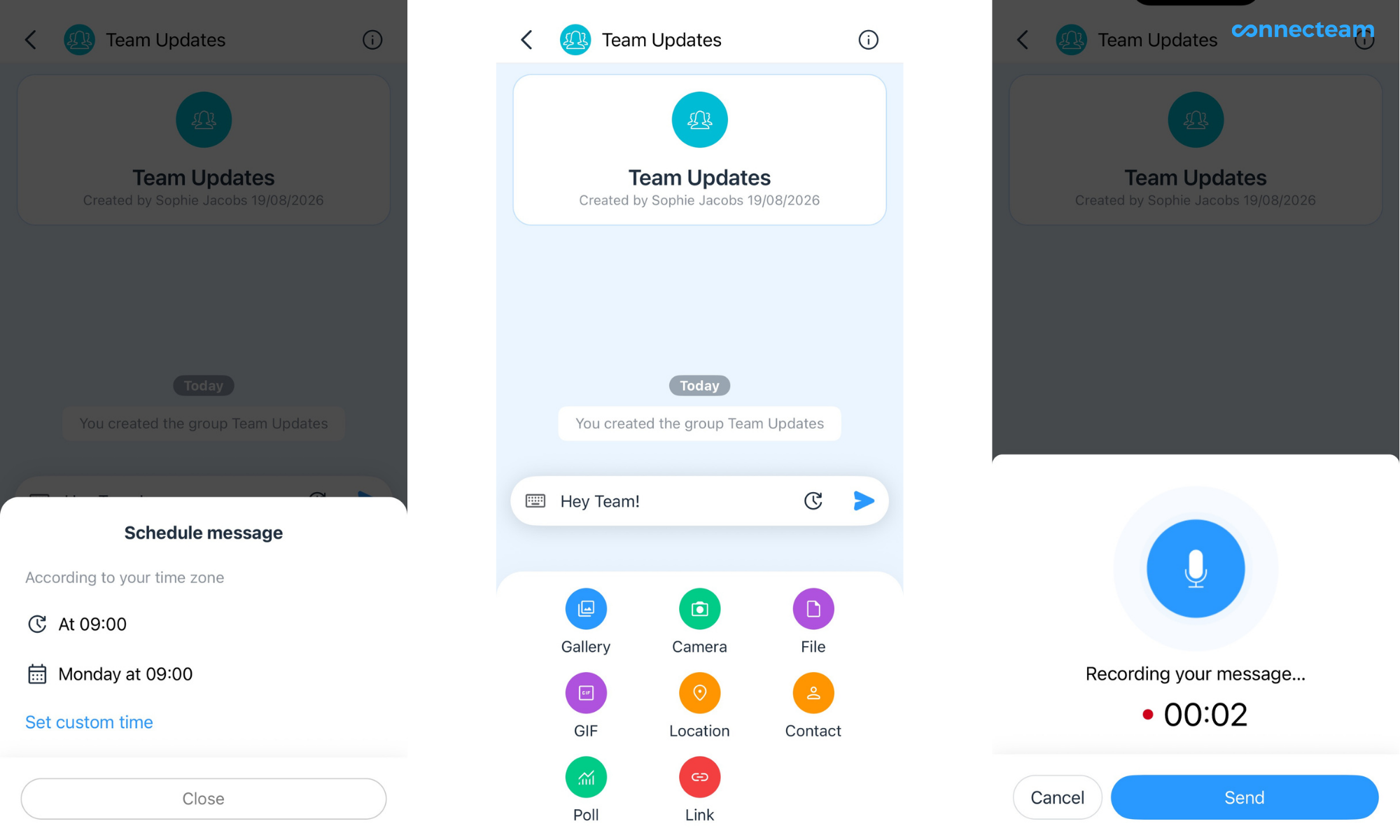
Schedule messages, add attachments, or record your message all in Connecteam’s chat. And So Much More…
Connecteam offers tools to help run your operations alongside the intranet, including an internal help desk, digital forms and checklists, task management, employee scheduling, and so much more.
When Connecteam Isn’t a Good Fit
Connecteam isn’t designed for large enterprises that need separate branded intranets, regional governance, multi-editor publishing, or complex approval workflows. It also lacks real-time document collaboration, so a dedicated file suite may be a better fit for some teams.
0Key Features
- Searchable knowledge base
- Smart Groups with automatic permissions
- Company updates feed
- Read tracking and confirmations
- In-app one-on-one and team chats
- Auto-updating employee directory
Pros
- Search and AI Agent for self-service answers
- Targeted updates with read confirmations
- Fully functional mobile app
- Knowledge access updated by role
Cons
- Lacks live document collaboration
- No multi-editor publishing
Pricing
Free-for-life plan availablePremium plans start at $29/month for 30 users
Make an Impact On Your
Start Communicating Now
Team’s Communication & Productivity -
Simpplr — Best for keeping employees informed with personalized, measurable communications
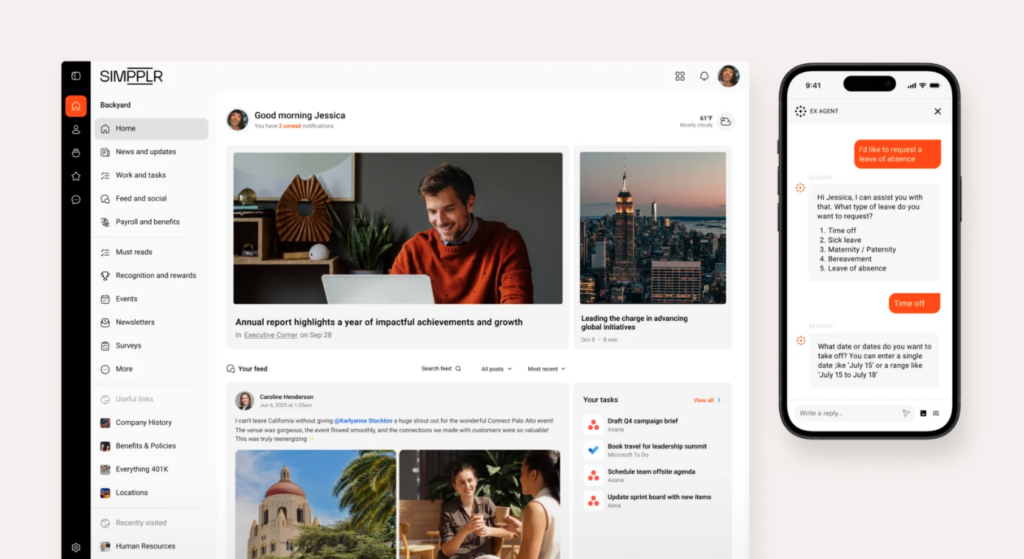
Simpplr is an employee experience platform with a single dashboard for its intranet, newsfeed, and analytics.
Why I chose Simpplr: I chose Simpplr because it helps comms teams see if messages are landing, not just being delivered. Its AI combines enterprise search with sentiment analysis, so teams can help employees find information and use feedback to improve the next update.
Intranet and Newsfeed
Simpplr puts a newsfeed, documents, calendar, and shortcuts on one screen, so employees don’t have to switch tabs to catch up. There’s a search bar and menu pinned at the top, and most of the page is a social-style feed that any employee can navigate without training.
You can group employees into “sites” by office or department, each with its own feed, then target newsletters, surveys, and event invites to specific sites.
The gap shows up when employees need a document rather than an update. There’s no centralized folder system to browse, so an employee looking for an operating procedure has to search for it by name. We found that the workaround is to publish a news post with links to each uploaded file, but that gets tedious fast. Feeds also can’t be viewed full-screen or branded, so the newsfeed always takes up a third or half of the window.
Simpplr AI and Enterprise Search
Simpplr’s AI runs through the whole platform. Content creators can draft news stories and emails with it, employees can ask questions and get answers based on documents and posts already in the intranet, and administrators can use it to analyze sentiment and automate workflows like time-off requests.
Simpplr also has a fully integrated AI-powered enterprise search inside the intranet.
The limitation we ran into is on the admin side: the mobile app doesn’t support most administrative features. Employees can read, like, comment on, favorite, and share existing content on a phone, but site managers need to use desktop to add users or manage sites, and new pages, albums, and events can only be created on desktop. That leaves a comms team unable to create a new intranet page on the go, even though they can engage with the existing feed.
Surveys, Recognition, and Sentiment Analytics
Simpplr offers more than 100 employee engagement questions, quick emoji-based pulse surveys, and longer surveys with scales, multiple-choice questions, and written responses. Managers can choose whether responses are anonymous, and employees can participate from the mobile app.
Employees can also recognize coworkers with custom badges and points redeemable for prepaid cards, gift cards, or charity donations. However, all recognition appears publicly in the company feed, with no private option.
Simpplr tracks sentiment by topic, group, and time period. It also includes instant messaging with audio and video calling, so teams can communicate without a separate chat tool.
What users say about Simpplr
I appreciate the options for the look and feel, which adds a nice customizable touch. Simpplr is great at solving engagement issues across the organization and storing important information in one space.

Some of the more advanced customisation options can feel a bit limited or require additional support. It would also be helpful to have more flexibility in design and layout options.

Key Features
- Single-dashboard intranet and news feed
- AI-powered enterprise search
- Pulse surveys and sentiment analysis
- Recognition badges with redeemable points
Pros
- News, documents, and calendar on one screen
- AI tracks sentiment across posts and surveys
Cons
- No browsable folder structure for documents
- Limited mobile app functionality
Pricing
Contact vendor for price Trial: Yes — 14-day, by request only Free Plan: No
-
Microsoft Sharepoint — Best for companies creating a central company hub in Microsoft 365
Available on
- Web
- iOS
- Android
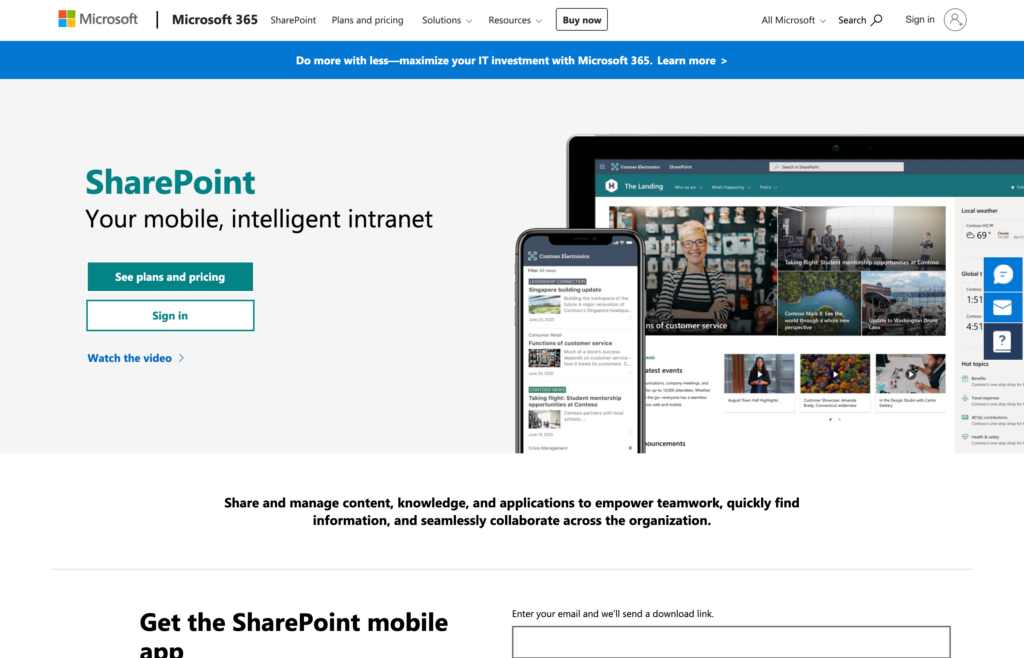
Microsoft SharePoint is a Microsoft 365 platform for document management, internal websites, content sharing, and team collaboration.
Why I chose Microsoft SharePoint: I chose SharePoint because it’s already included in most Microsoft 365 subscriptions, and it offers strong file management with folder hierarchies, metadata tagging, versioning, and granular permissions.
Document Libraries and Site Permissions
SharePoint organizes content into sites, document libraries, folders, and subfolders, which gives employees a clear structure to browse. Metadata lets admins classify documents in multiple ways, and version history tracks changes. You can apply permissions across an entire site or just to individual files. Plus, approval workflows help prevent content from going live before review.
The trade-off is that building a SharePoint intranet takes a lot of work and planning. You need to design the site and hub structure, set site-creation rules, and set up policies, labels, and permissions. Microsoft offers FastTrack onboarding and has certified partners to help, but SharePoint isn’t an intranet most businesses can launch in an afternoon.
Viva Connections for the Mobile Experience
SharePoint’s mobile intranet experience runs through the SharePoint app in Microsoft Teams, formerly Viva Connections. It gives employees a role-based home screen with dashboard cards for tasks, a news feed from SharePoint sites, and a list of useful links. Admins can use Microsoft Entra ID groups to show different content to specific teams.
The thing is that employees need to install Teams. The core experience is included with qualifying Microsoft 365 Enterprise, Frontline, and Academic licenses, while premium features require additional Viva licensing. The resources section supports up to 48 links and the spotlight up to 11 items. On mobile, the dashboard works only in portrait mode, doesn’t support custom fonts, and doesn’t sync employees’ card preferences across devices. There’s also no offline access to intranet pages or news. SharePoint’s offline support is limited to syncing files through OneDrive.
SharePoint Agents and Copilot Search
Each SharePoint content hub comes with its own AI agent, and you can build custom agents for specific sites or pages. Employees can ask questions in plain language, and the agent will pull up relevant documents and conversations. This makes it much easier to navigate large, organized content libraries.
Just know that some of the AI features cost extra. To access Copilot-powered news summaries, you need a Microsoft 365 Copilot license at $30 per user per month with an annual commitment. The summaries also only work in the desktop version of Teams.
Customizing Viva Connections beyond its standard cards also requires the SharePoint Framework, which is a developer toolkit. Microsoft describes card creation as low-code, but businesses will still need someone with development skills to get it up and running.
What users say about Microsoft SharePoint
SharePoint is the best place to keep our organization’s ‘source of truth.’ It’s fantastic for structured document management storing company policies, HR forms, and project documentation in a way that is secure and easy for the whole team to navigate.
Managing sites, permissions, and navigation often takes a lot of configuration, and if the structure isn’t set up properly from the start, it becomes hard to find information later on.
Key Features
- Document libraries with versioning
- Metadata tagging for searchability
- Viva Connections mobile dashboard
- SharePoint AI agents per content hub
Pros
- Already included in many Microsoft 365 plans
- Strong permissions and compliance controls
Cons
- Mobile intranet needs Teams and a Viva license
- Setup is a planning project, not a quick launch
Pricing
Start at $5/user/month Trial: No Free Plan: No
-

Staffbase — Best for enterprise comms teams reaching frontline workers without company email
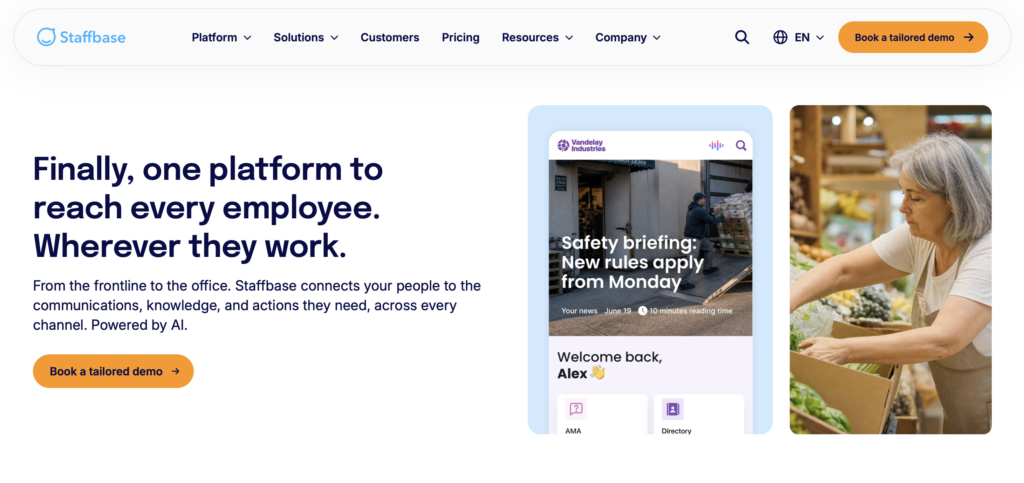
Staffbase is an employee communications platform for publishing company news, managing intranet content, and reaching employees through mobile apps, email, and digital signage.
Why I chose Staffbase: I included Staffbase because it prices frontline employees separately from desk workers, so you only pay for what non-desk staff actually need, and because its employee app is fully white-labeled.
Branded Employee App and Intranet
Staffbase lets businesses create a fully branded employee app with their company name, colors, and app store listing. Admins can customize navigation by audience, so warehouse employees might see a “Health and Safety” tab while office staff see a “CEO Blog.”
Each employee’s feed is personalized by location, role, community, and assigned group. Admins can track post views, remind employees to read an update, and require e-signatures for important content. However, Staffbase doesn’t have a mobile admin app, so managers need a computer to publish posts or check analytics. Employees can download selected pages for offline access, including text, images, and PDFs, which helps teams working with unreliable connectivity.
Editorial Calendar and Approval Workflows
Staffbase includes several tools for communications teams. There’s an editorial calendar that shows published and scheduled content, with drag-and-drop rescheduling. Team members can comment on drafts, tag coworkers, request approval, review previous versions, and restore earlier content.
Beyond that, the shared inbox brings together comments from news articles and social posts, so teams can assign questions and track responses.
The platform also provides a searchable asset library for images and videos. However, Staffbase doesn’t support co-editing for posts and news articles, so multiple editors can’t work on them at the same time. Admins also can’t require approval before employee posts appear in the social feed.
Multi-Channel Reach and Employee Journeys
Staffbase helps businesses reach employees across multiple channels. It lets teams publish the same content through the mobile app, intranet, email, SMS, and digital signage from one dashboard. You can also create custom automations, called employee journeys, to send content to specific groups on a schedule, like delivering one onboarding lesson to a new hire each day.
Staffbase’s AI tools can answer employee questions, draft posts, and analyze comment sentiment. They can also create personalized daily podcasts, flag duplicate or conflicting content, translate updates, and generate video captions. Admins can enable each feature separately. However, you can’t start a journey from custom triggers like work anniversaries.
What users say about Staffbase
Staffbase has been extremely helpful for a variety of reasons, though the biggest impact we’re seeing so far is the ability to keep everyone informed across the organisation. It’s also made it much easier to bring our multiple platforms into one, easily accessible space that staff can access on the go.
While the platform does a great job with basic features, it could include more tools to actively engage users. Additional interactive elements or creative templates could make the emails more captivating for employees and boost interaction.
Key Features
- White-labeled employee app
- Editorial calendar with approval workflows
- SMS and digital signage channels
- AI content governance and daily podcast
Pros
- Dedicated frontline pricing for non-desk staff
- Read confirmation with e-signature
Cons
- No mobile app for administrators
- Offline pages must be downloaded in advance
Pricing
Contact vendor for price Trial: No Free Plan: No
-
Workvivo — Best for building culture across large, distributed teams
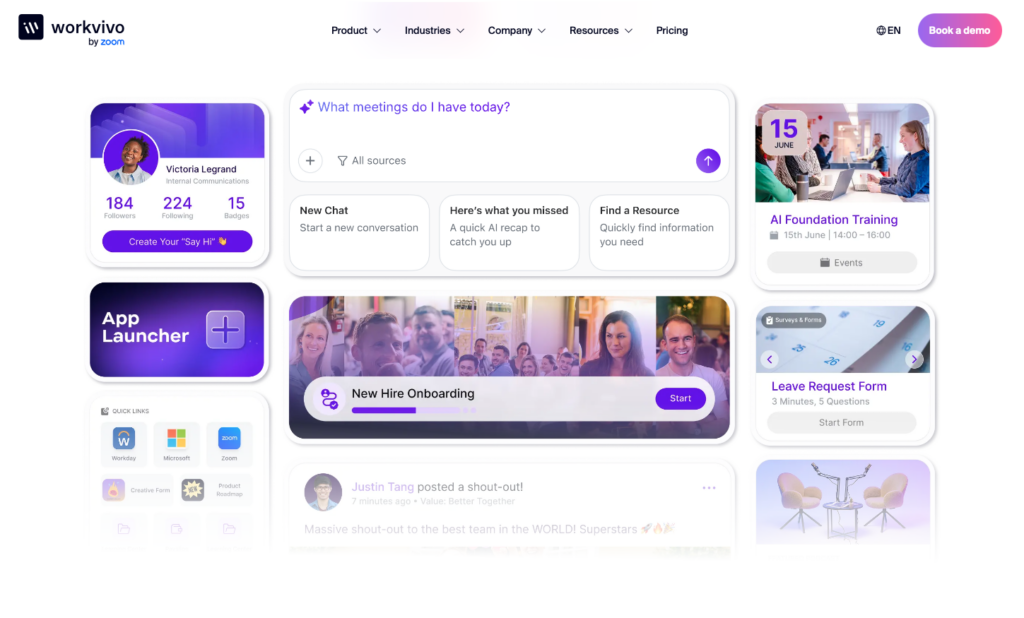
Workvivo by Zoom is an employee experience platform for internal communication, company news, employee recognition, and workplace engagement.
Why I chose Workvivo: Workvivo stands out because it gives large, distributed teams a social feed, internal podcasts, and livestreams that support two-way communication.
Knowledge and Document Management
Workvivo organizes information into spaces for specific departments, locations, or projects. You can create knowledge pages for each space to hold protocols, how-to guides, and HR documents, and permissions. Global pages hold the content everyone needs.
Permissions control who can access each space, and external contributor access lets freelancers or subject-matter experts join one space without seeing the rest of the platform. Files are searchable, and search analytics show what employees searched for and which queries returned no results.
However, content lives in spaces rather than a traditional folder hierarchy. This can make older documents harder to browse and makes it more important to search effectively.
Activity Feed and AI Communication Tools
Workvivo centers the employee experience around a personalized feed of news, social posts, and company updates. Admins can group posts into campaigns to measure their overall performance, send targeted newsletters, and automatically translate content. There are also urgent push notifications that can override do-not-disturb settings for updates such as site closures.
Built-in AI tools can draft content, maintain different brand or leadership voices, summarize missed updates, and turn written articles into audio. However, the newsletter builder doesn’t have a drag-and-drop editor, and multiple editors can’t work on the same post or comment on drafts. The mobile app also doesn’t work offline, which could be a limitation for some teams.
Podcasts, Livestreams, and Paid Add-On Modules
Workvivo lets businesses host private internal podcasts or import episodes from other platforms. Teams can also livestream from desktop or mobile with multiple hosts, save recordings for later viewing, and generate AI summaries of key moments. These formats give distributed employees more ways to connect with company content and each other.
However, several features require separate modules, including Chat, Workvivo TV for digital signage, HQ Agent for AI search, and Seer for engagement analytics. Since messaging isn’t included in the core plan, businesses that need chat should budget for the added cost. Workvivo also doesn’t publish pricing or offer a free trial, so you’ll need to request a demo and quote to get a better sense of the platform for yourself.
What users say about Workvivo
Workvivo makes it easy to share updates across the company and keep employees engaged. The social-style feed is intuitive and encourages interaction. It’s useful for announcements, recognition, and company-wide communication.
Sometimes it can be difficult to find older posts. If I need to reference an update for the company but I didn’t save it at the time, it can take a while to get back to the update.
Key Features
- Spaces with knowledge and global pages
- Smart activity feed with AI briefings
- Internal podcasts and livestreams
- Searchable document management
Pros
- Familiar social layout drives fast adoption
- Podcasts and livestreams built in
Cons
- Chat and digital signage cost extra
- Mobile app has no offline access
Pricing
Contact vendor for price Trial: No Free Plan: No
Compare the Best Company Intranet Apps
| Topic |
 Start for free
|
|
|
|
|
|---|---|---|---|---|---|
| Reviews |
 |
|
|
|
|
| Pricing |
Starts at just $29/month for the first 30 users
|
Contact vendor for price
|
Start at $5/user/month
|
Contact vendor for price
|
Contact vendor for price
|
| Free Trial |
yes
14-day
|
yes
14-day, by request only
|
no
|
no
|
no
|
| Free Plan |
yes
Free Up to 10 users
|
no
|
no
|
no
|
no
|
| Use cases |
Best for deskless teams that need mobile access to company information
|
Best for keeping employees informed with personalized, measurable communications
|
Best for companies creating a central company hub in Microsoft 365
|
Best for enterprise comms teams reaching frontline workers without company email
|
Best for building culture across large, distributed teams
|
| Available on |
Web, iOS, Android
|
How to Choose the Right Company Intranet App
Choosing the right company intranet app depends on where your people work and who will manage the platform post launch. Consider these questions to help narrow down your decision:
Team Size & Budget
- How many employees need access, and how many of those only need to read content rather than create it?
- Does the vendor charge per user, or a flat rate per band of users?
- Is there a minimum contract size or user count?
Industry & Use Case
- Do your employees have company email addresses, or will the app need to enroll them by phone number or employee ID?
- Is your main goal getting reference material into people’s hands, or building engagement and company culture?
- Do you operate across multiple locations, brands, or regions that each need their own content and permissions?
- Does your workforce need content translated across multiple languages for every update?
Feature Requirements
- Can employees browse a folder structure, or is search the only way to find a document?
- Do permissions update automatically when someone changes role or leaves, or is that a manual job?
- Can you confirm who has read a critical update, and follow up with the people who haven’t?
- Can employees ask questions and raise issues through the app, or does it only push information one way?
What Is a Company Intranet App?
A company intranet app is a private, internal platform where employees can find company information, read announcements, and connect with colleagues.
Modern intranet apps usually bring together a searchable knowledge base for policies and procedures, a company news feed, an employee directory, and some form of two-way communication. The point is consolidation. Rather than a policy manual in one system, announcements over email, and questions arriving by text at 9pm, everything sits behind one login that works the same on a phone as it does on a laptop.
How Do Company Intranet Apps Work?
Most intranet apps work the same way. An admin creates knowledge bases, sites, or spaces for different teams and topics, then adds pages and documents. Employees join manually or through an HR system or single sign-on provider, which keeps the user list current as people join and leave.
Admins then use permissions to show employees only the information relevant to their role, department, or location. The best platforms update group access automatically when an employee’s job details change.
Employees can access the intranet through a browser or mobile app to read updates, find documents, search the directory, or submit requests. Meanwhile, admins track views, searches, and read confirmations to see whether important information reached the right people, and follow up when it didn’t.
The Benefits of Company Intranet Apps
Here are some of the ways company intranet apps can improve your organization:
One Place to Find Answers
When company information is spread across email threads, shared drives, printed binders, and what a supervisor remembers, employees end up working from different versions of the truth. A single searchable source means the holiday policy an employee reads is the current one, and the procedure a new hire follows is the same one their colleague follows.
Fewer Repeat Questions for Managers
Supervisors spend a surprising share of their week answering questions that already have documented answers. Giving employees a way to look things up themselves, on the device already in their pocket, moves that time back to actual supervision. It also removes the bottleneck where work stops because the one person who knows the answer is on another site.
Reaching Employees on the Go
Frontline employees are the hardest group to reach and usually the group where poor information does the most damage. An intranet app that enrolls people without a company email address, and works on a personal phone, closes the gap between head office deciding something and the people affected finding out.
Proof That Updates Landed
Read confirmations and engagement data turn communication from a hope into a record. That’s useful for managing a team, and it’s necessary in regulated industries where you need to demonstrate that a specific person received a specific safety notice on a specific date.
Faster, More Consistent Onboarding
New hires get the same training materials, forms, and introductions regardless of which manager onboards them or which site they start at. Onboarding content sitting in the intranet also means employees can revisit it whenever they need a refresher.
How Much Do Company Intranet Apps Cost?
Company intranet apps are priced in two very different ways. Enterprise platforms often quote per user per month with an annual contract, and most require custom quotes. Some platforms start pricing around $5 per user per month, but it can increase depending on the features and modules you need.
Connecteam stands out for its Small Business Plan, which is completely free for up to 10 users. Paid plans also start at just $29 per month for the first 30 users, making it an affordable way to keep your employees connected.
The Bottom Line on Company Intranet Apps
A company intranet only works when employees can find the right answer before they ask a manager or act on an old document. The right choice depends on whether your team needs a governed document hub, a communications platform people will keep opening, or a mobile app that brings company information into the workday.
Connecteam is my top pick for deskless teams because it combines a structured knowledge base, targeted updates, chat, and more in one mobile app. It gives managers a single place to keep access current and everyday work moving.
FAQs
It depends on whether the intranet includes messaging. Many platforms exclude chat or charge extra for it, so businesses still need a separate communication tool. Connecteam combines direct and group chat, announcement channels, an employee directory, and a knowledge base in one app, which can eliminate that extra subscription for frontline teams.
The difference between an intranet and the internet is that while an intranet operates on a private network, the internet can be accessed by anyone in the public.
Using an intranet, you can work with your colleagues from afar and still ensure information is kept secure. A private intranet limits access to authorized employees, but its security still depends on permissions, identity controls, and how connected systems are configured.