


Without a central place to manage your virtual assistant’s workload, tasks can slip through the cracks, and you may spend more time coordinating work than you save.
I reviewed 5 virtual assistant apps, comparing their task management, team communication, and time tracking features.
Use these picks to help you organize assignments, track billable hours, and stay connected across time zones.
| App | Best for | Starting Price | Key Considerations |
| Connecteam | Managing virtual assistants with tasks, scheduling, and communication in one app | Just $29/month for the first 30 users | Covers core VA workflows, including task management, scheduling, time tracking, onboarding, and communication. No third-party add-ons necessary. Requires internet access to function. |
| Asana | Client teams that manage complex VA projects with multiple workflows | $10.99/user/month | Strong project and task management with multiple views and workflow automations. Time tracking is limited and requires a paid plan. |
| Slack | VA-client teams that communicate across multiple channels and time zones | $7.25/user/month | Communication platform with channels, huddles, and 2,500+ integrations. Lacks native task management and time tracking.<br /> |
| Hubstaff | Businesses that need to track VA hours and monitor remote work activity | $4.99/user/month | Built for remote team management with time tracking, activity monitoring, and payroll-ready timesheets. No free plan. |
| Calendly | Virtual assistants managing client scheduling and appointment booking | $10/seat/month | Effective tool for eliminating back-and-forth scheduling. Integrates with Google Calendar, Outlook, and Zoom. Doesn’t cover tasks, communication, or time tracking. |
What’s New in This Update (August 2026)
Our Top Picks
-
1

Best for managing virtual assistants with tasks, scheduling, and communication in one app
-
2

Best for client teams that manage complex VA projects with multiple workflows
-
3

Best for VA-client teams that communicate across multiple channels and time zones
Why trust us?
Our team of unbiased software reviewers follows strict editorial guidelines, and our methodology is clear and open to everyone.
See our complete methodology
How I Ranked the Best Apps for Virtual Assistants
Here are some key features I looked for when evaluating the best apps for managing virtual assistants:
Keeping Work From Falling Through the Cracks
- Stopping tasks from getting lost in email threads: The software should let managers create detailed assignments with due dates, sub-tasks, and file attachments so virtual assistants have everything they need in one place.
- Knowing what’s done without having to ask: Supervisors must be able to see real-time task status without sending follow-up messages or scheduling check-in calls.
- Preventing repeated instructions: The platform should support a searchable knowledge base or document storage so virtual assistants can reference SOPs and past instructions independently.
Staying Connected Across Time Zones
- Avoiding miscommunication when you can’t talk live: The software needs a dedicated messaging space with threaded conversations and file sharing so context isn’t lost between sessions, even when manager and assistant work different hours.
- Getting quick answers without scheduling a meeting: The platform should support instant audio or video calls so you can clarify something quickly.
- Keeping work chat separate from personal messages: The tool must provide a work-only communication channel that’s searchable and secure, so no one has to scroll through personal texts to find a project link.
Tracking Hours and Coordinating Schedules
- Paying your VA fairly without manual math: Virtual assistants should be able to log billable hours accurately with a live timer or manual entry, and compile those hours into payroll-ready timesheets.
- Knowing when your VA is actually available: Supervisors need to be able to view their assistant’s working hours, availability preferences, and time-off requests in one place to avoid scheduling conflicts.
- Catching overbilling or missed hours early: The software should provide clear timesheet reports that managers can review and approve before exporting to payroll,
The 5 Best Apps for Virtual Assistants
-
Connecteam — Best for managing virtual assistants with tasks, scheduling, and communication in one app
Connecteam is a workforce management platform designed to handle everyday operations.
Why I chose Connecteam: I ranked Connecteam #1 because it was the most complete option for managing virtual assistants, especially in areas like operational task management, centralized communication, and accurate time logging.
VA task management
Connecteam’s employee task tracking makes it simple to organize your virtual assistant’s workload. You can create detailed tasks, attach relevant files or images, and set clear deadlines. The platform allows you to break larger projects into sub-tasks, to make sure nothing gets missed.
As your virtual assistant works, you can track the status of each task in real time, so you know what’s in progress or completed without having to micromanage. Plus, each task has a built-in chat, so you can collaborate, keeping the conversation focused on the specific task.
Centralized team communication
Keeping in touch with a remote assistant is easy with Connecteam’s online team chat. You can send direct messages, share files, and even use voice notes to clarify instructions. The chat is fully searchable, meaning you won’t lose track of important details or links shared weeks ago. It keeps all work-related conversations in one secure place, separate from personal messaging apps.
For recurring questions and instructions, the company knowledge base gives your virtual assistant one place to find answers. You can organize SOPs, process guides, and reference documents by topic or department, so there’s no need to explain the same workflow each time. You can also see who has viewed each document and confirm that your assistant has reviewed the relevant materials before starting a project.
The knowledge base also connects to an AI assistant that answers your VA’s questions in the chat using company content, helping them find accurate information quickly.
Time tracking and scheduling
With the employee time clock, your virtual assistant can easily log their hours right from their phone or desktop. The system tracks time down to the second, eliminating guesswork. You can review their timesheets, approve the hours, and export the data directly to your preferred payroll provider, speeding up the entire payment process.
You get that same level of visibility for scheduling. Connecteam’s employee scheduler lets you set clear working hours for your virtual assistant. You can build schedules using a drag-and-drop interface and instantly notify your assistant when their shifts are published. They can also submit time-off requests and mark their availability directly in the app, making it easy to coordinate coverage.
And so much more…
Connecteam also includes custom digital forms for daily reports or expense reimbursements, quick polls to gather feedback, and built-in employee training software so you can get new virtual assistants up to speed in no time.
When Connecteam isn’t a good fit
Connecteam is a comprehensive workforce management platform, not a specialized project management tool for highly complex, multi-departmental software development. It doesn’t feature advanced Gantt charts or complex dependency mapping. Teams that need to manage intricate, multi-phase projects with hundreds of dependent variables might prefer a dedicated project management tool.
0Key Features
- Detailed task assignment with sub-tasks
- Built-in secure team chat
- Centralized knowledge base
- Precise time clock and timesheets
- Drag-and-drop scheduling
- Digital forms and checklists
Pros
- Combines essential VA management tools in one app
- Easy-to-use mobile and desktop interfaces
- Free-for-life plan for small teams
- Streamlines payroll with direct exports
Cons
- Requires an internet connection to work
- May have more features than a solopreneur needs
Pricing
Free-for-life plan availablePremium plans start at $29/month for 30 users
14-day free trial, no credit card required
Start your free trial -
Asana — Best for client teams that manage complex VA projects with multiple workflows
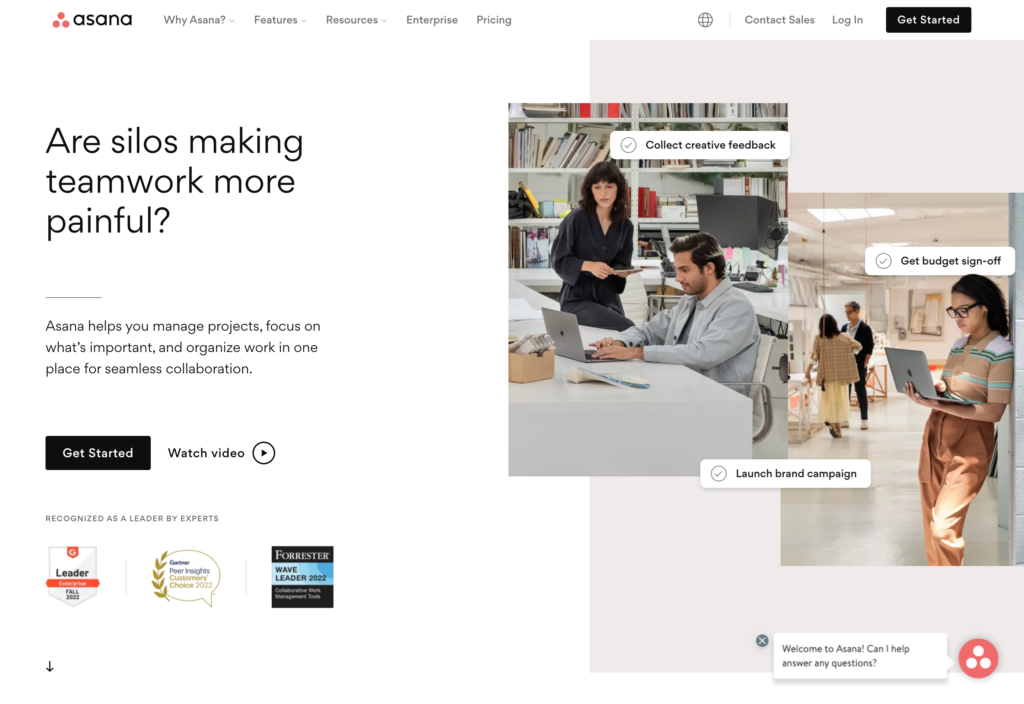
Asana is a project management platform that helps teams organize work and track progress.
Why I chose Asana: Asana offers powerful workflow automations and multiple project views, allowing you to coordinate intricate, multi-step processes.
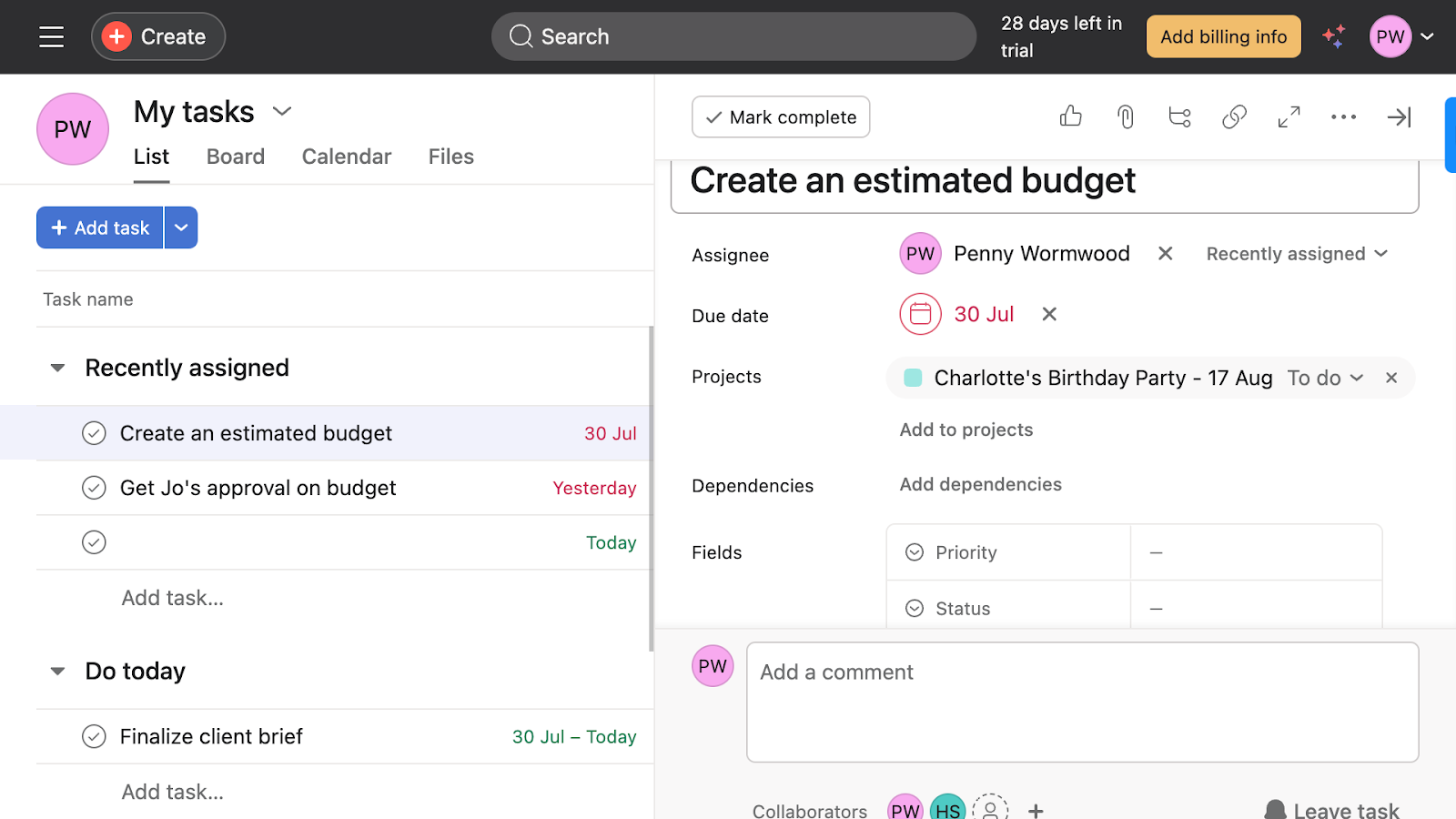
Managing tasks and projects
Asana allows you to visualize your virtual assistant’s work in several ways, including lists, boards, calendars, and Gantt-style timelines. The platform makes it easy to switch between these views, letting you manage everything from simple daily to-dos to complex, long-term campaigns. You can organize tasks into specific sections, such as “Do today” or “Do tomorrow,” to keep priorities clear.
Workflows and integrations
Asana’s automation capabilities are impressive. You can create custom rules to automate actions like moving a task to the next phase once completed or automatically assigning follow-up work. This reduces manual admin work and ensures your virtual assistant knows exactly what to tackle next.
Integrations are also strong, as Asana syncs with tools like Slack, Google Calendar, and Jira for more connected workflows.
Time tracking and limitations
Asana’s time tracking needs improvement. In our testing, the native tracker required manual setup for every project and lacked advanced controls to prevent inaccurate entries. You may need a third-party integration to track your virtual assistant’s billable hours reliably.
Asana offers a free plan, but it’s pretty limited, meaning you’d need a paid plan to get the most use out of the tool. Paid plans start at $10.99 per user per month, which can add up quickly even with just two or three users.
What users say about Asana
It provides clear visibility into task ownership, deadlines, and progress, which helps ensure important issues are handled on time. The ability to create workflows and prioritize tasks makes daily operations more structured.


My mobile experience is not as good on Asana as my web experience. For example, on my laptop I like to look at my task list organized by due date. For some reason, my mobile version doesn’t do this or doesn’t sync with this.
Key Features
- Multiple project views (list, board, timeline)
- Custom workflow automations
- Email-to-task creation
- Goal tracking and reporting
Pros
- Highly customizable for complex projects
- Strong visual organization tools
Cons
- Native time tracking is difficult to configure
- Interface can be overwhelming for simple tasks
Pricing
Starts at $10.99/user/month Trial: Yes — (30 days) Free Plan: Yes — (Personal plan for up to 2 users)
-
Slack — Best for VA-client teams that communicate across multiple channels and time zones
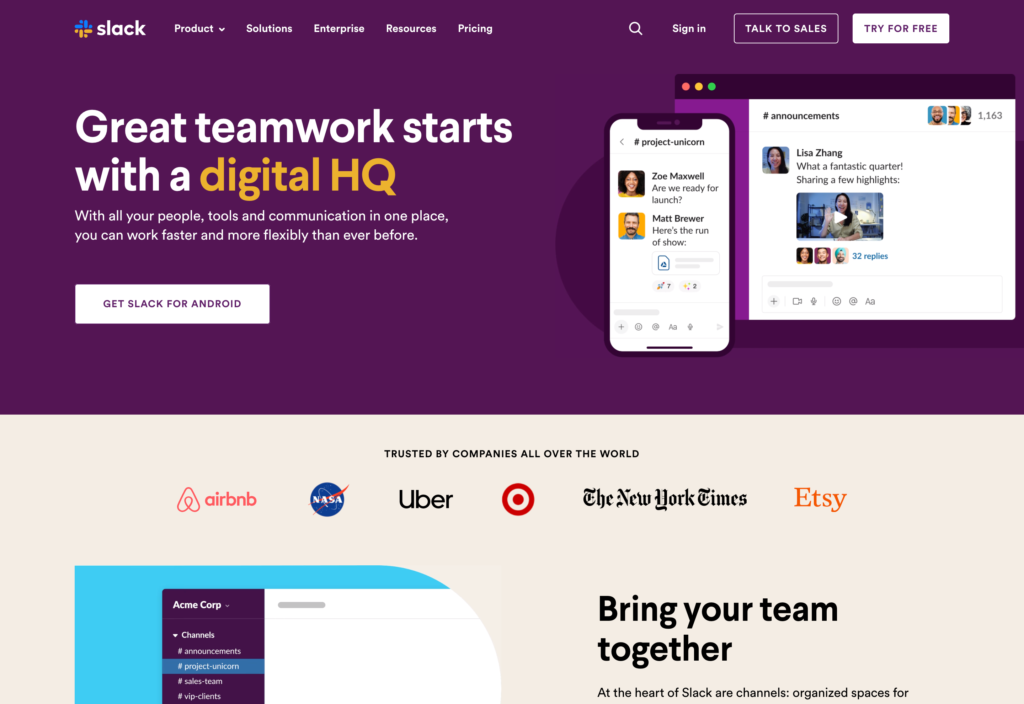
Slack is a communication platform designed to replace email with faster, more organized messaging.
Why I chose Slack: Slack made the list because its channel-based setup and instant huddles make it easy to keep conversations focused and accessible.
Channel-based conversations
Slack replaces messy email threads with organized channels. You can create specific channels for different projects, clients, or topics, ensuring your virtual assistant always knows where to find relevant information.
The threads functionality keeps discussions tidy, allowing you to reply to a specific message without cluttering the main channel view. The interface is clean, and you can tag people when you need their attention.
Voice and video calls
Slack huddles let you start an instant audio or video call from any channel or direct message. What makes it especially convenient is that you don’t even have to leave the chat or schedule a meeting in advance to join a huddle.
You can also share your screen, which is useful for walking a virtual assistant through a new process in real time. One drawback is that there’s no way to record these meetings natively. This can be frustrating if you want your virtual assistant to be able to revisit a training walkthrough or verbal instructions later.
Where it falls short
While Slack is great for communication, it doesn’t quite work as a full-service virtual assistant app. It lacks native task management, scheduling, and time tracking features. This means you’ll need to pay for and manage additional tools separately to fully support your virtual assistant.
The free plan also limits message history to 90 days, and the mobile app doesn’t let you manage automations or integrations, making it less useful for virtual assistants who need to access everything on the go.
What users say about Slack
The search functionality, file sharing, integrations, and reliable desktop and mobile applications make it easy to collaborate, troubleshoot issues, and keep projects moving efficiently.
Occasionally files don’t upload correctly, particularly the larger PDFs we send for handing over shifts or rental inventories. Plus this app freezes up during use and have to restart it. Finally, video calls are not always of the same quality as we use to talk with offsite vendors, so we have had to use other ways of communication for important meetings.
Key Features
- Topic-specific messaging channels
- Direct messaging and threaded replies
- One-click audio and video huddles
- Thousands of third-party integrations
Pros
- Keeps conversations organized
- Integrates easily with most other software
Cons
- Can’t record audio or video huddles
- Lacks built-in task and time management tools
Pricing
Starts at $7.25/user/month Trial: Yes — (30 days upon request) Free Plan: Yes
-

Hubstaff — Best for businesses that need to track VA hours and monitor remote work activity
What’s new with Hubstaff
February 2026: Hubstaff previously offered a free plan for individual freelancers; it appears this plan has been discontinued.
Hubstaff is a time tracking and workforce management tool built specifically for remote teams.
Why I chose Hubstaff: I included Hubstaff because it combines detailed timesheets and optional activity monitoring to provide clear visibility into how remote time is actually spent.
Detailed Time Tracking
Hubstaff allows your virtual assistant to log their hours using a desktop app, mobile app, or Chrome extension. The platform makes it easy to set policies restricting which apps can be used for tracking, helping prevent duplicate entries.
While Hubstaff can track breaks and overtime, it currently only supports weekly overtime calculations, which could be an issue if you need to track daily or double-time overtime.
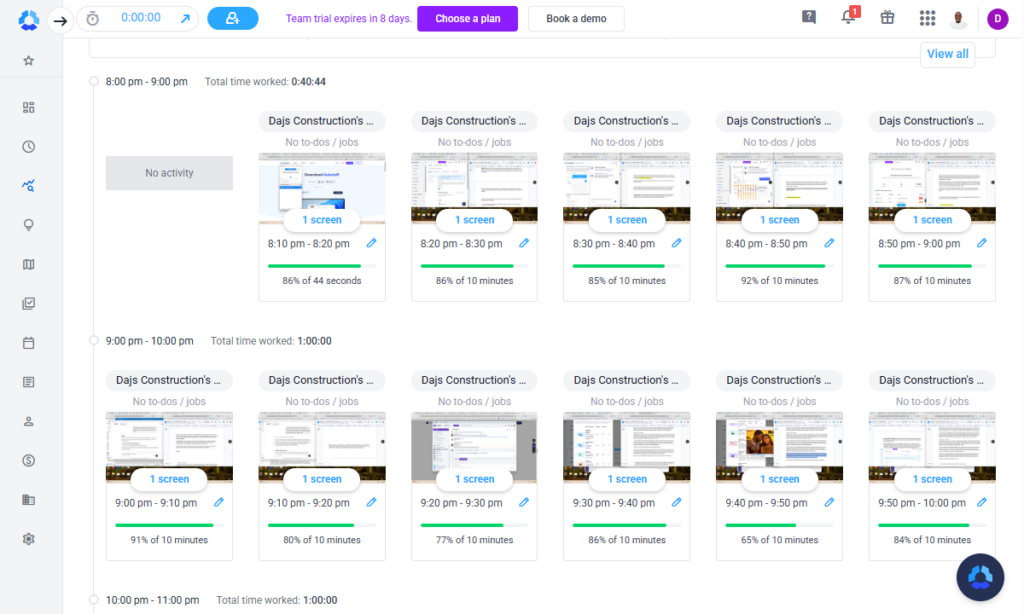
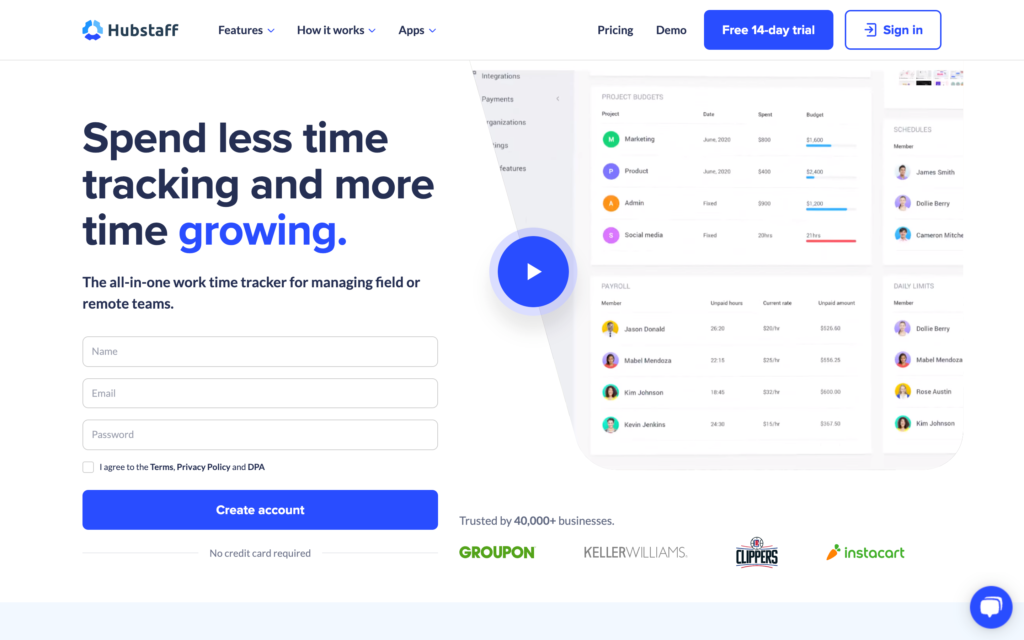
Hubstaff’s screenshots show a user’s activity level. Remote Activity Monitoring
For managers who want strict accountability, Hubstaff offers activity monitoring. Its desktop app can capture screenshots, monitor app and website usage, and detect periods of inactivity. You can also blur screenshots and app or URL names to protect sensitive client information.
While this provides strong oversight, this level of monitoring may feel intrusive in a trust-based relationship with a virtual assistant. It’s important to make sure your assistant is aware of and consents to the tracking.
Basic Shift Scheduling
Hubstaff offers a functional scheduling tool for planning your virtual assistant’s hours. Creating and assigning shifts is easy, utilizing a simple calendar view.
Yet, during testing we noticed that the scheduler doesn’t support draft publishing. The moment you save a shift, it’s published and the assignee is notified, so there’s no room to review the schedule for errors before it goes live.
What users say about Hubstaff
It’s very easy to use and self explanatory. It has an tab for task management, which can be very helpful when it comes to project management and task timer.
I don’t like that I can’t pause a task and keep tracking time without leaving the project that task belongs to that’s something that could be improved.
0Key Features
- Multi-device time tracking
- Desktop activity monitoring (screenshots, URLs)
- Break and weekly overtime tracking
- Basic calendar-based scheduling
Pros
- Provides high visibility into remote work habits
- Easy to restrict which apps can track time
Cons
- Activity monitoring can feel intrusive
- Scheduler lacks a draft mode
Pricing
Starts at $4.99/user/month Trial: Yes — 14 day Free Plan: No
-

Calendly — Best for virtual assistants managing client scheduling and appointment booking
Available on
- Web
- iOS
- Android
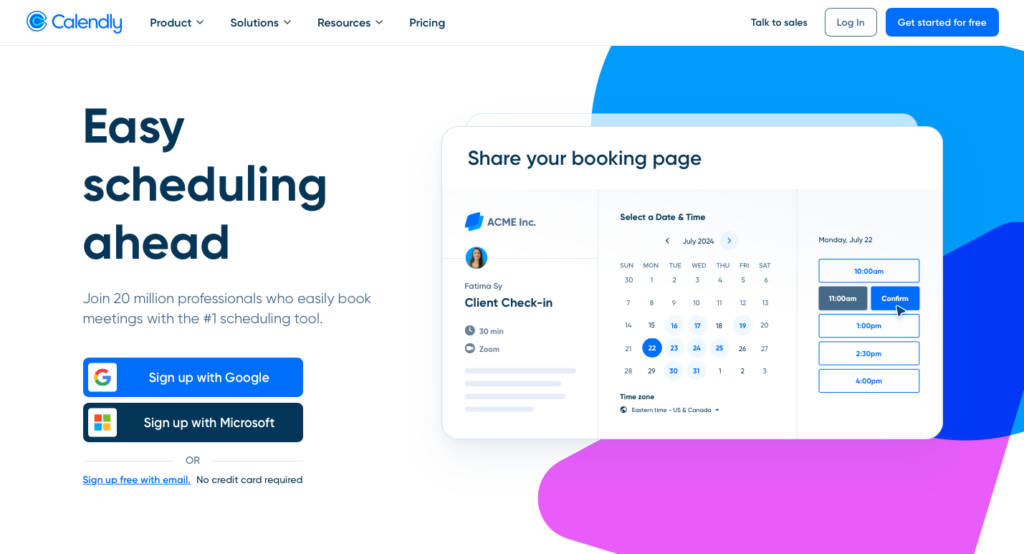
Calendly is a dedicated appointment scheduling platform that eliminates the back-and-forth emails of finding a meeting time.
Why I chose Calendly: I selected this platform because it solves the specific headache of appointment coordination by allowing virtual assistants to easily share availability or manage their clients’ calendars automatically.
Streamlined appointment booking
Calendly simplifies the scheduling process by letting you create custom booking links based on your live availability. The platform automatically detects the invitee’s time zone, which is super helpful when a virtual assistant needs to coordinate meetings for international clients. The invitee just had to click the link, choose an open time slot, and the meeting is instantly added to both calendars.
You can also create multiple event types for different meeting lengths or purposes. For example, a virtual assistant managing an executive’s calendar could set up a 15-minute discovery call, a 30-minute client check-in, and a 60-minute strategy session as separate booking links, each with its own availability rules and buffer times between appointments.
Calendar integrations
The software connects with major calendar providers, including Google Calendar, Outlook, and Microsoft 365. This integration prevents double-booking by checking your connected calendars for conflicts before showing available times. Paid plans allow you to connect up to six calendars at once, which is helpful if your virtual assistant manages scheduling across multiple client accounts.
Calendly also integrates with video conferencing tools like Zoom and Google Meet, automatically generating a unique meeting link for each booking.
Automated meeting workflows
Calendly takes care of routine meeting messages, saving you and your virtual assistant from sending them manually. You can schedule email or text reminders at set times, such as 24 hours and one hour before a meeting, to help reduce no-shows. You can also add questions to the booking page so you have the right context before the call begins.
After each meeting, Calendly can automatically send a thank-you note or next-steps email. Just know that it’s built specifically for scheduling, so it doesn’t include task management or time tracking. You’ll probably need other tools to manage your virtual assistant’s full workload.
What users say about Calendly
I appreciate how its Round Robin Scheduling feature distributes meetings fairly across our team. Also, our clients appreciate the automatic time zone detection and cancellation/ rescheduling feature whenever we are scheduling international meetings.
The interface is very plain and I wish that we could customize it a little bit, such as incorporating brand colors into the schedule so users feel like they are still working with us.
Key Features
- Shareable booking links
- Automatic time zone detection
- Calendar syncing (Google, Outlook)
- Automated meeting reminders
Pros
- Eliminates back-and-forth scheduling emails
- Very easy for clients and invitees to use
Cons
- Free plan is limited to one calendar connection
- Lacks broader task and time management features
Pricing
Starts at $10/seat/month Trial: Yes — (14-day) Free Plan: Yes
Compare the Best Virtual Assistant Appss
| Topic |
 Start for free
|
|
|
|
|
|---|---|---|---|---|---|
| Reviews |
 |
|
|
|
|
| Pricing |
Starts at just $29/month for the first 30 users
|
Starts at $10.99/user/month
|
Starts at $7.25/user/month
|
Starts at $4.99/user/month
|
Starts at $10/seat/month
|
| Free Trial |
yes
14-day
|
yes
(30 days)
|
yes
(30 days upon request)
|
yes
14 day
|
yes
(14-day)
|
| Free Plan |
yes
Free Up to 10 users
|
yes
(Personal plan for up to 2 users)
|
yes
|
no
|
yes
|
| Use cases |
Best for managing virtual assistants with tasks, scheduling, and communication in one app
|
Best for client teams that manage complex VA projects with multiple workflows
|
Best for VA-client teams that communicate across multiple channels and time zones
|
Best for businesses that need to track VA hours and monitor remote work activity
|
Best for virtual assistants managing client scheduling and appointment booking
|
| Available on |
Web, iOS, Android
|
How to Choose the Right App for Virtual Assistants
The best app for managing your virtual assistant depends on how you work together. Consider these questions when comparing your options:
- Do you need a single platform to handle tasks, communication, and time tracking, or are you looking for a specialized tool to fill a specific gap?
- Will you be paying your virtual assistant hourly, requiring precise time tracking and payroll exports?
- Does your virtual assistant need to coordinate complex, multi-phase projects, or just handle straightforward daily tasks?
- Are you comfortable using activity monitoring software, or do you prefer a trust-based approach focused on task completion?
- Do you frequently need to coordinate meetings across different time zones?
What Are Apps For Virtual Assistants?
Virtual assistant apps are tools designed to help business owners, managers, and individuals work more efficiently with remote assistants. Since virtual assistants are typically in different locations than their clients, it’s important to keep track of all remote work. Virtual assistant apps provide a structure for collaboration with features like task management, scheduling, communication, file sharing, and time tracking. Instead of managing scattered emails, documents, and platforms, apps for virtual assistants serve as a central place for all work and progress.
How Do Virtual Assistant Apps Work?
Apps for virtual assistants work by creating a shared digital workspace that clients and assistants can use to collaborate in real-time. Managers can use the app to assign tasks, track progress, and manage schedules, which makes it easier to stay aligned with virtual assistants.
Most apps have calendars, reminders, and file storage so everything is always accessible. Notifications alert users when task statuses change, deadlines near, or new messages come in. Some apps support automation, so you don’t have to manually follow up on tasks or create timesheets every pay period.
Virtual assistant apps aim to create a more organized workflow. By reducing the back and forth emails, messages, and phone calls, clients and assistants can both clearly understand where work stands.
What are the Benefits of Virtual Assistant Apps?
Here are some of the ways virtual assistant apps can help you and your business:
Improved efficiency
Virtual assistant apps streamline work by combining tasks, priorities, and progress tracking in one place. This replaces scattered emails, spreadsheets, and sticky notes, ensuring that everything is organized for quick access and ensuring that key projects don’t get overlooked.
Better time management
Built-in scheduling, reminders, and deadlines keep clients and assistants on track so they can manage their time more effectively. With a clear overview of needs to be done and when, you can reduce missed deadlines and help balance workloads more accurately.
Clearer communication
Since most virtual assistant apps offer messaging, file sharing, and real-time updates, it’s easier to collaborate across teams. With one central place for work-related communication, you cut down on email chains and keep everyone on the same page.
Centralized information
These apps serve as a central hub for tasks, files, and conversations. By centralizing all the relevant information, you avoid context switching, keep data organized, and find what you need faster.
Cost savings
Virtual assistant apps can help cut costs by reducing wasted time and the need for multiple tools. Since many apps combine key features, like scheduling, task management, and communication, you can considerably lower your software expenses and increase the return on investment for your business.
How Much Do Apps For Virtual Assistants Cost?
Apps for virtual assistants typically use subscription-based models, charging per user per month. Prices can range anywhere from $4 to $10 per user per month, with advanced platforms climbing to $15 to $25 per user per month, depending on the included features. These costs can add up quickly, even for small teams.
That’s where Connecteam stands out as the most affordable choice. Connecteam’s Small Business Plan is completely free for up to 10 users, and paid plans start at $29/month for up to 30 users. Higher tiered plans go up to $49/month for Advanced, and $99/month for Expert, both also including up to 30 users.
FAQs
You can ensure data security by choosing apps that offer encryption, role-based access, and compliance with regulations like GDPR or HIPAA. Connecteam provides secure data storage and audit trails, keeping sensitive information protected and your business compliant.
Integration challenges include incompatible data formats, limited API support, and workflow disruption. You can minimize these issues with careful planning, phased rollouts, and selecting apps with strong integration features.
Using a task management feature allows you to create detailed assignments with clear descriptions, sub-tasks, and file attachments. This ensures your assistant has all the context they need to complete the work efficiently.
The Bottom Line On Virtual Assistant Apps
Virtual assistants work best when expectations are clear, hours are tracked accurately, and communication doesn’t get lost in the wrong channel. The right tools can keep everything organized and everyone aligned.
Connecteam is the best choice for managing virtual assistants because it combines task management, precise time tracking, clear scheduling, and secure team communication into a single, intuitive platform. It eliminates the need to juggle multiple subscriptions, providing everything you need to coordinate workloads and process payroll smoothly.