

If your construction company is still using paper forms and scattered spreadsheets, costly mistakes, missed deadlines, and frustrated clients are sure to follow, leading to wasted time and lost business.
I reviewed 6 of the best apps for construction companies and ranked them based on ease of use, mobile compatibility, and safety features.
Use these picks to simplify project management, boost your team’s productivity, and stay on track.
| App | Best for | Starting Price | Key Considerations |
| Connecteam | Managing crews, tasks, and daily jobsite operations | Just $29/month for the first 30 users | Offers real-time coordination and oversight without dealing with multiple disconnected tools or manual processes; doesn’t work offline |
| Jobber | Small contractors managing jobs, clients, and invoicing | $29/user/month | Provides quotes, invoicing, and client jobs; lighter on compliance and team communication |
| Procore | Large contractors managing complex construction projects | Contact vendor for price. | Powerful for large builds; pricing and complexity may be too much for smaller teams |
| Buildertrend | Residential contractors managing projects and clients | Contact vendor for pricing | Strong client portal and budgeting tools; less ideal for shift-based crew scheduling |
| Fieldwire | Jobsite coordination and plan-based task management | $39/user/month. | Great for plan-based coordination; lacks time tracking and locks key tools behind top tiers |
| Raken | Daily reports and field documentation | $31.99/user/month | Strong for daily reporting and safety; doesn’t have geofencing or advanced scheduling |
What’s New in This Update (April 2026)
- Reverified features, pricing, and usability of all 6 apps as of April 2026, and aligned sections more closely with decision criteria.
- LetsBuild, Smartsheet, and Autodesk Construction Cloud were replaced by Jobber and Buildertrend to better reflect current needs around client management, quotes, invoicing, and project workflows.
- Restructured evaluation criteria to focus more clearly on construction-specific needs like scheduling, task management, GPS tracking, safety and compliance, CRM, invoicing and payments, and document management.
- The original article focused on general contractor apps, while this version is more directly positioned around construction company software.
Our Top Picks
-
1

Best for managing crews, tasks, and daily jobsite operations
-
2
Jobber
Best for small contractors managing jobs, clients, and invoicing
-
3

Best for large contractors managing complex construction projects
Why trust us?
Our team of unbiased software reviewers follows strict editorial guidelines, and our methodology is clear and open to everyone.
See our complete methodology
How I Ranked the Best Construction Company Apps
Here are the features I looked for to rank the best apps for construction companies.
Must-have app features:
These are the core features every construction company app must have.
I prioritized:
- Reliable scheduling: Construction projects involve tight timelines and moving parts. The software must support clear, conflict-free scheduling to avoid missed deadlines and project delays.
- Task management: Every worker should know exactly what their tasks are for the day, and managers need to track the progress in real-time to maintain quality.
- Accurate time tracking: The software must track labor hours to prevent timekeeping errors, payroll discrepancies, and potential compliance issues.
- GPS tracking: For crews working on multiple sites, managers should be able to track workers’ locations to confirm they are on the correct job site and on time.
- Safety and compliance tools: The software needs to include safety checklists, inspection forms, and incident reporting.
- Client and contractor management (CRM): The app should centralize all client and subcontractor details, making it easy to track project progress, manage communications, and store contract information.
- Invoicing and payments: Billing and payments should be integrated into the app.
- Document management: It should be easy to store, access, and share important documents across teams and clients.
I also looked at its everyday performance:
Beyond the basics, I checked how well each app works for day-to-day use:
- Ease of use: Everyone, from field workers to office staff, should be able to use the app with minimal training.
- Mobile accessibility: Construction crews need mobile access to project schedules, tasks, and documents when they’re on the job site.
Finally, I checked for these helpful features:
- Real-time communication: On-site teams need a reliable way to communicate with managers and other crew members through direct messaging, alerts, and notifications.
- Job cost tracking: The software should allow tracking of material usage, labor hours, and project costs in real-time.
- Reporting and analytics: You should be able to view insights into project status, labor efficiency, and overall performance.
The 6 Best Construction Company Apps of 2026
-
Connecteam — Best for managing crews, tasks, and daily jobsite operations
Connecteam is the best choice for construction companies because it combines job scheduling, time tracking, and safety compliance in one platform. It’s especially strong for teams that need real-time coordination and oversight without dealing with multiple disconnected tools or manual processes.
Why I chose Connecteam: I ranked Connecteam #1 because it was the most complete option for construction companies, especially in areas like reliable scheduling, accurate GPS time tracking, and real-time communication.
Here’s how Connecteam can improve your construction operations:
Job scheduling
Connecteam’s job scheduling tools make it easy to manage multiple projects across worksites. Use the drag-and-drop scheduler to quickly set up and adjust shifts, so every worker is assigned to the right job. I liked that you can also attach job-specific checklists and notes to each shift, keeping everyone aligned on expectations.
Employees can easily submit availability and time-off requests within the app, preventing scheduling conflicts. Once schedules are finalized, workers are notified instantly and can view their shifts right on their phones. You can even share schedules with clients through a link, so they stay informed.
What really impressed me is that Connecteam lets you set rules for smart scheduling, like assigning skilled workers to specialized jobs or ensuring team leads are present for larger projects. The AI-powered auto-scheduler then fills shifts automatically based on availability and roles, making the process faster and more efficient.
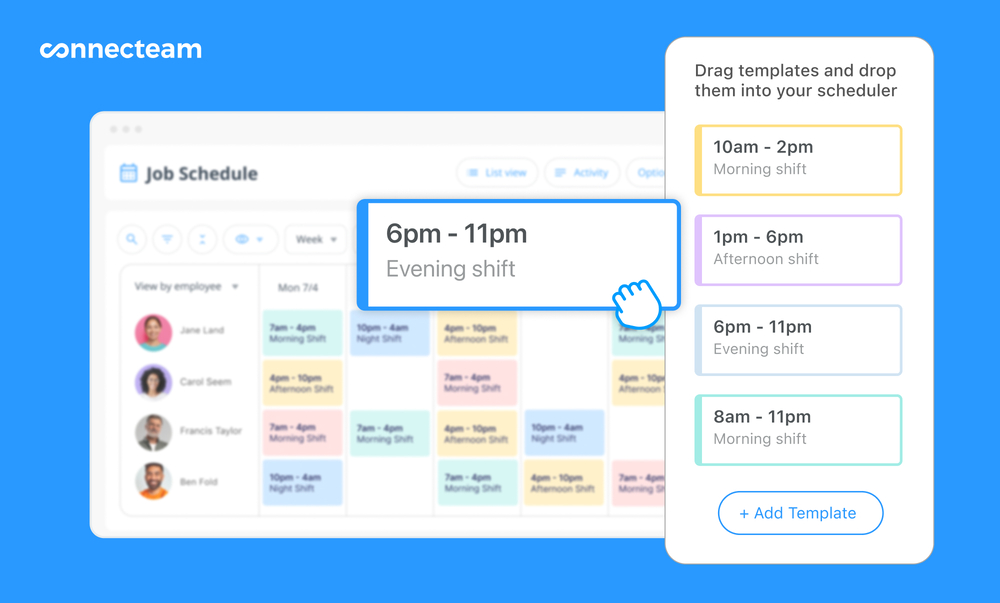
Use Connecteam’s AI scheduler to automatically assign shifts based on employee availability, qualifications, and business needs. GPS time tracking
With Connecteam’s employee time clock, crews can clock in and out with a single tap from the mobile, desktop, or kiosk app. Each clock-in records GPS location, so managers can confirm when and where work started. For added control, you can set up a geofence to ensure workers are at the correct job site. The geofence blocks off-site clock-ins and clocks employees out when they leave the area.
Alternatively, you can use NFC tags at job sites, which crew members scan once they’re on-site to verify attendance. Connecteam also tracks overtime and breaks, sending alerts when workers near overtime limits and automatically clocking them out when they hit max hours.
All hours are logged into digital timesheets for payroll, which managers can review, edit, and approve. Each change is tracked to give you audit-ready records, and when it’s time to run payroll, you just export timesheets directly to platforms like RUN Powered by ADP®, QuickBooks, Paychex, and Xero.
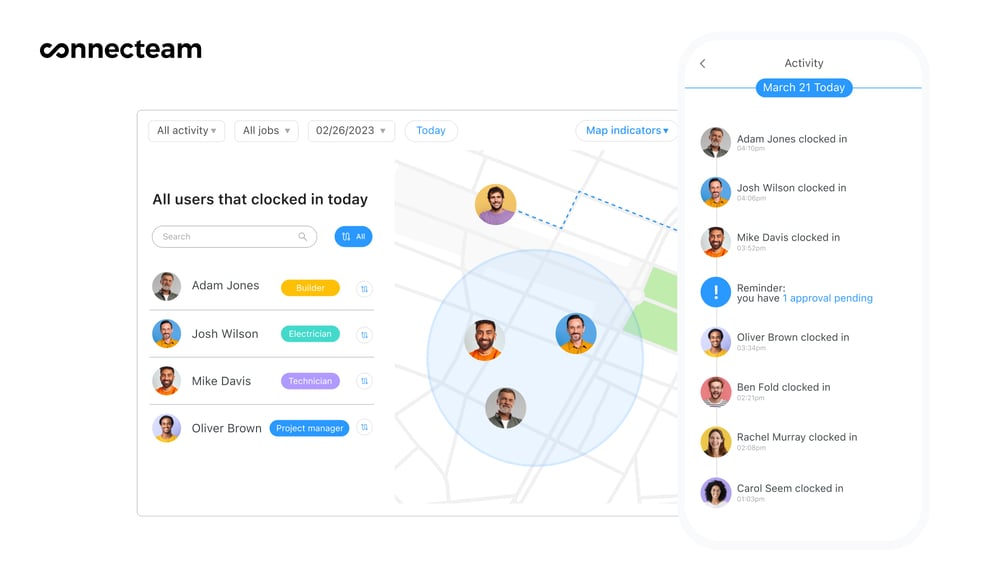
Connecteam’s time clock shows you exactly where your crew is working in real-time. Task management and forms
Connecteam’s employee task tracking gives construction managers real-time visibility into fieldwork. You can assign tasks to individuals or crews with deadlines, descriptions, and subtasks. Employees can leave comments, and managers are notified when tasks are marked complete.
I liked that you can also attach digital forms and checklists to each task for daily safety inspections, equipment condition reports, or hazard assessments. If you already have paper forms, just upload or snap a picture of them, and Connecteam’s AI will create a digital version, keeping your existing workflows intact.
What really stands out is the flexibility of the forms. Beyond standard text, dropdowns, and multiple-choice options, Connecteam offers speech-to-text functionality that uses AI to capture and summarize inputs. You can also attach photos, scan documents, collect e-signatures, and record GPS locations directly within the form, ensuring everything is documented accurately.
All forms are time-stamped and stored within the app, so it’s easy to review submissions and track progress.
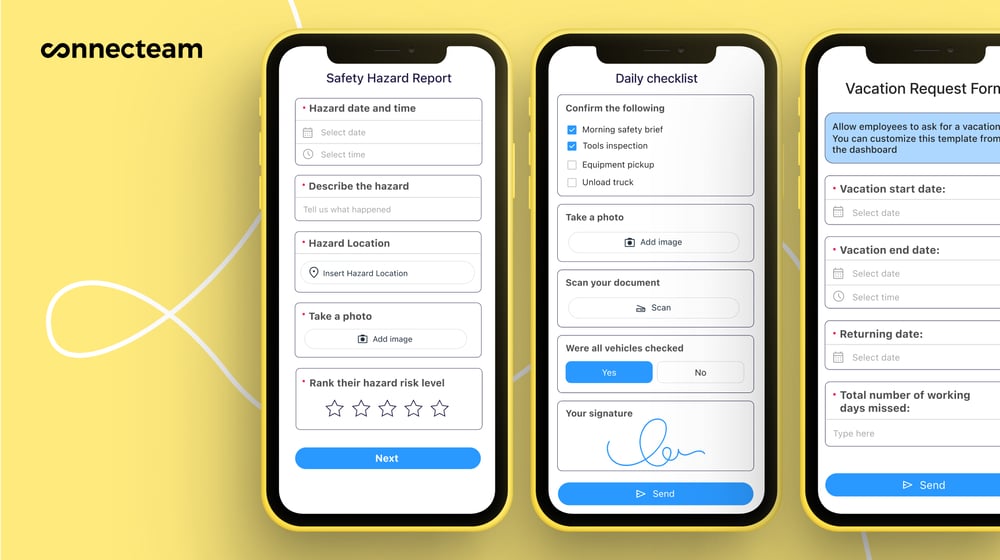
Get the information you need straight from the field with Connecteam’s custom forms. Crew communication
Connecteam makes team communication simple and organized for construction businesses. You can use team instant messaging to create group chats for job sites, crews, departments, or projects, and send direct messages to individuals as needed. The chat is accessible on both desktop and mobile, and it’s fully searchable to help you find information quickly. You can send files, photos, videos, and links, and tag team members so they see important messages.
I appreciated that managers have control over the chat, deciding who can start chats, delete messages, and whether team members can message each other directly or only their supervisors. Plus, push notifications keep everyone up to date with new messages.
And so much more…
Connecteam offers even more teams to help you manage the daily operations of your construction company:
- Company employee directory: Provide easy access to team and business contact info without sharing personal phone numbers for better communication across your crews.
- Training and onboarding: Use the AI Course Creator to quickly build custom training materials, helping onboard new employees and get them up to speed faster.
- Automatic reports: Gain real-time insights into task completion, attendance, and form submissions, so you can make data-driven decisions.
- Staff documents: Upload and organize employee documents like contracts, certifications, licenses with automatic reminders for upcoming expiration.
- Employee updates: Make sure everyone sees important updates, like safety protocols or weather alerts. Target by crew, location, or role, track views, and require confirmation.
When Connecteam is not the right choice
Connecteam may not be the best fit if your crew frequently works in areas with weak or unreliable internet service. Since it doesn’t offer a true offline mode, it can be limiting for teams in remote locations who need to access tasks, update forms, or complete work in real-time even when the connection drops.
It’s also not ideal if you need client-facing business tools. Connecteam doesn’t include native invoicing or billing features, so you’ll need a platform with stronger financial tools to manage client information, send invoices, and collect payments.
Connecteam also offers a free for life plan – Try Connecteam here!
0Key Features
- Drag-and-drop job scheduling
- GPS time tracking
- Custom geofencing
- Task management
- Digital forms
- In-app team chat
Pros
- Strong mobile access for on-site teams
- Easy to use for both field crews and managers
- Great for daily communication across crews and job sites
- Flexible forms for inspections, safety, and field reporting
Cons
- Doesn’t work offline in remote job sites
- No built-in invoicing or billing tools
Pricing
Free-for-life plan availablePremium plans start at $29/month for 30 users
14-day free trial, no credit card required
Start your free trial -
Jobber
Jobber — Best for small contractors managing jobs, clients, and invoicing
Jobber is a field service management platform that helps construction companies with scheduling, job tracking invoicing, and client management.
Why I chose Jobber: Jobber stands for its features that support both internal operations, like scheduling and time tracking, and external client-facing tasks, such as invoicing and payments.
Scheduling and dispatching
In our full Jobber review, we tested its scheduling and dispatching, which have multiple planning views, including Month, Week, Day, List, and Map. I liked that the drag-and-drop feature makes editing simple, and color coding helps you easily spot tasks, employees, and job types. Plus, the filtering options let you sort by type, assignment, and status to everything organized.
Jobber also offers route optimization, which helps crews get to job sites quickly by adjusting routes based on real-time job changes. There’s also GPS and waypoint tracking to provide live updates on team locations and job statuses. That said, we found that you need to have accurate data for precise routing, and setting up the master route can be a bit complex, especially with new client locations.
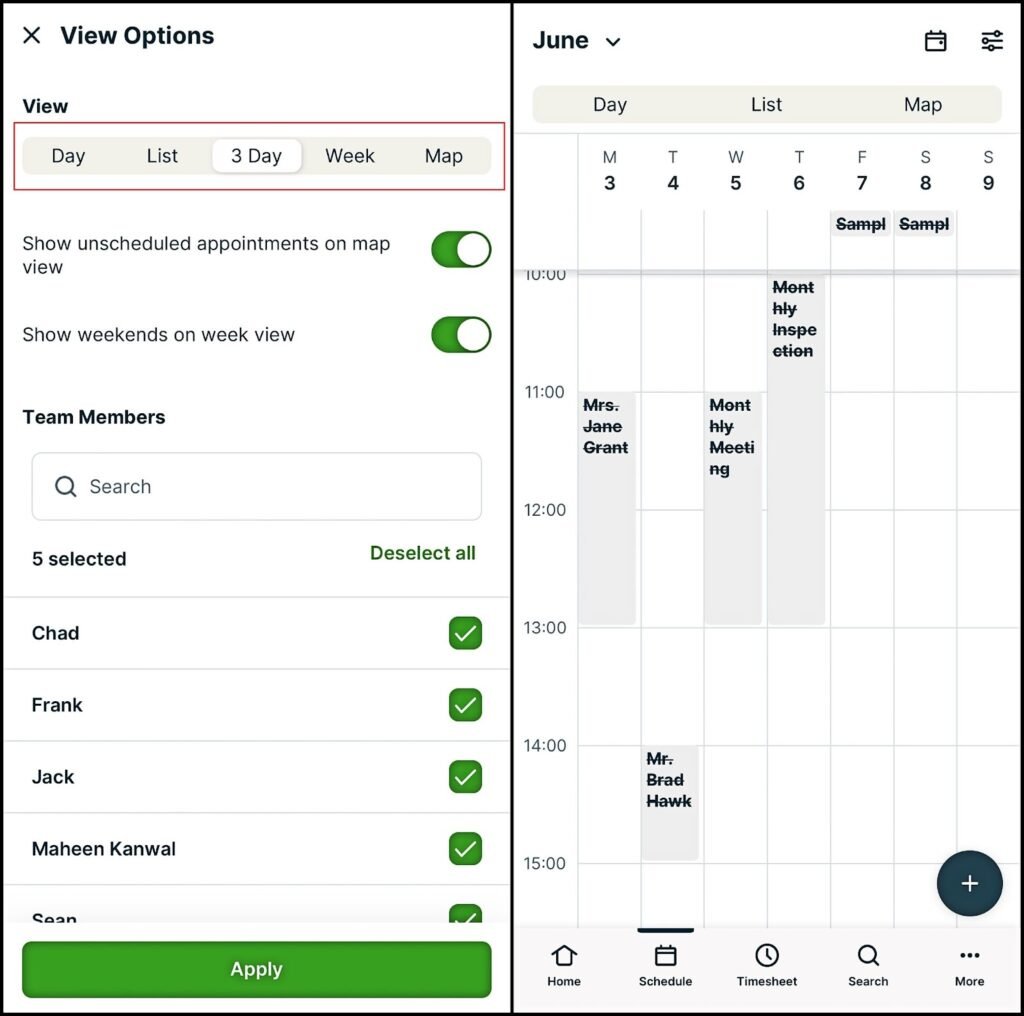
While testing Jobber, we could access job schedules via the calendar or map view. Time tracking
For tracking time, Jobber offers timers and manual entry. Employees can start and stop the timer in the app, automatically logging hours, or manually input their time if needed. Managers can easily approve timesheets for payroll with a simple “Mark Paid” option.
It works, but it’s clear that Jobber lacks some advanced features like built-in overtime tracking, requiring manual calculations or third-party integrations. You also can’t approve timesheets in bulk, which could get tedious. Also, while Jobber lets you to categorize time entries by job or task, you still need to manually mark them as billable or non-billable.
Jobber lacks geofencing, so workers aren’t automatically clocked in and out based on their location. On the plus side, the mobile app’s GPS features tracks when workers arrive at the job site, helping verify time entries and improve accountability.
Quotes, invoicing and CRM
I was impressed by Jobber’s quotes, invoicing, and client management features. You can easily create detailed quotes with descriptions, photos, and templates, and once approved, they automatically convert into jobs. This speeds up the sales-to-workflow process, eliminating the need for separate tools or extra steps.
Invoicing is just as efficient, with invoices generated instantly, branded, and sent via email or text. Jobber Payments supports online credit card and bank transfers, and payments sync directly with QuickBooks.
Jobber’s CRM features are good for basic client management. It includes client files with contact details, service history, and automated templates, plus a secure portal for clients to view and approve quotes and invoices.
What users say about Jobber
Overall, our experience with Jobber has been very good. It has helped us organize and manage key parts of our business, from customer requests and quotes to scheduling, jobs, and invoicing.

I have the most issues with the app version of Jobber. Specifically, when taking notes, capturing images, or filling out forms, I have lost a lot of time when they won’t upload or sync successfully.
Key Features
- Drag-and-drop scheduling
- Invoicing and online payments
- Client CRM and secure portal
- GPS time tracking
Pros
- Route optimization with map view
- Strong quote-to-job workflow
Cons
- No team communication
- Lacks labor compliance tools
Pricing
Starts at $29/user/month Trial: Yes — for 14 days Free Plan: No
-
Procore — Best for large contractors managing complex construction projects
Procore is an app for contractors managing large-scale projects, with tools to manage scheduling, time tracking, projects, and drawings.
Why I chose Procore: I chose Procore because it offers construction businesses a range of solutions, including workforce planning, detailed time tracking, project visibility, and financial oversight.
Scheduling and time tracking
In our full review of Procore, we found that scheduling is more tailored to workforce planning than shift building. You can assign workers based on skills, certifications, and availability. This is pretty useful for construction teams that need the right people on the right tasks, instead of just filling shifts.
The drag-and-drop schedule helps with adjustments, and I liked that the labor request tool lets managers send out open requests instead of chasing people down. However, we found that Procore doesn’t offer scheduling templates or auto-scheduling, which adds time to the process.
Time tracking is tightly tied to project costing. Workers clock in from their phones and log details like project, cost code, location, and whether time is billable. That level of detail is definitely valuable for tracking labor costs accurately across projects, but it felt a bit heavy.
The multi-step clock-in process could slow workers down, especially at the start of a shift. While geofencing reminders help reduce missed punches, there’s no built-in payroll, so you’ll still need integrations for pay runs and reporting.
Project management and financial tracking
Procore’s project management tools are impressive. There’s a central place to manage projects, with tools for drawings, RFIs, photos, inspections, and custom forms for safety and quality checks. I also liked the project dashboard, which shows timelines, responsibilities, and potential issues at a glance.
Managers can log incidents, run inspections, assign corrective actions, and track trends across sites. The best part is that it’s all tied to proper documentation.
The financial tools are just as strong. You can track budgets, costs, and change orders in a spreadsheet-style view, and even handle invoicing and billing within the same system. That said, we found that the financial tracking still requires manual updates, and for smaller teams, these tools may be more than they actually need.
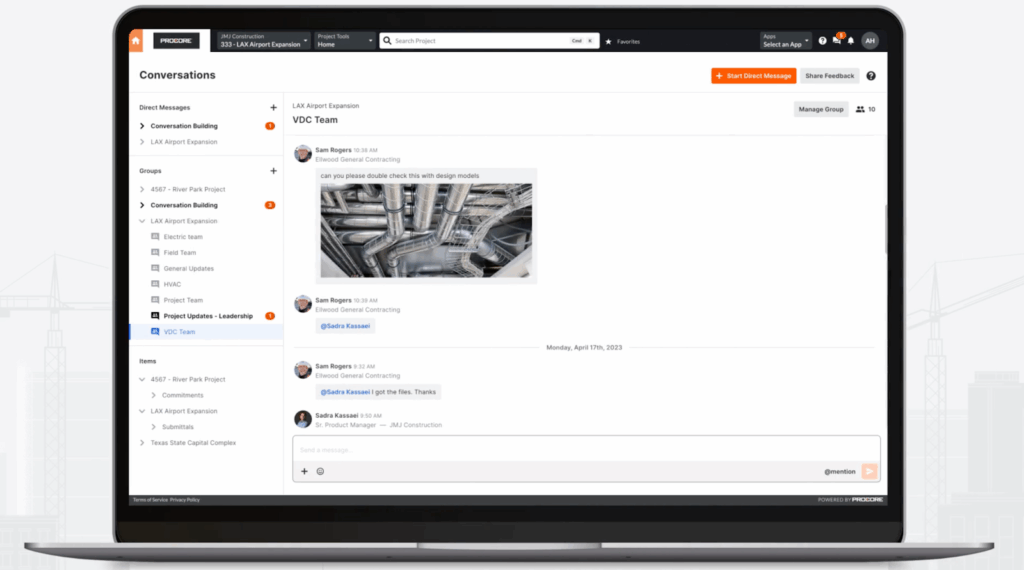
You can send one-on-one or group messages with Procore. Drawing and communication
Procore’s drawing tool is one of its standout features, especially for larger construction projects. It organizes drawings by title, discipline, and size, to make sure teams are working from the latest version.
One feature I really liked is the text recognition tool. It converts handwritten notes into searchable digital text. You can also tag people or create tasks directly on drawings using the Punch List, turning plans into a visual to-do list.
Procore’s “Conversations” supports one-on-one, group, and team-wide chats on both web and mobile, with messages tied directly to projects or tasks. Managers can also control visibility with permissions, and there are push notifications so nothing gets missed.
What users say about Procore
The centralized project documentation and the cloud base. I like how easy it is to receive view and sign change orders for projects. The lay out of the app is also very super user friendly. It makes it very easy to communicate to and from the contractor.

The commitments/billing system is not very detailed. There is not really a good SOV option which makes team collaboration difficult because on person does not know what another person has billed for ect.
Key Features
- Drag-and-drop scheduling
- Mobile time tracking with geofencing
- Project management and safety tools
- Finance and budget tracking
Pros
- Strong drawing management
- Custom safety and quality check forms
Cons
- Pricing isn’t transparent
- May be complex for smaller businesses
Pricing
Contact vendor for price. Trial: No Free Plan: No
-

Buildertrend — Best for residential contractors managing projects and clients
Available on
- Web
- iOS
- Android
- Windows
- Mac
Buildertrend is a construction company app that helps businesses with client interactions, project coordination, and budgeting.
Why I chose Buildertrend: I liked that Buildertrend offers a range of features built for the construction industry, including project scheduling, time tracking, and file management.
Scheduling and task management
In our full Buildertrend review, we found that scheduling is built around project timelines rather than day-to-day crew scheduling. You can use the drag-and-drop Gantt charts to map out jobs, assign tasks, set dependencies, and track progress. Plus, managers can compare planned vs. actual timelines.
I also liked that you can break projects into detailed task layers, link tasks together, and save templates for repeat jobs. It gives project managers a structured way to manage timelines across multiple builds. But it’s not designed for shift-based scheduling. If you need to manage hourly crews or last-minute changes, you’ll probably need a separate tool.
Time tracking and timesheets
Buildertrend’s time tracking works well for construction crews in the field. Workers can clock in and out from the mobile app, even offline, and data syncs once they’re back online. There’s also GPS stamps and geofencing to verify attendance.
I liked that crew leaders can manage time entries for their teams. You can tie hours directly to jobs or cost codes, which helps with accurate labor tracking and billing. Managers can review timesheets and export them to integrated payroll systems. However, we found that Buildertrend doesn’t include automated overtime or break alerts, which could be a limitation for teams that need tighter labor controls.
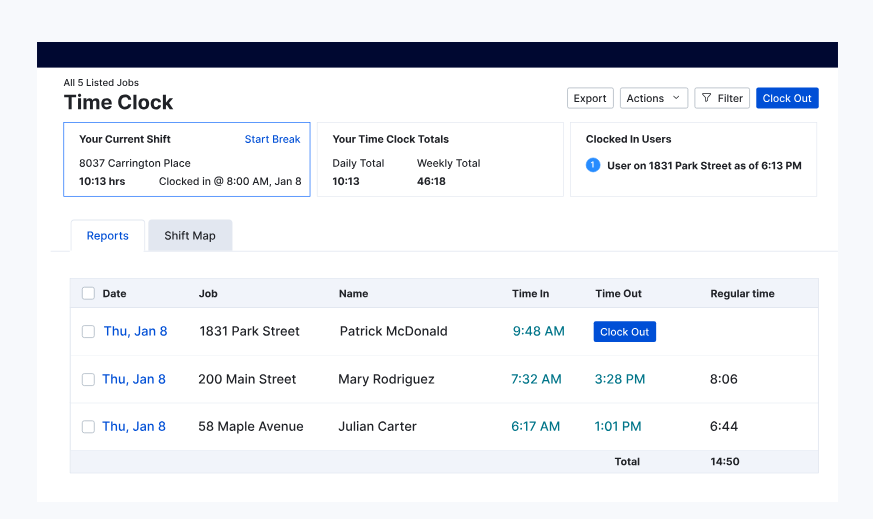
You can view clocked-in workers and their locations on Buildertrend. Client portal and financial tools
Buildertrend really stands out for its branded client portal. Customers can view updates, approve change orders, make selections, send messages, and track project progress in one place. I liked the AI-generated weekly updates, which keep clients informed.
Buildertrend also ties in financial workflows. You can manage budgets, track costs, create purchase orders, and handle bids with subcontractors, all connected to job costing. Proposals, invoicing, and digital signatures are strong, but the financial tools aren’t as advanced as dedicated accounting software.
What users say about Buildertrend
We used BuilderTrend from start to finish – from your first estimate (and being able to receive payment), through managing the project, updating our clients, and wrapping and documenting everything, and finishing up real nicely (and being able to receive payment).

Its scheduling function works but can be very simple. When working on larger commercial projects it won’t allow for the complexity needed.
Key Features
- Drag-and-drop Gantt project scheduling
- Budgeting, bids, and purchase orders
- Mobile time tracking with offline access
- Budgeting, bids, and purchase orders
Pros
- Branded client portal with messaging
- Strong project and budget visibility
Cons
- Lacks shift scheduling for hourly staff
- No automated overtime or breaks
Pricing
Contact vendor for pricing Trial: No Free Plan: No
-

Fieldwire — Best for jobsite coordination and plan-based task management
Fieldwire is a construction company app that helps teams manage on-site operations.
Why I chose Fieldwire: I chose Fieldwire for its strong focus on plans and field coordination, particularly its intuitive plan viewer, OCR-based sheet naming, and automatic version control.
Project and task management
In our full Fieldwire review, we were able to build projects and break them into tasks with details like location, checklists, assignees, deadlines, and status. I liked that you can clone projects, which helps speed up repeat jobs.
Task management is flexible, with Kanban, Calendar, and Gantt views, plus drag-and-drop updates. Managers can set priorities and attach plans directly to tasks so crews always work from the right drawings.
The main limitation we found is task dependencies. While tasks can be related, you can’t fully link them to control the order, which makes it harder to manage how work happens during a job.
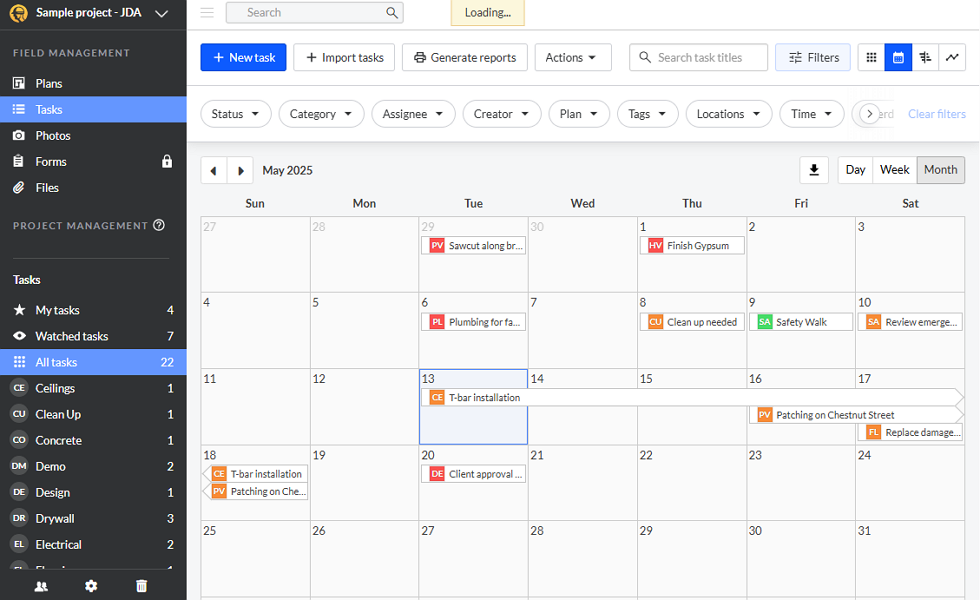
The calendar view made it easy to track task progress with Fieldwire. Plan viewing and documents
With Fieldwire, you can upload plans from your device or cloud storage, and the OCR tool automatically names and organizes them into sheets. I liked that this removes a lot of manual setup and makes it easier to navigate drawings and track revisions.
There’s also version control, which means that when new plans are uploaded, older versions are updated automatically. Notes are kept intact, and clearly marked so teams don’t work from outdated drawings, which is helpful.
Document management is also strong. Each project has its own file system, with organized folders, permissions, and the ability to link files directly to tasks, RFIs, and other project items. I liked that it keeps everything connected and easy to find.
Change orders and RFIs
Fieldwire has tools for change orders, RFIs, and submittals, but they’re only available on the highest-tier plan. The change order workflow lets you track scope, cost, and timeline changes, with preset costs to keep things consistent. The main drawback we found is that change orders can only be created on desktop, which might not be ideal for field use.
RFIs are more flexible. You can create them from mobile or desktop, link them to plans, and track responses in one place. Just keep in mind that email-based RFIs require manual updates, which could lead to potential gaps.
What users say about Fieldwire
As a part of Project management team, we use this one a daily basis to make any changes to drawing and provide the feedback to the field guys. This put all on the same page. The whole project collaboration is based on this software considering it links everyone on the Project management team.
I don’t feel like the tasks feature is very user friendly and have not found it very applicable, I have tried using it on various projects and don’t find it very helpful. It is also a little difficult/cumbersome to share documents with subcontractors.
Key Features
- Project and task management
- Kanban, calendar, and Gantt views
- Project-based file and document storage
- Change orders, RFIs, and submittals
Pros
- Automatic drawing version control
- OCR plan naming and labeling
Cons
- Lacks time tracking
- No true task dependencies
Pricing
Starts at $39/user/month. Trial: No Free Plan: Yes — (up to 5 users)
-

Raken — Best for daily reports and field documentation
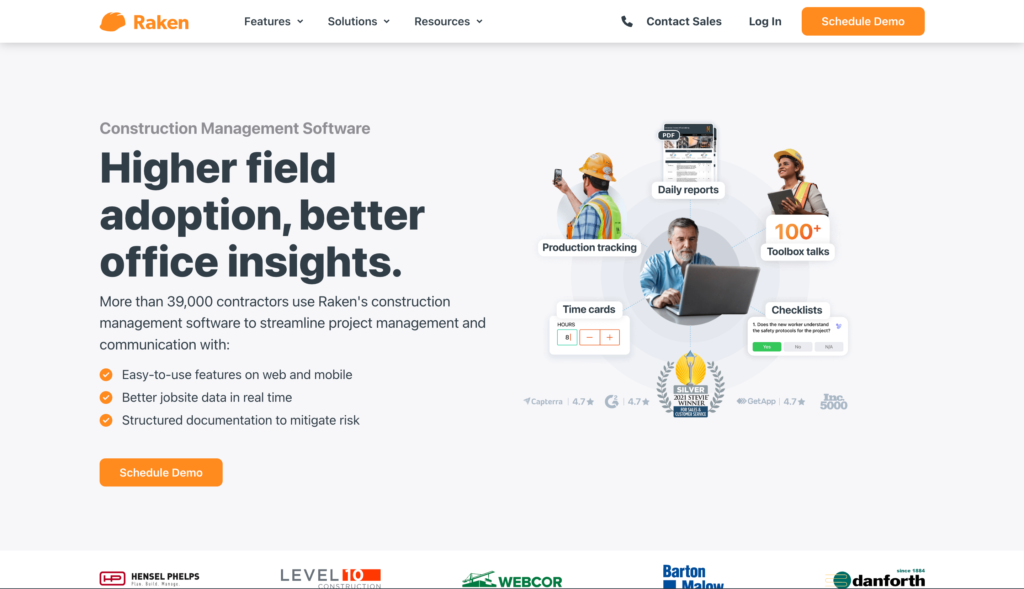
Raken is a construction company app that offers daily reporting, safety oversight, and field documentation.
Why I chose Raken: Raken’s documentation tools make it a good fit for contractors that need strong visibility into jobsite activity.
GPS time tracking
In our full Raken review, we tested its different time tracking methods. Supervisors can log hours for entire crews and assign them to cost codes. This could be useful for teams without devices, but it might get time-consuming, since there’s no bulk editing.
Employees can also clock in through the mobile app, select projects, and add notes. The app records a GPS stamp at clock ins, and I liked that you can also require selfies with AI verification. That said, there’s no geofencing or real-time tracking, and during testing we found that the timer start time wasn’t always consistent.
There’s also a kiosk mode that turns a shared device into a central clock-in point, which could be useful for on-site teams. Raken also tracks breaks and supports overtime rules, including daily and weekly thresholds, but it lacks proactive alerts and more advanced controls. All hours, breaks, and overtime are compiled into timesheets for approvals.
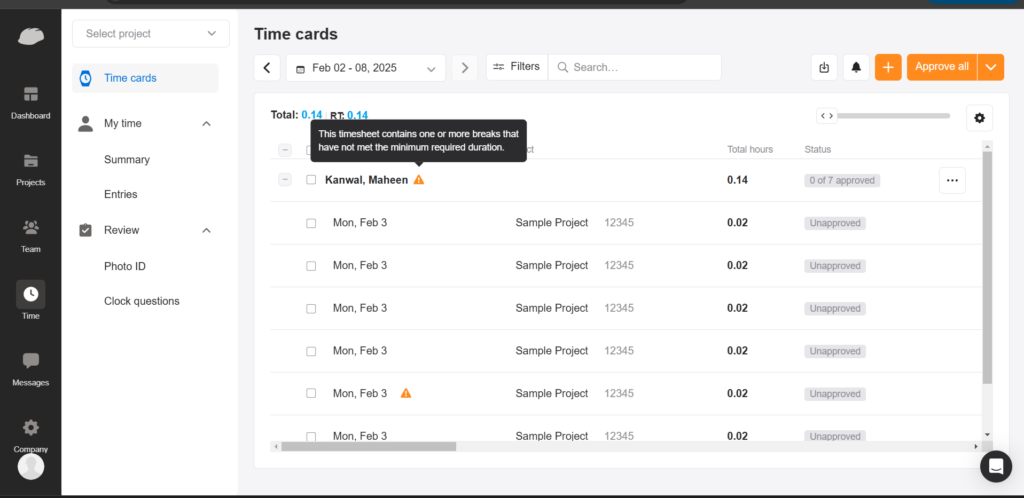
With Raken, we could review timesheets and check flagged entries with insufficient breaks. Production and subcontractor management
Raken’s production tracking lets teams monitor equipment usage, maintenance, materials, and hours in real-time. I liked that this helps connect daily field activity to overall project progress. This data also feeds into analytics, so managers have better visibility into labor, equipment, and productivity over time.
On the subcontractor side, collaboration is straightforward. You can invite subs into projects with limited access to submit reports, upload files, and complete checklists. I also liked the “Super Dailies” feature, which combines all subcontractor reports into one update, saving time managers on admin work.
That said, we found that some workflows still rely on manual input, and the platform doesn’t go as deep into project management or financial tracking. It works for field visibility, but less so for full project control.
Safety, quality and documents
Raken offers safety checklists, observations, and incident reporting, with 100+ templates and the option to create your own. I really liked that you can schedule and assign these across crews to keep safety and quality consistent on every job. Field reporting allows teams to log issues with photos, videos, and notes, while managers track them through to resolution.
Document storage is solid too. You can upload and organize plans, reports, and media in one place, with search and folder controls. Raken also tracks certifications with expiration dates, but e-signatures are limited to certain forms.
What users say about Raken
I used Raken as a General contractor so I tracked reporting from our subcontractor who utilized the app. The amount of information and communication a single pdf could provide was incredible. The features they used kept me in the loop and allowed for update meetings to run efficiently.
The only issue I’ve noticed is that when I’m using it on a PC, it seems like I have to be clocked out before I can make any changes to my time entries.
Key Features
- GPS-based time clock
- Production and equipment tracking
- Subcontractor access
- Document storage
Pros
- Strong safety and quality control tools
- Multiple time tracking methods
Cons
- No built-in shift scheduling
- Lacks geofencing
Pricing
Starts at $31.99/user/month Trial: Yes Free Plan: No
Compare the Best Contractor Appss
| Topic |
 Start for free
|
Jobber |
|
|
|
|
|---|---|---|---|---|---|---|
| Reviews |
|
|
|
|
|
|
| Pricing |
Starts at just $29/month for the first 30 users
|
Starts at $29/user/month
|
Contact vendor for price.
|
Contact vendor for pricing
|
Starts at $39/user/month.
|
Starts at $31.99/user/month
|
| Free Trial |
yes
14-day
|
yes
for 14 days
|
no
|
no
|
no
|
yes
|
| Free Plan |
yes
Free Up to 10 users
|
no
|
no
|
no
|
yes
(up to 5 users)
|
no
|
| Use cases |
Best for managing crews, tasks, and daily jobsite operations
|
Best for small contractors managing jobs, clients, and invoicing
|
Best for large contractors managing complex construction projects
|
Best for residential contractors managing projects and clients
|
Best for jobsite coordination and plan-based task management
|
Best for daily reports and field documentation
|
| Available on |
Web, iOS, Android, Windows, Mac
|
What are Construction Company Apps?
Construction company apps are software tools designed to improve construction project management. These apps help construction teams plan, schedule, track progress, and manage resources efficiently. They’re often used by contractors, project managers, and crews to handle everything from budgeting and invoicing to scheduling, safety compliance, and document sharing. These apps are built for both small businesses and large construction firms to simplify workflows, reduce errors, and improve communication across the job site and office.
How Do Construction Company Apps Work?
Construction company apps typically work by centralizing project data, so it’s easier to access and update information in real-time. The software allows construction teams to create and assign tasks, manage schedules, and track time and expenses, all from a single platform. They often include tools for communication, so that teams on-site and in the office can stay connected and quickly address any issues that arise.
Many apps offer features such as project scheduling, document management, and safety compliance tracking. Users can usually upload blueprints, photos, and notes, share them with the team, and monitor a project’s live progress. These apps may also integrate with other software, like payroll or accounting tools, to keep operations moving smoothly across departments. The goal is to improve productivity, minimize errors, and ensure that projects are completed on time while maintaining safety and compliance.
The Benefits of Construction Company Apps
The right app can benefit your construction company in multiple ways, including:
Improved communication
Construction company apps make sure teams stay connected, whether they’re in the office or on-site. They ensure that important updates reach the right people instantly, which helps prevent costly delays, improve efficiency, and reduce misunderstandings.
Met deadlines
Apps designed for construction teams provide a centralized scheduling system, so managers can assign tasks, track project timelines, and make adjustments on the fly. With automatic alerts for deadlines and task progress, these apps minimize the risk of missed appointments or delayed deliveries. This leads to more predictable project completion, improved client satisfaction, and continued repeat business.
Better cost control
Managing budgets on construction projects is a constant balancing act, with material costs, labor expenses, and unforeseen delays eating into profits. Software helps contractors stay on top of project costs by offering tools for real-time expense tracking. These apps ensure that every dollar is accounted for so you can stay on top of costs and boost your profitability.
Enhanced efficiency
Construction apps help workers log tasks, time, and materials directly from their mobile devices. This reduces administrative work and potential errors and makes it easier to track daily activities. With real-time updates, managers can respond quicker to issues, reducing downtime and keeping projects moving forward smoothly.
Reduced risk
Safety is crucial in construction, and failing to comply with regulations can lead to hefty fines or accidents. Construction apps help reduce these risks by providing safety checklists, incident reports, and reminders for safety training. They ensure teams follow protocols, stay up-to-date on certifications, and reduce workplace accidents.
How Much Do Construction Company Apps Cost?
Construction company apps typically follow a subscription-based pricing model, with costs often charged per user, per month. Prices start from around $29–$39 per user/month for basic features, with more advanced options or custom pricing available for larger teams. Some vendors may require you to contact them for a quote, depending on the scale of your business and the features you need.
Connecteam stands out for its Small Business Plan, which is completely free for up to 10 users. Paid plans start at just $29 per month for up to 30 users, and go up to $49/month for Advanced and $99/month for Expert, both also covering up to 30 users.
FAQs
Construction apps often provide safety checklists, incident reports, and training reminders, ensuring that workers follow protocols and stay updated on certifications. This helps reduce accidents, improves compliance, and minimizes legal risks.
For small construction businesses, apps like Connecteam offer solutions for scheduling, time tracking, and safety management. Its ease of use and scalability make it an excellent choice for growing teams.
Most construction apps are designed to be intuitive and simple for field workers. They usually offer mobile access with easy navigation, making it easy for teams of all tech levels to use.
Connecteam is a top choice for construction management, offering tools for job tracking, team coordination, safety compliance, and real-time updates. Its flexibility and user-friendly design make it ideal for managing construction crews of any size.
The Bottom Line on Construction Company Apps
Construction company apps can help businesses manage projects, track labor costs, and maintain safety compliance. When choosing an app, focus on features like job scheduling, team communication, and real-time updates.
Connecteam stands out because it combines job assignments, hour tracking, and safety protocols in one easy-to-use platform. See the Connecteam difference—try it for free today!