


When PTO requests pile up in spreadsheets or scattered messages, small tracking mistakes turn into payroll confusion, scheduling gaps, and frustrated employees who feel like no one knows what’s going on.
I reviewed 6 paid time off tracking software tools and compared them by ease of use, leave automation, and scheduling visibility.
Use these picks to simplify PTO tracking, avoid coverage issues, and keep your team and payroll running smoothly.
If you don’t have the time to read through our research, jump down to our quick comparison table.
| App | Best for | Starting Price | Key Considerations |
| Connecteam | Teams managing hours, PTO, absences, and staffing together | Just $29/month for the first 30 users | Best for having PTO, scheduling, and timesheets in one place with deep policy controls |
| Buddy Punch | Small businesses that want PTO tied to a simple punch clock | $19/month + $4.49/user/month | Good for simple PTO plus punch-clock workflows; lacks minimum notice rules for requests |
| OnTheClock | SMBs handling basic PTO alongside payroll-ready timesheets | $5/month + $4/user/month. | Works for basic PTO and payroll-ready time tracking; approved leave not connected to schedules |
| QuickBooks Time | QuickBooks users syncing PTO and tracked hours to payroll | $20/month + $10/user/month | Ideal for QuickBooks Payroll workflows and flexible accruals; timekeeping exceptions need manual review |
| ClickTime | Professional services tracking PTO against billable work | $12/user/month | Flexible PTO approvals and reporting; limited approval workflows |
| Jibble | Teams prioritizing attendance tracking and simple PTO management | $4.49/user/month | Help for straightforward PTO with flexible accruals and multi-level approvals; lacks shift scheduling |
What’s New in This Update (July 2026)
Our Top Picks
-
1

Best for Teams managing hours, PTO, absences, and staffing together
-
2

Best for Small businesses that want PTO tied to a simple punch clock
-
3

Best for SMBs handling basic PTO alongside payroll-ready timesheets
Why trust us?
Our team of unbiased software reviewers follows strict editorial guidelines, and our methodology is clear and open to everyone.
See our complete methodology
How I Ranked the Best PTO Tracking Software
Here are the features I looked at to help teams request time off quickly and give managers a clear view of who is out and when.
Must-have PTO tracking features:
These are the core features every strong PTO tracker should have.
I prioritized:
- Simple time-off requests: Employees should be able to quickly submit vacation, sick leave, personal days, and other requests.
- Clear approval workflows: Managers need an easy way to approve, deny, or review requests. I prioritized tools that make approval steps clear and organized.
- Accurate PTO balance tracking: The software should automatically track accruals, used time, remaining balances, and carryover rules.
- Shared calendar visibility: Teams need to see who is out, when they are off, and where scheduling gaps could happen.
- Time clock and scheduling support: The tools should connect PTO tracking with shift planning and time tracking, so approved time off reflects in schedules, coverage plans, and payroll records.
- Mobile access: Employees and managers should be able to request, approve, and check time off from their phones.
- Notifications and reminders: Good PTO software should send updates when requests are submitted, approved, denied, or still pending.
I also looked at how it performs day-to-day:
Beyond the basics, I considered how the software holds up for everyday use.
- Ease of use: The tool should be simple to learn and easy to use for both admins and employees.
- Customization: The software must let teams adjust policies, time-off types, accrual settings, approval chains, and holiday calendars.
- Scalability: The software should be able to support more employees, more managers, more locations, and more complex policies as a company grows.
Finally, I considered operational controls to reduce risk:
- Reporting: Managers should be able to see time-off trends, absenteeism patterns, balance summaries, and policy usage without doing manual math.
- Compliance support: The tool should help manage leave policies, carryover rules, and recordkeeping requirements.
- Manager visibility: The software needs to help managers spot conflicts, avoid understaffing, and make fair decisions without extra admin effort.
I ranked tools higher when PTO, scheduling, time tracking, and payroll prep worked together. Tools lost points for schedule disconnects, limited accruals, missing manager alerts, or manual workarounds.
The 6 Best PTO Tracking Software of 2026
-
Connecteam — Best for Teams managing hours, PTO, absences, and staffing together
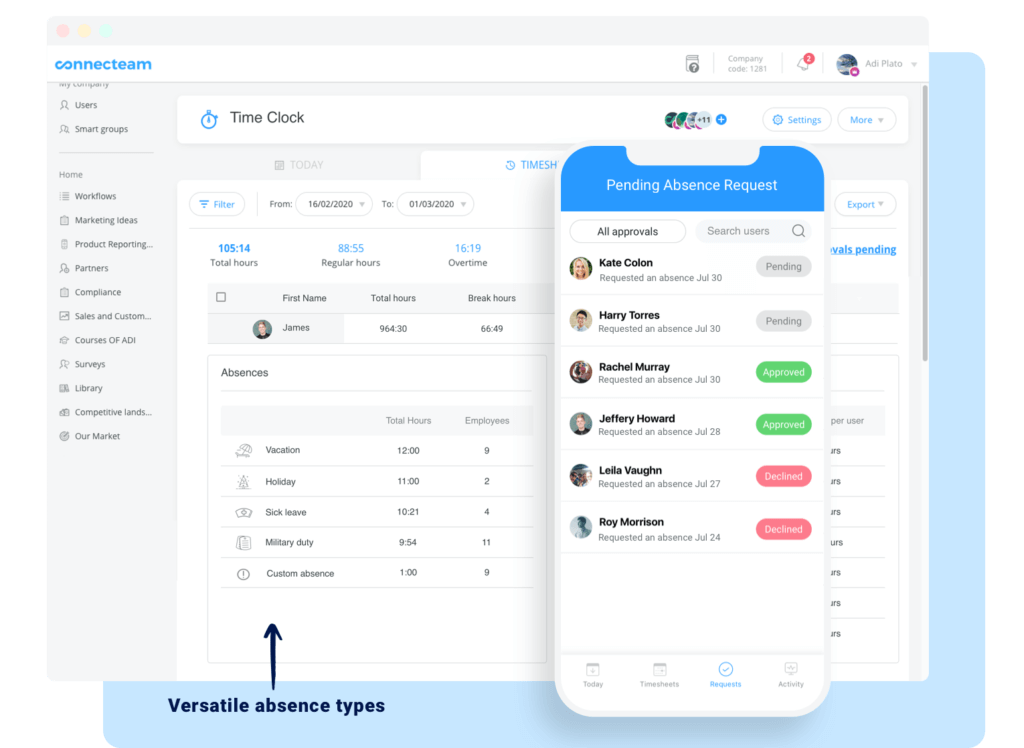
Connecteam is the best choice for businesses that want PTO, scheduling, and time tracking in one app. It’s especially strong for teams that need clear leave policies, accurate balances, and better day-to-day coverage without the extra admin work.
Why I chose Connecteam: I ranked Connecteam #1 because it was the most complete option for PTO tracking, especially in areas like policy flexibility, balance visibility, and accurate accrual tracking.
PTO requests and approvals
Employees can submit time-off requests from Connecteam’s mobile or desktop app. They just choose a policy, request full or partial days, add a note, and send it off, without needing any emails or manual forms. Once submitted, managers can review requests and approve or decline them.
Connecteam also adds useful controls around documentation. For example, admins can require approvals, set advance notice rules, and ask for attachments when needed, like a doctor’s note. Employees upload files or images directly with their requests, keeping records clean and organized.

Connecteam makes it easy to request and approve time off. Flexible time-off policies
Connecteam gives managers a lot of control over time off management, so it’s easy to build PTO policies for your team. You can create paid or unpaid policies, then customize them for different groups, such as full-time, hourly, or specific departments.
Policies can be tracked in hours or days, set as limited or unlimited, and run on calendar-year, custom, or anniversary cycles. I really appreciated this flexibility, because it means you’re not stuck forcing real policies into a generic system.
The policy setup is also super helpful. You can set fixed or earned-per-hour accruals, carryover limits, yearly caps, and even tenure-based rules, all within one policy. There’s also support for minimum-hours requirements and cycle-based accruals, so time off is earned in a way that actually reflects how your team works.
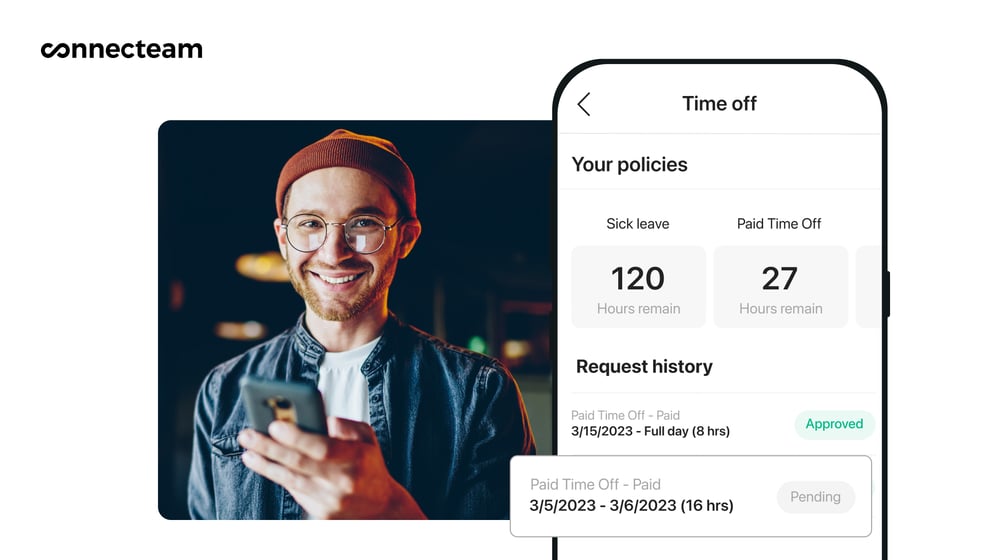
You can create flexible PTO policies with Connecteam. Better balance visibility
Connecteam gives both managers and employees a clear view of PTO balances. Employees can easily see their policies, balances, and request history.
Managers gain real-time visibility into what’s taken, approved, or still pending, plus detailed breakdowns of accruals and usage. They can adjust balances when needed and set limits on how far into a negative balance employees can go, which I found useful.
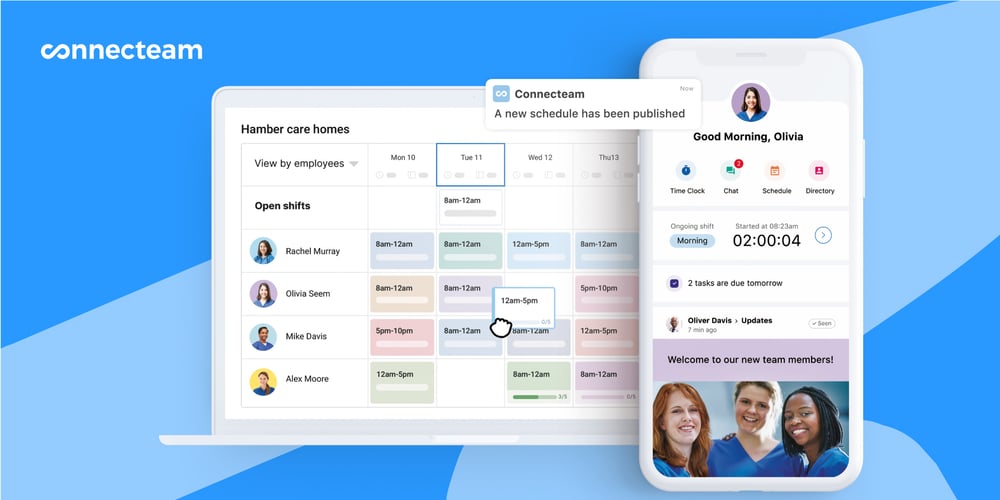
Connecteam helps you plan schedules and track time from one place. Scheduling and time tracking
Connecteam really stands out for how well paid time off is incorporated into the employee scheduler and employee time clock. Approved time off shows up directly in schedules and timesheets, so managers can see who’s out, plan coverage accordingly, and avoid last minute gaps.
You can also add holiday time in bulk, which flows into timesheets for payroll, and saves you from updating records one by one.
I like how practical it is to tie PTO to actual hours worked through the time clock. There are even options like cycle-based calculations and minimum-hours thresholds, so time off reflects real work, not just a fixed yearly number.
HR and payroll integrations
Connecteam’s PTO tracking software integrates with the HR and payroll tools you already have, including PrismHR, BambooHR, ADP, Xero, Paychex, and more.
And so much more…
Connecteam is a full workforce management solution and offers more than just paid time off tracking, including:
- Company knowledge base: Store PTO policies, leave rules, and employee guidelines in one searchable place. Use the built-in AI agent to get instant responses right from company documents.
- Online team chat: Keep work conversations organized and easy to manage. Share updates, files, and shift details in one-on-one or group chats.
- Employee onboarding: Speed up onboarding with role-specific packets, digital forms, and e-signatures. Required fields, policy confirmations, and sign-offs make sure nothing gets missed.
- Employee training software: Use the AI Course Creator to quickly build onboarding and policy training to get employees up to speed from day one.
When Connecteam isn’t a good fit
Connecteam isn’t the best choice for companies that only need a simple PTO tracker. Its strength comes from the added control and operational features, so smaller office teams with straightforward leave policies may find it more advanced than necessary. If you just want basic leave requests and approvals with minimal setup, a lighter tool may feel easier to manage.
Connecteam also offers a free for life plan – Get Started Now!
0Key Features
- Paid and unpaid time off policies
- Flexible PTO accrual settings
- Admin approvals and edits
- Detailed balance log
- Mobile time-off requests
- Scheduler and time clock
Pros
- Clear balance transparency
- Strong policy customization
- Deep admin controls
- Hour-based and tenure-based accruals
Cons
- Complicated setup for teams with simple leave policies
Pricing
Free-for-life plan availablePremium plans start at $29/month for 30 users
14-day free trial, no credit card required
Start your free trial -
Buddy Punch — Best for Small businesses that want PTO tied to a simple punch clock
Key Features
- Mobile PTO requests and alerts
- Fixed and hourly PTO accruals
- GPS time tracking
- Drag-and-drop employee scheduling
Pros
- Built-in leave types
- Approved PTO visible in schedule
Cons
- No minimum notice period for PTO
- Manual clock-in verification
Buddy Punch is a time off tracking software that also offers employee time tracking and scheduling.
Why I chose Buddy Punch: I liked that Buddy Punch goes beyond basic PTO by incorporating it into its time tracking and scheduling tools.
Time off tracking
In our full Buddy Punch review, we tested how well the PTO tracking works with the rest of the platform. I appreciated that most of the common leave types are already set up, so it’s easy to get started. You can also add your own custom policies, but it’s nice that there are already settings built in.
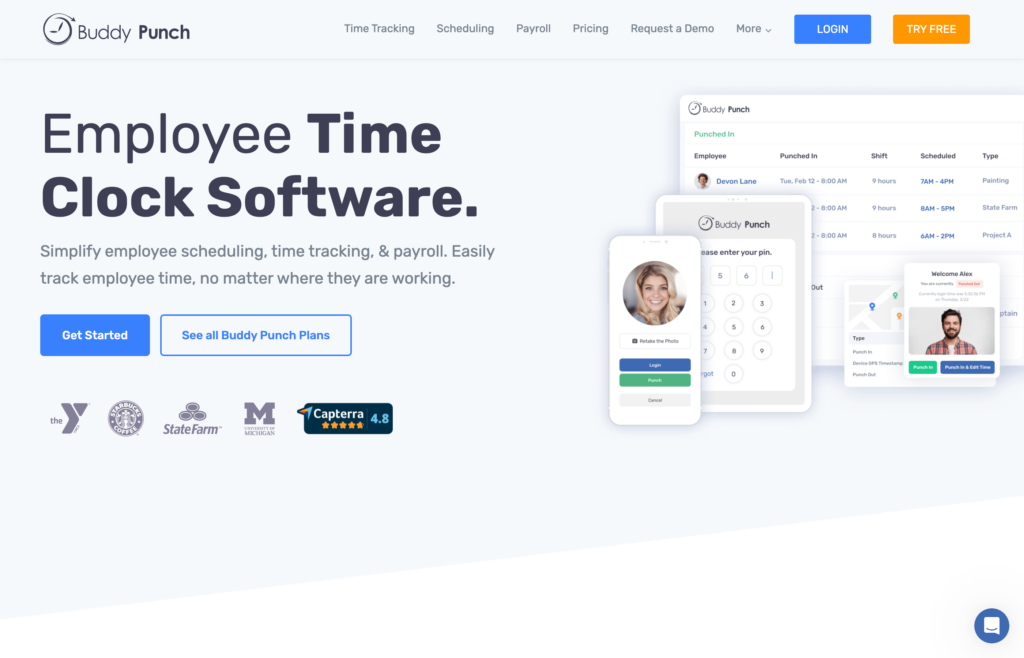
Employees can request leave on the mobile app, and real-time notifications help managers stay on top of approvals. I liked that approved time off appears on the schedule, so teams have better visibility into coverage.
Buddy Punch supports fixed and hour-based accruals, plus blackout dates for busy periods. The main drawback for me is that it doesn’t support minimum notice requirements, which can make last-minute requests harder to manage.
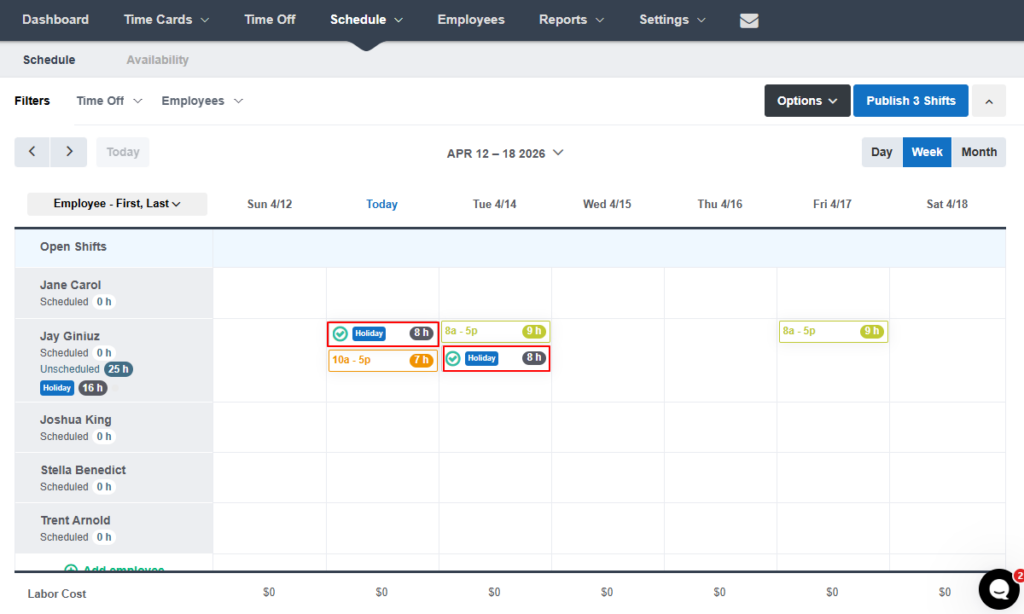
When we tested Buddy Punch, the tool displayed employee time-off on the employee schedule. GPS time tracking
Buddy Punch tracks regular hours, breaks, overtime, and double-time across web and mobile, while recording GPS data at each clock-in. There are also geofence and facial recognition features to help prevent off-site clock-ins and buddy punching.
While helpful, we found the facial recognition just takes a picture of the employee at clock-in and attaches it to their timecard. It’s up to managers to verify the employee’s identity after the fact, which is more manual than I would have liked. There’s also no offline mode, which could be inconvenient if you’re in an area with limited connectivity.
Scheduling, job tracking, and availability tools
Buddy Punch’s scheduler was pretty straightforward. Managers can assign shifts from day, week, or month views, and the drag-and-drop setup makes it simple to move shifts around or fix coverage gaps. I also liked the recurring shift feature for teams with repeat schedules. Employees can swap shifts, find coverage, and update their availability.
That said, scheduling automation seemed limited. There are no schedule templates or shift-copying tools, so managers still have to build schedules manually. It also lacks controls for daily or weekly hour limits and rest periods, which may be a drawback for businesses with stricter labor or safety requirements.
What users say about Buddy Punch
Overall, it’s been very easy to use and accurate with keeping everyone’s time entries up to date and the PTO feature is the favorite of the employees

There is no option for bereavement leave. Too bad I can’t edit a PTO request once it is submitted.
0Pricing
Starts at $19/month + $4.49/user/month Trial: Yes — a 14-day free trial is available. Free Plan: No
-
OnTheClock — Best for SMBs handling basic PTO alongside payroll-ready timesheets
Key Features
- Time off management
- Time tracking
- Geofence and compliance controls
- Drag-and-drop scheduling
Pros
- Flexible PTO policies
- Simple to request time-off
Cons
- PTO customization is limited
- Time off doesn’t sync to schedule
OnTheClock is a time tracking tool that also helps small and medium businesses with scheduling and leave management.
Why I chose OnTheClock: I liked OnTheClock because it’s a strong option for businesses that want essential workforce tools, including time-off management, without a more advanced setup.
Paid time off
In our full OnTheClock review, managing PTO was pretty simple. Employees can request time off from any device, and managers can review and approve requests on the go. I also like that it supports both accrual-based and allotment-style PTO policies, which gives businesses some flexibility.
That said, the setup feels more basic than some competitors. We found that you can’t apply PTO policies company-wide, so managers need to assign them individually or by group. OnTheClock also only supports four PTO categories by default: vacation, holiday, sick, and personal. You can rename them, but you can’t create new categories, which may feel limiting for companies with more detailed leave policies.
Another area to note is that approved time off doesn’t sync directly with scheduling, so managers could still accidentally assign shifts to employees who are unavailable.
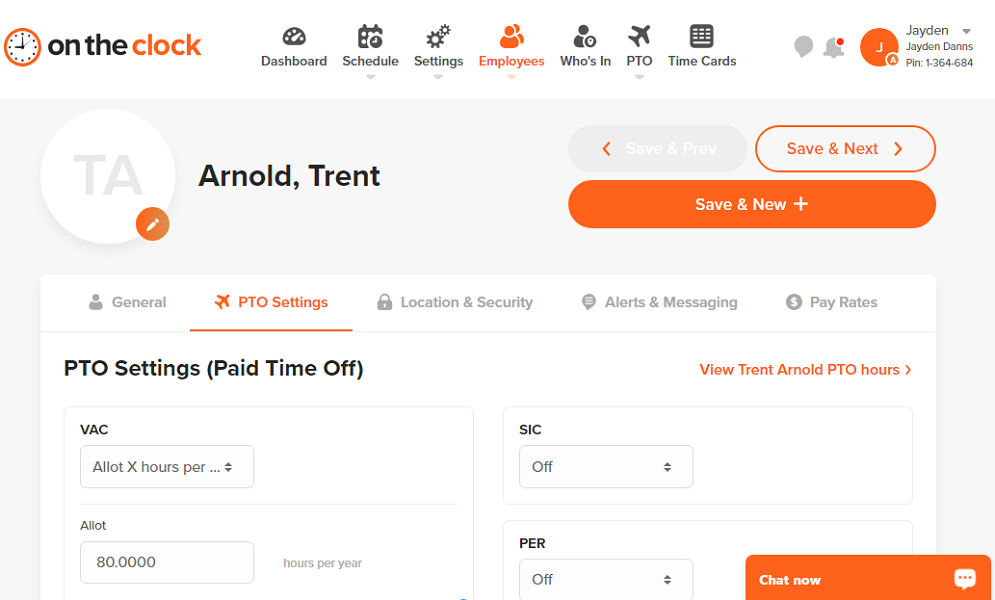
We created individual and group PTO policies with OnTheClock. Time tracking and compliance
OnTheClock lets employees track regular hours, overtime, double-time, and breaks. There are also built-in controls for preventing time theft, including geofencing, device restrictions, fingerprint punching, and real-time location tracking.
The overtime tools are another plus. OnTheClock includes preset overtime rules for different states, including California, and alerts managers before employees hit overtime. However, break tracking seemed more limited. The platform supports automatic break deductions, but it doesn’t handle stricter break compliance rules very well, which could be a drawback for businesses in states with tighter labor requirements.
Shift scheduling
With OnTheClock, managers can quickly create shifts, add details like jobs and locations, include notes, and use drag-and-drop scheduling to move shifts around. I also liked that you can copy shifts and schedules to save time when building recurring schedules.
Yet, the scheduling experience felt limited compared to stronger workforce platforms. During testing, there were issues with schedule publishing, and employees couldn’t properly manage shifts from mobile. OnTheClock also doesn’t support shift swapping, trading, or accepting and declining shifts, which could be challenging if you’re trying to manage shift coverage.
What users say about OnTheClock
Extremely user-friendly, with quick and easy onboarding that makes it simple to get started. Adding Bulk PTO is my favorite feature.
There are not many downsides, but I don’t like that I don’t get notification if someone is requesting PTO and that I manually have to log in to see if there have been any requests.
0Pricing
Starts at $5/month + $4/user/month. Trial: Yes — a 30-day free trial is available with no credit card required. Free Plan: No
-

QuickBooks Time — Best for QuickBooks users syncing PTO and tracked hours to payroll

Key Features
- Time-off management
- Timesheet approvals and exports
- Time tracking and geofencing
- Employee scheduling
Pros
- Flexible PTO accrual rules
- Strong integration with QuickBooks Payroll
Cons
- Geofencing can be bypassed
- Overtime calculations require manual review
QuickBooks Time is a time tracking tool that also offers scheduling and time-off management.
Why I chose QuickBooks Time: QuickBooks Time is a good choice for businesses that need PTO tracking software connected to QuickBooks accounting tools.
Time off tracking
QuickBooks Time lets admins create paid or unpaid time-off codes, assign them to individuals or groups, and automatically apply accrual rules across the company. It also offers common leave categories like vacation, sick time, holidays, and personal leave.
What stood out to me most is the flexibility around approvals and accruals. Employees can request time off by the hour or day, check their projected balances before submitting requests, and view balances from the mobile app. Once submitted, managers can approve requests, enter time off in bulk, edit balances, and choose whether approvals are required at all. Approved time off also appears in schedules once approved
The accrual setup is also pretty customizable. Businesses can base accruals on yearly rules, pay periods, or hours worked, with options for balance caps, negative balances, delayed accruals, resets, and use-it-or-lose-it policies.
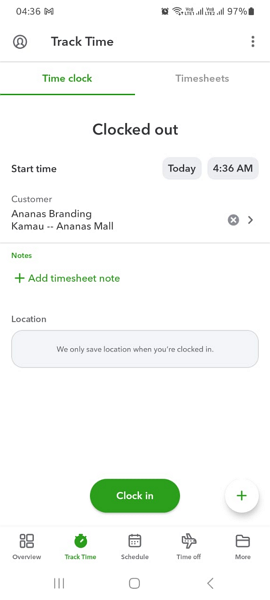
We could clock in and add a timesheet note on the QuickBooks Time mobile app. Employee time clock
With QuickBooks Time, employees can clock in from web, mobile, or a shared kiosk app. They can also start breaks and switch between tasks during shifts so hours are tracked against the right jobs or projects.
The platform also includes tools to reduce inaccuracy, like geofencing, clock-in reminders, and facial recognition on kiosk devices. The platform also supports offline mode, which is helpful for teams working in areas with spotty connectivity. However, we found that employees can still clock in outside the geofence by adding a note. Those entries are flagged for review, but it’s still something to keep in mind.
Another issue we ran into was with overtime tracking. While QuickBooks Time supports overtime and double-time rules, including California-specific settings, during testing the app didn’t calculate overtime correctly.
The biggest advantage of QuickBooks Time is its native integration with the broader QuickBooks ecosystem, making it easy to move approved timesheets directly into payroll for faster processing.
Employee scheduling
QuickBooks Time makes it easy to plan shifts and projects. Managers can use the drag-and-drop scheduler and add details like times, locations, assigned employees, customer info, and notes. Employees also get notifications when schedules are published or updated.
It’s important to note that advanced features like geofencing, mileage tracking, and project tracking are only available on the Elite plan, which may limit accessibility for smaller teams.
We found that QuickBooks Time doesn’t support shift swapping, employee shift acceptance, automatic reminders, or calendar integrations like Google Calendar and Outlook. So while the scheduler works well for planning, it may be less fitting for teams that rely on employee self-service and fast schedule changes.
What users say about QuickBooks Time
I love the level of ease when using QuickBooks Time. It’s very user-friendly and accurate. Time off requests are easy for staff to enter and for admins to review. I find it very easy to navigate, and it works well for our business and employees.
There is no way to personalize PTO accruals. (ex, employees get 3 more days when they have worked 6 months, an extra 2 days at 12 months, etc… but everything resets at beginning of the year) so this has to be done manually
 0
0Pricing
Starts at $20/month + $10/user/month Trial: Yes — (30 days) Free Plan: No
-

ClickTime — Best for Professional services tracking PTO against billable work
Key Features
- PTO requests and approvals
- Custom leave types
- Multiple time tracking methods
- Timesheets and reports
Pros
- Strong visibility and reporting tools
- Clear balance tracking for accruals
Cons
- Accrual rules not tied to hours worked
- Only one PTO approver per employee
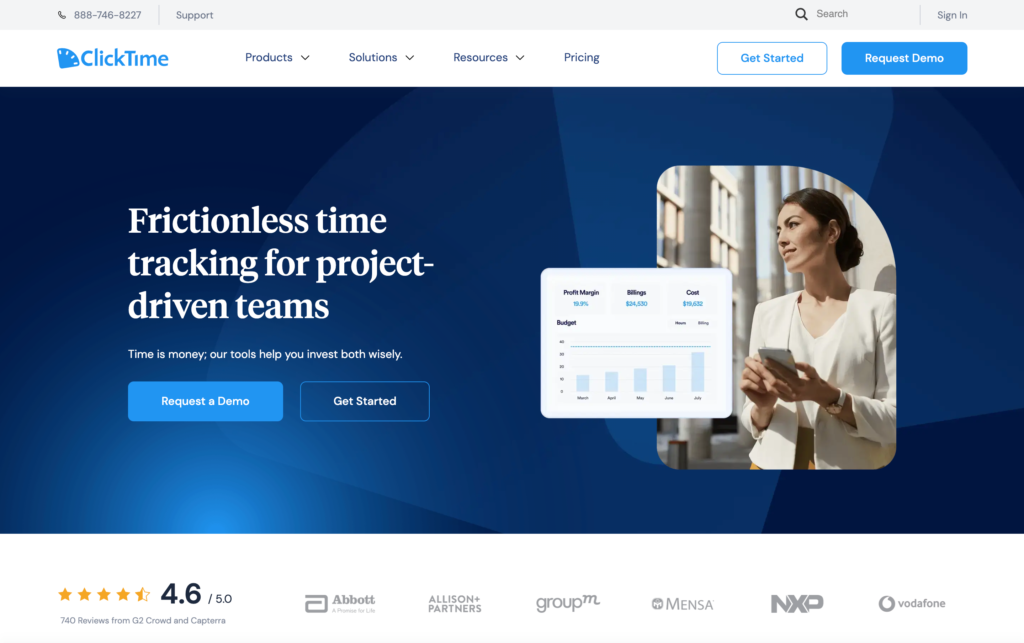
ClickTime is a time tracking platform that ties PTO controls, approvals, and reporting to timesheets.
Why I chose ClickTime: I chose ClickTime because its PTO management is structured well within the time-entry system.
Paid time off tracking
ClickTime gives businesses pretty good control over PTO requests and approvals. I liked that it separates leave types between ones that require approval and ones that don’t, so it’s easier to handle different policies. Employees can request time off, track request status, and view balances from the mobile app, while managers can approve or reject requests on the go.
You can also create custom leave types, assign approvers, control eligibility by employee type, set company holidays, and configure accrual rules with balance caps and monthly accrual rates. There are also reporting tools, which I liked because they give teams a clear view of balances, accruals, adjustments, and leave history over time.
The main downside for me is that PTO setup is less flexible than some other platforms. Accruals only work on a monthly cycle, not by hours worked, employees can only have one approver, and multi-day requests have to be fully rejected if one day needs changes. These limitations aren’t a dealbreaker, but they are something to be aware of, especially if your business has complex leave policies, multiple approval layers, or PTO rules tied closely to hours worked and shift-based scheduling. Read our full ClickTime review here.
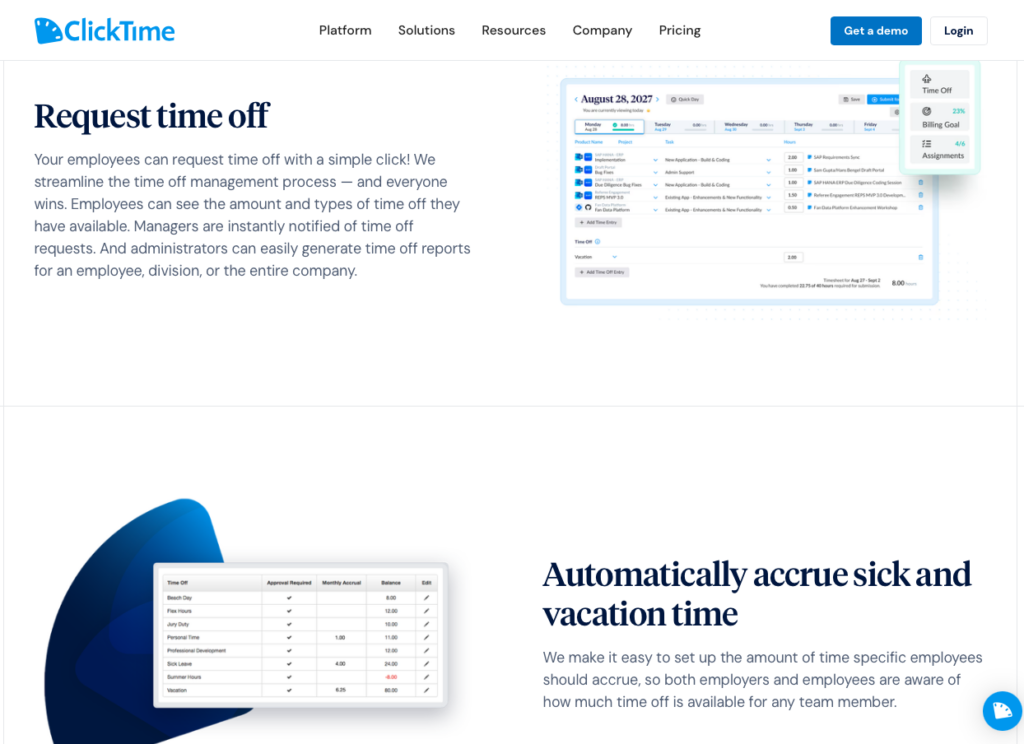
Screenshot of ClickTime’s time off features. Time tracking and approvals
Employees can log hours with ClickTime in a few different ways, including manual entry, stopwatch tracking, and start/end times with unpaid break tracking. You can also add project details, notes, and submit timesheets directly from the mobile app
The approval workflow is strong: managers can review, approve, reject, and lock timesheets, filter submissions by employee or status, and approve entries in bulk. I liked that pending PTO requests can hold a timesheet in a “Waiting for Time Off Approval” status, so teams catch leave issues before final approval.
Reporting and payroll
ClickTime offers 60+ built-in reports covering people, projects, clients, tasks, payroll, and time off, with filters, export options, and customizable views. For PTO, managers can track balances, accruals, adjustments, and future scheduled leave. For worked hours, ClickTime supports detailed time-entry, billing, and payroll reports, plus customizable exports for deeper analysis.
I also liked that it supports payroll exports for popular providers, so it’s easier to move approved time into payroll workflows. Combined with company holiday tracking and automated holiday entries, the reporting setup feels really useful for businesses that want stronger visibility into both worked time and leave balances.
What users say about ClickTime
I find ClickTime very easy to access, which makes it convenient for entering my time in and out. I enjoy using the expense button and being able to request time off, both features are easy to work with.
I would like there to be an easier way to track my time off balance and the accrual of my time off. The way it is right now, it makes it very difficult to see what my time off will be in the future.
Pricing
Starts at $12/user/month Trial: Yes — 14-day Free Plan: Yes
-

Jibble — Best for teams prioritizing attendance tracking and simple PTO management
What’s new with Jibble
In March 2026, Jibble raised its paid plan prices, with Premium increasing from $2.49 to $4.49 per user/month on annual billing and Ultimate rising from $4.99 to $7.99. That represents an increase of about 80% for Premium and 60% for Ultimate, making Jibble significantly more expensive than before.
Jibble is a time-tracking platform designed for office, frontline, and field-based teams that need straightforward attendance management without complex shift-scheduling requirements.
Why I chose Jibble: I included Jibble because its generous free plan offers powerful time tracking for unlimited users, with fast AI facial recognition.
PTO policies with flexible accruals and approvals
In our full Jibble review, we discovered that it allows managers to create custom paid and unpaid leave policies and apply lump-sum accruals that automatically assign balances to employees. The accrual setup is pretty straightforward, and lets you customize policies by employee group and adjust balances as needed. It’s important to mention that accruals and balances are only available on the paid plan.
Employees can submit time-off requests from any device, and Jibble approves time-off requests by default. Jibble also doesn’t notify managers about new time off requests. Luckily, you can create approval workflows, so managers can review and approve requests as they come in.
During testing, we noticed the platform doesn’t include minimum notice requirements or blackout date restrictions. This can be problematic for teams with tight scheduling needs, because it allows employees to request time off with little advance warning. Plus, the platform only supports salaried PTO (full-day requests), not hourly PTO, which limits its usefulness for hourly teams that need to track partial-day absences.
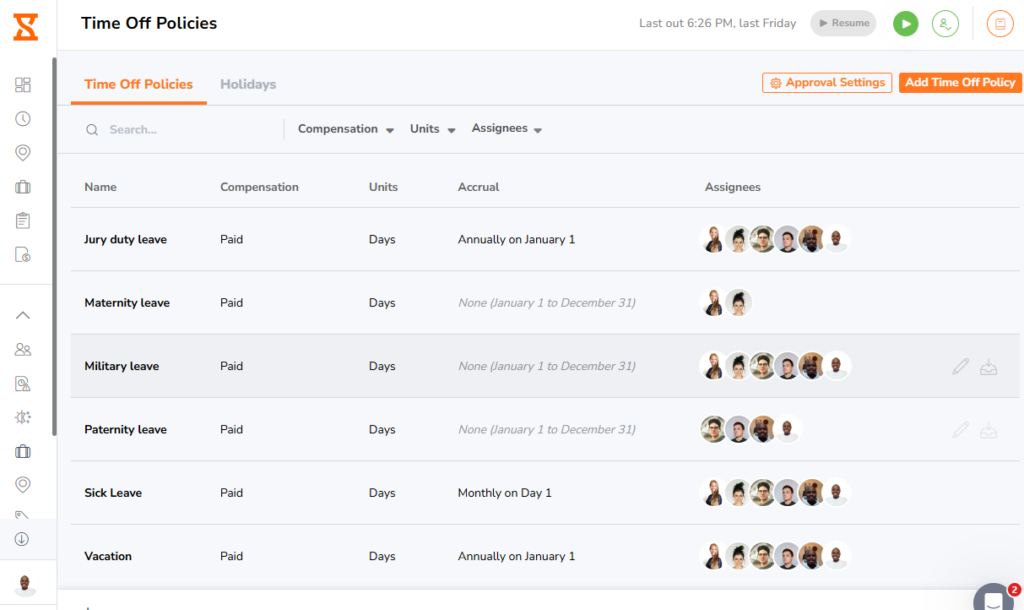
Jibble’s time off tracker let us create policies by department, location, and individual employees. Time tracking with verification
Jibble supports time tracking across web, mobile, desktop, and kiosk devices, giving teams plenty of flexibility. During testing, its AI facial recognition stood out. Employees create a 3D face template during their first clock-in, and the system uses it to verify future clock-ins automatically, reliably preventing buddy punching without manager involvement.
Kiosk mode also supports speed facial recognition, NFC tags, and PIN entry. We found the touchless speed facial recognition especially impressive, as it recognizes employees and automatically clocks them in, which is super helpful for busy job sites.
Jibble offers geofencing to block clock-ins outside approved locations and can automatically clock employees in or out as they enter or leave a geofence. One limitation we noticed, however, is that employees inside any approved geofence can still clock in to the wrong job or project, which could be an issue for businesses that need precise job-site tracking.
Location visibility and reporting
Jibble’s live map shows employee locations, active tasks, and clock-in durations in real time, with geofence overlays to verify workers are at the correct job site. While it also offers route tracking, we found that it only connects GPS points with straight lines rather than showing actual travel paths.
Reporting features are functional but limited. The platform offers standard reports like timesheets and attendance, but export and sharing options are restricted.
What users say about Jibble
Allows us to do all of the basic functions that we need and is flexible enough to add specific PTO policies for our org. Appreciate that you can use the desktop or app version.
There are some bugs we have had since using it. The tech team is great and always helps with those fairly fast. I dislike how team members have to request off one day at a time and can’t do it in bulk.
0Key Features
- Custom paid and unpaid leave policies
- Automatic PTO accruals and balances
- Mobile time-off requests
- Manager approval workflows
Pros
- Flexible leave policies by employee group
- Employees can request time off from any device
Cons
- Lacks manager notifications for new requests
- No minimum notice or blackout date rules
Pricing
Starts at $4.49/user/month Trial: Yes — 14 days Free Plan: Yes
Compare the Best PTO Tracking Software
| Topic |
 Start for free
|
|
|
|
|
|
|---|---|---|---|---|---|---|
| Reviews |
 |
|
|
|
|
|
| Pricing |
Starts at just $29/month for the first 30 users
|
Starts at $19/month + $4.49/user/month
|
Starts at $5/month + $4/user/month.
|
Starts at $20/month + $10/user/month
|
Starts at $12/user/month
|
Starts at $4.49/user/month
|
| Free Trial |
yes
14-day
|
yes
a 14-day free trial is available.
|
yes
a 30-day free trial is available with no credit card required.
|
yes
(30 days)
|
yes
14-day
|
yes
14 days
|
| Free Plan |
yes
Free Up to 10 users
|
no
|
no
|
no
|
yes
|
yes
|
| Use cases |
Best for Teams managing hours, PTO, absences, and staffing together
|
Best for Small businesses that want PTO tied to a simple punch clock
|
Best for SMBs handling basic PTO alongside payroll-ready timesheets
|
Best for QuickBooks users syncing PTO and tracked hours to payroll
|
Best for Professional services tracking PTO against billable work
|
Best for teams prioritizing attendance tracking and simple PTO management
|
| Available on |
What is PTO Tracking Software?
PTO tracking software is a tool that helps businesses manage employee time off in one place. Instead of relying on spreadsheets, email chains, or handwritten notes, teams can use it to track vacation days, sick leave, personal time, and other paid leave policies more clearly.
The software gives employees a simple way to request time off, while giving managers a better way to monitor balances, approvals, and upcoming absences. It’s used to reduce confusion, prevent tracking mistakes, and make leave management more organized across the business.
How Does PTO Tracking Software Work?
PTO tracking software keeps leave requests, approval rules, and employee balances in one shared system. Here’s how it works: an employee submits a time-off request, the software sends it to the right manager or approver, and the request is either approved, denied, or sent back for changes. Once a request is approved, the employee’s leave balance updates automatically.
Most tools also connect time-off data to a team calendar, work schedule, or time clock so managers can see how approved leave affects daily coverage. It turns time-off planning into something more practical, not just administrative. Instead of checking several tools at once, teams can often see leave balances, upcoming absences, and staffing gaps in one workflow.
Some platforms go further by sending reminders, applying accrual rules, and syncing approved leave with payroll or HR systems.
The Benefits of PTO Tracking Software
Here are some of the ways dedicated PTO tracking software can help your construction business.
Less manual admin
A good PTO tracker cuts down on the emails, spreadsheet updates, and follow-ups that usually slow leave management down. It reduces the workload for busy managers and HR teams that don’t have time to chase down every request.
Fewer mistakes
When balances, approvals, and leave records update in one place, there’s less room for human error. That means fewer payroll issues, fewer disputes, and less confusion about who has time off left.
Better coverage
PTO affects staffing just as much as it affects HR records. When approved leave shows up clearly in calendars or schedules, teams can plan coverage earlier and avoid last-minute scrambles.
Faster approvals
A clear process helps managers respond to requests more consistently. This also makes the experience feel fairer to employees, since everyone follows the same rules and approval path.
Stronger trust
Employees want to know their balances are accurate and their requests are being handled properly. When the process feels transparent, people spend less time guessing and more time feeling confident that time off is managed correctly.
Cleaner records
As teams grow, leave policies can get harder to manage. PTO tracking software gives businesses a cleaner record of requests, balances, and policy use, which makes reporting, audits, and policy management much easier over time.
How Much Does an Employee PTO Tracker Cost?
Most PTO tracking software uses a monthly subscription model based on the number of employees you have. Pricing usually starts around $2.99 – $12 per user per month, with some providers also charging a base fee between $5 and $20 per month. Generally, lower-cost plans cover basic leave tracking, while higher-tier plans may include features like automated approvals, reporting, compliance support, scheduling tools, and payroll integrations.
Connecteam’s Small Business Plan is 100% free for up to 10 users and includes everything you need to manage PTO in one place. Paid plans start at $29/month for up to 30 users, with Advanced at $49/month and Expert at $99/month, all covering up to 30 users.
FAQs
Inaccurate PTO tracking can lead to wage disputes, compliance violations, and fines, especially in regions where unused leave must be paid out. It also increases the risk of employee claims.
Keep policies clear, accessible, and consistent. Store them in one place, automate approvals, and send updates when changes happen. With Connecteam, you can share policies, track acknowledgments, and ensure everyone stays on the same page.
It gives employees visibility into their time off, makes requesting leave simple, and ensures fair approvals. This builds trust and encourages people to actually take breaks, helping prevent burnout.
The Bottom Line on PTO Tracking Software
PTO tracking software helps businesses that want a simpler, more reliable way to manage employee time off without the usual chaos. When choosing a tool, focus most on accurate balance tracking, clear approvals, schedule visibility, and how well it connects with time tracking and payroll.
Connecteam stands out as my top pick because it brings PTO, scheduling, and time clock tools together in one easy system. If you want fewer mistakes and smoother time-off management, start with Connecteam—try it for free today!