


When you operate a business that runs 24/7, managing shifts without burning out your team or inflating labor costs is a constant struggle.
The DuPont schedule guarantees continuous coverage with just four teams while giving employees seven consecutive days off every month. But it also comes with challenges.
This guide covers everything you need to know to decide if it’s right for your business and how to implement it successfully.
Key Takeaways
- Continuous coverage: The DuPont schedule guarantees 24/7 operations using four teams on rotating 12-hour shifts.
- Extended time off: Employees get seven consecutive days off every four weeks, giving them more time to rest, travel, or spend with family.
- Health and safety risks: The 12-hour shifts and frequent day-to-night transitions can disrupt sleep patterns and increase fatigue.
- Compliance matters: 72-hour workweeks trigger overtime requirements, and you must navigate new predictable scheduling laws.
- Technology is essential: Using the right software with auto-scheduling capabilities is the best way to handle the complexity of the four-team rotation.
What’s New in This Update (August 2026)
- Added a section on the business impact and cost analysis of the DuPont schedule.
- Added guidance on predictable scheduling laws and FLSA overtime threshold changes.
- Expanded the implementation section with practical, step-by-step advice.
What Is a DuPont Schedule?
The DuPont schedule is a rotating shift pattern designed to provide 24/7 coverage for continuous operations. It gives employees extended rest periods to offset the demands of long shifts and intense workweeks.
Developed by the DuPont Company in the 1950s, this schedule was originally created to maximize the use of expensive manufacturing machinery while giving workers consistent, predictable time off. Because it balances operational needs with employee downtime, it quickly became popular across many industries that require round-the-clock coverage.
Here’s how the DuPont shift schedule is structured:
- Your workforce is divided into four separate teams.
- Each team works 12-hour shifts, alternating between day and night shifts.
- The schedule rotates over a set four-week cycle (28 days).
- Because two teams work each day (one on days, one on nights), the schedule guarantees continuous 24/7 coverage.
How Does the DuPont Schedule Work?
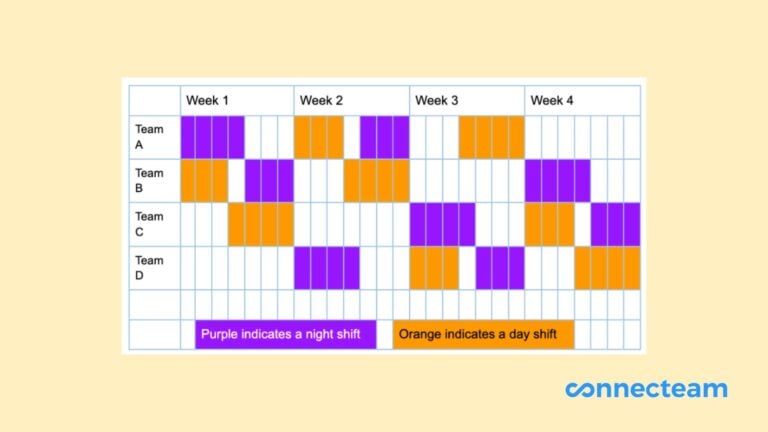
The DuPont shift schedule operates on a 4-week cycle. Each of the four teams follows a unique 12-hour shift pattern within that cycle. Here’s a detailed breakdown of how it looks week by week.
DuPont Schedule Example—Week 1
- Team A: 4 consecutive night shifts followed by 3 days off.
- Team B: 3 consecutive day shifts, 1 day off, then 3 consecutive night shifts.
- Team C: 3 days off followed by 4 consecutive day shifts.
- Team D: 7 days off.
DuPont Schedule Example—Week 2
- Team A: 3 consecutive day shifts, 1 day off, then 3 consecutive night shifts.
- Team B: 3 days off followed by 4 consecutive day shifts.
- Team C: 7 days off.
- Team D: 4 consecutive night shifts followed by 3 days off.
DuPont Schedule Example—Week 3
- Team A: 3 days off followed by 4 consecutive day shifts.
- Team B: 7 days off.
- Team C: 4 consecutive night shifts followed by 3 days off.
- Team D: 3 consecutive day shifts, 1 day off, then 3 consecutive night shifts.
DuPont Schedule Example—Week 4
- Team A: 7 days off.
- Team B: 4 consecutive night shifts followed by 3 days off.
- Team C: 3 consecutive day shifts, 1 day off, then 3 consecutive night shifts.
- Team D: 3 days off followed by 4 consecutive day shifts.
Want to see the schedule in action? Try our interactive DuPont schedule to see how each team rotates through the four-week cycle. You can filter by team or view all four teams at once.
Industries That Benefit From the DuPont Schedule
The DuPont schedule works best in industries that can't just turn the lights off at 5:00 PM. If you're in one of these sectors, this schedule might be worth exploring:
- Manufacturing: Manufacturers that rely on expensive machinery often use this schedule to keep equipment running around the clock. By avoiding frequent shutdowns and restarts, they reduce downtime, improve efficiency, and maximize production.
- Healthcare: Hospitals and care facilities need continuous patient care. Extended 12-hour shifts mean fewer handovers, which improves the continuity of care for patients. Nurses often prefer the predictability of the four-week cycle.
- Emergency services: Police, fire units, and emergency medical services must be available at all times. This schedule ensures critical services are always staffed and ready to respond.
- Utilities: Energy and water companies must continuously monitor facilities. The DuPont schedule allows for constant oversight to prevent service disruptions and respond quickly to emergencies.
- Customer service: 24/7 call centers find this schedule helps manage fluctuating call volumes while giving representatives meaningful time off. The extended breaks help prevent burnout in high-stress environments.
7 Benefits of the DuPont Shift Schedule
Here's a breakdown of the key benefits you and your team can expect from the DuPont schedule.
Benefits for Employees
- Seven Consecutive Days Off: The biggest draw for employees is the "long change", or a full seven consecutive days off every four weeks. This isn't just a weekend. It's a real break. Employees can take a short vacation, handle personal projects, or simply rest and recover. Many shift workers say this is the best perk of the DuPont schedule.
- Fair Distribution of Undesirable Shifts: The rotating nature of the schedule ensures a balanced distribution of day and night shifts across all four teams. No single employee or team gets stuck working only nights or weekends for extended periods. Everyone shares the burden equally.
- Predictable Long-Term Planning: Because the four-week cycle repeats exactly, employees can look months ahead to plan their personal lives, schedule appointments, and arrange childcare around their work time. This predictability is a huge stress reliever.
- Fewer Commute Days: Working 12-hour shifts means employees work fewer total days per month than they would on traditional eight-hour shifts. This reduction in workdays means fewer commutes, saving your team significant time and transportation costs.
Benefits for Employers
- Guaranteed 24/7 Coverage: The DuPont schedule ensures you always have staff on the floor. For businesses that require uninterrupted service, this schedule provides reliable, continuous coverage without the need for constant manual adjustments.
- Reduced Shift Handover Errors: As mentioned earlier, dropping from three daily shift changes to two cuts down on the communication errors and productivity dips that naturally occur when one team hands off work to the next.
- Flexibility in Workforce Management: The schedule allows managers to adjust teams based on real-time needs. Because employees have frequent days off, it's often easier to find coverage for an unexpected absence without disrupting the overall operation.
Challenges of the DuPont Schedule
While the DuPont schedule has notable benefits, it also comes with serious challenges that you must manage actively.
- Physical and Mental Fatigue: Working 12-hour shifts, especially at night, is physically and mentally demanding. Employees may experience intense fatigue and stress. NIH research shows that shift workers have a significantly higher risk of occupational accidents due to this fatigue. The longer the shift, the more pronounced the problem becomes.
- Circadian Rhythm Disruption The frequent rotation between day and night shifts can severely disrupt natural sleep-wake cycles. Up to 38% of shift workers report insomnia, and the constant transition makes it difficult for the body to establish a healthy rhythm. Some employees never fully adjust.
- Work-Life Balance Strain: Despite the extended days off, the long hours on workdays can strain personal relationships. Employees often find it impossible to attend social events or family dinners on the days they work, leading to feelings of isolation and resentment.
- Difficult Adaptation Period: New employees or those unfamiliar with shift work often find the rotating schedule overwhelming. The physical toll of adjusting to night shifts can negatively impact their performance and job satisfaction during the first few months.
- Complexity in Scheduling: Managing a DuPont schedule by hand requires intense planning. Balancing the four-week rotation with vacation requests, sick days, and shift swaps is a massive administrative headache that often leads to errors and understaffing.
- Long-Term Burnout Risk: Even with the seven-day break, the intensity of 12-hour shifts can lead to burnout over time. Some employees feel they spend their shorter breaks simply recovering from work rather than enjoying their time off.
Pro Tip
Is the DuPont Schedule Right for My Business?
The DuPont schedule isn't a magic fix for every company. Before you make the switch, consider these key questions:
Do you truly need 24/7 coverage?
If your workload experiences massive, unpredictable spikes, this rigid schedule might not be ideal. It works best for operations with steady, continuous demand.
Are your employees capable of working 12-hour shifts?
Consider conducting surveys to check their willingness to adopt long shifts and night work. The promise of seven days off is appealing, but the reality of a 12-hour night shift is harsh. Not everyone can handle it.
Can you afford the overtime costs?
While the DuPont schedule reduces your total headcount, it heavily impacts overtime. During the week a team works three day shifts and three night shifts, they log 72 hours. You must factor these overtime costs into your budget.
This Might Interest You
Use our Free Overtime Calculator to estimate the cost of switching to a DuPont.
What do your competitors do?
If other companies in your industry use DuPont, it's a sign it works for your sector. If they don't, there might be a reason.
Implementing the DuPont Shift Schedule: A Practical Guide
If you decide to adopt the DuPont schedule, it requires careful planning and clear communication. Here's how to do it right.
Step 1: Consult a Labor Lawyer
Before you make any changes, talk to a legal professional. Labor laws vary significantly by state and even by city. A lawyer can help you understand:
- How 12-hour shifts comply with state labor laws in your area
- Mandatory meal and rest breaks
- Overtime requirements and how they apply to your industry
- Predictable scheduling law requirements, such as 14 days’ in Oregon employers and 72 hours in New York City
- Compliance documentation you'll need to maintain
This step might cost a few hundred dollars, but it saves you from expensive compliance violations later.
Step 2: Engage Your Team Early
Talk to management, team members, and unions (if applicable). Getting buy-in is crucial because this change affects everyone's personal lives. Listen to their concerns and address them openly. Ask questions like:
- Are employees willing to work 12-hour shifts?
- Do they prefer day shifts, night shifts, or a mix?
- What concerns do they have about the new schedule?
- What support would help them succeed?
This conversation builds trust and often surfaces practical issues you hadn't considered.
Step 3: Develop a Clear, Written Policy
Create a comprehensive policy that outlines:
- The exact four-week rotation and how it works
- How overtime is calculated and paid
- How time-off requests will be handled within the rigid cycle
- How sick days and personal days fit into the schedule
- The process for shift swaps and coverage requests
- What happens if someone can't work a scheduled shift
- Expectations around attendance and punctuality
Put this in writing and share it with your entire team. Clarity prevents confusion and conflicts later.
Did You Know?
With Connecteam’s company knowledge base, employees can access policies, SOPs, and guides right from their mobile phones. The built-in AI agent instantly answers questions using information from those documents, so employees can quickly find what they need.
Step 4: Offer Training and Support
Provide training on how to manage the physical challenges of shift work. Educate your team on:
- Sleep hygiene (how to sleep well during the day)
- Healthy eating on night shifts
- Stress management and mental health resources
- Fatigue recognition and safety protocols
- How to communicate with managers about struggles
Consider using an employee training app to deliver these courses directly to your team's mobile devices. The more support you provide, the better your team adapts.
Step 5: Run a Trial Period
Don’t roll it out permanently right away. Run a 90-day trial period to identify unforeseen issues, gather feedback, and make necessary adjustments. During the trial:
- Track productivity, errors, and safety incidents
- Monitor attendance and no-shows
- Collect feedback from employees
- Adjust the schedule if needed
- Celebrate wins and address problems openly
This trial period is your safety net. It gives you a chance to course-correct before full implementation.
Step 6: Use Technology for Scheduling
Don’t try to manage a DuPont rotation on a spreadsheet. Invest in an employee scheduling app like Connecteam that can handle complex patterns, automate shift assignments, and manage time-off requests without creating conflicts.
Connecteam's auto-scheduler is specifically designed for complex rotations like DuPont. It considers employee availability, qualifications, fairness, and compliance limits to build perfect schedules in seconds. You can even save your four-week DuPont cycle as a template and let it repeat automatically, saving you hours of administrative work every month.
Step 7: Monitor Health and Performance
Keep a close eye on key metrics:
- Productivity rates and output
- Error logs and quality issues
- Safety incidents and near-misses
- Employee turnover and retention
- Absenteeism and no-shows
- Employee satisfaction surveys
If you notice a spike in accidents or absenteeism, you may need to adjust your fatigue management strategies or provide additional support.
Step 8: Keep Communicating
Maintain open lines of communication. Regularly check in with your team to see how they're adapting to the long shifts and the day-to-night transitions. Create a safe space for employees to raise concerns without fear of retaliation. The better you listen, the better your schedule works.
Did You Know?
Legal Considerations for Implementing the DuPont Schedule
When you implement the DuPont schedule, staying compliant with labor regulations needs to be your top priority.
Predictable Scheduling Laws
Many cities and states have enacted predictable scheduling laws (often called Fair Workweek laws). These laws typically require 10 to 14 days of advance notice for work schedules. If you change an employee's schedule within a certain window (often 72 hours), you may be required to pay predictability pay penalties.
The rigid, repeating nature of the DuPont schedule actually makes it easier to comply with these advance notice requirements, provided you manage shift swaps carefully. Since the schedule repeats every four weeks, you can publish it months in advance.
Overtime Regulations
Because the DuPont schedule includes weeks where employees work up to 72 hours, overtime is unavoidable. Most shift workers will be classified as non-exempt and eligible for overtime.
You must track hours closely and pay time-and-a-half (or double time, depending on your state) for hours worked beyond the standard 40-hour week or 8-hour day. In California, for example, any non-exempt employee who works more than 8 hours in a workday earns overtime for each additional hour, and double time after 12 hours. This makes 12-hour shifts highly expensive in certain states.
Health and Safety Standards
You must address the risks associated with fatigue. Ensure mandatory meal and rest breaks are taken, and offer mental health resources. If an accident occurs and you haven’t taken steps to mitigate known fatigue risks, you could face liability.
Document your fatigue management efforts. Keep records of:
- Training provided to employees
- Safety protocols and incident reports
- Employee feedback and concerns
- Adjustments made based on feedback
- Health and wellness resources offered
4 DuPont Alternatives
If the DuPont schedule seems too intense, here's how it compares to other continuous coverage models:
| Feature | DuPont | Pitman | 4 On, 4 Off | Panama (2-2-3) | Traditional 8-Hour |
|---|---|---|---|---|---|
| Shift Length | 12 hours | 12 hours | 12 hours | 12 hours | 8 hours |
| Rotation Cycle | 4 weeks | 2 weeks | Varies | 4 weeks | Weekly |
| Consecutive Days Off | 7 days | 3 days (every other week) | 4 days | 3-4 days | 2 days |
| Teams Required | 4 teams | 4 teams | 3-4 teams | 4 teams | 5-6 teams |
| Shift Transitions | Weekly day-to-night | Weekly day-to-night | No transitions | Bi-weekly transitions | Daily transitions |
| Predictability | Highly predictable | Highly predictable | Highly predictable | Predictable | Varies |
| Overtime Hours | 72 hours/week (1 week per cycle) | Variable | Minimal | Variable | Minimal |
| Fatigue Risk | Moderate to high | Moderate to high | High (4 consecutive 12-hr shifts) | Lower (fewer transitions) | Lowest |
| Best For | Manufacturing, healthcare, emergency services | Operations wanting shorter rotations | Employees preferring predictable blocks | Reducing day-to-night transitions | Administrative and back office work |
Bottom Line on the DuPont Schedule
The DuPont schedule is a powerful tool for industries that need reliable 24/7 coverage. By using 12-hour shifts and a four-team rotation, you can maintain continuous operations while offering employees the highly coveted perk of seven consecutive days off.
However, the physical toll of night shifts and the complexity of managing the rotation are significant hurdles. Success requires strict attention to fatigue management, a clear understanding of overtime laws, and the right technology to keep everything organized.
Use an employee scheduling app like Connecteam to automate the rotation, track your overtime accurately, and give your team the flexibility they need to thrive on a demanding schedule.
Start your 14-day free trial of Connecteam today.