


When performance reviews rely on spreadsheets and scattered notes, it’s easy to miss important details. Great work can go unnoticed, performance issues can slip through, and employees may question how their ratings were decided.
I reviewed 6 employee evaluation software tools, comparing how they handle assessments, goal tracking, and integrations.
Use this comparison to find a tool that helps you run more consistent reviews, track employee performance, and give feedback your team can actually use.
What Is an Employee Evaluation software?
An employee evaluation software helps managers assess employee performance, collect feedback, and track progress in one place. Instead of juggling spreadsheets and scattered notes, teams can use these tools to run structured performance reviews, set goals, and keep a record of past evaluations. Some apps also support self-assessments, peer feedback, and regular check-ins.
If you don’t have the time to read through our research, jump down to our quick comparison table.
What’s New in This Update (October 2026)
- Corrected performance plan pricing and repeated cost claims, including billing cadence, hub fees, and user limits.
- Clarified Connecteam’s conditional-form and recurring-task plan requirements, Timeline automation, and internet requirement.
- Corrected 15Five’s AI data scope and submitted-review editing, plus Betterworks’ mobile availability, goal cascading, review-cycle support, and Talent Intelligence package.
Our Top Picks
-
1

HR teams managing performance reviews alongside payroll and benefits
-
2

Managers seeking intuitive performance reviews with aligned goals
-
3

Continuous feedback and real-time performance conversations
Why trust us?
Our team of unbiased software reviewers follows strict editorial guidelines, and our methodology is clear and open to everyone.
See our complete methodology
How I Ranked the Best Employee Evaluation Software
I compared the tools based on how well they help managers run performance reviews, track progress, and act on feedback.
Here’s what I focused on:
- Evaluation features: Customizable review forms, recurring evaluations, and options for manager, self, and peer feedback.
- Performance tracking: Goal tracking, review history, reporting, and ways to follow up on feedback.
- Ease of use: Simple workflows, mobile access, and features that work for both HR teams and frontline managers.
- Pricing and flexibility: Overall value, integrations, and advanced features like AI assistance, calibration, and OKR tracking
Not every tool excels in every area. I considered how well each one meets the needs of its intended users and highlighted its limitations in the individual reviews.
The 6 Best Employee Evaluation Software Tools of 2026
-
BambooHR — HR teams managing performance reviews alongside payroll and benefits

BambooHR is an employee performance review software that aims to help growing companies manage essential employee information in a personalized human resources information system (HRIS).
Why I chose BambooHR: BambooHR offers a strong user experience and core HR features to help companies standardize their HR processes.
360-degree employee feedback
In our full BambooHR review, we found that its 360-degree feedback tool enables companies to collect comprehensive employee performance insights from multiple stakeholders. Performance Management is available from the Pro plan, starting at $17/employee/month. With customizable assessment templates, managers can quickly create reusable feedback forms containing specific questions and various rating scales.
You can set up manager-to-employee assessments, self-assessments, skip-level, and peer-to-peer reviews. However, we found that the assessment feature set covers the basics but doesn’t offer many advanced features, like calibration tools or AI summaries of employee assessments. Also, while the feature worked fine on the mobile app, we had difficulty locating the feature on the desktop version.
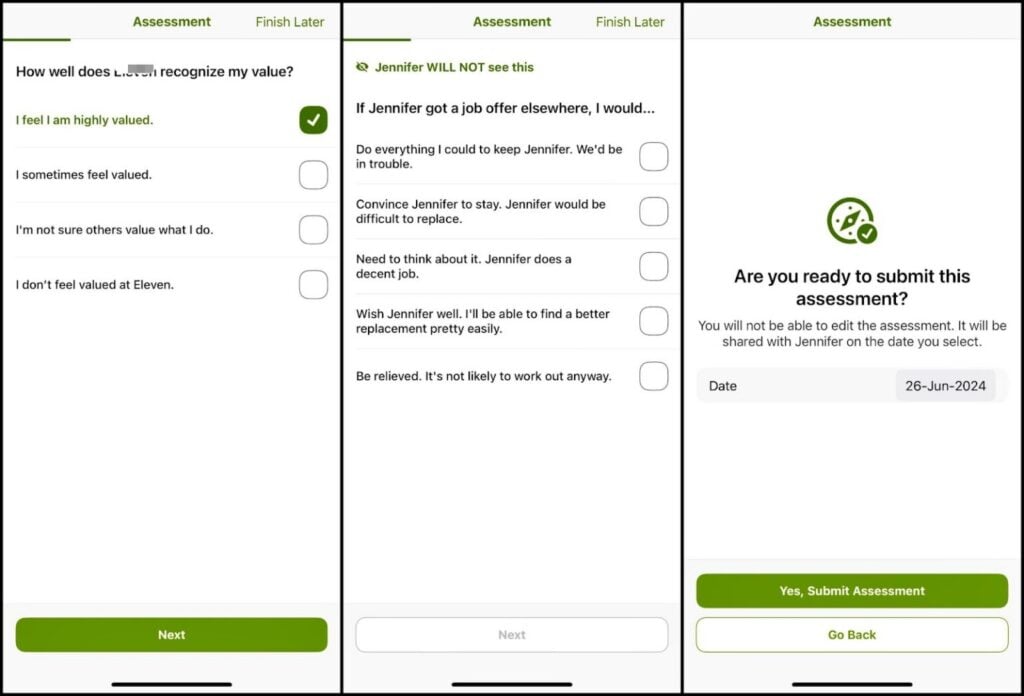
Employees can complete performance assessments directly on the BambooHR mobile app. Employee data management for performance tracking
BambooHR’s employee database is comprehensive and flexible, with solid support for performance evaluation workflows. The platform centralizes employee records across multiple dimensions: personal information, job classification, document storage, training completion, benefits enrollment, time-off history, emergency contacts, and asset assignments.
For performance management specifically, the Notes field stands out as a practical tool for recording observations about an employee’s performance, accommodations, or behavioral patterns. The People section offers multiple views of your workforce (list, directory, or organizational chart) with filtering options by status, department, location, compensation, and tenure.
Reporting and analytics for performance insights
BambooHR offers an extensive library of over 49 pre-built reports. While performance-related reports are available, the platform’s reporting strength lies in other areas like headcount and turnover, compensation analysis, benefits tracking, training investment, and attendance patterns.
The reporting interface is intuitive, letting you quickly configure parameters, select which fields to display, and apply filters to narrow results. Data exports are flexible, supporting common formats like CSV, PDF, and Excel, which makes it easy to share insights with leadership or integrate into other systems.
What users say about BambooHR
Visually appealing and easy to navigate. I like that with one-on-one performance reviews, you don’t see the other person’s comments until after you have both submitted your answers.

Sometimes finding certain things that I need are not so easy to locate. This can be frustrating at times when it shouldn’t.

Key Features
- Manager and self-assessments
- Performance management
- Goal setting
- Peer-to-peer reviews
Pros
- Strong suite of HR tools
- Employee self-service tools
Cons
- Can be difficult to navigate
- Limited advanced features
Pricing
Starts at $10/user/month Trial: Yes — 7 day Free Plan: No
-
PerformYard — Managers seeking intuitive performance reviews with aligned goals
Available on
- Web
- Windows
- Mac
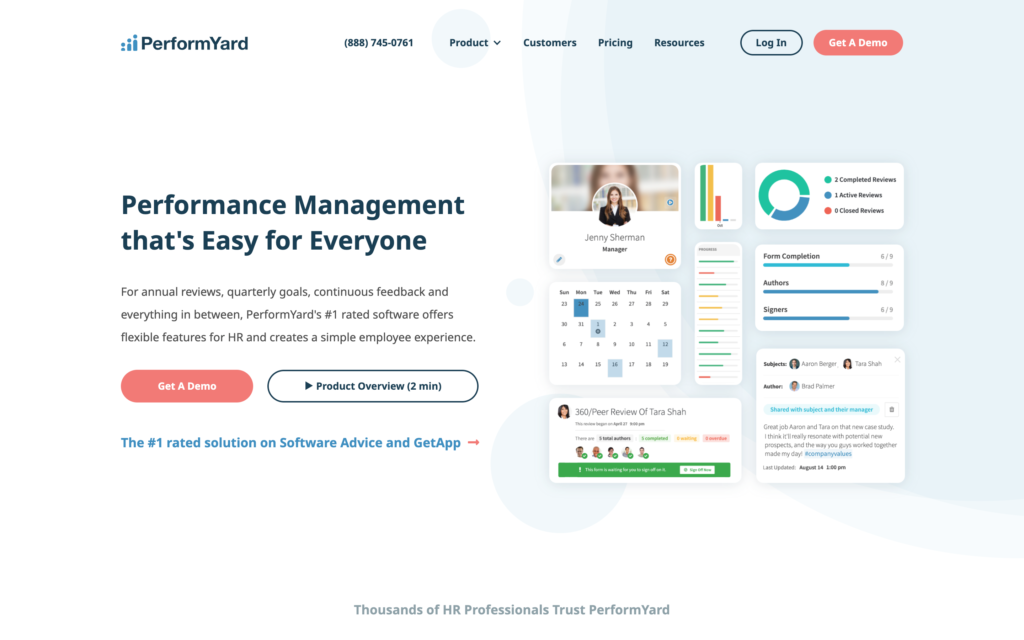
PerformYard is a performance management tool that aims to help businesses maintain reviews, goals, and consistent feedback.
Why I chose PerformYard: I included PerformYard because it lets you launch automated review cycles, view performance histories, and send reminders to complete assessments.
Employee goals management
PerformYard’s goal management system enables managers and employees to set, track, and align individual and team goals. Goals could be anything from launching a new marketing campaign to completing company onboarding and training. The platform supports cascading goals, allowing organizations to set company-level objectives and cascade them down to teams and individuals.
The dashboard provides visual progress tracking, showing the percentage completed for each goal and offering real-time insights into goal status. The platform also includes employee recognition features, making it easy to acknowledge strong performance. With Slack and Microsoft Teams integrations, achievements can be shared and celebrated across the organization.
That said, the goal management interface requires navigating multiple screens to reach common actions.
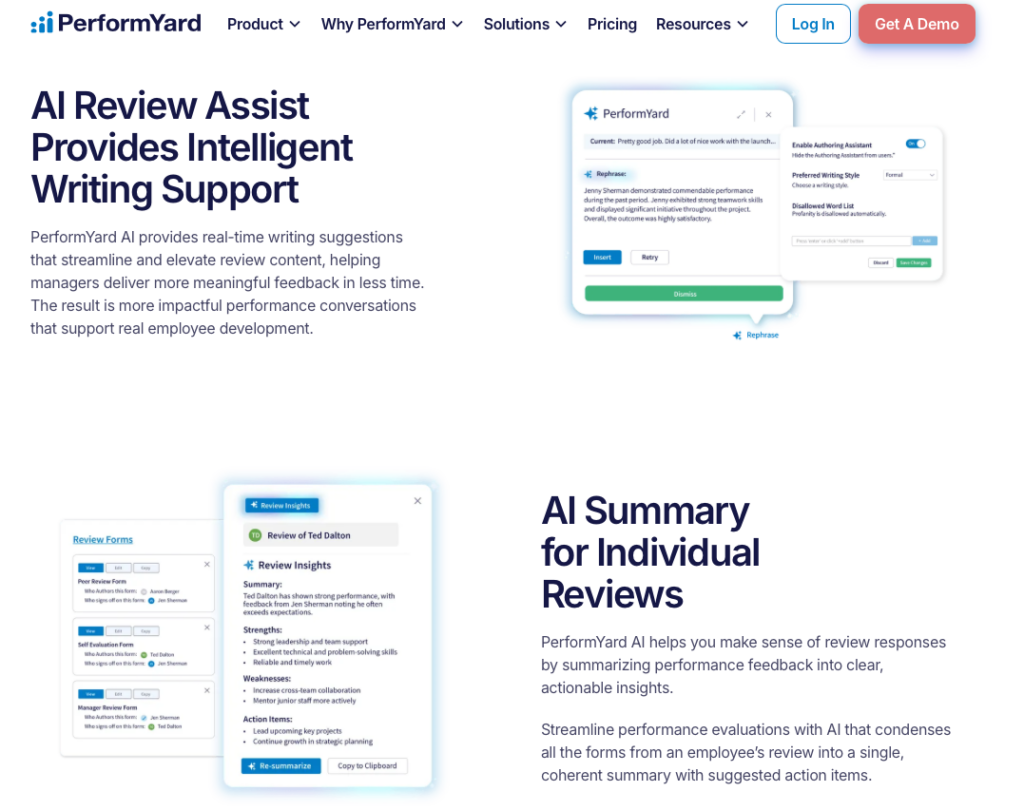
PerformYard offers AI tools to help write reviews and summaries. AI-assisted reviews and continuous feedback
PerformYard features AI-assisted review writing, rephrasing support, tone elevation, and summaries across multiple forms. PerformYard’s continuous feedback toolkit enables managers to give feedback privately or publicly, with the ability to request feedback from peers and track response status.
PerformYard lists Performance at $5–$15 per person/month, billed annually. This includes reviews, meetings, goals, engagement, feedback, surveys, and PerformYard AI, and costs vary by seats and selected products.
Flexible review cycles
PerformYard supports multiple review types including annual reviews, quarterly check-ins, 30-60-90 day check-ins, anniversary date reviews, and project-based reviews. Organizations can fully customize review forms, questions, and cycles to match their specific needs. The platform includes automated notifications and sign-off workflows to ensure reviews are completed on time.
What users say about PerformYard
The way everything is tracked in one place has improved significantly. This gives me greater peace of mind, as it allows me to clearly see progress and areas for improvement. I think it´s an excellent tool
Every single time I attempt to view the different report categories using the back button I am completely logged out of the application.
Key Features
- 360-degree evaluation
- Goal management
- Continuous feedback structure
- Assessment scheduling
Pros
- Highly customizable
- AI-assisted reviews
Cons
- Complicated goal management system
- Review Insights requires Premium plan
Pricing
Starts at $5/user/month Trial: Yes Free Plan: No
-
15Five — Continuous feedback and real-time performance conversations
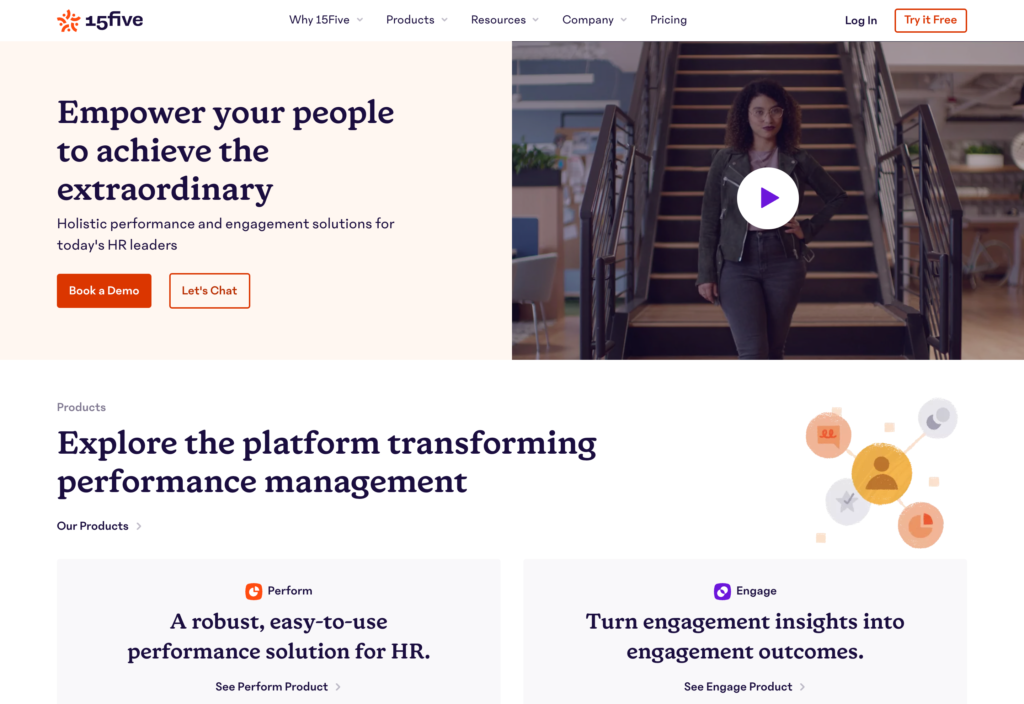
15Five is a performance management platform that helps companies manage and streamline employee reviews, engagement, compensation, and manager coaching.
Why I chose 15Five: I liked that 15Five speeds up the process of creating custom review cycles and offers in-depth performance reporting and AI-assisted summaries.
AI-assisted review cycles and automation
15Five’s Perform product, which starts at $11/user/month, includes an AI thought partner for HR Admins that analyzes people data to generate insights. I also appreciated that the platform supports customizable review cycles with question templates, visibility settings, and automated workflows.
Organizations can create tailored performance reviews aligned with their culture and employee types. Impressively, the system includes a Talent Matrix for 9-box calibration and Growth Studio for career paths, individual development plans (IDPs), performance improvement plans (PIPs), and succession planning.
However, once you launch these cycles they become rigid. Per 15Five’s help documentation, the review cycle type and question template content lock at launch, Performance Ratings+ formulas and rubrics lock after the first review is submitted, and calibration can only be enabled up to the “start sharing” date. Submitted self, peer, and manager can edit reviews without admin help, depending on the review’s status. But only admins can create or configure cycles and templates, which considerably limits manager flexibility.
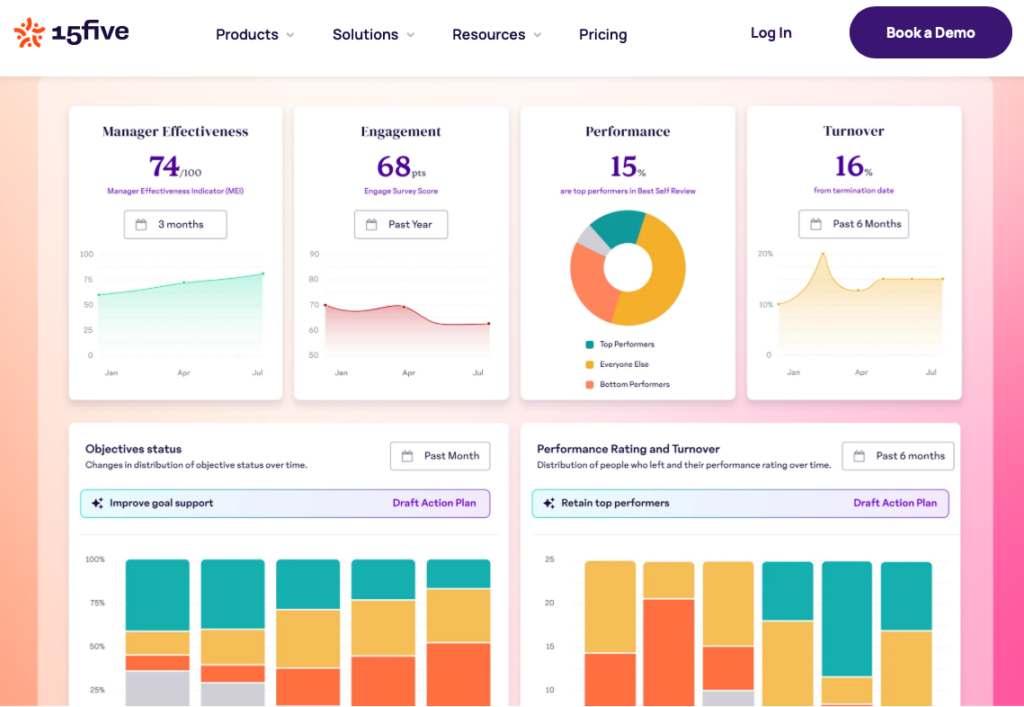
15Five’s dashboard shows you engagement, performance, and turnover statistics at a glance. Weekly check-ins and continuous feedback
15Five’s check-in feature enables employees to share their pulse, wins, and challenges on a weekly basis. The platform includes 1-on-1 meeting tools with collaborative agendas, action item tracking, and shared notes.
Managers can request feedback from peers at any time, and the system maintains a searchable feedback history. There are also “High Fives” for cultural recognition and “Best-Self Kickoff” for expectation alignment, which seem like useful tools to strengthen employee engagement.
Engagement surveys and manager coaching
15Five offers employee engagement surveys, targeted assessments, action planning, and AI-powered predictive analytics to surface key engagement drivers. There’s also a paid add-on for manager coaching through Kona AI (meeting assistant and coaching) and Manager Products (content library and live coaching sessions).
While helpful, user feedback suggests that the platform’s reporting can be limiting, while new users may find the platform overwhelming at first.
What users say about 15Five
It’s been great for keeping my team’s goals on track. Plus, the layout makes my 1:1s with my mentee much more productive.
While the core framework is excellent, the survey questions can feel highly repetitive over time if you don’t manually refresh them.

Key Features
- Review cycle setup and automation
- Feedback collection workflows
- AI-assisted employee evaluation
- Performance reporting
Pros
- Easy-to-set-up review cycles
- AI-powered summaries
Cons
- Limited reporting
- Rigid review cycles
Pricing
Starts at $4/user/month Trial: Yes — 14-day Free Plan: No
-

Lattice — Calibration and analytics-driven performance management
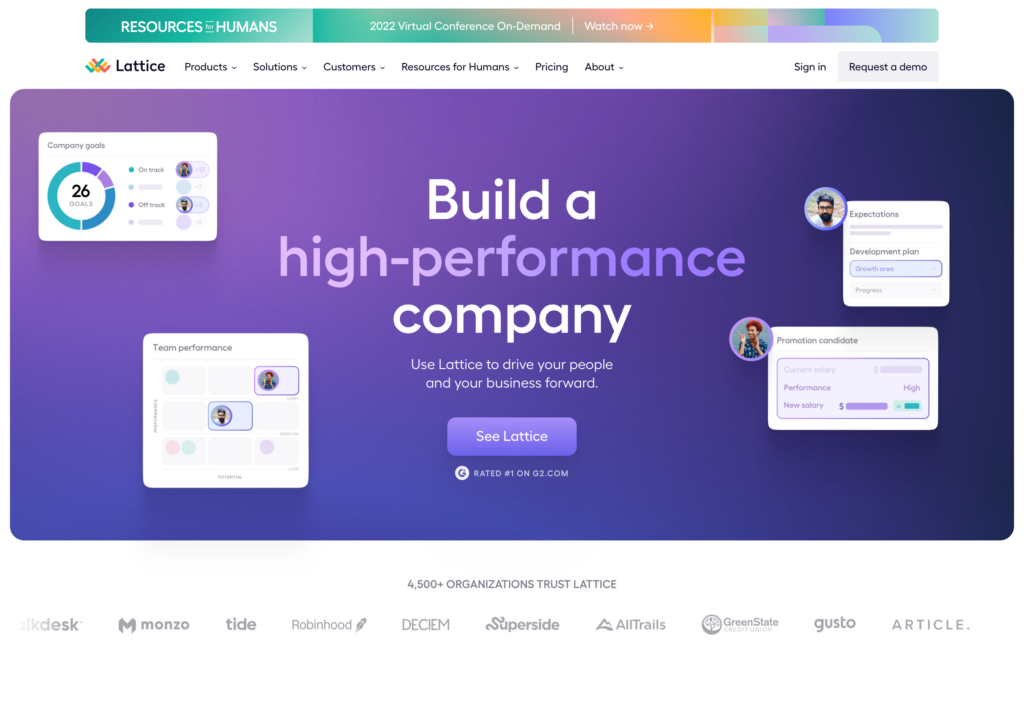
Lattice is an employee evaluation software that aims to empower leaders to build engaged, high-performing teams that inspire a winning company culture.
Why I chose Lattice: Lattice offers easy-to-use performance management features, like one-on-one meeting prep and powerful calibration grids, that facilitate employee growth.
One-on-one meeting preparation
Lattice’s 1:1 meeting tools help managers plan and conduct personalized conversations with direct reports. The platform includes weekly updates for proactive progress tracking and real-time feedback capabilities. Managers can view employee growth areas, peer performance reviews, and past meeting details.
The platform also provides sentiment analysis based on survey comments to help managers understand employee engagement before meetings.
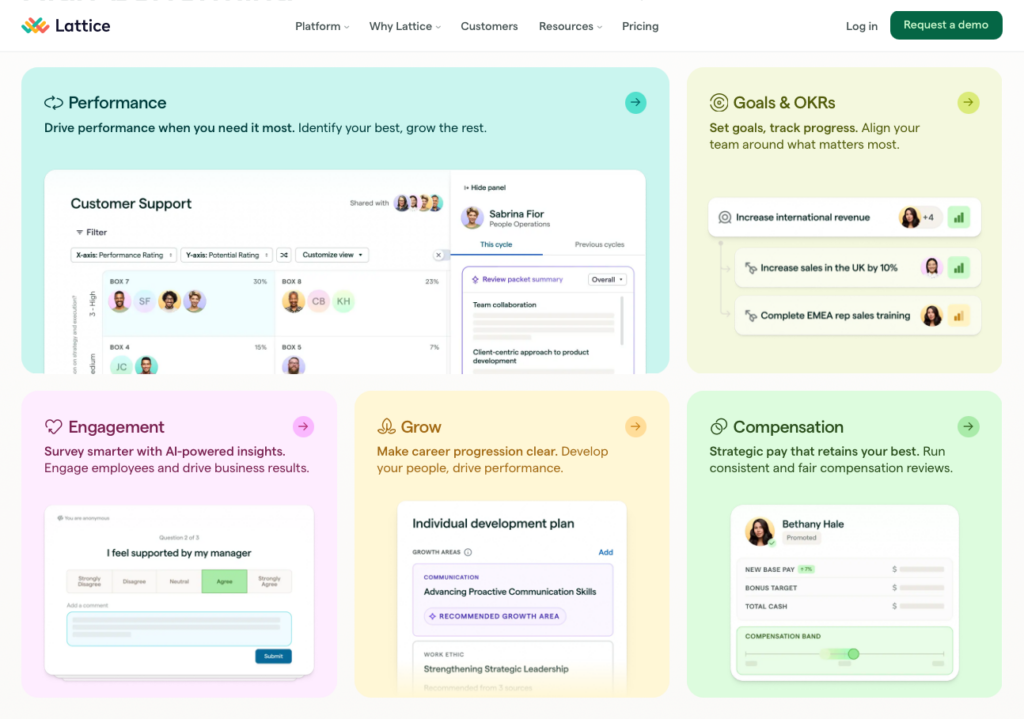
Lattice offers multiple modules for employee performance, engagement, goals, growth, and compensation. Talent reviews and calibration
Lattice includes talent review tools with 9-box assessment grids showing performance levels (below to exceeds) on the x-axis and potential (low to high) on the y-axis. This visualization helps leaders spot performance gaps and development opportunities. The platform also includes succession planning and promotion workflows, so organizations can make data-driven talent decisions.
One area to note is that calibration is limited to rating questions from manager (downward) reviews, so cycles built only around peer or upward feedback can’t be calibrated. Mid-cycle edits are also constrained, since you can only edit templates in Org Chart reviews and admins can’t add, remove, or reorder questions once a cycle is live, with competency, goal, and default questions locked from editing entirely.
Performance reporting and analytics
Lattice provides analytics dashboards that help leaders understand workforce trends and make informed decisions about hiring, promotion, and retention. I liked how the reporting function enables you to easily spot employees with performance gaps and those at risk of leaving the company. There’s also an AI Agent that acts on data, answers questions about policies and career growth, and coaches managers in the flow of work.
One limitation I noticed is that to access compensation planning or career growth tracks, you have to purchase additional add-ons on top of the base performance module. Beyond that, Performance starts at $10/seat/month, and Lattice requires a $4,000 minimum annual agreement and bills annually only, with no monthly option, making it less budget-friendly for smaller teams.
What users say about Lattice
Lattice is easy to use and helps keep performance conversations organized. The interface is simple to navigate, and it is helpful to have 1:1 agendas, appraisal notes, and performance documents stored in one place.
Some workflows (goals, check-ins, review steps) can feel click-heavy and time-consuming, especially when you’re just trying to make a small update quickly
Key Features
- 360-degree evaluation
- Question templates
- Performance reporting and analytics
- In-product calibration
Pros
- Powerful analytics and 9-box grids
- Strong one-on-one meeting prep tools
Cons
- Add-on pricing structure makes it expensive
- Limited calibration and template flexibility
Pricing
Starts at $4/user/month ($4,000 minimum annual spend) Trial: No Free Plan: No
Workforce Management Software for Employee Evaluation
-
Connecteam — Frontline teams connecting evaluations to daily work
Connecteam is a strong option for frontline businesses that want to manage employee evaluations alongside training, tasks, communication, and employee records. While it doesn’t provide the advanced calibration and talent-planning tools found in dedicated performance platforms, it makes routine evaluations easier to complete and act on across teams in the field.
Why I chose Connecteam: I included Connecteam because it incorporates employee evaluations as part of an ongoing performance management process. Managers can run mobile reviews, assign recurring evaluation tasks, keep records up to date, and assign training to address skill gaps from a single platform.
Custom digital forms and evaluations
Connecteam makes it easy to build custom review forms from scratch or use ready-made templates for 30-day check-ins, annual reviews, and self-evaluations. The digital forms support multiple field types, including rating scales, open-ended responses, and e-signatures for employee acknowledgment.
Employees and managers can complete these evaluations directly from their mobile phones, reducing paperwork and speeding up the review cycle. You can even use conditional logic so the form adapts based on previous answers with Operations Advanced or above.
Plus, you already have an evaluation form that works, just upload or take a picture of it and Connecteam’s AI will turn it into a digital version.
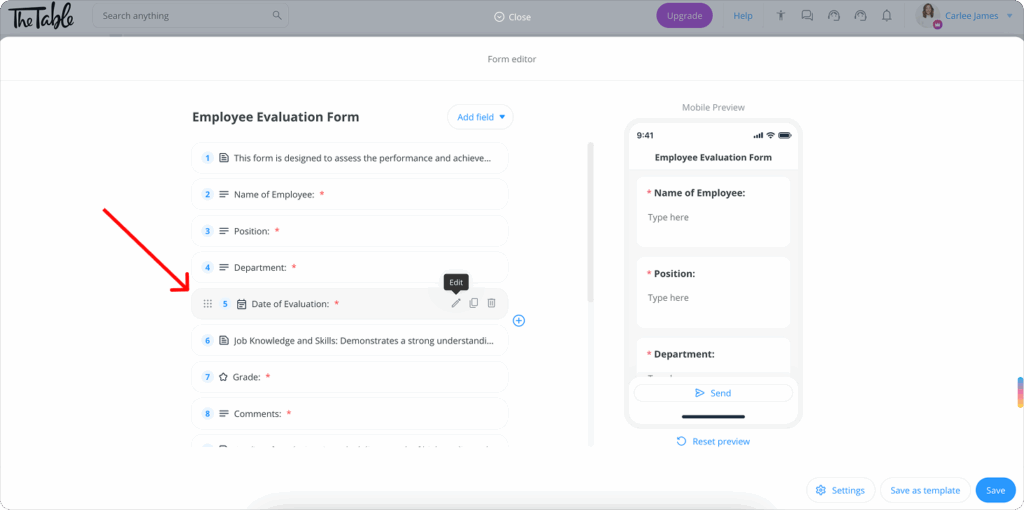
Create custom employee evaluations forms with Connecteam. Employee timeline and task tracking
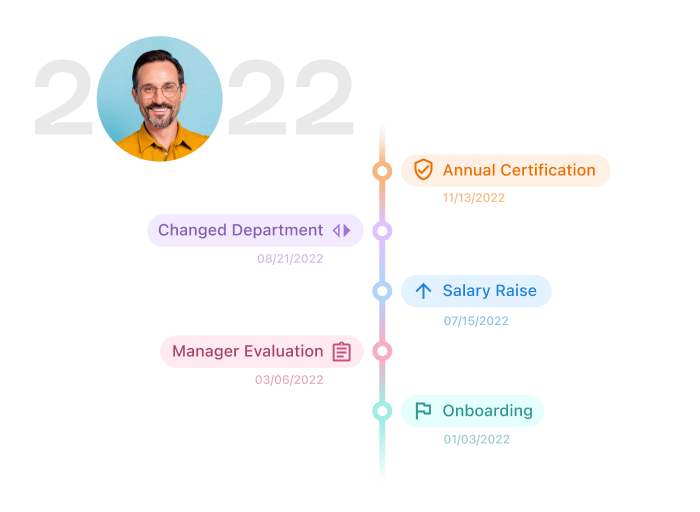
Connecteam’s employee timeline management is a useful way to keep track of each employee’s journey at your company. It automatically records profile changes such as pay rate, title, or department changes. You can manually add milestones such as training completions and past evaluations.
With everything in one place, it’s easier to track progress against goals and spot performance patterns before you sit down for a review. You can also assign reviews as recurring tasks with the Operations Advanced plan or above, ensuring managers never miss a scheduled evaluation.
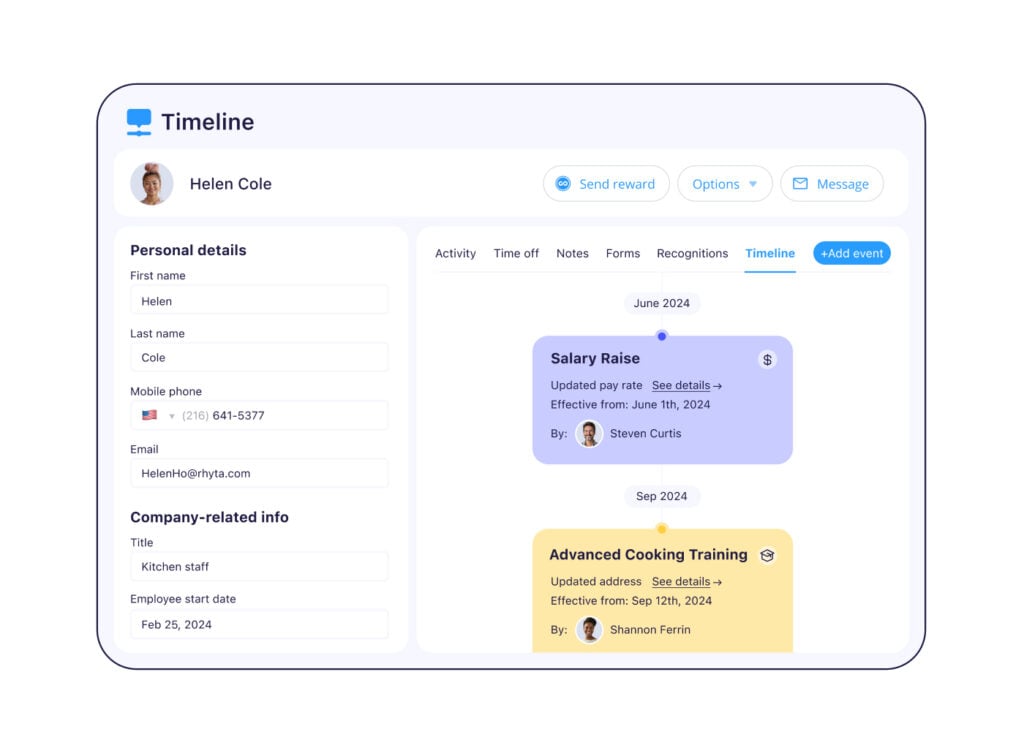
Track employee progress with Connecteam’s employee timeline. Recognition and rewards
Acknowledge your workers when they complete a difficult task or receive a stellar review. Connecteam allows you to create custom recognitions, add personal messages or badges, and share them on the company newsfeed.
You can also send digital tokens that employees can redeem for gift cards to their favorite stores, making it simple to reward top performers directly within the app.
Employee training and development
Connecteam’s employee training software helps you create custom professional development courses directly in the app to address areas of improvement identified during evaluations. You can monitor training progress in real-time, track completions, and assess learning with quizzes. If you’re short on time, the AI Course Creator lets you build custom training modules in seconds just by describing your topic.
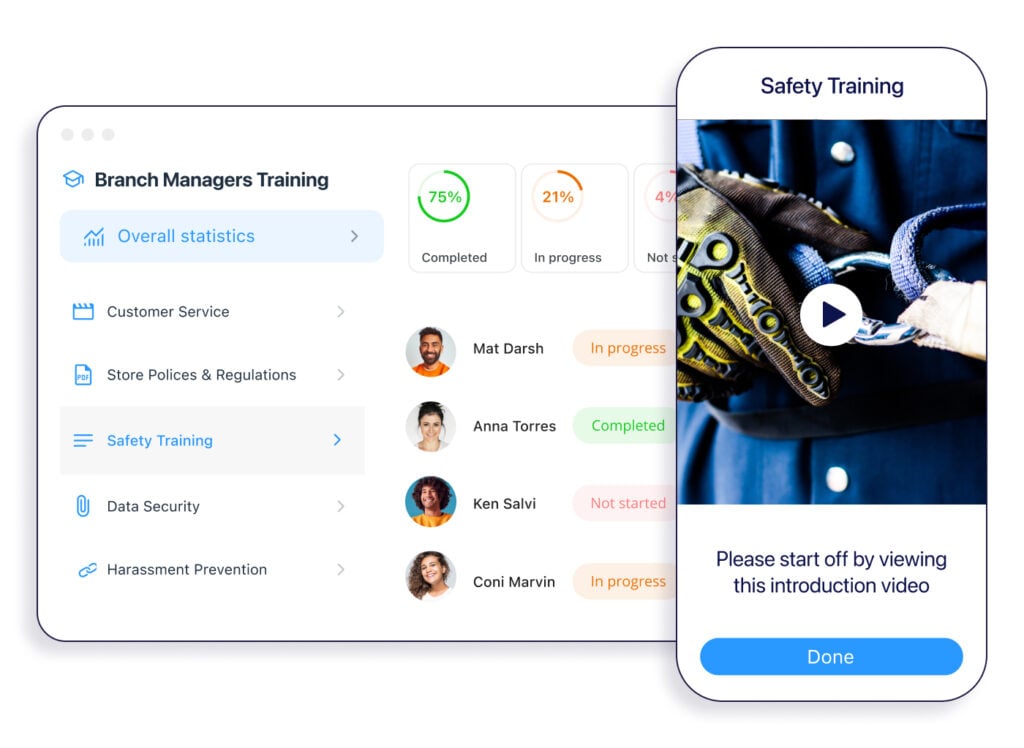
Connecteam’s employee training software reinforces professional development. Team chat and communication
Connecteam’s online team chat provides a professional, secure way to follow up with team members after evaluations. You can privately discuss objectives, provide coaching, or answer questions instantly. The chat is fully searchable and accessible on mobile, making it easy to maintain an ongoing dialogue about performance outside of formal review cycles.
And so much more…
Connecteam’s greatest strength is that it handles everything from drag-and-drop employee scheduling and GPS time tracking to document storage and surveys. You can store all completed evaluations securely in the staff documents hub, gather 360-degree feedback using anonymous surveys, and even manage time-off requests, all from the same mobile-first platform.
When Connecteam isn’t a good fit
Connecteam isn’t an enterprise-grade performance calibration tool. It doesn’t have native 9-box talent grids, complex compensation planning modules, or deep integrations with enterprise ERP systems like SAP. Large enterprise organizations that need complex, multi-layered calibration workflows and dedicated OKR cascading tools may prefer a specialist performance platform.
Connecteam also offers a free for life plan – Try Connecteam here!
0Key Features
- Digital forms builder for custom evaluations
- Employee timeline and milestone tracking
- Recognition badges and rewards
- Mobile-first employee training courses
- Task management for review scheduling
- Online team chat and company newsfeed
Pros
- Intuitive and easy to use on mobile devices
- Single solution for operations and HR
- Base hub pricing covers up to 30 users
- Excellent customer support
Cons
- Needs internet or WiFi access to use
- Lacks enterprise 9-box calibration grids
Pricing
Free-for-life plan availablePremium plans start at $29/month for 30 users
14-day free trial, no credit card required
Start your free trial -

Betterworks — Enterprise teams aligning performance to OKRs and business strategy
Available on
- Web
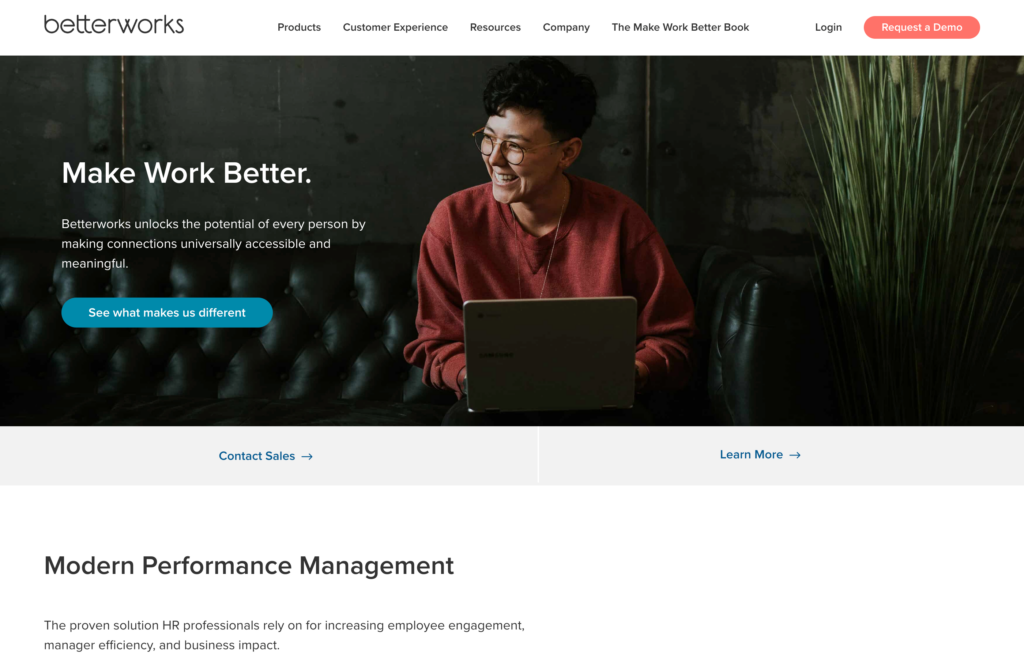
Betterworks is an enterprise-ready performance management software that transforms annual reviews into a continuous cycle of goal setting, feedback, and calibration.
Why I chose Betterworks: I chose Betterworks because it seems like a good fit for large organizations needing continuous performance management tied directly to strategic goals.
OKR alignment and goal cascading
Betterworks builds goal-setting directly into the evaluation workflow by connecting individual contributions to team and company OKRs. The platform uses AI to recommend goals aligned to strategy and role, so performance evaluation ties directly to business outcomes. Company priorities cascade to team and individual goals, giving leaders clear visibility into how employee work connects to broader strategic priorities.
The platform helps managers understand how employee work contributes to business goals. However, setup can be time-consuming, as goal creation often relies on bulk CSV uploads that can cause errors during onboarding.
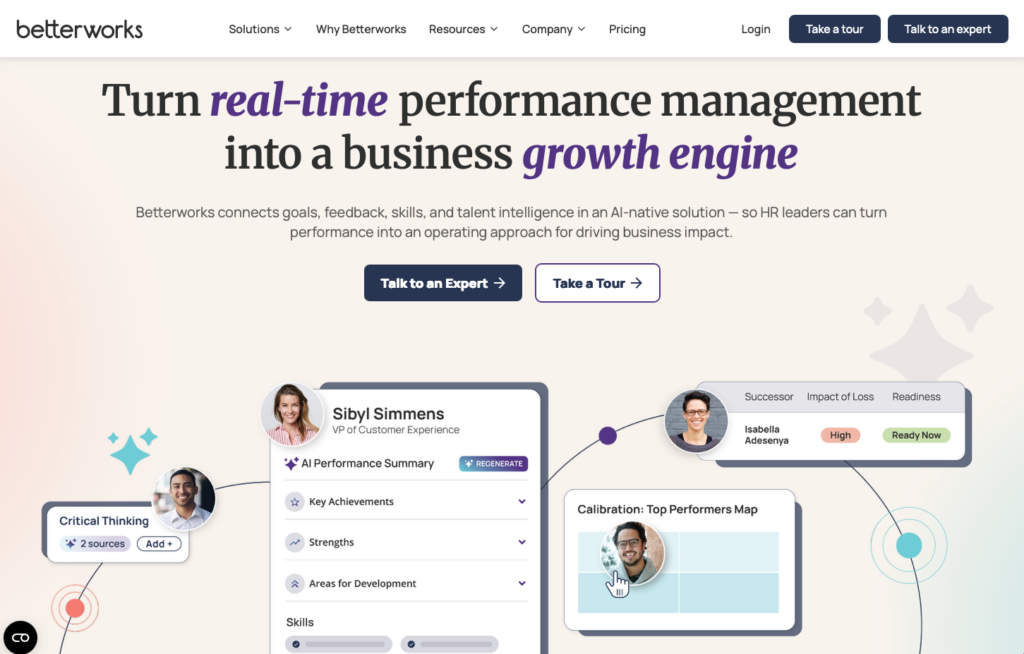
With Betterworks, you can access AI performance summaries, goals, feedback, and talent insights. Real-time feedback and 1:1 management
Betterworks focuses on continuous performance management alongside structured review cycles. Managers can capture real-time feedback tied to goals and ongoing work, while structured 1:1 templates link directly to OKRs and action items.
Notes from these meetings become part of each employee’s performance record, making reviews easier to support with documented examples. The platform also supports feedback between managers, peers, and direct reports, with optional anonymity to encourage honest input.
Skills intelligence and enterprise calibration
Betterworks uses AI to identify employee skills from goals, feedback, 1:1s, and other work activity, giving managers a more complete view of workforce capabilities. It also offers enterprise-grade calibration, succession planning, and an AI co-pilot that summarizes performance history, suggests goals, and flags at-risk employees.
These advanced Talent Intelligence features are available with Performance + Talent Intelligence. Betterworks also requires a separate HRIS for payroll and benefits, maintains both Classic and NextGen interfaces during its ongoing transition. Betterworks says it adds the most value for organizations with over 500 employees.
What users say about Betterworks
It simplifies goal tracking, encourages continuous feedback, and helps ensure that individual efforts are directly tied to overall business objectives, improving both accountability and performance.
More customization options for dashboards and notifications, including finer prioritization and configurable alerts, would make it easier to surface important updates and improve overall efficiency.
Key Features
- OKR and goal alignment
- Continuous feedback
- Enterprise calibration workflows
- AI-powered manager coaching
Pros
- Connects performance to strategic goals
- Excellent visibility into team alignment
Cons
- Interface is not perfectly intuitive
- Requires a separate HRIS for core HR functions
Pricing
Starts at $8/user/month Trial: No Free Plan: No
Compare the Best Employee Evaluation Software Tools
| Topic |
|
|
|
|
 Start for free
|
|
|---|---|---|---|---|---|---|
| Reviews |
|
|
|
|
|
|
| Pricing |
Starts at $10/user/month
|
Starts at $5/user/month
|
Starts at $4/user/month
|
Starts at $4/user/month ($4,000 minimum annual spend)
|
Starts at just $29/month for the first 30 users
|
Starts at $8/user/month
|
| Free Trial |
yes
7 day
|
yes
|
yes
14-day
|
no
|
yes
14-day
|
no
|
| Free Plan |
no
|
no
|
no
|
no
|
yes
Free Up to 10 users
|
no
|
| Use cases |
HR teams managing performance reviews alongside payroll and benefits
|
Managers seeking intuitive performance reviews with aligned goals
|
Continuous feedback and real-time performance conversations
|
Calibration and analytics-driven performance management
|
Frontline teams connecting evaluations to daily work
|
Enterprise teams aligning performance to OKRs and business strategy
|
| Available on |
Web, Windows, Mac
|
Web
|
How to Choose the Right Employee Evaluation Software
Start with how your team actually handles performance reviews. If managers just need a simple way to document evaluations and give feedback, you probably don’t need a complex performance management platform. But if you’re running 360-degree reviews, tracking goals, or comparing performance across departments, you’ll need more advanced features.
Think about who’s going to use the software, too. A tool might look great in a demo, but if your managers are constantly on the move, they need to be able to complete evaluations from their phones.
One thing I noticed while comparing these tools is that setting up reviews is often easier than changing them later. For example, 15Five locks certain settings once a review cycle starts, while Lattice also limits mid-cycle changes. If your review process changes frequently, this is something worth checking before you commit.
Finally, look beyond the starting price. Check which features are included in each plan, whether the software integrates with your existing tools, and how much it’ll cost as your team grows.
If there’s a free trial, have a manager run an actual evaluation before committing. You’ll quickly find out whether the process is as simple as it looks.
How Much Does Employee Evaluation Software Cost?
The pricing of performance evaluation software depends on the provider, the number of users, and the feature package. It often starts between $4 and $10 per user per month, which can get expensive if you’re working with a large team. Many enterprise-focused tools also require annual contracts or minimum spend thresholds that can run into the thousands of dollars.
Connecteam, meanwhile, offers a Small Business Plan that is 100% free plan for up to 10 users, and paid plans start at just $29 per hub for the first 30 employees.
The Bottom Line on Employee Evaluation App
For businesses that want to avoid the complexity and cost of enterprise tools, especially those managing frontline teams, Connecteam brings together flexible evaluation forms, mobile access, and built-in communication in one platform. Start your free Connecteam trial today.
FAQs
Using an app to assist with employee evaluations allows you to consolidate all performance data in a single place and streamlines the evaluation process. It makes it possible to more easily use employee data to effectively measure your employees’ performance, improves your HR department’s decision-making process, and ensures that evaluations are conducted consistently and fairly.
Employee evaluation software focuses on assessing how employees are doing through performance reviews, ratings, and feedback forms.
Performance management software takes things further. It helps managers set goals, track progress, hold regular check-ins, and support employee development throughout the year.
There’s plenty of overlap between the two, but if you mainly need to run occasional reviews, a simple evaluation tool may be enough. If you’re looking to manage performance on an ongoing basis, you’ll likely need something more comprehensive.
Yes. Some employee evaluation apps offer free plans, although the features and user limits vary.
For example, Connecteam has a free Small Business Plan for up to 10 users. You can create custom evaluation forms, collect employee feedback, and keep review records organized, all from your phone or computer.
It’s a practical option for small teams that don’t need a dedicated enterprise performance management system. You can get started with Connecteam for free.
Yes, but software alone won’t make performance reviews completely fair.
Using the same evaluation criteria and rating scales for employees in similar roles helps managers make more consistent decisions. Keeping a record of past feedback also makes it easier to judge performance over time instead of focusing on recent events.
Some tools also support self-assessments and peer feedback, giving managers a broader picture of each employee’s work.
That said, managers still need to back up their ratings with specific examples and question their own assumptions.
There are multiple ways to evaluate performance. Peer reviews allow employees to evaluate each others’ performance, providing multiple perspectives. Self-assessments encourage employees to reflect on and evaluate their own performance. Management by objective (MBO) involves managers evaluating employee performance and identifying goals for the employee to work on together. Connecteam supports all these evaluation types through its customizable digital forms.
While official performance reviews are usually held once a year, it’s important to provide employee feedback on a consistent basis. Use employee performance evaluation software, like Connecteam, to keep track of employee progress and productivity throughout the year. Upload past evaluations and store them for future reference, and use rewards and recognitions to acknowledge achievements as they occur.