

When catering orders, staff schedules, and last-minute changes aren’t in sync, small mistakes turn into missed deliveries, and you’re left dealing with unhappy clients and lost revenue.
I reviewed the 5 best catering management software and ranked them by scheduling, order coordination, and real-time staff visibility.
Use these picks to stay organized, reduce errors, and keep events running smoothly from first inquiry to final delivery.
| App | Best for | Starting Price | Key Considerations |
| Total Party Planner | Catering businesses managing events, menus, and clients | $199/month + $25/user/month | Strong for event, proposal, and operational planning, but weaker on native staff scheduling. |
| Caterease | Caterers that need detailed event planning and reporting | $99/month + $28/user/month | Good catering workflow depth, but the interface may feel heavy. |
| Better Cater | Small catering businesses managing events and proposals | $57/month + $25/user/month | Practical and small-business friendly, but lacks a mobile app. |
| Curate | Caterers managing proposals, menus, and client communication | Contact vendor for pricing | Strong proposal and client workflow, but important operational features gated by plan level or add-ons. |
| Connecteam | Managing catering staff, scheduling and daily operations | $29/month (up to 30 users) | Strongest for staff operations, visibility, and communication. |
| 7shifts | Catering teams managing staff scheduling and labor costs | $34.99/location/month | Strong scheduling and labor controls, but not a full catering management suite. |
What’s New in This Update (May 2026)
- Removed FoodStorm and added Caterease and 7shifts to the list.
- Split list into main catering platforms first, then a separate section for team/operations tools to better reflect use-case differences across vendors.
- Tailored criteria to the catering use case, emphasizing client-facing needs.
- Reverified pricing, free plans, and trials of all vendors as of May 2026.
Our Top Picks
-
1

Best for catering businesses managing events, menus and clients
-
2

Best for caterers needing detailed event planning and reporting
-
3

Best for small catering businesses managing events and proposals
Why trust us?
Our team of unbiased software reviewers follows strict editorial guidelines, and our methodology is clear and open to everyone.
See our complete methodology
How I Ranked the Best Catering Management Software
Here are the key features I looked for to rank the best catering management software.
Must-have catering management features:
Every catering management platform should have these core features.
I prioritized:
- Booking management: It should be easy to capture inquiries, manage quotes, confirm bookings, and keep every order detail organized from first contact to final event.
- Event coordination: I prioritized software that helps teams manage timelines, tasks, and key details in one place without relying on scattered notes.
- Menu management: The software should make it simple to build menus, track package options, manage item details, and adjust pricing or selections for different events.
- Contract and proposals: I looked for software that helps teams create quotes, proposals, and client agreements.
- Inventory and supply tracking: Catering businesses need a way to track ingredients, equipment, rentals, and other supplies so each event is properly prepared.
- Shift scheduling: The software should provide a clear way to assign staff, track schedules, and make sure the right people are prepared for each job.
- Staff visibility: Managers must be able to see employee locations in real-time to know who’s on-site, who’s on the way, and who’s available for last-minute requests.
- Real-time communication: I looked for software that helps different teams share updates instantly so changes, delays, and important details are seen right away.
I also looked at how it performs day-to-day:
Beyond the essentials, I evaluated how each software works in real catering operations.
- Ease of use: The tool should be simple enough for managers and staff to use without a steep learning curve or too much setup.
- Mobile accessibility: Teams need to be able to check schedules, update event details, and stay informed from their phones while working on-site or on the go.
- Customization: The software should support tailored workflows, forms, and event processes to match the way catering businesses actually operate.
Finally, I checked for features that improve control and profitability:
- Reporting and insights: Managers should be able to track sales, event performance, labor needs, and other key numbers so they can spot issues early and plan ahead.
- Permissions and approvals: The software should include admin controls so managers can decide who can edit bookings, schedules, or event information.
- Integrations and payments: I looked for software that connects with accounting and payment tools to reduce duplicate work and keep operations on track.
The Best Catering Management Software of 2026
-
Total Party Planner — Best for catering businesses managing events, menus and clients
Available on
- Web
- iOS
- Android
Total Party Planner is a catering management platform that offers event planning, proposals, client communication, back-of-house coordination, and more.
Why I chose Total Party Planner: I liked that Total Party Planner provides catering-specific workflows, especially when it comes to proposals, event management, menu costing, and operational planning.
Event planning and client management
Total Party Planner brings event details into one place, so managers can handle both client-facing and operational planning together.
The sales side also seems pretty well developed. It includes lead tracking, CRM tools, a client portal, digital signatures, and centralized communication. Leads move through a pipeline, and you can add visual elements to proposals before sending them to clients to review, sign, and pay in one flow.
For catering businesses managing high volumes of inquiries and events, that end-to-end sales and planning setup is definitely helpful.
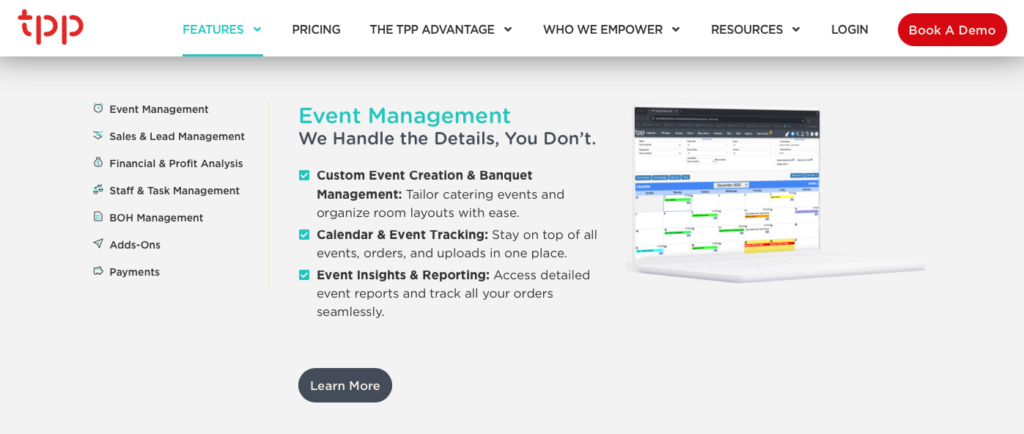
Total Party Planner includes event creation and tracking. Catering production and execution
Total Party Planner lets teams build and manage menus, packages, and rentals. On top of that, the platform can also generate BEOs to detail everything you need to execute an event, which I thought was impressive.
There are also tools for recipe and menu costing, profit tracking, and bulk cost updates, so teams can stay on top of margins. I really liked the menu database, which stores descriptions, ingredients, allergy notes, and images that you can reuse across events. The platform also offers automated pack lists and ties staffing and logistics directly to event details, keeping execution organized.
The one thing to keep in mind is that these workflows really depend on accurate upfront setup, so teams need to be consistent with data entry to get the full value. I can see that being an issue for busy teams that might not have time to maintain records manually.
Staffing and integrations
On the staffing side, Total Party Planner includes task and team management, templates, user permissions, and a mobile app. However, I would have liked to see stronger built-in scheduling and workforce management features.
Instead, it relies on integrations like Nowsta and StaffMate for its scheduling workflows. That means you would probably have to pay for an additional subscription on top of Total Party Planner just to access these basic tools. For teams that need deeper scheduling tools in the same system, that could be a real limitation.
What users say about Total Party Planner
We love that we can create a detailed proposal in TPP, that becomes a working event plan, and that we can have one version for the client with pricing and client appropriate notes and an internal version without pricing and kitchen/internal specific notes.

TPP had a big learning curve and takes a lot of effort to put together but once you have the system in place it can do amazing things.
Key Features
- Custom event creation and tracking
- Proposals, invoices, and payments
- Menu and recipe costing
- Client portal and chat
Pros
- Profit analysis and cost management
- Strong catering-specific tools
Cons
- No native staff scheduling
- Set up is manual and data-heavy
Pricing
Starts at $199/month + $25/user/month Trial: No Free Plan: No
-
Caterease — Best for caterers needing detailed event planning and reporting
Available on
- Web
- iOS
- Android
- Windows
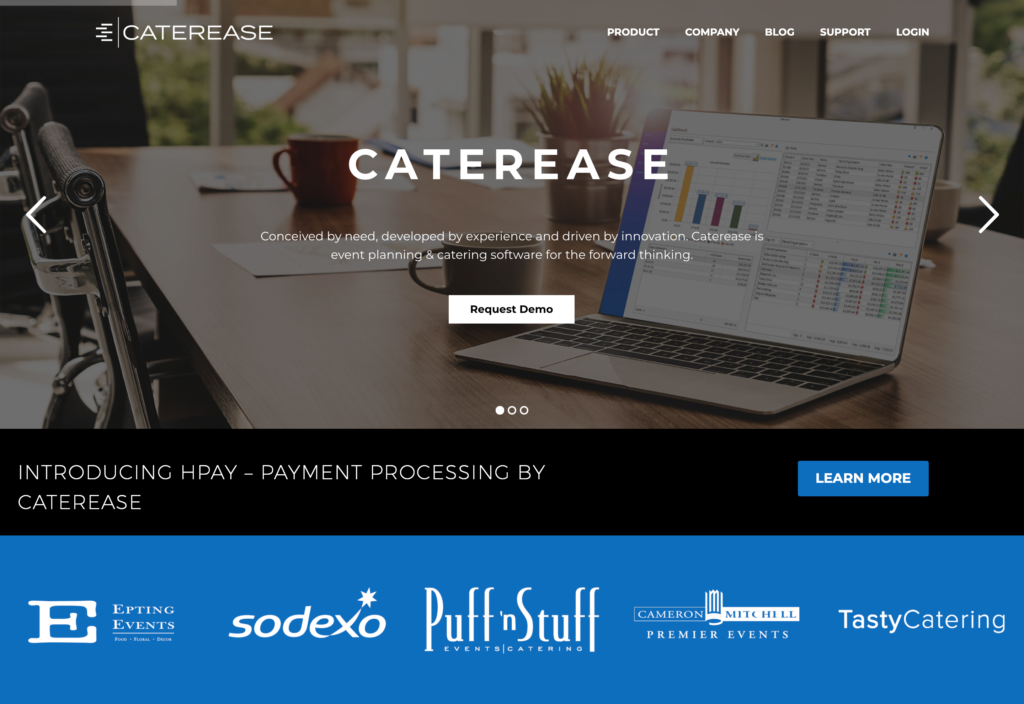
Caterease is a catering and event management software designed to handle bookings, menus, staffing, payments, and operations in one platform.
Why I chose Caterease: I chose Caterease because it offers a strong catering workflow, especially around booking, menu management, client-facing documents, and event logistics.
Bookings, event setup, and client workflow
Caterease offers booking tools that let you customize forms and workflows, so you can collect all the important event details upfront without missing anything. The level of detail is impressive, but it also felt overwhelming to me, especially with its outdated interface that didn’t seem super intuitive.
The platform also supports client management, with features for inquiry capture and prospect tracking. There’s even a customer portal where clients can view event details, sign contracts, make payments, and request updates.
Plus, there are event reports, dashboards, and custom documents to give teams a central way to manage both client-facing and operational details.
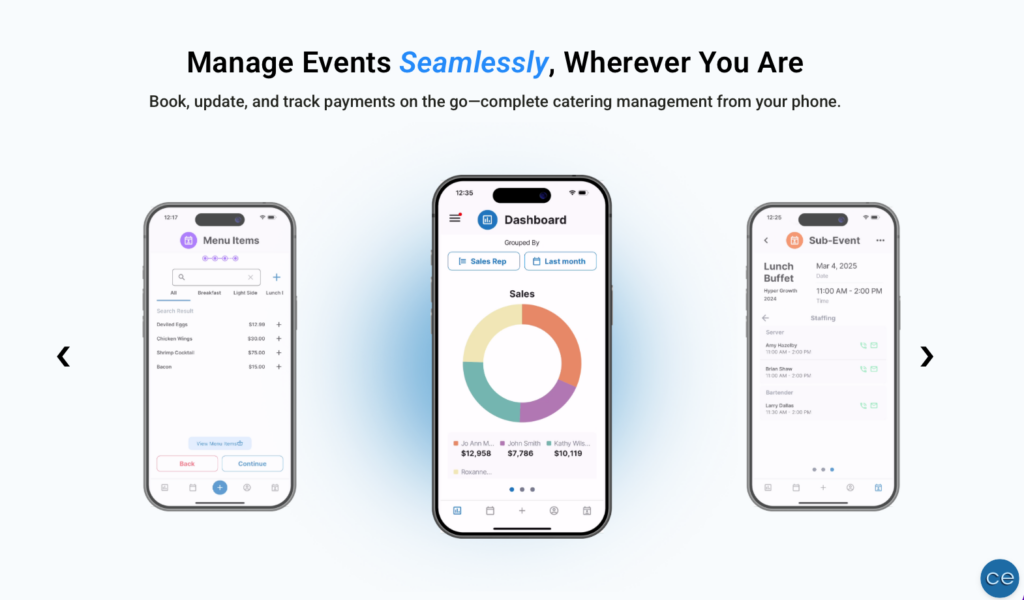
Use Caterease’s mobile app to plan menus, view profitability, and manage events. Menu management and event execution
Menu management is one of Caterease’s strongest areas. It lets teams build custom menus with ingredients, costs, and profit details. You can then quickly pull those items into events along with related packing lists, without having to re-enter information.
The operational side includes automatic packing lists, event documents, reminders, and detailed notes to keep execution on track. There are also optional add-on modules for things like document creation, venue management, and lead tracking, so you can expand the system as your needs grow.
Staffing and payments
Caterease lets managers assign employees to roles, store wage types (including overtime and flat rates), and manage seasonal staff by toggling availability as needed. I found this especially useful for rotating event crews.
Scheduling is also more detailed than I expected. Managers can track availability, set recurring rules, manage time off, and flag staffing conflicts when building events. You can assign staff to specific roles, add them to shifts, and track who has confirmed.
For payments, Caterease includes integrated processing for cards, ACH, and digital wallets, along with tracking, receipts, and built-in payment tools, which gives it a great operational setup.
What users say about Caterease
Ultimately I did have an incredibly positive experience using Caterease at my small boutique catering firm. The back of house and front of house capabilities did prove to be incredibly helpful to my entire team!
Hasnt been updated in years, needs an owners manual to use it and if you want a repair it take weeks to solve.
Key Features
- Event booking tools
- Custom event documents
- Customer portal and payments
- Staff shifts with reminders
Pros
- Strong catering-specific menu and event tools
- Automated proposals and packing lists
Cons
- Interface feels outdated
- May have steeper learning curve for new users
Pricing
Starts at $99/month + $28/user/month Trial: No Free Plan: No
-
Better Cater — Best for small catering businesses managing events and proposals
Available on
- Web
Better Cater is a catering software for small businesses that includes proposals, event management, menu costing, invoicing, and payments.
Why I chose Better Cater: Better Cater stood out for its practical catering workflow built around fast proposals, ingredient-based costing, event documents, and packing lists.
Proposals, quotes and event workflows
Better Cater helps teams quickly move from inquiry to booked event. It brings client details, event info, and guest counts into one place, so you can create and manage events without jumping between tools.
Managers can generate proposals and invoices directly from event data to speed up the quoting process. Document handling is also pretty flexible. I liked that you can preview, download, or send documents directly to clients, with control over pricing, taxes, totals, and branding.
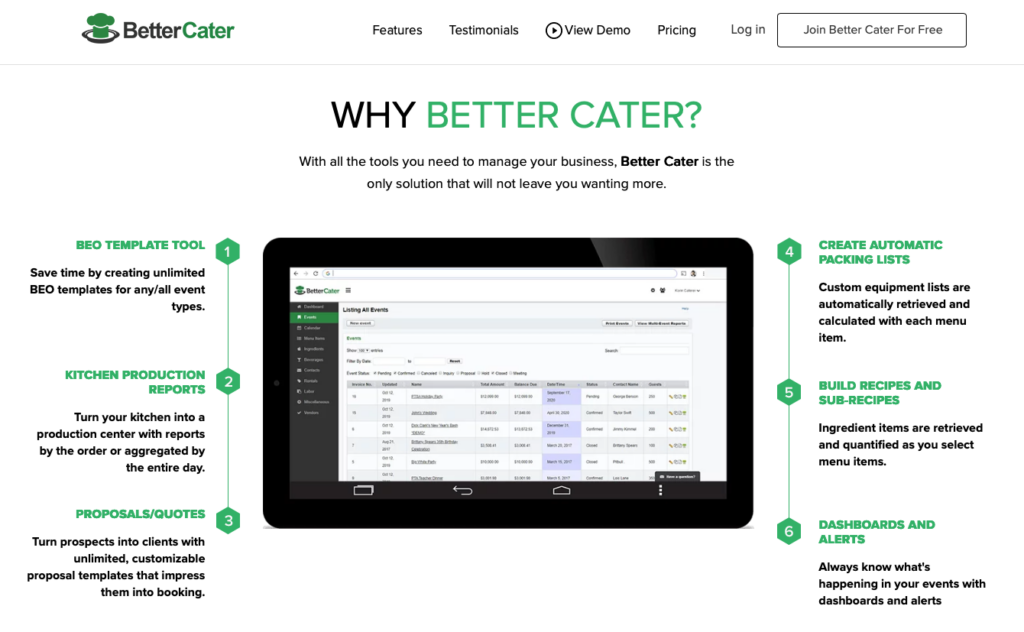
Better Cater helps manage events. Menus, recipes, and automatic packing lists
Better Cater lets you build recipes and sub-recipes, automatically pull in ingredients as menu items are selected, and generate packing lists tied directly to menu data.
I appreciated that it also calculates costs based on ingredients and allows you to group items into packages for faster event setup. Manual cost overrides are supported, which is helpful.
Payments and accessibility
Better Cater offers integrated online payments, which support major credit and debit cards. There are also tools for tracking balances, taxes, gratuities, discounts, and payment history.
Reporting includes BEOs, packing lists, kitchen reports, and multi-event profit tracking across date ranges, which I appreciated.
The biggest issue for me is that there’s no mobile app. Better Cater is fully web-based, and while you can access the platform on your mobile browser, it’s not the same as having a dedicated app.
What users say about Better Cater
I love the convenience of going to one site for your catering needs. I was able to manage the site perfectly.
Customization Limits – While flexible, certain template layouts or reports may not allow for full design control.
Key Features
- Proposals, quotes & invoices
- Ingredient costing and recipe management
- Event management with client history
- Online payments and balances
Pros
- Strong proposal and menu-costing
- Automatic packing lists
Cons
- No dedicated mobile app
- Lacks shift scheduling
Pricing
Starts at $57/month + $25/user/month Trial: Yes — 30-days Free Plan: No
-

Curate — Best for caterers managing proposals, menus, and client communication
Available on
- Web
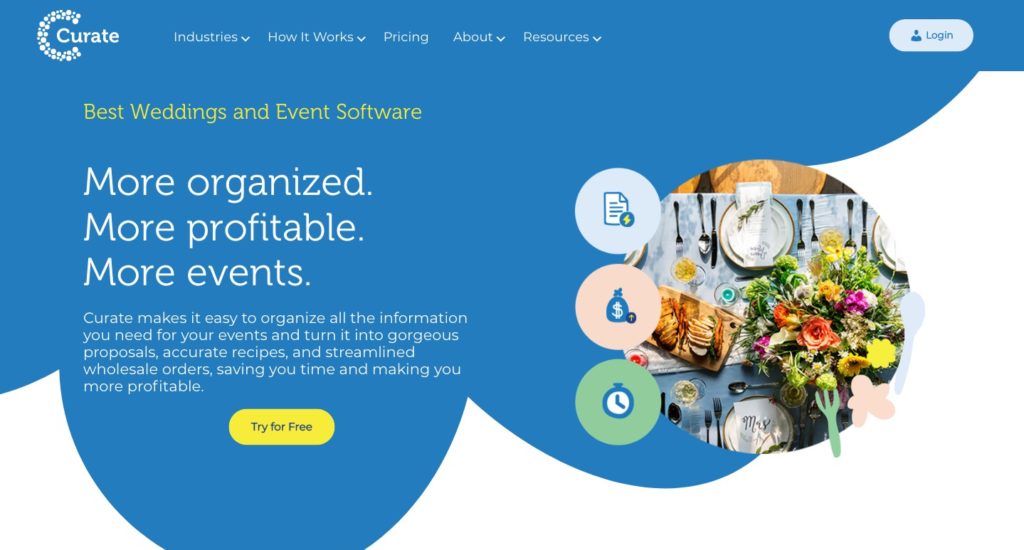
Curate is a catering and event management platform, offering proposals, client collaboration, payments, and operational planning.
Why I chose Curate: I liked that Curate connects inquiry intake, visual proposals, contracts, payments, and production planning in one system.
Proposals and client portal
With Curate, teams can capture inquiries through forms, turn leads into tailored proposals, and include menus, pricing, and event details in polished, client-facing documents. Proposals are shared as branded, interactive portals where clients can review, comment, sign, and pay.
It also supports templates, duplicate events, and personalized fields that auto-fill client and event data. I was really impressed by the process and how professional the proposals looked.
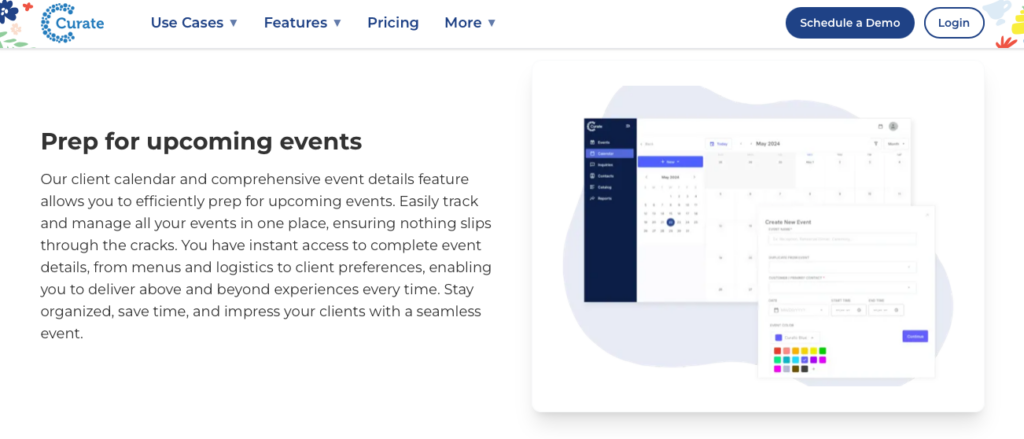
You can customize event details with Curate. Recipes and event documents
Curate is also strong when it comes to production. Managers can build a catalog of menu items, recipes, rentals, and staffing roles, with automatic cost calculations and suggested pricing to keep margins clear.
The system supports ingredient-level setup, sub-components, and even non-food items like disposables, which is helpful for making sure nothing gets missed during events. It also generates documents like recipe sheets, shopping lists, staffing schedules, and event prints with detailed notes.
Payments and integrations
Curate covers finance and coordination with built-in payments via Stripe (card and ACH), flexible payment schedules, automatic reminders, and e-signatures. Deposits and final balances are managed within the same client workflow, which is convenient.
It also supports integrations like QuickBooks, Google Calendar, and Nowsta. One trade-off I noticed is that several operational features, like recipes, forms, and purchase orders, are only available in higher plans, and some tools (like staffing and rentals) rely on add-ons rather than being included.
What users say about Curate
I like that Curate is our main system for keeping weddings and events organized. I appreciate how it manages our inventory, CRM, floral ordering, materials, payments, and contracts while providing a portal for clients to stay informed.

I think there’s some deeper features like timelines and task management that we would love to be able to have. More detail oriented approach to.
Key Features
- Branded client portal
- Inquiry forms
- Contracts and payments
- Recipes and shopping lists
Pros
- Visual proposal creation
- End-to-end proposal workflow
Cons
- Basic features locked behind higher plans
- Staffing and rentals as add-ons or integrations
Pricing
Contact vendor for pricing Trial: No Free Plan: No
Best tools for managing catering teams and operations
-
Connecteam — Best all-in-one catering management software
Connecteam is the best choice for catering businesses because it combines staff coordination, scheduling, and daily operations tools in one platform. It’s particularly strong for teams that need to manage changing event details, mobile staff, and fast-moving work without switching between multiple apps.
Why I chose Connecteam: Connecteam is a great choice for catering management, especially when it comes to staff scheduling, real-time communication, and visibility into daily work.
Staff scheduling
Connecteam’s employee scheduler is built for real operational work, not just basic calendar planning. Managers can build schedules by dragging and dropping shifts into place, create separate schedules by location or team, and add shift notes, tasks, or attachments so everyone knows what’s expected.
Staff can set their availability, request time off, and access schedules right from their phones. Real-time notifications keep everyone aligned when a new schedule is published or updated, and you can even share a read-only version with clients or vendors to keep them in the loop.
Managers can also set custom scheduling rules, like requiring specific roles or experience levels for certain events, and use the AI-powered auto-scheduler to fill shifts based on availability and qualifications. I also liked that Connecteam flags overlapping shifts and double bookings before schedules go live, so you can avoid staffing gaps or conflicts during important events.
Flexibility is built in, too. Employees can release shifts they can’t work, and teammates can pick them up with optional manager approval. You can also post open for staff to claim to quickly fill gaps without chasing anyone down.
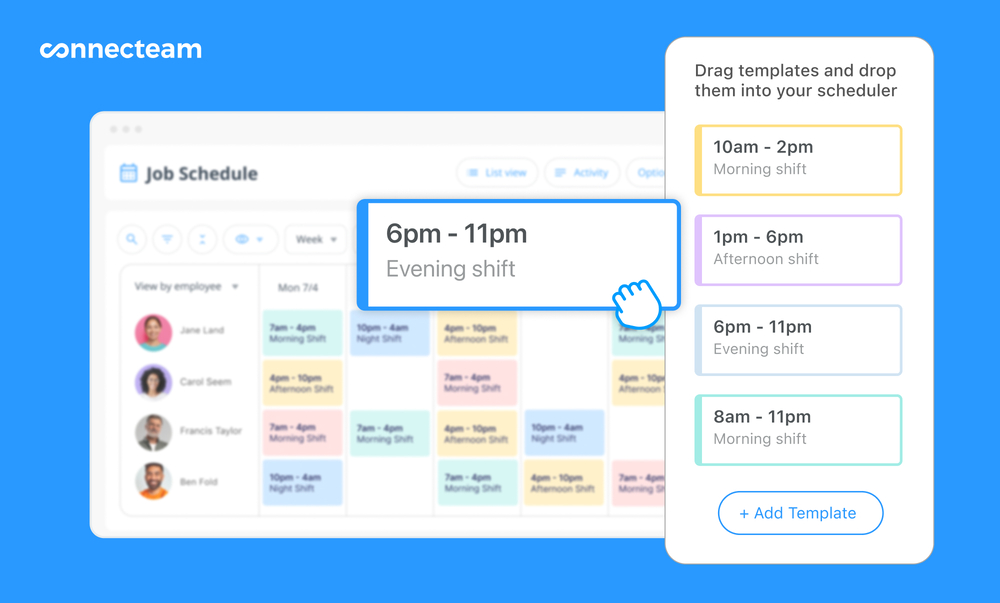
Create schedules that work for your business with Connecteam. Real-time communication
Connecteam’s team instant messaging lets managers message staff directly, create group chats, send files, images, videos, and links, and easily search conversations in one place. With the company update feed, you can post announcements and target updates by crew, role, or location. If you have important information everyone needs to know, require employees to confirm that they’ve seen it.
For catering businesses, that’s especially useful when timelines shift, headcounts change, deliveries run late, or staff need last-minute instructions.
The built-in company employee directory also makes a huge difference, helping you find staff, vendors, or contacts by name, role, or location without digging through old lists. Plus, since all communication happens in the app, there’s no need to save contacts on your personal phone.

Connecteam helps teams share the updates that matter most. GPS time tracking
Connecteam’s employee time clock gives managers clear visibility into where staff are and what’s happening throughout the workday. Employees can clock in from the mobile, desktop, or kiosk app, giving teams flexibility, depending on their work environment.
For catering crews working across venues, GPS tracking, location stamps, and geofencing help confirm staff are in the right place at the right time. Managers can track arrivals, monitor routes, and reduce guesswork around off-site work, deliveries, and setups.
At the end of each pay period, managers can review and approve timesheets for payroll. Custom pay rules, overtime tracking, and payroll-ready reports all help keep labor costs accurate and under control.
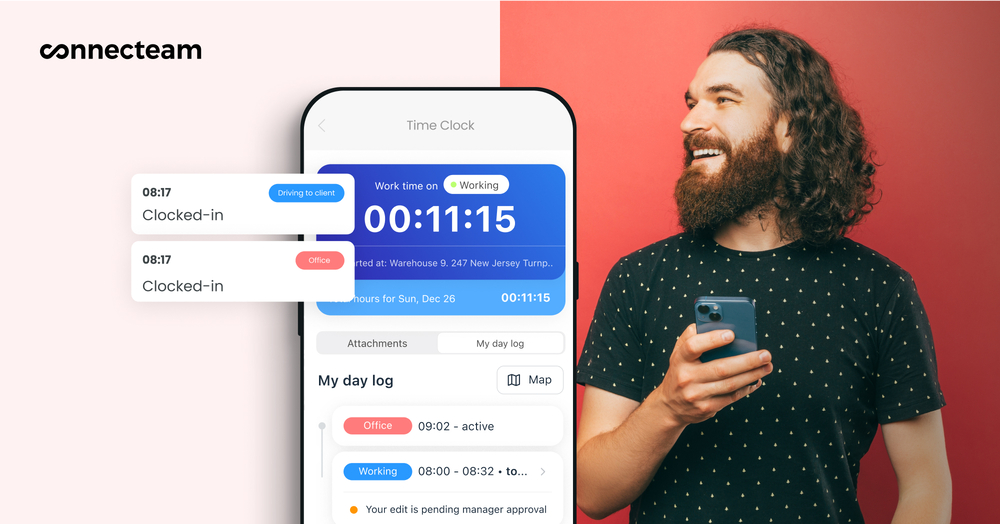
See where your employees are, wherever they’re working. Forms and workflows
Connecteam’s digital forms and checklists help catering teams create and maintain repeatable processes. You can build forms from scratch for everything from prep lists and setup checklists to delivery confirmations and incident reports, or start with a template and customize it to fit your workflow.
If you already have paperwork in place, you can upload or snap a photo of it, and Connecteam’s AI will turn it into a digital version. That means you can keep your existing processes without the manual work.
The forms are really flexible, with field types like text, dropdowns, and even speech-to-text for quick, hands-free input during busy service periods. Staff can also attach photos, files, signatures, or scanned documents. Every submission is time-stamped and stored in the app, so it’s easy to track records and revisit details when you need.
Integrations
Connecteam offers an API integration and connects to business tools you already use, including Zapier, Wix Bookings, QuickBooks, Gusto, and Square.
And so much more…
- Training and onboarding: Use the AI Course Creator to quickly build mobile training materials for service standards, food safety, and event procedures.
- Automatic reports: Get real-time insights into attendance, task completion, form submissions to keep events on track and spot issues early.
- Staff documents: Store and manage certifications, licenses, and contracts, with reminders for upcoming expirations.
- Employee task tracking: Assign prep, setup, and post-event tasks with subtasks and track progress in real-time to keep operations running smoothly.
When Connecteam isn’t a good fit
Connecteam isn’t the best fit for catering businesses looking to manage the full client-facing sales process, like proposals, contracts, menu creation, and bookings, in one system. If your priority is handling everything from inquiries to signed agreements, a more specialized catering platform might be a better choice.
0Key Features
- Drag-and-drop staff scheduling
- Availability and time-off requests
- In-app team messaging
- GPS and geofence time clock
- Digital forms and checklists
- Company directory with vendors
Pros
- Strong fit for mobile and event-based teams
- Live visibility into staff location and attendance
- AI-powered automatic scheduling
- Multiple self-service shift coverage tools
Cons
Lacks end-to-end sales and booking management
Pricing
Free-for-life plan availablePremium plans start at $29/month for 30 users
Try out the best catering management software for free
Get Started Now -

7shifts — Best for catering teams managing staff scheduling and labor costs
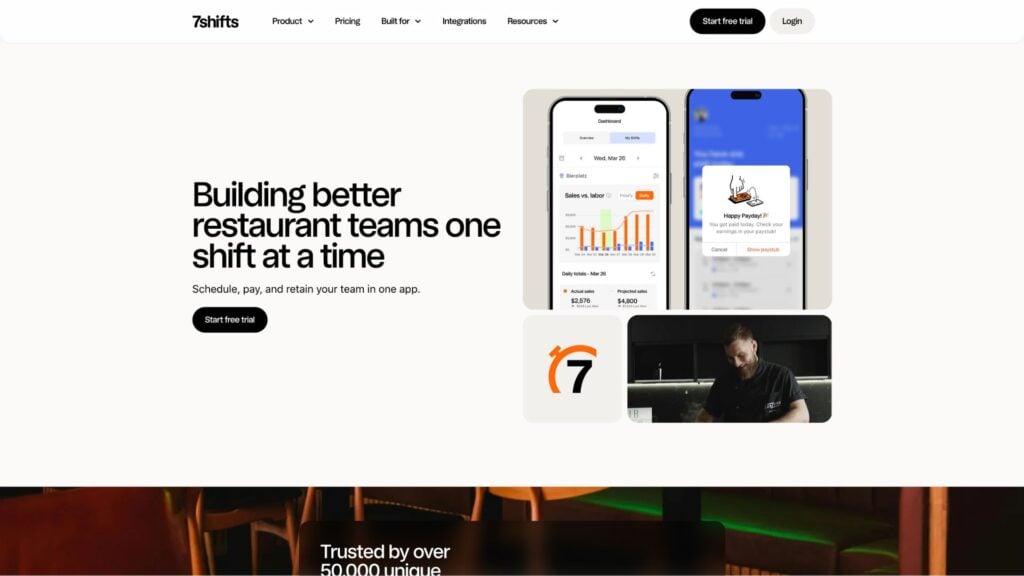
7shifts is a workforce management platform built for the restaurant industry, with tools for scheduling, labor control, time tracking, and communication.
Why I chose 7shifts: I included 7shifts because of its labor-focused scheduling and strong restaurant-specific workflows.
Scheduling and shift coverage
In our full 7shifts review, we tested the platform’s scheduling capabilities. The drag-and-drop builder lets managers assign shifts across roles and locations, while adding durations, breaks, and notes as needed.
I liked that repeat shifts and labor targets help save time and keep schedules aligned with your budget and projected sales. The system also flags overtime before it becomes an issue, so managers can keep costs down and avoid overworking staff. Most impressive, however, is the auto-scheduler, which uses past schedules, sales forecasts, availability, and labor rules to build optimal schedules with little manual input.
Employees can update availability and request time off in the app, with approved requests automatically reflected in schedules. When plans change, employees can swap, drop, or pick up shifts, with manager approval and automatic updates to keep everything accurate.
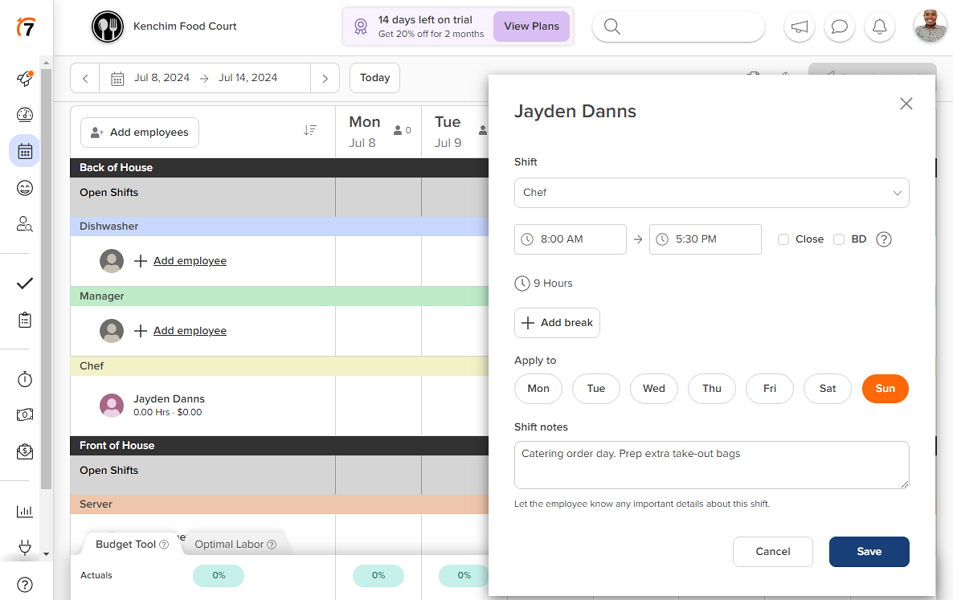
With 7shifts, we were able to create a shift, set its time and frequency, include a break, and add shift notes. Time tracking and labor controls
With 7shifts, time tracking isn’t built directly into the main app. During testing, we found that employees can only clock in through a separate app (7punches) or a POS system. Even though punches sync with 7shifts, switching between apps felt fragmented and added an extra step to the process.
The experience aside, 7shifts offers solid labor controls, including geofencing to limit off-site clock-ins and facial recognition to prevent buddy punching. I appreciated that there’s also break tracking, overtime alerts, and reports that compare sales data to labor costs.
Communication and tips
7shifts includes built-in messaging, which lets managers send direct messages or create group chats. There’s also a one-way announcements feature, which lets you send targeted updates by location, role, or department and track who’s seen them.
The platform also handles tip management, with flexible tip pooling options like equal splits, percentages, or point-based systems. Once it’s set up, payouts are calculated automatically, so distribution is faster and more transparent. Staff can see exactly what they earned and how tips were allocated, which I liked.
What users say about 7shifts
Love how easy it is to schedule folks and make adjustments on the fly. Also love how you can communicate with the entire team through it! Its like a group chat meets hr software.
Unfortunately, the schedule view is only one week at a time. It would be helpful to view multiple weeks, especially when we’re closing payroll for the period.
0Key Features
- Drag-and-drop scheduling
- Shift swapping and open shift requests
- Team chat and company announcements
- Tip pooling management
Pros
- Machine-learning auto-scheduler
- Strong focus on labor costs
Cons
- Time tracking uses a separate app
- Mobile app doesn’t work offline
Pricing
Starts at $39.99/month Trial: Yes — 14 days Free Plan: Yes — up to 15 users, 1 location
Compare the Best Catering Management Software
| Topic |
|
|
|
|
 Start for free
|
|
|---|---|---|---|---|---|---|
| Reviews |
|
|
|
|
|
|
| Pricing |
Starts at $199/month + $25/user/month
|
Starts at $99/month + $28/user/month
|
Starts at $57/month + $25/user/month
|
Contact vendor for pricing
|
Starts at just $29/month for the first 30 users
|
Starts at $39.99/month
|
| Free Trial |
no
|
no
|
yes
30-days
|
no
|
yes
14-day
|
yes
14 days
|
| Free Plan |
no
|
no
|
no
|
no
|
yes
Free Up to 10 users
|
yes
up to 15 users, 1 location
|
| Use cases |
Best for catering businesses managing events, menus and clients
|
Best for caterers needing detailed event planning and reporting
|
Best for small catering businesses managing events and proposals
|
Best for caterers managing proposals, menus, and client communication
|
Best all-in-one catering management software
|
Best for catering teams managing staff scheduling and labor costs
|
| Available on |
Web, iOS, Android
|
Web, iOS, Android, Windows
|
Web
|
Web
|
What is Catering Management Software?
Catering management software is a tool that helps catering businesses organize the work behind events, orders, and client service. Instead of managing everything through phone calls, paper notes, spreadsheets, and separate apps, it puts the moving parts of a catering job into one system. Depending on the platform, that can include inquiries, bookings, menus, event details, staff assignments, communication, payments, and delivery planning.
It serves as the main operating system for a catering business by helping teams keep track of what was ordered, what needs to be prepared, who’s working each event, and what still needs attention. For businesses that handle multiple orders at once, that kind of structure can make day-to-day operations much easier to handle.
How Does Catering Management Software Work?
Catering management software usually works by giving teams one place to manage the full event process from start to finish. A manager can log a new inquiry, build an order, confirm menu selections, add event details, assign staff, and track progress as the event gets closer. That means the team doesn’t have to bounce between texts, spreadsheets, printed notes, or inbox threads to figure out what’s happening.
Most platforms also keep important details connected as plans change. If a client updates a headcount, changes a menu item, or adds a delivery request, the software helps those updates flow into the schedule, prep plan, and event record. Staff can check their assignments, managers can monitor what’s on track, and the business has a clearer view of daily operations.
The Benefits of Catering Management Software
The right software can help your catering business in multiple ways, including:
Fewer mistakes
When orders, event details, and staffing plans live in one place, teams are less likely to miss key information. That can mean fewer wrong deliveries, missed prep items, and last-minute surprises that impact the client experience.
Smoother execution
A good catering management app helps everyone work from the same plan. Kitchen staff, drivers, servers, and managers can stay aligned, making events feel more controlled and less chaotic.
Faster responses
Catering work changes quickly. The right software helps teams react faster when clients update guest counts, timing, locations, or menu needs, so small changes don’t turn into bigger problems.
Saved time
When managers can see schedules, assignments, and workload more clearly, it becomes easier to place the right people where they’re most needed. That reduces confusion, cuts down on wasted time, and helps teams stay productive.
More confidence
As order volume increases, manual processes become harder to control. Catering management software gives businesses a more reliable way to stay organized, protect service quality, and handle more events without adding extra stress.
How Much Does Catering Management Software Cost?
Catering management software is typically priced using a base monthly subscription plus a per-user fee. Many providers charge around $99–$199/month, with additional costs of $25–$28 per user, while others offer lower base plans starting between $34.99– $57 per month. Pricing usually scales based on team size, features, and the number of events or locations managed.
In contrast, Connecteam’s Small Business Plan is completely free for up to 10 users, and paid plans start at just $29 per month for up to 30 users. Higher-tier plans start at $49/month for Advanced and $99/month for Expert, both also covering up to 30 users.
FAQs
It reduces waste, improves staff scheduling, tracks costs, and streamlines operations. Tools like Connecteam help optimize labor and prevent errors, directly lowering expenses and boosting profitability.
Common challenges include setup time, staff adoption, and data migration. These can be overcome with simple, user-friendly tools, proper onboarding, and choosing software with strong support and mobile accessibility.
Yes, many tools include CRM features to track clients, manage bookings, and automate follow-ups, which helps improve customer retention and generate repeat business.
It tracks ingredient usage, monitors stock levels, and helps forecast demand, reducing waste and preventing shortages during events.
The Bottom Line on Catering Management Software
Catering management software is a smart fit for businesses that need a better way to organize orders, coordinate staff, and keep event details from slipping through the cracks. When choosing a platform, the most important things to look at are how well it supports booking flow, staff visibility, real-time updates, and day-to-day ease of use.
Connecteam stands out as a top choice for managing catering staff, scheduling, and daily operations in one app. If you need a simpler way to keep events running smoothly and your team in sync, try Connecteam for free.