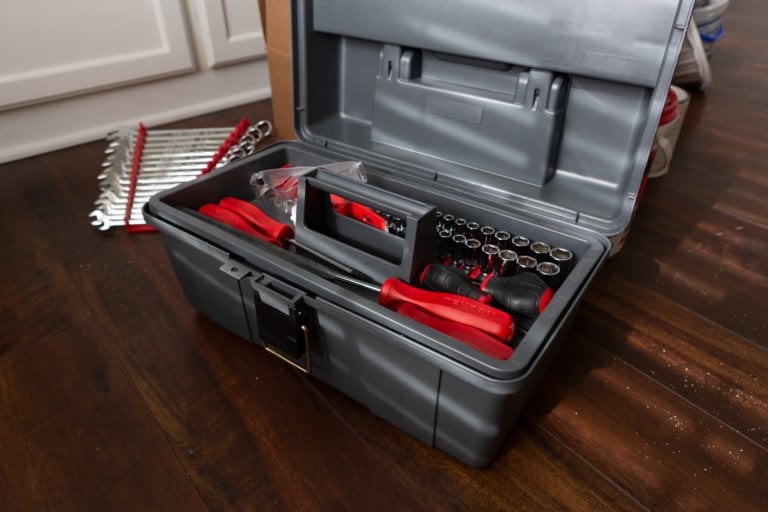


When maintenance requests pile up, small delays turn into costly breakdowns, leaving you with downtime, safety risks, and frustrated crews.
I reviewed 6 maintenance management software tools and compared them by ease of use, automation, and real-time visibility.
Use these picks to stay on top of work orders, reduce equipment downtime, and keep your costs under control.
If you don’t have the time to read through our research, jump down to our quick comparison table.
If you don’t have the time to read through our research, jump down to our quick comparison table.
| App | Best for | Starting Price | Key Considerations |
| Connecteam | Managing maintenance staff, field tasks, and daily coordination | Just $29/month for the first 30 users | Great for field team coordination, but not a full CMMS. |
| MaintainX | Mobile-first work orders and preventive maintenance | $20/user/month | Strong CMMS depth, but key automation tools are plan-gated. |
| Limble CMMS | PM-heavy teams that need asset and vendor workflows | Contact vendor for pricing | Strong PM and vendor tools, but limited advanced planning. |
| UpKeep | Maintenance teams that need work order automation and inventory visibility | $24/user/month | Broad CMMS feature set, but many tools depend on plan level. |
| Fiix | Asset-heavy teams that need reliability data and purchasing depth | $45/user/month | Strong asset and purchasing tools, but advanced analytics cost more. |
| eMaint CMMS | Larger teams that need configurable workflows and reporting | Contact vendor for price | Deep workflow control, but heavier setup and higher entry cost. |
What’s New in This Update (August 2026)
- Added Fiix’s AI assistant and noted the removal of support for older mobile operating systems.
- Updated eMaint section on its new release, which includes a new Vendor Portal and multi-asset PMs, and its change from publicly listed pricing (previously starting at $69/user/month) to a quote-based model.
- Reworked ranking criteria to focus on pain-based framework to better reflect real-world maintenance challenges.
Our Top Picks
-
1

Best for managing maintenance staff, field tasks, and daily coordination
-
2

Best for mobile-first work orders and preventive maintenance
-
3

Best for PM-heavy teams that need asset and vendor workflows
Why trust us?
Our team of unbiased software reviewers follows strict editorial guidelines, and our methodology is clear and open to everyone.
See our complete methodology
How I Ranked the Best Maintenance Management Software
Here are some key features I looked for when evaluating these tools against the daily challenges maintenance teams face.
Core Work Order and Request Management
- Centralized request intake: The software should allow operators, tenants, or staff to easily submit maintenance requests (via portal, QR code, or app) so nothing gets lost in texts or radio calls.
- Streamlined work order creation: Managers must be able to turn requests into trackable work orders quickly, attaching photos, due dates, and specific asset details.
- Mobile technician access: Technicians need to be able to view their assigned work orders, check instructions, and close out jobs directly from their mobile devices while in the field.
Asset and Preventive Maintenance Control
- Automated PM scheduling: The software should support recurring preventive maintenance schedules based on time, usage, or meter readings to prevent unexpected breakdowns.
- Detailed asset history: Supervisors should be able to view the complete service history, warranty data, and past repairs for any piece of equipment to make informed repair-or-replace decisions.
- Parts and inventory visibility: The tool needs to track spare parts and trigger low-stock alerts so technicians aren’t waiting on materials to finish a job.
Operational Visibility and Coordination
- Real-time team communication: The software must include messaging or comment threads tied to specific work orders so teams can clarify issues without switching apps.
- Clear workload scheduling: Managers need a visual calendar or dispatch board to see technician availability and balance the workload across the team.
- Actionable reporting: The platform should provide dashboards tracking key metrics like response times, completed work, and recurring issues to help optimize the maintenance program.
The Best Maintenance Management Software of 2026
-
Connecteam — Best for managing maintenance staff, field tasks, and daily coordination

Connecteam is a mobile-first workforce management platform that keeps your field and maintenance crews organized.
Why I chose Connecteam: Connecteam is the best choice for frontline teams because it combines scheduling, mobile time tracking, and digital forms in one app, making it incredibly easy to coordinate the people doing the maintenance work.
Job scheduling and time tracking
Connecteam makes it easy to organize day-to-day maintenance work. The job scheduling tools work especially well for planning recurring jobs, handling last-minute assignments, and sending the right technician to the correct location with clear instructions. You can build schedules with templates, assign workers to specific sites or tasks, and update everything in real time.
Technicians can access their schedules right from their phones, so they always know where they need to be and what they’re responsible for. I also liked that you can share schedules externally, which is useful when clients or site managers want visibility into upcoming service visits.
Connecteam’s employee time clock keeps things simple. Technicians can clock in and out from their phones, and GPS tracking helps verify where a job started or ended. All hours flow into digital timesheets for payroll, making labor tracking much easier and giving managers a cleaner record of time spent in the field.
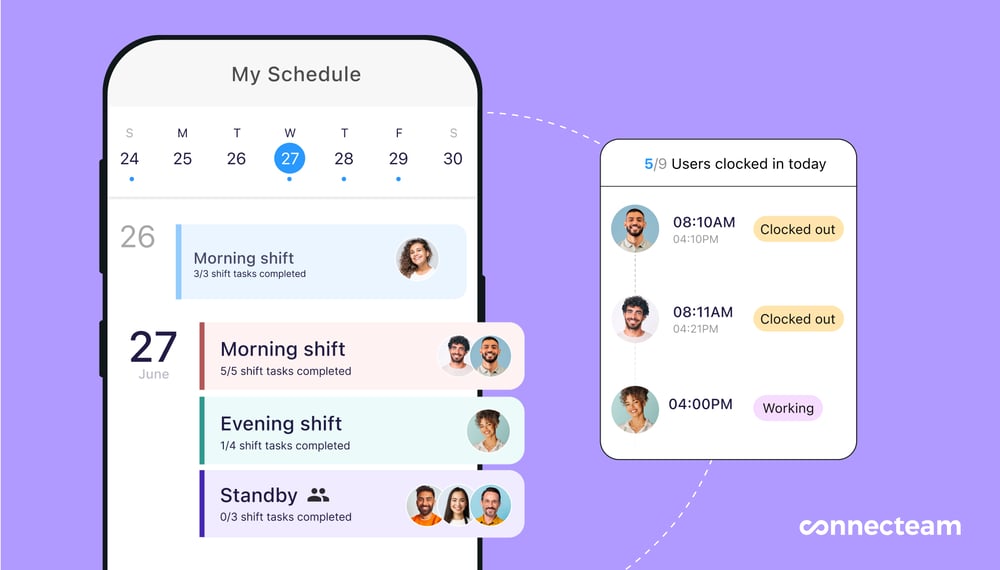
Techs can clock in and out to jobs right on their phones. Task management and digital forms
Connecteam also does a good job of helping maintenance teams stay on top of daily work with employee task tracking. Managers can assign tasks to one technician or a full crew, add due dates, notes, checklists, photos, files, and location details, and track progress as the work moves forward. I liked that technicians get instant mobile notifications and can check off subtasks as they go, which makes it easier to keep routine work and reactive jobs moving.
If someone needs clarification, they can comment directly inside the task instead of switching to another app. That keeps job-related communication tied to the work itself, which I find really useful for maintenance teams handling multiple requests at once.
Digital forms and checklists are also super helpful. Teams can replace paper inspection sheets, maintenance logs, safety checklists, and service reports with digital versions that are easier to complete, submit, and review. Just snap a photo or upload a file and Connecteam’s AI handles the rest. I also liked that this creates a cleaner history of completed work, so managers can spot repeat issues, track follow-through, and make better maintenance decisions over time.
NFC check-ins and workflow triggers
Connecteam’s NFC tags are great for maintenance teams working across multiple sites, equipment rooms, or facilities. Technicians just scan a tag at a location (like a machine or building entrance) to confirm they’ve reached the correct asset, automatically triggering a workflow.
You can also connect NFC tags to other systems through Connecteam’s Zapier integration, so each scan can log activity, send alerts, or update tasks. For teams that need tighter on-site tracking, I think it’s a really smart add-on.
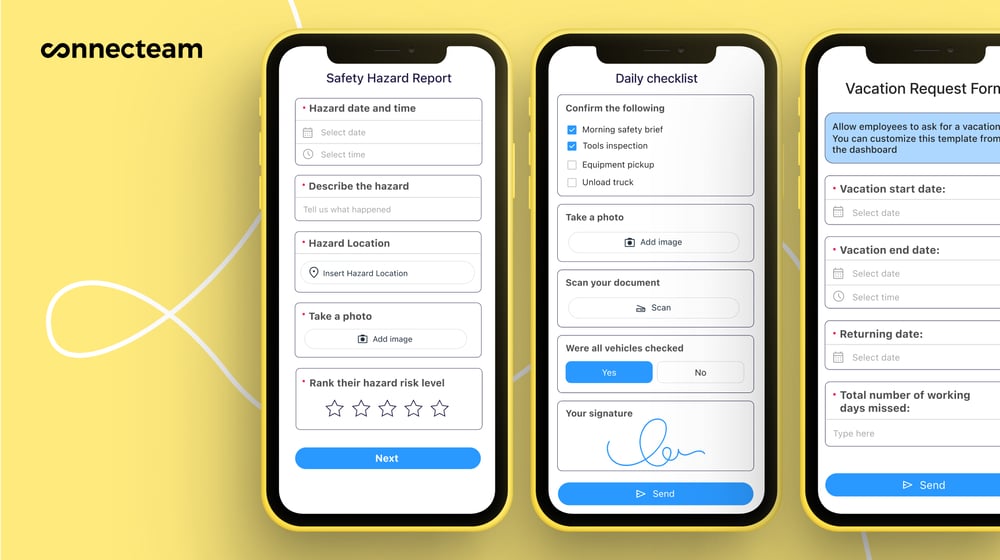
You add details to Connecteam’s forms, including images, signatures, and scans. Team messaging and communication
Another thing I really appreciate about Connecteam is how it keeps communication in one place. There’s an online team chat for quick back-and-forth, a company update feed for announcements, and a built-in company employee directory that makes it easier to find and contact the right person fast.
Plus, Connecteam’s AI can auto-translate messages and updates into each employee’s preferred language, so nothing slips through the cracks. That matters in maintenance work, where plans can change quickly because of urgent repairs, delayed parts, safety issues, or new service requests. Instead of jumping between texts, calls, and separate apps, teams can handle updates inside one system.
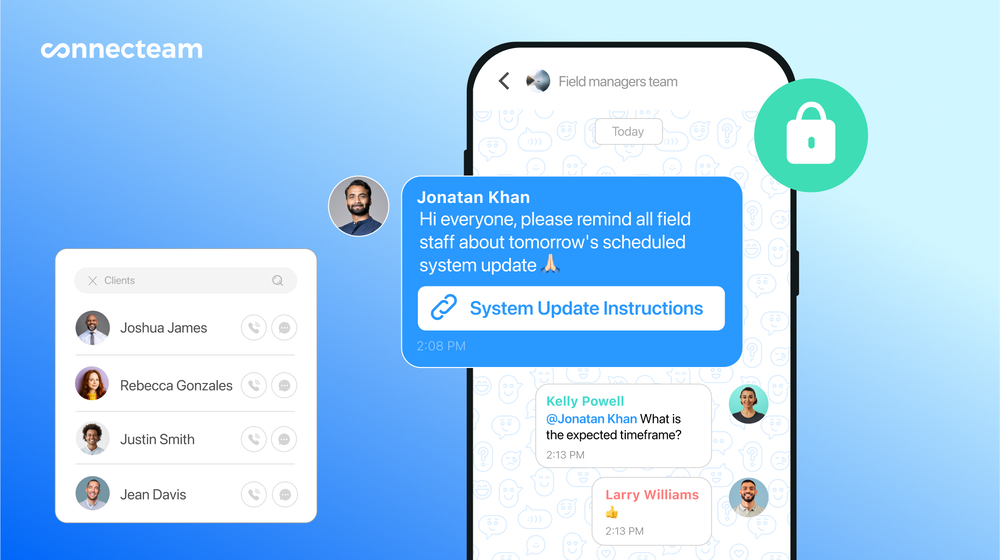
With Connecteam, find the right contact fast and message them easily. And so much more…
Connecteam also offers tools to help new technicians ramp up faster and ensure smoother cross-team coverage, including:
- Applicant tracking and hiring: Post mobile-friendly job listings, screen candidates with custom questions, and move applicants through one clear hiring pipeline.
- Employee onboarding: Collect e-signed contracts, tax forms, pay details, and policy acknowledgments in one place, so new hires are work-ready before day one.
- Employee training software: Use the AI Course Creator to quickly build training for maintenance tasks, safety procedures, and equipment handling to get new techs up to speed.
- Company knowledge base: Keep SOPs, repair guides, and safety protocols policies in one searchable place. Techs can ask the built-in AI agent for instant answers, pulled directly from your documentation.
When Connecteam isn’t a good fit
Connecteam isn’t a fit for businesses that need a true, full CMMS. If your operation depends on deep asset records, equipment hierarchies, meter-based preventive maintenance, parts and inventory tracking, vendor management, or detailed maintenance history tied directly to each asset, you’ll want a more dedicated CMMS platform.
It may also be a weaker fit for maintenance teams working in highly technical, asset-heavy, or heavily regulated environments where maintenance planning revolves around equipment lifecycle data, complex reporting, and advanced compliance records.
0Key Features
- Job scheduling and technician coordination
- Mobile time tracking with GPS
- Task management
- Digital forms and checklists
- Real-time team communication
- NFC-based check-ins
Pros
- Helps coordinate technicians across jobs, sites, and changing priorities
- Strong mobile tools for task updates, forms, and field reports
- Keeps job-related communication in one place
- Useful for multilingual maintenance teams with auto-translated updates
Cons
- Lacks inventory tracking tools
- Not a dedicated CMMS
Pricing
Free-for-life plan availablePremium plans start at $29/month for 30 users
14-day free trial, no credit card required
Start your free trial -
MaintainX — Best for mobile-first work orders and preventive maintenance
Available on
- Web
- iOS
- Android
- Windows
- Mac
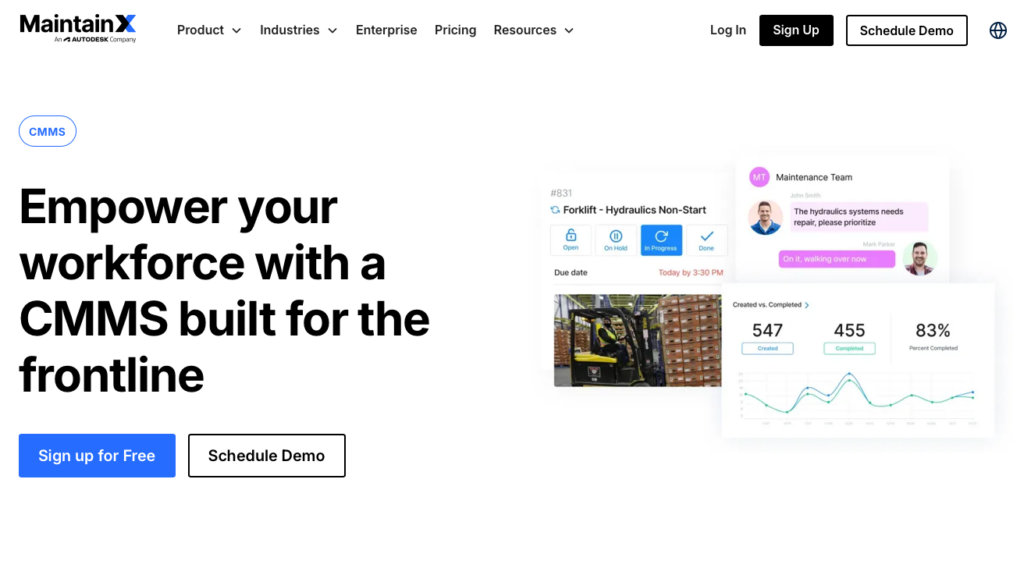
MaintainX is a CMMS designed to give frontline teams strong control over work orders, preventive maintenance, assets, parts, and reporting.
Why I chose MaintainX: I included MaintainX because its mobile app makes it incredibly simple for technicians to execute work orders and capture data on the go.
Work orders, requests and workflows
MaintainX really stands out when it comes to structuring maintenance work from request to completion. You can create standard, recurring, and even multi-level work orders, plus handle external jobs for third parties, all in one system.
One thing I liked is how simple it is to turn requests into work orders. Once approved, they flow straight into execution, which keeps things organized and avoids extra admin work. Plus, you can add step-by-step procedures, forms, and AI-generated instructions to work orders to help standardize how jobs get done.
The request side is also helpful for maintenance teams dealing with operators or tenants. People can submit requests through links, QR codes, or web forms. You can also let requestors scan an asset or location so the request comes in with the context already filled.
Preventive maintenance and scheduling
MaintainX does a good job when it comes to preventive and planned maintenance. You can set up recurring work, schedule tasks, and even use AI to estimate how long jobs should take based on past data. I can see this being useful when you’re trying to balance routine work with urgent repairs without guessing.
The workload view gives you a clear picture of each technician’s schedule, assigned tasks, and overall capacity in one place. You can drag and drop jobs, adjust timelines, and quickly spot when someone is overbooked or underutilized. It also supports condition-based maintenance using meters, triggering work when thresholds are hit.
However, I noticed that some of these automation features are locked behind higher-tier plans, which could be a limitation for smaller maintenance teams on tighter budgets. It’s also worth noting that time and cost tracking within work orders is only available on the Enterprise plan.
Assets and inventory tracking
MaintainX offers equipment and inventory tracking. You can track asset status, criticality, downtime reasons, and performance over time, giving you better visibility into how equipment is actually holding up.
On the inventory side, I appreciated that you can monitor stock levels, set minimums, link parts to specific assets, and track what’s already allocated to active jobs. It also supports multi-location inventory and alerts for critical parts.
Yet, standard work orders are tied to only a single asset or location. If you need to handle multi-asset jobs, you’ll have to use parent and sub-work orders, which adds some complexity. And the full reporting module is only available in the web application, so technicians can’t pull up dashboards or analytics from their phones.
What users say about MaintainX
I love that you are able to customize anything in MaintainX to better fit your business. I am able to track inventory, keep track of PMs and also any reactive calls to identify trends.

The view of the calendar is annoying. Our jobs span over days and the maintainx calendar only show you the start date.

Key Features
- Work orders and requests
- Workload planning with smart time estimates
- Assets, locations, meters, and automations
- Parts inventory tracking
Pros
- Strong fit for full CMMS workflows
- Useful workload planning and scheduling tools
Cons
- Some advanced features only on higher plans
- Some workflows are web-only
Pricing
Starts at $20/user/month Trial: No Free Plan: Yes
-
Limble CMMS — Best for PM-heavy teams that need asset and vendor workflows
Available on
- Web
- iOS
- Android
- Windows
- Mac
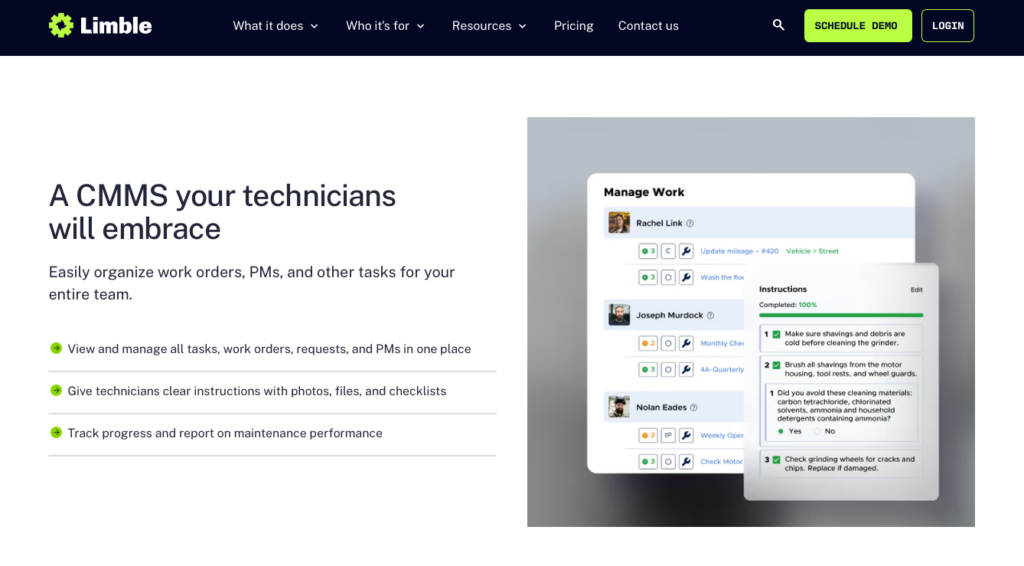
Limble is a CMMS and asset management software designed to help maintenance teams with work orders, PMs, asset and parts tracking, and vendor management.
Why I chose Limble CMMS: Limble made the list because its drag-and-drop scheduling and automated triggers make managing complex preventive maintenance routines very straightforward.
Work orders and preventive maintenance
Limble brings planned and unplanned maintenance together in one place. It covers preventive maintenance, scheduled work, reactive jobs, and parts-based triggers, so teams can manage daily tasks and long-term upkeep without switching systems.
The request flow is flexible. Non-users can submit issues through portals, links, email, or QR codes. On the preventive side, there are multiple scheduling options, including calendar-based, meter-based, or usage-driven. I noticed that visibility into these schedules depends on user roles and location access, which helps keep technicians focused on their specific areas but requires careful permission set up by administrators.
Asset, parts, and vendor management
Limble does a good job organizing assets and inventory. You can structure assets in multi-level hierarchies, assign locations, and link parts directly to assets or tasks, so technicians know what’s needed before starting a job.
It also helps with inventory control. Managers can set thresholds that trigger tasks when stock runs low or items sit unused too long, reducing both shortages and overstocking. Plus, you can store vendor details, link them to assets or parts, and assign tasks to external vendors without giving full system access.
Be careful when updating records in bulk. If you delete vendor names or part prices from the import file, Limble will also delete those values when you upload it.
Time tracking, scheduling and mobile access
Limble lets technicians log time, collaborate on tasks, track downtime, and use custom dashboards to monitor activity. It also includes useful metrics like MTTR, MTBF, and total downtime at the asset level.
That said, time tracking isn’t fully automated and still relies on manual input. The timer also resets if users leave the task, which could get tedious or lead to compliance issues if techs forget to start it again. I also noticed that the more advanced scheduling and workload balancing features are only available on higher-tier plans, which could definitely limit smaller teams.
For field work, techs can use QR codes to pull up asset info, submit requests, and manage tasks on-site. The mobile app supports offline mode, but bookmarks in the mobile app are device-specific and removed once tasks are completed.
What users say about Limble CMMS
Setting up PMs digitally and parts tracking are the best parts of the software. This will take our department away from keeping papers for tracking.
The only con about this is that when you complete a job you can’t reopen it up to change things or close the job by accident to reopen. Can’t do a correction.
Key Features
- Work request portals with QR codes
- PM scheduling by time, usage, or threshold
- Asset hierarchy and map-based locations
- Downtime and labor reporting
Pros
- Offline mobile work for open tasks
- Strong PM and reactive maintenance tools
Cons
- Key planning tools require higher plans
- Limited mobile functionality
Pricing
Contact vendor for pricing Trial: No Free Plan: No
-

UpKeep — Best for maintenance teams that need work order automation and inventory visibility
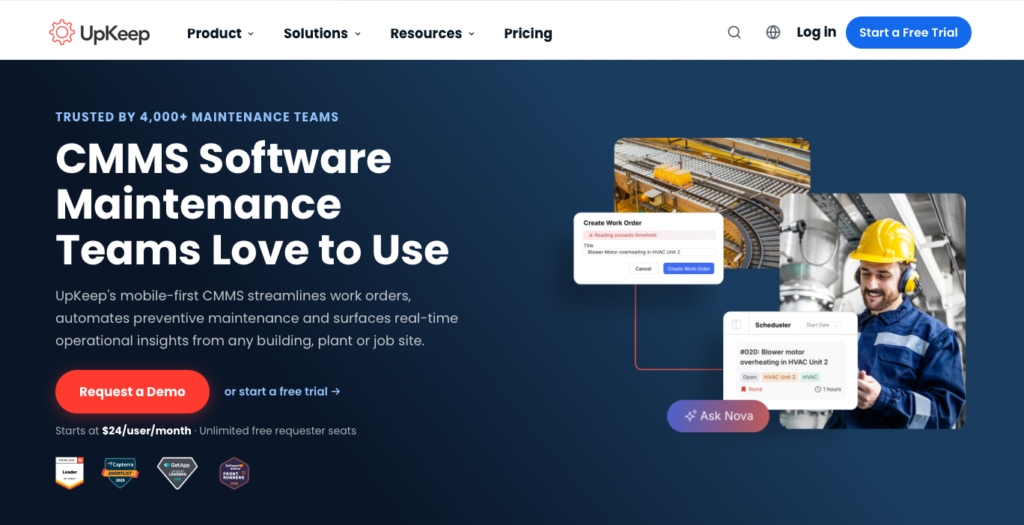
UpKeep is a maintenance management platform that helps teams handle work orders, preventive maintenance, assets, inventory, scheduling, and reporting.
Why I chose UpKeep: I chose UpKeep because it pairs a strong mobile-first design with deep inventory visibility, making it easy to track parts consumption alongside daily work.
Work orders, requests and workflows
UpKeep lets you build detailed work orders with everything in one place, including descriptions, images, priorities, assets, parts, checklists, and more. I liked that you can also attach documents like manuals, receipts, and how-to guides directly to the job, so the context stays clear while work is being done.
It’s easy for both internal teams and external users to report issues through forms or QR codes without having to log in. There are also helpful automations that let you auto-assign details like priority, team, or due date based on simple inputs.
However, there are a few limitations. Work orders are tied to a single location and asset, which might be restrictive for more complex jobs. More advanced workflow customization is also only available on higher-tier plans. I also found that offline mode is only available on Professional and Enterprise plans, so Essential plan users have no offline access at all. Even on Professional, offline is limited to 5 cached work orders, 2 draft work orders, and 5 image uploads.
Preventive maintenance and scheduling
UpKeep handles preventive maintenance well, with flexible scheduling options like calendar-based, meter-based, and hybrid triggers. You can also run multiple schedules from a single trigger, which is helpful for teams managing more complex maintenance routines. It’s easy to track what’s been completed, skipped, or overdue.
For scheduling, managers can drag and drop work orders, switch between different views, and quickly spot what hasn’t been scheduled yet. I was really impressed by the shifts feature, which helps plan coverage across different hours and teams.
Yet, I noticed that some of the more advanced planning tools, like automated scheduling, are restricted to higher-tier plans.
Assets and mobile field tools
UpKeep gives teams strong asset visibility. You can build multi-level asset structures, link locations, track downtime, and use QR codes for quick access in the field. It helps answer not just what broke, but where it is, who’s using it, and how it’s performing.
With inventory and purchasing, managers can track stock across locations, set thresholds, monitor costs, and handle purchase requests with approval flows. Labor and parts costs also roll into work orders, making it easier to see total maintenance spend.
The mobile app supports offline work, scanning, and GPS-based prompts. However, I found that multi-site support requires setting up a separate UpKeep account per facility and switching between them, which can be frustrating for regional managers. Beyond that, while you can update statuses and checklist tasks offline, you can only view (not edit) due dates, descriptions, parts, and asset details.
What users say about UpKeep
The system provides clear visibility into work orders, and I really appreciate how easy it is to use. It supports an excellent workflow and should make troubleshooting much easier in the future.
A better reporting system is needed, the current reporting tool can be very complex. Finding past reports requires too much searching, and the system is sometimes slow.
Key Features
- Structured work orders with checklists
- PM triggers by time, meter, or rules
- Scheduler with shift coverage
- Parts inventory and purchase orders
Pros
- Strong mix of CMMS and planning tools
- Good asset, parts, and workflow depth
Cons
- Many key features are plan-gated
- Some mobile workflows are limited
Pricing
Starts at $24/user/month Trial: Yes — 7-day. Free Plan: No
-
Fiix — Best for asset-heavy teams that need reliability data and purchasing depth
Available on
- Web
- iOS
- Android
- Windows
- Mac
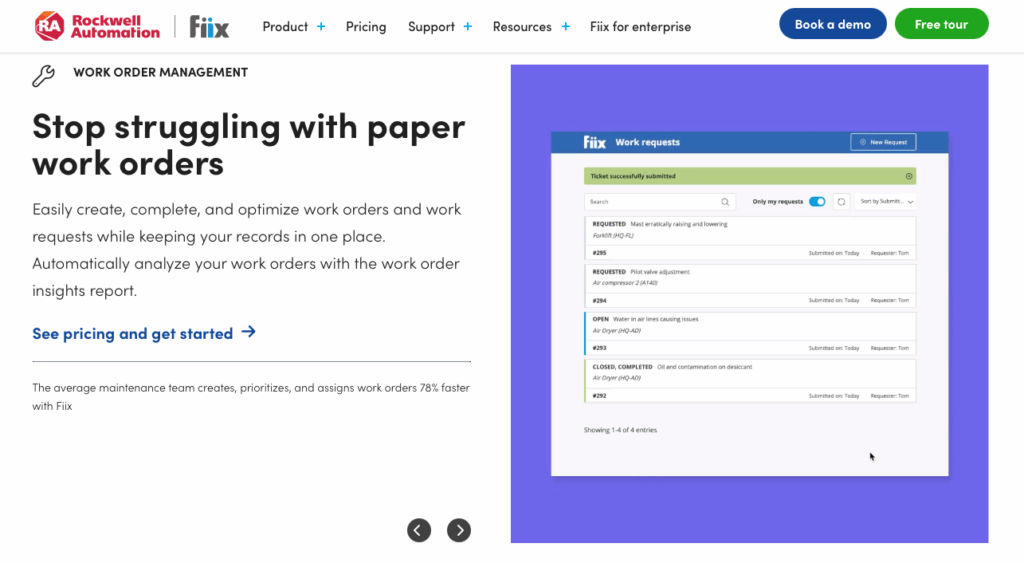
Fiix is a CMMS platform by Rockwell Automation for managing work orders, preventive maintenance, assets, and inventory.
Why I chose Fiix: I chose Fiix because it connects maintenance execution with deep reliability metrics (like MTTR and MTBF) and strong purchasing workflows.
Work orders and PMs
Fiix lets managers create structured work orders with assets, tasks, costs, attachments, and notifications to keep jobs organized from the start. Work orders can be triggered by time, meter readings, or events, and you can preload tasks, parts, and instructions ahead of time so everything’s ready when work begins.
You can even use the Fiix AI chatbot to answer questions about assets and records.
However, I noticed a few limitations. For example, some setups don’t support meter-based or event-based triggers, and more advanced features, like multi-asset work orders or condition-based maintenance, are only available on higher-tier plans.
Assets and field mobility
Fiix gives teams solid visibility into assets and reliability. I appreciated that you can track downtime, uptime, MTTR, and MTBF, and log issues by setting assets offline with reason codes and notes. It’s a straightforward way to understand why something failed.
For tracking, Fiix supports both QR codes and barcodes. You can keep existing barcodes or use Fiix-generated QR codes tied to specific assets, which helps keep records clean and consistent.
I thought the mobile app covered the basics pretty well, allowing techs to update work orders and work offline. One thing to keep in mind is that the mobile app no longer supports Android 10 or iOS/iPadOS 16. That means some teams may need to update their devices to keep using the app.
Parts, purchasing, and reporting depth
Fiix stands out when it comes to inventory and purchasing. Managers can track parts across locations, manage stock levels, use barcodes, set minimums, and log usage, all with solid structure. It also connects maintenance and inventory, with low stock automatically feeding into purchase planning and vendor workflows.
Purchasing itself is more advanced, with features like purchase orders, approvals, and receiving, but these are all mostly available on higher-tier plans. The same goes for reporting. While basic reports are included, more advanced analytics and custom dashboards are limited to higher tiers.
What users say about Fiix
Fiix is most helpful with job orders. You can and do a complete job order from start to finish. It’s also very easy to use ounce you are familiarized with Fiix by their easy-to-understand training courses.
Assets “Inventory Items” have their history attached to the storehouse location instead of the item SKU. So you can’t remove the item from a location once added if it has any history.
Key Features
- Work orders with tasks, costs, and attachments
- PMs with time, meter, and event triggers
- Parts, BOMs, and location-level stock tracking
- Analytics dashboards and custom reports
Pros
- Real free plan with core CMMS features
- Purchase orders, RFQs, and planning board
Cons
- Advanced features are plan-gated
- Limited mobile functionality
Pricing
Starts at $45/user/month Trial: No Free Plan: Yes
-

eMaint CMMS — Best for larger teams that need configurable workflows and reporting
Available on
- Web
- iOS
- Android
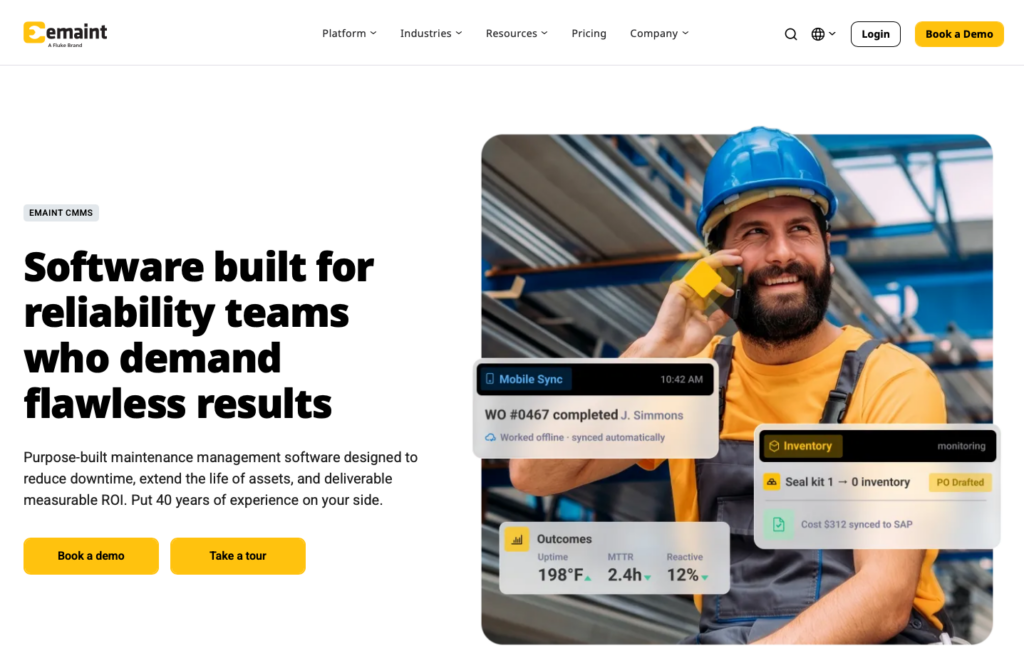
eMaint CMMS is a maintenance management software from Fluke Reliability for managing work orders, preventive maintenance, assets, and inventory.
Why I chose eMaint CMMS: I liked that eMaint’s highly configurable workflows and deep reporting allow enterprise operations to tailor the software to their exact processes.
Work orders and mobile workflows
With eMaint, technicians can manage tasks directly from the mobile app. They can view assignments, access asset details, log labor and materials, and attach files, all within the same workflow. Work-order statuses determine what techs do next, so everyone follows the same steps.
I also appreciated how detailed procedures are. You can add step-by-step instructions for inspections and routine maintenance, with options to mark steps as pass, fail, or urgent. If something fails, techs can trigger a follow-up work order immediately, creating a clear path from issue to action.
Just know that the mobile app’s offline mode and advanced workflows aren’t available on the entry-level Team plan.
Preventive maintenance and scheduling
eMaint supports PMs, inspections, and externally triggered work orders, with both single-asset and multi-asset setups. For multi-asset PMs, it automatically creates separate work orders per asset to maintain clear tracking at the asset level.
I liked that managers can use calendar views, drag and drop work into tech schedules, adjust time lengths, and filter by team or criteria. Assignments also sync with mobile users, so everyone stays aligned.
It’s important to note that the system won’t let you update the schedule too frequently, which could slow things down if you need to make rapid, constant adjustments to your dispatch board.
Assets, inventory and reporting
Teams can quickly search and manage assets using multiple identifiers, scan barcodes, and access full asset history, parts, and work orders with eMaint. It also supports downtime tracking, meter readings, and visual mapping, adding more context to asset management.
The inventory and purchasing are also pretty solid. You can track stock levels, link suppliers, create and send purchase orders, and automatically update status as items are received.
eMaint’s reporting is very customizable. I liked that you can automate actions based on events, build and reuse reports or dashboards, and manage access across sites. Keep in mind that API access, Single Sign-On, multi-site reporting, and the eMaint AI Suite are all locked to the Enterprise plan. Teams on the Professional plan can’t connect to ERP, BI, or SCADA systems through APIs, and the Vendor Portal is a paid add-on on both plans.
What users say about eMaint CMMS
What I like most about eMaint is that it helps me manage the department more easily. It’s a very comprehensive software that has practically all the tools a maintenance supervisor or manager needs to control their department, from preventive maintenance planning to inventory control.
The amount of work around we have had to create in our system to accomplish our company goals. I also dislike the scheduler in the system. It doesn’t have flexibility to fit my departments needs.
Key Features
- Work orders with labor and attachments
- Preventative maintenance
- Scheduler with drag-and-drop assignments
- Workflows, reports, and dashboards
Pros
- Strong scheduling and PM planning
- Deep inventory, purchasing, and workflow controls
Cons
- More complex setup than lighter CMMS tools
- High starting cost with 3-user minimum
Pricing
Contact vendor for price Trial: Yes Free Plan: No
Compare the Best Maintenance Management Software Tools
| Topic |
 Start for free
|
|
|
|
|
|
|---|---|---|---|---|---|---|
| Reviews |
 |
|
|
|
|
|
| Pricing |
Starts at just $29/month for the first 30 users
|
Starts at $20/user/month
|
Contact vendor for pricing
|
Starts at $24/user/month
|
Starts at $45/user/month
|
Contact vendor for price
|
| Free Trial |
yes
14-day
|
no
|
no
|
yes
7-day.
|
no
|
yes
|
| Free Plan |
yes
Free Up to 10 users
|
yes
|
no
|
no
|
yes
|
no
|
| Use cases |
Best for managing maintenance staff, field tasks, and daily coordination
|
Best for mobile-first work orders and preventive maintenance
|
Best for PM-heavy teams that need asset and vendor workflows
|
Best for maintenance teams that need work order automation and inventory visibility
|
Best for asset-heavy teams that need reliability data and purchasing depth
|
Best for larger teams that need configurable workflows and reporting
|
| Available on |
Web, iOS, Android, Windows, Mac
|
Web, iOS, Android, Windows, Mac
|
Web, iOS, Android, Windows, Mac
|
Web, iOS, Android
|
How to Choose the Right Maintenance Management Software
Selecting the right maintenance management software depends on your specific needs. Ask yourself these questions before making a decision:
- Do you need to track complex asset lifecycles and parts inventory, or are you focused on coordinating the technicians doing the work?
- Does your team work in remote areas like basements or rural sites where offline mobile access is critical?
- Are you prepared for a lengthy implementation process, or do you need a system that can be deployed in a few days?
- Does the pricing model (per-user vs. per-asset) align with the size of your maintenance team and equipment roster?
- Do you need advanced features like condition-based monitoring, IoT sensor integration, or automated purchasing workflows?
What is Maintenance Management Software?
Maintenance management software helps businesses plan, assign, track, and document maintenance work in one place. It’s commonly used by facility managers, maintenance supervisors, operations teams, and field technicians to manage equipment repairs, preventive maintenance, inspections, service requests, and recurring upkeep.
Many maintenance management platforms are also called CMMS platforms, or computerized maintenance management systems. A full CMMS usually includes work orders, preventive maintenance scheduling, asset records, maintenance history, parts or inventory tracking, and reporting. Some lighter tools focus more on the people side of maintenance, such as technician scheduling, task assignments, mobile forms, and team communication.
The main purpose is to give managers a clear view of what needs to be done, who is responsible, which assets are affected, and whether work is completed on time. This helps teams reduce downtime, avoid missed maintenance, improve accountability, and keep better records than they could with spreadsheets, paper forms, or scattered messages.
How Does Maintenance Management Software Work?
Maintenance management software starts by turning maintenance needs into trackable work. A request might come from a manager, technician, tenant, machine operator, customer, or automated trigger. Once the request is approved, it becomes a work order with the details technicians need, such as the asset, location, priority, instructions, photos, due date, safety steps, and required parts.
Managers can then assign the job, schedule recurring maintenance, track technician workloads, and monitor open, overdue, or completed work from a dashboard. In a full CMMS, asset records and maintenance history are tied to each job, so teams can see how often equipment breaks down, what repairs were done, and whether preventive maintenance is reducing repeat issues.
Technicians usually receive assignments on a mobile app. From the field, they can check instructions, update job status, upload photos, complete forms or checklists, log labour time, and record which parts were used. Once the work is completed, the system stores the record for reporting, audits, future troubleshooting, and planning.
For teams that don’t need a full CMMS, maintenance management software can still help coordinate the workday. Scheduling, task tracking, digital forms, time tracking, and team communication can keep technicians aligned, even if asset lifecycle management and inventory tracking are handled elsewhere.
The Benefits of Maintenance Management Software
There are multiple benefits of using maintenance management software, including:
Reduced downtime
By sticking to preventive maintenance schedules and tracking equipment health, maintenance software helps spot issues before they lead to failures. That means less surprise downtime and fewer production delays, keeping things running when they need to.
Improved efficiency
Digital work orders and mobile access can make a big difference to your business. Technicians can pull up everything they need, including task details, asset histories, and manuals, right from their phones. No paperwork, no wasted time. Instead, you gain faster, more focused work.
Extended asset lifespan
With regular maintenance driven by software reminders, equipment stays in better shape for longer. This kind of consistency lengthens asset life, delays replacements, and helps stretch your investment further.
Regulatory compliance
Automated records keep track of all maintenance activity, making audits and inspections much less stressful. For industries with tight regulations, this kind of built-in documentation is a lifesaver.
Data-driven decision making
Built-in reporting and analytics give you real visibility into what’s working and what’s not. You can identify problem areas, adjust your schedules, and make smarter choices when it comes to repairs or replacements.
How Much Does Maintenance Management Software Cost?
Most maintenance management software offers per user per month pricing. Basic plans usually start between $20–$45 per user per month. Prices increase depending on the features you need and your team size.
Connecteam offers a Small Business Plan that is completely free for up to 10 users. Paid plans start at just $29 per month for up to 30 users. Higher-tier plans start at $49/month for Advanced and $99/month for Expert, both also covering up to 30 users.
FAQs
CMMS stands for Computerized Maintenance Management System, used to plan and track maintenance. BMS, or Building Management System, controls building operations like HVAC, lighting, and security.
Maintenance management tools help plan, track, and manage equipment upkeep. They include work order systems, asset tracking, preventive maintenance schedulers, and inventory controls.
The four types are corrective (fixing issues), adaptive (adjusting to new environments), perfective (improving performance), and preventive (avoiding future issues).
Most tools can be set up in a few days to a few weeks, depending on complexity. Simpler platforms like Connecteam are quick to roll out, with minimal setup and fast team onboarding.
Many tools integrate with accounting, ERP, and inventory systems through APIs or native integrations. This keeps data synced across platforms, reducing manual work and improving accuracy.
It streamlines task assignments, reduces miscommunication, and enables preventive maintenance. Technicians spend less time chasing info and more time fixing issues, helping prevent breakdowns and keeping operations running efficiently.
The Bottom Line on Maintenance Management Software
Maintenance management software is essential for teams looking to move away from reactive, paper-based workflows. The biggest trade-off when choosing a solution is deciding whether you need a full CMMS focused heavily on asset lifecycles and parts inventory, or a workforce tool focused on coordinating the technicians doing the work.
Connecteam combines scheduling, mobile time tracking, digital forms, and team communication into a single app. It gives managers a simple way to keep daily work organized, ensure field crews are where they need to be, and maintain clear records without the heavy setup of a traditional CMMS.