



When meetings or presentations feel one-sided, it’s easy for people to tune out. Feedback dries up, and you’re left making important decisions without knowing what your team really thinks.
I reviewed the top 5 live polling apps and ranked them based on real-time polling features, audience segmentation capabilities, and depth of analytics.
Use these picks to energize your presentations, spark honest feedback, and make data-backed decisions.
| App | Best for | Starting Price | Key Considerations |
| Polly | Remote and hybrid teams that run polls natively inside Slack or Microsoft Teams | $6 per month ($72 billed annually) | Great at quick pulse surveys and automated recurring polls within chats, but lacks offline capabilities and advanced survey logic. |
| Slido | Enterprise and mid-size teams running live polls in all-hands meetings and slide presentations | $7/user/month | Strong presentation integrations and unique Q&A upvoting, but designed strictly as an add-on with no standalone presentation capabilities. |
| Vevox | Hybrid teams and Microsoft users needing anonymous live Q&A alongside polling | $7.75/month | Features unique visual formats like pin-on-image polls and strong anonymous Q&A safety nets, but customization is minimal and lacks offline support.<br /> <br /> |
| Poll Everywhere | Trainers and presenters who need SMS-accessible polls inside PowerPoint or Google Slides | $9/month | SMS polling allows participation without internet access, but the multi-question setup process can be confusing and integrations are limited. |
| Mentimeter | Workshop facilitators and trainers who want a standalone polling and presentation tool in one | $12 + tax/user/month | Provides a complete presentation builder with built-in polling and gamification, but has limited integrations with other presentation tools. |
| Connecteam | Deskless and frontline teams that need employee feedback tied to scheduling, tasks, and daily operations | Just $29/month for the first 30 users | Mobile-first design and deep audience segmentation for targeted polls and surveys |
What’s New in This Update (August 2026)
How I Ranked the Best Live Polling Apps
Here are the specific features I looked for when evaluating each live polling app:
Getting Honest Answers Without Awkward Silence
- Eliminating fear of speaking up: The software must support anonymous responses so employees can share honest feedback on sensitive topics, like leadership concerns or policy disagreements, without worrying about retaliation. Without this, managers only hear what people think is safe to say.
- Reaching the right people, not everyone: The app must let managers target polls to specific teams, departments, shifts, or locations instead of blasting the entire company.
- Removing barriers to participation: The tool needs to work on mobile devices without requiring app downloads or logins, so anyone can respond in seconds between tasks.
Collecting Feedback Without Disrupting Work
- Embedding polls where teams already work: The software should integrate directly into the tools teams already use, whether that’s Slack, Microsoft Teams, PowerPoint, or Google Slides, so participants don’t have to switch apps or open a separate link.
- Delivering instant notifications: The app needs to send alerts the moment a poll goes live so dispersed teams respond while the topic is fresh. If employees discover a poll hours or days later, the feedback loses its urgency and relevance.
- Supporting multiple question formats: Managers need access to word clouds, rating scales, multiple-choice, open-ended, and visual formats to match the question type to the situation.
Turning Responses Into Action
- Showing results in real time: The software must display responses as they come in, so presenters and managers can react on the spot during meetings or town halls.
- Tracking who hasn’t responded: The app should identify non-responders and support automatic reminders so managers can follow up before a deadline passes.
- Integrating with follow-up workflows: The tool should connect to communication or task management systems so managers can act on poll results immediately.
The 5 Best Live Polling Apps for 2026
-

Polly — Best for remote and hybrid teams that run polls natively inside Slack or Microsoft Teams
Available on
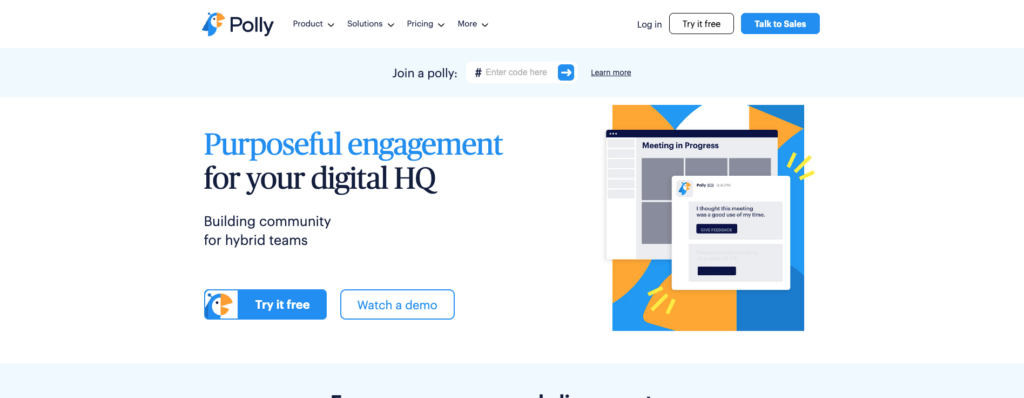
Polly is an engagement app that helps remote and hybrid teams collect employee feedback through polls, surveys, and quizzes inside Slack and Microsoft Teams.
Why I chose Polly: I picked Polly because it makes it simple to gather feedback within the chat tools remote and hybrid teams already use every day.
Quick Pulse Surveys
Polly’s quick pulse surveys work best for companies that require instant, actionable feedback on light issues. For example, a support manager can create a single-question poll to gather feedback on employees’ ticket loads and share it on Slack or Teams.
Employees answer the question with a single click without leaving the communication platform. This not only saves time but also lets managers gather real-time feedback without disrupting team productivity.
That said, Polly doesn’t support conditional logic or multi-step surveys where one answer determines the next question. This means that all users get the same follow-up questions even when their initial answers indicate different concerns or experiences, making it difficult to dig deeper into complex issues.
Automated Recurring Polls
If you need to gather feedback regularly but dread sending the poll manually each time, Polly automation can help. With automated recurring polls, you set the poll once, and Polly prompts employees to respond on schedule. The app supports various recurring cycles, including daily, weekly, biweekly, triweekly, monthly, quarterly, and biannually.
Poll automation is particularly useful for tracking trends over time. For instance, you can schedule a weekly poll to gauge how your team feels about the fairness of work schedules. Over time, you can address underlying scheduling issues to ensure employees are satisfied with their shift assignments.
Strong Poll Controls
Polly offers excellent customizability for polls. I liked that you can control how many times employees can respond, allow anonymous responses, send automatic poll reminders, and set cut-off dates. With these controls, companies gather timely insights and create a safe environment in which employees can give honest feedback without fear of reprisal.
While all that sounds appealing, Polly isn’t designed to operate as a standalone app, and I noticed in their documentation that advanced demographic audience segmentation is locked behind their Enterprise plan. The silver lining is that Polly lets you start polls in specific channels, group chats, or direct messages within integrated chat apps, which helps you collect feedback from the right audience.
What users say about Polly
Limited depth for more complex surveys or detailed analysis – Reporting is fairly basic compared to dedicated survey tools – Best value depends heavily on already using Slack.
I like the functions of this tool; I find it very easy to use, especially for surveys that are company-wide.
Key Features
- Real-time responses
- Anonymous submission option
- Different question types
- Multiple integrations
Pros
- Easy to use
- Seamless integration with chat and presentation tools
Cons
- Lacks advanced survey logic
- Demographic segmentation requires Enterprise plan
Pricing
Starts at $6 per month ($72 billed annually) Trial: Yes Free Plan: Yes
-

Slido — Best for enterprise and mid-size teams running live polls in all-hands meetings and slide presentations
Available on
- Web
- iOS
- Android
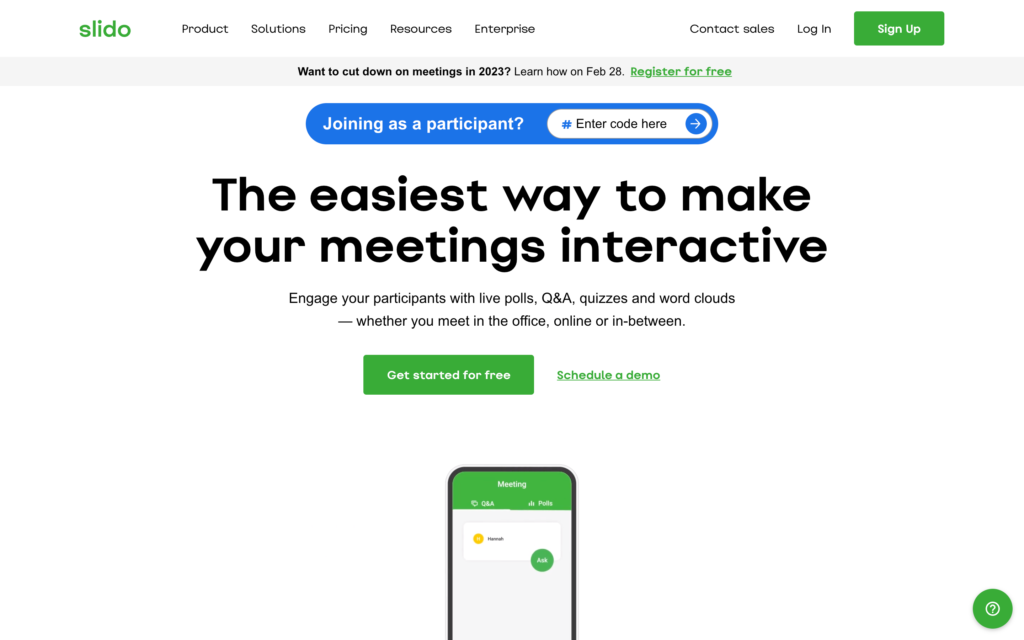
Slido is an audience engagement tool that lets you run live polls, Q&A sessions, quizzes, and surveys during meetings, presentations, and events.
Why I chose Slido: Slido stands out for enterprise and mid-size teams because its interactive poll formats and question upvoting turn passive all-hands meetings into engaging, contextually embedded experiences.
Interactive Poll Formats
While other live poll apps excel at in-app workplace feedback and image-based responses, Slido stands out for turning polls into interactive, contextually embedded experiences. To that end, it provides interactive poll formats, including star- and emoji-based rating polls, gamified quizzes, and ranking polls.
I was also impressed by the word cloud option. This format collects short, open-ended responses and turns them into a visual cloud, adjusting word size based on how often it’s submitted.
Although Slido offers a wide range of question formats, it’s useful only for short, interactive polling sessions. If you’re looking for advanced capabilities such as survey logic to dig deeper into complex issues, Slido falls short.
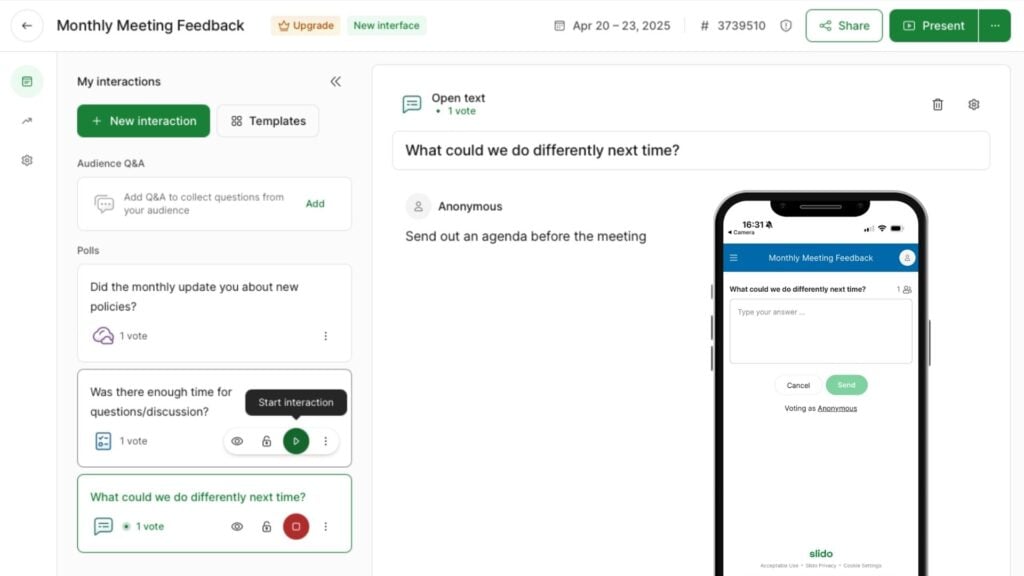
Slido makes it easy to run live polling for presentations, training sessions, and workshops. Live Q&A Tool
Slido allows participants to submit questions in real time during a presentation, meeting, or event. It supports anonymity during live Q&As, allowing participants to air pressing issues without fear.
In addition, Slido allows participants to upvote questions they want answered. Questions with the most upvotes move to the top of the list, mirroring participants’ most pressing issues. This enables moderators to address widely shared issues, not isolated or off-topic submissions from a few participants.
Integrations With Presentation Tools
Slido was built to enhance live presentations, and in that context, it enables you to embed live polls into your slide deck. Once you reach a poll slide in Google Slides or PowerPoint, participants can respond in real time without switching apps. You can also create a poll right inside a channel or group chat in Slack, Teams, Webex Meeting, or Zoom.
However, Slido is designed to work alongside presentation and communication apps, rather than as a standalone tool. Moreover, there’s no way to schedule polls and send them to teams in advance, follow up over time, or manage longer-term feedback. I also found that Slido sunsetted its mobile apps for iOS and Android in March 2026, meaning participants can now only access polls via web browser.
What users say about Slido
Slido is an easy-to-use platform that fosters interaction among virtual meeting participants. It includes various collaboration and participation features.

Sometimes it is tricky to advance past a leaderboard of responses. This feature is not appropriate for all presentations.
Key Features
- Online polling via web
- Customizable branding
- Many question types
- Multiple integrations
Pros
- Users can edit answers
- In-depth settings
Cons
- No dedicated mobile apps (web only)
- Confusing set up for multi-question polls
Pricing
Starts at $7/user/month Trial: Yes Free Plan: Yes
-

Vevox — Best for hybrid teams and Microsoft users needing anonymous live Q&A alongside polling
Available on
- Web
- iOS
- Android
- Windows
- Mac
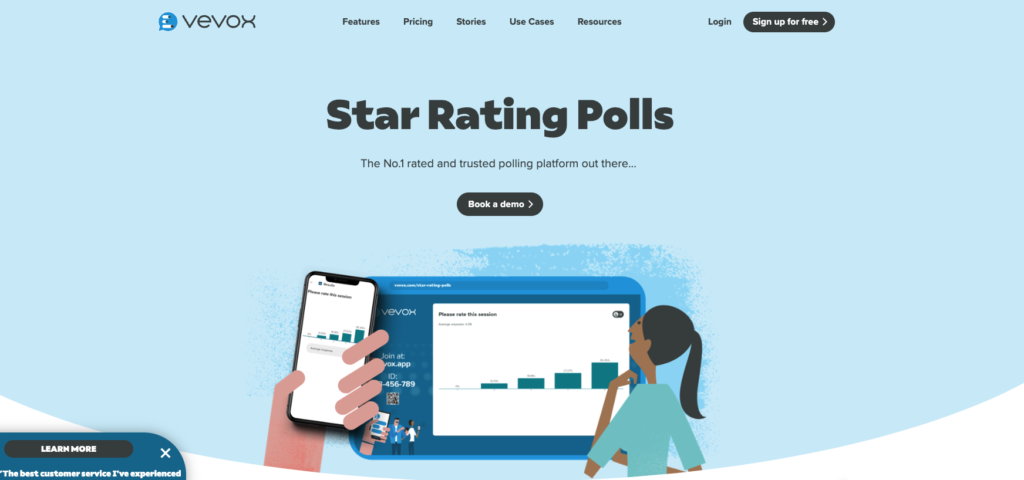
Vevox is a Q&A and voting app for meetings, online classes, and presentations built for lecturers, teachers, freelancers, and hybrid teams.
Why I chose Vevox: I chose Vevox because it integrates with PowerPoint and Microsoft Teams, and its anonymous live Q&A makes it easier to have honest conversations during sensitive town halls.
Easy to Set Up Polls
With Vevox, setting up live polls and Q&As doesn’t get any easier, whether you’re using its centralized dashboard or a presentation tool. What stood out to me was the variety of prebuilt question types and poll templates that let you tailor each poll to your unique needs.
What’s more, Vevox’s AI generation tool lets presenters create poll questions in seconds. I found it particularly useful for generating quick Q&A quizzes during online training sessions. The automation saves time and helps ask questions that reinforce key learning points and accurately test knowledge retention.
Vevox’s multilingual support is also useful when presenting to a diverse, geographically distributed audience or workforce. It allows participants to respond in their native languages, ensuring the feedback is accurate and inclusive. However, Vevox lacks offline capabilities for live polling and isn’t suitable for employees or learners in low-connectivity regions.
Pin-on-Image Polls
Like many live apps, Vevox offers a good mix of question types, including multiple-choice or open-text questions, star or slider ratings, word clouds, and distinct numeric polls. What sets it apart are its visual poll formats, such as a pin-on-image poll.
With this poll, you upload an image and ask participants to place a pin directly onto it. You can allow participants to place one or multiple pins and score pins that fall within a defined zone.
For example, a design lead can share a prototype user interface (UI) and ask product testers to drop a pin where they think a vital button should be. With pin scoring, the manager can quickly determine whether the UI is intuitive and exactly which elements need improvement. I did find on their pricing page that advanced poll types like pin-on-image are locked behind paid plans.
Anonymous Responses in Live Q&A
While many tools support anonymous responses in surveys, Vevox extends the safety net to live Q&A sessions, encouraging honest, real-time dialogues in company-wide webinars and town halls.
I found it particularly useful for situations where employees may withhold honest feedback for fear of retaliation. For example, when soliciting feedback on leadership, many employees may hesitate to voice criticism openly. Thankfully, with Vevox’s anonymous responses, employees can share feedback during a live session without fear of repercussions.
What users say about Vevox
It’s great experience, Vevox is usually helpful in meetings and capturing people’s feedback. I usually use it meeting ice breaking and knowledge improvement measurement.
While Vevox is generally very user-friendly, there are a few limitations. For example, participants cannot reply directly to comments or questions within the Q&A function, which can make discussions less interactive.
Key Features
- Different question types
- Live Q&A panel
- Participation data
- AI question prompts
Pros
- Straightforward set up
- AI speeds up creation
Cons
- Minimal customization
- Advanced poll types require paid plans
Pricing
Starts at $7.75/month Trial: No Free Plan: Yes
-

Poll Everywhere — Best for trainers and presenters who need SMS-accessible polls inside PowerPoint or Google Slides
Available on
- Web
- iOS
- Android
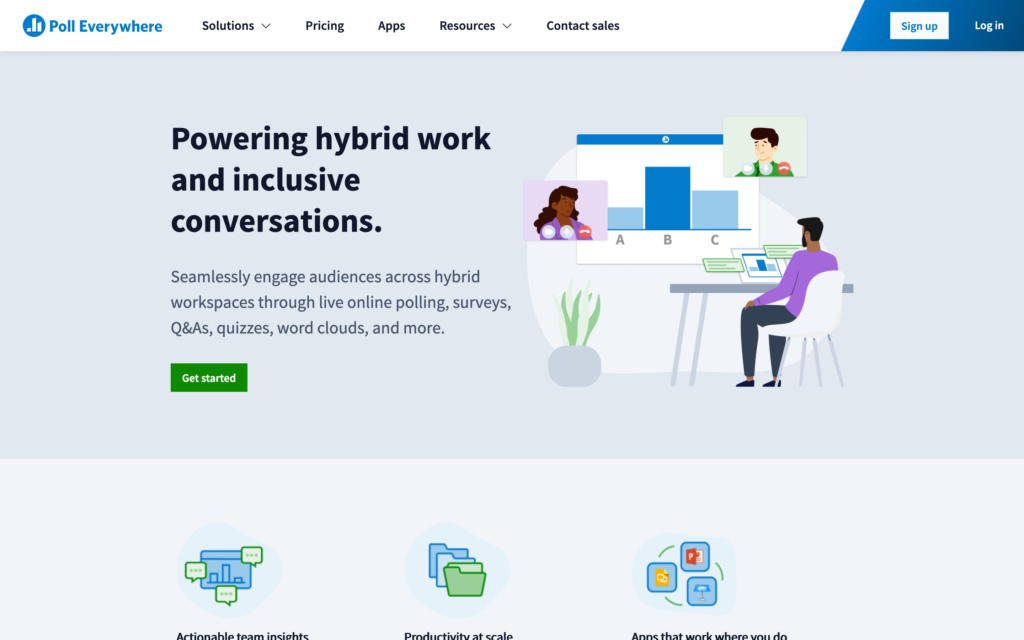
Poll Everywhere is an audience engagement platform that lets you share live polls, surveys, and quizzes during presentations and meetings.
Why I chose Poll Everywhere: I included Poll Everywhere because its SMS text-messaging polls let employees participate without an internet connection to ensure maximum inclusivity during in-person events.
Multiple Poll Types
Poll Everywhere offers a wide range of question “activity” types, including multiple-choice questions, word clouds, Q&As, open-ended questions, clickable images, emotional scales, donut charts, surveys, competitions, and even map-based prompts. I liked the variety, especially the clickable image option, which is useful for visual formats such as asking people to select locations on a map.
However, I found the setup process confusing. To build a multi-question poll, you have to create each item separately as a “new activity” and then manually organize the flow afterward. There’s no single, unified way to create and manage a full poll with multiple parts. It’s flexible, but the process wasn’t as smooth as I’d hoped.
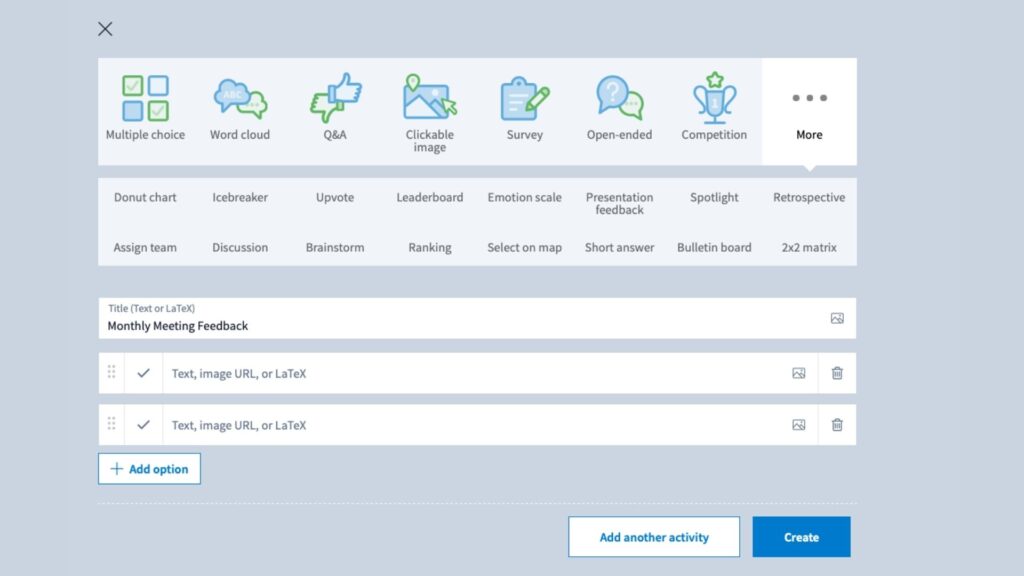
Poll Everywhere lets you create live polls in minutes.
Powerful SMS Voting System
Poll Everywhere supports SMS polling, which is useful when accessibility, inclusivity, and reliability matter more than advanced features. Picture this: you need maximum participation on a company-wide poll during an in-person town hall, but some of the participants don’t use smartphones.
In this case, Poll Everywhere allows employees to join the poll by texting a unique key to a phone number, usually designated by the presenter. Once they join, they can respond to multiple-choice and open-ended questions via text message. Poll Everywhere combines responses sent via the app and text messages, and instantly displays the results on the live presentation screen.
Keep in mind that SMS responses may incur costs that vary with response volume and carrier charges. Also, just note that true offline mode isn’t supported. You still need an internet connection for the presenter to see results come in.
Seamless Integration With Presentation Tools
Poll Everywhere integrates with tools like PowerPoint, Google Slides, Zoom, Microsoft Teams, Webex, Keynote, and Slack. Once you send out the poll, the results update in real time. You can also accept or reject responses live, which gives you more control over what’s displayed.
I also liked that you can distribute a poll via direct link, QR code, or text message, which is useful for different audiences depending on the setting. That said, I found the mobile layout a little clunky; it worked, but it didn’t feel polished or exceptionally user-friendly.
What users say about Poll Everywhere
I found this software user-friendly, easy to set up polls and questions. It is an excellent tool to engage learners.
The reporting features are powerful, but I wish the export options were a bit more customizable out of the box. It would help streamline post-session analysis.
Key Features
- SMS text-message polling
- PowerPoint/Google Slides integration
- Clickable image and map-based prompts
- AI-generated poll questions
Pros
- SMS voting for participants without smartphones
- Wide range of distribution options (link, QR, text)
Cons
- Limited integrations in version 2.0
- Presenter requires internet for live results
Pricing
Starts at $9/month Trial: Yes Free Plan: Yes
-

Mentimeter — Best for workshop facilitators and trainers who want a standalone polling and presentation tool in one
Available on
- Web
- iOS
- Android
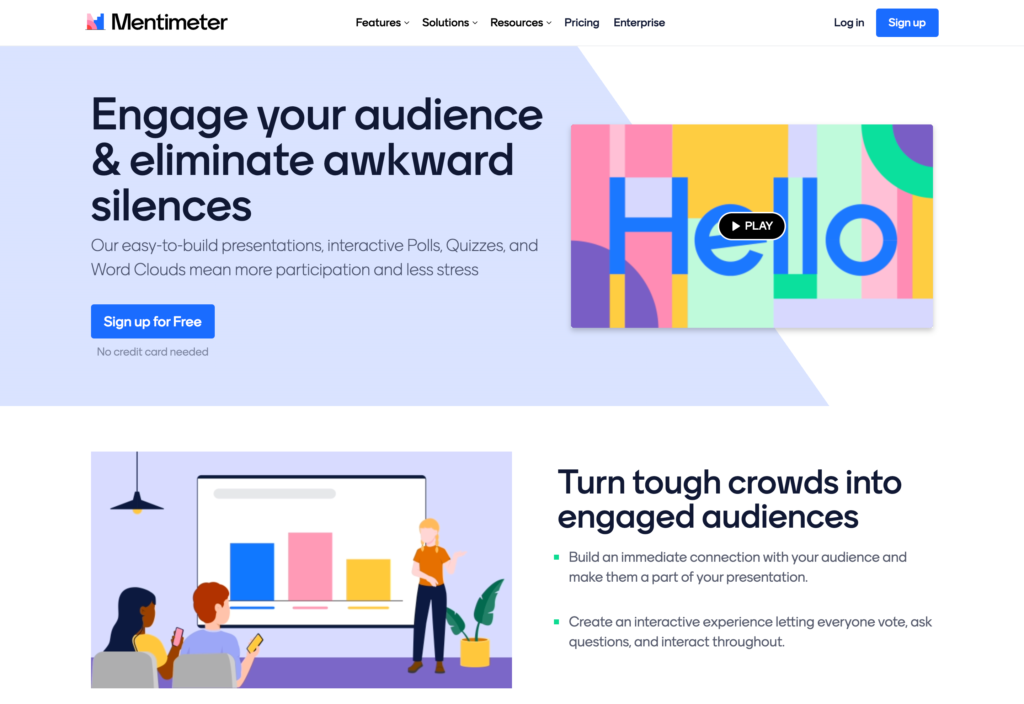
Mentimeter is a presentation-based polling tool that lets you build interactive slides with live audience input through online polls, word clouds, rankings, and more.
Why I chose Mentimeter: Mentimeter made the list because it’s a presentation builder with built-in polling, which eliminates the need to juggle PowerPoint and separate polling add-ons during a session.
Easy to Create Polls
Mentimeter’s intuitive design, combined with handy features like premade templates, makes it easy to create and launch polls in minutes. It offers a wide range of question formats, including word clouds, multiple-choice questions, open-ended questions, rankings, pin-on-image, and scales, allowing you to create online polls for unique scenarios.
Mentimeter comes into its element when used as a standalone app rather than an add-on to a presentation platform. As a result, it allows you to create slide decks and present without needing to integrate with PowerPoint. This makes it ideal for educators and workshop moderators who want to deliver presentations without juggling multiple apps.
That said, Mentimeter is less suitable for live sessions hosted within communication apps like Slack or Teams. While it integrates with these tools, it doesn’t provide tools to follow up with participants after the live presentation.
Powerful Gamification Elements
I love that Mentimeter allows workshop moderators, trainers, and educators to gamify polls. Quiz mode makes it easy to grade responses and award points to respondents. Mentimeter tallies these points automatically and displays rankings on a centralized leaderboard in real time.
Gamification is particularly useful for boosting participation rates and knowledge retention, especially in a learning and development environment. For example, a construction company can use a quiz at the end of a compliance training session to gauge how well crew members understand site regulations and safety procedures.
Displaying the results on a leaderboard turns a routine training session into a friendly competition, motivating participants to master the key learning points. This goes a long way towards reducing safety violations, accidents, and costly penalties. Be aware that they don’t offer a dedicated mobile app, so participants need to access quizzes via a web browser.
Limited Integration with Presentation Tools
Mentimeter integrates with learning management systems (LMS), including Canvas, Noodle, Brightspace, and Blackboard. While it works well for institutions that already use these platforms, it falls short for others.
I also found its integration with presentation and communication apps to be very limited. To be precise, it integrates only with Microsoft Teams and Zoom, limiting usability for teams that want to run online polls in other apps, such as Slack. On the presentation side, it integrates only with PowerPoint—sorry, Google Slides users.
What users say about Mentimeter
Mentimeter is a focused, engaging and very interactive approach that uses diverse modes like word clouds, live polls, Q&A among others to make presentation successful

There are a few features that could be improved, such as more versatile textual and visual customization, and additional survey/quiz functions (e.g. point-based voting / ranking, etc. to allow more complex gamification of interactions).
Key Features
- Presentation builder with polls
- Gamified quizzes with leaderboards
- Word clouds and ranking slides
- LMS integrations (Canvas, Blackboard)
Pros
- No separate presentation tool needed
- Built-in gamification boosts engagement
Cons
- Limited integrations
- No deeper analysis
Pricing
Starts at $12 + tax/user/month Trial: Yes Free Plan: No
Workforce Communication Software With Live Polls
-
Connecteam — Best for deskless and frontline teams that need employee feedback tied to scheduling, tasks, and daily operations
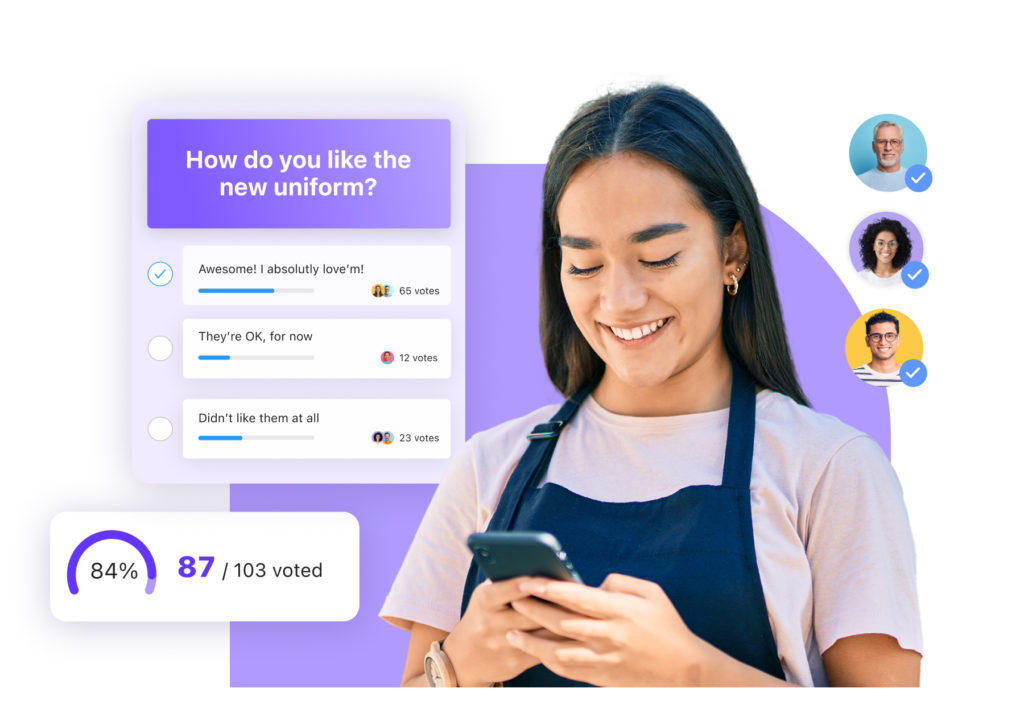
Connecteam is a workforce communication and employee management app with built-in polls and surveys for deskless teams. It’s especially useful for businesses that need to collect feedback from frontline employees and then act on it through the same platform—whether that means sharing updates, assigning tasks, adjusting schedules, or following up in chat.
Why I chose Connecteam: Connecteam combines mobile-first polls and surveys with deep audience segmentation, allowing managers to gather targeted feedback and instantly turn it into action through the same platform’s scheduling and task tools.
Mobile-First Polls and Surveys
Setting up a live poll in Connecteam is fast, even on a smartphone. You can choose from premade templates or build your own with multiple-choice, open-ended, yes/no, or rating questions to launch a poll in seconds. Responses can be made anonymous to encourage honesty and limit submissions to one per person to avoid duplicates and accidental spam.
The mobile-first design enables employees to answer poll questions directly from their smartphones, anytime, anywhere. Additionally, when you publish a poll, employees receive instant notifications so no question goes unnoticed. This helps maximize participation, ensuring each employee’s input counts toward decisions.
For example, a construction company can send a quick weather-risk alert poll to crew members across sites and get instant feedback without making dozens of phone calls. Instant feedback enables managers to make faster decisions, such as pausing risky activities before incidents occur.
Targeted Audience Segmentation
Connecteam enables targeted audience segmentation, ensuring polls reach the right employees rather than being sent randomly. You can send polls to a specific team, shift, job role, department, location, or a company-wide poll when necessary.
Using our earlier example, a manager can send the weather-risk alert poll to workers at sites along a storm’s forecast track. Similarly, a restaurant franchise can target a poll to workers at one facility, while a manufacturing company can direct a poll specifically to night-shift workers.
Deep audience segmentation lets you nudge only relevant employees instead of cluttering everyone’s feed. This results in cleaner data and high response quality. The cleaner the raw data, the better the insights and decisions that managers can draw from a poll.
Conditional Logic in Forms
Connecteam’s digital forms include conditional logic, which lets managers create follow-up questions that change based on an employee’s previous answer. This ensures employees only see the questions that are relevant to them, making questionnaires quicker to complete while reducing survey fatigue.
For example, imagine a daily safety survey that asks, “Did you encounter any safety hazards today?” If an employee answers “Yes,” the form automatically displays follow-up questions to gather more details. If they answer “No,” it skips those questions and moves them to the next section.
Connecteam also supports GPS verification. You can require employees to share their location when answering specific questions, making it easy for field teams to verify exactly where an issue occurred and add valuable context to each report.
Real-Time Results Dashboard
Connecteam shines when it comes to quick, actionable feedback. Poll results are instantly updated in an analytics dashboard, offering real-time visibility into who answered which questions without having to wait days for reports. If you need to dive deeper into the data, you can export responses to Excel with a single click.
When creating polls, you can set the platform to automatically remind employees who haven’t responded. This speeds up responses, ensuring you get the report within the set timeframe. Following up with a poll respondent is a breeze thanks to Connecteam’s built-in online team chat. You can go into a poll question and message individual respondents without switching tabs.
And So Much More
In addition to live polls and surveys, Connecteam provides a full suite of employee management tools, including:
- Employee scheduling: Create conflict-free schedules with the easy-to-use drag-and-drop scheduler, or use the AI-powered auto-scheduler to assign hundreds of shifts in seconds based on employee availability and qualifications.
- Compliant time tracking: Track employee hours, overtime, and breaks in full compliance with local labor laws.
- Task management: Assign and track tasks from start to finish. Set due dates, create recurring sequences, and break large projects into bite-sized subtasks.
- Training and onboarding: Create an onboarding workflow to ensure new hires have an excellent first-time experience. Use the AI course creator to build custom multi-step courses in minutes and track completion rates on a centralized dashboard.
When Connecteam Isn’t a Good Fit
Connecteam is a workforce management platform, not a dedicated presentation-embedded polling tool. It doesn’t integrate directly into PowerPoint or Google Slides to display polls on a presentation screen, and it doesn’t support SMS-based polling for users without smartphones. Teams looking strictly for a tool to embed live Q&A or word clouds into their slide decks during all-hands meetings may prefer a dedicated presentation polling add-on
Connecteam also offers a free for life plan – Get Started Now!
0Key Features
- Conditional logic for branching follow-up questions
- Audience segmentation by team, shift, or location
- Automatic reminders to non-responders
- Anonymous polling with one-response limits
- Real-time results dashboard with Excel export
- Built-in chat for instant follow-up
Pros
- Instant push notifications for higher response rates
- Polls tied directly to scheduling and task workflows
- Deep targeting reaches only relevant employees
- Mobile-first design built for deskless workers
Cons
- Needs internet or Wi-Fi access to work
- Not designed for presentation embedding
Pricing
Free-for-life plan availablePremium plans start at $29/month for 30 users
Create engaging surveys and measure employees' responses with Connecteam
Try for free!
Compare the Best Live Polling Apps
| Topic |
|
|
|
|
|
 Start for free
|
|---|---|---|---|---|---|---|
| Reviews |
N/A
|
|
|
|
|
|
| Pricing |
Starts at $6 per month ($72 billed annually)
|
Starts at $7/user/month
|
Starts at $7.75/month
|
Starts at $9/month
|
Starts at $12 + tax/user/month
|
Starts at just $29/month for the first 30 users
|
| Free Trial |
yes
|
yes
|
no
|
yes
|
yes
|
yes
14-day
|
| Free Plan |
yes
|
yes
|
yes
|
yes
|
no
|
yes
Free Up to 10 users
|
| Use cases |
Best for remote and hybrid teams that run polls natively inside Slack or Microsoft Teams
|
Best for enterprise and mid-size teams running live polls in all-hands meetings and slide presentations
|
Best for hybrid teams and Microsoft users needing anonymous live Q&A alongside polling
|
Best for trainers and presenters who need SMS-accessible polls inside PowerPoint or Google Slides
|
Best for workshop facilitators and trainers who want a standalone polling and presentation tool in one
|
Best for deskless and frontline teams that need employee feedback tied to scheduling, tasks, and daily operations
|
| Available on |
Web, iOS, Android
|
Web, iOS, Android, Windows, Mac
|
Web, iOS, Android
|
Web, iOS, Android
|
How to Choose the Right Live Polling App
Selecting the right live polling app depends on your specific needs. Ask yourself these questions before making a decision:
- Are you looking for a free plan that can accommodate your typical meeting size?
- Do you need a flat monthly fee, or are you comfortable paying per user as your team grows?
- Will your participant limits exceed the caps on lower-tier plans?
- Are you primarily polling remote workers in Slack, or deskless workers in the field?
- Do you need to embed polls directly into PowerPoint or Google Slides presentations?
- Will your audience need to participate via SMS text message instead of a smartphone app?
- Do you need anonymous Q&A capabilities for sensitive town hall meetings?
- Are advanced question types like pin-on-image or conditional logic necessary for your surveys?
- Do you need to segment your audience by department, location, or shift?
What is a Live Polling App?
A live polling app lets you ask a question and get instant answers from your team. It’s a simple way to collect feedback in real time—during a meeting, a training, or even just to check in.
You can ask multiple-choice questions, gather open comments, or see responses displayed in visual charts. It helps you hear from everyone quickly, without putting anyone on the spot. Whether you’re leading a small team or a big room, it’s a fast, easy way to see where people stand.
How Do Live Polling Apps Work?
Live polling apps make it easy to collect quick feedback from your team, wherever they are. You create a poll—like a multiple-choice, ranking, or open-ended question—and share it through a link, QR code, or access code. Your team responds from their phone, tablet, or laptop; no special login is needed.
As people vote, answers appear in real time. Most apps show results as bar charts, pie charts, or word clouds. You can choose whether to show results immediately or wait until everyone has answered. Some tools also include features like anonymity settings, response limits, or timers. It’s a fast, easy way to reach your team, whether they’re in a formal meeting, in the field, or between tasks.
The Benefits of Live Polling Software
Live polling software provides several advantages that improve team communication and decision-making.
Enhanced audience engagement
Live polls turn passive listeners into active participants. For teams that are spread out, like remote or deskless workers, polls offer a quick way to connect and join the conversation. When everyone gets to weigh in, even just with a tap on their phone, the experience feels more personal and interactive.
Real-time feedback you can use
Instead of waiting for post-meeting forms or guessing how things landed, live polling gives you immediate insight. You can take the pulse of your team mid-discussion and adjust on the spot. It makes decisions faster and more informed, and it shows employees their input matters right now, not later.
Inclusive decision-making
When everyone gets a chance to vote or share input, it shifts the tone from top-down decisions to team-driven choices. Polling gives every employee a voice and helps you spot patterns you might miss in one-on-one chats.
A simple way to boost transparency
Showing poll results, even just a quick summary, helps reinforce trust. It shows your team that their opinions aren’t just collected, but considered.
Helpful for training and development
During training sessions, polls can highlight what’s clear and what needs more explanation. You can identify gaps, adjust on the fly, and keep people engaged. It’s an easy way to check understanding without putting anyone on the spot.
Encourages honest input
For employees who hesitate to speak up in meetings, live polls offer a low-pressure alternative. When anonymity is an option, people are more likely to be honest—which gives you better data and a clearer view of what’s really going on.
How Much Do Live Polling Apps Cost?
Live polling apps typically offer a range of pricing models to fit different needs, from free basic plans to enterprise-level subscriptions. Many platforms charge a per-user monthly fee, which can range from $10 to $20 or more. Some tools also limit the number of participants or responses you can collect on lower-tier plans, meaning costs can scale quickly as your audience grows or if you need advanced features like conditional logic or custom branding.
Connecteam’s Small Business Plan is completely free for life for up to 10 users, giving you access to live polling alongside scheduling, time tracking, and task management. For larger teams, paid plans start at just $29 per month for the first 30 users.
The Bottom Line on Live Polling Apps
Live polling apps are useful for gathering real-time feedback and keeping audiences engaged. The right solution depends on how and where you interact with your audience. If you’re running presentations, meetings, or events, a tool that integrates with your presentation software may be the best fit. But if you’re collecting feedback from employees throughout the workday, look for a solution that’s easy to access on the devices they already use and fits naturally into their daily workflows.
Connecteam combines mobile-first polls and surveys with workforce management tools in a single app. You can gather targeted feedback through deep audience segmentation, use conditional logic to dig into complex issues, and instantly follow up with employees via built-in chat, all while managing schedules, tracking time, and assigning tasks from the same platform.
FAQs
Yes, live polling apps are excellent for remote teams. Some tools integrate directly into Slack and Microsoft Teams, while other platforms like Connecteam offer mobile-first polling that reaches deskless and remote workers wherever they are.
Not necessarily. Many live polling apps offer free plans with basic features and participant limits. Connecteam offers a free-for-life Small Business Plan for up to 10 users that includes full access to polls and surveys.
Yes, most top live polling apps offer anonymous response options. This is crucial for gathering honest feedback on sensitive topics without employees fearing reprisal.