


When store updates, checklists, and follow-up are spread across separate systems, teams miss priorities, managers lose proof of completion, and standards slip between locations.
I reviewed 7 YOOBIC alternatives and ranked them by frontline operations, targeted employee communication, task management, and mobile learning.
Use these picks to compare YOOBIC competitors, narrow down platform options, and choose a frontline employee app that fits your workforce.
If you don’t have the time to read through our research, jump down to our quick comparison table.
| App | Best for | Starting Price | Key Considerations |
| Zipline | Retail task execution and store communication | Contact vendor for price | The Day Sheet combines targeted messages, prioritized tasks, and photo proof. Assessments auto-save, don’t fully work offline. |
| WorkJam | Enterprise frontline workforce orchestration | $799/month for up to 500 users | Employee details help target tasks, learning, and communication. Core operations require Operations Elite add-ons. |
| Axonify | Frontline learning and performance reinforcement | Contact vendor for price | Adaptive daily microlearning connects knowledge with guided execution. Offline learning isn’t officially documented. |
| Connecteam | Frontline workforce operations plus communication | Just $29/month for the first 30 users | Communication, tasks, training, scheduling, and time records share one platform. App requires internet connection. |
| Workvivo | Culture and employee communication | Contact vendor for price | Campaigns, recognition, and Journeys support a culture-led employee experience. Chat is a paid add-on. |
| Beekeeper | Frontline communication and workflows | Contact vendor | Targeted campaigns connect with forms, tasks, and location reporting. Task management doesn’t work offline. |
| Staffbase | Enterprise employee communications | Contact vendor for price | Personalized, multi-channel publishing suits large communications teams. No mobile app for admins. |
What’s new in this update (September 2026)
- Removed Jolt, Blink, and Jostle, adding Zipline, WorkJam, Axonify, Beekeeper, and Staffbase.
- Updated features, pricing, free-trial, and free-plan details across all alternatives.
- Clarified limitations around offline access, add-ons, mobile access, integrations, rollout scope, and store-execution capabilities.
Our Top Picks
-
1

Best for retail task execution and store communication
-
2
Best for enterprise frontline workforce orchestration
-
3
Best for frontline learning and performance reinforcement
Why trust us?
Our team of unbiased software reviewers follows strict editorial guidelines, and our methodology is clear and open to everyone.
See our complete methodology
What is YOOBIC?
YOOBIC is a retail-focused frontline platform for employee communication, tasks and checklists, mobile learning, store visits, frontline analytics, and integrations. It gives headquarters and store teams a shared place to coordinate daily retail operations.
Managers can send updates, assign store work, collect photo evidence, run audits, and give employees training to complete. Teams can then review completion, learning, and store operations data across locations.
The offline mode can download selected data periodically, but not necessarily every message, checklist, lesson, or submission. YOOBIC doesn’t share pricing publicly, and there’s no listed free trial or free plan.
Why Are People Moving Away From YOOBIC?
YOOBIC covers retail communication, learning, and execution, so switching to an alternative might not be the best move for every team. Still, multiple users report that finding pages, posts, and documents can be difficult, particularly when there’s lots of similar content.
One reviewer suggested making the homepage easier to navigate, while another found searching for posts from specific people confusing. Users also want an easier login process with SSO and read receipts for chat messages. Other concerns include limited reporting workflows and store delegation, as well as occasional difficulty using geolocation for in-store mission feedback.
YOOBIC’s custom pricing makes it difficult to estimate the full cost or compare it with alternatives. Before committing, ask for a written quote covering every required module, administrator access, integrations, implementation, and ongoing support.
How I Ranked the Best YOOBIC Alternatives
I compared each product against the work a frontline team needs to communicate, execute, learn, and improve across locations.
Here’s what I prioritized:
- Targeted frontline communications: Can managers aim updates at the right roles, locations, teams, or people and confirm reach?
- Tasks and checklists with evidence: Can employees complete assigned work while managers collect photos, files, forms, approvals, or other proof?
- Learning and reinforcement: Does mobile learning support short employee training, knowledge checks, reminders, progress, or manager follow-up?
- Multi-location retail execution: Can the platform standardize store operations, visits, routines, and action follow-up across an operating hierarchy?
- Frontline analytics: Do reports turn communication, execution, learning, or engagement data into useful location-level decisions?
- Precise mobile and offline scope: Which exact mobile workflows keep working when connectivity drops, and what needs to wait for service?
- Integrations and rollout: Can the platform connect with required systems, and is the implementation work clear enough to plan?
I gave the most weight to tools that could replace YOOBIC’s core combination of targeted communication, store execution, proof-based tasks, and frontline learning. Platforms ranked lower when they covered only part of that workflow, required major add-ons, or lacked retail-specific execution tools. I treated broader workforce features such as scheduling and time tracking as useful differentiators, but not substitutes for the core YOOBIC workflow.
The 7 Best YOOBIC Alternatives
-
Zipline — Best for retail task execution and store communication
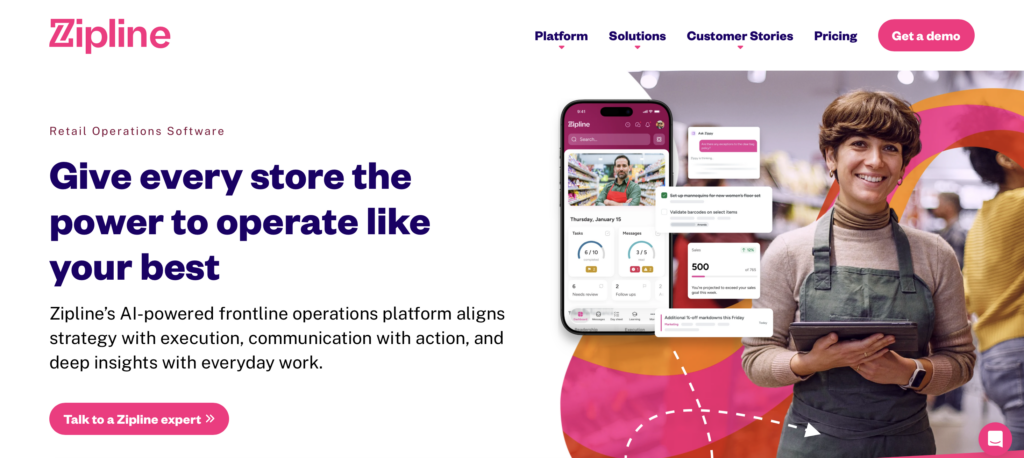
Zipline is a retail operations platform that brings frontline communication, tasks, store assessments, learning, and reporting into one work environment.
Why I chose Zipline: I chose Zipline because its Day Sheet turns targeted store communication into prioritized work with statuses and photo proof.
Targeted messages and the Day Sheet
Zipline lets headquarters target messages and tasks by store or individual, while readership reporting shows what was read and by whom. Its dashboards bring relevant communication and priorities together.
The Day Sheet shows each team’s messages, assigned tasks, and statuses into a shift-level view. Headquarters can flag important work, managers can track progress, and photo approvals help verify setups.
Zipline Assessments and Learning Center
Zipline Assessments support mobile store walks with conditional logic, photos, in-app annotations, and corrective tasks. Combined results let leaders compare locations and decide where follow-up is needed.
If Wi-Fi drops, assessment information auto-saves so the user can continue. Assessment auto-save doesn’t mean the platform works fully offline. Ask Zipline to show what employees can complete offline and how assessments, tasks, messages, and training sync when service returns.
The Learning Center adds mobile courses, certifications, task-oriented onboarding, and progress reporting.
Operational Health Dashboard and integrations
The Operational Health Dashboard gives headquarters and store leaders a high-level view of readership, employee engagement, and execution across locations. Zipline maps reporting to the store hierarchy for district and regional filtering and documents secure exports to business intelligence tools.
Connections cover workforce management, learning, service, customer-experience, and reporting systems, while open APIs support custom work. Pricing and included features require a custom quote because Zipline doesn’t publish rates or a feature comparison.
Key Features
- Targeted messages with readership reporting
- Day Sheet with prioritized task statuses
- Mobile assessments with annotated photo proof
- Learning Center courses and certifications
Pros
- Connects store communication directly to execution
- Combines audits, learning, and hierarchy-based reporting
Cons
- Pricing and included features require custom quote
- Assessment auto-save doesn’t confirm full offline access
Pricing
Contact vendor for price Trial: No Free Plan: No
-
WorkJam — Best for enterprise frontline workforce orchestration
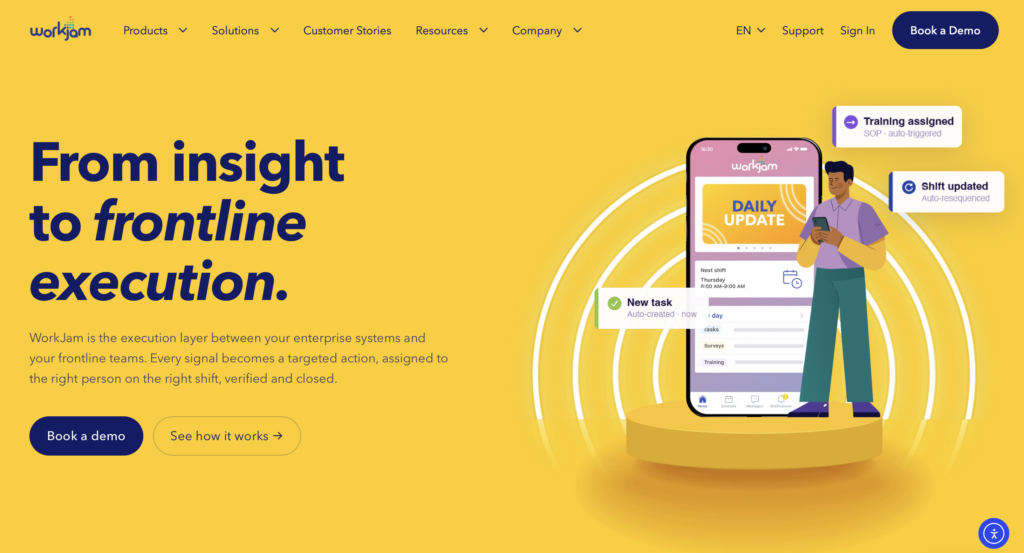
WorkJam is a modular frontline operations platform for communication, tasks, audits, learning, flexible scheduling, and enterprise-connected data.
Why I chose WorkJam: WorkJam made the list because its Target Audience Engine can route messages, tasks, and training using detailed workforce attributes.
Targeted communication and task execution
WorkJam can target communication by role, location, shift status, seniority, or custom attributes. Its Target Audience Engine applies similar detail to tasks.
Managers can build Standard, Audit, Form, and Project tasks with weighted checklists. Employees can then submit photo or video proof, while audits add scores, annotations, corrective tasks, and an audit trail.
Learning, staffing, and offline limits
WorkJam supports mobile microlearning, Guided Learning Paths, SCORM and xAPI content, assessments, badges, and progress tracking. Training can be assigned by role, department, location, or shift schedule.
However, core operations require Operations Elite add-ons. Productivity Plus covers tasks, audits, and forms; Skilling Plus covers learning and assessments; and Staffing Plus covers shift management, punches, and time-off requests. Offline access only works for task completion, so buyers shouldn’t assume communication, learning, or scheduling works without a connection.
Analytics, integrations, and rollout
Task dashboards show completion, compliance, audit scores, and hierarchy filters. Data can flow to Tableau, Power BI, Snowflake, and BigQuery, while Task Connect, APIs, and Custom Widgets connect enterprise systems.
In terms of rollout, it can include configuration, integrations, data migration, training, and change management. Timing varies with size, locations, connections, and workflow complexity.
Key Features
- Precision-targeted messages, tasks, and training
- Four task types with weighted checklists
- Mobile learning paths with SCORM support
- Hierarchy analytics and two-way integrations
Pros
- Connects communication, execution, learning, and staffing
- Targets work using detailed workforce attributes
Cons
- Offline access limited to task completion only
- Core operations require Operations Elite add-ons
Pricing
Starts at $799/month for up to 500 users Trial: Yes — 60 day Free Plan: No
-
Axonify — Best for frontline learning and performance reinforcement
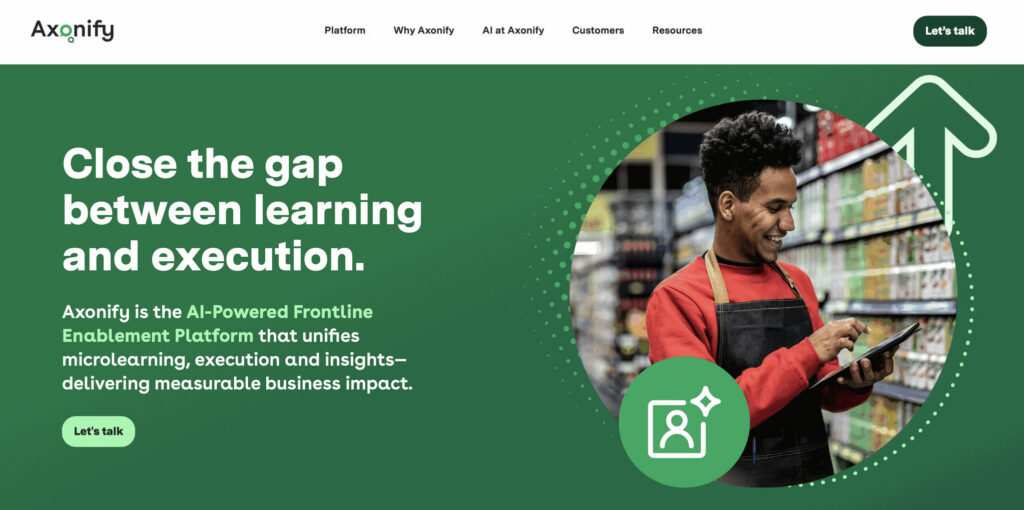
Axonify is a frontline enablement platform that brings adaptive microlearning, communication, task execution, and readiness insights into one employee experience.
Why I chose Axonify: I included Axonify because its personalized daily reinforcement links what employees learn with the work managers need them to carry out and measure.
Adaptive microlearning and daily reinforcement
Axonify delivers personalized learning paths and daily questions that adapt to each worker’s progress. Employees can access three-to-five-minute sessions across workplace devices, while points, leaderboards, rewards, and games encourage repeat use.
Role and region shape each employee’s content across mobile, tablet, kiosk, and desktop. Offline learning isn’t documented, so ask to test access, submissions, and syncing in low-connectivity locations.
Targeted communication and verified execution
You can target communications by role and location, with receipt and comprehension checks, pulse surveys, and employee feedback. Managers can assign tasks, checklists, and SOPs to roles, locations, or individuals, then track completion in real time.
Photo verification, comments, manager verification, audits, and follow-up give store leaders proof across locations. Tasks can repeat automatically, while dashboards summarize performance by team, region, or company.
Readiness insights and enterprise connections
Insights & Action brings knowledge scores, employee confidence, coaching needs, observations, and performance data into manager dashboards. Data Connect and open APIs link Axonify with tools for analytics, HR, learning, workforce management, collaboration, content, and devices.
Full implementation can take up to 90 days, but Axonify says most pilots take four to six weeks. Plan for setup work involving employee hierarchies, content, integrations, responsibilities, and governance.
Key Features
- Personalized daily microlearning and reinforcement
- Role- and location-targeted communication
- Checklists with photo and manager verification
- Knowledge scores and manager readiness dashboards
Pros
- Connects daily learning with frontline execution
- Targets reinforcement using role and region attributes
Cons
- Offline learning isn’t officially documented
- Full rollout can take up to 90 days
Pricing
Contact vendor for price Trial: No Free Plan: No
-
Connecteam — Best for frontline workforce operations plus communication
Connecteam is a workforce management platform that combines frontline communication, tasks, forms, training, scheduling, and time tracking in one mobile-first app.
Why I chose Connecteam: Connecteam’s strength is that it offers communication, checklists, and learning alongside scheduling, time tracking, and payroll-ready timesheets to manage frontline operations.
Targeted updates and team chat
Connecteam’s employee updates can go to everyone or selected teams, and managers can view engagement data and even require read confirmation on important posts. Smart Groups use profile rules such as branch, department, location, or skill to update audiences automatically.
The online team chat supports 1:1 and group messaging, while the directory helps employees find coworkers by fields such as department or role. This gives managers a structured feed for important employee communication and a quicker route for day-to-day questions.
Tasks, checklists, and frontline reporting
With Connecteam’s employee task tracking, you can assign one-time or recurring tasks, with due dates, subtasks, reminders, and attached images, files, forms, or checklists. Digital forms and checklists are timestamped, and you can require photos, e-signatures, and location tags, keeping proof with the assigned workflow.
Managers can track submissions, follow up on missing entries, group results by Smart Group, date, status, or form field, and review responses. Automatic form reports require the Expert plan, so teams that need scheduled exports should budget for that Operations tier.
Mobile training across locations
Connecteam delivers bite-sized mobile training employees can complete anywhere. You courses from scratch, customize a template, upload SCORM content, or use the AI Course Creator to generate one from a prompt. Add videos, audio, files, quizzes, and surveys to keep training engaging and check understanding.
The course dashboard shows who’s completed or started, and who hasn’t opened the training yet. Filter results by team, department, or employee, identify knowledge gaps from quiz results, and automatically remind employees about unfinished material. Just know that mobile learning won’t work offline.
Scheduling, time tracking, and integrations
Connecteam’s employee scheduling supports multi-location visibility, recurring schedules, open shifts, conflict alerts, and auto-scheduling based on availability, roles, labor rules, and fairness. Managers can attach job details or tasks to shifts, while employees can view published schedules in the app.
The employee time clock supports mobile, desktop, kiosk, and NFC clock-ins, plus optional geofences and GPS tracking. When it’s time to run payroll, timesheets sync directly to popular payroll providers, including RUN Powered by ADP®, QuickBooks, and Gusto.
0Key Features
- Targeted updates with rule-based Smart Groups
- Recurring tasks and proof-based digital checklists
- Mobile courses with progress and quiz reporting
- Multi-location scheduling and payroll-ready time records
Pros
- Connects communication to proof-based frontline work
- Adds scheduling and timesheets for payroll
Cons
- Requires internet access to work
- Communications and Operations are separate hubs
Pricing
Free-for-life plan availablePremium plans start at $29/month for 30 users
14-day free trial, no credit card required
Start your free trial -

Workvivo — Best for culture and employee communication
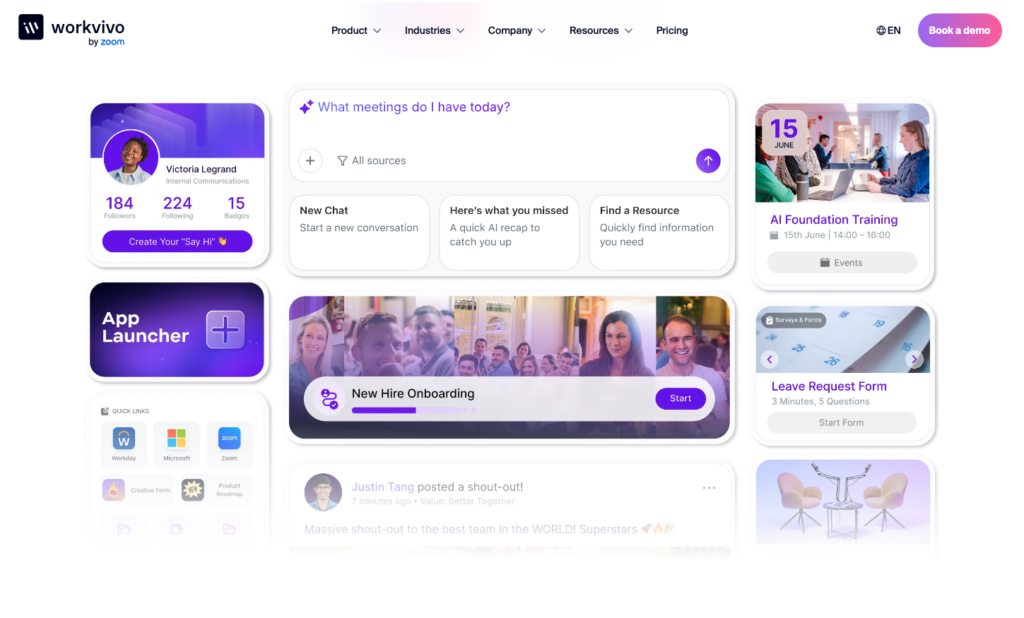
Workvivo by Zoom is an employee experience and intranet platform focused on targeted company communication, culture, knowledge, recognition, and guided employee workflows.
Why I chose Workvivo: Workvivo combines campaign planning, precise audience targeting, visible recognition, and automated Journeys to form a culture-led employee experience.
Campaigns, Spaces, and recognition
With Workvivo, you can target content by role, location, team, or employee group. The Campaign Manager puts related content into one planning and measurement dashboard.
Spaces organize communication and knowledge around a department, team, location, or topic, while shoutouts and profile badges make peer recognition visible.
Workvivo offers chat as an optional add-on, so buyers that need real-time messaging plus voice and video should factor it into the quote.
Journeys and mobile forms
Journeys creates guided sequences with triggers, intervals, content, surveys, badges, and acknowledgements. Employees can complete them on mobile, while administrators track results from desktop.
Surveys and forms help collect structured responses on web or mobile. That supports onboarding, upskilling, compliance communication, and operational inputs, but there’s no YOOBIC-style store audits, visual-standard approvals, corrective tasks, or a general task-status board.
Offline knowledge, analytics, and integrations
Workvivo’s offline mode lets iOS and Android users open eligible Pages, Articles, Folders, Documents, and embedded images after downloading them in advance. It’s important to note that offline access covers pre-downloaded content only, and current documentation doesn’t establish offline Chat, Forms, Journey completion, analytics, or task execution.
The platform’s analytics cover content, activity, engagement, adoption, activation, and governance, while Campaign and Journey reports add reach and completion data. During our hands-on testing, there was no way to access analytics in the mobile app, so know that the dashboard remains web-only.
Key Features
- Targeted campaigns and personalized employee feed
- Spaces and visible peer recognition
- Triggered Journeys with completion analytics
- Pre-downloaded offline mobile knowledge
Pros
- Strong culture and recognition experience
- Connects campaigns with guided employee workflows
Cons
- Chat is an optional add-on
- Offline access covers pre-downloaded content only
Pricing
Contact vendor for price Trial: No Free Plan: No
-

Beekeeper — Best for frontline communication and workflows
What’s new with Beekeeper
In July 2025, Beekeeper merged with LumApps and is no longer available as a standalone platform. Our hands-on testing took place before the merger.
Beekeeper, now part of LumApps, is a mobile-first frontline platform that combines targeted communication with tasks, forms, workflow automation, learning, and location-level analytics.
Why I chose Beekeeper: I chose Beekeeper because it links targeted frontline messages with traceable task and form workflows across groups and locations.
Targeted campaigns and task proof
With Beekeeper’s campaigns, you can target locations, groups, and segments, request read confirmations, and report receipt, opens, and replies. Managers can also follow up on unread or unconfirmed messages.
For tasks, you can include due dates, images, subtasks or an embedded form, and links. An embedded form moves a task through its statuses. Forms can collect files and route records as PDFs or through webhooks, though full task controls depend on your subscription.
Mobile learning and offline mode
Beekeeper’s mobile learning covers multilingual training and completion tracking. From the dashboard, you can find metrics on engagement, task completion, communication reach, and workflow performance.
Admins need to mark which forms are eligible for offline use. There are device, field, and attachment limits on iOS and selected Android devices. The offline mode also doesn’t include task management, so teams can’t rely on it for disconnected task completion.
Analytics and operational insights
With task analytics, you can view status and completion by department or location. The form analytics adds trends by user, group, and location.
Beekeeper’s full integration into LumApps is also rolling out in phases. Buyers should confirm current feature access, integration ownership, and timing, instead of just assuming that the unified experience is live.
Key Features
- Targeted campaigns with read confirmations
- Tasks with embedded proof forms
- Mobile learning screen and certificates
- Location-level task and form analytics
Pros
- Connects communication with operational actions
- Tracks execution across groups and locations
Cons
- LumApps integration still in progress
- No offline mode for task management
Pricing
Contact vendor Trial: No Free Plan: No
-

Staffbase — Best for enterprise employee communications
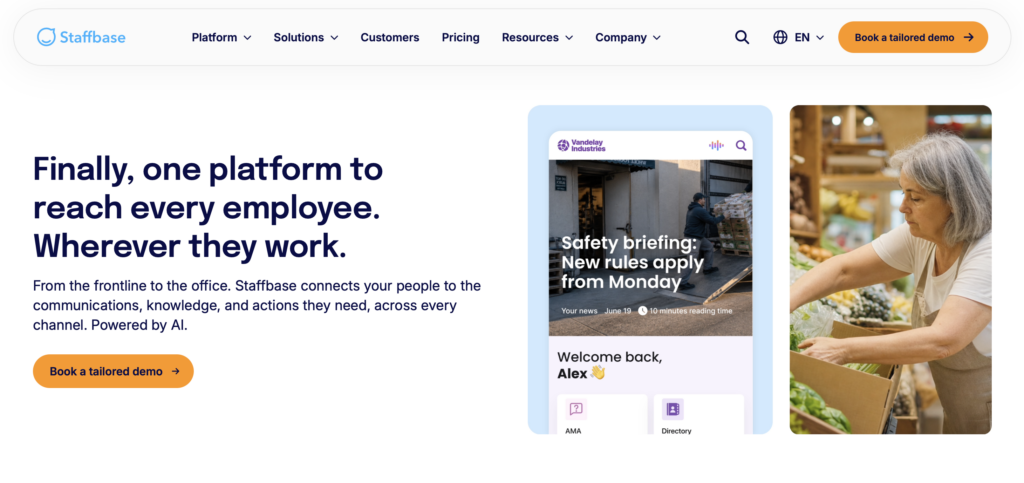
Staffbase is an employee communications platform for enterprise-scale companies, combining an employee app and intranet with newsletters, SMS, digital signage, and communication analytics.
Why I chose Staffbase: I chose Staffbase because it combines precise audience personalization with content-planning and approval tools for enterprise communications teams.
Personalized news and multi-channel communication
Staffbase’s feed combines company updates with employee posts. Managers can personalize content by location, role, communities, and groups, then track views, push unread announcements, or require an e-signature.
You can distribute communication across the app, intranet, email, SMS, newsletters, and signage. Calendars, comments, approvals, versioning, and a shared inbox support publishing, but there’s no co-editing for posts and news articles.
Employee journeys and mobile access
Staffbase’s employee journeys deliver content to selected groups on a preset schedule, like chapters from an onboarding guide or a series of campaign announcements. They start manually or at a scheduled time and don’t support custom activation triggers.
Employees can access the news feed, self-service HR tools, and messaging through mobile apps. Staffbase doesn’t have a mobile app for admins, so administrators can’t draft news or check post analytics on the go. Employees also can’t use the Staffbase app offline.
Analytics, integrations, and implementation
Staffbase’s analytics dashboard pulls data from news, social posts, and landing pages, with filters for group, location, channel, and device. Teams can group content into campaigns, export CSV files, and share raw data through an API.
Staffbase also supports enterprise integrations, provisioning, APIs, webhooks, and MCP. But these are communication insights, not complete store-performance analytics, and implementation typically takes about four months, but timelines aren’t guaranteed.
Key Features
- Personalized employee news and social feed
- Multi-channel app, intranet, SMS, and signage
- Scheduled employee journeys for targeted content
- Campaign analytics with location and channel filters
Pros
- Strong content planning and approval workflows
- Detailed communication analytics and audience filters
Cons
- No co-editing for posts and news articles
- Lacks mobile app for admins
Pricing
Contact vendor for price Trial: No Free Plan: No
Compare the Best YOOBIC Alternatives
| Topic |
|
|
|
 Start for free |
|
|
|
|---|---|---|---|---|---|---|---|
| Reviews |
N/A
|
N/A
|
N/A
|
  |
|
|
|
| Pricing |
Contact vendor for price
|
Starts at $799/month for up to 500 users
|
Contact vendor for price
|
Starts at just $29/month for the first 30 users
|
Contact vendor for price
|
Contact vendor
|
Contact vendor for price
|
| Free Trial |
no
|
yes
60 day
|
no
|
yes
14-day
|
no
|
no
|
no
|
| Free Plan |
no
|
no
|
no
|
yes
Free Up to 10 users
|
no
|
no
|
no
|
| Use cases |
Best for retail task execution and store communication
|
Best for enterprise frontline workforce orchestration
|
Best for frontline learning and performance reinforcement
|
Best for frontline workforce operations plus communication
|
Best for culture and employee communication
|
Best for frontline communication and workflows
|
Best for enterprise employee communications
|
| Available on |
The Bottom Line on YOOBIC Alternatives
If you’re looking for a YOOBIC alternative, focus on the job that matters most. Zipline fits retail execution, WorkJam supports enterprise orchestration, and Axonify leads with reinforcement. Workvivo, Beekeeper, and Staffbase suit different communication-led needs, but buyers should check the scope around store proof, offline work, mobile administration, and rollout.
Connecteam is the best choice for teams that need communication tied to tasks, forms, employee training, scheduling, and time tracking. It gives mobile workforces one app for coordinating people and daily work.
