

When managers can’t be at every job site, unverified punches can turn into payroll disputes and avoidable labor costs.
I evaluated six GPS time clock apps for location accuracy, geofence enforcement, mobile reliability, overtime handling, and payroll readiness.
Use these picks to eliminate time theft, streamline payroll, and protect your profits with data you can actually trust.
Heads up before you read: We’re Connecteam, and we’ve included ourselves in this list — because after testing all six apps, we’re convinced we’ve earned it. That said, we’ve called out real limitations for every tool on this list, including ours. If something else fits your team better, we’ll tell you. We’ve linked to in-depth reviews throughout so you can check our work and decide for yourself.
| App | Best for | Starting Price | Key Considerations |
| Connecteam | Field teams that need strict GPS enforcement and payroll-ready hours | Just $29/month for the first 30 users | GPS time clock, enforceable geofencing, job-based time tracking, automated overtime rules |
| ClockShark | Construction and trade crews tracking labor by job | $40/month + $9/user/month. | Strong job costing, but pricing scales with team size |
| QuickBooks Online | Businesses already using QuickBooks payroll | $38/user/month | Direct QuickBooks payroll sync, flexible geofence enforcement |
| Buddy Punch | Small field teams that want simple clock-ins | $19/month + $4.49/user/month | GPS and payroll features require paid add-ons |
| Hubstaff | Hybrid or admin teams that want GPS plus activity monitoring | $4.99/user/month | Monitoring-focused, not strict job-site enforcement |
| Clockify | Budget-conscious teams that need basic GPS tracking | $3.99/user/month | No geofencing or direct payroll integration |
What’s New in This Update (June 2026)
- Updated QuickBooks Time pricing from $38/user to a hybrid model ($20/month + $8/user for Premium).
- Re-evaluated Buddy Punch, adding that using new testing data: geofencing now blocks clock-ins when configured, but the app still has no offline mode and an Android geofence alert glitch.
- Added NFC time tracking to the Connecteam section.
- Confirmed Hubstaff’s free plan has been discontinued; GPS tracking requires a paid add-on ($3.33/seat) on Team plan only.
- Updated the intro to better address reader needs.
Our Top Picks
-
1

Best for field teams that need strict GPS enforcement and payroll-ready hours
-
2

Best for construction and trade crews tracking labor by job
-
3

Best for businesses already using QuickBooks payroll
Why trust us?
Our team of unbiased software reviewers follows strict editorial guidelines, and our methodology is clear and open to everyone.
See our complete methodology
How I Ranked the Best GPS Time Tracking App
I focused on apps that help field teams verify where employees work, prevent payroll errors, and control labor costs without making time tracking harder. I used the following criteria to identify which tools could handle those challenges reliably in day-to-day use.
Core Requirements
- Proving where clock-ins happened: I looked for accurate GPS stamps that managers could verify easily.
- Preventing off-site punches: Reliable geofences should restrict clock-ins outside approved job sites.
- Avoiding slow or missed punches: Employees should be able to clock in from their phones within seconds.
- Knowing where labor hours go: Apps scored higher when workers could track time by job, project, or cost code.
- Reducing payroll errors: Regular hours, breaks, and overtime should calculate automatically.
- Resolving timesheet disputes: I prioritized clear approvals, visible edits, and reliable audit trails.
- Avoiding payroll rework: Approved hours should sync or export without manual reformatting.
- Tracking time in dead zones: Offline punches or alternatives such as NFC tags earned extra points.
Day-to-Day Usability
- Preventing app failures in the field: The mobile app should record punches reliably on employees’ devices.
- Spotting problems quickly: Managers should see who’s working, late, or nearing overtime at a glance.
- Stopping unauthorized changes: Role-based permissions should control who can view or edit time records.
Labor Cost Protection
- Catching overtime early: Managers should receive alerts before employees cross overtime thresholds.
- Reducing time theft and attendance errors: I looked for missed-punch alerts, reminders, and location controls.
- Making labor data useful: Reports should support payroll, job costing, accounting, and recordkeeping.
I evaluated each app against the same checklist: how reliably it verifies employee locations, prevents off-site punches, records time in poor-signal areas, calculates hours, and prepares timesheets for payroll. Tools ranked lower when GPS records were inconsistent, clock-ins were difficult, changes were hard to audit, or managers still had to correct and reformat time data manually.
6 Best GPS Time Clock Apps
-
Connecteam — Best for field teams that need strict GPS enforcement and payroll-ready hours
Connecteam is built for field and multi-location teams that need verified clock-ins tied to real job sites. It combines GPS tracking, enforceable geofencing, and payroll-ready timesheets in one system, which makes it a strong fit for businesses managing crews across different locations.
Why I chose Connecteam: I ranked Connecteam #1 because it handled the full workflow better than the others, especially when it came to geofence enforcement, overtime accuracy, and clean payroll exports. It’s not the cheapest tool on this list, but it reduces the need for manual corrections and workarounds.
Here’s a closer look at what Connecteam has to offer your business:
GPS Time Clock
Connecteam’s GPS employee time clock works well for both field and on-site teams. Employees can clock in and out with a single tap from their mobile device, desktop, or shared kiosk. The real-time GPS tracker captures an employee’s location at every punch, attaching a location stamp directly to the timesheet. Managers can see exactly where someone was when they started or ended a shift, without chasing screenshots or texts.
I liked that managers can control how strict it is. GPS can be optional, required to clock in, or turned off entirely. If you need location tracking, Connecteam can also capture a stamp when employees switch jobs mid-shift, giving you a clear record of where work happened throughout the day.
Just keep in mind that GPS tracking laws vary by region. Before enabling it, make sure you have proper employee consent and comply with state GPS tracking laws.
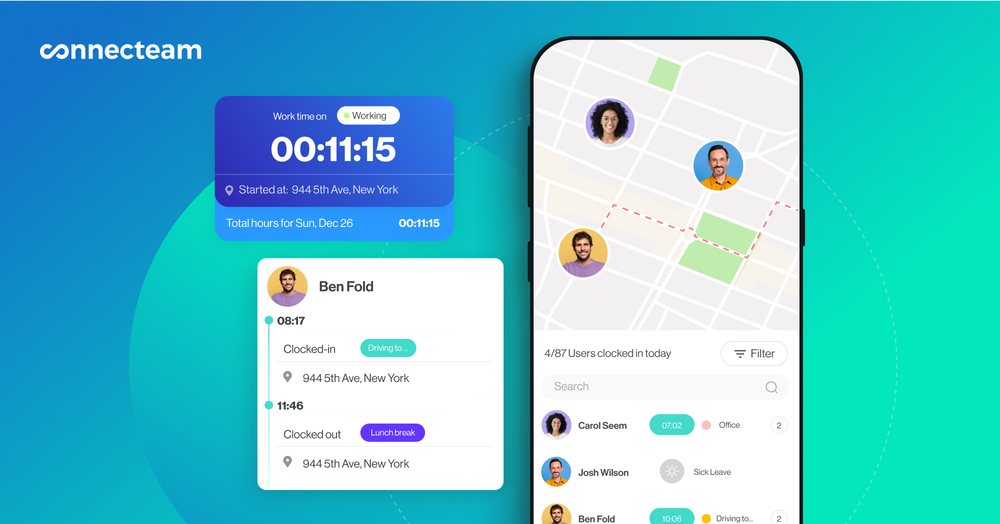
The GPS time clock records location data with every clock-in and clock-out to verify where your employees are working. Live GPS Tracking
Connecteam uses breadcrumbs for live tracking. Instead of only recording clock-in and clock-out points, you can choose to map your employee’s movement while they’re clocked in. This is especially helpful for managing teams in lawncare, delivery, or transportation, so you can see the exact route taken and how much time was spent at each stop.
I appreciated that you get an update every 5 to 10 minutes after movement, so employees don’t drain their battery life. Managers can view live trails to confirm job visits, improve route efficiency, resolve disputes, and quickly locate team members when needed.
It’s important to note that location tracking only runs during active shifts. When employees clock out, tracking stops to protect their privacy.
On-Site Geofencing
With Connecteam’s geofence time clock, managers can create a virtual boundary around a job site. When enabled, employees can only clock in once they’re physically inside that area. This is especially useful for retail, cleaning, security, or construction businesses.
I really liked that you can require geofences for certain jobs, such as on-site projects, while keeping other job types, like travel time or supply runs, unrestricted. Plus, if someone tries to clock out outside the geofence, you can require manager approval or enable automatic clock-outs when they leave the area.
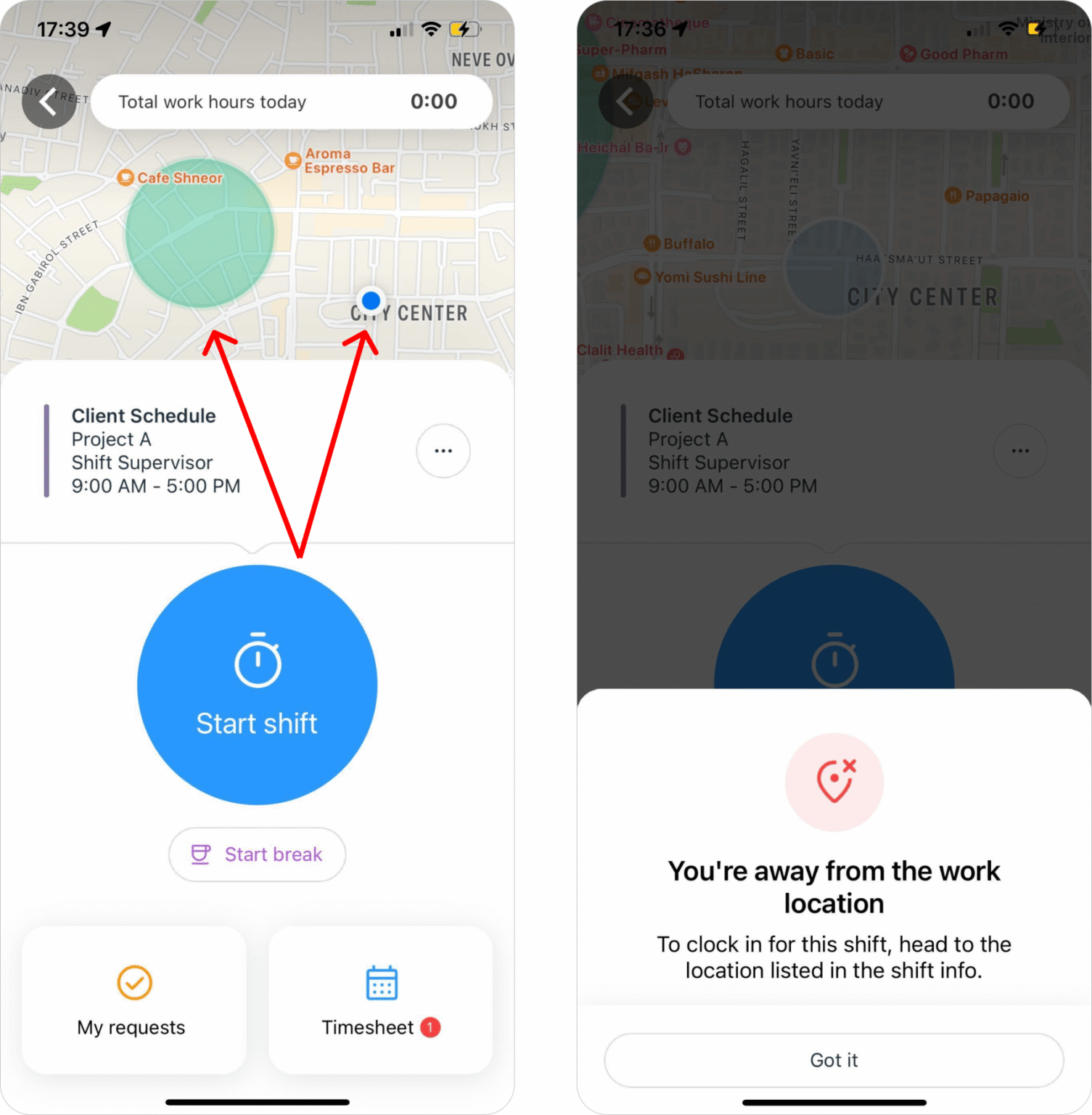
You can only clock into your shift once you’re inside the geofence. Overtime and Breaks
Connecteam helps businesses stay compliant with built-in rules for overtime tracking, breaks, and work hour limits. Overtime is calculated automatically, and managers can receive real-time alerts when employees approach unapproved overtime or set the system to clock them out automatically.
The break management software is also flexible and easy to use. You can set manual or automatic breaks, choose paid or unpaid, customize durations, schedule multiple breaks per day, prevent early clock-ins, and send reminders when breaks start or end. Automatic breaks are deducted after a set number of hours to meet meal and rest break compliance laws by state.
NFC Time Tracking
For businesses that need physical proof of on-site presence (like security companies, cleaning services, or facility managers) Connecteam offers NFC time tracking. Managers place NFC tags at specific job sites, and employees must physically tap their phone against the tag to clock in.
This goes beyond GPS by requiring physical proximity to a specific checkpoint. It’s especially useful in buildings where GPS signals are unreliable, like basements, parking garages, or large indoor facilities.
Timesheets and Payroll
Employee hours are logged automatically into organized timesheets for payroll, giving you a clear breakdown of regular time, overtime, breaks, and time off. You can filter by employee, job, task, or location to see exactly where time is spent, and built-in warnings help catch inconsistencies before they turn into payroll mistakes.
Managers can assign custom pay rates by employee or role, so wages are calculated correctly without manual fixes. Employees can review their hours, request edits, and submit timesheets for approval in the Connecteam app, while managers receive notifications to review, comment, adjust, and approve.
When it’s time to run payroll, just sync with systems like RUN Powered by ADP®, QuickBooks, and Xero, export data in multiple formats, or connect through API integrations.
And So Much More
Connecteam also includes employee scheduling, time off management, and team communication tools. These are useful if you want time tracking to connect directly to shift planning and payroll prep, but they aren’t required to use the GPS time clock.
When Connecteam May Not Be a Good Fit
Connecteam isn’t built for companies that want to monitor employee activity on their devices. It doesn’t track keystrokes, capture screenshots, log app usage, or measure productivity based on computer activity. If your goal is detailed device monitoring for remote desktop workers, a workforce surveillance tool would be a better fit.
It’s also not a payroll processing system. While it prepares accurate, payroll-ready timesheets, you’ll still need a separate payroll provider to handle tax calculations and payments.
Connecteam also offers a free for life plan – Get Started Now!
0Key Features
- GPS time clock
- Enforceable geofencing
- NFC time tracking
- Automated overtime rules
- Manager approval workflows
- Payroll integrations
Pros
- Strict geofence enforcement
- Reliable overtime calculations
- Mobile-friendly for field crews
- Clean payroll exports
Cons
- No offline capabilities
- Not designed for device activity monitoring
Pricing
Free-for-life plan availablePremium plans start at $29/month for 30 users
14-day free trial, no credit card required
Start your free trial -
ClockShark — Best for construction and trade crews tracking labor by job
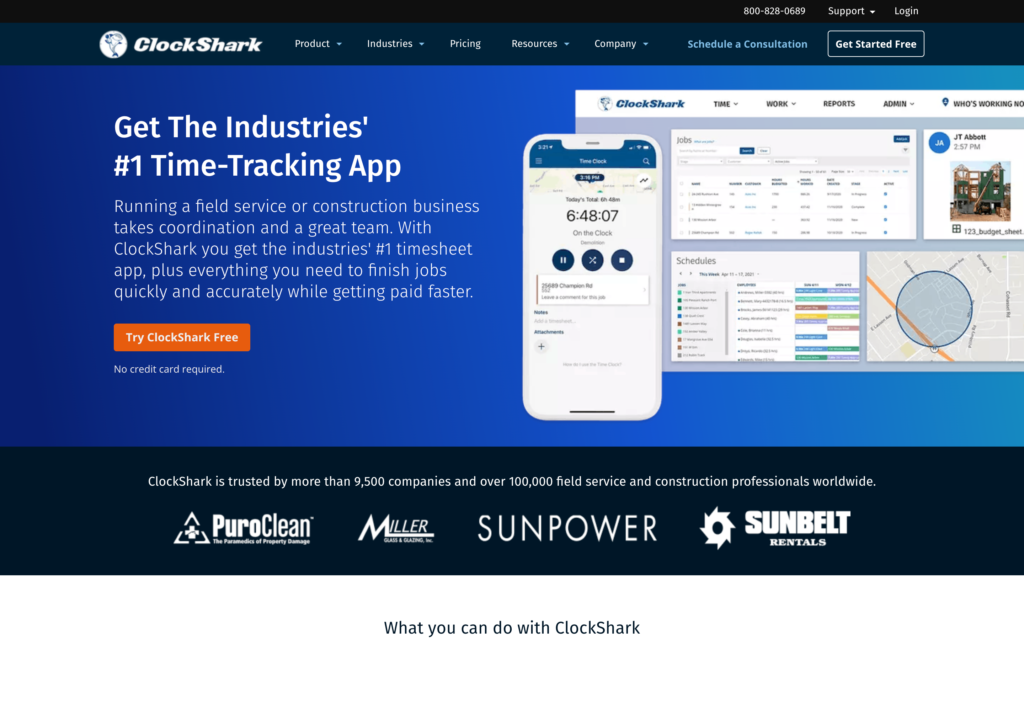
What’s new with ClockShark
As of mid-2026, a 3-year contract term applied to all ClockShark plans.
ClockShark is a GPS time tracking and job management platform built specifically for construction, landscaping, and field service businesses.
Why I chose ClockShark: I included ClockShark because it handles job-level labor tracking better than most general time clock apps. For construction and trade businesses that measure profitability by project, its job costing tools are a meaningful differentiator. It’s not the most affordable option on this list, but for companies that rely heavily on per-project cost visibility, it fits the use case.
GPS Time Tracking
In our full ClockShark review, we found that the system captures location data when employees clock in or out. The timer was accurate, and I liked that you have the option to clock in across mobile, web, or kiosk apps. The kiosk app specifically offers facial recognition and photo capture to prevent buddy punching. While helpful, I wish the same option was available for the desktop and mobile time clock apps.
That said, I really appreciated that the GPS tracker shows employee locations when they’re clocked in. The location updates every 15-20 minutes, so you can confirm that employees are actually where they need to be. Plus, there’s geofencing, which adds another layer of oversight for crews.
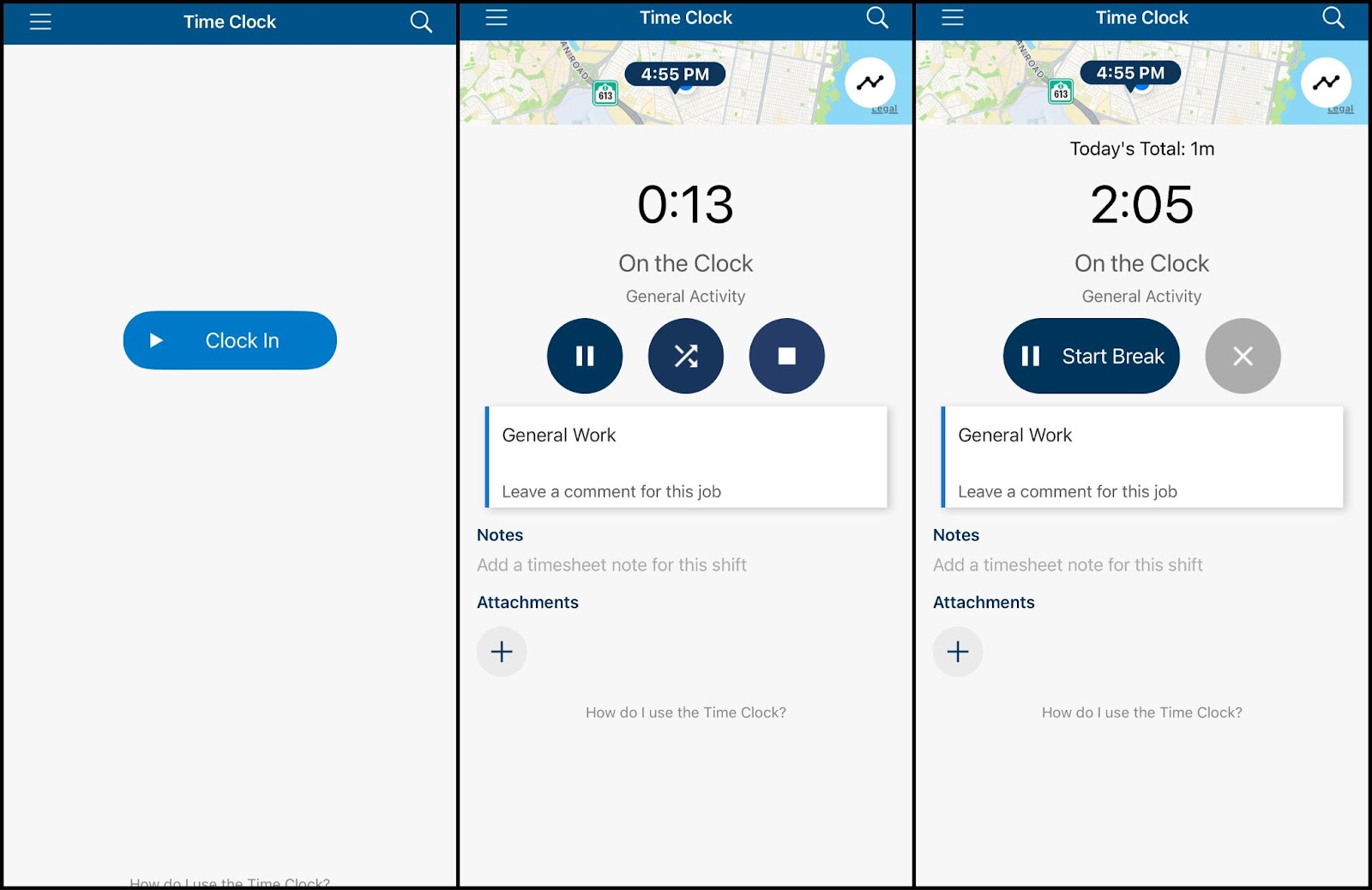
When testing ClockShark’s GPS time clock, we were able to clock in to a specific job and clock out for breaks. Note: Always check local privacy laws and employee consent requirements before enabling GPS or geofencing.
Overtime and Timesheets
ClockShark offers flexible overtime rules, allowing managers to set custom policies based on company needs or use pre-built rules (like California overtime laws). These overtime policies are applied automatically, and you can see flagged conflicts and an overview of work hours on the timesheet page.
Employees can edit timesheets with full visibility of changes made, which I appreciated. When it’s time to run payroll, managers can approve timesheets instantly from the main view or open each one to review details before approving.
Job Costing and Reports
ClockShark stands out for its job costing. I really liked that employees can clock in to specific jobs or projects, and the system will automatically assign time and expenses to each project. This is a good way to give managers visibility into labor costs per job, especially for construction and field service businesses that need to track their profitability by project.
ClockShark’s reports cover the basics, including total hours, attendance, overtime, and job tracking. During testing, we realized that it doesn’t offer advanced analytics or highly customizable reports, such as detailed productivity insights. For many small businesses, the standard reports will be enough, but companies looking for deeper performance data may find it a bit limiting.
What users say about ClockShark
I like being able to see on a map where my team members are, and that they can clock in and out for different jobs.

ClockShark can be pricey for larger teams, and it needs internet or GPS access to work properly. Some users may find the setup or mobile app a bit tricky at first.
 0
0Key Features
- GPS time clock
- Project-based job costing
- Facial recognition kiosk
- Custom overtime rules
Pros
- Detailed project-level labor tracking
- Accurate GPS visibility for field crews
Cons
- Base + per-user pricing scales quickly
- Reporting and analytics are fairly basic
Pricing
Starts at $40/month + $9/user/month. Trial: Yes — (14-day) Free Plan: No
-
QuickBooks Online — Best for businesses already using QuickBooks payroll
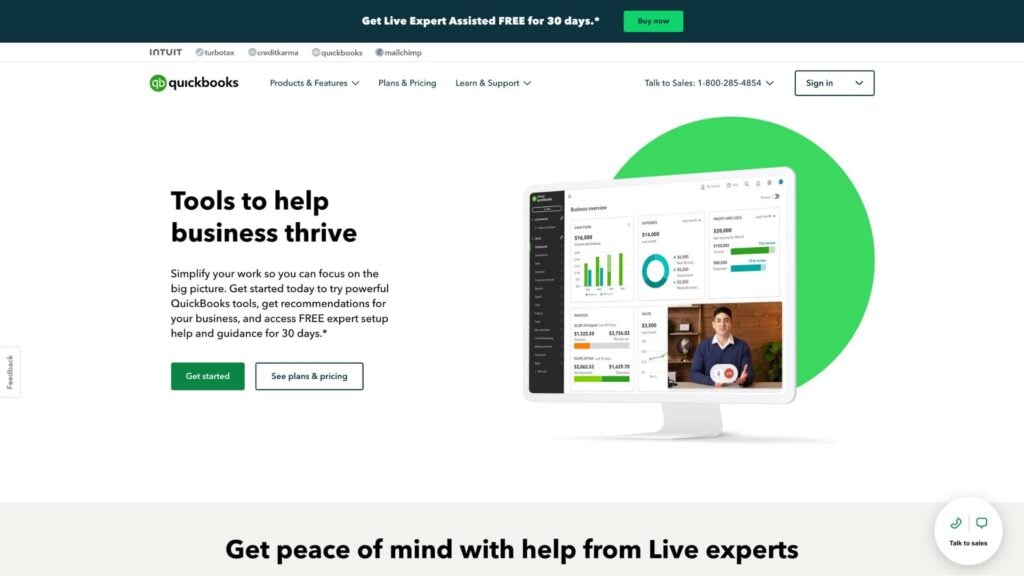
QuickBooks Time is a time-tracking system designed to integrate tightly with QuickBooks Online Payroll and other QuickBooks accounting tools. Its main advantage is syncing approved hours directly into the QuickBooks ecosystem.
Why I chose QuickBooks Time: QuickBooks Time’s payroll integration is stronger than most competitors on this list. For companies already using QuickBooks for accounting and payroll, the direct sync reduces duplicate data entry. Outside that ecosystem, its value proposition becomes narrower.
Time Clock and Geofencing
In our full QuickBooks Time review, we were able to track time on the web, mobile, and kiosk apps. Employees clock in by selecting an assigned task, making it easy to track time by project or job.
Geofencing restricted clock-ins to approved job sites, but enforcement allows some flexibility. During testing, employees could clock in outside a geofence if they added a note. While entries are flagged for review, enforcement relies on manager oversight rather than strict blocking. For teams that need hard location controls, that distinction matters.
It’s important to note that geofencing is now available only on the Elite plan, which costs $40/month + $10/user.
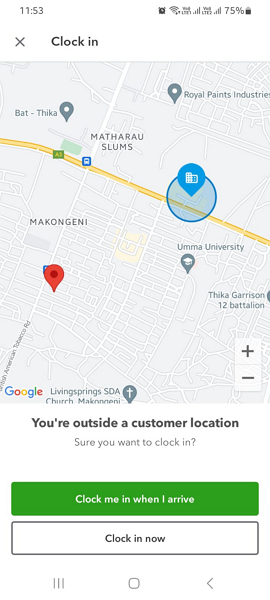
QuickBooks Time correctly recognized when our tester tried to clock in outside the geofence. GPS and Overtime Tracking
Managers can view the real-time location of clocked-in employees from a map view. For field service teams, this makes it easier to dispatch employees by proximity. I also appreciated that the GPS tracking only runs when employees are on the clock to comply with privacy laws.
Setting up overtime was simple: you just create daily, weekly, or double-time rules, and there’s even a preset option for California’s overtime requirements. In our latest testing, the overtime tracker calculated daily and double-time hours accurately, which was an improvement from our previous review where we found inconsistencies.
Timesheets and Payroll
All tracked hours are recorded into digital timesheets for manager review and approval. The information is there, but the layout felt slightly cluttered, especially when handling bulk edits.
Once approved, hours sync directly with QuickBooks Online Payroll, which is the platform’s strongest advantage. However, integrations outside the QuickBooks ecosystem are pretty limited.
That makes the software helpful for businesses already using QuickBooks Online Payroll. If your team relies on a different payroll provider, other time tracking systems may offer similar functionality without tying you to one accounting ecosystem.
What users say about QuickBooks Time
I love the level of ease when using QuickBooks Time. It’s very user-friendly and accurate. Time off requests are easy for staff to enter and for admins to review. I find it very easy to navigate, and it works well for our business and employees.
I don’t like that QuickBooks Time does not automatically tally up the hours from a specific pay period, so we had to enter the daily amount of hours into a program when payroll hit and then add it up to actually pay the employees.
Key Features
- Mobile and web time clock
- Real-time GPS location map
- Geofencing with exception flags
- Direct QuickBooks payroll sync
Pros
- Seamless sync with QuickBooks payroll
- Clear real-time location visibility
Cons
- Geofence rules can be bypassed with notes
- Value depends heavily on QuickBooks ecosystem
Pricing
Starts at $38/user/month Trial: Yes — 30-day Free Plan: No
-

Buddy Punch — Best for small field teams that want simple clock-ins
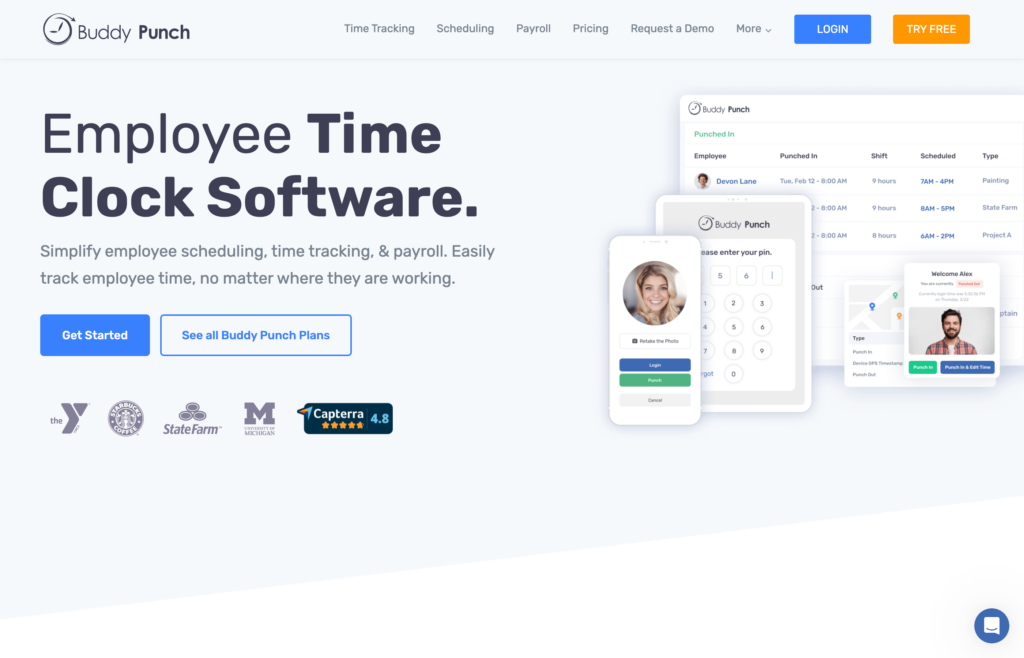
Buddy Punch is a straightforward time clock app focused on quick setup and simple clock-ins. It combines mobile punches with optional GPS tracking and facial recognition for identity verification.
Why I chose Buddy Punch: Buddy Punch is easy to set up and works well for small teams that don’t need complex job costing or strict enforcement controls. It keeps time tracking simple, but some GPS and payroll features come as paid add-ons.
Mobile Time Clock
In our full Buddy Punch review, we tested the time clock across mobile, tablet, and shared kiosk apps. Employees can clock in from any of these devices, and the system automatically calculates regular hours, breaks, and overtime based on your rules. It supports one automatic break per shift, with all additional breaks tracked manually.
Overtime is automatically calculated, and I appreciate that employees are notified as they approach their hour limits so they can clock out before going over.
The main drawback for me was that the mobile app requires an internet connection, which may be limiting for field teams in low-coverage areas. During testing, we also had to log in each time we opened the app, which definitely adds friction if quick clock-ins matter to your business. In addition, Buddy Punch doesn’t have an offline mode, so employees can’t clock in or out without an active internet connection.
GPS Tracking and Geofencing
Buddy Punch offers GPS tracking as a paid add-on ($2 per employee per month). We set a geofence with a 210-meter radius. Buddy Punch successfully blocked our attempt to clock in while outside the job site and displayed the error message “You are not within the assigned geofence.”
That said, geofencing features, including reminders, only work with an active internet connection, limiting their usefulness for employees in areas with poor cellular service. During testing, we also ran into a glitch where the Android app sent multiple incorrect geofence alerts after reconnecting to the internet, claiming that we’d entered or exited job sites we hadn’t visited.
I liked that the platform also includes facial recognition, requiring employees to take a selfie before clocking in. The photo is attached to the employee’s timesheet for managers to review and verify.
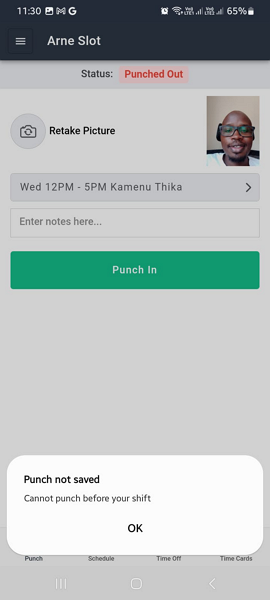
Buddy Punch shows how far you’re from the assigned geofence. Timesheets and Reporting
Recorded hours are automatically calculated and organized into clear digital timesheets, making it easy for managers to review, approve, and monitor overtime based on preset rules.
There are built-in reports that cover hours worked, attendance trends, overtime, and missed punches. More advanced attendance insights are available on higher-tier plans. Buddy Punch also offers its own payroll add-on ($39 base + $6/user/month) along with integrations for several popular payroll providers if you want to use another system.
What users say about Buddy Punch
I like how fast, easy, and simple it is to use. I don’t have to click through multiple screens just to get to my punch in/out.
The phone application lacks a lot of features that are only available on PC. Specifically customizing notifications and account details.
0Key Features
- Mobile and kiosk time clock
- GPS tracking (paid add-on)
- Geofencing with exception flags
- Facial recognition kiosk mode
Pros
- Simple setup for small teams
- Optional identity verification with selfies
Cons
- GPS and payroll features cost extra
- No offline mode
Pricing
Starts at $19/month + $4.49/user/month Trial: Yes — a 14-day free trial is available. Free Plan: No
-

Hubstaff — Best for hybrid or admin teams that want GPS plus activity monitoring
What’s new with Hubstaff
February 2026: Hubstaff previously offered a free plan for individual freelancers; it appears this plan has been discontinued.
What’s new with Hubstaff: Hubstaff previously offered a free plan for individual freelancers; it appears this plan has been discontinued.
Hubstaff is a time tracking platform that combines GPS tracking with employee activity monitoring. It’s designed primarily for remote and hybrid teams working on computers, rather than pure field crews that only need job-site verification.
Why I chose Hubstaff: Hubstaff offers a mix of time tracking and productivity monitoring that some hybrid teams may find useful. Its GPS tracking adds visibility for mobile workers, but its core focus remains desktop activity tracking rather than strict job-site enforcement.
Time Tracking and Overtime
In our full Hubstaff review, we tested the tool’s time tracking across mobile, desktop, and Chrome extensions. I liked that Hubstaff lets managers control which timer employees can use to help prevent people from tracking time across multiple apps. You can apply this rule company-wide or by team. For example, office staff can be restricted to desktop tracking, while field employees use mobile only.
The platform tracks regular hours, breaks, and overtime. Overtime tracking supports weekly overtime rules and automatically calculates pay based on preset rates. But there’s no option for daily overtime, and you can’t assign both overtime and double-time rules to the same employee. For businesses in states like California, those gaps could be a serious drawback.
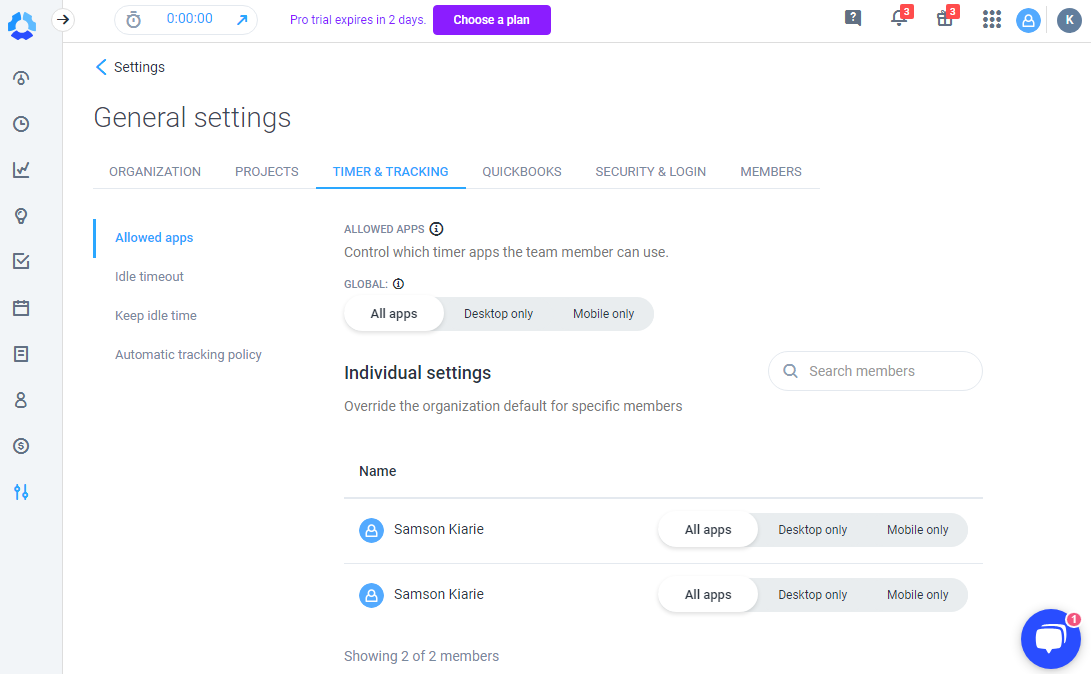
When testing Hubstaff, we were able to restrict time tracking to the desktop or mobile app. Activity Monitoring and Productivity Tracking
Activity monitoring is central to how Hubstaff works.
The platform can take screenshots at set intervals, track app and URL usage, and measure keyboard and mouse activity to estimate productivity. Screenshots are taken only while employees are clocked in, and optional blurring can be enabled.
These features may make sense for teams working primarily on desktops. For field teams, this level of monitoring may not add practical value. Employers should also review local monitoring laws and obtain appropriate consent before enabling these features.
GPS Tracking and Geofencing
Hubstaff offers GPS tracking and geofencing, but GPS is available only as a paid add-on ($3.33/user/month) on the Team plan ($10/user) and included on Enterprise ($25/user). This means a business on the Grow plan must first upgrade to Team just to access location features.
Geofencing can automatically clock employees in and out as they enter or leave a job site. But it doesn’t strictly block clock-ins outside approved areas in the same way that some other tools do. For field-only teams that need firm location-based clock-in restrictions, that can be a drawback.
What users say about Hubstaff
I really appreciate how Hubstaff makes work hours calculation easy and stress-free. It’s valuable because it gives clear visibility into how time is being spent across projects and teams, helping me track the organizational activity of employees effectively.
Hubstaff is poor in monitoring business activities, more so on actual work that each employee has done. The tool is consistently draining mobile battery, and this affects the field users.
0Key Features
- Desktop and mobile time tracking
- Screenshot and activity monitoring
- Weekly overtime rules
- GPS location tracking
Pros
- Detailed activity visibility for remote teams
- Flexible time tracking across devices
Cons
- No daily overtime support
- Geofencing does not block clock-ins
Pricing
Starts at $4.99/user/month Trial: Yes — 14 day Free Plan: No
-

Clockify — Best for budget-conscious teams that need basic GPS tracking
What’s new with Clockify
April 2026: Clockify capped its free plan at 5 users, replacing its previous unlimited-user model.
What’s new with Clockify: Clockify capped its free plan at 5 users, replacing its previous unlimited-user model.
Clockify is primarily a general time tracking tool that works well for teams that want basic hour logging without committing to monthly per-user fees.
Why I chose Clockify: I included Clockify because its free plan makes it accessible for small teams or businesses just starting out. It handles basic time tracking reliably, but it lacks some of the enforcement controls and payroll depth that field-based teams may require.
Timer and Timesheets
In our full Clockify review, we tested the time tracker across web, mobile, and desktop apps. To clock in, employees have to start and stop a timer. I appreciated that you can use the mobile app offline, which is a big help for teams in areas with low connectivity.
Clockify’s timesheets are useful and easy to approve and view at a glance, even if the interface is a bit dated and mostly table-based. However, in our testing, we found that you can’t approve timesheets on the mobile app. While you can access basic time tracking, other reporting and admin features are only available on the desktop version. This could be limiting for managers that rely on mobile access to handle approvals on the go.
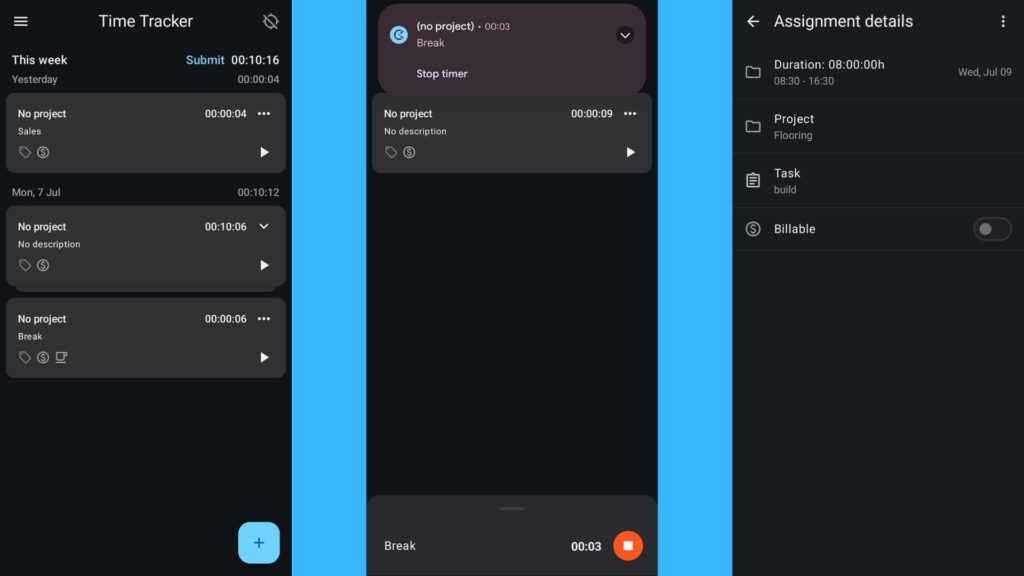
During testing, we were able to select a project, start the timer, and add breaks. GPS Location Tracking
Clockify includes GPS tracking on paid plans. It records employee locations during clock-ins and provides location history through the web dashboard.
What it doesn’t include is geofencing, which is available on the Pro plan at $7.99/user/month. You can’t restrict clock-ins to approved job sites or block punches outside specific areas. The system records where employees were, but it doesn’t enforce where they’re allowed to clock in.
For teams that only need visibility into clock-in locations, this may be enough. For businesses trying to prevent unauthorized punches at the source, the lack of enforcement can be a limitation.
Payroll and Integrations
Clockify connects with QuickBooks Online for accounting and invoicing through a two-way sync, but it doesn’t integrate with QuickBooks Online Payroll. That gap stands out, especially for businesses looking for a seamless link between time tracking and payroll. On top of that, the QuickBooks integration is limited to paid plans.
Although Clockify mentions integrations with payroll providers like ADP and Paychex, these aren’t true direct integrations. Instead, they rely on manual data exports. That means you need to export timesheets as a PDF, Excel, or CSV file and then upload them into your payroll system yourself. This extra step adds admin work and can create more room for mistakes, especially when payroll deadlines are tight and stressful.
What users say about Clockify
It is the time control and tracking tool that we use in the company, and in my area, I use it to keep track of the activities and times of my team both in the main office and in the remote offices.
Its rigidity can slow you down. When you need to correct entries, switch tasks quickly, or manage more complex workflows, it feels clunky. The interface gets the job done, but it’s not always intuitive, and small admin tasks can take more clicks than they should.
0Key Features
- Online timesheets
- Web and mobile time tracking
- GPS tracking (paid plans)
- Project-based time entries
Pros
- Free plan for up to 5 users
- Offline mobile time tracking
Cons
- No geofencing enforcement
- Payroll requires manual exports
Pricing
Starts at $3.99/user/month Trial: Yes — a 7-day free trial is available. Free Plan: Yes — limited to 5 users.
Compare the Best GPS Time Clock Apps
| Topic |
 Start for free
|
|
|
|
|
|
|---|---|---|---|---|---|---|
| Reviews |
 |
|
|
|
|
|
| Pricing |
Starts at just $29/month for the first 30 users
|
Starts at $40/month + $9/user/month.
|
Starts at $38/user/month
|
Starts at $19/month + $4.49/user/month
|
Starts at $4.99/user/month
|
Starts at $3.99/user/month
|
| Free Trial |
yes
14-day
|
yes
(14-day)
|
yes
30-day
|
yes
a 14-day free trial is available.
|
yes
14 day
|
yes
a 7-day free trial is available.
|
| Free Plan |
yes
Free Up to 10 users
|
no
|
no
|
no
|
no
|
yes
limited to 5 users.
|
| Use cases |
Best for field teams that need strict GPS enforcement and payroll-ready hours
|
Best for construction and trade crews tracking labor by job
|
Best for businesses already using QuickBooks payroll
|
Best for small field teams that want simple clock-ins
|
Best for hybrid or admin teams that want GPS plus activity monitoring
|
Best for budget-conscious teams that need basic GPS tracking
|
| Available on |
How to Choose the Right GPS Time Clock App
Choosing the right GPS time clock depends on your team size, industry, budget, and how strictly you need to enforce location-based clock-ins. Here are some key questions to ask yourself to help narrow down your decision:
Team Size & Budget
- Are you managing a small team or a larger crew? Small teams (under 10 people) may benefit from per-user pricing models, while larger teams often save money with flat-fee pricing structures.
- Do you have a tight budget? Look for options with free plans or free trials to test before committing. Some platforms offer free tiers for small teams (typically under 5-10 users).
Industry & Use Case
- Are you in construction, trades, or field services? Look for tools with strong job costing capabilities, allowing you to track labor by project or cost code.
- Do you use accounting software? Check if the GPS time clock integrates directly with your existing accounting system to reduce data entry.
- Are you managing remote, hybrid, or office-based teams? Some tools focus on field enforcement, while others balance GPS tracking with activity monitoring for remote workers.
Red Flags to Avoid
- No geofencing: If location enforcement is critical, skip tools without geofencing capabilities.
- No offline support: If your team frequently works in dead zones, offline clocking is non-negotiable.
- Limited payroll integration: If manual payroll exports are required, expect extra admin work and higher error risk.
- No advanced overtime rules: If your pay structure requires daily or double-time calculations, confirm the tool supports them.
- Poor mobile performance: Test the app on real devices in your actual work environment. Slow or unreliable mobile apps create friction in the field.
What Is a GPS Time Clock?
A GPS time tracking app is employee time clock software that records work hours and verifies location at clock-in and clock-out. It’s commonly used by businesses with mobile or field teams, including construction, home services, delivery, landscaping, and healthcare.
Instead of relying on paper timecards or spreadsheets, employees clock in through a mobile app. The system attaches a location stamp to each punch, creating a digital record of when and where work happened. This helps reduce disputes and prepares accurate timesheets for payroll.
How Do GPS Time Clocks Work?
Most GPS time clocks operate through a mobile app. Employees tap to clock in, and the system records the time and GPS coordinates in the background. The same applies when clocking out or taking breaks.
Many tools also support geofencing. Managers define virtual job-site boundaries, and employees must be inside the area to clock in. Some apps only flag location exceptions, while others block punches entirely. That difference matters if you’re trying to prevent unauthorized clock-ins rather than review them later.
On the admin side, all data flows into digital timesheets. Hours, breaks, and overtime are calculated automatically. Managers review and approve entries before exporting hours to payroll.
What Are the Benefits of a GPS Time Tracker?
Better Labor Cost Control
When you can verify clock-in locations and monitor hours in real time, it’s easier to prevent unauthorized overtime and early punches. Small discrepancies add up over a pay period. GPS visibility reduces that risk.
More Accurate Attendance
Location stamps and geofencing discourage buddy punching and inaccurate reporting. Instead of relying on trust alone, managers have a record tied to each shift.
Fewer Payroll Corrections
Automatic calculations reduce rounding errors and manual math. Clear audit trails make it easier to fix missed punches before payroll runs.
Clearer Job Costing
For businesses operating across multiple sites, labor needs to be tied to specific jobs. GPS time tracking tools help track hours by project so you can see which work is profitable and which isn’t.
Less Day-to-Day Oversight
Managers don’t need to call or text employees to confirm arrivals. Real-time visibility replaces manual check-ins.
How Much Do GPS Time Clock Apps Cost?
Most GPS time clock apps charge either:
- A flat monthly fee plus a per-user rate
- Or a per-user monthly price
Entry-level plans typically range from $3.99 to $4.99 per user per month. Other platforms start around $19 to $40 per month, plus $4 to $9 per user.
Costs increase if GPS tracking, geofencing, payroll integrations, or advanced overtime rules are locked behind higher tiers or add-ons.
Connecteam stands out for its Small Business Plan, which is totally free for up to 10 users. Connecteam’s paid plans start at just $29 per month for up to 30 users. Higher-tier plans start at $49/month for Advanced and $99/month for Expert, both also covering up to 30 users.
FAQs
Most apps track location only while employees are clocked in. Employers should review state and local laws and obtain proper consent before enabling GPS or biometric features.
Managers can edit timesheets and review flagged entries. Many systems send reminders to reduce missed punches. Connecteam includes edit logs and approval workflows so corrections are visible.
GPS tracking is generally legal during work hours, but laws vary by state and country. Employers should confirm compliance before implementing tracking or monitoring tools.
The Bottom Line On GPS Time Clock App
The Bottom Line on GPS Time Clock Apps
GPS time tracking apps help businesses verify where work happened and prepare accurate payroll without manual corrections. The right choice depends on how strict you need location enforcement to be and how closely you want time tracking connected to payroll.
If strict geofencing, reliable overtime calculations, and payroll-ready exports matter most, Connecteam remains the strongest overall option on this list.
Start with the plan that fits your team size and test it in your real workflow before committing.