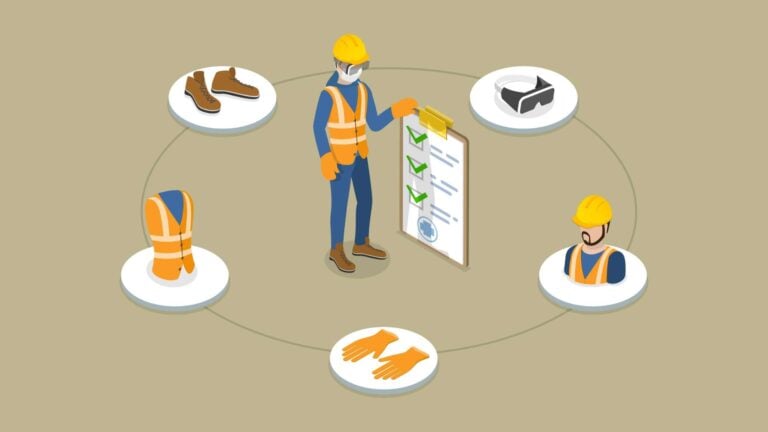


When safety incidents go unreported, minor hazards can escalate into costly accidents, leaving you with injuries, compliance violations, and operational downtime.
I reviewed 17 health and safety management software apps and ranked the top five based on incident reporting, compliance management, and frontline communication capabilities.
These software solutions will equip you to reduce workplace risks, improve compliance, and respond to safety issues faster.
What’s New in This Update (May 2026)
- Redefined the selection criteria to focus more tightly on health and safety (H&S) management solutions that work for field and frontline teams.
- Retested the platforms and shortlisted five products that meet the updated selection criteria.
- Ranked the apps based on recent performance.
- Expanded each product description to include benefits and key considerations to help you make an informed decision.
Our Top Picks
-
1

Field safety and quality managers that need a mobile-first solution
-
2

Safety and sustainability teams in mid-sized to large organizations that need an OSHA-focused EHS management system
-
3

Large enterprises in regulated, high-risk, and service industries that need an end-to-end EHSQ system
Why trust us?
Our team of unbiased software reviewers follows strict editorial guidelines, and our methodology is clear and open to everyone.
See our complete methodology
How I Ranked the Best Health and Safety Management Software
To rank these health and safety management software solutions, I focused on how they implement incident reporting, speed up issue resolution, and streamline training to minimize compliance and safety risks.
Must-Have Features
For a platform to make it on my list, it needed to provide the following features in some capacity:
- Incident and near-miss reporting: The best platforms support mobile-friendly incident reporting, allowing employees to log workplace hazards, accidents, and near-misses in real time, improving risk visibility.
- Corrective action tracking: The platform should let managers assign, track, and document follow-up work after hazards, incidents, or failed inspections. Platforms with full CAPA workflows earned additional points.
- Audit and inspection management: The platform should offer audit tools and digital checklists to automate and document safety inspections, eliminating risky manual paperwork.
- Onboarding and training management: Health and safety management software should centralize safety training with easy course planning, safety training renewal, and progress tracking. This ensures that all employees receive the necessary training and remain compliant with industry standards.
- Real-time alerts and communication: The software should enable managers to instantly share urgent policy changes and hazard alerts to keep everyone informed in near real time.
- Reporting and analytics: The software should provide dashboards and key performance indicators to enable managers to spot trends.
Operational Reliability Features
- Ease of use: The platform should be user-friendly so employees can spend less time learning it and more time managing workplace safety.
- Mobile accessibility: Mobile-friendly safety management software enables frontline employees to report incidents, receive instant safety alerts, complete inspections, and access safety resources directly from the field.
- Integrations: If the platform isn’t part of a broader suite of workforce management solutions, it should integrate with your go-to HR, employee experience, scheduling, and other applications to ensure data flows consistently across systems.
Value-Added Features:
- Advanced analytics: Some platforms provide an interactive dashboard and predictive analytics that help anticipate risks, pinpoint safety trends, and expedite decisions before incidents escalate.
- AI and automation: Modern platforms may use AI tools to streamline various phases of health and safety management, such as auto-generating forms or voice-to-text input.
Note: I considered operational reliability features and value-added features as ranking factors rather than as inclusion/exclusion criteria. As such, you’ll find tools that don’t offer these features ranked at the bottom of this list.
The 5 Best Health and Safety Management Software of 2026
-
SafetyCulture — Field safety and quality managers that need a mobile-first solution
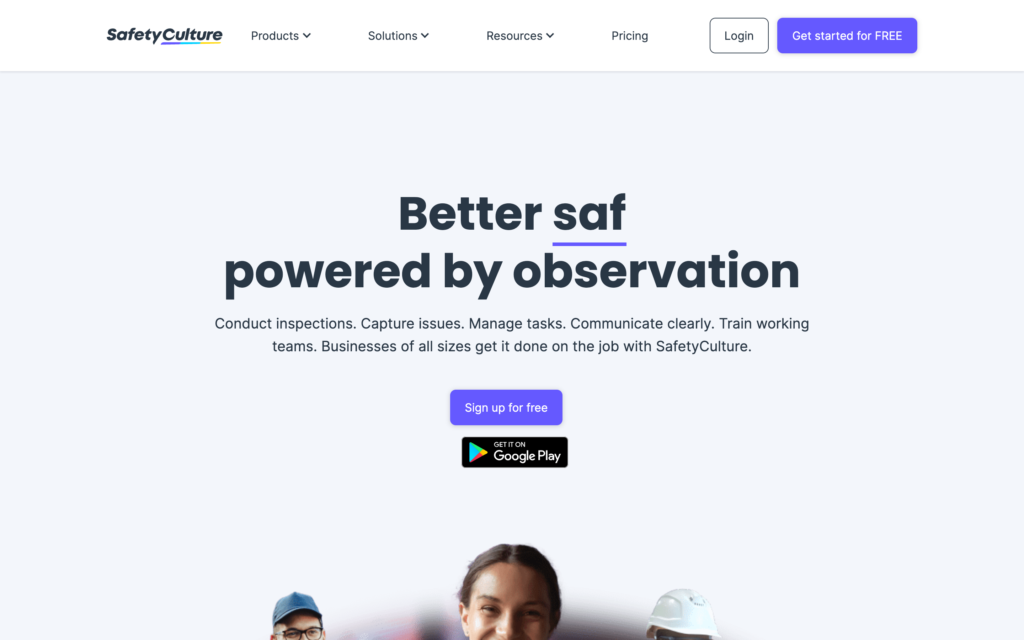
SafetyCulture (formerly iAuditor) is an inspection and safety compliance management software solution designed to streamline inspections and audits.
Why I chose SafetyCulture: I chose SafetyCulture for its flexible mobile inspection workflows that help streamline audits and standardize safety checks for consistent, real-time reporting. However, while its free plan works for very small teams, per-user pricing can become expensive as your organization grows.
Let’s discuss some of SafetyCulture’s key features:
Inspection and Audits
SafetyCulture provides more than 9,000 mobile-friendly inspection and audit templates across processes, including incident reports and vendor due diligence. The templates are ready-to-use, which means you can deploy inspections in minutes, not hours. You can customize the templates if need be or create new forms and checklists from scratch using SafetyCulture’s AI generator.
Since the forms are built primarily for inspections and audits, they help inspectors include photos, notes, GPS, and signatures on-site. The details help gather enough context to quickly assess every situation. You can assign fixed tasks and verify completion, though SafetyCulture doesn’t offer full CAPA workflows.
Even better, templates support offline access on mobile, so inspectors can complete safety inspections and audits without an internet connection. This makes SafetyCulture ideal for teams in low-connectivity areas. However, some users report that the app struggles to sync data when the internet connection is slow.
Safety Training
Through its SC Training platform (formerly EDApp), SafetyCulture lets you generate complete safety courses in minutes using AI. All you have to do is upload images of your compliance and safety course.
The AI tool automatically scans the images to create structured lessons, saving you hours of tedious design work. You can also add in-lesson narration with a text-to-speech AI tool to create more inclusive training.
However, like any other AI tool, SafetyCulture’s AI doesn’t create 100% accurate courses. The AI-generated lessons serve only as launchpads for your training programs. You’ll have to edit and customize them to meet your specific requirements.
Asset Register
SafetyCulture’s digital asset register provides a centralized dashboard that streamlines tracking and management of machinery, equipment, safety gear, and vehicles. Each asset can have a unique QR code, NFC tag, and digital checklist, which helps quickly identify and locate assets, and capture inspection data.
The digital register also provides real-time updates on asset status so you can spot and address issues before they spiral out of control. Addressing problems early prevents failures that could cripple operations, while also helping you maintain safety and compliance. However, teams that require advanced issue workflows, such as asset depreciation tracking or predictive maintenance scheduling will find SafetyCulture limited.
What Users Say About SafetyCulture
The best has been the team collaboration features that help us to plan and organize our safety inspection tasks by assigning duties and work together in ensuring our workplace is safe for everyone and compliant with all regulations.

You cannot go back to a previous page when viewing items without it reverting back to page one even if you are on page ten, it’s frustrating.

Key Features
- Large library of templates and forms
- Text, photo, and video messaging
- Digital register for managing assets
- Sensor device integration
Pros
- Free guest access for contractors and vendors
- Reports are exportable to Word, Excel, and PDF
Cons
- Per-employee pricing can add up
- Users note permissions can be confusing
Pricing
Starts at $24 per seat per month Trial: Yes Free Plan: Yes
-
EHS Insight — Safety and sustainability teams in mid-sized to large organizations that need an OSHA-focused EHS management system
Available on
- Web
- iOS
- Android
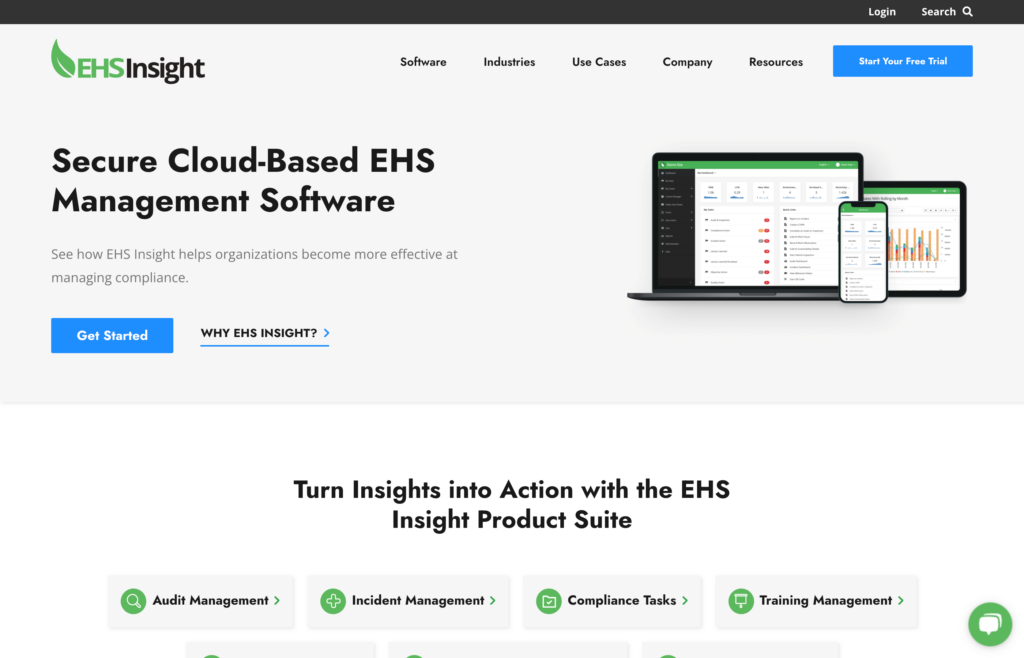
EHS Insight is a cloud-based environmental health and safety (EHS) platform built primarily for safety and sustainability teams in mid-sized to large companies.
Why I chose EHS Insight: I chose EHS Insight for its user-friendly interface and offline access, which allows teams to perform safety checks and audits with ease, even when in areas with unreliable internet connectivity. However, while it’s a good fit for comprehensive H&S programs, it can be overly complex and costly for smaller teams.
Let’s explore some of EHS Insight’s features:
Incident Management
Unlike SafetyCulture, which focuses on quality and safety incidents, EHS Insight streamlines management of OSHA-reportable incidents. Its built-in support for OSHA 300, 300A, and 301 forms makes it ideal for recording and addressing work-related incidents that require instant notification to OSHA, such as fatalities and inpatient hospitalizations.
I liked that users can submit, review, and escalate incidents anywhere, anytime, even in low-connectivity regions, thanks to EHS Insight’s mobile compatibility and offline capability. Real-time incident reporting enables safety teams to quickly apply corrective actions to mitigate escalation and future risks. However, the investigation workflow can be confusing at first and requires training for efficient use.
Compliance Management
EHS Insight stores internal policies and external regulations in a single repository, and links each one to a specific task and due date. It also constantly scans due dates and sends alerts to the responsible person when a policy is due for renewal.
One feature in particular that caught my eye is the option to schedule recurring audits, compliance activities, and policy reviews, and assign them to specific team members. The assignees receive automated notifications and reminders of due dates, ensuring everything stays on track.
Moreover, the real-time dashboards provide managers with instant insights into compliance status, enabling them to spot trends and make informed decisions. However, while the platform is generally user-friendly, some users find its dashboards cumbersome to navigate.
Training Management
EHS Insight’s training management module lets you tailor safety programs to your organization’s unique needs. You can also monitor learning progress with the platform’s automated tracking and real-time reporting. I like that training objectives can be tied directly to safety and compliance requirements to prevent knowledge gaps.
The platform supports a Bring Your Own Content (BYOC) model, allowing you to upload existing SCORM courses to speed up deployment. There’s also a library of prebuilt safety training materials, but they aren’t fully customizable. Unfortunately, EHS Insight lacks a built-in course creator, which can be a dealbreaker for organizations looking to build training programs from the ground up.
What Users Say About EHS Insight
This software is every bit as powerful as higher priced competitors such as Enablon, Intelex, etc.
The dashboard is cumbersome and complicated. It is not user-friendly, and it doesn’t allow you to “back-up” readily.
Key Features
- Audit management
- Training management
- Incident management
- Compliance management
Pros
- Easy-to-use apps
- Modular design makes it affordable
Cons
- Confusing workflows
- Complex reporting
Pricing
Starts at $5,000 per year (contact vendor for details) Trial: Yes Free Plan: No
-
CorityOne — Large enterprises in regulated, high-risk, and service industries that need an end-to-end EHSQ system
Available on
- Web
- iOS
- Android
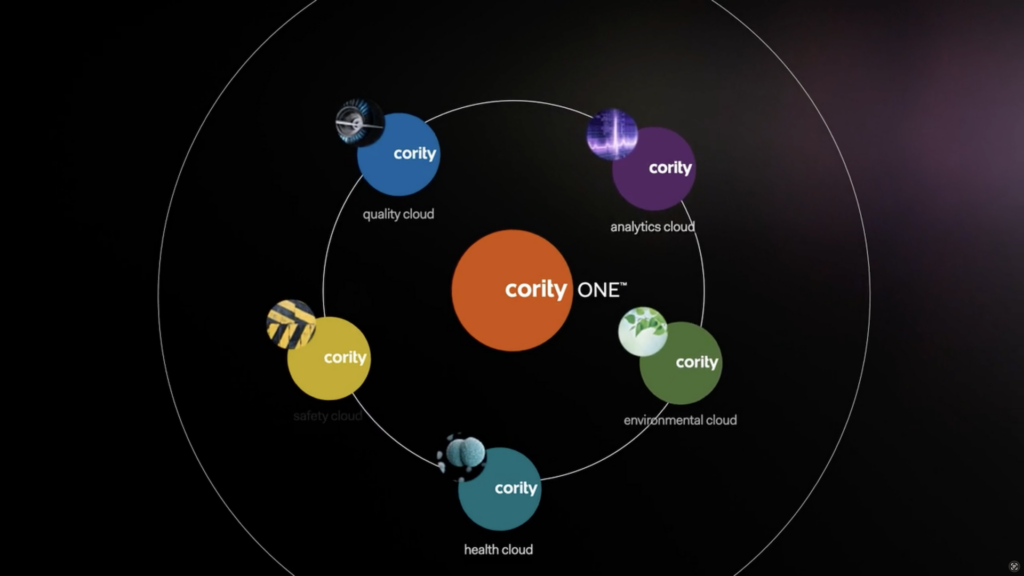
CorityOne is an all-in-one environmental, health, safety, and quality (EHSQ) and sustainability platform for organizations in regulated, high-risk, and service industries.
Why I chose CorityOne: I chose CorityOne for its Cortex AI suite, particularly its ability to automate repetitive data entry and analysis, which helps inspectors easily scan for trends. However, the overall learning curve is steep, mainly due to the wide range of features.
Let’s discuss some of the benefits of using CorityOne:
Modular Design
CorityOne packs quite a punch, but it can be pricey for large organizations that need all its firepower. However, the vendor adopts a modular design, so businesses can purchase only the modules they need.
This reduces the software costs and makes it easy for small businesses to build a platform that aligns with their compliance priorities. However, if you combine multiple modules, you may need to carry out extensive configuration before CorityOne becomes useful.
Mobile Incident Reporting
CorityOne’s mobile-friendly incident reporting stands out, especially for field and frontline teams. It allows users to capture and submit incidents directly from their smartphones, even without an internet connection. This reduces paperwork delays, allowing organizations to resolve issues as soon as they surface.
While CorityOne’s mobile reporting is powerful, some users claim that it doesn’t integrate seamlessly with certain modules, such as the investigation workflow. As a result, cross-module investigation and root-cause analysis can be less effective, which may be off-putting for organizations that need to use multiple modules to manage complex incident investigations.
Advanced Analytics
What sets CorityOne apart is its advanced analytics capabilities. Combined with its AI agents, these features speed up incident trend analysis to uncover hidden risks early. It also lets you implement a predictive safety model to spot and minimize preventable incidents.
Organizations seeking enterprise-level oversight will appreciate that CorityOne delivers safety insights through configurable dashboards. However, with this level of advanced insight comes significant setup that can be difficult to achieve for small teams or organizations that don’t have dedicated analytics resources.
What Users Say About CorityOne
The adaptability and ability to customize layouts and information to what is relevant to us is excellent. The fact that it gets updated every 4 months means when we do find improvements we would like, they are quite often already in the works.
Reporting module could be improved by being more default as for example Power BI.
Key Features
- Compliance management
- Integration with wearables and other devices
- Customizable access controls and permissions
- Task scheduling
Pros
- Includes EHS and adjacent modules in one app
- Vendor management for access to contractors
Cons
- Users have said features can be difficult to navigate
- May not be ideal for small- and medium-sized businesses
Pricing
Contact vendor for price Trial: No Free Plan: No
-
Ideagen EHS — Mid-sized to large organizations looking for a systematic EHS solution
Available on
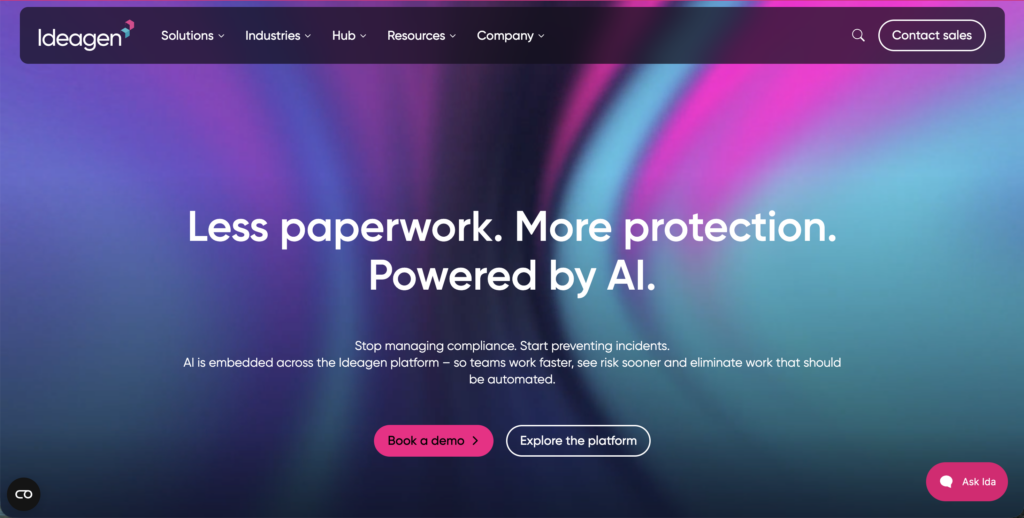
Ideagen EHS (formerly ProcessMAP) is another modular EHS solution built primarily to streamline risk assessment, incident reporting, and regulatory compliance for organizations in industries like manufacturing, energy, and aerospace.
Why I chose Ideagen EHS: I chose Ideagen EHS mainly for its AI-driven automation and mobile accessibility. The platform provides three modules that can be used on their own or combined to support a holistic approach to safety management. The modular design makes it affordable, but integrating all modules can present a learning curve for first-time users.
Let’s dive into Ideagen EHS’ key features:
Environmental Management
Ideagen EHS handles environmental management well, with real-time tracking and AI-driven insights to help organizations navigate complex, multi-jurisdictional compliance requirements. The platform helps monitor air quality, dust, and noise using IoT sensors, meteorological modeling, and predictive analytics.
This integrated approach enables organizations to detect and prevent environmental issues before they blow up into regulatory violations or community complaints. While this helps organizations move beyond reactive compliance, the software can be difficult to set up and use as some features are tucked away in cluttered menus.
Inspection Management
If you’re looking to ditch inconsistent, paper-based checklists, Ideadgen EHS has the tools to automate safety inspection workflows. With contextual AI, the platform lets you build digital protocols and use predictive scheduling to ensure no critical inspection is missed. Inspections are mobile-optimized, so team members can complete them while in the field.
I also like Ideagen EHS’ automated compliance tracking, which automatically and continuously scans local and international regulatory sources for updates. If it finds anything that needs addressing, it automatically creates action items and assigns them to specific users for faster resolution.
Training Management
Ideagen EHS integrates training data with other EHS modules, such as incident and audit management. Using embedded AI, it correlates incident data with employee records to uncover training gaps. An EHS manager can leverage these insights to update courses and training plans, ensuring employees maintain the required qualifications.
However, Ideagen EHS’ training resources aren’t optimized for mobile users. For this reason, the platform is unsuitable for organizations that need to design and implement training programs for remote and field-based workers.
What Users Say About Ideagen EHS
The software is set up on a module styled basis. This makes the system easier to access the correct locations for different types of users.
Insight is difficult. Sometimes, customer service can take too long.
Key Features
- Environmental management
- Inspection management
- Training management
- Audit quality management
Pros
- Modular design
- Responsive support teams
Cons
- Steep learning curve
- Rigid workflows
Pricing
Contact vendor for price Trial: Yes Free Plan: No
-
Quentic — Europe-based organizations looking for an EHS and sustainability platform
Available on
- Web
- iOS
- Android
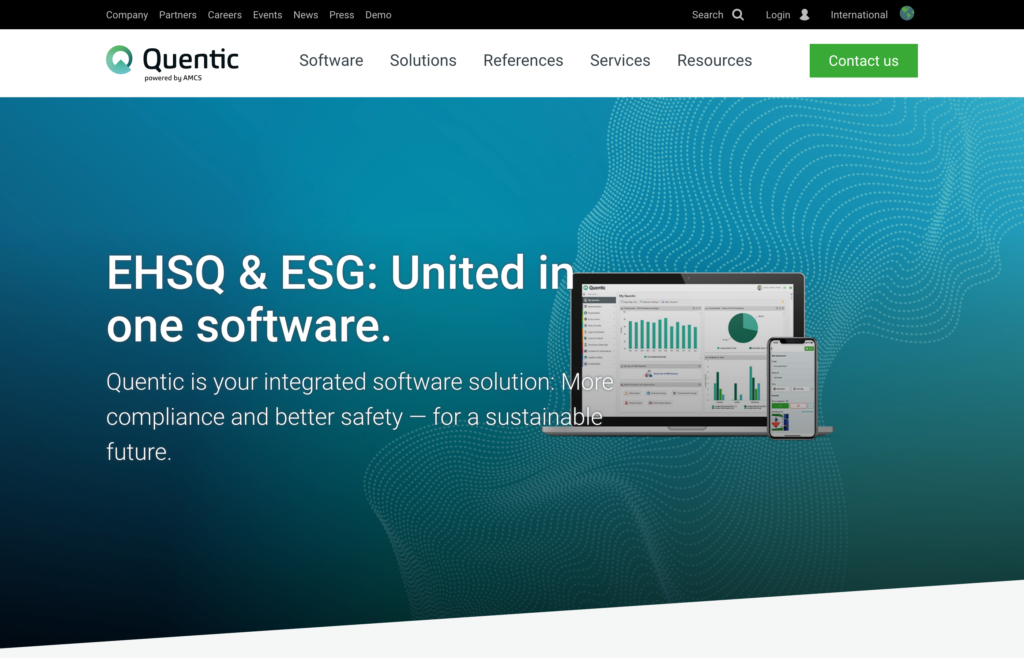
Quentic is a modular EHS software built primarily to streamline incident management, risk assessment, legal compliance and training. The platform is designed around strict EU regulatory compliance standards, and is therefore well suited for Europe-based companies.
Why I chose Quentic: I chose Quentic for its integrated global legal content and multilingual capabilities, making it a good fit for international companies. It offers intuitive risk analysis and ISO-aligned templates suitable for complex, multi-location operations. However, its focus on EU markets makes it unsuitable for organizations outside the region, and its steep implementation curve can be off-putting for small companies.
Let’s explore some of Quentic’s key features:
Safety Instructions
Quentic has numerous standardized templates and prebuilt ISO 7010:2019 phrases and pictograms that enable organizations to define safety guidance. These features help managers create a structured approach to safety activities, equipment, or departments. Doing so ensures everyone is clear about proper safety practices, fostering a culture of safety within the organization.
However, Quentic’s design and feature-rich nature increase its overall complexity, creating a steep learning curve for first-time users. This can also slow down global enterprises needing highly tailored document structures or those looking to provide workplace safety instructions in fast-moving operations.
Risk Assessment
Quentic provides structured templates and predefined hazard catalogues that make it easy for organizations to structure risk assessment workflows. I liked that inspectors can perform assessments without an internet connection, which enables teams in low-connectivity regions to accurately identify and document risks in the field.
Quentic also handles review task assignments well. It analyzes risk impact, frequency, and probability scoring to help teams focus on the most critical safety risks. Unfortunately, the platform’s limited customization and complex configuration may hinder proper implementation of niche risk frameworks.
Training Management
Quentic’s training module is an ideal fit for businesses that want to define safety training paths based on job roles or qualifications. The platform makes it easy to identify training needs and structure programs around them. You can add questions at the end of each training session to ensure everyone understands the material.
The only area where Quentic could improve is its course-creation capabilities. Currently, it doesn’t provide any essential course-creation tools or an AI-powered creator to speed up deployment. However, it does let users import existing content from third-party programs and integrate interactive SCORM content.
What Users Say About Quentic
Once the master data for the modules has been entered and linked, Quentic becomes a powerful system. With each data expansion, new possibilities arise for its application in business processes.
The tool can be overwhelming at first, as it offers a wide range of functions, which can make it difficult for new users to familiarize themselves with it.
Key Features
- Health and safety
- Incidents and observations
- Legal compliance
- Environment management
Pros
- Comprehensive modular design
- Strong multilingual support
Cons
- Complex to set up and use
- Unresponsive technical support
Pricing
Contact vendor for price Trial: No Free Plan: No
Workforce Management Software for Safety and Compliance
-
Connecteam — Field and frontline teams that need a workforce management tool with health and safety features in one platform
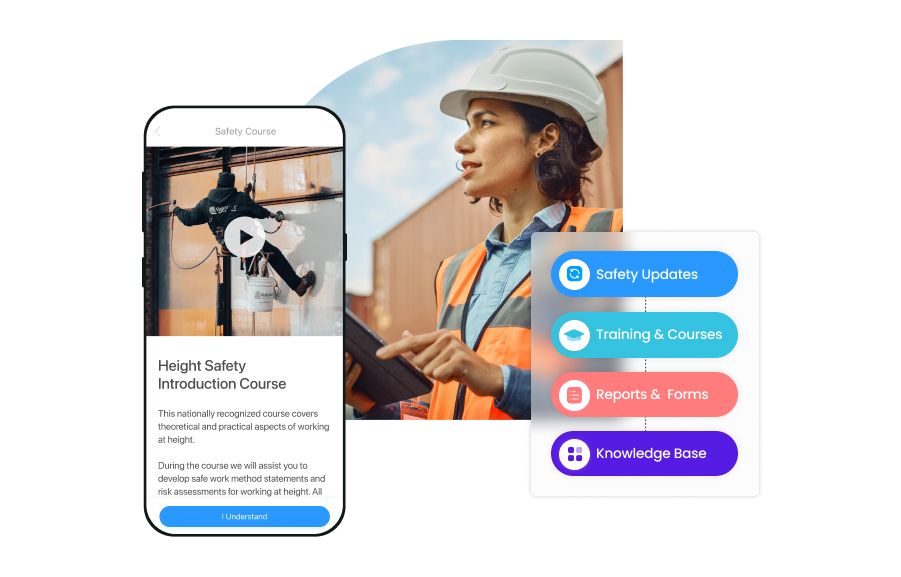
Connecteam is the best choice for field and frontline teams because it combines workforce management with health and safety capabilities in one platform. It’s especially strong for teams that need incident reporting, real-time communication, and safety compliance but don’t want to juggle multiple disconnected apps.
Why I included Connecteam: Connecteam brings everyday safety workflows into the same mobile app employees already use for their shifts and other work. Employees can complete forms, access training, receive safety updates, and respond to assigned tasks without switching between multiple systems.
Let’s explore some of Connecteam’s key features:
Smooth Safety Training
Connecteam’s training management enables organizations to deliver mobile-friendly courses, making it a good fit for field and frontline teams. Instead of employees gathering in a boardroom for one-on-one training sessions, they can access safety courses from anywhere and complete them at their own pace.
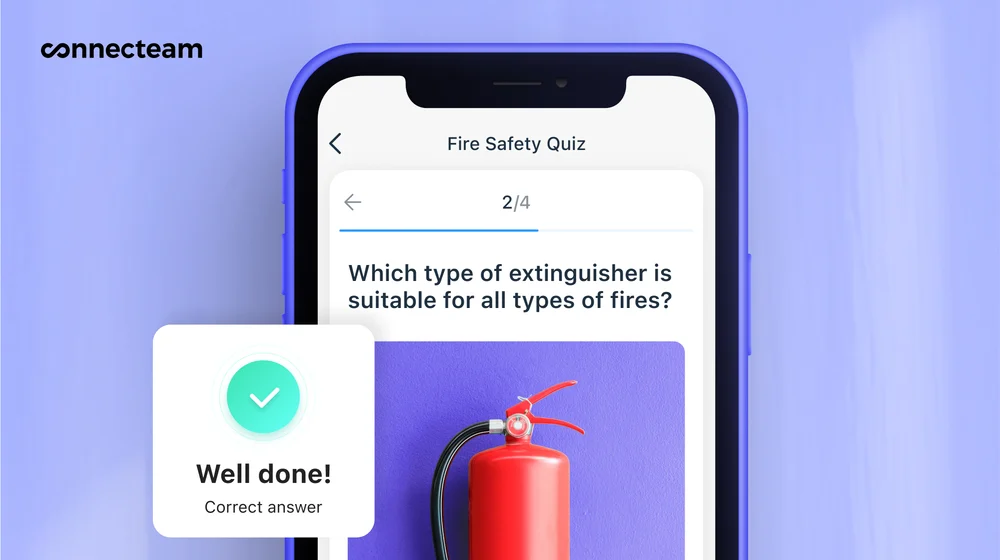
Interactive quizzes in Connecteam provide instant feedback to help reinforce employee safety training. Creating a safety course takes minutes, thanks to Connecteam’s built-in AI course creator, which generates complete, multistep training from simple text prompts. The platform also offers a wide range of customizable safety courses that managers can easily tailor to suit organizational needs. I also like that Connecteam is SCORM compliant, so it’s easy to upload your existing safety training materials and deploy them without additional work.
Managers can set due dates and reminders for time-sensitive courses, ensuring that employees complete training on time and thereby preventing compliance issues. Connecteam also has centralized dashboards that provide real-time visibility into course completion. A manager can drill down to specific sections an employee hasn’t completed and send a direct notification or start a chat, all without leaving Connecteam.
Easy-to-Use Checklists and Forms
Connecteam’s forms and checklists enable managers to create digital checklists for safety inspections, audits, and equipment checks, replacing error-prone paper processes. The organization can reuse these checklists across locations, teams, and departments, ensuring that everyone follows the same procedures.
I like that the checklists and forms are mobile-friendly. Workers can submit incident reports and hazard observations in real time from their smartphones, which enables the safety manager to respond quickly to safety risks. Moreover, Connecteam makes it easy to attach photos and voice notes to each incident, improving resolution accuracy.

Connecteam’s mobile checklists streamline field reporting with photo attachments, star ratings, and digital signature collection. What sets Connecteam apart is its GPS stamps and digital signature. When an employee or a manager completes a safety checklist or an inspection, Connecteam adds a GPS stamp. This helps confirm that the checklist was actually completed on the jobsite, not at a remote location. In addition, you can require employees to append a digital signature to indicate that they completed the checklist themselves.
Real-Time Incident Reporting via Chats and Updates
Proper issue resolution thrives on fast, clear communication, and Connecteam’s Chat and Updates enable just that. Field and frontline employees can instantly report incidents and hazards as soon as they happen through the mobile-friendly Connecteam Chat. Incident reports include photos, voice notes, and videos, which help quickly assess the situation.
When an issue is first reported, managers can send instant safety alerts through Connecteam’s Updates so everyone is immediately informed of potential risks or ongoing corrective actions. The auto-translate feature means all employees can read the alert in their native language, reducing miscommunication.
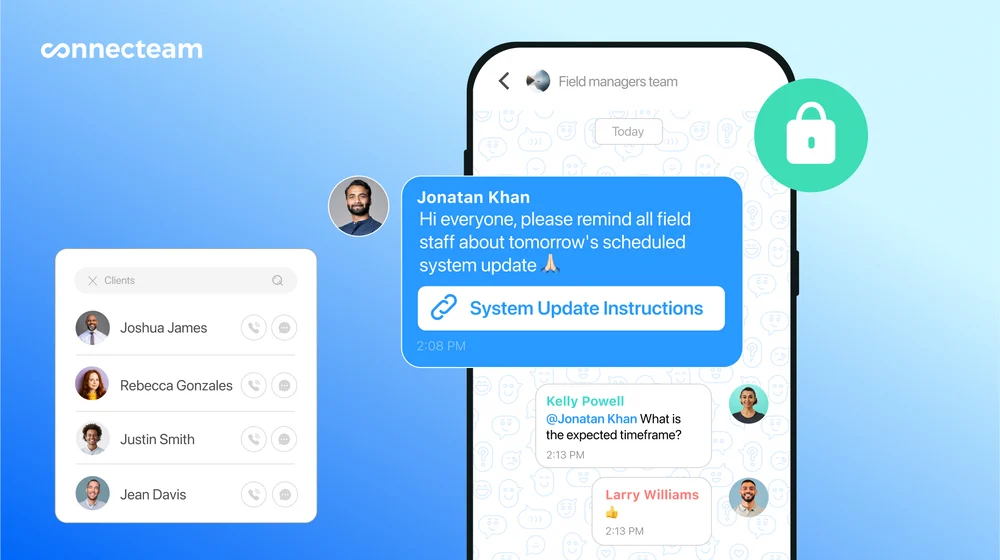
Connecteam’s secure team chat enables seamless communication and file sharing across field teams and managers. Connecteam also lets you send the alert to a specific location, role, or department. This ensures that the alert reaches only the affected cohort, reducing noise. Plus, with read receipts, managers can see who has received important updates and send automated reminders to those who haven’t viewed them. This helps verify that everyone is in the loop for consistent safety awareness across the organization.
Streamlined Corrective and Preventive Actions
Resolving safety issues isn’t just about speed; it’s also about ensuring that the right person handles the problem for effective resolution. Connecteam tasks let you assign corrective action to a person with the appropriate expertise. Moreover, the built-in task comments ensure that the resolution process is clearly documented for accountability and compliance.
What I really like is that Connecteam lets you implement preventive measures to eliminate catalysts of workplace accidents. You can restrict overtime, set work-hour limits, and ensure that employees in safety-critical roles take mandated rest between shifts to reduce the likelihood of fatigue- and burnout-related accidents.
Moreover, Connecteam’s scheduling helps match employees with shifts they’re qualified for, preventing near-misses and accidents. It also ensures adequate staffing for high-fatigue roles so no employee is overworked. Additionally, I appreciate having the option to attach pre-shift safety checks, health declarations, and OSHA forms to shifts so employees know which procedures to follow.
And So Much More
Connecteam provides other workforce management tools, including:
- Accurate time tracking
- Centralized knowledge base
- Availability and time-off management
- Employee recognition and rewards
When Connecteam May Not Be the Best Fit
While Connecteam enables organizations to manage end-to-end team operations on one platform, such as scheduling, time tracking, communication, and safety, it may not be suitable for companies that need advanced compliance modules. For instance, large enterprises looking for ISO tracking, OSHA 300 logs, or full environmental, social, and government (ESG) reporting will find Connecteam limited.
0Key Features
Comprehensive task management
Built-in chat for real-time communication
Templated and custom forms and checklists
Training tools for on-the-go learning
Knowledge base to store safety documents securely
Real-time data and alerts for incident reporting
Pros
Intuitive mobile app
All-in-one solution
Free trial and free plan
Cons
Needs internet or wifi access to work
Pricing
Free-for-life plan availablePremium plans start at $29/month for 30 users
14-day free trial, no credit card required
Start your free trial
Quick Picks Comparison Table
| Topic |
|
|
|
|
|
 Start for free
|
|---|---|---|---|---|---|---|
| Reviews |
 |
|
|
|
|
|
| Pricing |
Starts at $24 per seat per month
|
Starts at $5,000 per year (contact vendor for details)
|
Contact vendor for price
|
Contact vendor for price
|
Contact vendor for price
|
Starts at just $29/month for the first 30 users
|
| Free Trial |
yes
|
yes
|
no
|
yes
|
no
|
yes
14-day
|
| Free Plan |
yes
|
no
|
no
|
no
|
no
|
yes
Free Up to 10 users
|
| Use cases |
Field safety and quality managers that need a mobile-first solution
|
Safety and sustainability teams in mid-sized to large organizations that need an OSHA-focused EHS management system
|
Large enterprises in regulated, high-risk, and service industries that need an end-to-end EHSQ system
|
Mid-sized to large organizations looking for a systematic EHS solution
|
Europe-based organizations looking for an EHS and sustainability platform
|
Field and frontline teams that need a workforce management tool with health and safety features in one platform
|
| Available on |
Web, iOS, Android
|
Web, iOS, Android
|
Web, iOS, Android
|
How Much Does Health and Safety Management Software Cost?
Many health and safety management software solutions use a modular pricing model, meaning you pay only for the modules you want. This helps keep the pricing low, especially for small organizations that don’t need all the features. However, costs can add up quickly for large organizations that need multiple modules to streamline health and safety workflows.
Other solutions, like Connecteam, offer a transparent flat rate per month for a set number of employees and charge for additional employees. Connecteam’s Small Business plan lets small businesses with up to 10 employees use all health and safety management features for free. Paid plans begin at $29 per month for 30 employees and charge $0.50–0.80 per additional employee per month.
The Bottom Line on Health and Safety Management Software
Health and safety management software streamlines safety processes and simplifies everything from safety checklists to recordkeeping. It also reduces incident rates, enhances compliance, and improves the overall health and safety of your workplace.
The tool that works best for you depends on your unique organizational needs. If all you need is to streamline core EHS processes such as inspections, audits, and incident reporting without managing the broader workforce, a solution like SafetyCulture checks all the boxes.
However, if you need to streamline EHS workflows and manage your workforce all on a single platform, Connecteam is the perfect fit. In addition to automating inspections, audits, and incident reporting, Connecteam simplifies shift scheduling, time tracking, employee availability management, and other essential workforce management processes.
Get started with Connecteam for free today!
The Bottom Line on Health and Safety Management Software
Health and safety management software streamlines safety processes and simplifies everything from safety checklists to recordkeeping. It also reduces incident rates, enhances compliance, and improves the overall health and safety of your workplace.
The tool that works best for you depends on your unique organizational needs. If all you need is to streamline core EHS processes such as inspections, audits, and incident reporting without managing the broader workforce, a solution like SafetyCulture checks all the boxes.
However, if you need to streamline EHS workflows and manage your workforce all on a single platform, Connecteam is the perfect fit. In addition to automating inspections, audits, and incident reporting, Connecteam simplifies shift scheduling, time tracking, employee availability management, and other essential workforce management processes.
FAQs
Small businesses should prioritize mobile reporting, reusable checklists, employee training, task tracking, and simple pricing. Avoid complex enterprise systems if you don’t need advanced environmental management, regulatory reporting, or predictive analytics.
Safety audit software should include customizable checklists, mobile access, photo attachments, signatures, location data, corrective task assignment, and clear reporting. Offline access is also important for teams working on remote sites or in areas with unreliable internet.
Some safety management platforms support offline inspections, incident reporting, and risk assessments. Employees complete the work without an internet connection, and the app syncs their records later. Check which features work offline, including attachments, signatures, and saved forms.
Contractors should look for mobile inspections, offline access, jobsite forms, incident reporting, employee training, certification tracking, and assigned follow-up tasks. The software should be easy for workers to use across changing sites, projects, and crews.
Safety software gives employees simple ways to report hazards, complete training, receive alerts, and respond to assigned actions from their phones. Mobile forms, photos, reminders, and read receipts make participation part of everyday work.