


Without a good document management system in place, employees waste time digging through folders, work off outdated file versions, and sometimes access information they shouldn’t. This can lead to slower workflows, delayed approvals, and data privacy breaches for managers and business owners.
I reviewed 26 of the best electronic document management systems based on document storage and retrieval, collaboration, and audit trail features. The systems below stood out most strongly across these criteria.
Use these picks to keep your team aligned, reduce compliance risk, and avoid costly operational delays.
If you don’t have the time to read through our research, jump down to our quick comparison table.
| App | Best for | Starting Price | Key Considerations |
| Connecteam | Teams needing mobile document sharing and compliance | Just $29/month for the first 30 users | Mobile-first document distribution and compliance tracking, but lacks advanced enterprise governance tools |
| M-files | Teams handling large file volumes | Contact vendor for price | Powerful context-based document management with Microsoft 365 integration, but requires careful setup |
| DocuWare | Large businesses automating document capture and processing | Contact vendor for price | Strong OCR indexing and workflow automation, but less suited for heavy real-time document collaboration |
| Microsoft Sharepoint | Larger enterprises already subscribed to Microsoft 365 | Start at $5/user/month | Deep integration with Microsoft Office tools and strong governance controls, but requires significant configuration |
| Google Workspace | Teams prioritizing cloud-native document collaboration | Start at $7/user/month | Best-in-class real-time collaboration, but limited lifecycle management and compliance controls |
| Everteam | Enterprises needing document lifecycle management | Contact vendor for price | Advanced lifecycle and retention policy automation, but complex implementation and IT oversight required, and no mobile app |
What’s New in This Update (May 2026)
- Refined ranking criteria to better assess search reliability, version control, governance controls, and workflow automation.
- Updated the list of top-ranking tools, adding four new systems: M-Files, SharePoint, Google Workspace, and Everteam.
- Refreshed Connecteam and DocuWare’s document management and security features.
- Replaced outdated product screenshots with recent images.
- Added guidance on compliance and data handling, including around automated document indexing, classification, and retention policies.
Our Top Picks
-
1

Best for teams needing mobile document sharing and compliance
-
2

Good for teams handling large file volumes
-
3

Good for large businesses automating document capture and processing
Why trust us?
Our team of unbiased software reviewers follows strict editorial guidelines, and our methodology is clear and open to everyone.
See our complete methodology
How I Ranked the Best Electronic Document Management Systems
I focused on tools that actually solve everyday document workflow problems, such as quickly finding and sharing files, keeping versions organized, moving documents through approvals, and maintaining compliance.
Must-have capabilities
- Reliable document storage and organization: I prioritized systems that make it easy to store and organize documents. Platforms with complicated folder setups or those needing constant manual upkeep scored lower.
- Search and document retrieval: Employees rarely remember exact folder paths in their day-to-day jobs. I gave higher ratings to platforms with easy search, metadata, or indexing functionality than to those that required digging through multiple folders.
- Version control and change history: A good EDMS automatically tracks document versions and maintains a full change history to prevent mistakes. Systems with manual or unclear version tracking lost points.
- Access controls: I prioritized systems with clear, role-based permissions.
- Governance and compliance controls: I preferred tools with automated retention schedules, audit logs, and deletion policies. Platforms requiring manual compliance tracking and extra work ranked lower.
Dealbreakers for this category
- Weak permission management: Given my strong focus on compliance and data privacy risks, I immediately rejected platforms with unclear or easily bypassed access controls.
- Steep learning curve: A good EDMS should be easy to use for everyone in the company, from junior staff to company leaders. I excluded any system that was difficult to navigate or had an overly cluttered user interface.
- No mobile app: Today’s teams are used to working on their smartphones, and denying them mobile access to important documents causes unnecessary delays. For me, this was a dealbreaker. The only solution I included without a mobile app was Everteam, because it works well for admins who need advanced record management and governance and typically have web access.
Nice-to-have differentiators
- Workflow automations: I gave extra points to platforms that automate document routing, approval workflows, retention rules, and user-triggered alerts.
- Collaboration tools: Tools with commenting, co-authoring, and in-app messaging ranked higher because they improve teamwork and reduce version conflicts.
- Alerts and notifications: I also favored platforms that automatically notify users about document expirations, approvals, or updates, reducing the risk of missed actions.
The Best Electronic Document Management Systems of 2026
-
Connecteam — Best for teams needing mobile document sharing and compliance
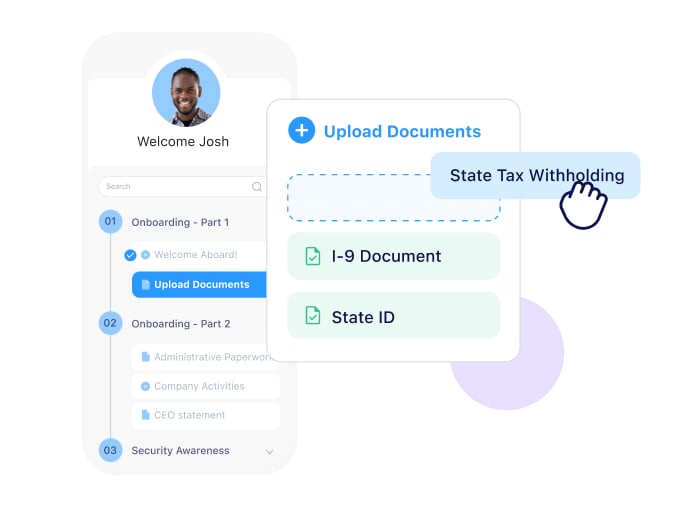
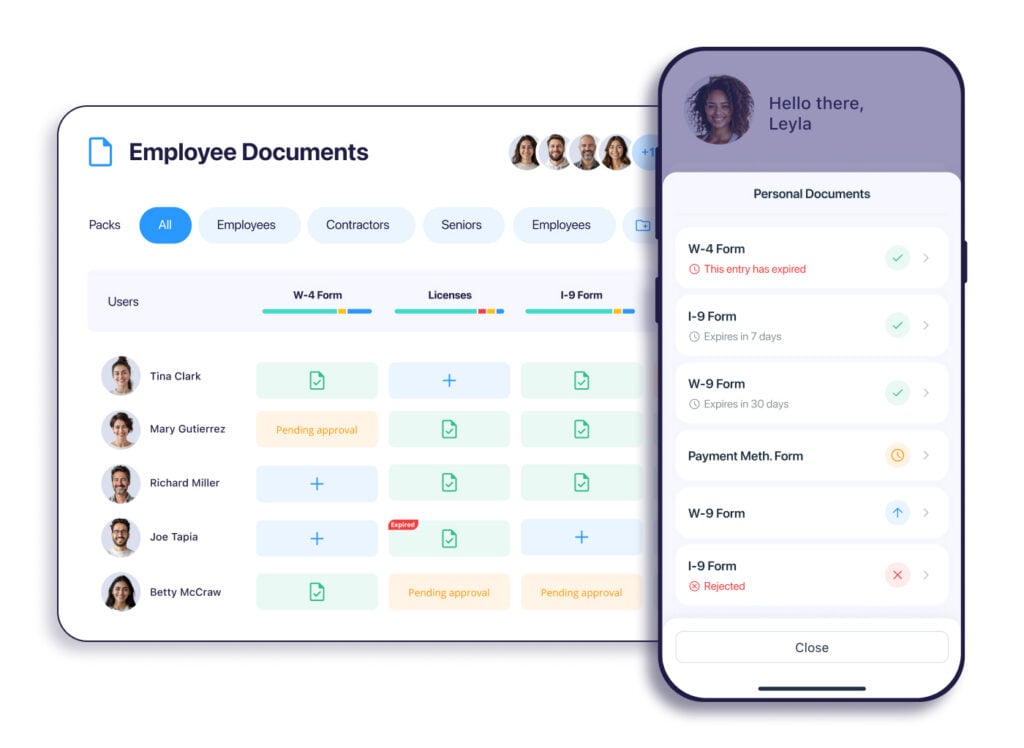
Connecteam centralizes document uploads, tracking, and compliance in one dashboard. Connecteam provides a simple way to store, share, and track important documents without having to manage a complex document system.
Why I chose Connecteam
While it’s not a traditional enterprise EDMS, I found that Connecteam offered the most practical features for document distribution, storage, and compliance tracking. On top of that, it was easy to use and mobile-first, allowing workers to access files, submit documents, and receive updates from anywhere.
Below are Connecteam’s key document management features.
Document management and retrieval
Connecteam lets you store and organize team documents, including certificates, forms, policies, and employee files, in a centralized cloud. I like that the interface isn’t cluttered, and files are easy to upload, categorize, and retrieve without complex folder structures.
Connecteam also has a powerful search function that helped me locate documents quickly. I think this is especially useful when you need quick access to employee documents, licenses, and more.
Unlimited storage was also much appreciated because it means you can upload and manage team documents without worrying about hitting storage limits, even as your company grows.
Compliance support
The expiration tracking feature was another highlight. I could assign expiration dates to documents such as licenses or certifications and receive alerts before they expire. And, I could set expiry dates for documents I must delete based on relevant data privacy laws.
Onboarding document collection
Connecteam simplifies onboarding through easy document uploads and reminders. New employees can upload required files, like contracts, tax forms, or certifications, directly from their mobile devices.
I also loved the automated reminders that help ensure new hires don’t forget to submit required paperwork, significantly reducing the manual hassle of chasing employees.
Document sharing via in-app communication tools
Connecteam’s online team chat really stood out during my review because it’s more than just a messaging tool. I could share updated team documents, operational SOPs, and other instructional docs instantly through the in-app chat and even track which employees have opened and read them.

Connecteam lets you share documents instantly using the team chat. I also discovered another way to share important documents through the company updates tool. I could update the entire company in one go and even require a read confirmation from employees. I thought this was particularly useful for policy updates, safety procedures, or regulatory notices where you need proof that employees have received the information. If your biggest challenge is tracking whether employees have read critical documents, this feature is very helpful.
Security and access control
Finally, I was happy with Connecteam’s strong security controls. Company and employee documents are stored in a secure cloud environment with end-to-end encryption. I could also assign role-based permissions to control who can access or edit specific files. Connecteam had additional security measures, such as two-factor authentication and custom password policies.
And much more
Beyond document management, Connecteam includes employee task tracking, staff scheduling, a time clock app, and more, so you can manage everyday workflows from a single, central system.
When Connecteam may not be the best fit
Connecteam isn’t designed for advanced document management needs like metadata-based classification, complex approval workflows, legal hold management, or automated retention policies across multiple systems.
It’s also not the best fit for large enterprises in highly regulated industries, like finance, healthcare, or legal services, where strict records management, audit readiness, and cross-repository governance are core requirements.
Connecteam also offers a free for life plan – Try Connecteam here!
0Key Features
- Centralized document management
- Mobile-based document uploads, storage, and access
- Unlimited document storage
- Custom document access controls
- Expiration dates on documents
- File-sharing through in-app chat and newsfeed
Pros
- Quickly find and access important employee documents
- Instantly share documents and track acknowledgements
- Easy mobile document uploads for teams on the move
- Faster and smoother employee onboarding
Cons
- No metadata tagging
- Not suited for enterprise document management
Pricing
Free-for-life plan availablePremium plans start at $29/month for 30 users
14-day free trial, no credit card required
Start your free trial -
M-files — Good for teams handling large file volumes
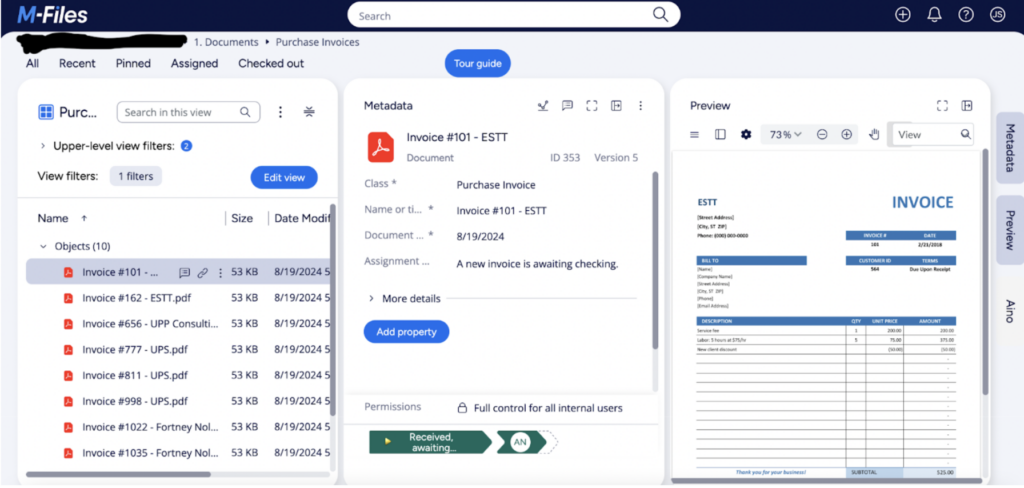
M-Files’ dashboard shows invoice files, metadata details, and a live document preview for selected invoices. M-Files is a document management system that organizes files using metadata, such as client name, document type, or status, rather than traditional folder structures.
Why I added M-Files
I included M-Files because of its unique metadata-driven approach, which is great for businesses handling large volumes of documents. It’s also integrated with Microsoft 365, which keeps collaboration smooth and consistent for companies already using Microsoft 365 tools.
Here are M-Files’ core document management features.
Metadata-based file organization and search
I liked how every document in M-Files is tagged with metadata showing its context in business processes. Tags can include client name, project ID, document type, dates, lifecycle status, and more. This made it much faster to locate the exact file I needed.
It also has a strong search function that lets you find files by keywords or specific metadata fields. While this new approach takes some time to get used to, once you adjust your thinking, it becomes a powerful tool to store and find all your documents easily.
Document workflow automation
M-Files lets you automate how documents move throughout your business. You can create rule-based workflows, where documents are sent to the right people automatically for review, approval, or signing.
To simplify approval workflows, it has an add-on for electronic signatures directly within the tool.
This automation is also backed by compliance features, including automatic logs of every action for full traceability.
For these features to work as intended, you need to spend time on planning, implementing, and refining rules that actually fit your team’s needs. Errors in these workflows can also have major downstream impacts.
Security, compliance, and risk management
M-Files has data security and compliance features to keep your documents safe. It has both gated access (which controls who can access documents at different process stages) and role-based permissions. The EDMS also simplifies compliance with automated policies, data retention schedules, version control tracking, master record tagging, and audit trail views.
Native to Microsoft 365
M-Files integrates with the Microsoft 365 ecosystem. That means you can open, co-author, and save documents directly in Microsoft 365 applications (Word, Excel, PowerPoint), with M-Files managing metadata, security, and lifecycle in the background. This keeps content organized and consistent even as multiple users collaborate in real time.
Notable limitation
M-Files is not a plug-and-play solution. Setting up the right metadata model takes planning, and sometimes multiple rollouts. For smaller businesses or teams without dedicated IT support, this can feel overwhelming, but it may also be unnecessary. If your main need is a lightweight document storage solution, you might want to consider other options.
What users say about M-Files
Very intuitive once [you] understand the structure. Easy to find documents without the hassle for exact folder paths. Version control and permission management is also one of its strong points. Good integration to Outlook.


The setup took longer than we had anticipated, and this is largely because the structure of the system varies so greatly from the more common folder structures[…] The interface could also be considered a bit outdated.
Key Features
- Metadata-driven document organization
- Workflow automation
- Automated data policies
- Microsoft 365 integration
Pros
- Faster document retrieval with metadata search
- Strong compliance and audit readiness
Cons
- Setup and planning can be time-consuming
- Might be too complex for small teams
Pricing
Contact vendor for price Trial: Yes Free Plan: No
-
DocuWare — Good for large businesses automating document capture and processing
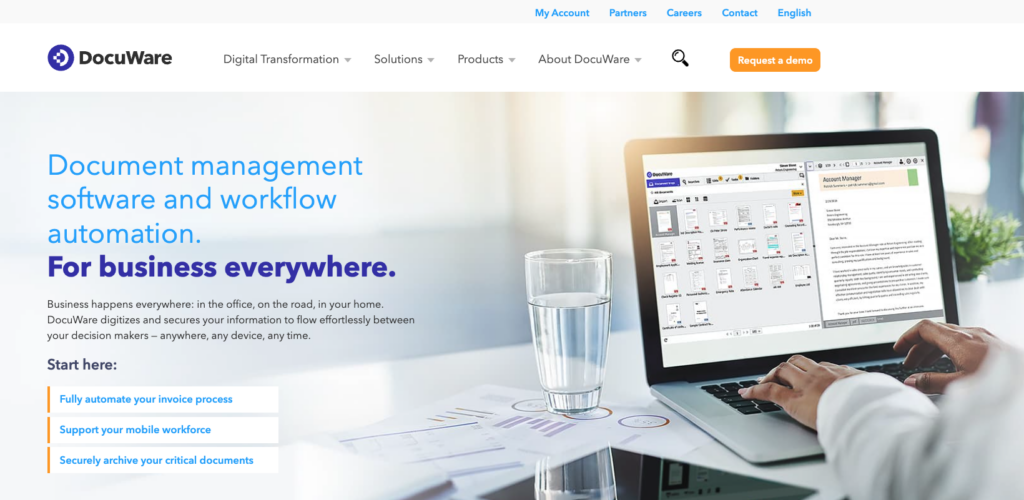
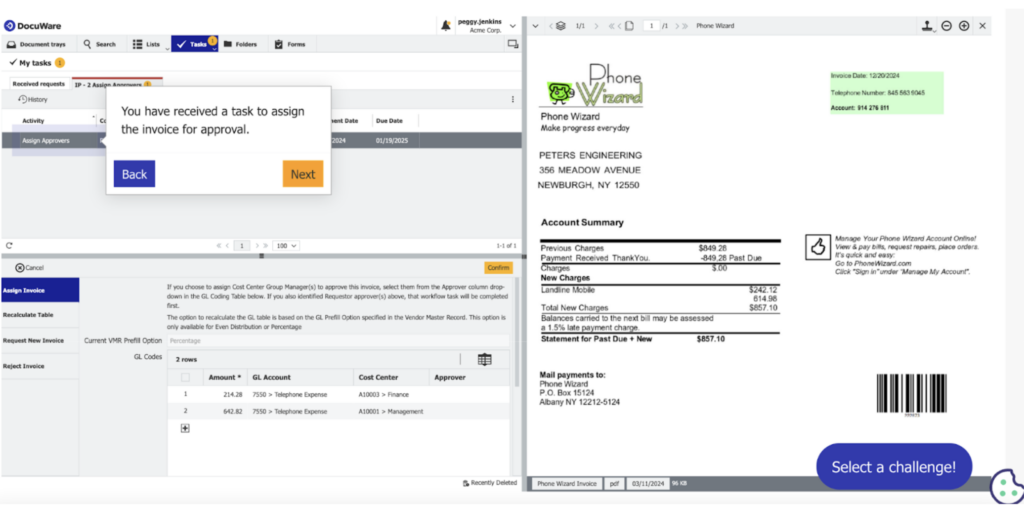
DocuWare’s invoicing dashboard shows amounts, GL accounts, cost centers, and approver fields. DocuWare is an automated document management system designed for centralizing, indexing, and securing documents.
Why I included DocuWare
DocuWare allows you to centralize and manage documents from a wide variety of sources. It also has features to automate indexing and invoice processing, saving hours of manual work, and supports e-signatures.
Let’s look at its main document management features.
Document capture and indexing
What stood out for me was DocuWare’s ability to automatically capture files from emails, shared folders, external apps, Microsoft Teams, and even scanners. Setting up the connections took a little time, but once running, document capture was almost effortless.
The AI-powered indexing and Optical Character Recognition (OCR) scanned documents and extracted key information such as invoice numbers, dates, and client names. This significantly reduced the need for manual data entry, though you might occasionally need to correct errors during the initial setup to improve accuracy.
Secure storage and archiving
DocuWare archives all types of documents, such as docs, PDFs, CSV files, and more, in a central system. I was impressed by features like version control, audit trails, and disaster recovery which prevent accidental overwrites and document loss, while allowing teams to collaborate easily.
Like the other solutions in my list, DocuWare offers role-based access controls, unchangeable system entries, and logs of every user action (audit trails). You can also set document retention policies to support regulatory compliance.
Document search and retrieval
With DocuWare I could find documents quickly using indexed metadata and full-text search. You can search by keywords, document content, or specific invoice fields, like dates or invoice numbers, and even use filters and saved search queries for faster action. This is especially useful when dealing with large volumes of files.
Workflow automation
Like M-Files, DocuWare lets you create custom, automated document workflows using drag-and-drop tools in the Workflow Manager. While these workflows simplify processes, you do need to invest time and effort in creating these automations and ensuring they’re accurate.
Notable limitation
While DocuWare is great for automation and archiving, it’s less suited to teams that constantly edit or co-author documents in real time. If your work relies on multiple people editing the same file simultaneously, then consider another solution.
What users say about DocuWare
I love that it’s user-friendly, excels in document importing and form handling, and provides strong indexing capabilities.
Does not integrate [too] well with the major ERP platforms.
Key Features
- Automated document capture and OCR
- Secure cloud-based archiving
- Compliance-ready retention rules
- Workflow-driven document routing
Pros
- Great for paper-heavy and structured data processes
- Reduced manual data entry through AI-powered indexing
Cons
- Limited support for real-time document collaboration
- Initial setup and automation planning can be complex and time-intensive
Pricing
Contact vendor for price Trial: Yes Free Plan: No
-

Microsoft Sharepoint — Good for larger enterprises already subscribed to Microsoft 365
Available on
- Web
- iOS
- Android
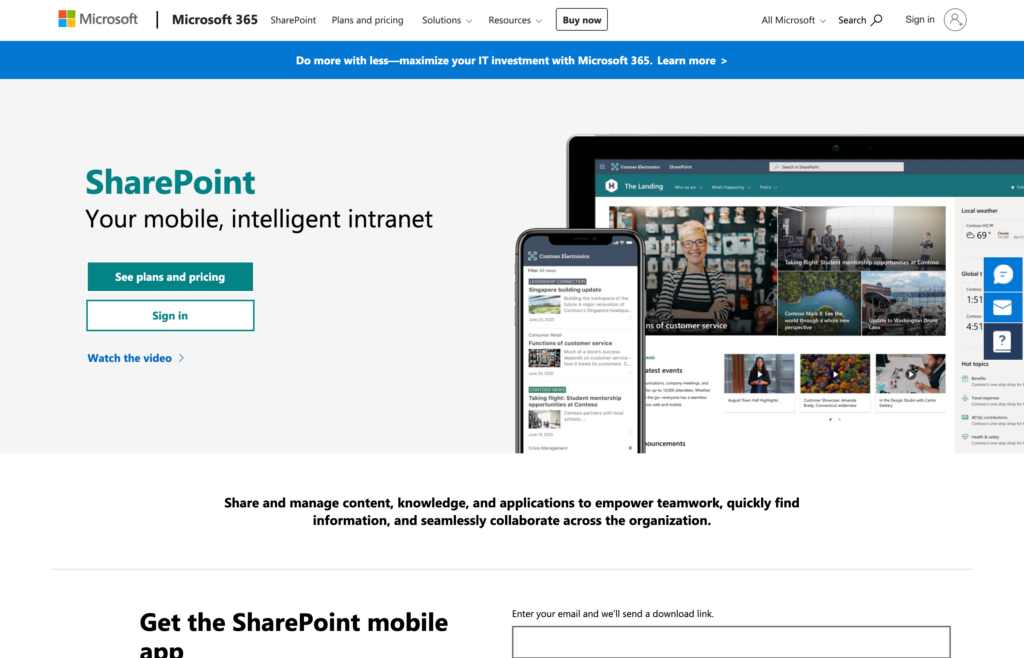
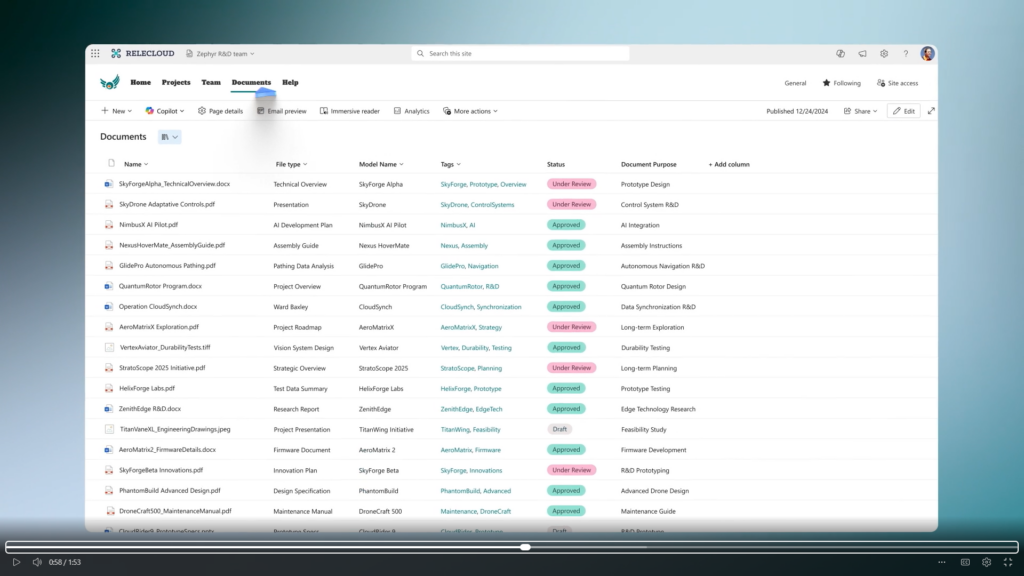
Store documents and sort through them using context-based columns on Microsoft SharePoint. Microsoft SharePoint is an enterprise content and document management platform built into Microsoft 365.
Why Microsoft SharePoint made it to my list
SharePoint is a natural choice for large and enterprise organizations already embedded in the Microsoft ecosystem. They can seamlessly add structured document storage, collaboration, and governance controls to their existing workflows, and import and share files from Teams and Outlook. Given Microsoft’s progress in AI adoption, SharePoint also comes with integrated AI-powered capabilities.
Here are SharePoint’s core document management tools.
Document libraries and AI-powered organization
I found SharePoint’s document libraries flexible for organizing content by department, project, or client. The ability to add metadata columns, sort documents, and even use AI to suggest metadata based on document content saves time and effort.
That said, setup requires careful planning upfront. Configuring AI tools requires trial and error to ensure accuracy, especially when documents have duplicates, unstructured content, or old versions. And without clear folder structures and naming conventions, libraries can quickly become cluttered.
Advanced governance
SharePoint Advanced Management (SAM) is a governance solution with a deep range of options for managing your site and documents. You can set site ownership policies and granular access controls down to the site, folder, or file level.
The downside is that this level of control can quickly become hard to manage, especially as the number of sites and users grows. Unclear governance rules lead to duplicated access groups and permissions, increasing the chance of data breaches.
Collaboration and workflow
SharePoint’s real-time co-authoring allows multiple team members to edit documents simultaneously, and version history tracks every change. You can share folders, control permissions, and create custom agents to provide insights on specific document sets. For teams coordinating on complex projects, this reduces version conflicts and improves collaboration efficiency.
Notable limitation
SharePoint’s power comes with complexity. Configuring governance rules and maintaining libraries requires dedicated administrators. If your team doesn’t have IT support or a structured governance plan, it’s easy for permissions to become inconsistent, increasing the risk of security gaps or compliance issues.
What users say about Microsoft SharePoint
Our company uses it as an intranet, with each department having its own page. It is easy to share documents and information between departments.
Permissions are not always inherited properly with group permissions and individual permissions being difficult to manage. In addition, you have to deal with M365 groups vs SharePoint groups.
Key Features
- Flexible document libraries
- AI assistance
- Real-time co-authoring
- Comprehensive security controls
Pros
- Live collaboration with fewer version conflicts
- Enterprise-grade security protects sensitive content
Cons
- Requires careful setup and ongoing administrative oversight
- AI accuracy depends on proper configuration and clean data
Pricing
Start at $5/user/month Trial: No Free Plan: No
-

Google Workspace — Good for teams prioritizing cloud-native document collaboration
Available on
- Web
- iOS
- Android
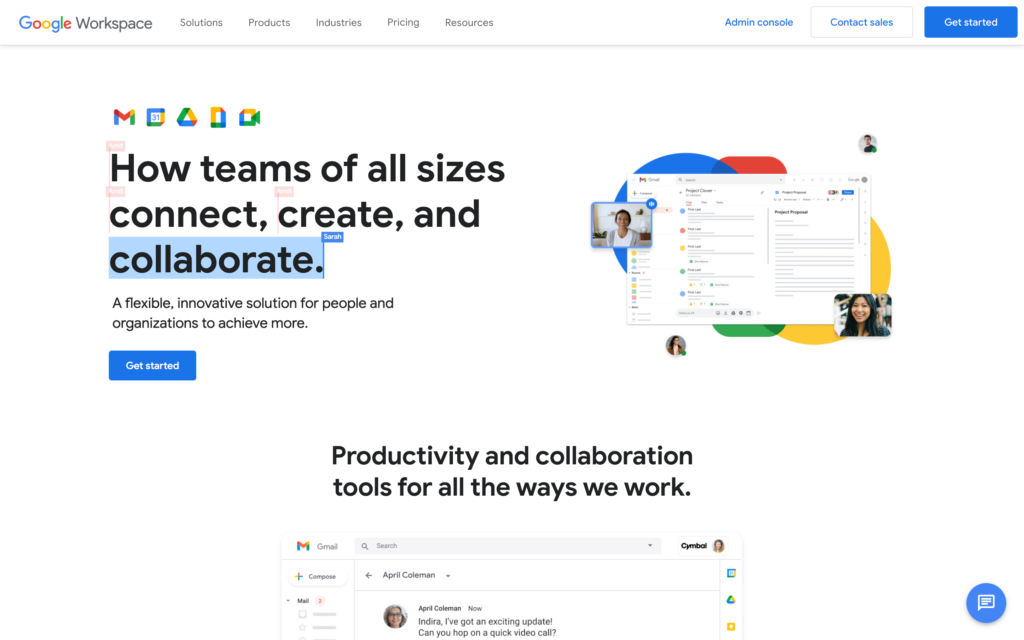
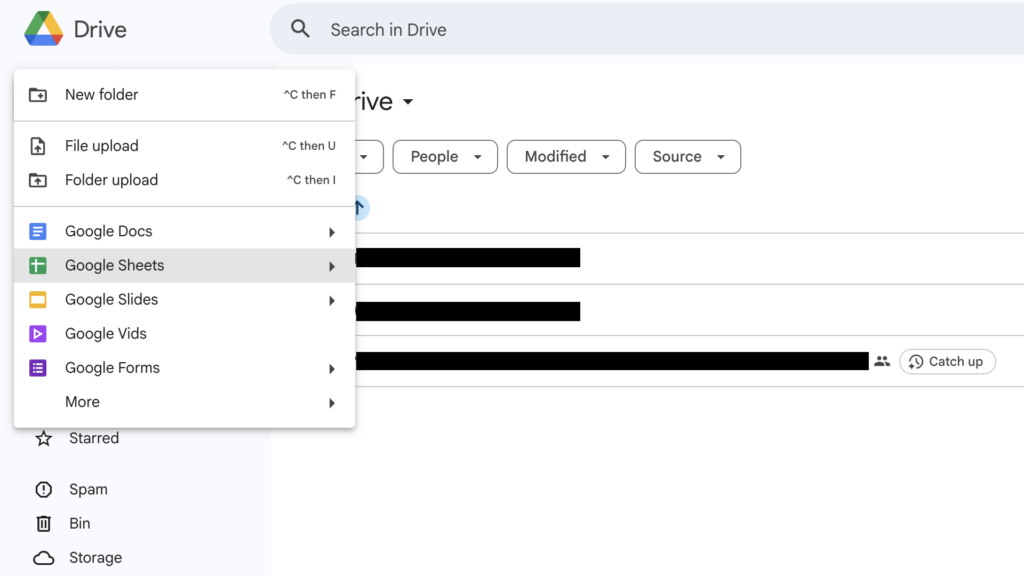
Create, organize, and manage documents through Google Drive. Google Workspace is a cloud-based productivity and collaboration suite that includes Google Drive, Docs, Sheets, Slides, and Gmail. Teams can create, store, and collaborate on documents in real time.
Why I included Google Workspace
I loved how fast and easy it was to edit and share documents in Google Workspace. It’s also easy to implement and intuitive to use, especially for remote or distributed teams. While its features are geared primarily towards productivity, it does have useful features for document organization.
Here are its main document management features.
Google Drive and file storage
Google Drive centralizes your documents in the cloud, which instantly makes them accessible from any device. I could organize content into folders or shared drives for departments or projects. This is also a great way to maintain continuity when someone leaves your team.
But Workspace doesn’t enforce metadata standards, document classifications, or retention rules by default like other document management solutions. This means consistent document organization depends heavily on your team’s ability to keep things neatly organized, which is especially challenging as your organization grows.
Real-time collaboration, version history, and access controls
Google Workspace really shines when it comes to real-time collaboration. Multiple users can edit a file simultaneously in Docs, Sheets, or Slides, and all the changes appear instantly. You can also add comments, @mentions, and suggestions to simplify collaboration while eliminating bottlenecks that often occur when emailing documents back and forth.
Version history is automatic, and I like how easy it is to use. You can see who made changes, what they changed, and when, and roll back to earlier versions with a few clicks if needed. There are no complex processes for manual versioning.
Sharing documents is also quick and flexible. You can grant view, comment, or edit access to individuals, groups, or entire domains using links. This easy sharing is especially valuable when working with external partners.
But if sharing rules are not clearly defined, documents can be overshared and accessed by users they weren’t intended for.
Search
You can find files easily through Google Drive’s powerful search function. You can search for documents by file name, file type, and even keywords within documents and comments. I like that the search function often does the heavy lifting, so you don’t need perfect folder structures for it to work well.
But poor organization can hinder how effective search is, with cluttered drives, duplicate files, and multiple versions of the same document spread across folders, making it harder to find what you need.
Notable limitation
Google Workspace is not a dedicated document management solution with advanced records management or governance controls. If your company needs strict compliance, regulatory oversight, or governance across thousands of documents, Workspace may not meet those requirements.
What users say about Google Workspace
Google Workspace is reliable because it has a secure and dependable cloud storage solution. It streamlines project management.
Functionality and loading speed. It was very slow at times. Also, document editing tools don’t have the capability as the desktop software like Office.
Key Features
- Cloud-based document storage
- Real-time co-authoring
- Automatic version history
- Simple sharing and access controls
Pros
- Easy to use, even for non-technical users
- Mobile access boosts productivity for remote teams
Cons
- Limited advanced record management and governance controls
- Lifecycle and retention management require manual oversight
Pricing
Start at $7/user/month Trial: Yes Free Plan: No
-
Everteam — Good for enterprises needing document lifecycle management
Available on
- Web
- iOS
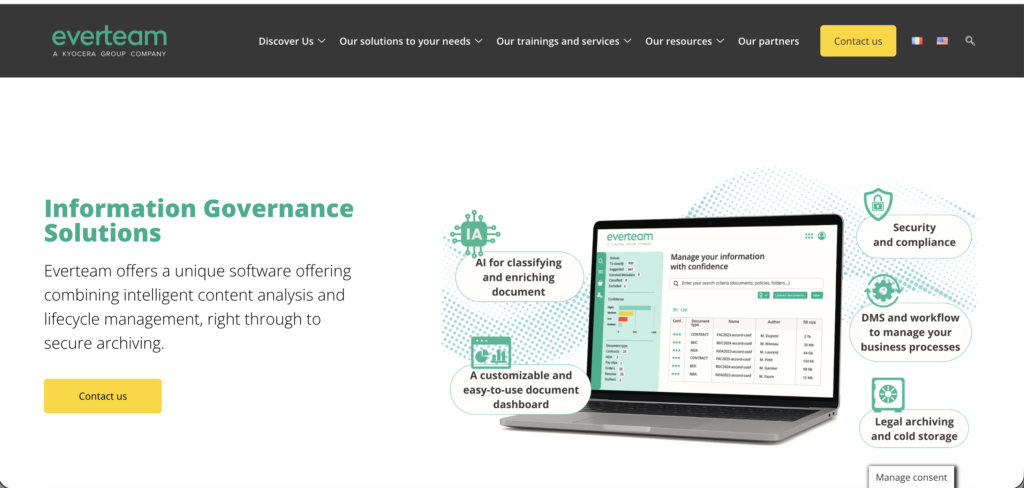
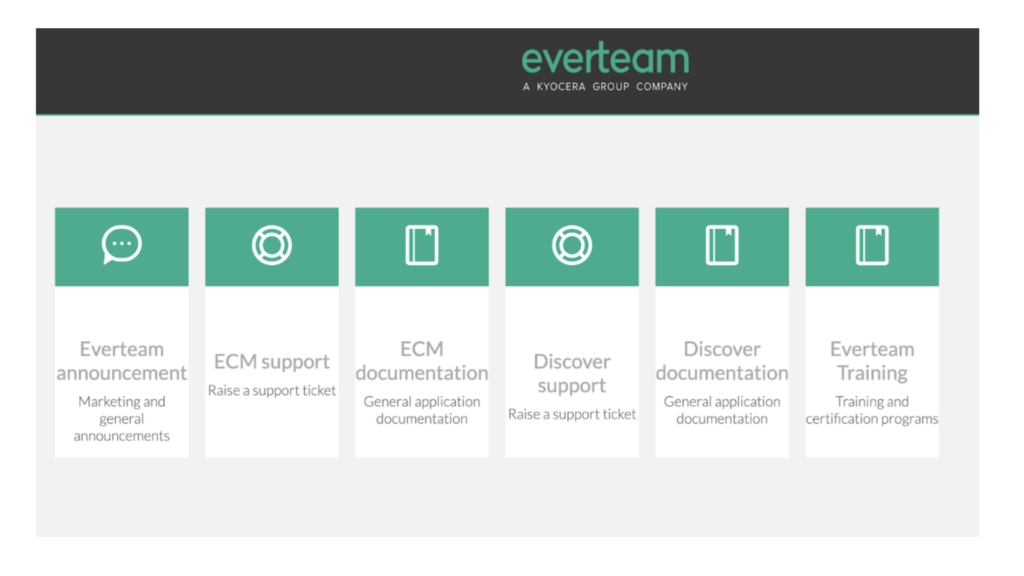
A screenshot of Everteam’s customer service portal, showing options for Everteam announcements, support, training, and more. Everteam is an enterprise-grade content, records, and information governance platform. It’s built to manage documents across their entire lifecycle, from creation to retention and deletion.
Why I added Everteam
Everteam is a great tool for enterprises with strict regulatory needs and high volumes of structured content. It’s designed to enforce governance at scale and integrate with existing enterprise repositories.
Let’s dive into Everteam’s core features.
Document management
Everteam offers an electronic document management tool that supports document capture from multiple sources. I liked that it has an API to connect to your existing business applications for smoother data imports.
You can organize documents using a structured file plan and easily find them using search. The tool maintains integrity through traceability and logging mechanisms that help with auditing.
Enterprise document lifecycle and retention policies
What stood out to me was how Everteam treats every document as a governed record, instead of just files on a drive. You can develop retention and governance policies, and the tool automatically applies them to all relevant records throughout your organization.
For example, you can set retention rules for all the documents in a project, and after the project is completed, Everteam enforces your policies to automatically move the files into long-term archiving.
If your organization struggles with managing retention rules manually, this feature alone can save significant time and mitigate regulatory risks.
Integrations and enterprise scalability
Everteam integrates with shared drives, electronic content management (ECM) systems, content platforms, and more to apply your governance rules across environments. You could also create custom connectors for your existing systems.
This is a significant benefit for enterprises, as they don’t have to separately govern each system manually.
Notable limitation
Everteam’s governance and lifecycle automation are powerful but complex. Setting up policies and integrations requires significant planning, IT resources, and time. Smaller organizations or teams without dedicated IT support would likely find this platform too resource-intensive. It also doesn’t have a mobile app, which isn’t ideal for dispersed or frontline teams.
What users say about Everteam
The platform is highly effective in quickly discovering information and it has the ability to locate and identify content from diverse data sources.
Struggled with implementation with smaller companies.
Key Features
- Automated classification and governance
- Enterprise retention and disposal policies
- Integration with existing document repositories
- Large organization scalability
Pros
- Enforces document governance, reducing compliance risk
- Automates retention and archiving to cut manual oversight
Cons
- Complex setup requiring IT expertise and planning
- No mobile app
Pricing
Contact vendor for price Trial: No Free Plan: No
Compare the Best Electronic Document Management Systems
| Topic |
 Start for free
|
|
|
|
|
|
|---|---|---|---|---|---|---|
| Reviews |
 |
|
|
|
|
N/A
|
| Pricing |
Starts at just $29/month for the first 30 users
|
Contact vendor for price
|
Contact vendor for price
|
Start at $5/user/month
|
Start at $7/user/month
|
Contact vendor for price
|
| Free Trial |
yes
14-day
|
yes
|
yes
|
no
|
yes
|
no
|
| Free Plan |
yes
Free Up to 10 users
|
no
|
no
|
no
|
no
|
no
|
| Use cases |
Best for teams needing mobile document sharing and compliance
|
Good for teams handling large file volumes
|
Good for large businesses automating document capture and processing
|
Good for larger enterprises already subscribed to Microsoft 365
|
Good for teams prioritizing cloud-native document collaboration
|
Good for enterprises needing document lifecycle management
|
| Available on |
Web, iOS, Android
|
Web, iOS, Android
|
Web, iOS
|
Safety & Compliance Notes
Consider the following features that could create compliance or privacy risks:
- AI-powered document analysis and automation: Microsoft SharePoint, DocuWare, and M-Files use AI tools to analyze documents, extract information, or generate insights. While these features can speed up document workflows, inaccurate outputs or poorly configured access rules could expose sensitive data or create incorrect records. Regularly review AI outputs and limit what data these tools can access.
- Automated document classification and metadata tagging: M-Files categorizes documents using metadata. If the metadata model or workflows are misconfigured, sensitive files could be routed to the wrong department or exposed to unauthorized users. Carefully design metadata structures and audit workflows regularly.
- OCR-based document capture: DocuWare can scan documents and extract data using OCR and AI. Incorrectly indexed financial records, invoices, or personal data could lead to compliance errors. Teams should verify extracted data and review indexing rules before relying on automation.
- External sharing links: Google Workspace allows users to share documents through public or link-based permissions. If sharing rules aren’t tightly controlled, confidential files could be accidentally shared outside the organization. Restrict external sharing where possible and review permissions regularly.
- Automated retention and deletion policies: Everteam automatically enforces retention and disposal policies across repositories. If these policies are configured incorrectly, documents could be deleted too early or retained longer than regulations allow. Compliance teams should review retention rules and test them before applying them across the organization.
- Mobile access and local downloads: Several platforms on my list have mobile apps, which increases the risk of employees taking screenshots or downloading confidential documents to their personal devices. Adjust your settings to restrict mobile downloads if the option is available.
What Are Electronic Document Management Systems?
An electronic document management system (EDMS) is a type of cloud-based software that allows organizations to store, manage, and access important documents digitally.
These systems replace physical storage solutions, like storing paper documents in a filing cabinet. Instead, they provide a secure, central location to store, share, and collaborate on documents. Businesses can store everything from invoices and contracts to employee records and training materials—plus so much more.
How Do Electronic Document Management Systems Work?
Managers and employees can download most document management software solutions as mobile or desktop apps, or use them as web-based applications.
First, managers or admins must develop a process for uploading and organizing documents. This includes creating folders and sub-folders, setting custom rules, adjusting role-based permissions, adding expiry dates, and more. You then need to train employees on how to use the system correctly, and either start uploading documents yourself or give staff members access to do this themselves.
Once documents are uploaded, employees can access them at any time, from anywhere. They can search for documents by title, date, author, keyword, or other criteria. Moreover, workers can collaborate on documents—in some cases, live—and the system can track each user’s changes to keep versions clean and up to date.
The Benefits of Electronic Document Management Systems
Here are the main benefits of EDMS software.
Reduced time and manual effort
Electronic document management systems make it faster to store, find, and share documents across your organization. Instead of digging through folders or paper files, employees can quickly locate documents using search tools that filter by keywords, titles, authors, dates, and other criteria.
Many EDMS platforms also automate routine tasks like document routing, approvals, and indexing. This reduces manual work and speeds up everyday processes, so teams can spend less time managing documents and more time focusing on higher-value work.
Enhanced collaboration and improved productivity
These systems make it easy for employees to collaborate on documents. Multiple people can edit documents simultaneously, and most EDMS platforms also include version control, which automatically tracks every change and keeps a clear history of edits.
This ensures teams are always working from the latest version and reduces errors caused by duplicate files, outdated documents, or conflicting edits.
By improving collaboration and streamlining document workflows, these systems will ultimately increase productivity, too.
Improved security
Most EDMS software solutions allow you to set custom access permissions for certain documents and/or users. This ensures that only authorized people can access sensitive or even confidential materials. Similarly, the software can track changes that users make to documents. This way, it’s easy for you to see who’s responsible for certain changes.
Enhanced compliance
These systems make it easy for you to ensure you’re storing and managing documents in accordance with relevant laws and regulations. With a reliable way to store and access documents, you can maintain accurate, up-to-date records and instantly produce them whenever required.
Reduced costs and better sustainability
With EDMS software, you won’t have to worry about spending money on printing and storing paper documents. By digitizing documents and storing them electronically, these systems also eliminate the need for physical storage space, which can be expensive. This can save your business a lot of money in the long term.
Moving to digital documents can also support sustainability goals by reducing paper consumption and waste, making your operations more environmentally friendly over time.
How Much Do Electronic Document Management Systems Cost?
Many EDMS solutions don’t list their pricing plans publicly, so you’ll have to contact the vendor directly for pricing information.
Of the ones that do publish their prices, quotes are typically structured on a user-per-month basis. For example, Google Workspace starts at just $7 per user per month for its annual business plan.
Because pricing is typically tied to the number of users, costs can increase quickly as your organization grows or more departments adopt the system. It’s important to factor in future team expansion, additional storage, and potential add-ons when estimating the long-term cost of an EDMS.
Connecteam is not only transparent with its pricing but also offers affordable options for businesses of all sizes. Teams of up to 10 can use Connecteam free for life, while prices for larger teams start at just $29 per month for up to 30 users. After that, additional users cost just $0.50 each per month.
Connecteam also offers a free trial you can use to test it out before committing to a paid plan.
FAQs
An electronic document is any document that can be created, edited, and stored electronically. Some examples include PDF files, Excel spreadsheets, and Microsoft Word documents. You can use electronic document management systems, such as Connecteam, to store and manage your documents digitally.
There are many examples of great electronic document management systems, depending on your needs and business size. Microsoft SharePoint and Google Drive are good choices for large, enterprise businesses, while Connecteam offers powerful document management features at affordable prices, making it an excellent choice for small to medium-sized companies.
An electronic document management system (EDMS) is used to store and manage electronic documents. An electronic records management system (ERMS) is more comprehensive and is used to manage records throughout their lifecycle. Electronic records include not just documents but also emails, images, social media posts, and more.
The Bottom Line on Electronic Document Management Systems
Electronic document management systems (EDMS) make it easy to store, manage, and collaborate on a wide range of digital documents, while staying compliant with data regulations. Users can access and retrieve them whenever, wherever.
There are many EDMS software solutions out there, but Connecteam topped my list for its user-friendly dashboard, file-sharing features, in-app chat, and reasonable pricing.