

Easy-to-use payroll with lightweight workforce management tools but no free plan
Verdict: 7.9/10
Verdict: Gusto is the payroll tool I’d recommend first to a small business. I found the setup straightforward, the interface easy to follow, and the time tracking and scheduling practical for basic needs.
Gusto best suits a US business that wants payroll with some light workforce management on top. With no free plan and a $49 monthly fee before per-person charges, it’s a stretch for very small businesses on a tight budget. Field teams may find the time tools and scheduling too limited, though, so Gusto often works best paired with software that handles those functionalities better.
Key Features:
- HR management: Organizes employees, supports hiring, onboarding, and learning, manages time off, and summarizes benefits and expense reimbursements.
- Time tracking: Allows employees to track hours worked through various channels.
- Scheduling: Provides a drag-and-drop weekly grid with availability, coverage requests, and overtime warnings.
- Payroll: Automatically calculates taxes and pays employees via direct deposit.
- Integrations: Offers an app directory with integrations, including Connecteam.
Pros
- Intuitive interface
- Strong account security
- Automatic tax calculations & payments
- Responsive live chat
Cons
- No free plan
- Time tools need Plus or an add-on
- Full-featured payroll for US workers only
- Limited time tracking
How I Tested Gusto
I created a Gusto account for a fictional 7-person construction company in Oregon on the Gusto Plus plan. I added employees in various roles, set up time tracking, break and overtime policies, a Time Kiosk, 2 weeks of schedules, a PTO policy, and a project. I used the web and Android mobile app to explore employee self-service tools like onboarding, editing timesheets, and requesting time off, and tested workflows as an admin.
I also tried edge cases like creating overlapping shifts or leaving a worker clocked in past midnight to see how Gusto handled them. Beyond that, I visited Gusto’s interactive demo and knowledge base, checked user reviews, and contacted the Gusto support team with questions to better understand the product.
Gusto Pricing
I found Gusto’s pricing easy to understand. Plans are month-to-month with unlimited payroll runs. Gusto charges a per-person fee for every active employee each month, even if you don’t pay them that month. Contractors count toward your bill only in months when you pay them.
| Plan | Simple | Plus | Premium |
|---|---|---|---|
| Price and users | $49 per month + $6 per active person | $80 per month + $12 per active person | $180 per month + $22 per active person |
| Features |
| Adds:
| Adds:
|
Prices when billed monthly. As of September 2026.
The Simple plan may suit small teams that need payroll alone, though time tracking costs an extra $6 per person after a free trial. For businesses needing more advanced tools, the Plus and Premium plans include multi-state payroll, next-day direct deposit, PTO management, and even performance and compensation management, making them better for fast-growing companies with more complex needs.
Gusto also has a Contractor Only plan for businesses with no W-2 employees. It costs $35 per month plus $6 per contractor, although Gusto may offer promotional pricing.
I like that Gusto’s plans are easy to tailor. You pick a base plan and then add only the extras you need, all billed month to month with no long-term contract. Some of the most relevant add-ons available depending on your plan are:
- Next-day pay: $15/month + $3 per person on Simple (included in Plus and Premium).
- Time & Attendance Plus: free trial, then $6 per person per month in Simple (time tracking, scheduling, time off, and project tracking are included in Plus and Premium).
- Performance reviews: included on Plus and Premium. The former Simple add-on is no longer offered to new customers.
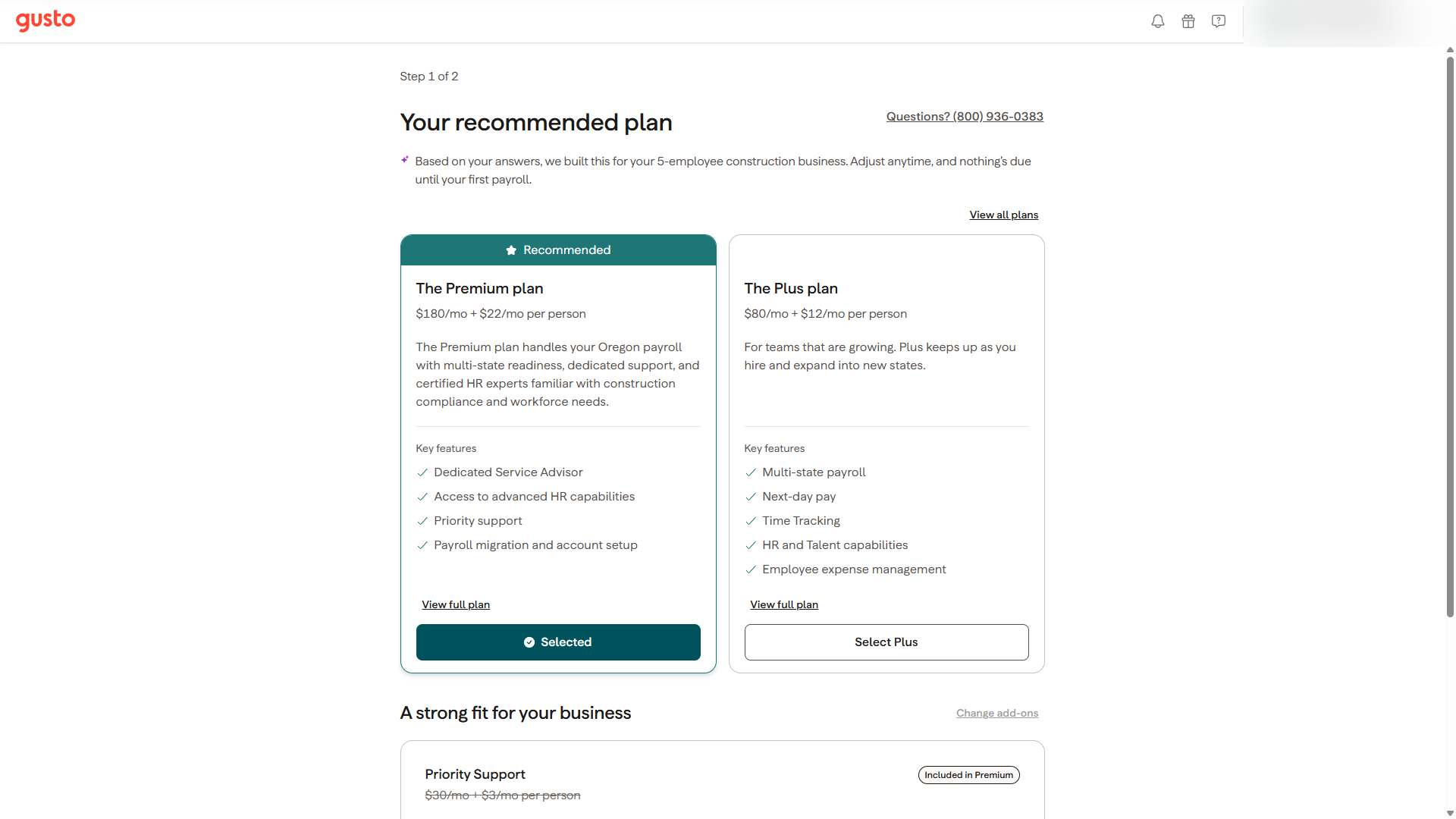
Gusto has no free plan and doesn’t advertise a conventional free trial, but you don’t pay until your first payroll. I tested the software extensively without entering any card details. One wrinkle I noticed was that my Plus quote included a $30 monthly (plus $3 per person) Priority Support add-on I hadn’t knowingly selected, but you can remove it from the billing page.
Gusto Simple costs about the same as the equivalent OnPay and SurePayroll plans. I consider it slightly below average value for money because the Simple plan leaves out much of what an hourly or field team needs (time tracking and scheduling cost extra, while expense reimbursements need Plus).
Here’s a comparison of the month-to-month pricing for Gusto’s Simple plan next to similar plans from competitors:
| Team size | Gusto (Simple) | SurePayroll (Small Business) | OnPay (Essentials) | Connecteam (Operations Basic) |
|---|---|---|---|---|
| View pricing | View pricing | View pricing | View pricing | |
| 10 Users | $109/mo | $99/mo | $109/mo | Free for life — All features and dashboards |
| 20 Users | $169/mo | $169/mo | $169/mo | $29/mo |
| 30 Users | $229/mo | $239/mo | $229/mo | $29/mo |
| 50 Users | $349/mo | $379/mo | $349/mo | $45/mo |
| Learn more about Connecteam |
Gusto, SurePayroll, and OnPay bill monthly only and offer no annual discount. Connecteam’s pricing assumes annual billing, which includes a discount over monthly pricing. Prices as of September 2026.
Verdict: 6/10
Gusto Usability & Interface
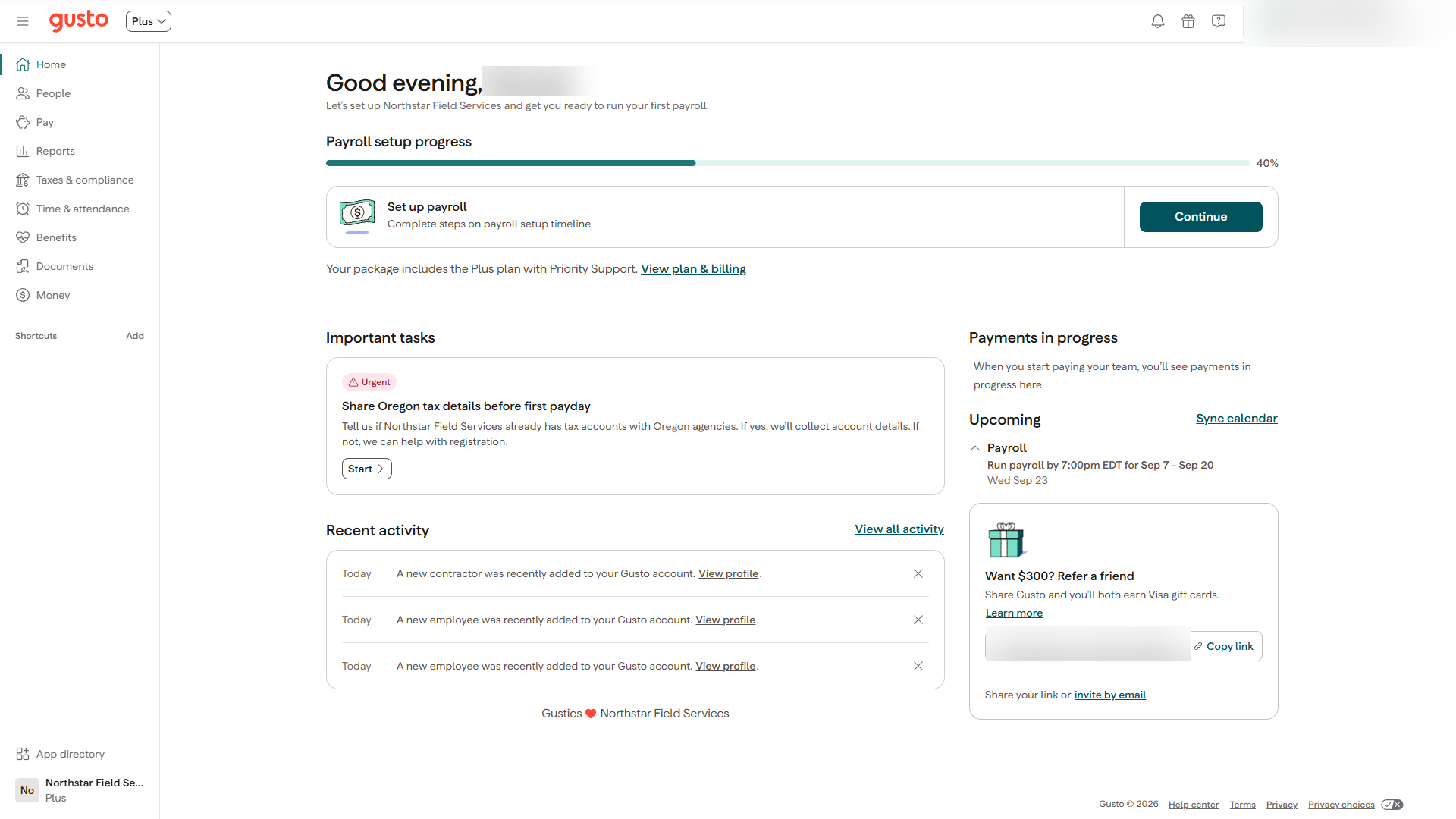
Gusto’s payroll software is easy to navigate, even for people without payroll software experience. I like that the software is entirely browser-based so there’s no desktop application to download, install, and take up space on your hard drive. This means you can get started with Gusto as soon as you create an account and purchase a plan.
Initial sign-up took about 10 minutes, needed only an email and a password, and asked for no credit card details. While setting up payroll requires several more setup steps, I could add people and create schedules right away (I discuss these in more detail further below).
During sign-up, Gusto asks a few onboarding questions about your headcount, state, industry, benefits, and time tracking needs, then recommends a plan.
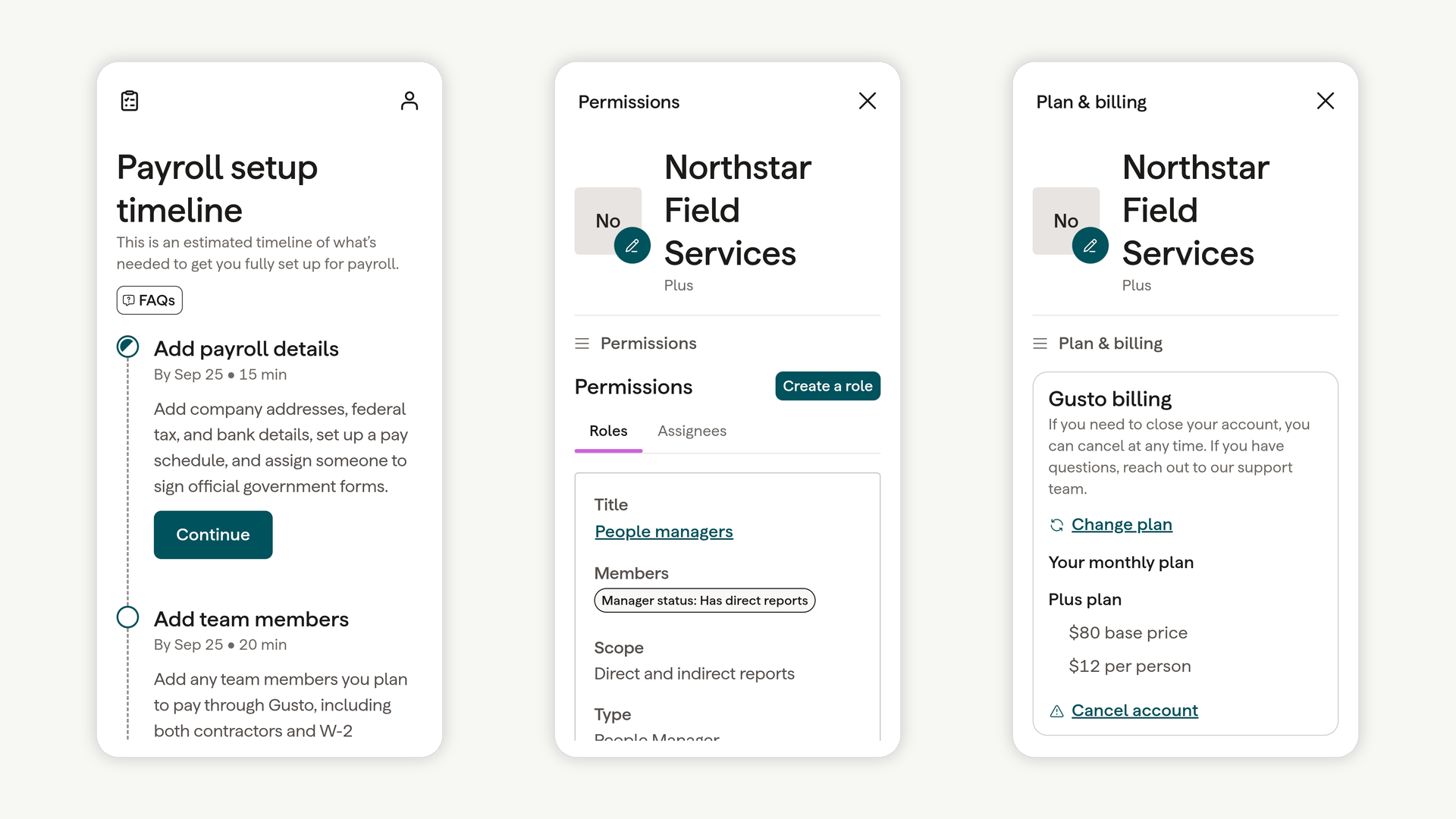
Setting up roles and permissions was quick. A 3-step process on a person’s profile let me make them a People Manager and choose exactly what they could view, edit, or approve, from time off and timesheets to expenses and scheduling. I could limit their access to everyone with the Field Technician job title. Gusto notes that People Managers never see Social Security numbers, bank accounts, or tax elections, which I found reassuring.
I wouldn’t say the user experience is particularly snappy, though. Almost every interaction displays an animated cartoon pig running for a few seconds while the page loads. By the end of my extensive testing, I was already getting quite tired of seeing that pig. It highlighted how slow the Gusto site can be.
I also ran into unexplained errors several times. While setting up new hires, I received the error, “We couldn’t save your Form I-9 verification.” When running time tracking reports, I got a “Something went wrong” error twice. I’d prefer more descriptive error messages that suggest potential remedies.
On accessibility, Gusto says it consults standards such as WCAG 2.1 Level AA, but I found no VPAT (Voluntary Product Accessibility Template) or independent audit report. A VPAT is a standard document software vendors publish to show how well a product works with assistive technology such as screen readers. Without one, buyers who need to meet accessibility requirements have to take Gusto’s word for it.
Verdict: 7/10
Mobile app
Gusto Mobile (formerly Gusto Wallet) is available on iOS and Android. Gusto says admins can run payroll, approve timesheets, and manage teams through the app, while workers can access pay documents, clock in, view schedules, and submit expenses.
I installed Gusto Mobile on Android and signed into my Plus account. The app opened on the payroll setup timeline. Unfortunately, during testing, I couldn’t access the main payroll and workforce tools without setting up payroll information, such as payment details, a bank account, and tax details. However, I could still open company details, permissions, billing, notifications, and security settings. These pages are simply mobile versions of the Gusto website.
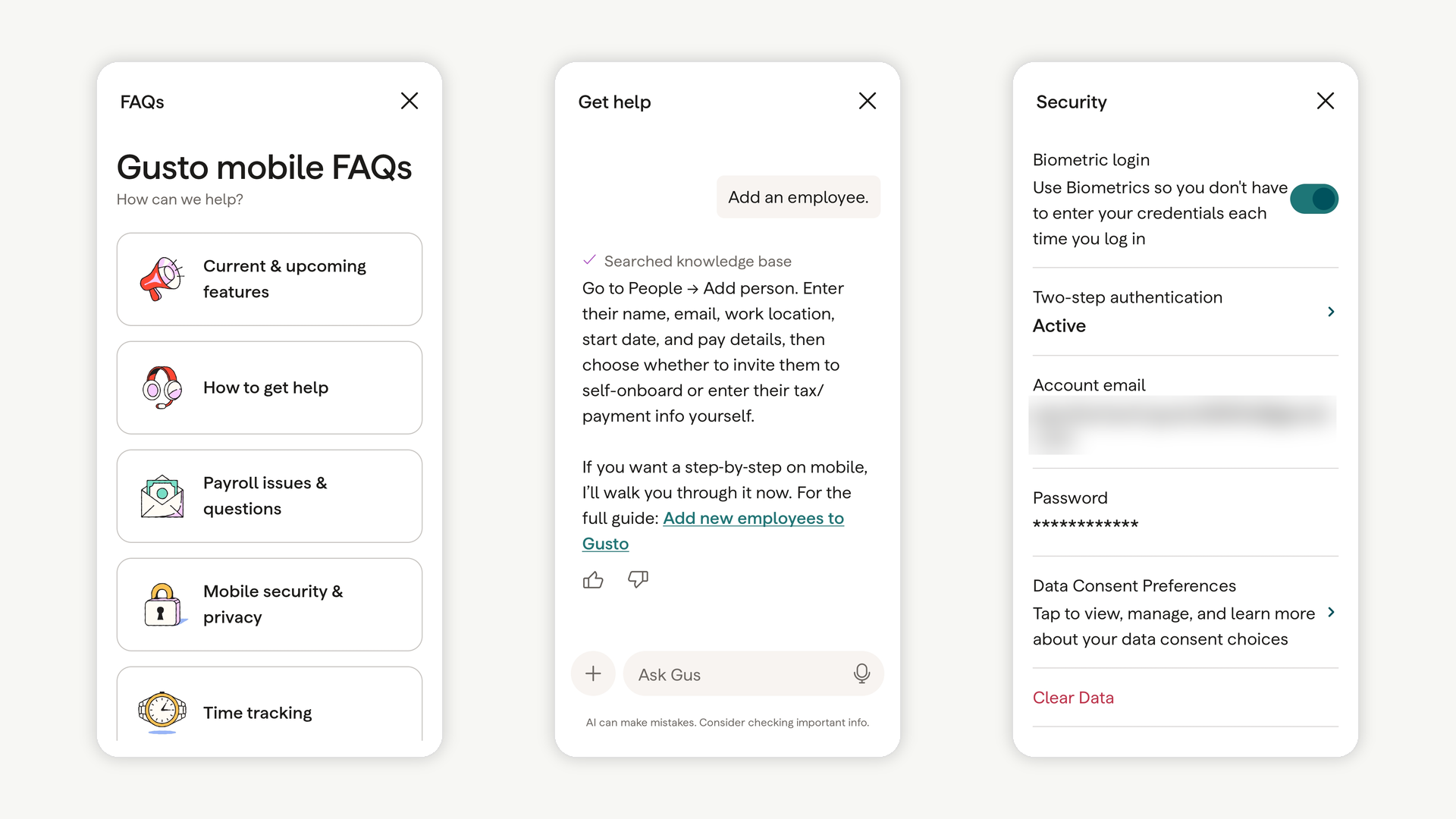
I set up a biometric login, which worked well, and the app showed 2-step authentication as active on my account. The mobile app also has access to “Gus,” Gusto’s AI assistant, which can feed you answers to your questions from the knowledge base or pass you on to live chat.
Gusto says hourly employees can clock in and out through the app, which records the location when geolocation is enabled, but offline clock-ins aren’t available.
Recent user reviews of the Gusto mobile app lean positive. A training manager on Capterra wrote in April that “the functionality in our office and on their phones is great,” and a sales consultant on TrustRadius listed the mobile app first among Gusto’s pros because remote staff can track time and request days off from their phones.
Not all reviews are glowing. A director of operations on Capterra said in December 2025 that employees “have reported long loading periods when attempting to clock in or out.” Still, as of September 2026, the app has a strong 4.8-star rating in the App Store from around 50,000 ratings.
Here’s how the website and the app compare for each role, based on testing and Gusto’s support documentation.
| Admin: website | Admin: app | Employee: website | Employee: app | |
|---|---|---|---|---|
| Run payroll | ||||
| Team management | ||||
| Timesheet approval | ||||
| Clock in and out | ||||
| Create and publish shifts | ||||
| View shifts | ||||
| Time off | ||||
| Expenses | ||||
| Reports | ||||
| Permissions and billing | ||||
| Security settings | ||||
| Help and support |
Verdict: 8/10
Gusto Core Functionalities
HR management
People management and onboarding
The first step to setting up a new payroll software is adding your employees to the system.
Gusto makes this easy with a separate People tab where you can add team members, view a company org chart, and even fully manage hiring, onboarding, and background checks via Checkr.
When you choose Add Person, you’ll enter the worker type, location, start date, and pay. Bulk import is limited to US-based workers.
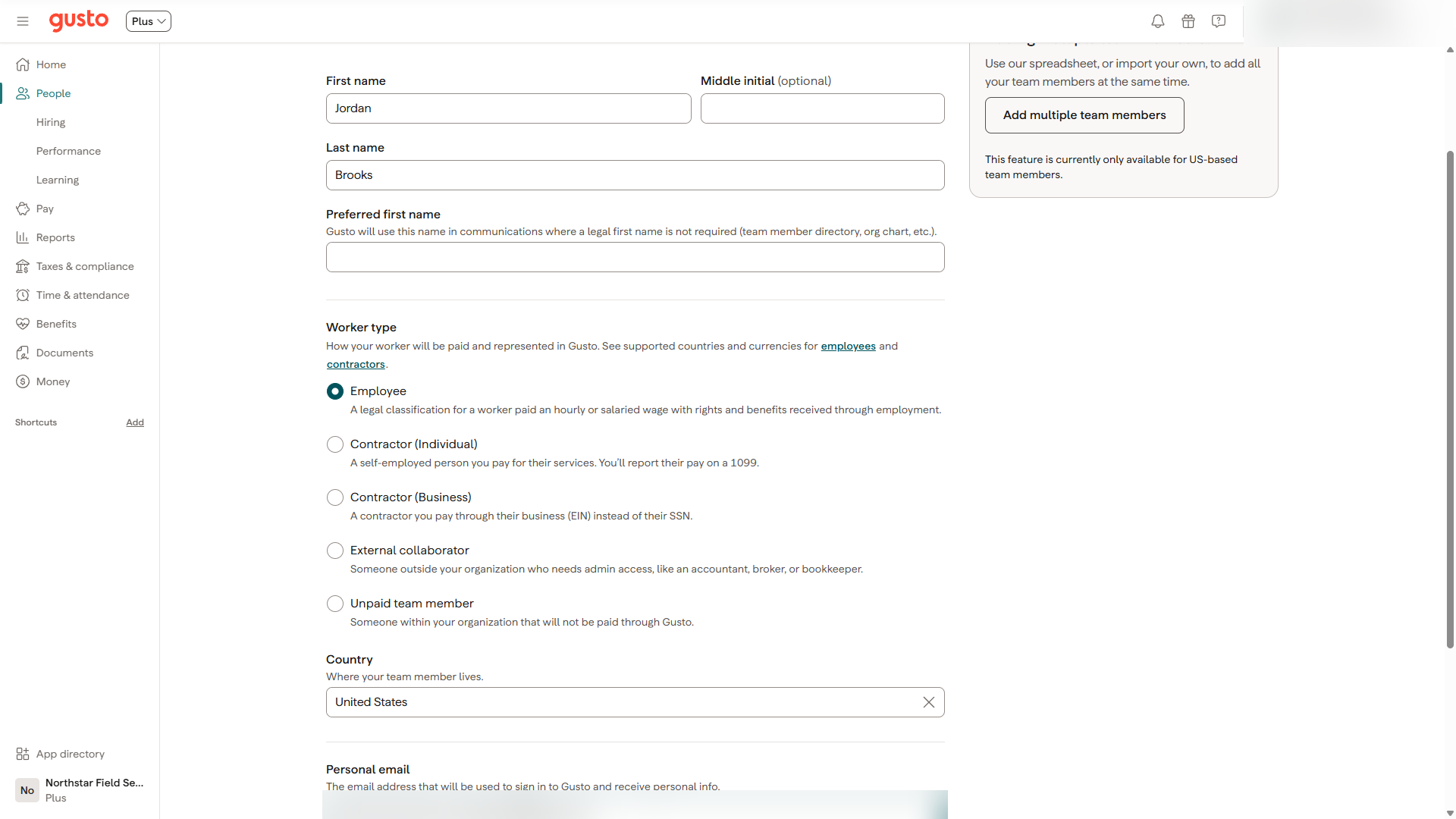
Once you’ve added someone, Gusto emails them an invitation to onboard themselves in 6 steps. Employees check the details you entered, confirm their I-9 employment eligibility, fill in federal and state tax withholding forms such as the W-4, and choose direct deposit or a paper check.
They then e-sign their tax forms and I-9 in Gusto, which saves you from chasing paper copies. Because the employee does most of the work, it can take some back-and-forth before they’re ready for payroll. If you’d rather enter everything yourself, there’s a 6-step manual route for admins too.
Plus and Premium plans also include hiring tools, including job postings, custom offer letters, and an applicant tracking system, so you can take someone from job ad to onboarding without leaving Gusto.
Expense management
Under the Expenses menu, you can review employees’ company expenses. Employees can enter expense details manually through the website, while the mobile app can scan a legible receipt.
When expenses are ready to be reviewed, Gusto will notify you and show a summary of how much is owed to each employee. Expenses are then automatically paid back to each employee the next time you run payroll.
Time off management
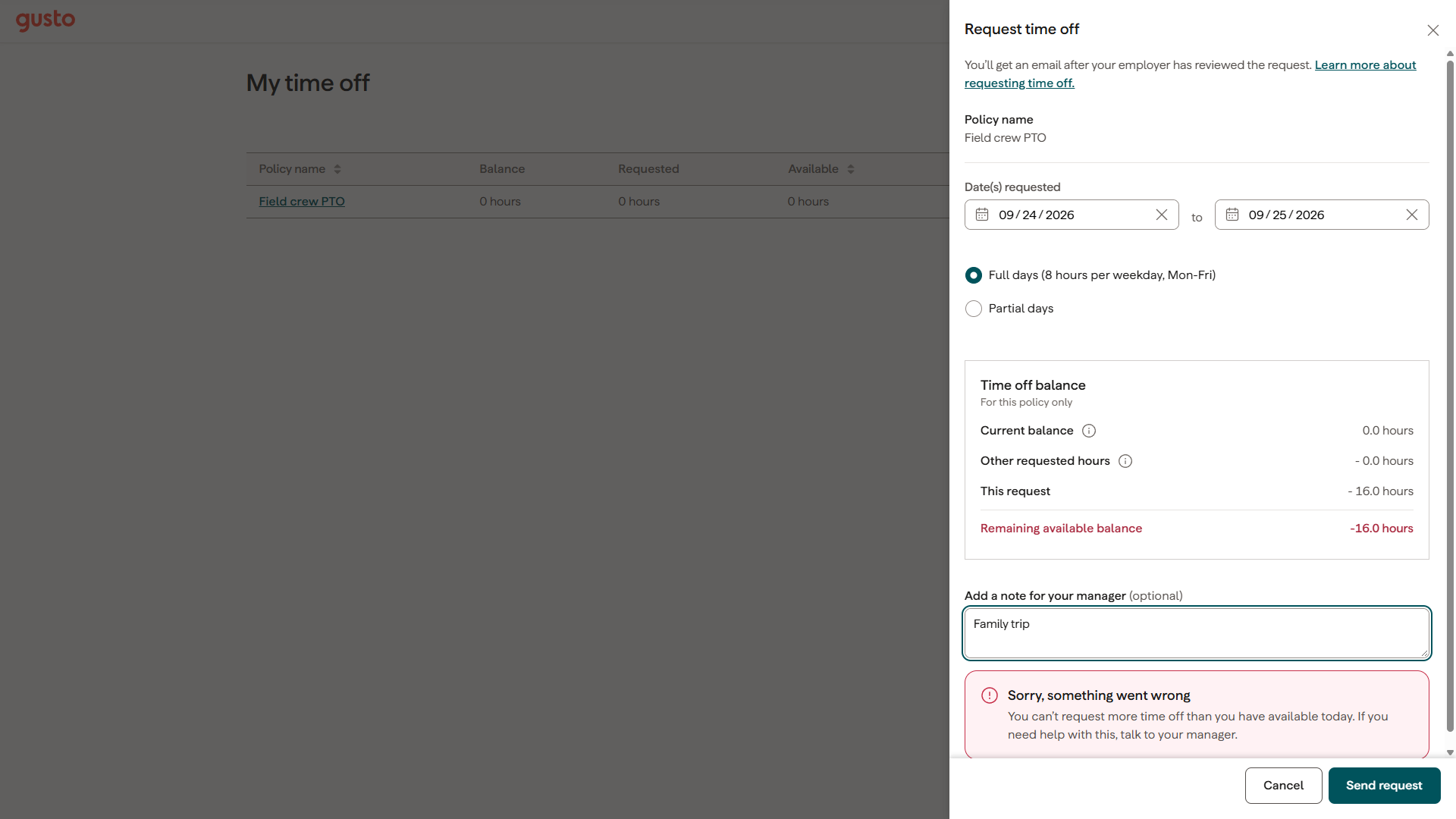
Time off policies are found under Time & Attendance. I wanted to see what happens when someone asks for leave they haven’t earned, so I left negative balances switched off in the policy and had my employee request 2 days against a zero balance. Gusto rightly refused the request and told him to talk to his manager. When I recorded the same day for him as an admin, Gusto warned about the problem but let me through, which I think makes for a flexible system.
Benefits administration
Finally, Gusto lets you set up and manage employee benefits, including but not limited to:
- Health benefits
- 401(k) retirement plans
- Commuter benefits
- Charity matching
For 401(k) plans, Gusto now offers its own Gusto 401(k), powered by Guideline, which Gusto acquired. Contributions sync with payroll automatically. You can also set up a plan with partners like Human Interest, Betterment, and Vestwell, or connect an existing plan from providers including Fidelity, Empower, and Ascensus.
Verdict: 8/10
Time tracking and timesheets
Gusto’s time tracking feature records when, where, and for how long your employees work. It’s included on Plus and Premium plans, while it’s a paid add-on for the Simple plan.
Employee hours worked can be recorded in 4 different ways:
- Supervisor input: Managers can manually enter hours worked for each employee. This ensures accuracy but requires time for input and review.
- Employee input: Employees can clock in and out in real time from a web browser, which includes an automatic timer. If you give them edit access, they can also enter start and end times manually.
- Time kiosks: Managers can turn most internet-connected devices (like tablets or computers) into a shared time kiosk, which employees can use to clock in and out in real time. This setup can provide site-based time tracking without any extra hardware purchases.
- Gusto Mobile: Employees can use the Gusto Mobile app to clock in and clock out in real time.
For added fraud protection, the mobile app features geolocation. You can ask employees to share their locations when they’re clocking in and out. The app records where they are at those 2 moments only, not during the shift, so there’s no live or breadcrumb GPS tracking like Connecteam and other tools. Clock-ins outside an authorized workplace are flagged on the timesheet for review rather than blocked.
I also found that Gusto leaves overtime rules largely up to you. It links to state overtime rules but doesn’t pre-fill them, and it accepted my 30-hour weekly threshold without comment. A manager who doesn’t know their state’s rules, such as California’s daily overtime, gets no guardrail.
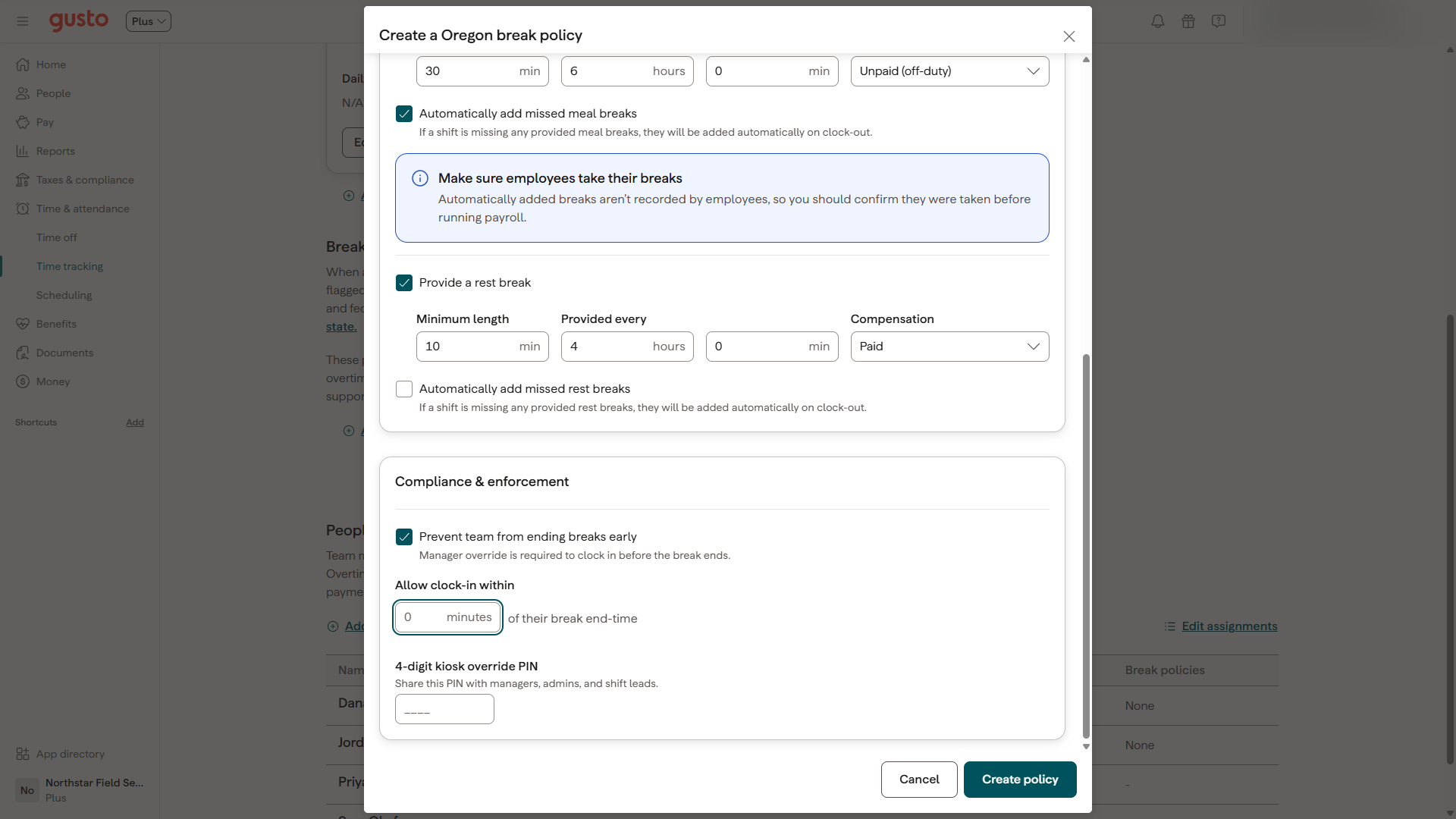
There’s better assistance for break policies, though. When creating a break rule for Oregon, the form suggested state-specific meal and rest breaks and let me block early returns.
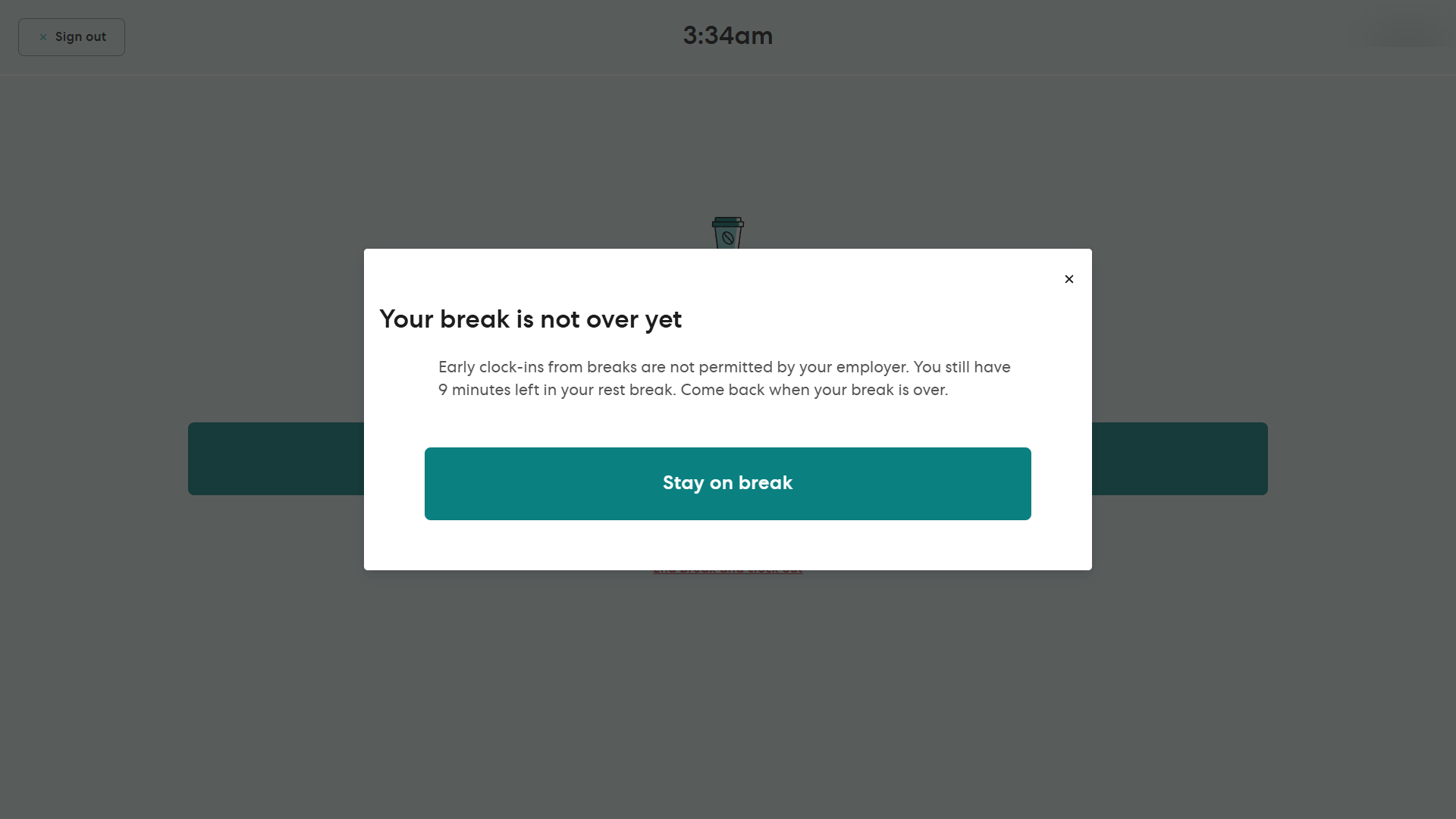
The kiosk enforced the policy in my test. When an employee tried to return from their break after one minute, Gusto blocked the clock-in and showed the 9 minutes remaining.
I really like Gusto’s project tracking feature. This allows you to track time on a project-by-project basis, which is ideal for businesses managing multiple clients or working jobs with different billable hours. Simply create a project, add tasks, and your employees will be able to track time with all the same methods discussed above, but with the option to assign certain working hours to specific projects.
When it comes time for payday, approved hours entered in Gusto automatically sync with the payroll dashboard, letting you review and adjust timesheets before processing payments.
For field teams, though, the gaps add up. Location is only captured at clock-in and clock-out, and off-site clock-ins are flagged rather than blocked. The kiosk app runs on tablets and computers, but not phones. Gusto doesn’t document the ability to clock in offline. And customer support told me missed breaks are only flagged in the timesheet for the admin afterward – there’s no in-app warning for workers before they miss a break or tip into overtime.
Verdict: 7/10
Scheduling
Gusto offers scheduling on Plus and Premium plans. It’s also available as an add-on for the Simple plan. I found the weekly grid view easy to use, with scheduled hours totaled for each day and each employee. Clicking a cell opens a panel for the shift, which includes details such as assignee, times, breaks, job title, and a shared note. Each new shift includes the worker’s required breaks.
Shifts save as drafts until you publish them, which notifies workers by email and in the app. When I added a shift that pushed an employee over 30 hours, I was warned before I could save the shift.
But when I tested whether Gusto would let me schedule a shift and approve time off for a user on the same day, it went through with no conflict warning.
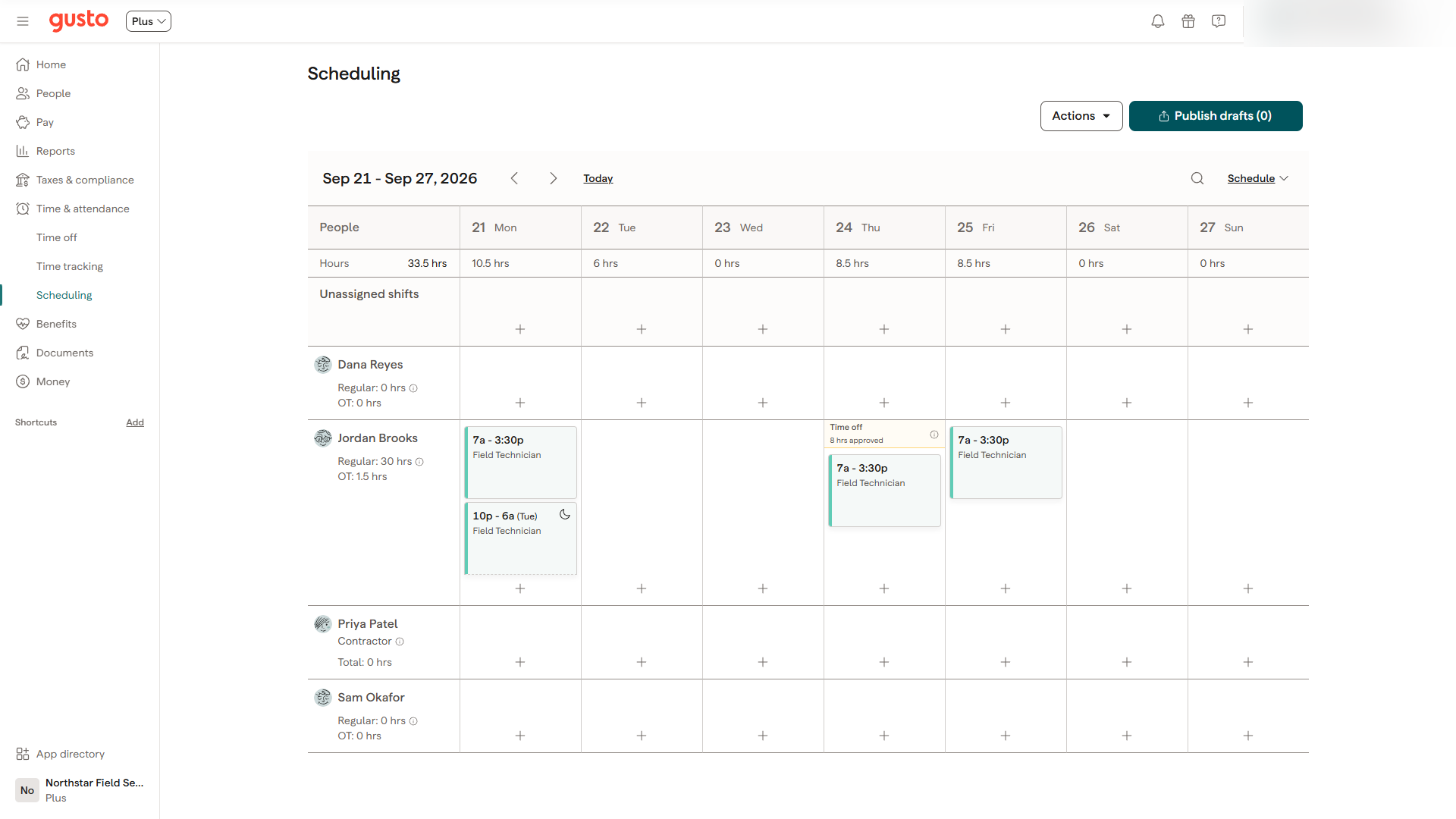
Workers can also set availability for managers to consider while creating schedules. Gusto also supports shift swapping. If you turn on coverage requests, workers can offer a published shift to coworkers, who can claim it for manager approval. But there’s no pool of open shifts for workers to pick up, because unassigned shifts stay hidden from workers. I also found no way to auto-assign shifts based on availability.
Verdict: 7/10
Payroll
I appreciate that Gusto makes running payroll easy enough for a layperson to manage.
One of the toughest things about running payroll is calculating taxes. Employers are responsible for withholding federal income tax, state income tax, Social Security tax, and Medicare tax from employees’ wages, as well as paying employer contributions for Social Security and Medicare. They must also report and remit these amounts to the appropriate tax agencies on time to avoid penalties.
Assuming you’ve properly entered all your employees’ information, like county, state, salary, and employee vs. contractor status, Gusto automatically calculates payment and tax amounts for you based on the most current tax laws and summarizes it in a dashboard for easy review and spot checks. Then, when you run payroll, it withholds the proper amounts from your employees’ paychecks, updates the relevant tax filings, and even pays the IRS on your behalf.
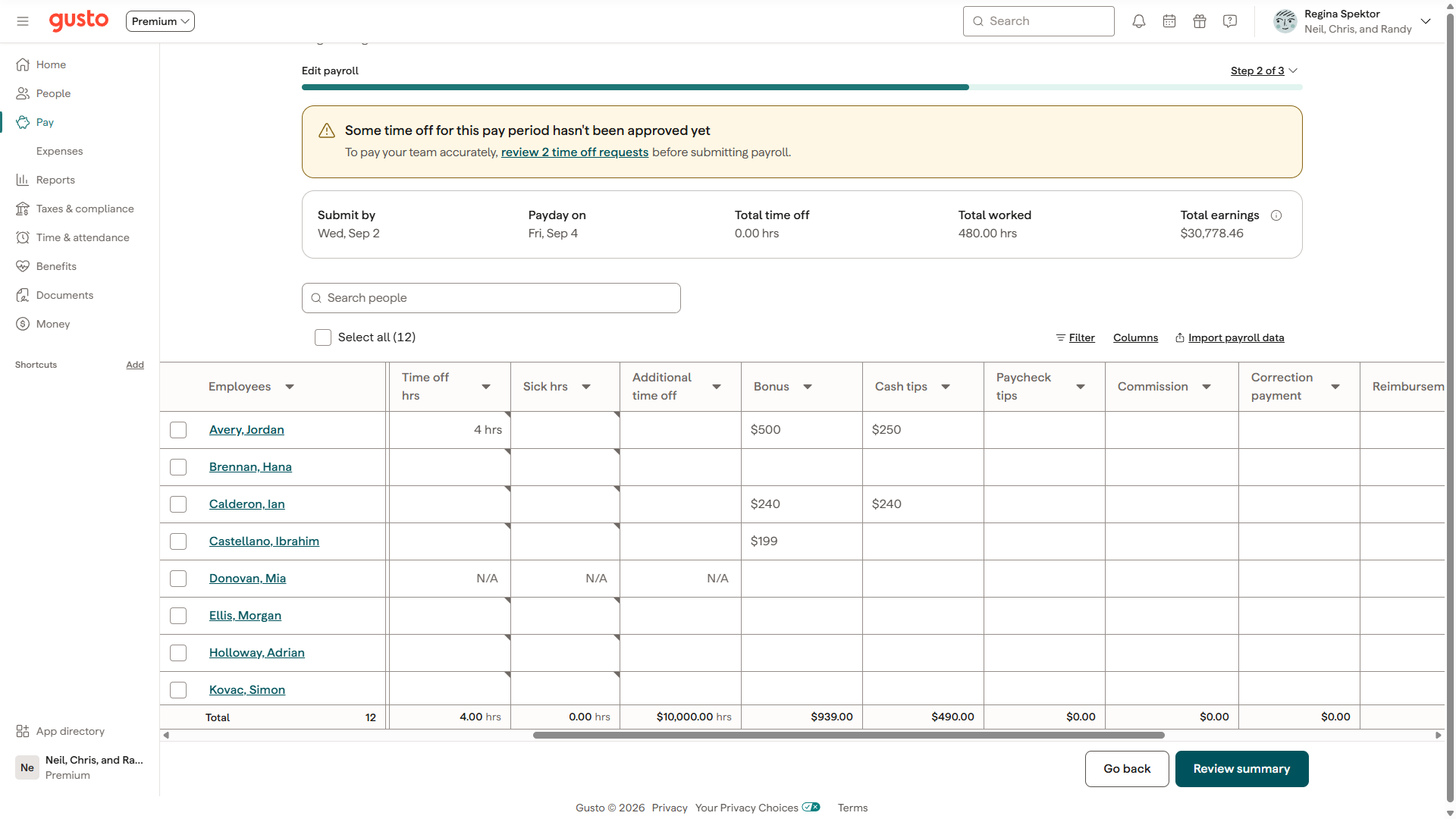
Gusto lets you specify your payment deposit speed, something I found really helpful in the case of unexpected payroll changes or last-minute adjustments. You can choose between 4-day, 2-day, or next-day direct deposits, but which ones you can use depends on your plan, payment history, and account standing.
Gusto says most new employers start on 4-day pay and unlock 2-day pay after a 15-day wait and one successful payroll. Next-day pay is included on Plus and Premium and costs extra on Simple. Whichever one you choose will affect the deadline you must run payroll by. With 2-day pay, for example, you have until 4 PM PT on Wednesday to run payroll for a Friday payday.
You can also customize your bank descriptor, which is what your employees see on their bank statements when their payroll comes in. You can change it from the default “GUSTO” to something like “[Your Company] paycheck.” Though some may find this unnecessary, I found it to be a really nice option for more customization.
On Plus and Premium, Gusto also gives you the ability to add fully custom earnings criteria for irregular pay items like sign-on bonuses, commissions, or severance pay.
Gusto also works well for businesses that hire freelancers. On any plan, you can pay US contractors by direct deposit, and Gusto files their 1099s and you’re only charged for them in months you pay them. For contractors abroad, Gusto’s global contractor payments cover more than 120 countries in local currency, with no monthly per-contractor fee. Instead, Gusto charges a small service and foreign exchange fee on each payment.
Finally, Gusto gives you the option to pay certain employees with paper checks instead of direct deposit.
Verdict: 10/10
Integrations
I found managing app integrations quite painless with Gusto. You can connect with other software through the “App Directory” menu in the sidebar. There, you’ll find a full list of over 150 compatible software solutions, sorted into different categories.
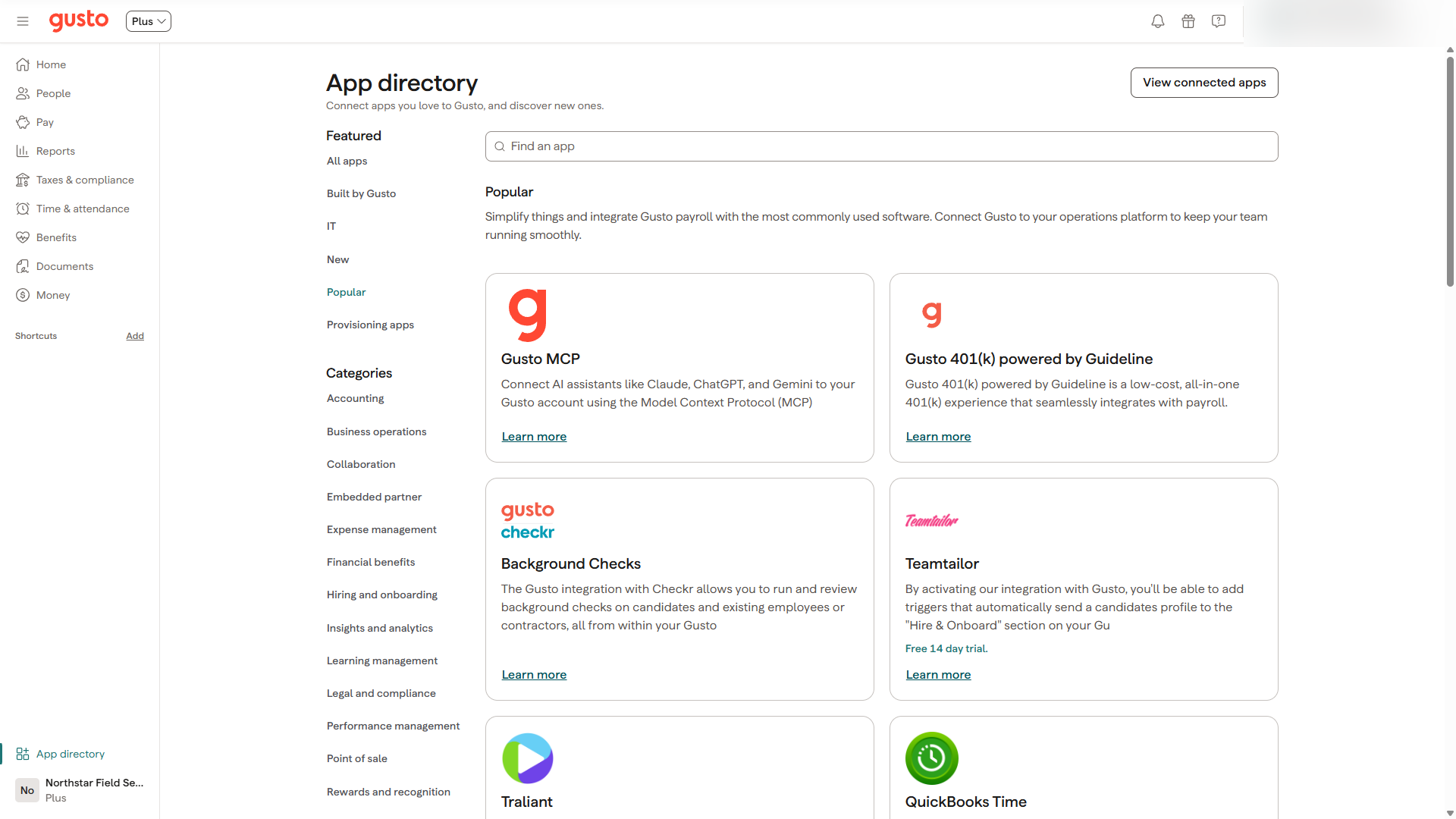
Accounting software includes popular options like QuickBooks (online and desktop), FreshBooks, Xero, and Ignition. Gusto integrates with business applications including Shopify, Clover, and Carta. It also connects with hiring and HR tools like BreezyHR, ApplicantPro, and Gusto Recruiting. For team collaboration, you can link Gusto with Slack and Asana. Gusto also integrates with Connecteam for better time tracking, scheduling, and team communication.
I really appreciate that once you choose a software within the App Directory menu, you can integrate right then and there within your browser.
When my colleague used Gusto to run payroll at their old position, they integrated it with QuickBooks, which was their primary accounting software. They say the integration was seamless, and it let them run payroll from Gusto and then see those payroll expenses automatically reflected within QuickBooks.
Verdict: 8/10
Gusto Security Features
Gusto applies several security checks to account access and when you’re making sensitive changes.
I used multifactor authentication with Gusto. Once I’d set up Google Authenticator with a code from Gusto, signing in with a new device asked for an authenticator code, and when I went to save an employee’s tax details, it stopped me and asked for a fresh code first, as this was considered a sensitive change. You can set up passkeys, SMS fallbacks, and a Photo ID backup for recovery.
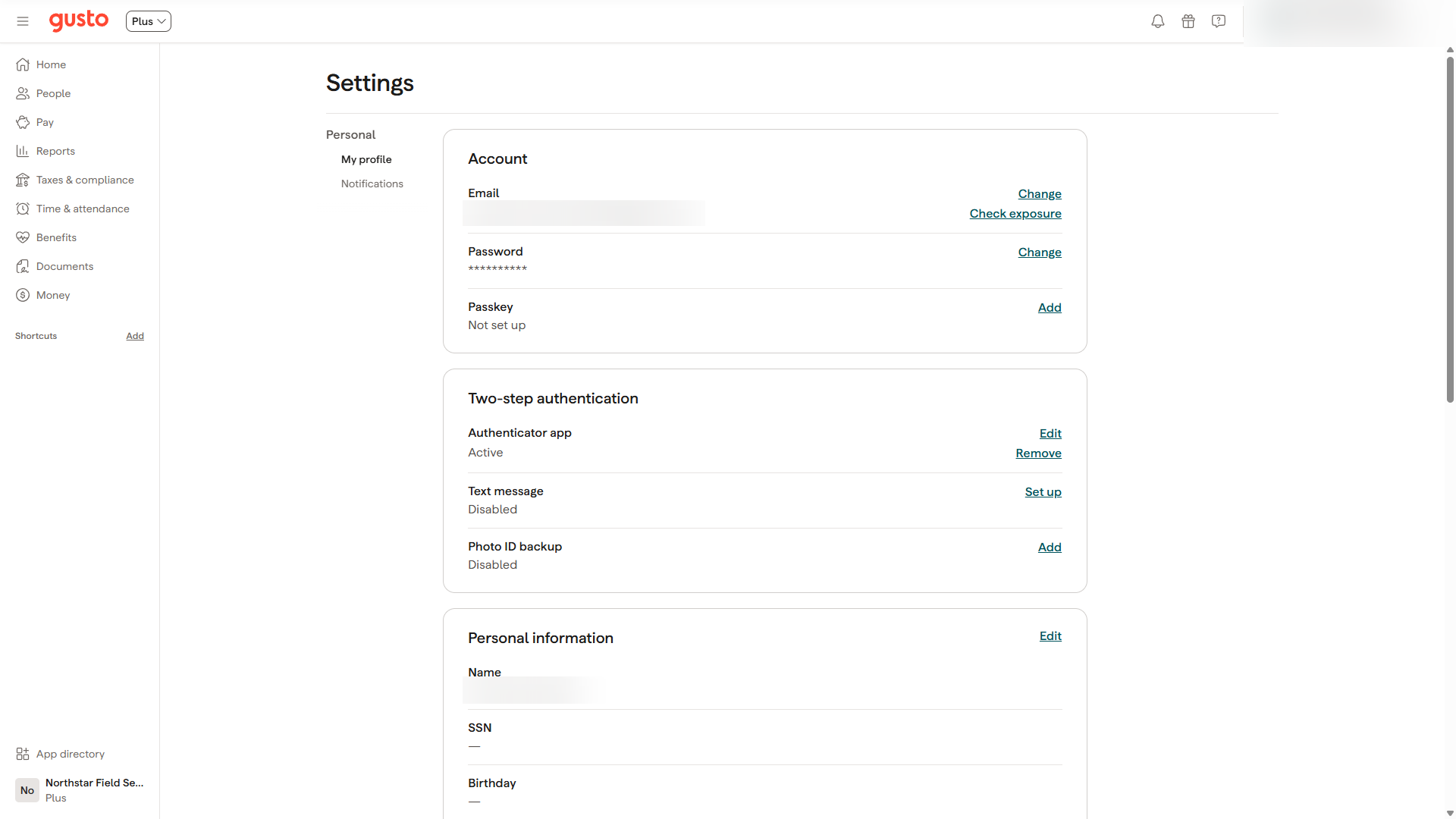
Gusto’s security page says it encrypts data in transit with TLS 1.2 and data at rest with AES-256 on AWS. It also lists third-party penetration testing, a bug bounty program, and annual SOC 1 and SOC 2 reports available under NDA.
Gusto says it supports HIPAA guidelines and offers a business associate agreement (BAA) for health data. The BAA applies only to Gusto’s listed HIPAA-eligible services for employers acting as a group health plan, and it doesn’t make your business compliant on its own.
Verdict: 9/10
Gusto Reporting & Analytics
In my testing, Gusto’s Reports page listed 19 ready-made reports plus a custom report builder.
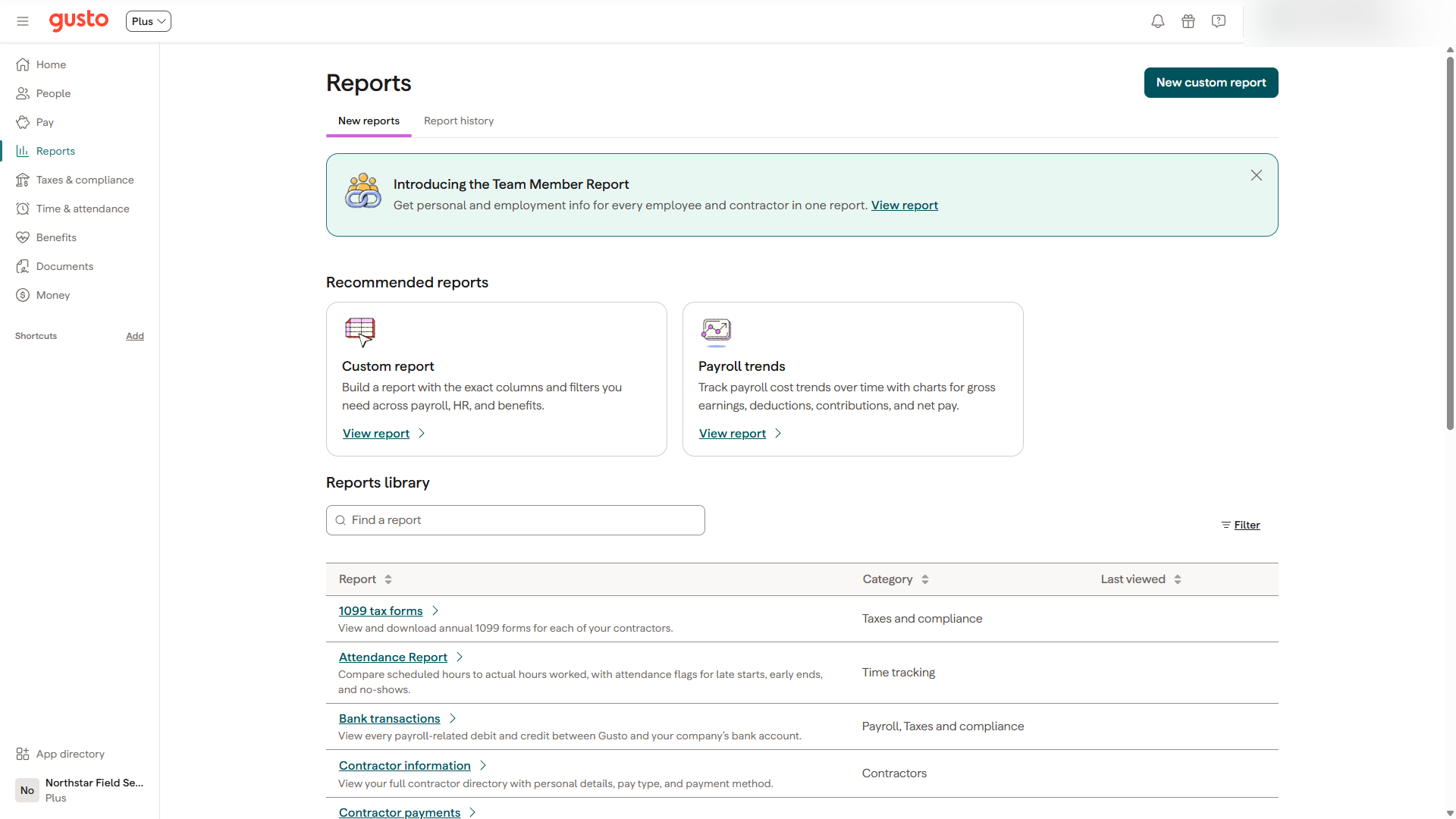
I tested the custom builder and found it very flexible, with 109 selectable columns, filters, a live preview, and templates. Reports can be scheduled to run regularly at daily, weekly, bi-weekly, monthly, quarterly, or annual intervals. Reports can also be exported in Excel, CSV, or PDF formats.
Some of the most useful reports that caught my eye were:
- 1099 tax forms: Provides details of contractor payments for tax filing purposes.
- Attendance report: Compares scheduled hours with actual hours and flags late starts, early finishes, and no-shows.
- Custom report: Allows users to create fully custom reports across payroll, HR, and benefits.
- Payroll trends: Charts gross earnings, deductions, contributions, and net pay over time.
- Time tracking hours: Tracks hours with daily breakdowns and approval status.
In all the reports I generated, I didn’t see any AI analysis from Gusto. I also received several “Something Went Wrong” errors when generating reports, though these may have been resolved once the company’s payroll setup was complete.
Verdict: 8/10
Gusto Customer Support
Gusto offers customer support through phone, live chat, email, self-service articles, and its AI assistant.
Phone, chat, and email support is available Monday–Friday, 6:00 am–6:00 pm MST, and closed on weekends. With priority support, you get priority in the phone and chat queue. Priority support is a $30-a-month (plus $3 per person) add-on on Simple and Plus and is included on Premium, which also gets a dedicated service advisor.
The Help Center has up-to-date articles and tutorials with step-by-step instructions for using the software. It’s also available in the mobile app, though I found the formatting needed work, as some pages were hard to read.
I contacted Gusto’s support team several times throughout my testing. The process starts with a discussion with its support bot, which can only suggest information from the knowledge base.
About half the time, when I asked to speak to a human, I was connected to a Small Business Advisor within a minute, and they answered my query within 5 minutes. The other half of the time, I was told no agent was available and asked to schedule a call the following week.
Verdict: 8/10
What are Gusto’s Review Ratings from Review Sites?
(As of September 2026)
Gusto App Review
Gusto is a user-friendly payroll software solution that simplifies ordinarily complex processes for small to medium-sized businesses. It automatically makes tax calculations, generates reports, and integrates with a wide variety of accounting and business software. Employees benefit from the mobile app, which allows them to track hours, access pay stubs, and view tax forms.
I’d recommend Gusto to SMEs that want payroll to be at the center of their HR software. Gusto’s time tracking and scheduling features may not be comprehensive enough for field and deskless teams that need clock-ins restricted to job sites, live GPS tracking, open shifts workers can pick up, or built-in live chat, though. It’s often better paired with a business operations management platform that covers these in more depth.
Connecteam: The Better Gusto Alternative for Time Tracking & Scheduling
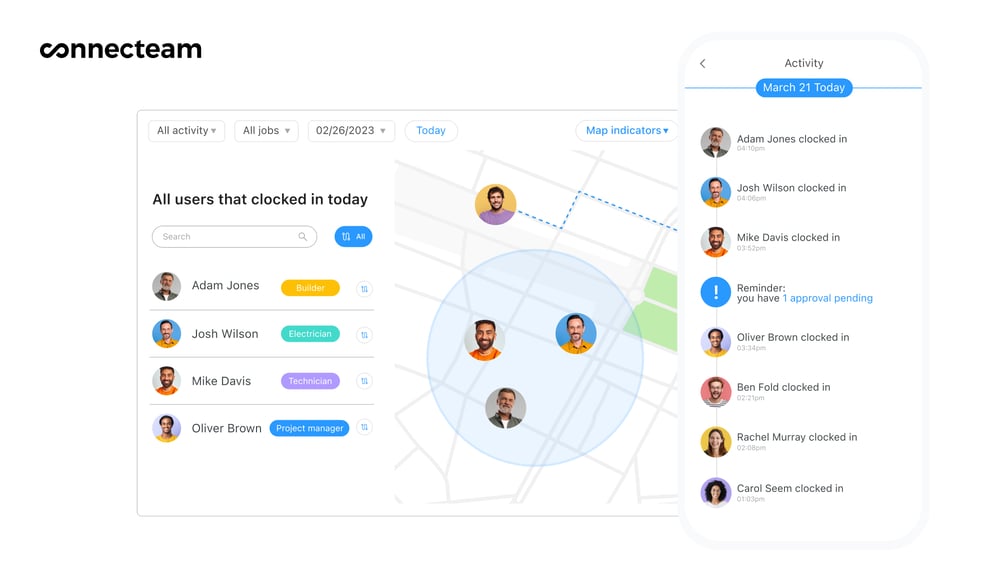
If you like Gusto for payroll but not for workforce management, you might consider Connecteam.
Connecteam is an all-in-one business operations management platform that streamlines communication and organizes administrative tasks into an easy dashboard for managers and employees. It covers several field-work functions that Gusto lacks.
Connecteam’s employee time clock covers virtually everything in Gusto’s time tracker, but you can draw geofences around job sites and restrict clock-ins to just those areas. You can track equipment and vehicle mileage within time entries, too. Its GPS tracking app can also record a worker’s route while they’re on the clock (Operations Expert and above).
You can configure breaks, overtime, and automatic clock-outs through its break management software. The kiosk app runs on phones and tablets.
Plus, Connecteam has loads more features for managing your workforce, from advanced employee scheduling with claimable open shifts and configurable shift-swap workflows, to HR management systems. Communication between team members is much better than with Gusto, thanks to the online team chat, shared document storage, and news timeline.
For field crews, Connecteam’s task management app lets managers assign one-off or recurring tasks with due dates, subtasks, checklists, and images. Workers get notified on their phones, and managers can follow progress as each subtask is completed.
It’s also affordable, with a free Small Business Plan for up to 10 users. Operations Basic starts at $29/month for the first 30 users when billed annually.
The best part is, you don’t have to choose between Connecteam and Gusto. Connecteam integrates with Gusto. So you can use Connecteam for its superior time tracking and scheduling while sticking with Gusto for your actual payroll runs.
FAQs
Gusto doesn’t offer a typical, limited-time free trial, but it’s free to use on any plan until you run your first payroll.
Yes, Gusto says it follows HIPAA guidelines for protected health information handled through its benefits products, and it offers a business associate agreement that covers its listed HIPAA-eligible services for employers acting as a group health plan. The agreement doesn’t extend to every Gusto product.
