
When volunteer schedules live in one spreadsheet, donor records in another, and approvals get buried in email threads, it’s easy to miss follow-ups, frustrate volunteers, and leave funding opportunities on the table.
I reviewed 7 nonprofit apps and ranked them based on operational efficiency, fundraising capabilities, and volunteer management tools.
Use these top picks to help you simplify daily operations, raise more money for your organization, and keep volunteers engaged.
| App | Best for | Starting Price | Key Considerations |
| Connecteam | Managing nonprofit staff and volunteers in one place | Just $29/month for the first 30 users | Offers scheduling, time tracking, and communication in one platform. Free for life plan for up to 30 users. |
| DonorBox | Nonprofits setting up recurring donation forms quickly | $150/month (1.75% platform fee + processing fees) | Fast setup with customizable donation forms and built-in donor management. |
| Givebutter | All-in-one fundraising, events, and donor CRM | $29/month | Covers fundraising pages, events, auctions, peer-to-peer, and donor management in one platform. |
| VolunteerMatch | Nonprofits recruiting new volunteers from a large network | $149/year | Connects nonprofits with skilled volunteers by location, interest, and skills. |
| VolunteerHub | Managing and scheduling existing volunteer rosters | $143/month | Handles volunteer scheduling, database management, and group reservations with strong CRM integrations. |
| Canva | Nonprofits creating professional marketing visuals on a tight budget | $17.5/month/user | Easy-to-use graphic design with templates for social media, newsletters, and events. |
| DialMyCalls | Nonprofits sending bulk SMS and automated calls to supporters | $6.74/month for 25 contacts | Automates outreach to thousands of donors and supporters via text and voice. |
What’s New in This Update (August 2026)
Our Top Picks
-
1

Best for managing nonprofit staff and volunteers in one place
-
2

Best for nonprofits setting up recurring donation forms quickly
-
3
Best for all-in-one fundraising, events, and donor CRM
Why trust us?
Our team of unbiased software reviewers follows strict editorial guidelines, and our methodology is clear and open to everyone.
See our complete methodology
How I Ranked the Best Nonprofit Apps
Here are some key features I looked for when evaluating the best nonprofit apps for this list.
Core Operational Workflows
- Keeping volunteers and staff aligned: Managers should be able to build schedules for both paid employees and unpaid volunteers from a single interface, with real-time notifications when shifts change.
- Tracking hours accurately for grants and reporting: Nonprofits often need to report volunteer hours to funders or government agencies. The app should provide a way to log hours automatically and generate exportable timesheets.
- Replacing group texts with unified communication: Supervisors should be able to send real-time updates, chat with individuals or groups, and share important documents without relying on personal texting apps.
Fundraising and Donor Management
- Making it easy for supporters to give without friction: The platform should provide customizable donation forms that load quickly, support recurring giving options, and accept modern payment methods like Apple Pay, Google Pay, and Venmo.
- Knowing who your donors are and what motivates them: There needs to be a way to track donor history, segment supporters by giving frequency or amount, and automate tax receipts and personalized thank-you messages.
- Running events and campaigns from one dashboard: For nonprofits that rely on galas, auctions, or peer-to-peer campaigns, the platform should consolidate ticketing, bidding, and donation collection into a single system.
Volunteer Coordination and Outreach
- Finding new volunteers who actually match your needs: The tool needs to help organizations reach a wide audience of potential volunteers and match them based on geographic proximity, skills, and cause-area interest.
- Reaching supporters instantly when it matters: Administrators should be able to send bulk SMS messages or automated voice calls to quickly notify supporters about upcoming events, emergency needs, or last-minute schedule changes.
- Managing group and corporate volunteer reservations: The software should support group sign-ups, unique join codes, and the ability to reserve slots for specific organizations while keeping remaining spots open to the public.
The 7 Best Nonprofit Appss
-
Connecteam — Best for managing nonprofit staff and volunteers in one place
Connecteam is a workforce management platform designed to handle the day-to-day operations of your nonprofit from a single mobile app.
Why I chose Connecteam: Connecteam made the top of my list because it’s the most complete option for managing the people doing the work, especially in areas like scheduling volunteers alongside paid staff, tracking hours, and keeping everyone connected through built-in communication tools.
Drag-and-drop scheduler for employees and volunteers
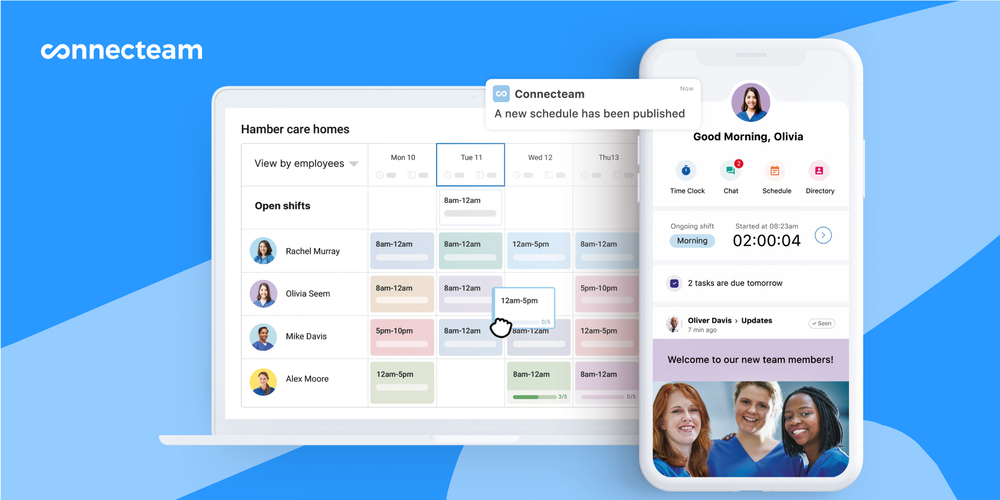
Connecteam’s employee scheduler makes it easy to manage scheduling across your entire organization from one place. The drag-and-drop editor lets you quickly build and edit shifts for both full-time staff and volunteers, and you can create entirely separate schedules for different departments, programs, or event locations. Add notes, tasks, or files (like briefings or event maps) to each shift so your team always arrives prepared.
The platform also offers an AI-powered auto-scheduling tool. You set custom rules, such as requiring a certified first-aid volunteer on every shift, and the system automatically assigns open shifts based on availability, qualifications, and your preferences. When things change, just update the schedule and notify everyone instantly on their phones. You can also post open shifts for volunteers to claim, so you’re never short on coverage.
Time clock and GPS tracking
Connecteam’s time clock app lets volunteers and staff clock in and out from their phones with a quick tap. The GPS tracker adds a location stamp to each clock-in, so you can easily confirm that people are where they need to be, whether that’s a food bank, community garden, or fundraising venue.
Every hour is automatically recorded in digital timesheets, so it’s easier to report volunteer hours to funders or government agencies. You can filter time by job, task, or location, review and approve entries, and export timesheets to payroll platforms like QuickBooks, Gusto, and Xero. Connecteam also applies your overtime and breaks rules automatically, so you don’t have to risk making manual mistakes.
Schedule your team and track their time from one app. Task management and digital forms
With Connecteam’s employee task tracking, you can create tasks and subtasks and assign them to specific team members with detailed instructions, due dates, and priorities. To ensure nothing gets missed, include customized checklists and digital forms within each task.
If volunteers are working at different locations, they can check their assignments right from their phones, mark tasks as complete, and even attach photos as proof of completion. Managers receive real-time notifications as tasks are finished, and can track overall progress from a central dashboard. For recurring work, you can set tasks to repeat automatically so they never fall off the radar.
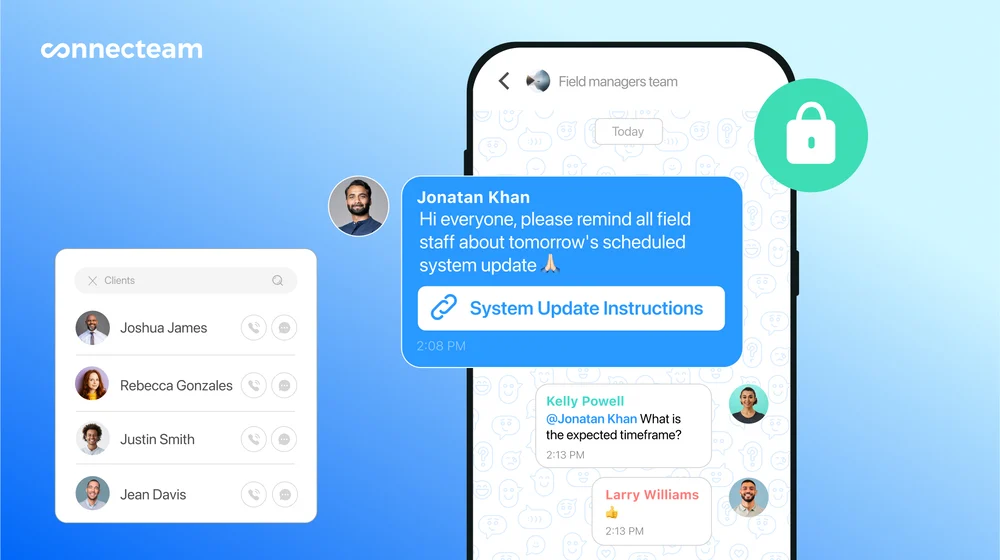
Reach everyone on your team with Connecteam. Built-in team communication
Connecteam’s online team chat lets managers message individual employees or create department-specific group chats. You can set up one for your events team, another for your volunteer coordinators, and a third for your board members. Send pictures, videos, or files directly in the conversation, and access read receipts to confirm who’s seen important updates. The chat is fully searchable, so you can always find past conversations or important details without scrolling through endless threads.
Managers have full control over permissions, so you can decide who starts new chats, delete messages, or limit direct messaging to supervisors only. Push notifications make sure that time-sensitive messages are seen immediately, even when volunteers are out in the field.
Company updates feed and knowledge base
The employee updates feed is a great way to ensure everyone sees important announcements. It works like a social media feed, making it a natural place to share safety protocols, event alerts, policy changes, or organizational news. Managers can enable comments, likes, and emoji reactions, target updates by crew, program, or role, and track exactly who has viewed each post, with the option to require confirmation that employees have read critical updates.
Connecteam also has an internal knowledge base to store policies, training manuals, and operational guides in one searchable location. New volunteers can access everything they need during onboarding without emailing coordinators for documents, and the AI-powered agent lets staff ask questions and get instant answers based on your uploaded content.
And so much more…
- Employee training software with custom courses, quizzes, and AI course creation for fast volunteer onboarding.
- Built-in employee directory for quick contact access without saving numbers to personal phones.
- Recognition and rewards to celebrate volunteer milestones and keep morale high.
- Surveys and live polls to gather feedback from your team after events or programs.
When Connecteam isn’t a good fit
Connecteam isn’t a fundraising or donor management tool. Nonprofits looking for a platform to process online donations, run peer-to-peer fundraising campaigns, or manage donor giving history won’t find those capabilities here and will need a dedicated fundraising solution alongside it.
Connecteam also offers a free for life plan – Get Started Now!
0Key Features
- Drag-and-drop employee and volunteer scheduling
- GPS-enabled mobile time clock
- Digital forms and task management
- Built-in online team chat and updates feed
- Mobile employee training and onboarding
- Native payroll integrations
Pros
- Keeps all operational tools in one app
- Intuitive mobile experience for volunteers
- Free-for-life plan for up to 30 users
- Faster shift coverage
Cons
- Requires internet access for real-time syncing
- Not built for fundraising or donor management
Pricing
Free-for-life plan availablePremium plans start at $29/month for 30 users
Amazing for Nonprofit Apps
Create Free Account -
DonorBox — Best for nonprofits setting up recurring donation forms quickly
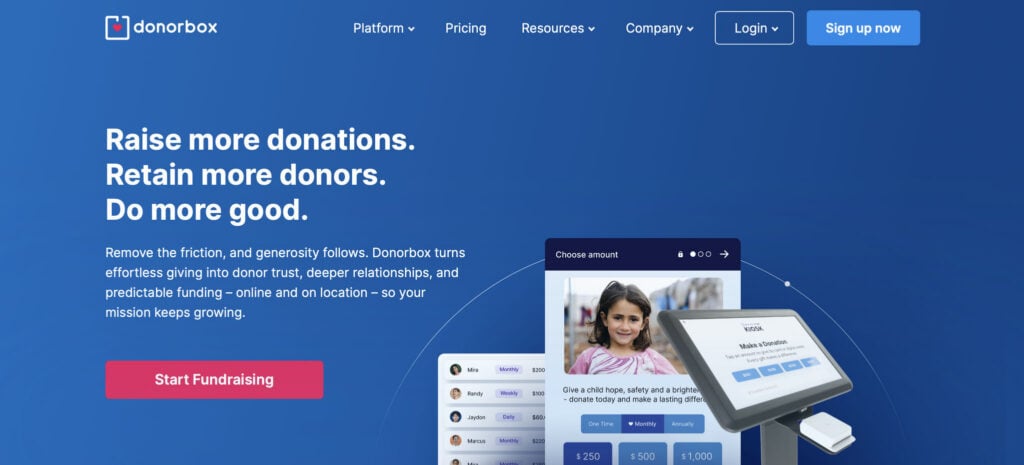
DonorBox is a dedicated fundraising software platform focused on streamlined donation collection for nonprofits of all sizes.
Why I chose DonorBox: Donorbox lets nonprofits add recurring donation forms to almost any website without coding. Its UltraSwift checkout loads up to four times faster than traditional donation pages, helping donors complete their gifts quickly.
Custom donation forms and checkout
DonorBox allows organizations to customize donation forms that embed directly into existing websites as inline forms, pop-up widgets, or standalone hosted pages. You can brand the forms with your organization’s logo and colors, set suggested donation amounts with impact descriptions (e.g., “$50 feeds a family for a week”), and add custom questions to collect specific details from donors.
The checkout experience is designed to minimize donor drop-off. DonorBox supports Apple Pay, Google Pay, PayPal, Venmo, and ACH bank transfers alongside standard credit cards. Donors can also save their payment information using the QuickDonate feature, which lets them repeat their gift in a single click on future visits.
It’s worth noting that the Standard free plan charges a 2.95% platform fee on donation forms but a higher 3.95% fee on event ticketing and membership transactions, so organizations running a lot of events should factor that into their cost calculations.
Recurring giving and donor portal
DonorBox places a strong emphasis on recurring donations. Donors can easily set up weekly, monthly, quarterly, or annual giving plans directly from the donation form. Donorbox provides a branded donor portal where supporters can manage recurring donations, update payment methods, view their giving history, and download tax receipts. This self-service approach really saves time for nonprofit staff who would otherwise have to handle dozens of emails about receipt requests.
DonorBox also offers a “Recurring Donation Upsell” feature on the Pro plan that prompts one-time donors to convert their gift into a monthly contribution. It’s a smart nudge that can meaningfully increase your recurring revenue over time.
Built-in donor management (CRM)
DonorBox’s CRM automatically adds donors to your database and tracks their complete giving history across all campaigns. You can segment donors based on donation frequency, amount, campaign involvement, or custom criteria to create targeted outreach. The system also stores communication records within each donor profile, helping your team maintain context when following up with major supporters.
One limitation I noticed on the pricing page is that advanced integrations, like Zapier and API access for connecting donor data to external tools like Salesforce or HubSpot, are locked behind the $150/month Pro plan. Similarly, tracking and analytics features (Google Analytics, Meta Pixel) and receipt whitelabeling are Pro-only. For small nonprofits that need to automate workflows across multiple platforms, the free Standard plan may feel restrictive once you outgrow basic donation collection.
What users say about DonorBox
Really intuitive plug-and-play donation features for self-serve kiosks, as well as online forms and alternative donation methods, with donor info all in one centralized place.


I was extremely surprised by the fees for transactions. It doubled our Stripe fees (actually may be more!). I also wish there was an easier way to update all of the campaigns at once.

Key Features
- Embeddable, customizable donation forms
- Recurring donation management
- Donor self-service portal
- Automated tax receipt generation
Pros
- Fast setup on existing websites
- Strong support for modern digital wallets
Cons
- Zapier and API access require higher tier plan
- Text-to-Give requires a monthly add-on fee
Pricing
Starts at $150/month (1.75% platform fee + processing fees) Trial: No Free Plan: Yes
-
Givebutter — Best for all-in-one fundraising, events, and donor CRM
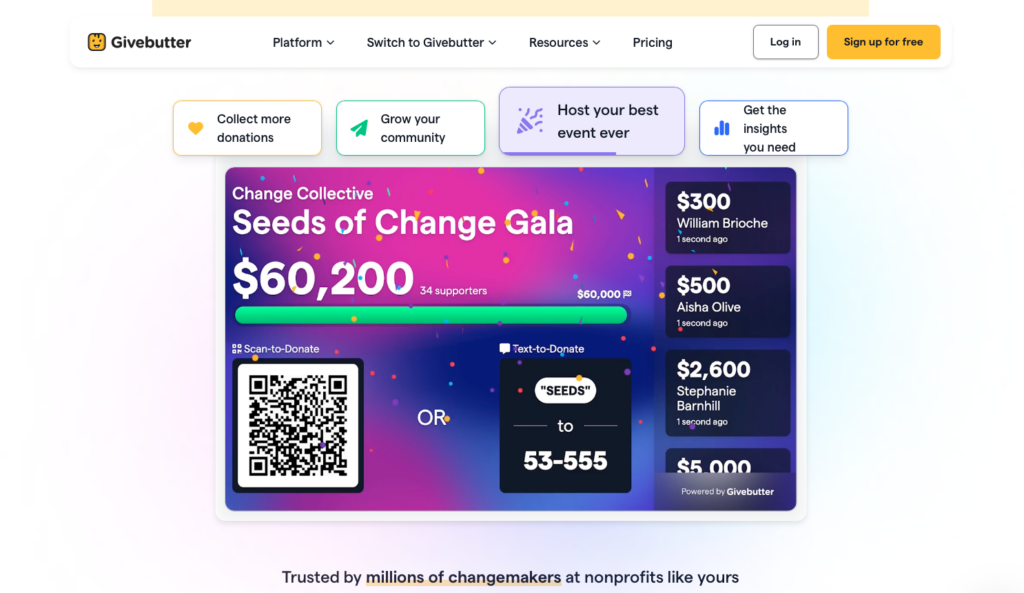
Givebutter is a fundraising platform that combines donation collection, event ticketing, auctions, and donor management into a single ecosystem.
Why I chose Givebutter: I included Givebutter because it offers the broadest suite of fundraising tools on the list, including peer-to-peer campaigns, silent auctions, and livestreaming.
Unified fundraising campaigns
Givebutter allows nonprofits to run multiple types of campaigns from a single dashboard without needing separate subscriptions for each. You can create standard donation forms with a reported 47% conversion rate, build interactive crowdfunding pages with goal thermometers and donor walls, and launch peer-to-peer campaigns where supporters create their own personalized fundraising pages on your behalf.
The platform supports Venmo, Cash App, PayPal, Apple Pay, Google Pay, and even DAF (Donor Advised Fund) donations, which is particularly effective for reaching younger donor demographics who prefer digital wallets over credit cards.
The pricing model is what really makes Givebutter unique. When you enable optional donor tips, your nonprofit pays zero platform fees and zero processing fees (backed by the Givebutter Guarantee, which covers any fees donors don’t opt to pay). If you disable tips, a flat 3% platform fee applies across all campaign types, plus standard processing fees of 2.9% + 30¢. This means small nonprofits can actually start fundraising at no cost, though the tipping model may confuse some donors who don’t realize the tip is optional.
Event ticketing and auctions
Givebutter’s event management features let you sell tickets for in-person, virtual, or hybrid events, manage attendee check-ins using the Givebutter mobile app, and accept on-site Tap to Pay donations during the event itself. Givebutter also provides modern silent auction tools where supporters can browse items and place bids directly from their phones, so you don’t need a separate auction app.
Integrating ticketing, auctions, and donations keeps revenue data in one place and gives you a complete view of each supporter’s engagement.
Centralized donor CRM and marketing
Givebutter includes a free CRM that centralizes all contacts and transactions with unlimited users and unlimited contacts at no cost. At-a-glance donor profiles show every interaction and contribution across campaigns. You can segment supporters using custom tags and filters, then send personalized emails with built-in analytics and tracking.
While the core CRM and email marketing are free, advanced features, like outbound text messaging, automated workflows, and task management, all require upgrading to Givebutter Plus. Plus pricing starts at $29/month for organizations with 250 or fewer contacts, but scales up to $129/month for larger databases, which is something to keep in mind for growing nonprofits.
What users say about Givebutter
I am still using Givebutter – and haven’t even thought of looking for another fundraising platform. They now cover all fees (when a donor doesn’t)! We used the platform for our online auction this past year and it was amazing and simple to use!
I don’t like that we can’t customize it more, especially the donate button and the interface. We have had several donors complain that they were tricked into “tipping”, assuming that the money was going to our nonprofit, only to realize it went to Givebutter.
Key Features
- Interactive crowdfunding and peer-to-peer pages
- Event ticketing and silent auctions
- Built-in donor CRM with email marketing
- Venmo and digital wallet support
Pros
- Core platform is free with optional donor tips
- Replaces multiple disjointed fundraising tools
Cons
- Donor tipping model may confuse supports
- Automated workflows and texting require paid plan
Pricing
Starts at $29/month Trial: Yes Free Plan: Yes
-

VolunteerMatch — Best for nonprofits recruiting new volunteers from a large network
Available on
- Web
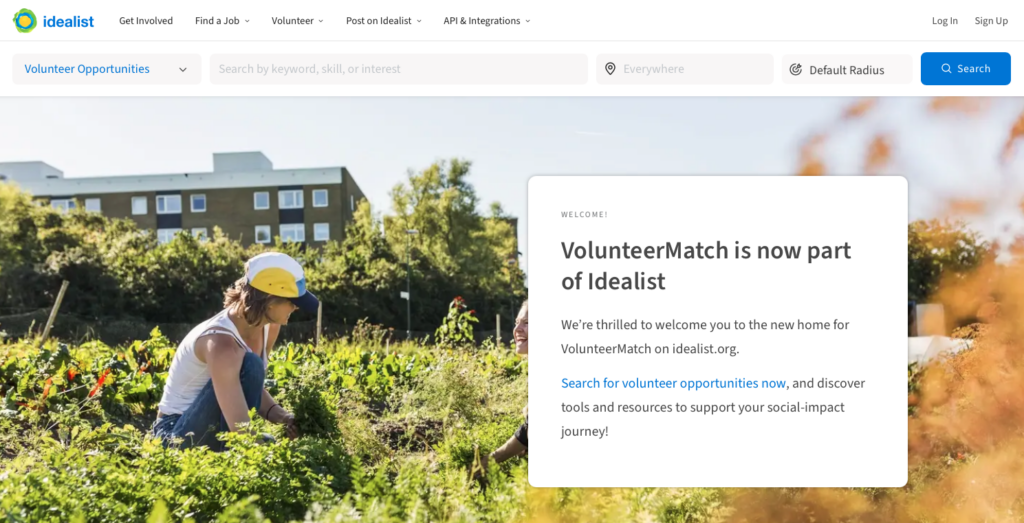
VolunteerMatch (now powered by Idealist) is a dedicated recruitment network that connects nonprofits with individuals looking to donate their time.
Why I chose VolunteerMatch: VolunteerMatch reaches over 3 million volunteers and partners with 230,000+ organizations across 180 countries, giving your opportunities exposure to a massive, pre-qualified audience that you can’t easily reach through social media alone.
Volunteer opportunity listings
Organizations can post volunteer opportunities that people can find by location, cause, required skills, and format, including in-person, virtual, and group roles. You can also highlight kid-friendly opportunities, skills-based positions, and one-time events. The platform matches listings with volunteers whose interests and qualifications fit, helping you attract applicants who are genuinely interested in your mission.
The free basic listing tier allows nonprofits to post opportunities and receive applications at no cost, so organizations of any size can use the platform. Listings include descriptions, photos, and scheduling details, but the customization options on the free tier are pretty limited compared to what you’d get with a premium subscription.
Application management and automated communication
You can review applicant profiles, send messages, and coordinate scheduling without leaving the dashboard. VolunteerMatch also includes automated email responses and reminders, which helps keep applicants engaged and informed throughout the onboarding process. This is a good way to reduce the problem of volunteers signing up but never showing up because they didn’t receive follow-up communication.
The dashboard also provides analytics on the performance of your posted opportunities, including the number of views, applications received, and geographic reach. This data shows which roles attract the most interest, helping you refine your recruitment strategy. However, the free plan offers only basic analytics, so you’d need to upgrade for detailed exports and long-term volunteer retention tracking.
Strategic partnerships and API access
VolunteerMatch offers integrations and partnerships with major corporate social responsibility (CSR) platforms like Benevity, Blackbaud, and Bonterra. This puts your opportunities in front of employees looking to fulfill company volunteer commitments, which is helpful if you need to recruit reliable groups for large events.
The platform also offers an API (Volunteer Match, powered by Idealist) and embeddable search widgets that let you display volunteer opportunities directly on your own website. Yet, access to the API requires an additional annual fee.
What users say about VolunteerMatch
Read review here.VolunteerMatch links with LinkedIn and other popular job-seeking software. Due to this link, it can accurately find more significant numbers of volunteers.
Read review here.When postings expire all of the leads stay within that posting. If you renew the posting, the leads stay with the old posting and don’t migrate to the new one.
Key Features
- Massive searchable volunteer network
- In-platform application management
- Automated applicant messaging
- Corporate CSR platform exposure
Pros
- Great for finding new, skills-based volunteers
- Free basic listings available
Cons
- Premium features are very expensive
- Limited customization on the free tier
Pricing
Starts at $149/year Trial: No Free Plan: Yes
-

VolunteerHub — Best for managing and scheduling existing volunteer rosters
Available on
- Web
- Windows
- Mac
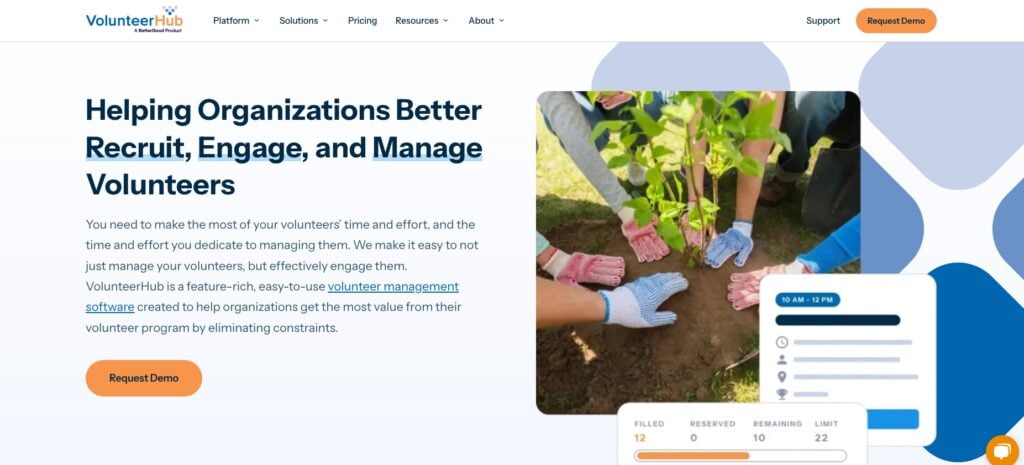
VolunteerHub is a specialized volunteer management software designed to organize, schedule, and track your existing volunteer base at scale.
Why I chose VolunteerHub: VolunteerHub offers deep CRM integrations with Salesforce and Blackbaud, powerful group reservation tools for corporate volunteer days, and automated workflows that handle complex coordination without manual follow-up.
Volunteer scheduling, registration, and waitlists
VolunteerHub provides branded, opportunity-specific landing pages where volunteers can view upcoming events and self-schedule for shifts from any device. The system handles capacity limits and waitlists automatically. If an event is full, volunteers can join a waitlist and are instantly registered and notified via email or text when a spot opens up, so you maximize attendance without manual intervention.
Volunteers can also access the mobile app to view their daily schedules and check in and out of events. The platform supports automated text reminders that go out before shifts, which helps reduce no-shows. For organizations managing recurring programs, you can set up events with repeating schedules so you don’t have to recreate the same opportunity every week.
One thing I noticed is that the initial configuration and data import process can be time-consuming, particularly for organizations migrating from spreadsheets with years of historical volunteer data.
Group reservations and corporate volunteer management
VolunteerHub lets you create group reservations with unique join codes, so members of a specific group, like a company’s CSR team or a university service club, can claim reserved slots while leaving the remaining spots open to the public. You can also designate Group Managers who have permission to view registrations, track hours, and communicate with members of their specific team.
VolunteerHub lets you assign points to opportunities and recognize volunteers as they reach milestones on a leaderboard. This is a good way to help keep long-term volunteers motivated. However, recognition and fundraising features cost extra on the Plus plan and are only included on the Enterprise plan.
CRM integrations and background checks
VolunteerHub integrates with major nonprofit CRMs like Blackbaud’s Raiser’s Edge, Blackbaud CRM, eTapestry, Altru, Luminate CRM, and Salesforce. This allows you to sync volunteer data with donor records and see the full picture of each supporter’s engagement. It also integrates with background check providers like Sterling Volunteers and PeopleFacts, which is especially important for nonprofits working with vulnerable populations that require volunteer screening.
The platform includes both standard and custom reporting, so you can track volunteer hours, attendance trends, and program impact. I noticed that there’s no free plan available, and the entry-level Plus plan starts at $143/month with a setup fee. Data import/export capabilities and configurable forms are locked behind the Pro ($288/month) or Enterprise tiers, which means smaller nonprofits may find themselves paying for features they can’t fully access on the base plan.
What users say about VolunteerHub
Read review here.The process to schedule or review information pertaining to volunteers and events are easy to follow and organized well.
Read review here.If there was a way to give user groups permissions to view certain event groups without having to reach out to support that would be helpful.
Key Features
- Volunteer self-scheduling and waitlists
- Group reservations and unique join codes
- Advanced liability waiver management
- Native CRM and background check integrations
Pros
- Strong management of large volunteer groups
- Deep integration with enterprise nonprofit CRMs
Cons
- No free plan available
- High starting price point
Pricing
Starts at $143/month Trial: No Free Plan: No
-

Canva — Best for nonprofits creating professional marketing visuals on a tight budget
Available on
- Web
- iOS
- Android
- Windows
- Mac
Canva is a popular digital design platform that helps users create professional graphics and marketing materials without needing specialized design skills.
Why I chose Canva: I chose Canva because it offers its full premium Pro features, including access to 100 million+ stock assets and the AI image generator, completely free to registered charitable organizations. It provides enterprise-grade design tools at zero cost for teams of up to 50 users.
Drag-and-drop design editor
Canva’s interface is incredibly easy to use. Even staff with no graphic design experience can create high-quality visuals in minutes. The drag-and-drop editor makes it simple to adjust text, swap images, apply filters, and resize designs for different platforms. You can design everything from social media posts and email headers to printed flyers, event posters, annual reports, and even short videos, all within the same browser-based platform.
Canva also has an AI assistant that can generate design suggestions, create images from text prompts, and help you brainstorm layouts. For nonprofits that need to produce a high volume of content with a small team, this can definitely speed up the creative process. The platform works on desktop and mobile, so you can make edits to an event flyer right from your phone.
Extensive template and media library
Canva has thousands of pre-sized templates specifically designed for different social media channels (Instagram, Facebook, LinkedIn, TikTok) and marketing formats (newsletters, presentations, infographics). The free nonprofit program grants access to Canva’s premium library of over 100 million stock photos, videos, graphics, and audio tracks, which would all normally require a paid subscription.
Canva also offers specific template collections for fundraising materials, SDG (Sustainable Development Goals) reporting, and impact storytelling, which are tailored to the nonprofit sector. You can start from a template and customize it to match your brand, or build something from scratch using the asset library.
Brand Kits and team collaboration
Canva allows organizations to set up Brand Kits, storing official logos, color palettes, and fonts in one place so every design stays consistent regardless of who creates it. This is particularly helpful for nonprofits with multiple chapters or programs that all need to produce on-brand materials independently.
Canva supports team collaboration for up to 50 users on the free nonprofit plan. Team members can comment on designs, share folders, and work on projects simultaneously. Canva also integrates with tools like Slack, Asana, and monday.com for workflow management, and offers direct publishing to social media platforms so you can schedule and post content without leaving the app.
One drawback is that version control can get tricky when several team members edit the same design. Without a formal check-out system, someone may accidentally overwrite a colleague’s changes.
What users say about Canva
Read review here.The thing I like most about canva is the ability to create. It has just enough blend of guidance and freedom to create. Any vision I have had I was able to either find a template or create on my own using the tools. Great value for price with what you need it to do!
Read review here.My least favorite thing is that occasionally something we want to design isn’t possible or the elements of the default design that we want to change is hard to navigate.
Key Features
- Drag-and-drop visual design editor
- Pre-sized templates for social media and print
- Premium stock photo and graphics library
- Brand Kits for consistent logos and colors
Pros
- Pro features are 100% free for eligible nonprofits
- Extremely manageable learning curve
Cons
- Version control can be tricky with multiple editors
- Browser performance can lag on large design files
Pricing
Starts at $17.5/month/user Trial: Yes Free Plan: Yes
-

DialMyCalls — Best for nonprofits sending bulk SMS and automated calls to supporters
Available on
- Web
- iOS
- Android
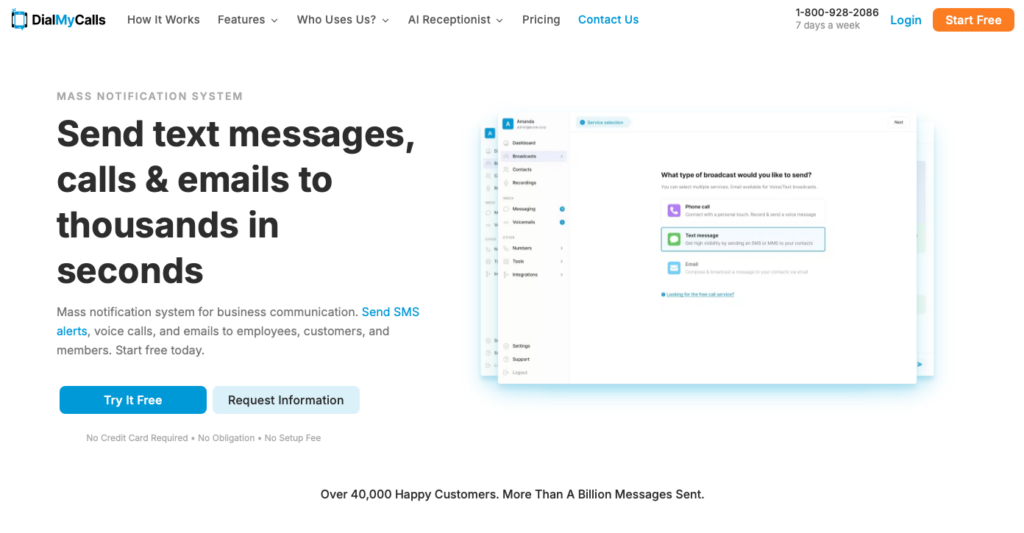
DialMyCalls is a mass notification system designed to broadcast text messages, voice calls, and emails to large contact lists at high speed.
Why I chose DialMyCalls: I chose to include DialMyCalls because it can deliver messages to up to 3,000 contacts per minute, offers a dedicated 10% nonprofit discount on all plans, and provides both credit-based and contact-based pricing models that flex with your organization’s outreach volume.
Mass text messaging
DialMyCalls provides a solid interface for managing contact lists and sending bulk SMS messages. You can segment your contacts into specific groups, and schedule messages in advance for optimal delivery times. The platform supports extended-length texting beyond the standard 160-character limit, and includes AI texting tools that can help you draft message content quickly.
Two-way texting is available on credit-based and contact-based plans, so recipients can reply to your broadcasts directly. This is useful for answering quick questions about an upcoming fundraiser, confirming volunteer attendance, or collecting RSVPs without requiring a separate form. You can also personalize messages using variable fields (first name, last name) so each text feels personal rather than like a mass blast.
However, I noticed that MMS messages use extra credits, so sending images to large contact lists can get expensive quickly.
Automated voice broadcasting
DialMyCalls helps teams send automated voice messages, which is still an effective way to reach older donor demographics. You can record a message using your computer’s microphone, dial in from a phone using a call-in number, or upload a pre-recorded audio file. The system then calls your contacts and plays the message, with options to leave a voicemail if no one answers, detect answering machines, and allow recipients to press a button to opt out or leave a callback message.
There’s also more advanced calling features like telephone polls (useful for quick board votes or event preference surveys), push-to-talk for live interactions, and recurring call broadcasts for weekly reminders. You can also customize the caller ID so your calls come from your organization’s number rather than an unknown line, which improves answer rates.
Reporting, integrations, and limitations
DialMyCalls generates detailed reports for every broadcast you send. You can view delivery rates, see which numbers are no longer active, track opt-outs, and measure recipient engagement. The platform integrates with Zapier, Salesforce, monday.com, Calendly, and other tools, enabling you to trigger broadcasts based on events in your other systems (like sending a reminder when someone registers for an event in your CRM).
It’s important to point out that the platform is purely a communication tool, so it doesn’t include event registration, donor tracking, volunteer scheduling, or any operational management features. It needs to be used alongside other nonprofit software to be effective.
In addition, the free plan is very limited (only 25 credits, which is enough for about 25 text messages or calls), so any real-world usage requires a paid plan. The credit-based pricing model can also be confusing at first. One credit equals one 160-character text segment per number or one 30-second voice recording per number, so longer messages or calls consume credits faster than you might expect.
What users say about DialMyCalls
I love that it’s accessible both as an admin on the computer and through the app. We use it for emergencies, building closures, and similar situations, so being able to send updates from my phone quickly and easily is really important.
It has less customization options in message templates and occasional delays in message delivery during high volume sends. Sometimes messages don’t get sent when it’s used by many of my employees.
Key Features
- Bulk SMS text messaging
- Automated voice broadcasts
- Two-way text communication
- Detailed message delivery reporting
Pros
- Extremely fast message delivery to large lists
- Offers a 10% discount for nonprofits
Cons
- Requires other tools for full management
- Free plan is limited to only 25 credits
Pricing
Starts at $6.74/month for 25 contacts Trial: Yes Free Plan: Yes
Compare the Best Nonprofit Appss
| Topic |
 Start for free
|
|
|
|
|
|
|
|---|---|---|---|---|---|---|---|
| Reviews |
|
|
N/A
|
|
|
|
|
| Pricing |
Starts at just $29/month for the first 30 users
|
Starts at $150/month (1.75% platform fee + processing fees)
|
Starts at $29/month
|
Starts at $149/year
|
Starts at $143/month
|
Starts at $17.5/month/user
|
Starts at $6.74/month for 25 contacts
|
| Free Trial |
yes
14-day
|
no
|
yes
|
no
|
no
|
yes
|
yes
|
| Free Plan |
yes
Free Up to 10 users
|
yes
|
yes
|
yes
|
no
|
yes
|
yes
|
| Use cases |
Best for managing nonprofit staff and volunteers in one place
|
Best for nonprofits setting up recurring donation forms quickly
|
Best for all-in-one fundraising, events, and donor CRM
|
Best for nonprofits recruiting new volunteers from a large network
|
Best for managing and scheduling existing volunteer rosters
|
Best for nonprofits creating professional marketing visuals on a tight budget
|
Best for nonprofits sending bulk SMS and automated calls to supporters
|
| Available on |
Web
|
Web, Windows, Mac
|
Web, iOS, Android, Windows, Mac
|
Web, iOS, Android
|
How to Choose the Right Nonprofit Apps
Choosing the right nonprofit apps depends on your specific needs and organizational scale. Ask yourself these questions before making a decision:
- Do you have a budget for monthly software subscriptions, or do you need tools that offer free plans for verified nonprofits?
- Are you managing a handful of core volunteers, or do you need to coordinate hundreds of shift workers across multiple event locations?
- Do you process enough donation volume to justify a flat monthly CRM fee, or does a percentage-based fee structure make more financial sense right now?
- Does your organization rely heavily on recurring monthly donations that require a dedicated donor portal?
- Are you constantly recruiting new volunteers from the public, or are you primarily scheduling a reliable, existing team roster?
- Do you need an all-in-one platform to consolidate your tools, or are you looking for a specialized app to integrate with your existing Salesforce or Blackbaud setup?
- Is internal team communication a major pain point that requires a secure, dedicated chat app separate from personal text messages?
- Do you need the ability to send urgent, mass SMS alerts to thousands of supporters at once?
What are Nonprofit Apps?
Nonprofit apps are mobile or web-based applications specifically designed to support the missions and daily activities of charitable organizations. These apps serve as powerful digital tools for nonprofits to engage with donors, coordinate volunteers, and streamline their internal operations. Unlike generic business software, purpose-built nonprofit tools account for the unique requirements of the sector, such as tax-deductible giving workflows, volunteer hour tracking, and donor retention management.
These applications often include features such as secure donation processing, event ticketing, volunteer scheduling, and mass communication with supporters. By centralizing these critical functions into accessible digital platforms, nonprofit apps play a crucial role in enhancing an organization’s reach, facilitating smoother operations, and supporting greater community involvement.
How Do Nonprofit Apps Work?
Nonprofit apps work by leveraging cloud-based technology to automate and streamline various aspects of an organization’s operations. For fundraising, these apps provide secure payment gateways that process online donations via credit cards or digital wallets, automatically generating tax receipts and logging the transaction into a donor database. This eliminates the need for manual data entry and ensures accurate financial records.
For operations and volunteer management, these apps provide centralized dashboards where administrators can post opportunities, coordinate shift schedules, and track hours worked. Volunteers and staff can typically download a companion mobile app to their smartphones, allowing them to view their schedules, clock in for shifts, and communicate with supervisors in real-time. This mobile connectivity ensures that everyone stays aligned, whether they are working in the main office or out in the field.
The Benefits of Nonprofit Apps
Nonprofit management isn’t easy, but it’s crucial for ensuring your organization reaches its goals. Implementing the right software can transform how your team operates.
Enhanced fundraising
Nonprofit apps provide a convenient and secure platform for online donations, making it easier for supporters to contribute to your cause. Features like recurring giving options and digital wallet support significantly reduce friction during the checkout process, leading to higher conversion rates and more consistent revenue.
Increased donor engagement
These apps enable regular, targeted communication with donors through features like segmented email blasts, newsletters, and personalized updates. By keeping supporters informed about how their contributions are making an impact, organizations can foster stronger, long-term connections.
Volunteer coordination
Nonprofit apps simplify volunteer recruitment and scheduling, making it easier to manage and mobilize helpers for various initiatives. Automated reminders, self-scheduling portals, and mobile time tracking reduce the administrative burden on volunteer coordinators and improve attendance rates.
Improved transparency and data management
Modern apps provide real-time reporting and data analytics tools, helping nonprofits track their impact, monitor donor behavior, and identify areas for operational improvement. This data visibility allows organizations to provide transparent updates to stakeholders, building trust within the community.
How Much Do Nonprofit Apps Cost?
The cost of nonprofit apps varies significantly depending on the features, the scale of your organization, and the pricing model of the software. Many fundraising platforms charge no monthly fee but take a percentage of each transaction (typically between 1.5% and 4%), while specialized volunteer management or enterprise CRM tools may charge flat monthly fees ranging from $100 to over $150. Many software providers also offer substantial discounts or entirely free premium plans for verified 501(c)(3) organizations.
Connecteam offers affordable plans for nonprofits of different sizes. The Small Business Plan is free for life for up to 10 users and includes scheduling, time tracking, and communication tools. Larger organizations can use a limited free plan for up to 30 users or choose a paid plan starting at just $29 per month for the first 30 users.
The Bottom Line On Best Nonprofit Apps
Running a nonprofit organization requires balancing multiple complex functions. You’re handling everything from recruitment and scheduling volunteers to running fundraising campaigns and managing donor relationships. The key trade-off when choosing software is deciding whether to piece together multiple free, specialized tools or invest in platforms that unifies your data and operations.
Connecteam stands out by providing the operational backbone that every nonprofit needs to function smoothly. By combining drag-and-drop scheduling, mobile time tracking, task management, and secure team communication into a single, user-friendly app, it eliminates the administrative chaos of managing a distributed team of staff and volunteers.
FAQs
Yes, just like any other business, a nonprofit can greatly benefit from using specialized apps to run its processes more effectively. Depending on its capabilities, nonprofit apps can help you manage your staff and volunteers, boost your fundraising efforts, and improve your donors’ user experience. For daily operations, a tool like Connecteam ensures your team stays connected and organized through a single mobile interface.
While each app works differently, getting started generally involves setting up an administrator account on the web platform, customizing the settings to suit your organization’s needs, and adding your users or donors to the database.
The best app depends on whether you are recruiting new volunteers or managing an existing roster. For recruiting, networks like VolunteerMatch are highly effective. For managing the day-to-day schedules, communication, and time tracking of your existing volunteers, Connecteam provides a comprehensive, easy-to-use mobile platform that keeps everyone aligned.