
Picking the wrong shift pattern can show up as blown overtime budgets, firefighters who can’t recover between shifts, and the kind of fatigue that turns a routine call into an injury report.
But most departments still rely on schedules planned decades ago, even as call volumes and staffing pressures have changed.
This guide compares eight firefighter schedules and the labor rules you need to know that impact cost and coverage.
Key Takeaways
- The 24/48 schedule is the most common career pattern, but departments switching to 48/96 gained roughly 23 extra minutes of sleep per day within three months.
- Your choice of FLSA work period length matters as much as the schedule itself. The same hours worked can produce zero overtime or 54 overtime hours depending on how you set it.
- Seven in ten firefighter injuries happen away from the fireground, during training, station duties, or the drive to and from calls.
- Firefighters on 24-hour shifts start those shifts already short on sleep, so pre-shift rest policy matters more than shift length.
What’s New in This Update (August 2026)
- Compared all eight schedule patterns on hours, handovers, overtime exposure, and best-fit conditions.
- Measured results from a department that actually switched from 24/48 to 48/96, plus 2025 fatality and 2024 injury data.
- Added work period selection, the complete overtime threshold table, and the sleep and meal time rules that apply to 24-hour shifts.
- Included what fatigue and schedule design cost in overtime, injuries, sick leave, and turnover.
Firefighter Shift Patterns at a Glance
Before diving into each schedule, here’s how the patterns stack up. Since most firefighter schedules don’t follow a standard seven-day cycle, weekly hours are averaged across the entire rotation.
| Schedule | Pattern | Avg. hours/week | Handovers | Consecutive days off | Best fit |
|---|---|---|---|---|---|
| 24/48 | 24 on, 48 off | 56 | 1 per day | 2 | Medium to high call volume; the default for most career departments |
| 48/96 | 48 on, 96 off | 56 | 1 every 2 days | 4 | Low to medium call volume; crews with long commutes |
| 24/72 | 24 on, 72 off | 42 | 1 per day | 3 | Well-funded departments; requires a fourth platoon |
| Kelly (3 platoon) | 24 on, 24 off, 24 on, 24 off, 24 on, 96 off | 56 | 1 per day | 4 | Departments wanting long breaks without a fourth platoon |
| Kelly day add-on | Scheduled day off layered onto any pattern | Varies | Unchanged | Varies | Trimming hours below an overtime threshold without a pay cut |
| 1-2-1-4 | 24 on, 2 off, 24 on, 4 off | 42 | 1 per day | 4 | Departments prioritizing recovery over staffing efficiency |
| 10/14 split | 10-hour days, 14-hour nights | 42–56 | 2 per day | Varies | Stations with sharp day-night call volume swings |
| 8-hour triadic | Three rotating 8-hour shifts | 40 | 3 per day | Varies | Small departments; administrative and prevention divisions |
Answer five quick questions.
Calls per station, per 24 hours?
Include EMS and service calls.
Overnight calls per shift?
Roughly 10 pm–6 am.
Typical commute?
Use the commute most of your crew makes.
How many platoons can you staff?
A fourth lowers weekly hours but needs more staff.
What needs fixing first?
Pick your department’s biggest pressure.
Best fit
No single shift pattern wins. According to the IAFF, there’s no clear evidence that 24-hour shifts are better or worse for firefighter health than shorter or rotating alternatives. The union takes no official position, treating shift length as a local decision.
So the question you should be asking isn’t which schedule is the best, but which one fits your department’s call volume, budget, and crews.
How Firefighter Schedules Work
Firefighters have to be ready around the clock, so nearly every firefighter schedule is shift-based. That structure lets departments stay covered while giving crews set time to rest and recover between shifts.
There’s no one-size-fits-all pattern. The right schedule depends on your department’s size, budget, and community needs, which is why schedules vary so widely from one department to the next.
Scale explains a lot of that variation. FEMA counts 27,117 fire departments in the US, and just over 14% are all or mostly career. A 40-firefighter career department and a 15-member volunteer company aren’t necessarily solving the same problem.
Call volume has also changed what a shift means. US fire departments answered 42.6 million calls in 2024, nearly four times the 10.8 million logged in 1980. Two-thirds were medical aid, and fewer than 4% were actual fires. Whatever pattern you run, keep in mind that most of what fills it is EMS work.
Why shift length varies so much
Firefighter shifts are long by design. IAFF confirms 24-hour schedules are the most common length across departments. Rural or lower-volume departments sometimes run 48-hour shifts to cut down on handovers, while urban departments with heavy call loads may split coverage into 10- and 14-hour blocks.
Handover math is a real operational driver, especially when a 24-hour shift needs one shift change per day, a 10/14 split needs two, and eight-hour shifts need three. Every handover is a window where crews are briefing, swapping gear, and not fully available, so fewer changes means less disruption to readiness.
Many schedules also rotate, so no one is permanently stuck with the least desirable slot. That rotation direction matters more than most departments realize. IAFF research found that backward-rotating schedules and quick returns between shifts are specific risk factors for shift work sleep disorder. Rotating forward, from mornings toward afternoons toward nights, is easier on the body.
How firefighter roles impact the schedule
- Career (full-time) firefighters typically work the structured rotations above, providing consistent coverage and staffing stability. They make up about 35% of US firefighters.
- Part-time firefighters get scheduled more flexibly, filling gaps or boosting staffing during peak periods and special events.
- Seasonal firefighters, like those hired for wildfire season, work the most demanding schedules, with extended shifts during critical periods.
- Volunteer firefighters usually don’t work fixed shifts unless call volume justifies it, but they need to be ready to respond. Volunteers still account for roughly 52% of US firefighters.
Scheduling transparency has become a recruiting issue for volunteer departments. NVFC research found that more than half of people don’t know they can volunteer as a firefighter, and nearly two-thirds are unsure whether their local department is even looking.
Among those who do consider it, the most common request is clarity on the time commitment and what a typical shift involves. Consider that a vague schedule could cost you recruits.
How specialized assignments affect scheduling
- Hazardous materials and technical rescue: These teams often stay on-call because specialized incidents are unpredictable. Their schedules usually layer on-call rotations over regular duty hours.
- Wildland firefighting and hotshot crews: Seasonal work with intense deployments during peak fire season. Crews go out on 14- to 21-day shifts, called “tours” or “rolls,” working near the fire line from various camps. NWCG guidelines require one hour of rest for every two hours in work status, a 2:1 ratio that determines how long crews can stay committed before mandatory recovery.
- Emergency medical services: EMS units inside fire departments run more conventional shift patterns, commonly 12 to 24 hours, while still covering the clock.
- Administrative roles: Training officers, EMS coordinators, fire prevention, and public information staff usually work standard day shifts on a 40-hour week.
Pro Tip
What firefighters actually do on shift
A shift is structured around a handful of recurring activities, including:
- Emergency response: Fires, medical calls, accidents, and rescues.
- Maintenance and inspections: Checking apparatus, equipment, and gear so everything works when it’s needed.
- Training and drills: Ongoing skills work and scenario practice.
- Station duties: Cleaning, cooking, and administrative tasks.
- Rest and recovery: Designated rest and meal periods on longer shifts, so crews stay alert.
Those non-emergency hours carry serious risk. NFPA recorded 53,575 firefighter injuries in 2024, and only 30% happened on the fireground. Training accounted for 10,050 injuries and station and other on-duty activities for far more.
Seven in ten firefighter injuries happen somewhere other than a fire, which means your schedule for the quiet hours matters just as much as the one for calls.
8 Firefighter Schedule Patterns
Here’s an overview of 8 firefighter schedules and what each one involves:
24/48: The Default That Still Works
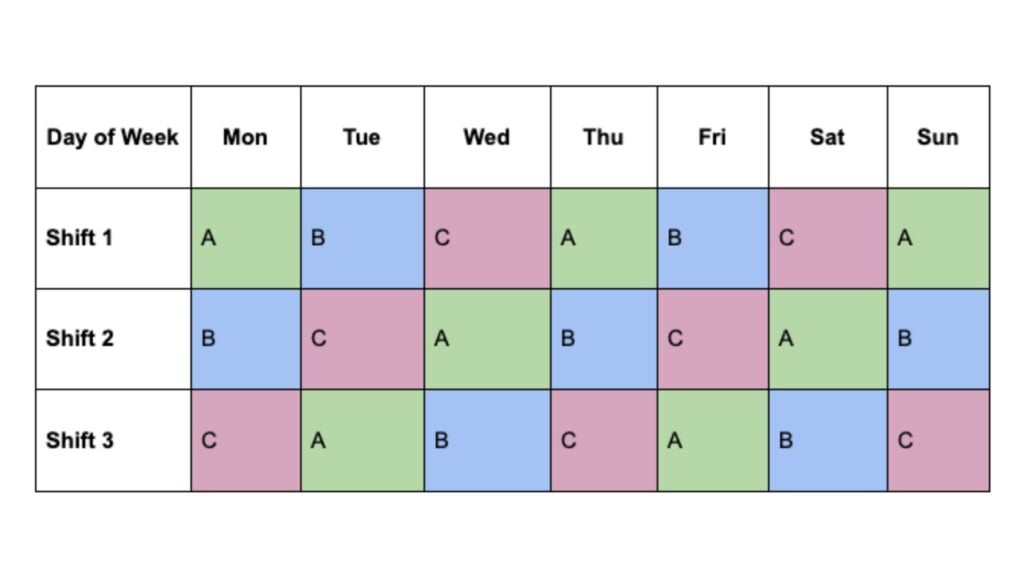
For a 24/48 schedule, firefighters work 24 hours straight, then take 48 hours off. The cycle repeats continuously, and it’s the most common career firefighter schedule in the US.
Example:
- Day 1: On duty from 8:00 am to 8:00 am the following day.
- Day 2 & 3: Off duty.
- Day 4: On duty again, and the cycle repeats.
You’ll need three platoons (A, B, and C) to keep it covered continuously.
Pros:
- A steady number of firefighters on duty every day.
- The repeating pattern makes long-term planning manageable.
- One handover per day minimizes operational disruption.
- Covering a single 24-hour absence is easier than covering a longer one.
Cons:
- Long hours result in overtime you’ll need to budget and manage carefully.
- You need real fatigue policies, especially in high-call-volume stations.
- Recovery is compressed. Two days off between shifts doesn’t fully clear a rough night.
Research points to a specific weak spot in this pattern. A 2024 study found that the lowest total sleep time consistently occurred the night before reporting for a new shift. On the 24/48, sleepiness peaked on the first afternoon of the shift. Firefighters were arriving already short on sleep, not getting worn down by the shift. That makes pre-shift rest and start times important factors to consider.
Did You Know?
48/96: Fewer Handovers, More Recovery
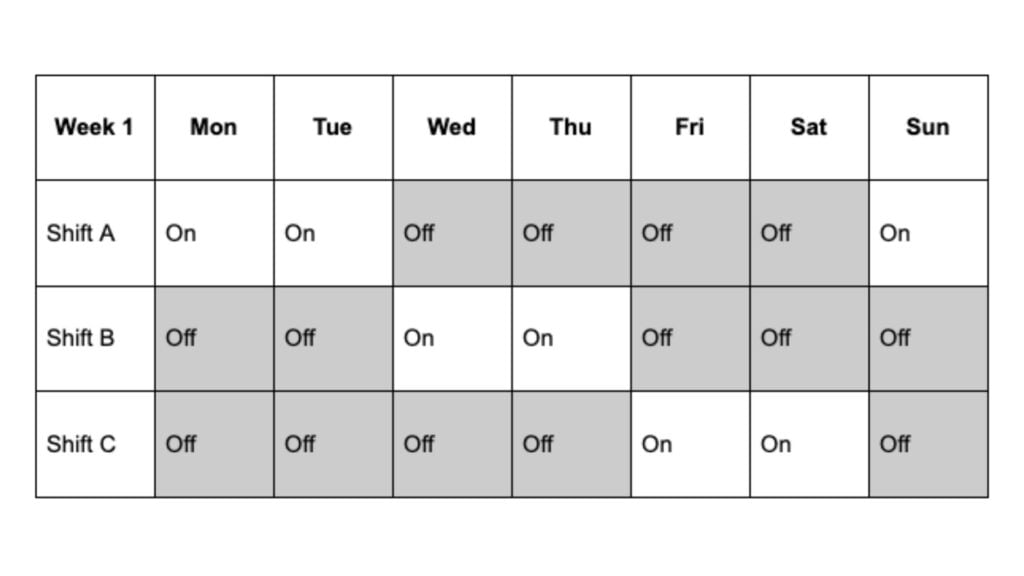
On a 48/96 schedule, firefighters work two consecutive 24-hour shifts, then take four days off.
Example:
- Day 1-3: On duty from 8:00 am on Day 1 to 8:00 am on Day 3.
- Day 3-6: Off duty before returning on Day 7.
Pros:
- Each shift delivers two full days of continuous staffing.
- Handovers drop to roughly twice a week instead of daily.
- The 96-hour break gives real recovery time and helps crews with long commutes.
- The cycle repeats predictably, simplifying long-term planning.
Cons:
- Shift swaps involve a bigger time commitment, so they’re harder to arrange.
- Managing fatigue across 48 hours takes deliberate policy, especially in busy stations.
- Covering a 48-hour gap for a sick call is harder than covering 24.
Pro Tip
24/72: The Recruiting Pitch
A 24/72 puts firefighters on duty for 24 hours followed by three full days off, averaging about 42 hours a week. It needs a fourth platoon, which is why it’s less common. That means you’re staffing more people to cover the same stations.
Departments may adopt this schedule to reduce fatigue and retain more firefighters. Palm Beach County firefighters negotiated a switch from 24/48 to 24/72 starting in January 2027. The county is hiring 148 firefighters to support the change, while researchers will track its effects on fatigue, recruitment, and retention.
Pros:
- Three consecutive days off between every shift, so recovery is rarely compressed.
- Lower average weekly hours reduce baseline overtime exposure.
- A strong recruiting and retention argument in a competitive hiring market.
Cons:
- Requires a fourth platoon, which means hiring or restructuring.
- Higher headcount cost, though partly offset by reduced overtime and turnover.
- Harder to justify to a budget office without data on your current overtime and turnover spend.
Kelly Days: Trimming Hours Without Cutting Pay
A “Kelly Day” is a scheduled day off layered onto an existing rotation to bring total hours down. It’s named for Chicago Mayor Ed Kelly, who proposed giving career firefighters extra time off to reduce their hours without cutting their pay.
There are two things people mean by “Kelly.” One is the add-on day, while the other is the full Kelly schedule: 24 on, 24 off, 24 on, 24 off, 24 on, then 96 hours off.
How Kelly Days work:
- Scheduled days off: Firefighters get a day off they’d normally be scheduled to work, on a regular but rotating basis.
- Purpose: Reduce total hours over the work period, which manages fatigue and cuts overtime costs.
- Implementation: Frequency depends on department policy and union agreements. The day off is in addition to regular days off.
Pros:
- Controls overtime by reducing each firefighter’s total hours, which is often the cheapest way to get under an FLSA threshold.
- Creates predictable extended breaks that help mental and physical recovery.
Cons:
- Requires careful planning to hold coverage without creating gaps.
- Someone has to cover the Kelly Day, which can mean temporary understaffing or calling in off-duty personnel.
- The full Kelly rotation has a sleep cost. The 24/48, 48/96, and Kelly schedules all disrupt circadian rhythms, but the Kelly schedule produces statistically worse sleep quality than the others.
1-2-1-4: Recovery-Weighted Rotation
This pattern runs a 24-hour shift, two days off, another 24-hour shift, then four days off. It averages around 42 hours a week over an eight-week cycle.
Pros:
- Never more than one 24-hour shift before a meaningful break.
- Lower average hours than a 24/48 or 48/96.
- Predictable four-day stretches for family and second-job commitments.
Cons:
- The eight-week cycle is harder to hold in your head than a three-day repeat.
- Staffing efficiency is lower, so you need more people for the same coverage.
10/14 Splits: Matching Staffing to Call Volume
Some departments split the day into a 10-hour day shift and a 14-hour night shift. Over a 28-day period, a common version runs seven 10-hour day shifts and seven 14-hour night shifts.
The reason to do this is call volume. If your daytime call load is triple your overnight load, a 24-hour pattern staffs your quietest hours the same as your busiest. A split lets you weight crews toward demand.
Pros:
- Staffing can track actual call patterns instead of averaging across the day.
- Shorter shifts are easier to cover when someone calls out.
- No overnight sleep-time complications, since nobody’s shift spans a full night.
Cons:
- Two handovers per day instead of one, doubling the readiness gaps.
- More commutes per month.
- A one-day illness is far more likely to land on a scheduled workday. A firefighter on a 10/14 pattern works about 182 days a year, so a one-day illness has roughly a 50% chance of falling on a workday. On 24-hour shifts, working about 91 days a year, the odds drop to about 25%. Both work 42-hour weeks.
8-Hour Triadic: Three Shifts, Three Handovers
The triadic system rotates three crews through 8- or 10-hour shifts covering days, evenings, and nights. It’s less common in suppression but standard for administrative and prevention divisions.
Example with 8-hour shifts:
| Shift | Week 1 | Week 2 | Week 3 |
|---|---|---|---|
| A | 7am-3pm | 3pm-11pm | 11pm-7am |
| B | 3pm-11pm | 11pm-7am | 7am-3pm |
| C | 11pm-7am | 7am-3pm | 3pm-11pm |
Pros:
- Highly customizable to departmental needs and activity patterns.
- Useful where demand varies sharply through the day.
- Covering an 8- or 10-hour absence is much easier than covering 24.
Cons:
- Running three patterns at once is complex and usually needs scheduling software.
- Keeping everyone informed across three crews is harder.
- Three handovers per day is the maximum disruption to operational readiness.
- Rotating through nights every three weeks carries real risk. Research on 352 firefighters found that across 3-day, 6-day, 9-day, and 21-day rotations, neurocognitive function dropped significantly the day after night work, affecting memory, attention, psychomotor speed, and motor speed.
Did You Know?
California Swing Shift: Two Patterns, One Name
There are two different schedules that use this name, so check which one someone means.
The version most firefighters describe is a 24-hour pattern: 24 on, one day off, 24 on, one day off, 24 on, then four days off.
The IAFF defines the California swing shift differently: four consecutive days on, three off, rotating among day, swing, and night shifts across a 21-day cycle. Both exist. The 24-hour version is more common in fire suppression, while the rotating version shows up more in agencies that split coverage into shorter shifts.
What Sleep Research Actually Says
Departments argue about schedules as if one pattern will fix fatigue. The research doesn’t support that. What it does show is where the risk concentrates, which is more useful.
Firefighters aren’t unusually sleepy compared to other shift workers, but they’re chronically short on sleep. The IAFF cites survey data showing 60% of firefighters get only short bursts of sleep, and 40% report feeling excessively fatigued. A national sample found nearly 40% of firefighters had at least one sleep disorder: insomnia, shift work disorder, or sleep apnea.
The performance cost is measurable. Cognitive function starts declining after 16 hours awake, and by 24 hours without sleep it resembles intoxication.
NWCG describes cumulative fatigue as fatigue that normal rest doesn’t resolve, and notes it slows reaction time, narrows attention, limits short-term memory, and impairs judgment. In EMS, workers who reported fatigue were 1.5 times more likely to report errors and adverse outcomes and more than twice as likely to report on-duty injuries.
Pro Tip
It’s worth mentioning that there is no national standard that mandates firefighter sleep on shift. Every rest policy is departmental. Common examples include no beds before 8:00 am, lights out at 10:00 pm, and giving company officers authority to approve extra sleep after a heavy night. If you don’t write those rules, nobody has them.
What Bad Scheduling Actually Costs
Fatigue isn’t just a wellness concern. Here’s how it shows up in four budget lines:
Line 1: Firefighter lives and cardiac risk
NFPA reported 83 firefighter fatalities in 2025, up from 69 the year before. Heart attacks were the single largest cause of on-duty deaths at 27 fatalities, 42% of the total. Overexertion or strain caused 45% of on-duty fatalities, and all but four of those were heart attacks. One case in that report was a career firefighter who suffered a heart attack after a 48-hour shift that included strenuous physical activity.
The health risks can build over time. Research cited by the IAFF found that cardiovascular disease risk increases by about 7.1% for every five years of shift work. Night shift work has also been linked to several cancers. In other words, regularly assigning firefighters more overnight shifts may add to their long-term health risks.
Line 2: Injuries and lost time
Fatigue can also increase the risk of injury. Of the 53,575 firefighter injuries recorded in 2024, 9,100 led to missed work. Strains and sprains made up 43% of fireground injuries and 63% of training injuries, while overexertion was the leading cause of fireground injuries.
The drive home also creates an added risk. In 2025, 16 firefighters died while responding to or returning from calls, up from six in 2024. Because firefighters may be especially tired after a 48-hour tour, departments should treat release times and post-shift travel as safety issues, not just administrative details.
Line 3: Overtime and staffing cost
Many chiefs overlook how your FLSA work period can change how much overtime pay you owe. Say a firefighter works 80 hours, 80 hours, 52 hours, and then zero over four weeks. Under a 28-day work period, the total is 212 hours, so no overtime is due. With a 14-day work period, the first two weeks alone create 54 overtime hours. The hours and coverage are identical, but the cost is very different.
Shorter workweeks can improve firefighters’ schedules, but departments still need to cover the same shifts. That usually means hiring more firefighters, paying more overtime, or combining both.
Line 4: Sick leave, turnover, and recruiting
Schedule design can affect how often firefighters use sick leave. Two firefighters may both average 42 hours a week, but one working a 10/14 pattern may report for duty about 182 days a year, compared with roughly 91 days for someone working 24-hour shifts. Fewer scheduled workdays mean an illness is less likely to fall on a shift and medical appointments are easier to schedule.
Schedules also affect recruitment and retention. With departments competing for the same candidates, more recovery time and fewer commutes can make a position more attractive. Volunteer departments should also clearly explain the time commitment and support retention through mentorship and family involvement.
Did You Know?
FLSA and State Rules That Shape Your Schedule
Compliance sets the parameters of what you can schedule. Here’s what to keep in mind:
The Section 7(k) work period
Most fire departments pay overtime under FLSA Section 7(k) rather than the standard 40-hour workweek. It lets you set a recurring work period between 7 and 28 consecutive days and pay overtime based on hours above a threshold for that period. Because firefighter schedules don’t align to seven-day weeks, this is what makes them workable.
But the work period has to be an established, regularly recurring block, and once you set it, it stays fixed. It doesn’t have to match your duty cycle or your pay period. You can change it, but only permanently and not as a way to dodge overtime.
Here are the thresholds for fire protection employees:
| Work period (days) | Overtime after (hours) |
|---|---|
| 28 | 212 |
| 27 | 204 |
| 26 | 197 |
| 24 | 182 |
| 21 | 159 |
| 18 | 136 |
| 14 | 106 |
| 7 | 53 |
The ratio is about 7.57 hours per day. A 28-day period gives you the most room to balance heavy and light weeks against each other.
Two other FLSA rules may apply:
- Fire departments with fewer than five fire protection employees in a workweek may be exempt from FLSA overtime requirements under Section 13(b)(20).
- Departments may offer 1.5 hours of compensatory time for each overtime hour instead of cash. Firefighters can bank up to 480 hours, and requests to use that time generally must be approved unless doing so would seriously disrupt operations.
Sleep and meal time on 24-hour shifts
Under 29 CFR 553.222, sleep time cannot be excluded from hours worked on a tour of duty of less than 24 hours, and it can’t be excluded on a shift of exactly 24 hours either. Unlike the general FLSA sleep-time rules, firefighters must be paid for all 24 hours of a standard 24-hour shift.
Sleep time can be unpaid only on shifts longer than 24 hours, and only when the department and firefighter have an agreement. Even then, no more than eight hours of sleep can be excluded. If calls prevent the firefighter from getting at least five hours of sleep, the entire sleep period must be paid.
Meal breaks also need to be paid when firefighters are required to remain at the station during shifts of 24 hours or less.
Pro Tip
State rules and staffing standards
States layer their own limits on top.
Oregon is a good example of why you have to read the actual statute: ORS 652.060 caps firefighters at 72 hours a week only in departments employing three or fewer full-time firefighters. Departments with four or more are capped at 56 hours a week, averaged over each quarter of the fiscal year.
A 2019 Oregon Court of Appeals decision also held that the cap applies to a department’s firefighters collectively, not to each individual. If hours are shortened by the statute, total wages can’t be cut for that reason.
For staffing and deployment, the national reference point has also changed. NFPA 1710 for career departments and NFPA 1720 for volunteer departments have been combined into NFPA 1750. The 2026 edition took effect on December 9, 2025, making the 2020 editions the last stand-alone versions of 1710 and 1720.
Other standards were reorganized too. Firefighter health and safety guidance moved to NFPA 1550, while occupational health, wellness, and on-scene rehabilitation guidance moved to NFPA 1580. Check and update any SOPs that still reference NFPA 1710, 1720, 1500, or 1584.
This is general information, not legal guidance, so consult a qualified professional about the requirements that apply to your department.
Best Practices for Managing Firefighter Schedules
Here are some practical tips to help you manage your firefighting schedule most effectively:
- Match your work period to your rotation before you build the schedule. Choose the FLSA work period length that gives you the most room to balance heavy and light stretches, then design the rotation inside it. Doing this backwards is how departments end up paying overtime they didn’t need to.
- Staff to a standard, not to a budget line. Use NFPA 1750 as your deployment reference and document where you fall short. That documentation is what funds future positions.
- Build a callback plan before you need one. Many departments recall off-duty firefighters for major incidents, and some maintain reserve rosters.
- Write a real rest policy. Since no national standard covers on-shift sleep, yours is the only one. Cover protected quiet hours, tactical napping, when officers can authorize extra sleep, and post-shift release for long shifts. The US Fire Administration recommends monitored rest periods as part of departmental risk management.
- Plan for seasonal leave demand. Summers, weekends, and holidays can build up. An annual leave bidding process, where firefighters submit vacation requests early and receive them by seniority or another agreed system, handles this more fairly than first-come-first-served.
- Distribute overtime by clear rule. Rotate opportunities equitably among eligible firefighters and keep the record visible so nobody has to ask why someone else got the call.
- Make shift trades easy but bounded. Create a clear request and approval process for shift swaps, and set rules that stop swaps from stacking into excessive consecutive hours. Note that departments on 24/48 schedules see far more schedule changes from leave and trades than departments on 48/96, just because taking a single day off is easier than taking two.
- Publish schedule changes to one place. Use a single channel so nobody works from a stale version. Team chats with read receipts tell you who’s actually seen a change.
- Ask your crews what’s working. Collect scheduling feedback regularly. Firefighters know which stations run hot at night and which rotations wear people down, and that information rarely reaches administration on its own.
- Give real notice on changes. For major overhauls, phase the transition and expect resistance. Tell people upfront so early friction doesn’t kill the change.
How to Change Your Schedule Without Losing the Crew
Here’s how to gradually introduce a new shift pattern to your department:
- Start with your own numbers. Pull twelve months of call volume by hour of day, overtime hours by station, sick leave usage, and turnover. You need a baseline to argue from and to measure against later.
- Model the cost both ways. Calculate total hours and overtime under your current pattern and the proposed one, using the same FLSA work period. If the new pattern needs a fourth platoon, model hiring cost against reduced overtime and turnover.
- Bring the union in early. Shift length is usually a bargaining item, and it’s a local decision by design.
- Run a pilot if you can. One or two stations for three to six months gives you real data.
- Set the pattern up once. Build the rotation as a reusable template rather than rebuilding it monthly. This is where scheduling software earns its cost on a 28-day cycle.
- Measure the same things you measured at baseline. Overtime hours, sick leave, injury reports, turnover, and crew feedback. Without the comparison you’ll be arguing about the change from opinion.
The Bottom Line on Firefighter Schedule Management
There’s no best firefighter schedule, only the one that fits your call volume, budget, and crews. High-volume stations need more recovery between shifts than a 48/96 provides; low-volume departments with long commutes usually gain from it, and the FLSA work period you pick will shape your overtime bill more than the rotation itself.
Use the information above to narrow your options, then build the pattern once in fire department scheduling software and let it run. See how Connecteam can help—try it for free today.