


Employee time theft can look obvious, such as one worker clocking in for another. More often, it shows up in smaller ways: someone records time before reaching the job site, leaves early without clocking out, adds unworked time to a timesheet, or takes a longer break than they record.
Those small gaps can create a bigger problem for the business. Managers spend time correcting timesheets, checking schedules and messages, and chasing employees for missing details before payroll can move forward.
Connecteam analyzed anonymized sales conversations with 500 companies that discussed employee time theft, inaccurate hours, or attendance controls. The findings show the most common problems these companies raised and the controls they were looking for.
Methodology note: This analysis covers anonymized conversations with 500 companies between May 6 and August 6, 2026. The companies were included because they discussed time theft, inaccurate hours, or attendance controls, so these percentages describe this sample rather than employers generally. The 51%, 30%, and 19% top-level classifications are mutually exclusive; other issue percentages can overlap because companies could receive multiple tags. Read the full methodology below.
Key Employee Time Theft Statistics at a Glance
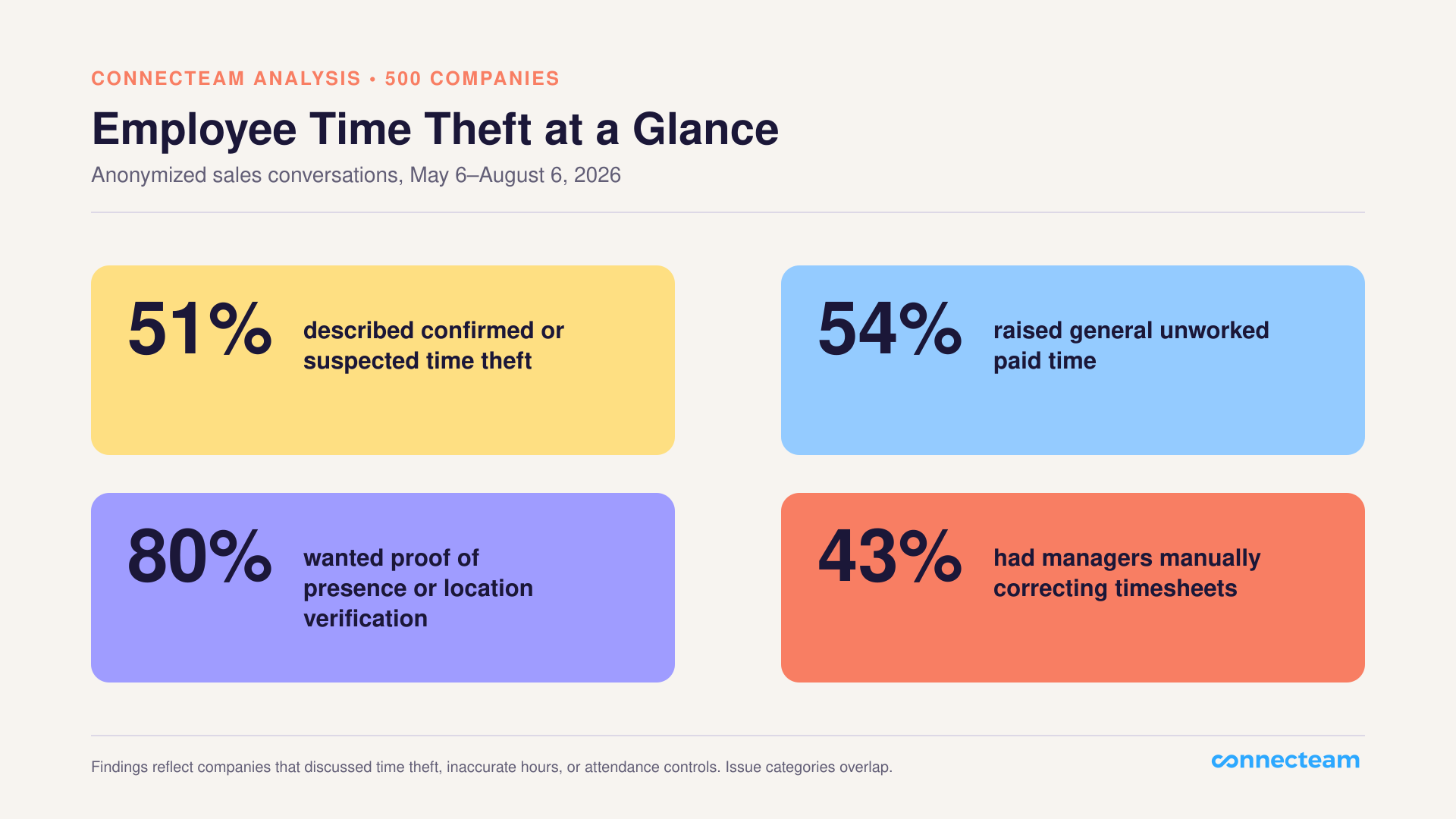
- 51% of companies reported deliberate employee time theft or suspected it was happening.
- 54% raised general unworked paid time.
- 80% wanted proof-of-presence or location verification.
- 43% had managers manually correcting timesheets.
- 39% reported missed or forgotten punches.
- 35% reported incorrect, incomplete, or duplicate time entries.
- 32% had managers checking schedules, CCTV, messages, or other records to verify hours.
- 29% reported offsite or false-location punches.
- 26% had managers chasing employees for their hours.
- 22% reported early clock-ins or late clock-outs.
- 20% reported timesheet padding or falsification.
- 15% reported buddy punching.
- 11% reported overpayment, underpayment, or pay disputes caused by inaccurate hours.
How Common Was Employee Time Theft in This Sample?
51% reported or suspected employee time theft
Just over half of the companies in the analysis, 255 out of 500, reported deliberate time theft or suspected that it was happening.
This classification applied when a company representative described employees claiming time they did not work or suspected that this was happening. The concerns included employees clocking in from home, adding hours to timesheets, leaving early, backdating entries, and clocking in for coworkers.
The other companies were not necessarily free of timekeeping problems. Thirty percent described inaccurate records without alleging deliberate misuse, while 19% wanted stronger attendance controls as a preventive measure.
Business takeaway: Employee time theft was a real concern for many companies discussing timekeeping. But businesses also need a process that separates suspected misuse from an honest missed punch or recording mistake.
54% raised general unworked paid time
General unworked paid time was the broadest issue in the analysis, raised by 270 companies.
This finding covers several different situations: employees recording extra time, clocking in before work starts, staying clocked in after leaving, or claiming hours that do not match the work completed. It overlaps with the more specific behaviors below, so these percentages should not be added together.
For a small business, a few extra minutes may not seem urgent. But when inaccurate paid time happens every day across several employees, locations, or payroll periods, it can raise labor costs and make it harder to trust the numbers in the timesheet.
Business takeaway: The main risk is paying for hours that do not match the work actually performed.
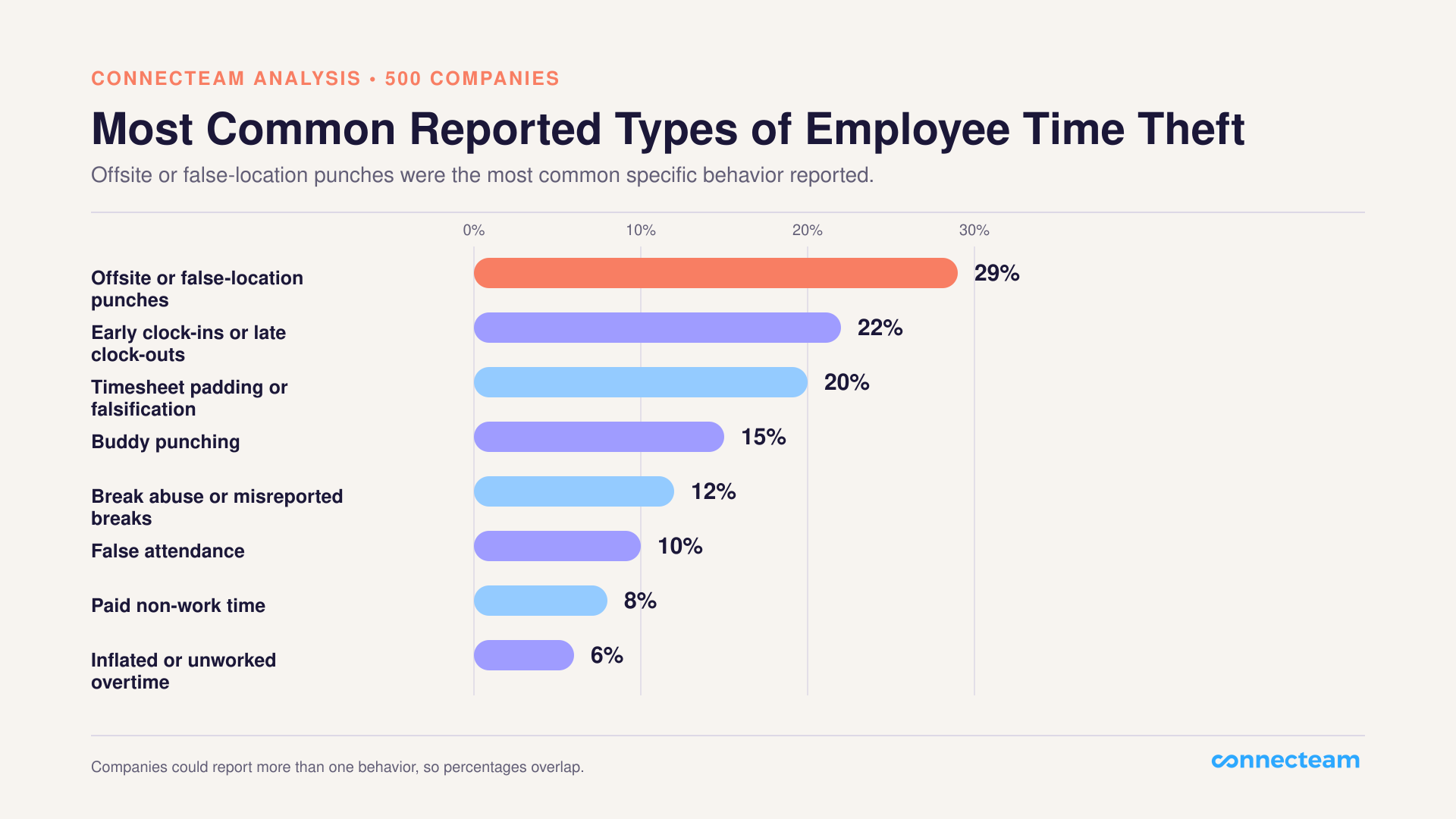
The Most Common Reported Types of Employee Time Theft
The following behaviors appeared most often among the 500 companies. A company could report more than one behavior.
| Time-theft behavior | Companies | Share of companies |
| Offsite or false-location punches | 145 | 29% |
| Early clock-ins or late clock-outs | 110 | 22% |
| Timesheet padding or falsification | 100 | 20% |
| Buddy punching | 75 | 15% |
| Break abuse or misreported breaks | 60 | 12% |
| False attendance | 48 | 10% |
| Paid non-work time | 40 | 8% |
| Inflated or unworked overtime | 32 | 6% |
29% reported off-site or false-location punches
Offsite or false-location punches were the most common specific time-theft behavior in the analysis. One hundred forty-five companies, or 29%, described employees clocking in from home, from a vehicle, before reaching the job site, or remaining clocked in after leaving.
This is especially difficult for field teams, cleaners, contractors, service workers, and multi-site businesses. Managers cannot be at every location when a shift begins or ends. Without a clear attendance record, they may only discover the problem after reviewing payroll, checking another system, or hearing from a client.
Business takeaway: A clock-in time alone does not show whether an employee was at the right place when the recorded time began.
22% reported early clock-ins or late clock-outs
One hundred ten companies reported early or late punches they described as unworked or falsely recorded time.
The behavior can take several forms. An employee may start the clock from the parking lot, enter a scheduled start time after arriving late, leave before the end of a shift, or stay clocked in after work is done. Each instance may be small, but repeated extra minutes can add up across a week.
This issue also creates friction for managers. They need to decide whether the recorded time reflects the actual start and finish of work, then correct the timesheet if it does not.
Business takeaway: Early or late punches should be reviewed against the work actually performed rather than treated as time theft automatically.
20% reported timesheet padding or falsification
Timesheet padding or falsification was reported by 100 companies.
Companies described employees adding unworked hours, rounding time up, backdating entries, or claiming the full scheduled shift despite arriving late or leaving early. These problems are harder to spot when employees submit hours manually or when managers do not have a clear record of changes.
A good review process should not require a manager to remember every employee’s schedule or search through texts to understand why an entry changed.
Business takeaway: Timesheet edits should be visible. Managers need to see what changed, who changed it, and when.
15% reported buddy punching
Seventy-five companies reported buddy punching, where one employee clocks in or out for another employee.
This can happen when workers share access codes, use a shared device without individual identification, or ask a coworker to record a punch on their behalf. Buddy punching is a familiar time-theft problem, but it was less common in this analysis than false-location punches, early clock-ins, and timesheet padding.
Business takeaway: Shared clock-in methods need clear individual identification controls so each time entry can be connected to the right employee.
Other reported time-theft behaviors
Several other behaviors appeared less often but still created payroll and attendance problems.
| Behavior | What it can look like | Share of companies |
| Break abuse or misreported breaks | Taking a longer break than recorded | 12% |
| False attendance | Claiming to be present when not working | 10% |
| Paid non-work time | Being paid while not performing assigned work | 8% |
| Inflated or unworked overtime | Claiming overtime that was not worked or approved | 6% |
These behaviors can overlap with the broader unworked-time finding. For example, an employee who takes an unrecorded extended break may also remain clocked in after leaving a job site.
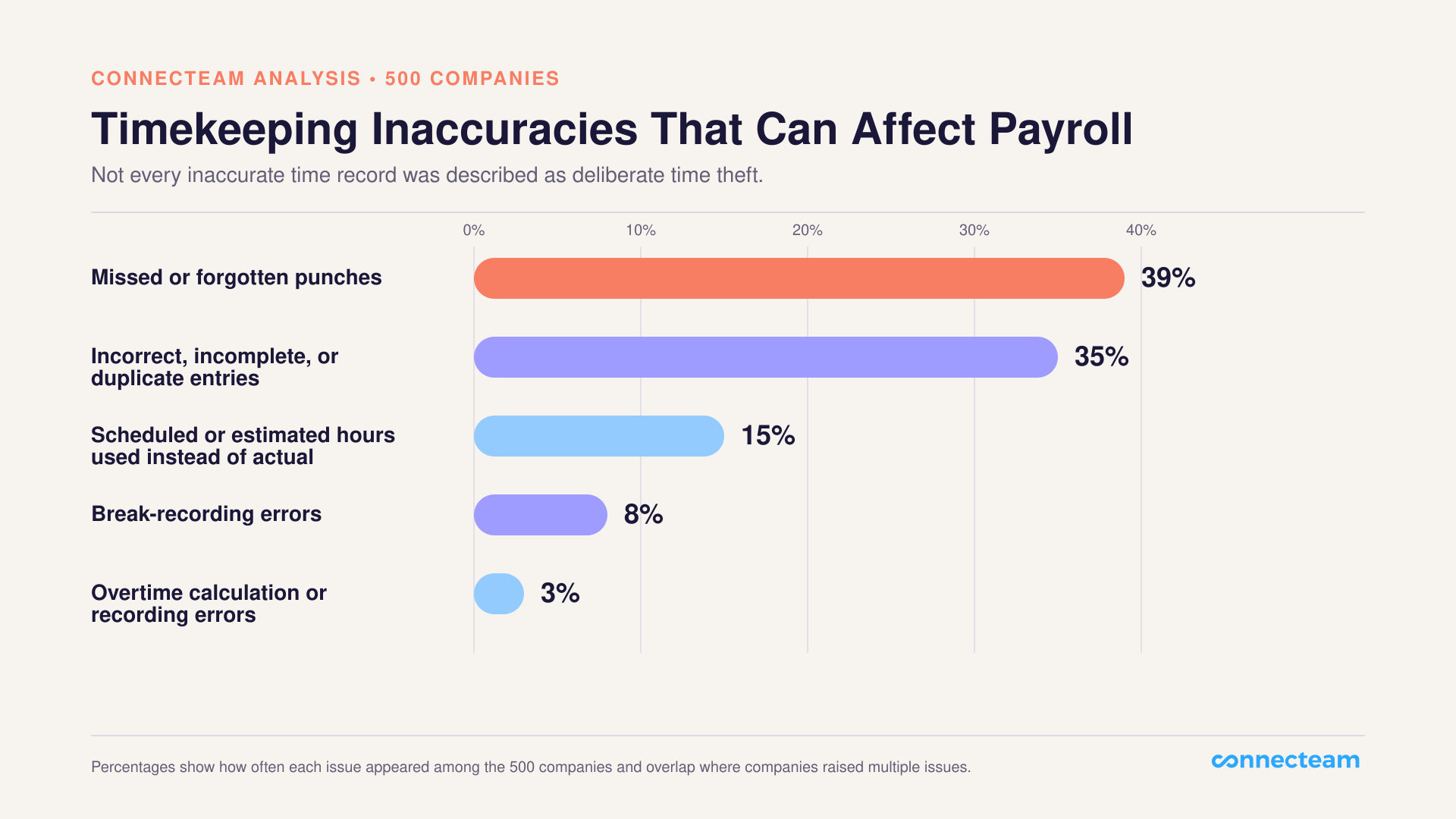
Timekeeping Inaccuracies That Can Affect Payroll
Not every inaccurate time record is time theft. In fact, 150 companies, or 30%, described timekeeping inaccuracies without alleging deliberate misuse.
These errors still matter. A missed punch, duplicate entry, or incorrect overtime record can delay payroll, lead to a pay dispute, and create extra work for managers.
39% reported missed or forgotten punches
Missed or forgotten punches were the most common discrete timekeeping inaccuracy, reported by 195 companies.
Employees may forget to clock in when a shift starts, forget to clock out at the end of the day, or miss a break entry. When that happens, managers often need to ask employees for the correct time, compare it with the schedule, and make a manual correction.
For a small team, that may feel manageable. For a shift-based or multi-location business, it can become a regular payroll bottleneck.
Business takeaway: Missed punches are often a process problem, not an employee-discipline problem. Reminders and a simple correction workflow can reduce the cleanup work.
35% reported incorrect, incomplete, or duplicate time entries
Incorrect, incomplete, or duplicate entries were reported by 175 companies.
These issues can start with a simple mistake, but disconnected records make them worse. A manager may have a paper timesheet, a text message, a spreadsheet, and a payroll system that all show different hours. The business then has to decide which record is correct.
This problem is common when time tracking still depends on manual data entry, copied schedules, or several systems that do not share the same information.
Business takeaway: Businesses need one clear record of employee time from clock-in through approval and payroll preparation.
15% used scheduled or estimated hours instead of actual hours
Seventy-five companies said they used scheduled or estimated hours instead of actual hours worked.
A schedule is useful for planning labor. It does not show whether an employee arrived on time, worked the full shift, took an unrecorded break, or stayed late. Using the schedule as the payroll record can lead to overpayment when someone works less than planned and underpayment when someone works more.
Business takeaway: Schedules show what should happen. Approved timesheets should show what actually happened.
Other timekeeping inaccuracies
| Inaccuracy | Share of companies |
| Break-recording errors not described as deliberate | 8% |
| Overtime calculation or recording errors | 3% |
Breaks and overtime can create payroll risk even when no one is trying to misuse the system. Businesses need clear records of breaks taken, hours worked, and overtime rules applied.
The Management Work Created by Inaccurate Employee Hours
Time theft and timekeeping errors do not end when the shift ends. They create a second job for managers and payroll teams.
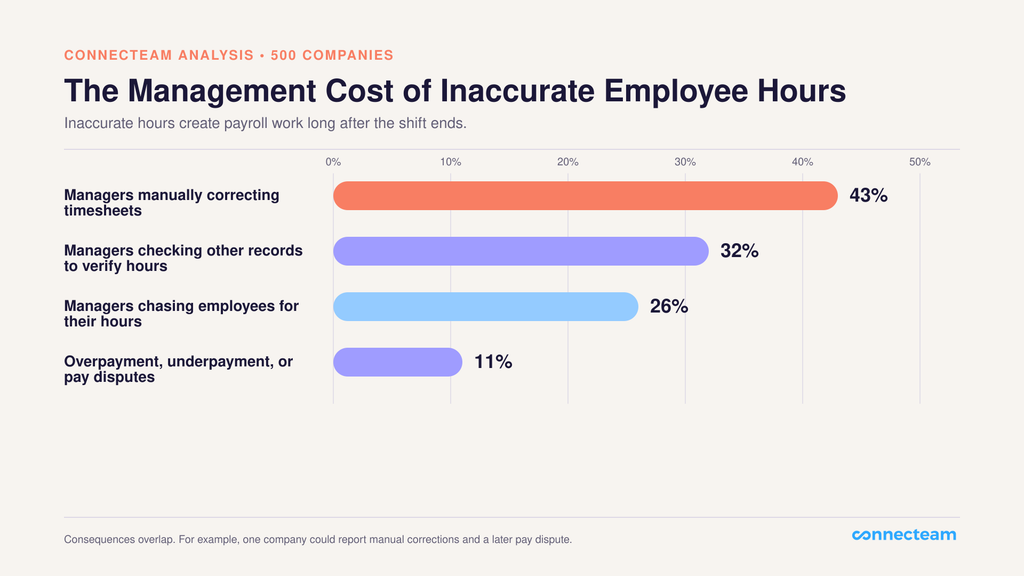
Caption: Inaccurate employee hours often turn into manager cleanup work before payroll, with 43% of companies manually correcting timesheets.
Alt text: Horizontal bar chart of management and payroll consequences among 500 companies: manual timesheet corrections 43%, checking other records to verify hours 32%, chasing employees for hours 26%, and overpayment, underpayment, or pay disputes 11%.
| Management or payroll consequence | Companies | Share of companies |
| Managers manually correcting timesheets | 215 | 43% |
| Managers checking other records to verify hours | 160 | 32% |
| Managers chasing employees for their hours | 130 | 26% |
| Overpayment, underpayment, or pay disputes | 55 | 11% |
43% had managers manually correcting timesheets
Manual timesheet corrections were one of the most common operational problems in the analysis. Two hundred fifteen companies said managers had to fix time records.
Those corrections can include missed punches, wrong start or finish times, unrecorded breaks, duplicate entries, and changes to employee-submitted hours. The work is repetitive, and it often happens right before payroll, when managers already have less time to investigate.
Business takeaway: Inaccurate time can cost businesses through unworked paid hours and the manager time spent fixing records.
32% checked schedules, CCTV, messages, or other records to verify hours
One hundred sixty companies described managers checking other sources to confirm employee hours.
The records used included schedules, paper timesheets, CCTV, GPS data, text messages, and conversations with other employees. This kind of verification is slow because managers are trying to reconstruct a shift after the fact.
It also means payroll accuracy depends on scattered records and memory instead of a single timekeeping process.
Business takeaway: The best time to flag an exception is during or soon after the shift, not at the end of the pay period.
26% chased employees for their hours
Managers at 130 companies had to chase employees for missing or unclear time details.
They asked employees when they arrived, when they left, whether they took a break, or why their hours did not match the schedule. This follow-up can delay timesheet approval and create tension when employees disagree with the corrected record.
Business takeaway: Employees should have a simple way to review and complete their time records before managers have to follow up.
11% reported pay errors or pay disputes
Fifty-five companies explicitly described overpayment, underpayment, unpaid overtime, or another pay dispute caused by inaccurate hours.
Pay disputes can come from intentional time theft, but they can also come from ordinary mistakes. An employee may believe they worked late, picked up an extra shift, or forgot to record a punch. Without a clear approved record, the business has to investigate the disagreement after payroll questions arise.
Business takeaway: Clear, approved time records help businesses pay employees correctly and give employees a better way to understand their pay.
80% Wanted Better Proof of Employee Presence or Location
Proof-of-presence or location verification was the largest issue finding in the analysis. Four hundred of the 500 companies wanted a better way to verify that employees were in the right place when they recorded time.
This does not mean every company suspected time theft. Some were looking for preventive controls. But the finding shows that a timestamp was not enough for many businesses, especially those with field workers, client locations, mobile teams, or several sites.
Companies discussed a need for controls such as:
- GPS location stamps at clock-in and clock-out
- Job-site geofencing
- Individual employee access
- Shared kiosk access with employee identification
- Clock-in rules tied to scheduled shifts
- Planned-versus-actual hour comparisons
- Attendance alerts and reminders
- Timesheet approvals and audit records
Business takeaway: The goal is not to assume every employee is dishonest. It is to create a clear record of when and where time was recorded, so managers can review exceptions before payroll.
What These Statistics Mean for Business Owners
The companies in this analysis were dealing with different symptoms, but the practical fixes are similar.
Set clear procedures for recording work time
Employees need clear procedures for recording all time they work, including early starts, late finishes, breaks, and corrections. Clear procedures make it easier to identify exceptions and review them fairly while following applicable wage-and-hour rules.
Capture actual hours, not just scheduled hours
A schedule is a plan. Payroll needs a reviewed record of actual time worked, including changes, breaks, and overtime.
Catch exceptions while the details are fresh
Missed punches, unusual clock-in locations, long shifts, and overtime changes are easier to review during the shift or soon after it ends. Waiting until payroll makes the process slower and less reliable.
Keep corrections visible
Managers and employees should be able to see when a timesheet entry changes. A clear audit record helps reduce confusion and creates a fairer approval process.
How Connecteam Can Help You Track Employee Time More Accurately
The companies in this analysis had one problem in common: their managers were trying to verify hours after the shift had ended. That meant checking CCTV, messages, schedules, paper records, or asking employees what happened.
Connecteam gives teams one place to capture and review employee time. With the Employee Time Clock, employees can clock in from a phone or shared kiosk instead of relying on paper timesheets, spreadsheets, or text messages.
For teams that work across sites, GPS tracking and job-site geofencing can help managers verify where a shift started. When an employee starts at a client location, store, job site, or field assignment, that location is attached to the time record.
Managers can review missed punches, compare scheduled and actual hours, check timesheet edits, and approve the final record before payroll. Connecteam then creates payroll-ready time data for export or supported payroll integrations.
At payroll review, managers can see the recorded hours, the location of relevant clock-ins, and any changes to the timesheet without reconstructing the shift from other records.
See how Connecteam can help your team track time more accurately. Try Connecteam now.
Methodology
Connecteam analyzed anonymized sales conversations with 500 unique companies between May 6 and August 6, 2026.
A company was included when a company representative discussed one or more of the following:
- Reported or suspected employee time theft
- A specific type of time theft
- A timekeeping inaccuracy that could affect pay
- A need to prevent or detect inaccurate or unworked paid time
Each company received one top-level classification:
- Reported or suspected time theft
- Timekeeping inaccuracies only
- Prevention or control only
Companies could receive multiple issue tags. For example, one company could report missed punches, manual timesheet corrections, and a need for location verification. For that reason, issue percentages overlap and should not be added together.
“Reported” means a company representative described the behavior as happening. “Suspected” means a company representative raised concern that it may be happening.
The analysis used anonymized conversation data. This article does not identify companies, employees, company representatives, locations, or other potentially identifying details.
These findings show trends among companies discussing time theft or timekeeping with Connecteam. They are not a nationally representative survey of all employers, and they reflect company-reported concerns rather than independently verified incidents or financial losses.