
Small business owners are heading into 2026 with a familiar challenge: finding ways to grow while costs rise, hiring stays difficult, compliance gets more complicated, and customers expect faster, better service.
That pressure matters because small businesses are not a small part of the economy. According to the SBA Office of Advocacy, the U.S. has 36.2 million small businesses, representing 99.9% of all businesses. They employ 62.3 million people, or 45.9% of private-sector workers, and generate 43.5% of GDP.

The businesses that perform best in 2026 will be the ones that turn that pressure into better systems: tighter scheduling, clearer communication, faster cash flow, smarter use of AI, stronger employee retention, and less manual admin work.
Here are the small business trends that will define success in 2026, and what business owners should actually do about them.
Key Takeaways
- Operational visibility will separate stronger small businesses from overwhelmed ones. Owners need clearer ways to track labor costs, schedules, tasks, documentation, and manager workload before small issues become expensive.
- Labor pressure will make retention a business priority. Hiring will remain difficult, so businesses will need better scheduling, communication, onboarding, and training systems to keep good employees.
- AI will only matter when it removes real work. The most useful AI use cases will be tied to repeatable workflows like job descriptions, employee updates, training materials, customer messages, and planning.
- Compliance and documentation will become harder to manage manually. Small businesses will need more consistent ways to track time, store employee documents, manage leave requests, document incidents, and share policies.
- Manager overload will become a growth barrier. Businesses that reduce scattered tools, texts, spreadsheets, and paper processes will be better positioned to protect margins, support employees, and deliver consistent service.
1. Profitability will depend on operational control
Inflation is still the challenge small business owners cannot ignore. In the U.S. Chamber of Commerce’s Q1 2026 Small Business Index, 53% of small business owners named inflation as their biggest challenge, while only 28% said the U.S. economy was in good health.
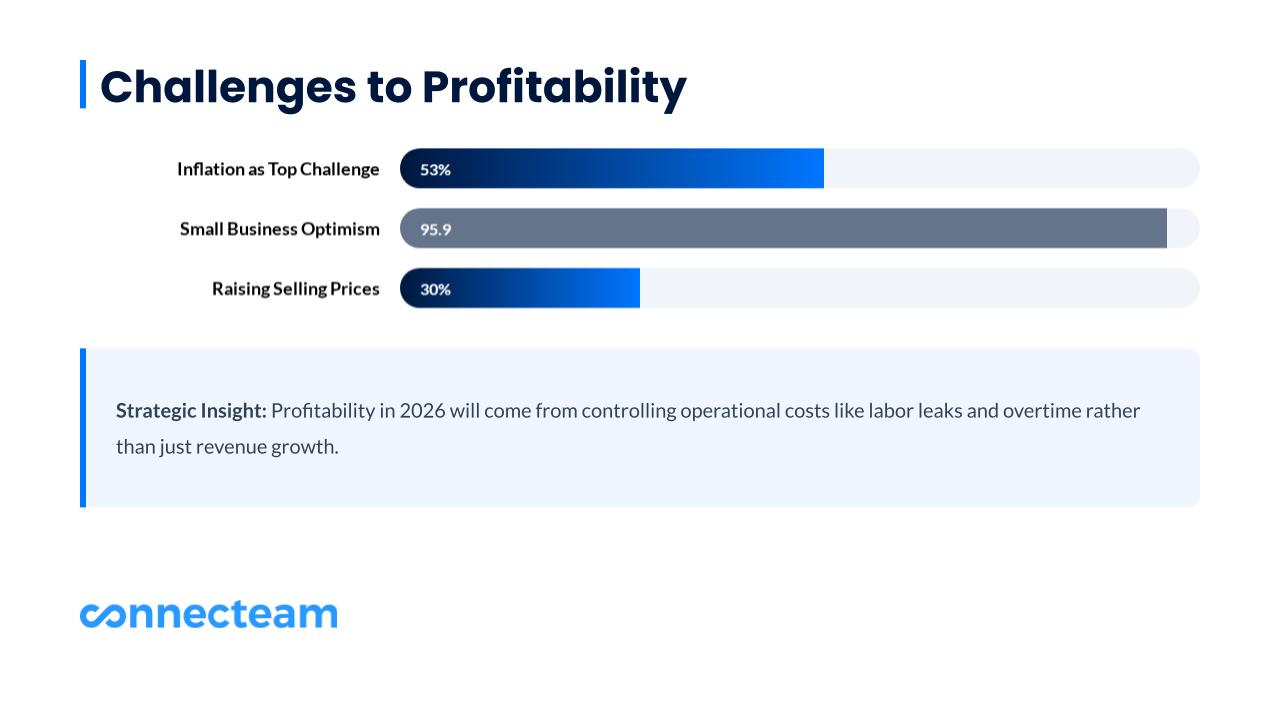
NFIB data tells the same story from another angle. Its April 2026 Small Business Optimism Index came in at 95.9, below its 52-year average of 98.0, and 30% of owners reported raising average selling prices, more than double the historical average of 13%.
For business owners, this means profitability in 2026 will come down to control. Sales still matter, but revenue growth can hide serious problems if labor costs, overtime, supplier prices, rework, missed shifts, and admin hours keep rising in the background.
The practical move is to review margins more often and with more detail. A yearly financial review is too slow for today’s environment. Owners should look at margin by service, location, job type, product line, or customer segment every month. The goal is to see where profit is leaking before the business is forced into rushed price increases.
A good 2026 margin review should answer:
- Which services or jobs are taking more labor hours than expected?
- Where are managers relying on overtime to cover poor scheduling?
- Which suppliers raised prices, and which increases were passed on?
- Which customers or locations create the most rework?
- Which manual processes are taking paid employee time away from revenue-producing work?
Price increases may still be necessary, but the strongest businesses will know exactly why prices are changing and where costs can be reduced first.
For businesses with hourly, mobile, or shift-based teams, labor is one of the first places profit can slip away. A missed clock-in, last-minute schedule change, unnecessary overtime, or slow timesheet approval might not seem like much in the moment. But over time, those small gaps can add up fast.
Pro Tip
Connecteam helps owners and managers stay closer to those costs by bringing employee scheduling, time tracking, attendance, time-off requests, and timesheet approvals into one easy-to-use app. Instead of waiting until payroll to spot a problem, you can see what is happening in real time and make better decisions before small issues turn into expensive ones.
Bottom line for owners: Profitability will come from knowing the numbers behind the work, not just checking the bank balance at the end of the month.
2. Labor shortages will turn retention into a growth strategy
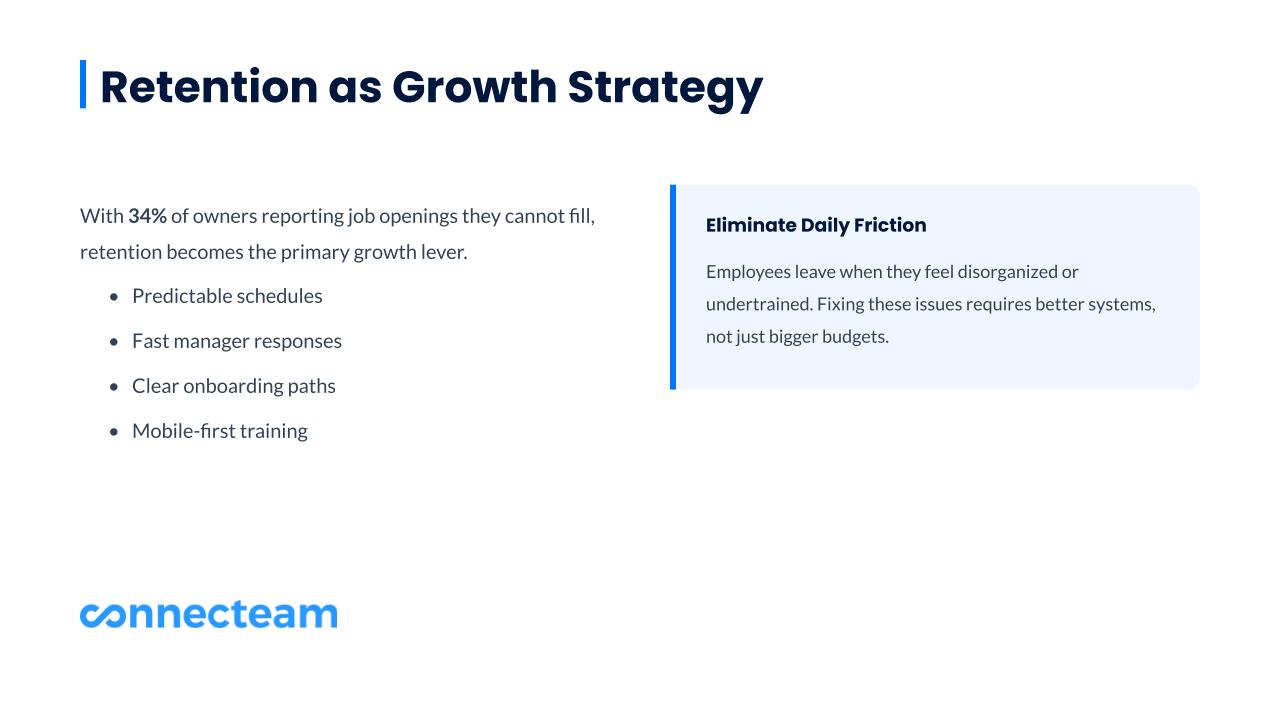
Hiring is still difficult, especially for businesses that rely on hourly, field, shift-based, or frontline workers. NFIB reported that 34% of small business owners had job openings they could not fill in April 2026, above the historical average of 24%. Among owners hiring or trying to hire, 46% reported few or no qualified applicants.
This changes the way owners should think about growth. In 2026, the question is not only “How do we hire more people?” It is “How do we get more consistent output from the team we already have?”
That starts with retention. Losing an experienced employee is expensive because the cost is not limited to recruiting. It also includes lost productivity, manager time, schedule disruption, service mistakes, customer frustration, and slower onboarding for the replacement.
Owners should focus on the parts of the employee experience that directly affect whether workers stay:
- Predictable schedules where possible
- Fast answers from managers
- Clear task expectations
- Better onboarding during the first 30 days
- Recognition for reliable work
- Simple ways to request time off or swap shifts
- Training that is easy to access from a phone
The businesses that win on retention usually remove daily friction. Employees leave when they feel disorganized, ignored, undertrained, or constantly surprised by schedule changes. Fixing those issues does not always require a bigger budget. It requires better systems.
For frontline employees, that friction often shows up in simple but frustrating ways: not knowing when they work, missing important updates, waiting for a manager to answer, or starting a shift without clear instructions. When that happens day after day, it affects more than productivity. It affects whether good employees want to stay.
Pro Tip
Connecteam gives employees one place to check their schedule, get updates, chat with managers, access training, submit forms, and find the information they need to do the job right. With a built-in employee communication app, owners can reduce missed messages, make onboarding smoother, and create a more consistent employee experience across every shift, location, and team.
Bottom line for owners: In a tight labor market, retention is not an HR project. It is a business protection strategy.
3. AI will become useful when it is tied to real workflows
AI is no longer just a future trend for small businesses. The Federal Reserve’s 2026 Small Business Credit Survey found that 46% of small employer firms are already using AI in some way, while another 15% plan to start using it within 12 months. The most common uses are writing and marketing, productivity, planning, and analysis.
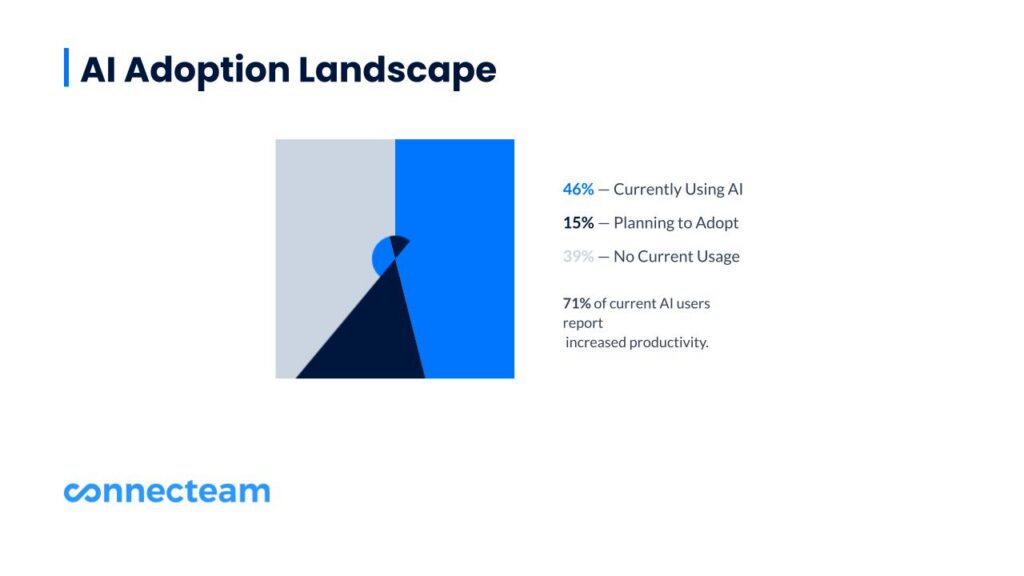
The same report found that 71% of AI users said it increased productivity, 39% saw improved quality of goods or services, and 31% reported higher sales.
That sounds promising, but business owners should be careful with AI hype. AI does not create value just because a business uses it. It creates value when it removes a bottleneck.
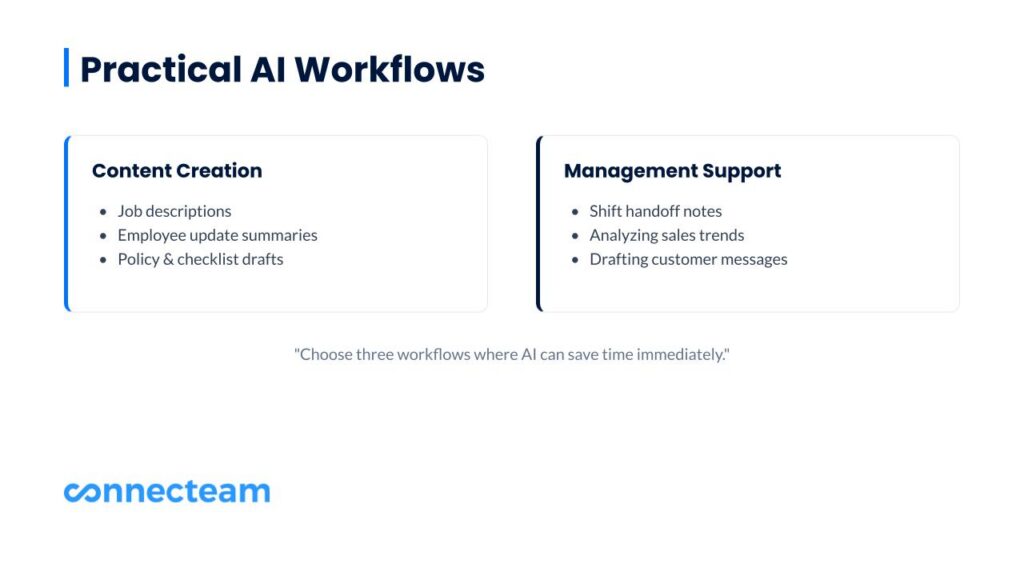
The best AI use cases for small businesses in 2026 will be practical:
- Drafting job descriptions
- Turning notes into employee updates
- Summarizing customer feedback
- Creating first drafts of policies or checklists
- Helping managers write shift instructions
- Analyzing sales trends
- Preparing FAQs for employees
- Creating training materials
- Drafting customer messages after delays or service issues
ADP’s 2026 HR trends research found that more than 70% of small businesses are exploring or already using AI for payroll and HR tasks, but 85% still want a human involved when using AI tools. That is the right mindset. AI can speed up work, but owners still need human review for anything involving employees, pay, scheduling, compliance, or customer relationships.
The smartest approach is to choose three workflows where AI can save time immediately. For example, a cleaning company might use AI to create new client onboarding checklists, draft employee reminders, and summarize site inspection notes. A restaurant might use it for shift handoff notes, training guides, and local marketing drafts.
Each use case should have an owner and a measurable goal, such as reducing manager admin time by five hours per week or cutting onboarding prep time in half.
Bottom line for owners: AI is most valuable when it is connected to a recurring task, a clear manager, and a measurable result.
4. Compliance will become harder to manage manually
Small business compliance is becoming more fragmented. ADP’s 2026 compliance guidance highlights state and local changes across employee leave, AI, background checks, wage and hour rules, discrimination protections, employee notices, pay data reporting, pay transparency, and workplace safety.
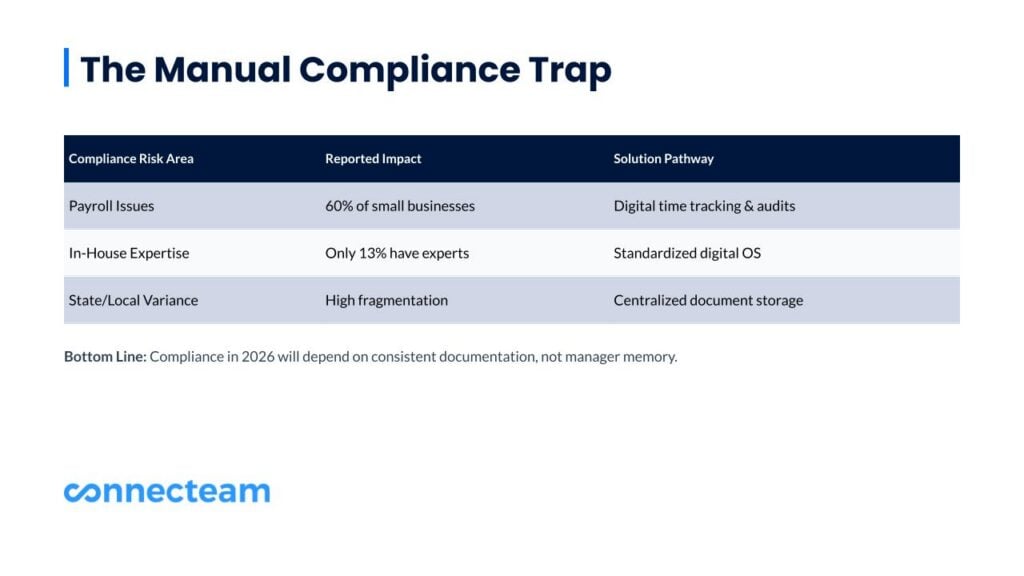
For small businesses, the danger is not only a major legal mistake. It is the daily accumulation of small process gaps: missing time records, inconsistent leave approvals, outdated employee documents, unclear pay policies, misclassified workers, or managers who do not know which rules apply.
ADP’s small business HR research also found that 60% of small businesses report payroll issues during some, most, or all pay cycles, while only 13% have an in-house compliance expert.
That combination creates real risk. A business can be confident it is compliant while still relying on manual processes that make mistakes more likely.
Owners should treat compliance as an operating system. That means:
- Store employee documents in one place
- Keep time tracking accurate and easy to verify
- Standardize leave requests and approvals
- Document schedule changes
- Create simple manager guidelines for overtime, breaks, and time off
- Review state-specific rules before expanding into a new location
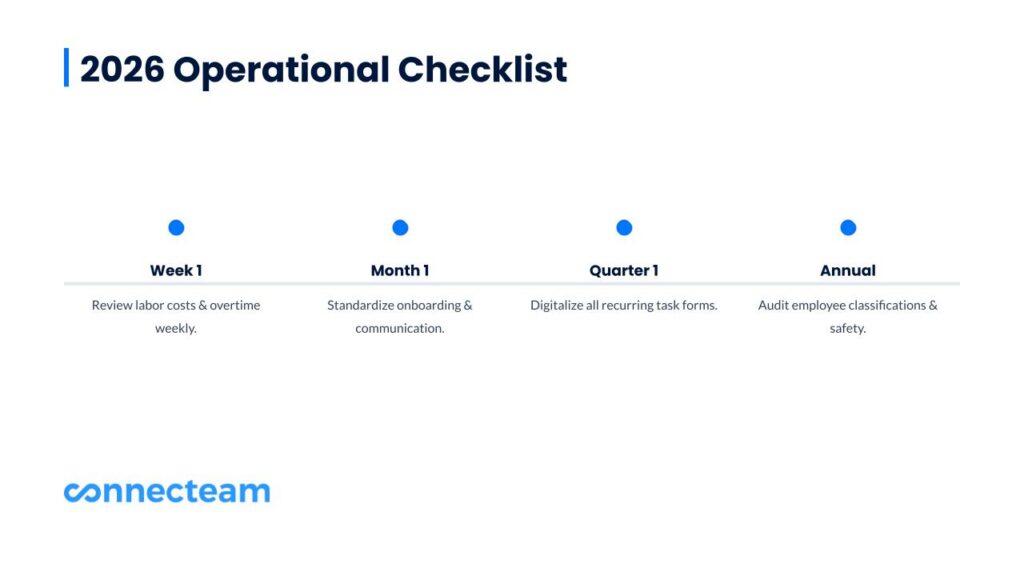
- Audit employee classifications at least once a year
This is especially important for businesses with hourly employees, mobile teams, multiple locations, or workers in more than one state. As soon as the business grows beyond the owner personally knowing every shift, every employee issue, and every payroll detail, manual tracking starts to break down.
For many small businesses, the challenge is not a lack of effort but the fact that important information is scattered everywhere. Time records live in one system, employee documents in another, policies sit in a folder, incident reports are on paper, and manager approvals happen over text.
Pro Tip
Connecteam helps bring more of that day-to-day documentation into one place. Managers can use digital forms and checklists for incident reports, inspections, employee requests, procedures, and read-and-sign policies, while keeping employee documents, schedules, time records, training, and team communication easier to manage and easier to find when needed.
Bottom line for owners: Compliance in 2026 will depend on consistent documentation, not memory.
5. Cash flow visibility will become a competitive advantage
Financing is still uneven for small businesses. The Federal Reserve found that 60% of small employer firms applied for financing in the 12 months before its 2025 survey. Among applicants, 42% received the full amount they requested, 36% received some or most, and 22% received none.
Online lending is also growing. The Fed reported that the share of firms applying to online lenders rose from 17% in the 2020 survey to 29% in the 2025 survey, but 60% of firms that borrowed from online lenders said borrowing costs were higher than expected.
The lesson for owners is clear: waiting until cash is tight is expensive. Businesses with better visibility can make better decisions earlier.
A practical cash flow system should include:
- A 13-week cash forecast
- Expected payroll costs
- Upcoming tax payments
- Loan payments
- Supplier payment dates
- Expected receivables
- Slow-paying customers
- Seasonal dips
- Planned equipment or hiring costs
Owners should also connect cash flow to operations. For example, inaccurate time tracking can create payroll surprises. Poor scheduling can increase overtime. Late customer invoicing can delay collections. Too much inventory can trap cash. These are operational issues before they become financial issues.
Bottom line for owners: Cash flow should be reviewed before there is a cash problem.
6. Customer expectations will keep rising across every industry
E-commerce is still expanding. The U.S. Census Bureau estimated that U.S. retail e-commerce sales reached $1.2337 trillion in 2025, up 5.4% from 2024. E-commerce accounted for 16.4% of total retail sales in 2025, up from 16.1% in 2024.
Even businesses that do not sell online are affected by this trend. Customers have become used to speed, convenience, status updates, digital payments, online booking, and quick answers. A local service business is now judged against the convenience customers experience everywhere else.
For small business owners, this means customer experience is increasingly operational. It depends on whether the team has the right information at the right time.
A field service company cannot deliver a great customer experience if technicians do not see updated job notes. A home care agency cannot build trust if families do not receive timely updates. A restaurant cannot protect service quality if shift handoffs are inconsistent. A cleaning company cannot keep clients happy if site instructions live in texts, binders, and one manager’s memory.
Owners should focus on the handoff points where customer experience usually breaks:
- New customer intake
- Scheduling
- Dispatch or shift assignment
- Job instructions
- Service completion notes
- Customer follow-up
- Complaint handling
- Payment collection
The goal is to remove confusion before it reaches the customer.
That is where better day-to-day operations become a customer experience advantage. When employees can see their tasks, shift notes, job instructions, checklists, and updates from their phones, they are less likely to miss the details that matter to the customer.
Pro Tip
With Connecteam’s task management app, managers can assign work, share job instructions, send updates, collect forms, and track progress from the field. For service businesses, that can mean fewer missed steps, cleaner handoffs, faster follow-up, and a more consistent experience no matter where the team is working.
Bottom line for owners: Customer experience in 2026 will depend on how well the business communicates internally.
7. Supply chain pressure will require faster pricing and supplier decisions
Supply chain challenges are no longer limited to large companies. The Federal Reserve found that 48% of small employer firms sourced at least some inputs from outside the U.S. Among firms with foreign inputs, 84% said those inputs cost more, 76% passed at least some of those costs to customers, and 60% absorbed at least some of the increases.
NFIB also reported that 64% of small business owners said supply chain disruptions affected their business to some extent in April 2026.
For owners, the biggest risk is delayed decision-making. Absorbing higher costs for too long can quietly destroy margins. Passing costs to customers too suddenly can damage trust. Changing suppliers too quickly can create quality problems.
A better approach is to create decision rules before the next disruption. For example:
- If supplier costs rise by more than 5%, review pricing within 30 days.
- If a critical item has a lead time longer than two weeks, identify a backup supplier.
- If a product or service line falls below target margin for two months, adjust pricing, packaging, or delivery process.
- If delays affect customers, use a standard communication template so managers are not improvising under pressure.
This gives owners more control when costs change quickly.
Bottom line for owners: Supplier risk is now a pricing, customer communication, and margin management issue.
8. Cybersecurity will become a frontline business issue
Small businesses are no longer too small to be targeted. Mastercard’s survey of more than 5,000 small and medium-sized business owners across four continents found that 46% had experienced a cyberattack on their current business. Among businesses that suffered an attack, nearly one in five later filed for bankruptcy or closed.
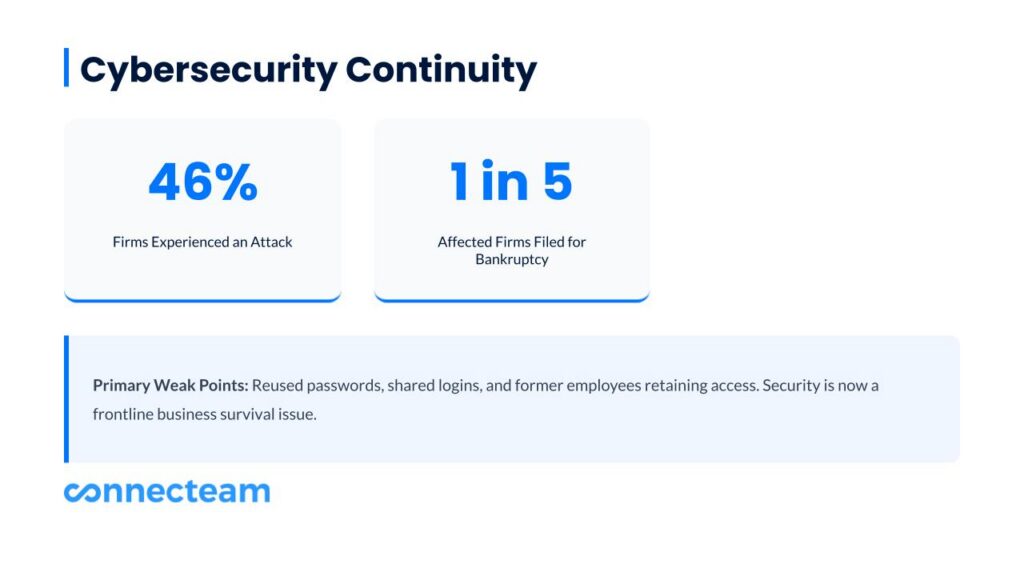
The impact goes beyond the initial breach. Mastercard also found that after an attack, 80% of affected business owners had to spend time rebuilding trust with clients and partners.
That makes cybersecurity a business continuity issue. For many small businesses, the weak point is not advanced technology. It is everyday behavior: reused passwords, shared logins, lost devices, phishing emails, former employees retaining access, or sensitive customer information stored in unprotected places.
Owners should start with the basics that reduce the most risk:
- Require multi-factor authentication
- Use a password manager
- Remove access immediately when employees leave
- Limit admin permissions
- Train employees to spot phishing attempts
- Back up critical files
- Keep software and devices updated
- Create a simple incident response plan
- Review vendor security before sharing sensitive data
Cybersecurity also needs to be part of onboarding. Every employee who uses company systems should know what they can access, what they cannot share, and who to contact if something looks suspicious.
Bottom line for owners: Cybersecurity is no longer just an IT task. It is part of employee training, customer trust, and business survival.
9. Micro-businesses will keep raising the bar for lean operations
Small businesses are getting leaner in structure. Census Bureau data shows that nonemployer establishments, businesses with no paid employees, made up 78.4% of all U.S. establishments in 2023 and generated nearly $1.8 trillion in revenue.
At the same time, business formation remains active. The Richmond Fed reported that business applications grew sharply during 2025, with the four-week moving average approaching 130,000 in late December before sitting near 110,000 by late February 2026.
This means many business owners are operating with small teams, contractors, part-time workers, or their first few employees. They do not have HR departments, operations departments, or full-time compliance teams. The owner often handles sales, scheduling, payroll, customer service, hiring, and problem-solving.
That creates a major advantage for businesses that build simple systems early. A five-person business with clear schedules, documented tasks, digital forms, employee records, and customer notes can operate more professionally than a larger business relying on scattered texts and spreadsheets.
Owners should systemize before growth forces the issue:
- Create repeatable onboarding for every new hire
- Write down the top 10 tasks employees perform most often
- Use templates for customer updates, employee announcements, and incident reports
- Keep schedules, time tracking, and task assignments in one place
- Set clear expectations for response times
- Document what only the owner currently knows
This is especially important when hiring the first employee or first manager. The earlier the business creates structure, the easier it is to scale without chaos.
Bottom line for owners: Lean teams can compete with larger businesses when their systems are simple, clear, and consistent.
10. Industry-specific growth will change where small businesses find opportunity
Small business growth will not look the same across every industry. The Bureau of Labor Statistics projects the U.S. economy will add 5.2 million jobs from 2024 to 2034, with total employment growing 3.1%. Healthcare and social assistance is projected to be both the fastest-growing and largest job-growth sector, increasing 8.4%.
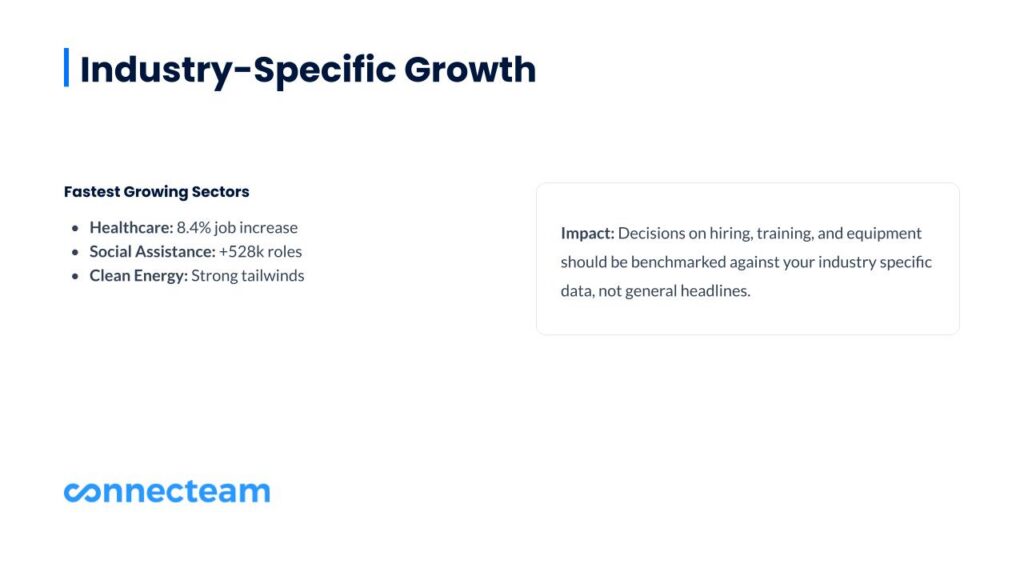
BLS also projects strong growth in healthcare support roles, healthcare practitioners, community and social service occupations, computer and mathematical roles, and clean energy-related occupations. Services for the elderly and people with disabilities are projected to add 528,500 jobs, the most of any detailed industry.
For small business owners, the lesson is to stop thinking about “the economy” as one market. Some industries will have stronger demand, while others will face more pressure from automation, consolidation, e-commerce, and changing labor needs.
This matters for:
- Hiring plans
- Local market expansion
- Service line decisions
- Training investments
- Partnerships
- Equipment purchases
- Marketing strategy
A home care business, construction company, cleaning service, retail store, restaurant, security company, and field service operation will face very different versions of 2026. Owners should benchmark against their industry, not just general small business averages.
Bottom line for owners: The best growth decisions will come from industry-specific data, not broad economic headlines.
11. Business continuity planning will become part of day-to-day operations
Extreme weather, cyberattacks, supply disruptions, and staffing shortages are all continuity risks. For small businesses, even one disruption can affect payroll, customer service, employee safety, and cash flow.
The Census Bureau’s Business Trends and Outlook Survey showed how quickly weather can hit local businesses. After Hurricane Beryl made landfall in Houston, the share of Houston-area businesses reporting weather-related monetary loss rose from 25.4% to 56.4% within two weeks.
Aon’s 2026 Climate and Catastrophe Insight report estimated that natural disasters caused $260 billion in global losses in 2025, with $127 billion covered by insurance.
For owners, continuity planning does not need to be complicated. It needs to be usable when things go wrong.
A practical continuity plan should include:
- Emergency contact list
- Employee communication process
- Backup schedule coverage
- Payroll continuity steps
- Customer notification templates
- Supplier backup list
- Insurance documentation checklist
- Critical passwords and account access rules
- Process for reporting incidents, damage, or injuries
- Plan for operating if the main location is unavailable
The key is to make the plan accessible. A binder in the office is not enough if the office loses power or employees are in the field. Managers need mobile access to contacts, schedules, updates, and forms.
Pro Tip
For frontline and field-based teams, continuity planning only works if managers can reach employees quickly and keep work moving when plans change. Connecteam helps businesses send updates, access employee contact information, adjust schedules, assign tasks, and collect forms from one place, so teams are not relying on scattered texts and phone calls during an emergency.
Bottom line for owners: A continuity plan is only useful if the team can follow it during a real disruption.
12. The winning small businesses will reduce manager overload
There is one trend underneath all the others: managers are being asked to do too much.
They are expected to schedule shifts, answer employee questions, handle customer issues, track tasks, train new hires, monitor labor costs, enforce policies, document incidents, and keep the owner updated. In many small businesses, managers are doing all of that while also covering shifts or serving customers.
That creates a hidden growth barrier. When managers are overloaded, problems show up everywhere:
- Missed updates
- Poor onboarding
- Inconsistent service
- Higher turnover
- Payroll errors
- Unclear expectations
- More overtime
- Slower response times
- More owner involvement in daily issues
Owners often try to fix these problems one at a time. In reality, many of them come from the same source: managers do not have a simple way to run the day.
In 2026, small businesses should look for ways to remove manager friction. That includes better scheduling, employee self-service, clear task assignments, mobile training, digital forms, faster announcements, and real-time visibility into what is happening across the team.
Pro Tip
This is where Connecteam can make a real difference for small businesses. Instead of asking managers to jump between separate tools for scheduling, time tracking, team updates, forms, tasks, training, and employee information, Connecteam brings the daily work into one operations management app built for frontline and deskless teams.
Bottom line for owners: Reducing manager overload is one of the fastest ways to improve employee experience, service quality, and operational consistency.
A 2026 Small Business Operations Checklist
- Review labor costs weekly, not only after payroll.
- Track overtime, missed clock-ins, and schedule changes in one place.
- Standardize onboarding for every new hire.
- Centralize employee communication so updates do not get lost in texts.
- Document recurring tasks, procedures, inspections, and incidents.
- Use digital forms for employee requests, issue reports, and policy acknowledgments.
- Create a 13-week cash flow forecast.
- Build backup plans for staffing, suppliers, severe weather, and technology outages.
- Give managers one place to schedule, communicate, assign work, approve time, and track completion.
How We Chose the Most Important Small Business Trends
We evaluated trends based on practical business impact using data from the Federal Reserve’s Small Business Credit Survey, including its 2026 report based on 6,525 small employer firms with 1–499 full- or part-time employees, along with NFIB monthly reports, U.S. Census Bureau data, and workforce, cybersecurity, and risk research from sources like ADP, Mastercard, and Aon.
Selection factors included revenue impact potential, cost reduction opportunities, competitive advantage, risk mitigation, and implementation feasibility. The focus is on small businesses with fewer than 500 employees, especially employer firms managing frontline and non-office teams, where scheduling, communication, documentation, employee retention, and compliance can create daily operational challenges.
Sources
- SBA Office of Advocacy: Frequently Asked Questions About Small Business 2026
- U.S. Chamber of Commerce: Small Business Index Q1 2026
- NFIB: Small Business Optimism Remains Below Average but Stable
- NFIB: Jobs Report
- Federal Reserve Banks: 2026 Report on Employer Firms
- ADP: The 2026 HR Trends Small Businesses Can’t Ignore
- ADP: 48 State-Specific HR Compliance Changes for 2026
- U.S. Census Bureau: Quarterly Retail E-Commerce Sales
- Federal Reserve Bank of Cleveland: Small Business Optimism Wanes as Performance Metrics Hold Steady
- NFIB: Small Business Economic Trends
- Mastercard: Small Business Cybersecurity Study
- U.S. Census Bureau: Small Business Week
- Federal Reserve Bank of Richmond: Business Formation Boom Continues
- U.S. Bureau of Labor Statistics: Employment Projections 2024–2034
- U.S. Census Bureau: Extreme Weather Impact on Businesses
- Aon: 2026 Climate and Catastrophe Insight Report