

AI is everywhere in business coverage, but the examples usually stop at the office door. They’re about writing emails, summarizing meetings, and building presentations.
Frontline managers have a different list: build next week’s schedule, turn a paper checklist into a mobile form, train new hires, and answer the same employee questions again and again.
The real test for frontline AI is whether it can take one of those jobs, produce a useful result, and earn a place in the workday.
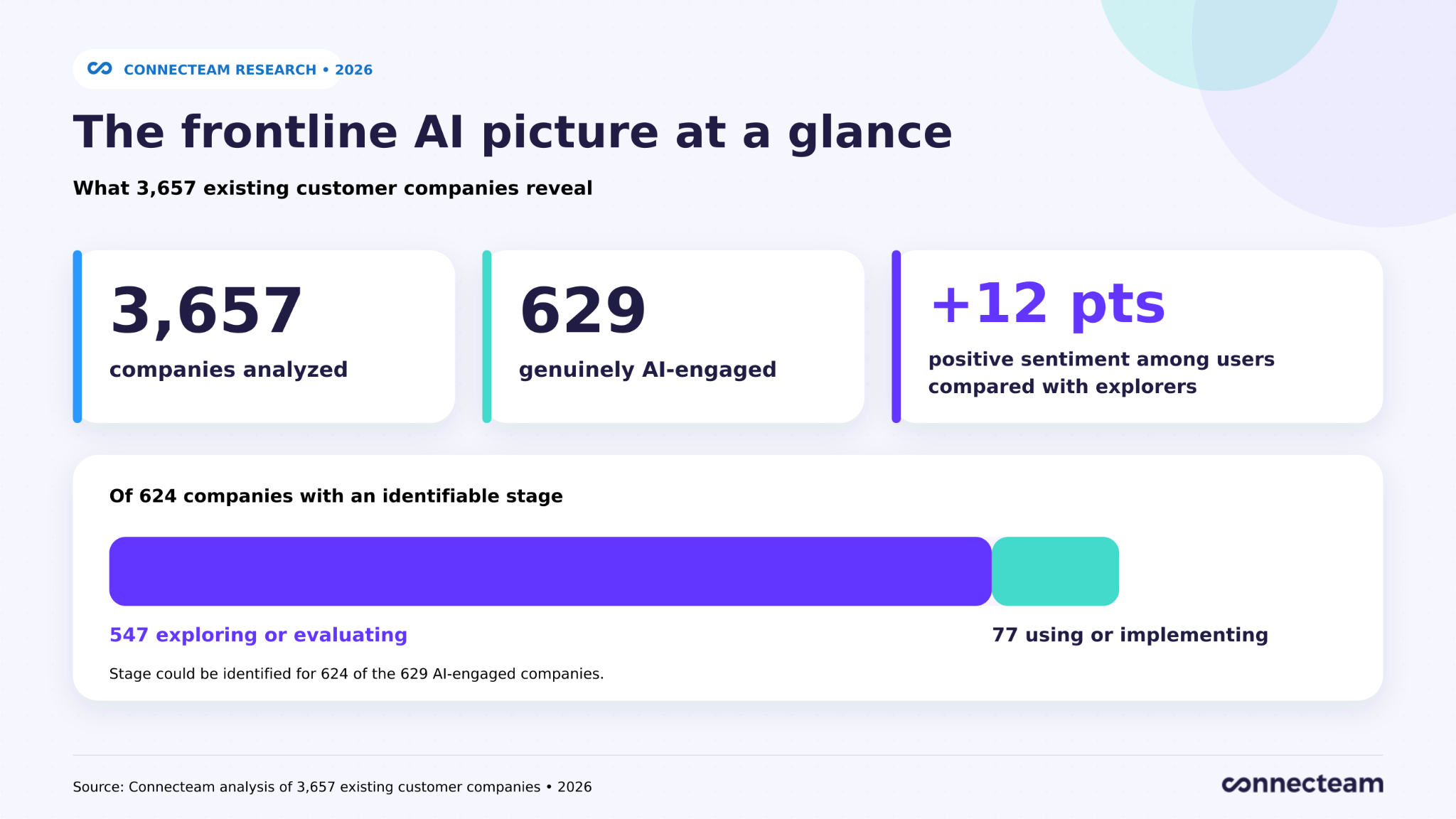
Connecteam analyzed anonymized customer conversations involving 3,657 existing customer companies over six months. We classified 629 as AI-engaged based on customer descriptions of current use, active evaluation, practical questions, or specific concerns.
Most are still exploring, but companies already using or implementing AI are 12 percentage points more positive than explorers.
For frontline businesses, the adoption question is concrete: Which task should AI handle first, and will the result save enough time or effort to justify the cost?
About the research: This analysis is based on anonymized customer conversations, with each company counted once. See the full methodology below.
Key Findings
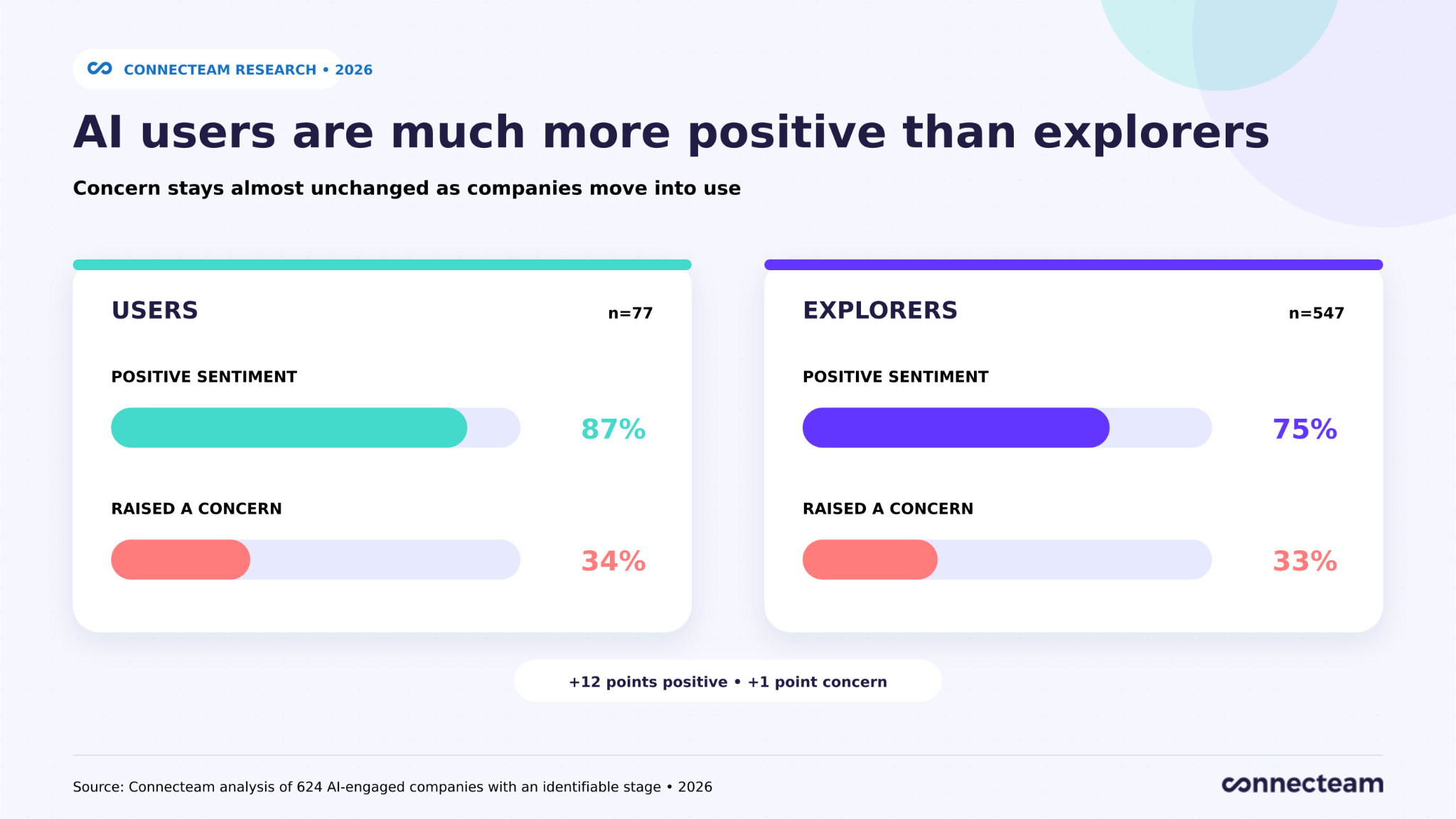
- AI users are much more positive than companies still exploring it. Positive sentiment reaches 87% among users, compared with 75% among explorers.
- Concern stays almost identical among users and explorers. It appears at 34% of users and 33% of explorers. Companies can see value while continuing to question the result, process, or investment.
- About one in six companies are actively exploring, using, or raising practical questions about AI. Among the 3,657 companies analyzed, 629 discuss a real use case, evaluate a capability, put AI into use, or raise a specific concern.
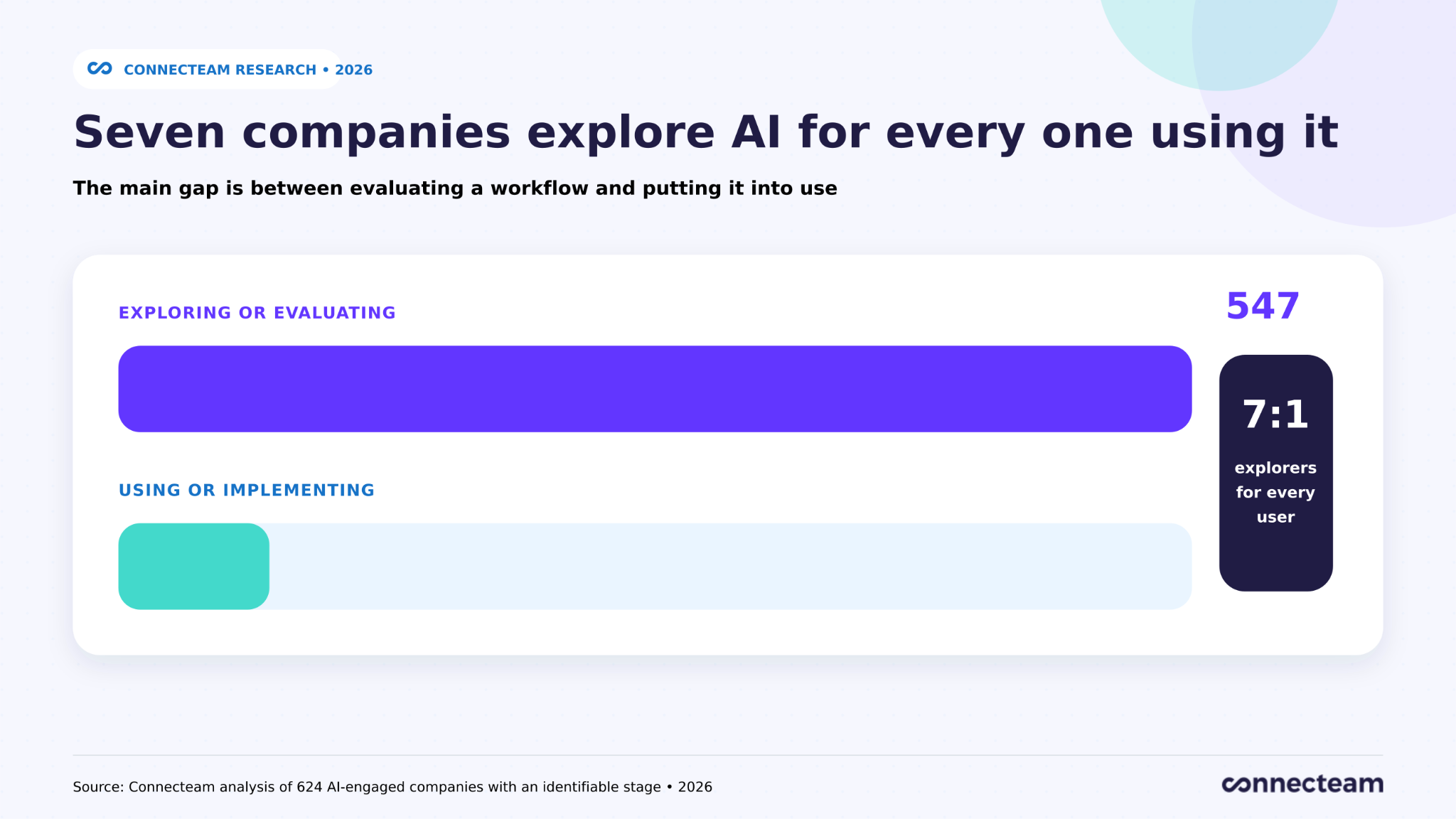
- Exploration outweighs implementation by roughly seven to one. Among the 624 AI-engaged companies with a clear stage, 547 are exploring or evaluating AI and 77 are using or implementing it.
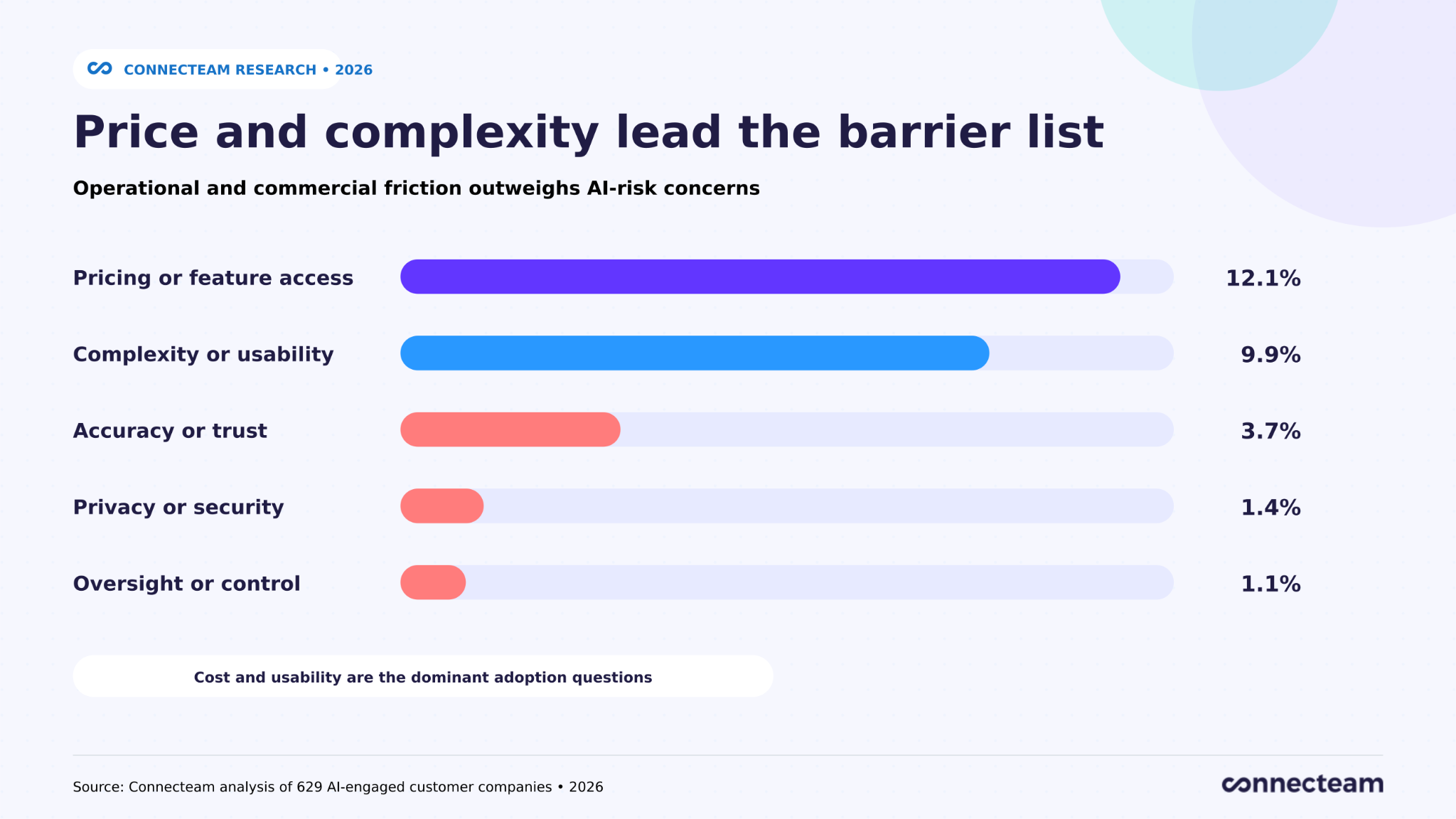
- Cost and complexity are the main barriers. Pricing or feature access leads, followed by complexity and usability. Businesses need a use case valuable enough to justify the spend and simple enough to put into practice.
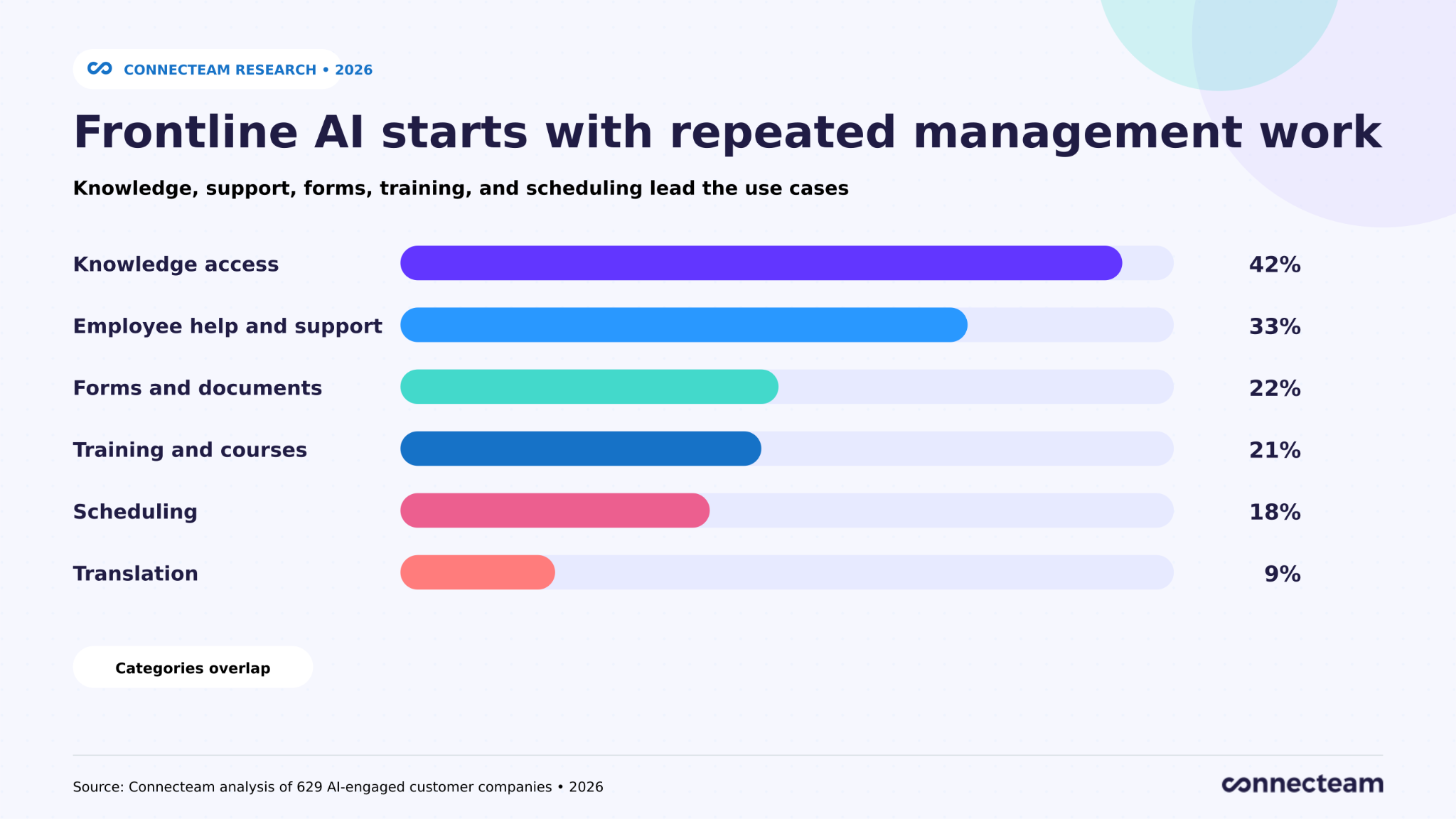
- Businesses are focusing AI on repeated management work. Knowledge access, employee support, forms, training, scheduling, and translation are the leading use cases.
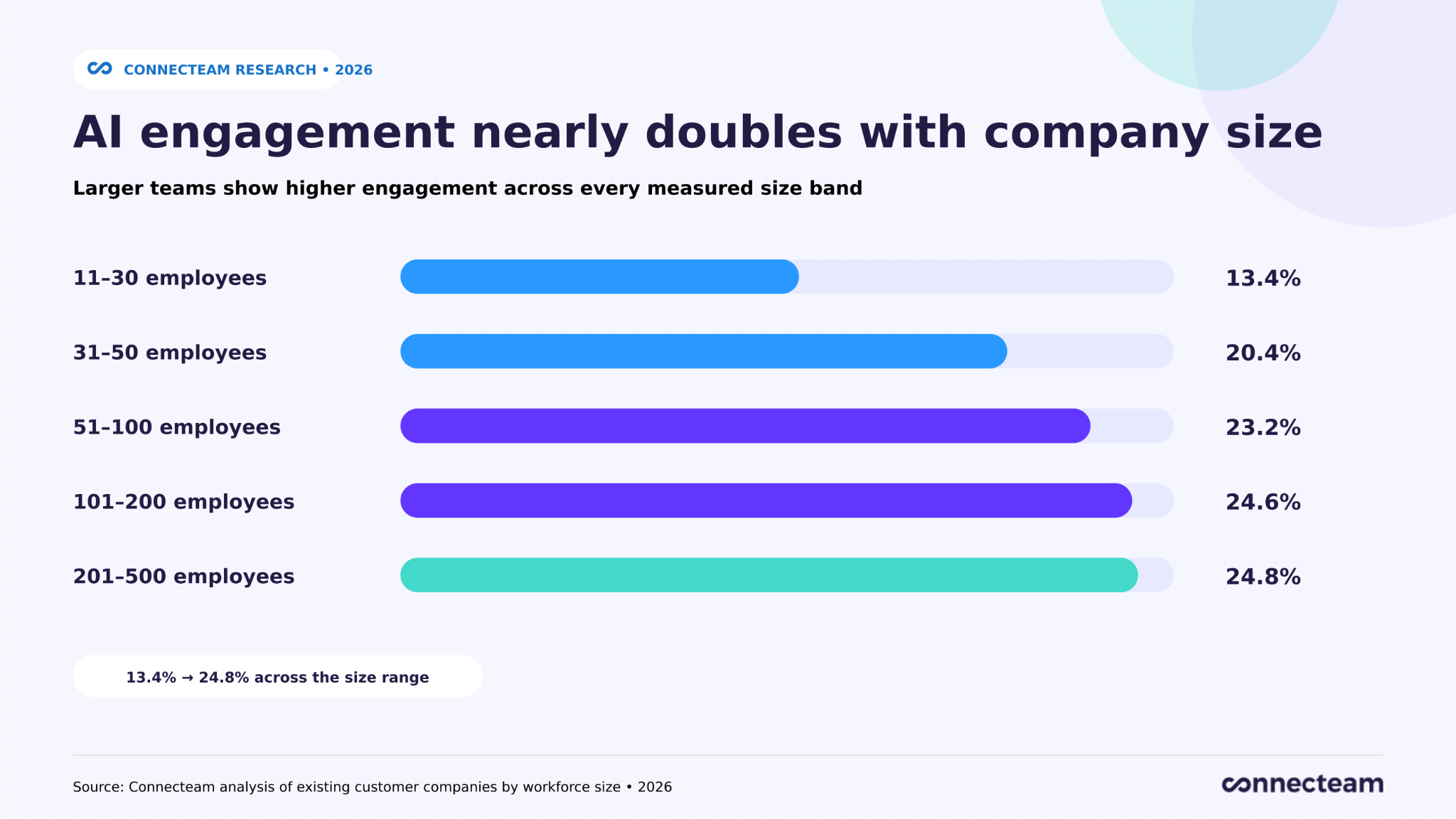
- AI engagement rises with company size. It increases from 13.4% among companies with 11–30 employees to roughly one in four among those with 51–500 employees.
AI Users Are Much More Positive Than Explorers
Companies using or implementing AI are substantially more positive than those still exploring it.
Positive sentiment reaches 87% among users, compared with 75% among explorers. That 12-point gap is one of the strongest findings in the research.
Concern barely changes. It appears at 34% of users and 33% of explorers.
Users see more value without becoming less critical. Managers still review AI output and question its accuracy, access, and cost. The user group is both more positive and just as demanding of the result.
Across all 629 AI-engaged companies:
- 65% express positive sentiment without raising a concern.
- 22% raise a concern without expressing positive sentiment.
- 11% express both.
- 2% express neither.
In total, 76% express positive sentiment and 33% raise a concern. These groups overlap: 11% express both. A company can see value and ask hard questions in the same conversation.
For Every Company Using AI, Seven Are Still Exploring It
AI engagement appears at 629 of the 3,657 customer companies in the research base, or 17.2%.
Among the 624 companies whose stage could be identified, 547 are exploring or evaluating AI. Only 77 are already using or implementing it. For every company putting AI into use, roughly seven are still deciding where it fits.
These businesses already know AI is available. Their questions are practical: Which task should we start with? What information does the tool need? How much work will implementation take? Will managers trust the result? Is the benefit worth the added cost?
National adoption is also in an early phase. The U.S. Census Bureau found that 17% to 20% of U.S. businesses used AI in a business function during its six-month measurement period ending May 2026, while 20% to 23% expected to use it within the following six months.
The gap is wider by type of work. Gallup reported that 27% of white-collar employees used AI frequently, compared with 9% of production and frontline workers. Leaders reached 33%.
Frontline AI use often starts on the management side of the business. Owners and managers use it to build workflows that reach the whole team, from schedules and forms to training and company knowledge.
Price and Complexity Are the Main Barriers
Pricing or limited feature access is the most common barrier, raised by 76 companies, or 12.1% of the AI-engaged group. Complexity and usability come next, raised by 62 companies, or 9.9%.
Accuracy and trust follow at 3.7%, with privacy and security at 1.4% and management oversight at 1.1%.
Before paying for AI, a business needs to know which process it will improve, what setup requires, and whether managers can trust the result. Companies already using AI are much more convinced of its value than those still exploring.
The same pattern appears in an OECD survey of more than 5,000 small and medium-sized businesses across seven countries. The most common reason for not using generative AI was that it did not suit the company’s work. Value for money was another barrier, while 86% held neutral or positive attitudes toward the technology.
Businesses are broadly open to AI. Adoption turns on whether it fits the work and earns the spend.
Where Frontline Businesses Are Putting AI to Work
The clearest opportunities sit inside work that repeats every day.
Among the 629 AI-engaged companies:
- 266, or 42%, discuss finding and using company knowledge.
- 209, or 33%, discuss employee help and support.
- 137, or 22%, discuss forms and documents.
- 133, or 21%, discuss training and courses.
- 113, or 18%, discuss scheduling.
- 54, or 9%, discuss translation.
Companies can appear in more than one category.
Knowledge access leads because frontline teams generate the same questions repeatedly. Where can I find this form? What is the policy? What do I do at this job site? Which procedure applies? Managers often carry those answers in their heads, inboxes, or scattered documents.
For forms and training, AI can turn existing source material into a first draft, so managers do not have to start with a blank page. Scheduling gives AI an even more concrete job: combine availability, qualifications, coverage requirements, and business rules into a schedule the manager can review.
The value companies describe is practical: less time spent creating materials, faster first drafts, and fewer repeated questions. AI handles more of the starting work, while managers review the output and deal with exceptions.
AI Engagement Nearly Doubles With Company Size
AI engagement increases as the workforce grows:
- 13.4% among companies with 11–30 employees
- 20.4% among companies with 31–50 employees
- 23.2% among companies with 51–100 employees
- 24.6% among companies with 101–200 employees
- 24.8% among companies with 201–500 employees
The 1–10 employee segment is omitted because the base was too small for a stable comparison.
The engagement rate nearly doubles between companies with 11–30 employees and those with more than 100.
Larger frontline businesses face more coordination work and have more capacity to experiment. They manage more shifts, employee questions, and training materials, while larger teams and budgets make new tools easier to test.
Census data shows the same size effect. Among U.S. businesses with 100–249 employees, 32% reported using AI, rising to 37% among those with at least 250 employees.
How to Move Frontline AI From Exploration Into Use
For companies still evaluating AI, a single repeated task provides the clearest place to begin.
-
Choose a repeated task
-
Give AI reliable source information
-
Keep one person responsible for the result
-
Decide what success looks like
- Time spent creating the schedule, form, or course
- Corrections required before use
- Repeated employee questions
- Speed from request to finished output
- Completion or response rates
-
Expand from a proven use case
Start with work that returns every day or every week: scheduling, employee questions, forms, training, or translation. Repetition gives the manager enough examples to judge whether AI is helping.
A schedule depends on accurate availability, approved time off, qualifications, coverage needs, and scheduling rules. An AI assistant depends on current policies and procedures. A course or form depends on good source material.
AI cannot repair an operational process built on outdated information.
Name the manager who reviews the output, corrects mistakes, and decides when it is ready for employees. Review matters most when the result affects pay, attendance, safety, discipline, customer commitments, or someone’s ability to work.
Measure something the manager already experiences:
The first test should answer one question: Did this workflow become easier to run?
Once the first application is working, look at the next connected task. Employee questions can connect to company knowledge. Training can use the same policies and procedures. Scheduling can connect to availability and time off. Forms can feed tasks and operational reporting.
Gallup workplace research found that frequent use, manager support, and a clear organizational plan were all associated with stronger reported productivity gains from AI. Managers make AI part of the workday by setting expectations, reviewing results, and deciding where it belongs.
Put AI to Work Inside Connecteam
Connecteam brings scheduling, time tracking, forms, training, communication, employee support, and company knowledge into one app for frontline teams. Its AI features work inside those workflows, so managers can create and review the output where the finished work already lives.
Auto Scheduling builds a draft schedule around employee availability, approved time off, qualifications, shift coverage, work preferences, fairness, and scheduling rules. The assignments remain drafts, so the manager can review and adjust them before publishing.
File-to-Form turns an existing file or a photo of a paper form into a mobile form. Managers can edit the fields before employees start using it on a shift or job.
The AI Course Creator produces a course draft from a description of the subject. Managers can review the content, assign it to the right employees, and track completion in the same app.
Connecteam’s Knowledge Base AI Agent answers employee questions using the company’s approved resources. Employees can view the sources behind an answer, while managers can improve future responses by updating the agent’s instructions or the underlying knowledge.
AI can also help managers prepare company updates, translate messages inside Chat, and capture spoken information in forms. The schedule, form, course, answer, or message stays inside the workflow where the team will use it.
Most AI-engaged companies are still exploring, while users are already much more positive. The practical path into use is one repeated workflow, reliable company information, and a result managers can review before the team uses it.
Frontline AI will move from interest to routine use one workflow at a time.
Explore Connecteam’s AI tools for frontline teams.
Methodology
We analyzed anonymized customer conversations involving 3,657 existing Connecteam customer companies during the six months ending July 2026. Sales conversations were excluded, customer companies were deduplicated, and each company was counted once.
We classified a company as AI-engaged when the customer showed substantive engagement with AI, including current use or implementation, active evaluation, operational questions, or concerns about applying it. A passing mention or a rep-led mention without meaningful customer engagement did not qualify.
AI included the capabilities Connecteam classifies as AI, including AI-supported scheduling; form and course creation; knowledge and support agents; translation; and content assistance. We excluded conventional rules-based automation unless it formed part of one of those AI capabilities.
Percentages use either all 3,657 companies or the 629 AI-engaged companies, as stated. Stage comparisons use the 624 AI-engaged companies whose stage could be identified: 547 explorers and 77 users. The five remaining AI-engaged companies stay in the overall cohort but are excluded from stage comparisons. The findings reflect the views of owners, managers, and other company representatives and should be read as operational trend data, not a nationally representative survey or a measure of employee sentiment.
FAQs
Frontline businesses are mainly using AI to find information, answer employee questions, prepare forms and documents, create training, and build schedules. These use cases reduce repeated management work while keeping people involved in reviewing the output.
Yes. Among AI-engaged Connecteam customers, 87% of companies using or implementing AI expressed positive sentiment, compared with 75% of companies still exploring it. Concern remained nearly identical at 34% and 33%, suggesting that experience builds confidence without removing scrutiny.
Price and feature access are the leading barriers, followed by complexity and usability. Accuracy, privacy, and oversight concerns appear less often. Businesses are primarily asking whether AI fits their workflow, is easy to use, and delivers enough value to justify the cost.
Frontline AI is technology that helps businesses manage employees who work away from a desk. It can support scheduling, knowledge access, employee questions, training, forms, documents, and communication inside the tools managers and workers already use.
Choose AI that solves a specific frontline problem, works inside existing workflows, and is easy for employees and managers to use. Check how it handles permissions, business data, inaccurate answers, and human review. Start with one repeated task and assess the results before expanding.