Training cleaning staff can be tricky. People work at different speeds, and experience levels vary, so it’s hard to maintain consistency.
Having run a domestic cleaning company myself, I know how tough it can be to train staff while ensuring speed, quality, and reliability.
The good news is that with the right approach, training becomes a lot smoother.
In this guide, I share 10 expert tips for training cleaning staff, combining my own experience with insights from other cleaning business owners and managers.
Key Takeaways
- Training starts with strong onboarding, which helps new cleaners understand their role clearly, learn company standards, and feel supported from the start.
- SOPs, an employee handbook, and shadowing help cleaners understand exactly what’s expected, so they can work confidently, avoid mistakes, and deliver consistent results.
- Health and safety, accident protocol, and soft skills training are key to avoiding risks, preventing mistakes, and keeping clients happy.
Training Cleaning Staff: 10 Tips, Approved by Cleaning Company Pros
Whether you’re just starting your cleaning business or looking to improve your current team’s performance, these 10 tips will help you create an effective training program you can use right away.
-
Have a solid onboarding process
- Any forms or contracts to complete.
- Login details for your scheduling, communication, or training apps.
- A short welcome email or video introducing you, your company, and what to expect on their first day.
- Key documents, such as your health and safety standards, absence procedures, and company policies.
- A “what to bring” checklist that includes things like their ID, uniform, bank details for payroll, etc.
- Welcome and introductions. Share a bit about yourself and introduce anyone they’ll be working with.
- Company overview. Explain why you began your business, who your clients are, and what kind of cleaning you do (e.g., commercial, residential, short-term rental). Also, share your company values, such as reliability, respect, attention to detail, and professionalism.
- Expectations. Go over things like punctuality, dress code, and how to act professionally in client spaces. Make sure they know how to report issues, ask questions, or let you know if they’ll be absent.
- Walk-through of a typical day. I like to play a short video walkthrough of a typical clean so my new hires can see how each room is usually tackled.
- Additional details about tools and systems. Explain how to check schedules, access task lists, clock in and out, and message the team.
- Safety essentials. Go over personal protective equipment (PPE) basics, accident and hazard reporting, and where to find first-aid supplies.
- Basic logistics. Let them know where to park, what time to arrive, what to bring to work, etc. If you have an office, you can also give them a tour, pointing out break areas, restrooms, supply closets, and emergency exits.
-
Craft simple standard operating procedures (SOPs)
- Kitchen cleaning
- Bathroom deep cleans
- Vacuuming and mopping
- Sanitizing surfaces
- Which supplies and products to use (and in what order)
- How to perform the cleaning
- Safety and PPE reminders relevant to the task
- Quality standards to uphold
-
Create an employee handbook
- A brief overview of your company and what you stand for.
- Key contacts if they need assistance
- Basic HR information (how to call in sick, request time off, update your contact details, be paid for overtime, etc.).
- Health and safety guidelines (PPE, chemical handling, accident procedures, etc.)
- Daily tasks, cleaning checklists, or key training points.
- Expectations, dress code, and professional behavior and communication standards.
-
Build a clear training schedule
- Meet the team
- Company background
- Safety basics
- Review cleaning SOPs
- Shadow an experienced cleaner
- Ask questions in real time
- Learn tools and systems
- Practice core cleaning tasks
- Review client communication
- Discuss expectations
-
Organize shadowing
- Pair each new cleaner with a patient, experienced mentor. This could be you or their onboarding buddy.
- Have the new hire join their mentor on a job, such as cleaning a customer’s apartment, to observe and take notes. (This can be on a physical notepad or their mobile device.)
- Provide a cleaning checklist for your new hire to follow during shadowing. This way, they can see how their mentor completes required tasks in real time.
- Encourage your new cleaner to pay attention to how their mentor chooses and packs supplies, manages time, and handles finishing touches, like folding towels or neatly arranging items.
- Let your new hire take on 1 task or area (such as dusting or cleaning a bathroom), then gradually add more responsibility until they’re ready to complete a full clean independently.
- Adjust the number of shadowing shifts based on the job. A couple of shifts may be enough for residential jobs, but specialized work might need a week.
- Check in after each shadowing shift to answer questions, talk through what went well, and help build their confidence.
-
Keep the lines of communication open
-
Prioritize health and safety training
- Recommended Practices for Safety and Health Programs: A step-by-step resource to help you build your own safety training and procedures.
- Safety Pays Program: Shows how injuries impact profits; useful for making the case for better safety.
- Safety and Health Management Program Guidelines; Issuance of Voluntary Guidelines: Tips to help you prevent workplace injuries and shape your safety policies.
- Elements of an Effective Safety and Health Program: Key info for training staff on working safely with toxic materials.
- Business Case for Safety and Health: Explains how safety boosts productivity and profits—great for getting leadership support.
-
Train staff to deal with potential damage
- Contact [Manager/Team Lead’s Name] immediately. Reach out as soon as the incident occurs, using the most direct method available (phone, text, email, or in-app message).
- Formally document the incident. Take clear photos of the damaged item and the surrounding area, and write a brief note describing:
- What happened
- When and where it happened
- Who was involved
- What task was being performed
- Inform the client calmly and professionally. Clients should be notified promptly and respectfully, regardless of whether they are on-site.
- General liability insurance: Covers accidental damage to a customer’s property or injuries to third parties while on the job. Typically costs $25–$95/month.*
- Workers’ compensation: Pays for medical expenses or lost wages if an employee is injured while working. Generally costs less than $150/month.*
- Equipment and small tools insurance: Protects your cleaning gear if it’s lost, stolen, or damaged. Usually costs less than $25/month.*
- Business Owner’s Policy (BOP): Combines liability and property coverage in 1 policy. Typically costs around $75/month.*
-
Strengthen your team’s soft skills
- Role-playing client interactions: Practice greeting clients and asking what they’d like done, and handling small complaints politely. This helps staff feel confident and able to communicate clearly.
- Team exercises: Pair cleaners during shadow shifts or group jobs, and have them divide tasks to help each other. This builds strong teamwork and communication skills.
- Adaptability drills: Give your team scenarios where the unexpected happens, such as a last-minute client request or missing supplies, and show them how to stay calm and find solutions. This helps them stay adaptable on the job.
- Problem-solving practice: Ask cleaners to think through small challenges, such as how to clean really tough stains or deal with a time crunch without sacrificing quality. This trains them to think quickly and make good decisions.
- Client notes: Encourage staff to write down customers’ likes, dislikes, and special requests, then share those notes with the team. It’s a simple way to ensure your team remembers details and can provide personal service.
- Feedback sessions: After each job, review client feedback together. Highlight and celebrate wins, and point out ways to improve.
- Service basics for new hires: Hold short sessions to teach customer service essentials, e.g., answering calls quickly, leaving time between jobs to prevent late arrivals or rushed work, wearing the proper uniform, and double-checking they have all the right cleaning tools and supplies (plus backups of products). This ensures reliability and consistency.
-
Bring everything together in an employee training app
- Create customized training courses in minutes by uploading your own documents, videos, images, or using templates.
- Use built-in AI tools to quickly generate training content that’s tailored to your cleaning procedures and safety standards.
- Deliver mobile-friendly training that cleaners can complete on the go, wherever they are. This is ideal for teams working across different sites.
- Assign role-specific or company-wide courses to keep everyone aligned and up to date.
- Test knowledge through quizzes that you can include directly in courses.
- Track progress in real time through an easy-to-navigate dashboard. It gives you a complete view of who has started, completed or missed training. Plus, Connecteam keeps a record of all mandatory courses and certifications (with expiration dates) so you can stay compliant.
- Set deadlines and send automatic reminders so no one falls behind on training.
- Build a searchable knowledge base of SOPs, health and safety protocols, guides, videos, FAQs, and other materials, so your team can find answers instantly.
- Communicate with your cleaners, individually or in groups, in real time.
“The biggest mistake is treating cleaners like robots and skipping proper onboarding. People need empathy, clarity, and support,” Vic from Oak Bay Clean tells Connecteam.
And I couldn’t agree more. Jumping straight into on-the-job training only leads to confusion, mistakes, and frustration on both sides.
A clear, structured onboarding process prevents that. It helps new hires learn your standards, understand their role, build confidence, and feel part of the team before they start cleaning on their own.
Here’s what I make sure to do during onboarding:
Handle admin early
Onboarding should start before your new cleaner’s first day, and most of that early work is administrative. Getting the basics sorted in advance saves you time later and helps new hires show up confident.
At least a few days before their start date, send your new hire:
Give a warm, structured welcome
On their first day, focus on helping your new cleaner feel welcomed and prepared. A great first day covers:
Assign a buddy or mentor
Pair your new employee with a buddy or mentor, someone experienced, patient, and familiar with your standards. This can be you or another cleaner.
Make sure they know their role: answering questions, helping the new hire navigate apps and tools, supporting shadow-based training (which I’ll cover later), and checking in regularly (daily in week 1, then weekly through weeks 2–4).
Pro Tip
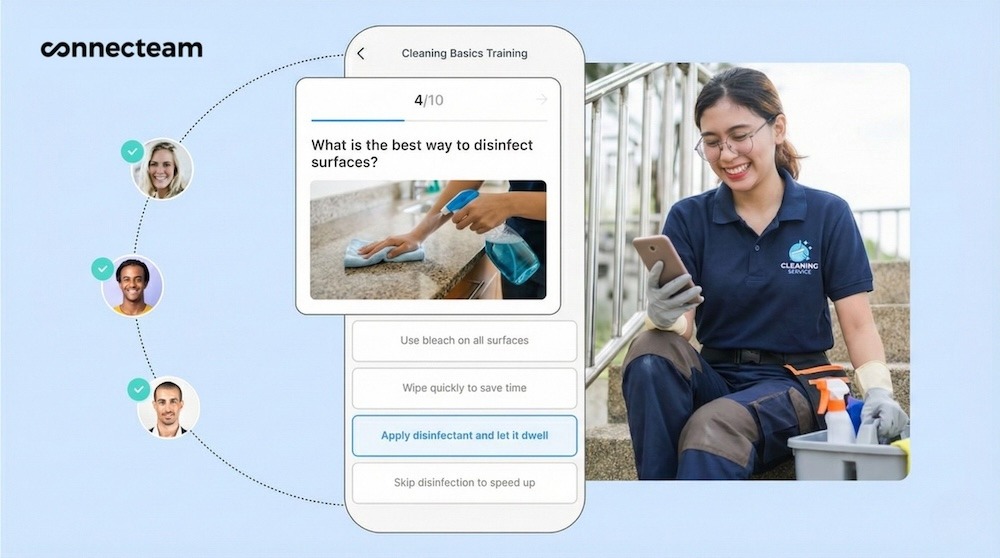
You can make employee onboarding even smoother with Connecteam, helping new cleaners get job-ready faster and reducing early mistakes. The platform lets you create customized onboarding courses and quizzes, share welcome videos, and post messages so new cleaners get to know your team and learn the ropes right from their mobile devices, on the go, between jobs, or on-site when they need a quick refresher.
As Martha Gonzalez, owner of Sparkly Maid San Diego, tells Connecteam, “A good training program combines hands-on mentorship and written SOPs.”
I’m with Martha on this one.
Before you start training anyone, you need clear SOPs: step-by-step instructions for how tasks should be done at your company. SOPs keep team members from feeling lost or overwhelmed, reduce mistakes, lower the risk of accidents, and ensure your customers always get a great, consistent clean no matter who’s on the job.
You don’t need anything fancy; even a few simple checklists or laminated cards work perfectly.
Start by identifying your everyday tasks, such as:
Then, write them out step by step, covering:
It can look something like this. (Follow the link and click “make a copy” to view.)
Once you’ve drafted your SOPs, walk your team through them during training, ask for feedback (e.g., “Does this order make sense? Is this step clear?”), and adjust as needed.
Then, store them somewhere easy to access. This can be in a physical place in your workspace or on a ring card hung on the handle of your cleaning supply caddies. But I recommend creating and storing your SOPs digitally, such as in a cleaning business management app like Connecteam. This way, cleaners can check them in real time on the job.
Also, be sure to update your SOPs whenever you change processes, add new tasks, or incorporate new products or cleaning methods, etc.
This Might Interest You
Need a starting point? Use Connecteam’s free SOP template to write clear, step-by-step cleaning procedures faster.
An employee handbook helps new hires get up to speed and feel more confident faster. Plus, it keeps all team members on the same page so there’s less confusion about rules, procedures, daily tasks, and requirements.
Think of your handbook as a guide that outlines how your business runs. Keep it clear, not too long, and easy to update.
Here’s what I recommend including:
Did You Know?
With Connecteam, you can upload your employee handbook directly to the built-in company knowledge base, so your team can access it anytime, anywhere, right from their mobile devices.
All good training plans include a clear schedule. This gives new hires a roadmap for what they’ll learn and when, making the process less overwhelming.
Whatever your schedule looks like, I advise breaking training into manageable chunks. For example, if your new-employee training will span 5 days, your schedule could look like this:
Day 1 (9am–1pm): Welcome + safety + SOPs
Days 2–4 (9am–1pm): Shadowing + hands-on learning
Day 5 (9am–1pm): Practice + client communication
You can also reinforce what they’ve learned by having them complete quizzes or checklists at certain checkpoints, such as at the start of day 2, after a session on safety rules, or on the last day of training. These help employees review key points and build confidence in their skills and knowledge.
“Cleaning is all about doing, so you have to be able to train on actually doing the job versus just saying how to do it,” says Eli Barker, Director of Sales & Marketing at Smart Cleaning LLC.
I’ve found that the best way to do this is through shadowing, here new hires observe an experienced cleaner. It shows them how tasks are done correctly and lays the groundwork for strong customer service skills and client-focused behavior.
Here’s how to run shadowing effectively:
When your cleaners are training at different houses or commercial spaces, communication is your lifeline.
Encourage your staff to reach out whenever they have questions, and regularly check in with them yourself, not just when something goes wrong or you need an update on their progress. A short message or 5-minute chat asking how their day/week is going, how they’re feeling about training, and if they need additional support can make a huge difference to their job satisfaction.
You could use tools like Slack or Microsoft Teams, but those are built for communication only, meaning you have to switch between tools for everything else. A better option is to use an all-in-one platform like Connecteam. You can communicate with your team, schedule staff, oversee tasks, and train employees, all in the same place (more on this later).
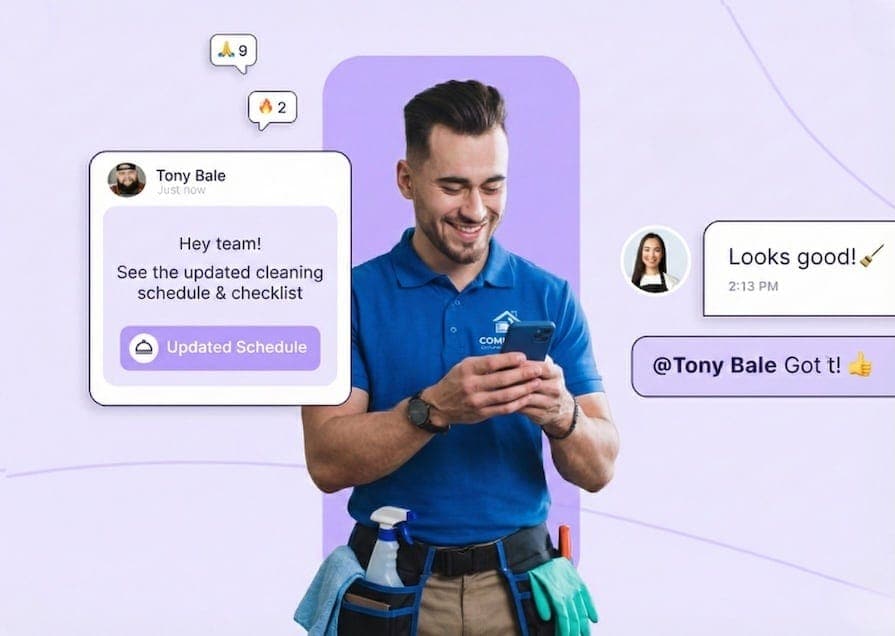
Connecteam’s team instant messaging lets you chat individually or in groups (and turn on read receipts to track who’s seen your messages). This not only allows employees to reach you anytime, but also supports a healthy work-life balance by keeping work and personal messages separate.
There’s also a social-media-style company update feed where you can share announcements, celebrations, newsletters, and other posts.
Pro Tip
Add all cleaners’ contact information to an employee directory, so staff can call or email their colleagues if needed.
Health and safety should be high on your list of training topics for cleaning staff. Your team needs to be 100% up to speed on everything from fire safety protocols and chemical handling to proper ventilation, PPE use, and equipment handling. It’s key to keeping them safe, your customers satisfied, and your company compliant.
For businesses in the US, the Occupational Safety and Health Administration (OSHA) has laid out health and safety topics relevant to cleaning companies. You can use these to build your staff training programs, create safety procedure documents, and ensure your operations comply with OSHA standards:
Even the best cleaners may accidentally break or damage something. The important thing is that your staff knows how to handle it.
Here’s my approach to this aspect of training:
Give clear instructions for incident reporting
I like to share step-by-step instructions during training so cleaners know from the beginning what to do when they or their teammates damage or break client property. Instructions also help everyone follow the same procedure.
Instructions can look like this:
What to say: “Hello, this is [Your Name]. I’m currently on a [residential/commercial/etc.] cleaning job at [client’s address]. The client’s name is [Client Name]. While [I/my teammate, Name] was [describe task], [I/they] accidentally [describe damage, e.g., ‘broke a vase’]. I am formally documenting the incident and will wait for your guidance on how to proceed. The job [can/cannot] be completed safely.”
Save this documentation in your company app or send it directly to [Manager/Team Lead’s Name].
What to say if the client is present: “Hello, [Client Name]. This is [Your Name] from [Company Name]. I want to inform you that while [I/my teammate, Name] were completing [task], an accident occurred and [describe damage]. I’ve contacted my manager and documented the incident. I apologize for the inconvenience, and we will ensure it’s handled appropriately.”
What to do if the client isn’t present: Leave a polite note or send a professional message (if appropriate) explaining what happened, letting the client know you’ve reported it internally, and assuring them it will be handled.
Pro Tip
Use a standardized form to make incident reporting easier and more thorough. Connecteam has a free incident report form template you can print or complete digitally. If you use the app, cleaners can also submit reports on the job, and you can review them in real time.
Practice during training
I also recommend conducting role-playing scenarios. Ask your new cleaner to walk you through what they’d do if they broke a lightbulb while dusting a lamp, left a stain on a carpet, or scratched a customer’s wood floor. Also, have them practice what they’d say to the client.
This practice helps them feel prepared to respond responsibly and professionally when accidents do happen.
Explain how insurance protects everyone
It’s a good idea to hold a short session on what insurance your company has, such as:
*Average costs vary depending on your location, business size, claims history, and other factors. You can find out more in Connecteam’s guide on getting your cleaning business bonded and insured.
During the session, explain what each type of insurance does, using real-life examples. For example, “If you or another cleaner damages or breaks a customer’s mirror, general liability insurance may pay to repair or replace it.”
Soft skills like communication, teamwork, adaptability, and problem-solving don’t just make your team easier to work with; they lead to happier clients and repeat business.
Here’s how I like to strengthen soft skills in cleaning staff:
Instead of juggling checklists, emails, messages, and spreadsheets across platforms, move your training online. A digital training platform keeps everything in one place, so your new (and existing) cleaners can learn anytime, anywhere.
Take Connecteam, for example. It’s an all-in-one employee training app that enables you to:
Did You Know?
Small cleaning teams of up to 10 people can use Connecteam free for life, with access to all premium features.
The Benefits of Training Cleaning Staff
When you properly train cleaning staff, you benefit from:
- Better cleaning and efficiency. Clear training helps your team know exactly how to tackle each task, so work gets done faster and to a higher standard.
- Reduced costs and fewer mistakes. Proper training prevents errors and mistakes that can lead to wasted products, property damage, equipment breakage, and rework that cost you money.
- Improved safety. Teaching proper PPE use, chemical handling, and other health and safety protocols lowers the risk of injuries, insurance claims, and downtime.
- Happier customers. Well-trained cleaning staff deliver consistently strong results. This builds trust with your clients, encouraging repeat business and landing you positive reviews.
- Increased team engagement and loyalty. Investing in training shows your team they’re valued. It also boosts their confidence and empowers them to succeed. This all helps them feel more motivated, stay longer, and take pride in their work.
Most cleaning problems show up in the same places: missed steps, unclear standards, and rushed first weeks. A simple training routine helps your team know what “done” looks like and deliver it more consistently. Start small, improve one piece at a time, and keep what works.
FAQs
Cleaners should get practical, hands-on training so they know exactly what to do on the job. That includes learning how to use cleaning products and equipment correctly, following health and safety rules, and interacting with clients professionally.
Most of this is best learned through shadowing an experienced cleaner. It’s the fastest way to pick up real-world techniques you won’t find in a training manual for cleaning staff.
The 20-minute rule in cleaning is a guideline to ensure high-traffic areas get enough attention. You spend at least 20 minutes focusing on the most important spaces (such as kitchens, bathrooms, or reception spaces) before moving on.
The certificate you need for cleaning depends on the type of work you do. For basic residential work, you might not need formal certification. But for commercial or specialized cleaning (such as healthcare facilities, industrial sites, or food-handling areas), you’ll usually need certifications in health and safety training, COSHH (Control of Substances Hazardous to Health), or food hygiene standards.
Most owners start with a short onboarding day, then a few shadow shifts, then supervised practice. The right length depends on the work (residential vs. deep cleans vs. specialty jobs) and the cleaner’s experience. Plan to extend training if quality is inconsistent or the cleaner still needs frequent help.
How many shadowing shifts does a new cleaner need?
Often, a couple of shifts is enough for standard residential work, but deeper cleans or specialty jobs may need a week. The goal is progression: observe → do one task → do a room → run most of the clean with supervision. Don’t move them to solo work until quality is steady.
The best ways to train cleaning staff are structured onboarding, clear SOPs, hands-on shadowing, and regular check-ins. Use room-by-room checklists, teach safety basics early, and have new hires practice tasks with feedback. Keep standards written down so every cleaner learns the same “done” definition.
A cleaning staff onboarding program should include job expectations, safety basics (PPE and chemical handling), your cleaning standards, and how to communicate and report issues. Send paperwork and “what to bring” info before day one. On day one, cover a typical workflow, then assign a mentor for shadowing.