


Investing in employee training is important, but how do you know if it’s actually working?
Measuring training effectiveness is the best way to ensure that your program is delivering real value, not just taking up time.
In this article we cover practical ways to evaluate your training so you can link learning directly to stronger performance and business growth.
Key Takeaways:
- Measuring training effectiveness helps prove its value and align learning with business goals.
- Using a framework gives you a reliable way to evaluate training effectiveness from first impressions to business outcomes.
- It’s important to track what people learned, how they apply it on the job, and what happens after the training.
- Combine different sources, like surveys, interviews, and performance data to understand the scope of training’s effectiveness.
- Tools like Connecteam simplify measurement by centralizing course creation, quizzes, feedback, and reporting in one easy-to-use platform.
What is training effectiveness?
Training effectiveness measures the impact of your training program. It considers how well employees learn new knowledge and skills, how they implement what they’ve learned on the job, and whether the organization actually sees a return on investment (ROI). Essentially, it’s about showing whether the training produced your intended results, such as better productivity, higher sales, or improved employee satisfaction.
What’s the difference between training evaluation and training effectiveness?
It can be easy to confuse training evaluation with training effectiveness, but they each have distinct functions:
- Training evaluation looks at the training itself. It focuses on the quality of the content, how clearly the instructor taught it, and whether learners felt the training met its goals. The evaluation usually comes from surveys, course feedback, or quick assessments. Think of it as an internal review of the training experience.
- Training effectiveness, on the other hand, looks at what happens after the training. It measures the impact: Did employees use what they learned? Did their performance improve? Did the business benefit because of it? This is about assessing if training led to a change in behavior that positively affected the business.
To sum up: training evaluation looks at the learning process, while training effectiveness looks at the application and business results.
This Might Interest You
Need some help creating a training program that drives an impact? Check out our guide on How to Build an Effective Employee Training Program.
Why does measuring training effectiveness matter?
In 2024, organizations spent an average of 47 hours and $774 per employee on training. That’s a huge investment. Measuring training effectiveness helps ensure that business resources are used well and support your company’s strategic goals. It turns training from a cost into a powerful tool for growth.
Here’s why it matters:
Maximizing your return on investment (ROI)
Measuring effectiveness helps organizations calculate the financial return of their training programs. This makes it easier to justify budgets, show value, and decide which programs to keep, improve, or drop.
ROI shows the value you get for the cost of training, helping you think about training as an investment in your business, rather than an expense.
To calculate training ROI, look at how the training affected specific business metrics. Compare the dollar value of those improvements to the total cost of the training. If the benefits are higher than the cost, the ROI is positive. If not, you may need to rethink the training so it delivers stronger value.
Let’s break it down:
1. Identify the benefits (the “Return”)
List the business outcomes the training was supposed to improve and assign them a dollar value. This might include:
- Increased revenue
- Higher productivity
- Cost savings
- Improved customer satisfaction
2. Calculate the total costs (the “Investment”)
Add up all the expenses tied to training, such as:
- Direct costs: Instructor, materials, and technology.
- Indirect costs: Employee time spent in training instead of working.
- Development costs: Time and resources spent creating the training.
Once you have the benefits and the costs, you can use this formula:
ROI (%) = ((Monetary Benefits – Total Costs) / Total Costs) x 100
Or, test it out using the free ROI Calculator below. Just enter your benefits (return) and costs (investment) along with their dollar amounts. When you’re ready, click “Calculate ROI” to see your results.
Training ROI calculator
List your training benefits and costs, then calculate the return on investment (ROI).
Benefits
Costs
Improving key performance indicators (KPIs)
Effective training should improve the metrics that matter most to your business. By tracking KPIs, you can see exactly how training connects to real outcomes. For example:
- Productivity: Well-trained employees work more efficiently, which usually leads to a higher output and better use of time and resources.
- Sales: Strong sales training can lead to higher conversion rates, which means larger deal sizes and increased revenue.
- Customer Satisfaction: Customer service training can boost satisfaction, build customer loyalty, and reduce complaints.
Optimizing resource use
Not every training program provides the same value. Measuring results helps you identify what works and what doesn’t so your budget can go to the right places. Instead of spending money on programs that don’t deliver, you can invest more in training that actually improves skills and drives business growth.
Enhancing employee performance and engagement
You don’t want training to be a chore. When employees see that training can help them do their jobs better and advance in their careers, they’re more motivated. Measuring effectiveness helps you shape training programs to be more relevant and useful to your employees. This shows your team that you care about their development, which boosts employee engagement and retention.
Did You Know?
According to SHRM, 76% of employees are more likely to stay with a company that offers ongoing opportunities for learning and development.
Aligning with business goals
Measuring training effectiveness ensures that every program supports your company’s overall strategy. If your goal is to improve customer experience, you can measure how well training strengthens communication and response times. This keeps learning directly tied to your business’s direction and priorities.
How to Measure Training Effectiveness
Now that we’ve gone over why measuring training effectiveness matters, let’s dive into how to measure it.
Metrics might look different from one company to another, but most businesses rely on standard frameworks to guide their evaluation process. These models offer a structured way to collect and analyze data, covering everything from initial learner reactions to long-term business outcomes.
Let’s explore a few of the best ways to measure training effectiveness:
The Kirkpatrick Model
The Kirkpatrick Model is the most common way to evaluate the effectiveness of training. Created in the 1950s by Dr. Don Kirkpatrick, it breaks training evaluation down into four levels. Each level builds on the one before it, so you can really go deep into the training’s impact.
Level 1: Reaction
This level looks at how learners felt about the training. It focuses on collecting their first impressions on the content, instructor, materials, and learning environment. It’s the easiest level to measure because the training is still fresh.
- What it answers: Did the learners like the training? Did it feel relevant and engaging?
- How to measure it: Surveys, feedback forms, or informal conversations after the session.
- Why it matters: If employees don’t enjoy or value the training, they’re less likely to pay attention, learn effectively, or apply the skills on the job.
Level 2: Learning
This level measures what participants actually learned. It focuses on knowledge, skills, and attitudes gained from the training.
- What it answers: Did participants learn what they were supposed to?
- How to measure it: Quizzes, practical exercises, role-playing scenarios, pre- and post-training tests, or demonstrating skills.
- Why it matters: You need to know your employees have actually learned before anything can change on the job. If knowledge doesn’t improve, performance won’t either.
Level 3: Behavior
This level checks whether employees use what they learned at work. It focuses on long-term behavior change, which is important but usually difficult to measure.
- What it answers: Are employees applying their new skills and knowledge in their daily work?
- How to measure it: Manager observations, 360-degree feedback, performance reviews, or self-assessments.
- Why it matters: Training is only effective when behavior changes. If nothing changes on the job, then the training didn’t make a real impact.
Level 4: Results
The final level looks at the training’s impact on the business. It connects behavior change to measurable outcomes.
- What it answers: Did the training help achieve business objectives?
- How to measure it: Track KPIs like higher productivity, increased sales, fewer errors, or lower turnover.
- Why it matters: This level shows the true value of the training and gives you the data to calculate ROI.
The Phillips ROI Methodology
Developed by Dr. Jack Phillips, this framework builds on the Kirkpatrick Model by adding a fifth level:
Level 5: ROI:
This level compares the financial benefits of the training program to its total costs. It takes the data from Kirkpatrick’s Level 4 and converts it into financial value. This provides a clear percentage that shows the return on the training investment.
Other models
While the Kirkpatrick and Phillips models are the most common, there are several other frameworks that also offer useful ways to evaluate training, including:
- LTEM (Learning-Transfer Evaluation Model): This is a more detailed, eight-level model that focuses on how well learning transfers to the workplace.
- SCM (Success Case Method): This is a qualitative approach that looks at the most and least successful participants to understand what makes training effective.
- CIPP (Context, Input, Process, Product) Model: This is a broad framework that assesses the context, resources, delivery, and outcomes of a training program.
Best Practices for Measuring Training Effectiveness
More doesn’t necessarily mean better when it comes to data. Measuring training effectiveness is about collecting the right data and using it to make meaningful improvements. Here are some best practices to help you do it right:
Connect training goals to your business needs
You need to start by knowing what business problem training should solve. Ask yourself questions like, “What business issues are we addressing” or “Which strategic goal does this support?” When you tie training to a clear outcome, it’s easier to measure.
For example:
Don’t say: “I want to improve communication.”
Do say: “I want to cut service delays by ten percent by improving communication between the front of the house staff and the kitchen.”
Use multiple types of measurements
No one metric is going to give you the full picture. Use a mix of data to measure the overall effectiveness of your training. Consider combining test scores and KPIs (numbers) with feedback and survey responses (insights). That way, you can see the results and the reasons behind them.
Measure before, during, and after the training
Your evaluation should be ongoing and happen throughout the process, not just at the end.
- Before: Establish a baseline by measuring starting KPIs and assessing employee skills before the training begins.
- During: Use quizzes, quick checks, and feedback to see if learners are understanding. This lets you make real-time adjustments to the training if you need.
- After: Test what employees have learned and track behavioral changes and KPIs over a few months. It may take a while, but it’s worth it to understand the training’s long-term impact.
Separate the training impact from other factors
One of the biggest challenges in measuring training effectiveness is proving that the training caused the improvement, not something else. Here’s how to isolate the impact:
- Use a control group: If you can, compare trained employees to similar employees who didn’t receive the training.
- Analyze trends: Look at employee performance before and after the training. If there’s a clear improvement that lines up with the training, it’s a strong indicator that the training worked.
Treat measurement as ongoing feedback
Your goal of measuring training effectiveness is to keep improving training. Create an ongoing feedback loop and share the data with your team so everyone understands what works and what needs to change. This turns measurement into a powerful tool for future business growth.
Measure Training Effectiveness with Connecteam
Creating a training program, implementing it, and then measuring its effectiveness can seem like a lot to manage. But it doesn't have to be. Connecteam’s employee training software simplifies the entire process from course creation to tracking impact.
Create courses in minutes
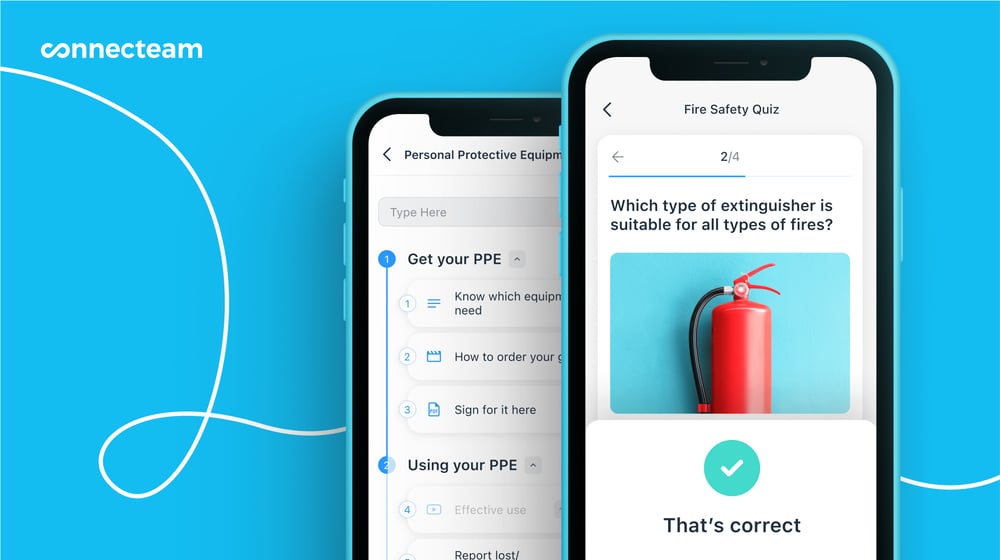
With Connecteam, training can happen anywhere, anytime. It’s a mobile-first solution designed to deliver bite-sized training modules employees can complete right from their mobile devices.
You can start from scratch or use one of Connecteam’s customizable templates to get going. Short on time? Connecteam’s AI Course Creator lets you build custom training in seconds. Just describe your topic and the platform will instantly generate a complete course.
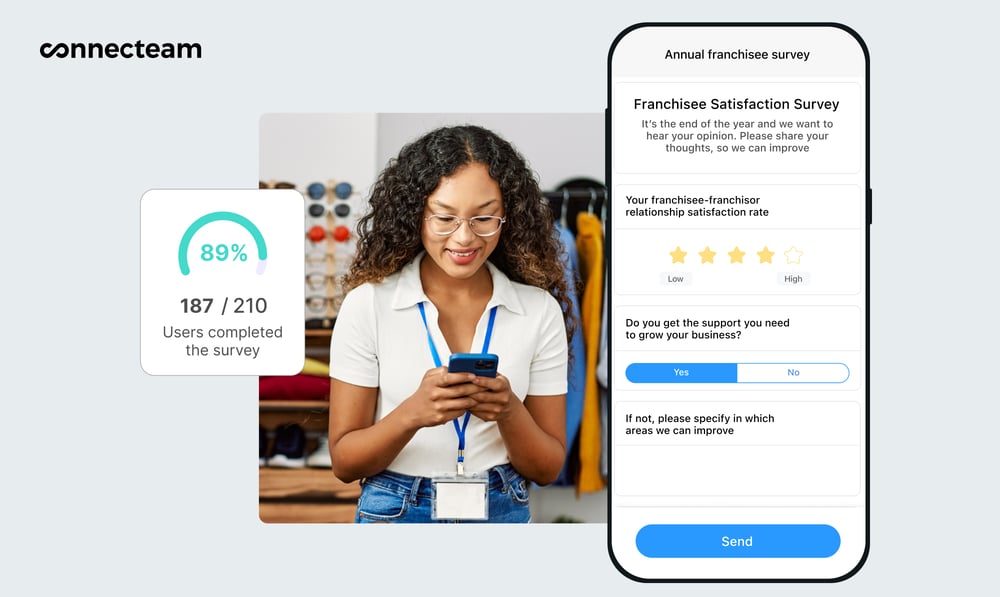
Courses are dynamic, so you can add videos, audio, and files, to engage your team. Build measurement directly into the course itself with quizzes at the end of each section to test knowledge or gather immediate feedback with surveys.
Made to measure
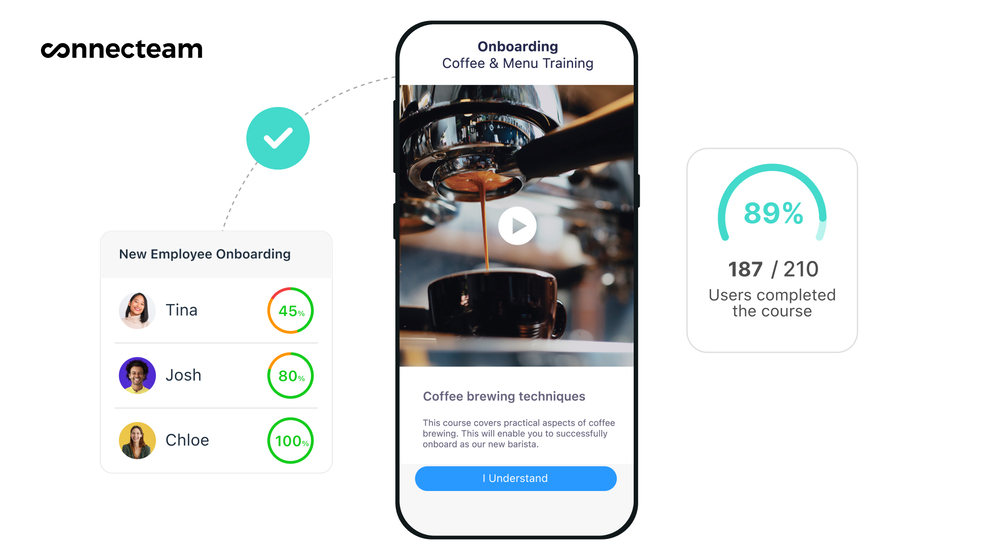
Monitor training progress in real-time from Connecteam’s course dashboard. Track which employees have completed the training, who’s still working on it, and who hasn’t started yet.
Filter by teams, departments, or individuals and use quiz data to zero on which sections employees are struggling with. Send automatic reminders to employees who have more materials to learn.
Reinforce and repeat
Training isn’t a one-time thing. With Connecteam, you can easily create short refresher courses or quizzes to reinforce training over time. Use Connecteam’s digital forms and checklists to complete employee performance evaluations, and stay on top of submissions to track training effectiveness over time.
Value from day one
Connecteam’s Small Business Plan is completely free for up to 10 users. Connecteam’s paid plans are designed to be cost-effective, starting at $29 per month for up to 30 users. Higher-tier plans with more advanced features start at $49/month for Advanced and $99/month for Expert, both also covering up to 30 users.
See the value for yourself—try Connecteam for free today!
The Bottom Line on Measuring Training Effectiveness
Measuring training effectiveness is more than just checking a box. It’s a strategic tool that helps you link training to measurable business results.
Using a framework to evaluate effectiveness helps you set clear goals, measure consistently, and use data to prove your ROI.
If you do this well, training stops being an expense and becomes a data-driven tool for growth and business success. When you measure training effectiveness, you can see how every dollar you spend goes right back into your business.
FAQs
What are the best ways to measure training effectiveness?
The best ways to measure training effectiveness involves assessing reaction, learning, behavior, results, and financial return. To get a complete view of training impact, consider adding feedback surveys, skills assessments, and performance data.
What are the common pitfalls to avoid when measuring training effectiveness?
Avoid common pitfalls like only relying on participant reactions, skipping long-term behavior tracking, or failing to align training goals with business outcomes. Incomplete data collection, poor survey design, and ignoring ROI can also lead to inaccurate or misleading results.
What are the legal and compliance considerations related to training programs?
Legal and compliance considerations for training programs include meeting industry regulations, documenting employee participation, and providing accessible content. Training must comply with labor laws, anti-discrimination policies, and data privacy regulations like GDPR or HIPAA, depending on your industry.
How do I choose the right training programs for my employees?
Choose the right training programs by identifying skill gaps, setting clear goals, and aligning content with business needs. Evaluate course quality, delivery method, and employee learning styles to ensure the program supports growth, retention, and measurable performance improvement.
What are the key metrics you should measure?
Key metrics for measuring training effectiveness include knowledge retention, behavioral change, course completion rates, and performance improvement. Use ROI to assess financial impact and surveys to track learner satisfaction. These indicators help evaluate both learning outcomes and business value.