


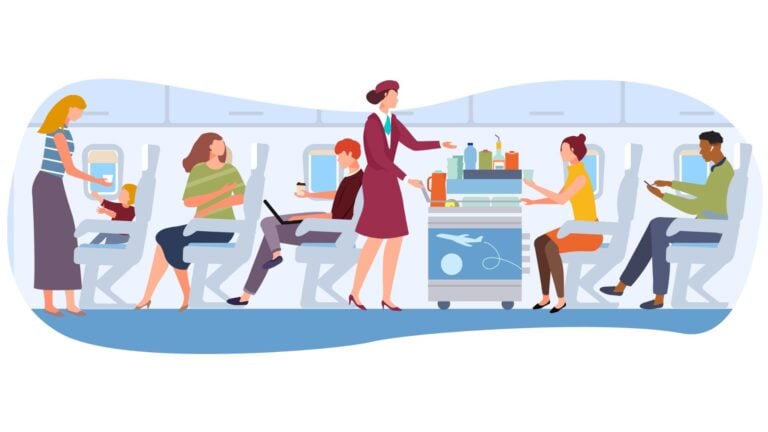
One flight attendant calling in sick can disrupt an entire flight if a legal replacement isn’t available. Airlines use reserve crews to cover disruptions, but they still can’t operate with fewer required flight attendants or ignore the rules that decide who’s legal to work.
Airlines answer that with one of the most tightly engineered scheduling systems in any industry, and the logic behind it works for any business that runs around the clock.
Here’s how those schedules get built, what the law requires, and which parts you can borrow for your own business.
Key Takeaways
- Flight attendants typically work 12 to 14 days a month and fly 65 to 85 hours, but on-duty shifts can run anywhere from 4 to 18 hours or longer.
- The FAA now requires 10 consecutive hours of rest after a duty period of 14 hours or less, and that rest can’t be shortened.
- Many new flight attendants start on reserve, meaning they’re on call and can be assigned a trip with only a few hours’ notice.
- Seniority strongly influences home base, routes, days off, and whether you hold a regular line instead of reserve.
What’s New in This Update (August 2026)
- Updated current FAA rest rules, including full breakdown of the 10-hour non-reducible rest requirement and the duty-period tiers that trigger longer rest.
- Added coverage of the FAA’s 2026 proposal to preempt state meal and rest break laws for cabin crew.
- Created side-by-side schedule comparison on turns, multi-day trips, long-haul rotations, and reserve.
4 Flight Attendant Schedules That Run an Airline
Here’s a quick look at the four main patterns airlines use to maintain round-the-clock coverage.
| Schedule type | What it looks like | Days away | Best for | Main drawback |
|---|---|---|---|---|
| Turns | Two or more flights out and back to base in one day | None | Crew who need to sleep at home nightly | Long duty days with tight connections and no recovery buffer |
| Multi-day trips | 2 to 4 day rotations with overnight layovers | 1 to 3 nights | Building flight hours efficiently | Sleep debt accumulates across the trip |
| Long-haul rotations | One or two very long flights, extended layovers abroad | 2 to 5 nights | Senior crew wanting fewer work days | Jet lag and body-clock disruption that outlast the trip |
| Reserve (on call) | Available for assignment, often with a few hours’ notice | Unpredictable | New crew gaining flight experience | No ability to plan personal life around it |
Most crew members work a blend. A line holder might fly two turns, a three-day trip, and a long-haul rotation inside the same month. What decides the mix isn’t preference alone, and to see why, it helps to start with what the job actually involves.
Why the Job Description Drives the Schedule
Flight attendants are usually pictured as service staff, but the Flight Aviation Administration (FAA) describes them as workers who “serve on the front lines of passenger safety and crisis management.” That distinction is the reason why their schedules are regulated at all.
A crew member’s day starts well before the aircraft doors close. They attend a briefing, check emergency equipment, verify catering and supplies, board passengers, deliver the safety demonstration, and secure the cabin. In the air they run service, monitor the cabin, and handle whatever comes up. On the ground they file reports, wait for aircraft, and reset for the next leg.
Only part of this is paid flight time, which is a distinction that matters for how schedules are built and priced.
The safety-critical work is what forces the structure. Crew members administer first aid, manage medical emergencies, respond to in-flight fires, handle disruptive passengers, and run evacuations. Larger aircraft carry a lead crew member, called a purser or in-flight service manager depending on the airline, who directs the cabin team and acts as the link to the flight deck.
Did You Know?
Flight attendants have one of the highest rates of injuries and illnesses of all occupations tracked by the Bureau of Labor Statistics, mostly sprains, strains, and bruises from working a moving cabin.
How Many Crew Members a Flight Legally Needs
Crew staffing isn’t based on how many passengers actually booked the flight. Under 14 CFR 121.391, the minimum is set by the aircraft’s seating capacity:
- 51 to 100 seats: two flight attendants
- 101 seats and above: two flight attendants, plus one more for every 50 seats (or part of 50) over 100
A half-empty 180-seat aircraft still needs four flight attendants. The reason is evacuation capability, not service levels, which is why crew must be positioned near floor-level exits and spread through the cabin for takeoff and landing.
Understanding this rule explains why airlines can’t trim crew on light loads, and why a single crew member calling out sick can ground an aircraft entirely.
Training That Has to Fit Inside the Roster
Initial training runs several weeks to a few months at the airline’s training center. Trainees cover evacuation procedures, emergency equipment, first aid, flight regulations, and company operations, then complete practice flights before qualifying.
Passing earns an FAA Certificate of Demonstrated Proficiency, and it’s tied to specific aircraft types. Adding a new aircraft means new training. Every crew member also needs training annually to stay certified.
That requirement is growing. The FAA Reauthorization Act of 2024 directed the TSA to set minimum standards for crew self-defense training, including recurrent training, and added requirements around cabin air safety reporting, emergency medical kits, and evacuation standards.
Training days also aren’t optional overhead. They’re blocks that have to be built into the monthly plan alongside flying, which is exactly the problem any business faces when compliance training competes with billable hours.
Using employee training software to track certification expiration dates alongside the schedule helps prevent conflicts.
Career Progression Runs Heavily on Seniority
Seniority is the single most important variable in a flight attendant’s working life. According to the BLS, home base and route assignments are based on it. So are days off, holidays, and whether you get a predictable schedule at all.
Senior crew bid the trips they want. Junior crew take what’s left. With enough seniority, some crew members commute in from another city or fly only regional routes. Advancement into purser, lead, or training and recruiting roles follows the same clock.
Reserve vs. Line Holder: The Divide That Defines Everything
Every airline runs two categories of crew, with major differences between them.
Line holders have a published monthly schedule. They know their trips, their days off, and roughly when they’ll be home. They can plan a dentist appointment.
Reserve crew are on call. Almost all flight attendants start out on reserve, and they usually live near their home airport because they may be told to report on short notice. Reserve exists to cover sick calls, weather disruptions, aircraft swaps, and crew members timing out mid-trip.
An FAA study of 202 flight attendants across 28 airlines found that reserve assignments were most common among junior crew members. More than half of the junior regional flight attendants were on reserve, compared with none in several mid-level and senior groups.
Reserve scheduling has also become a major focus in union negotiations. United Airlines’ flight attendant contract, ratified in May 2026, eliminated 24-hour on-call reserve schedules, added limits on red-eye flying, and included an average 31% pay increase. These changes reflect the growing concern about the strain caused by long, open-ended availability periods.
Pro Tip
If you run an on-call rotation, cap the availability window and publish it in advance. Open-ended “be reachable” expectations are the fastest route to burnout, and they’re increasingly being bargained away in industries that pioneered them. Our guide to building an on-call schedule covers the models that work best.
How Bidding Actually Works
Airlines don’t hand out schedules. Crew members bid for them based on their preferences, using a process that can also apply to other workplaces.
The building block is a pairing, or a sequence of flights that starts and ends at the crew member’s home base. A month’s worth of pairings stitched together forms a line. Airlines allocate those lines in one of three ways:
- Assigned lines. Management builds the schedule and hands it out. No bidding.
- Bid lines. The airline builds complete lines, crew bid on them, and seniority wins. Simple, but pre-planned absences like vacation or training create conflicts that then need manual reassignment.
- Preferential bidding systems (PBS). Crew submit ranked preferences (specific trips, days off, layover cities, credit hours) and software builds a personalized line around them, honoring seniority order.
The advantage of PBS is that it accounts for pre-planned activities such as vacation, training, and military leave up front, rather than discovering conflicts afterward.
Whichever system an airline uses, the software solves a genuinely difficult problem. It has to minimize crew cost while satisfying every FAA duty and rest limit, every clause in the union contract, aircraft qualification requirements, and thousands of individual preferences. Labor is one of an airline’s largest costs alongside fuel, so the optimization is worth real money.
Did You Know?
Preference-based scheduling isn’t just for airlines. Connecteam’s auto-scheduler assigns open shifts based on availability, qualifications, and stated preferences, then flags conflicts before the schedule goes out, which is the same core logic a preferential bidding system uses.
The Hours Behind the Schedule
Now that the structure is clear, here’s what it adds up to in practice.
A typical flight attendant works 12 to 14 days a month and logs 65 to 85 flight hours. That sounds light until you separate flight hours from actual working time. Flight hours count only the airborne portion. Briefings, boarding, deplaning, ground delays, and sit time between legs are all real work that doesn’t add to that total.
On-duty shifts vary from 4 to 18 hours or longer, with the longest tied to international flying. Crew spend several nights a week or month away from home, and airlines typically provide meal allowances plus hotels or shared crash-pad apartments.
In most cases, a contract between the airline and the flight attendant union determines total daily and monthly workable hours. Federal rules set the minimum requirements, while union contracts determine the day-to-day working rules and are often stricter.
The FAA Rest Rules Every Schedule Has to Clear
In October 2022 the FAA extended flight attendant rest periods from 9 hours to 10, and removed the provision that had let airlines shorten it. The change fulfilled a mandate in the FAA Reauthorization Act of 2018 and followed more than 1,000 public comments.
Here’s what’s required today:
| Scheduled duty period | Required rest | Conditions |
|---|---|---|
| 14 hours or less | 10 consecutive hours | Can’t be reduced below 10 under any circumstances |
| Over 14, up to 16 hours | 12 consecutive hours | Requires 1 flight attendant above the minimum crew |
| Over 16, up to 18 hours | 12 consecutive hours | Requires 2 flight attendants above the minimum |
| Over 18, up to 20 hours | 12 consecutive hours | Only for flights outside the 48 contiguous states and DC, and requires 3 extra crew |
Two more rules matter for anyone building a schedule:
Rest means rest. A rest period is time completely free of all duty and responsibility for work. No assignments during it. Deadhead flights, where crew members travel as passengers to reach another work assignment, and company transportation to or from the airport don’t count as rest. Travel time isn’t recovery time.
Everyone gets a real day off. Crew must have at least 24 consecutive hours free from all duty in any 7 consecutive calendar days.
After a long duty period, the required 12-hour rest can be reduced to 10 hours only if the flight attendant receives at least 14 consecutive hours of rest within the next 24 hours. The airline also can’t schedule a duty period longer than 14 hours during that window.
Alternatively, airlines can apply the stricter Part 117 pilot rest rules to flight attendants if they have written procedures approved by the FAA.
Pro Tip
Build your rest minimums into the scheduling tool rather than checking them after the fact. Connecteam’s employee scheduler flags conflicts, double-bookings, and approaching overtime as you build, so a violation gets caught before the schedule is published instead of after someone’s already been assigned.
The 2026 Proposal Worth Watching
On July 6, 2026, the FAA proposed a new rule that would determine whether state and local break laws apply to flight attendants. If finalized, federal duty and rest regulations would override all state and local meal and rest break requirements.
The FAA’s reasoning is that different state rules would create an inconsistent system for a national industry and interfere with airline prices, routes, and services. The proposal would also clarify that flight attendants can’t take off-duty breaks during an active duty period.
It’s still a proposal. The comment period closed on September 4, 2026, and the FAA has not published a final rule. For any employer running multi-state operations, it’s a useful reminder that federal and state scheduling rules can point in different directions. Assuming your state’s break law applies isn’t always safe. Our state labor laws guide breaks down where those rules currently stand.
What Fatigue Actually Costs a Business
Duty and rest rules can feel overly restrictive until you consider the cost of operating without them.
Flight attendants start work already fatigued. The FAA’s study we mentioned found that flight attendants slept an average of 5.7 hours on work days and 6.3 hours on days off. Crew working international routes slept even less, averaging 4.9 hours versus 5.9 hours for domestic crew.
Every group showed measurable impairment on reaction-time tests taken before their shift compared to their own best baseline.
The risks can also increase as a flight progresses. In a study of 65 cabin crew on an Auckland to Chicago route, fatigue peaked at top of descent and after landing, which is exactly when the safety-critical work happens. The same study found every extra hour of in-flight sleep reduced fatigue at descent, while jet lag stayed elevated four days after returning home.
The financial impact extends beyond aviation. NIOSH estimates that work-related fatigue costs U.S. employers at least $218 billion annually through lost productivity and health-related absences. It may also contribute to nearly one in eight workplace injuries.
Poor crew coverage creates further operational costs. In June 2026, air carrier delays, which include crew scheduling problems, maintenance, and aircraft cleaning, accounted for 30.5% of domestic delay minutes. Weather accounted for 6.7%.
One late flight can leave a crew unavailable for several later flights. Airlines reduce this risk with reserve crews, schedule buffers, crew pre-positioning, and aircraft pairing. These measures cost money, but widespread delays and cancellations can cost far more.
Did You Know?
Fatigued workers make more errors, and the cost shape changes by industry. In aviation it’s a safety event. In healthcare it’s patient harm. In manufacturing it’s an accident rate. In field services it’s a callback and a lost customer. The scheduling fix is the same in all four.
Find weak points in your 24/7 coverage plan before a callout turns into a scramble. Answer six quick questions to see where your roster needs stronger guardrails.
Use this quick check as a planning guide; it doesn’t replace legal, safety, or labor advice.
- Answer each question based on how your team works today.
- Review your score and the gaps that create coverage risk.
- Prioritize the first safeguard to strengthen in your next schedule.
How Pay Connects to the Schedule
Pay structure explains a lot of the friction in flight attendant scheduling because not every hour spent working is paid.
Traditionally, flight attendants were paid only from when the aircraft door closed until it reopened. Boarding, deplaning, delays, and other ground time went unpaid, even though crews were still working. On a day with four short flights and long waits between them, a flight attendant could spend 12 hours at the airport but only be paid for six.
That’s been changing. Delta Airlines introduced boarding pay at 50% of flight time pay starting in June 2022, becoming the first major U.S. carrier to pay for boarding, and American Airlines and Alaska Airlines followed. United Airlines’ 2026 contract added boarding pay worth an additional 7% to 8%, plus pay for delays over 2.5 hours.
The BLS reports that flight attendants earned a median annual wage of $67,130 in May 2024. Employment is expected to grow 9% between 2024 and 2034, with around 19,800 openings each year.
Pro Tip
If “unpaid” working time is part of your team’s schedule (setup, cleanup, travel between sites, waiting for a job to start), treat it as a compliance risk, not a cost saving. Use a time clock app to get a clear picture of what each day actually costs before unpaid hours turn into a wage claim.
5 Scheduling Lessons for Any 24/7 Team
Airlines have spent decades improving their scheduling under intense regulatory pressure. But any 24/7 business can learn a lot from their approach.
- Publish schedules as far ahead as you can. Airlines publish monthly bid results for a reason. The further out people can see, the less churn you get from conflicts, swap requests, and callouts. Predictability is the cheapest retention tool available.
- Treat rest as a hard constraint, not a target. The FAA made the 10-hour rest period non-reducible because a reducible minimum becomes the default. If your minimum turnaround is negotiable, it will be negotiated away on your busiest week.
- Build a real reserve pool. Airlines don’t hope nobody calls out. Instead, they staff for it. A defined pool of cross-trained people who know they’re on call for a specific window beats scrambling through a group chat at 5 a.m.
- Distribute the bad shifts by a set rule. Seniority is blunt, but it’s transparent, and everyone understands it. Whatever rule you use, publishing it prevents the perception that the same people always get the worst assignments.
- Count all the working time, not just the productive part. Airlines learned this the expensive way through boarding pay disputes. If your schedule assumes an eight-hour day but the real day is ten, your labor costs and your compliance exposure are both wrong.
The Bottom Line
Flight attendant schedules work because rest is treated as a hard limit, coverage is staffed rather than hoped for, and the rules for distributing good and bad assignments are visible to everyone.
Whether you’re running a hospital floor, a field service crew, or a 24-hour production line, those three principles transfer directly.
For teams that need a simple way to put those guardrails into practice, Connecteam helps managers build, share, and update schedules from one place.
See for yourself–try Connecteam free today.
FAQs
Most work 12 to 14 days a month and log 65 to 85 flight hours, but flight hours only count time in the air. Individual on-duty shifts range from 4 to 18 hours or longer, and union contracts usually set stricter daily and monthly caps than federal rules require.
The median annual wage was $67,130 as of May 2024, according to the Bureau of Labor Statistics. Pay is typically hourly and rises steeply with seniority, and several major airlines now add boarding pay on top of flight-hour pay.
Initial training lasts several weeks to a few months at the airline’s training center and covers evacuation procedures, emergency equipment, first aid, flight regulations, and company operations. Trainees complete practice flights, then receive an FAA Certificate of Demonstrated Proficiency for specific aircraft types. Recurrent training is required every year.
Flight-hour pay traditionally starts when the aircraft door closes and stops when it opens. Because that left boarding and ground delays unpaid, several airlines added boarding pay.
For a scheduled duty period of 14 hours or less, the FAA requires 10 consecutive hours of rest, and it can’t be shortened. Longer duty periods require 12 hours. Crew must also get 24 consecutive hours completely free from duty in any 7 consecutive days, and transportation to or from the airport doesn’t count as rest.
Line holders have a published monthly schedule with known trips and days off. Reserve crew are on call and can be assigned a trip on short notice, so they usually live near their home airport. Nearly all flight attendants start on reserve and move to line-holding status as they gain seniority.
Indirectly. Crew bid for schedules each month, and seniority determines whose preferences win. Some airlines use preferential bidding, where crew submit ranked preferences and software builds a personalized schedule. Others publish complete schedules that crew bid on directly.
