



Managing PTO gets complicated when one request has to move through a balance record, manager approval, the work schedule, and payroll. Each handoff creates another place for managers to check, update, or correct.
We analyzed anonymized conversations with 63 companies that discussed how they currently manage planned time off from March through August 2026. 52% rely on an owner or manager to personally track PTO, and manual work shows up throughout the rest of the process too.
Key PTO Statistics From Our Research
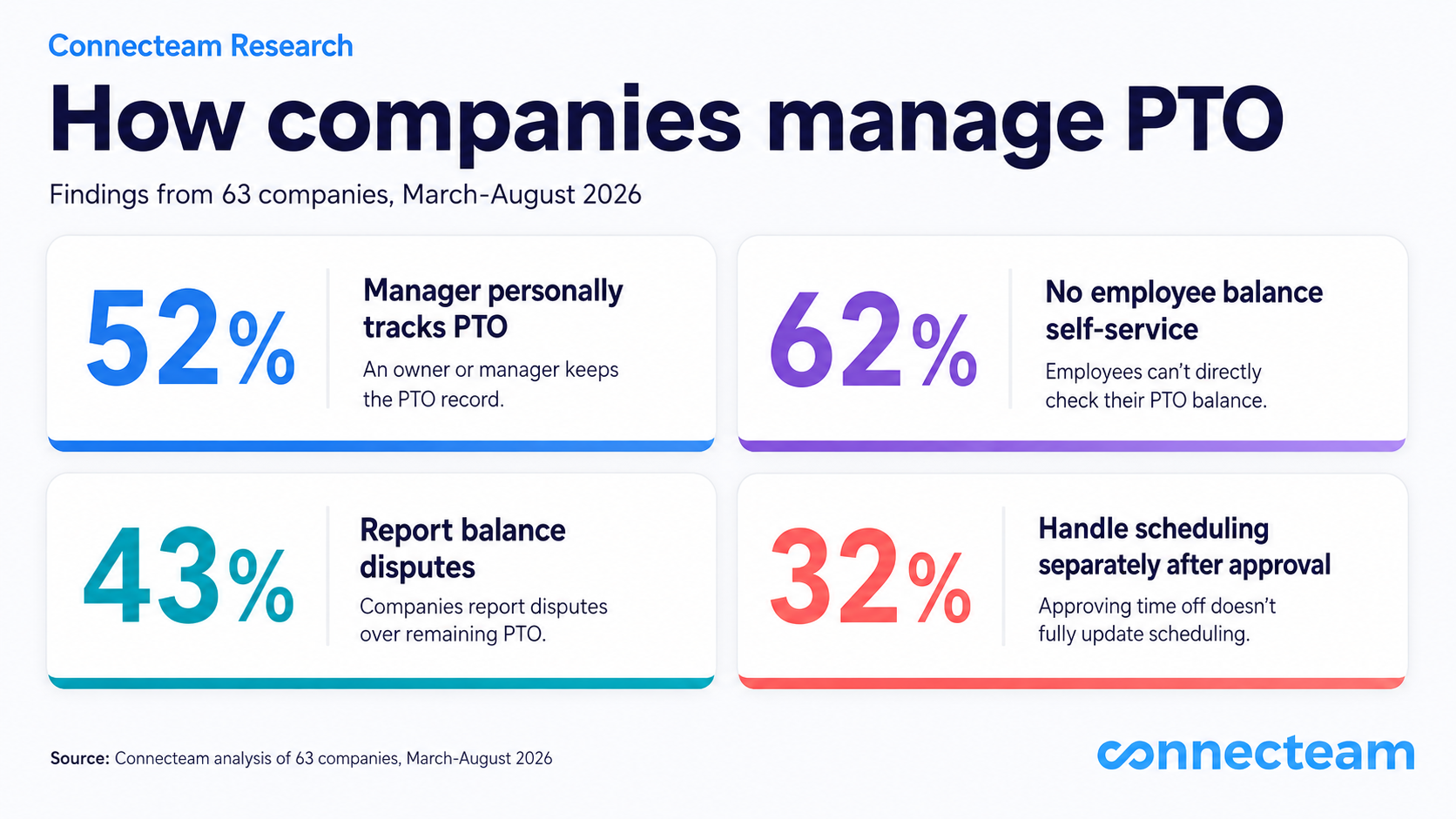
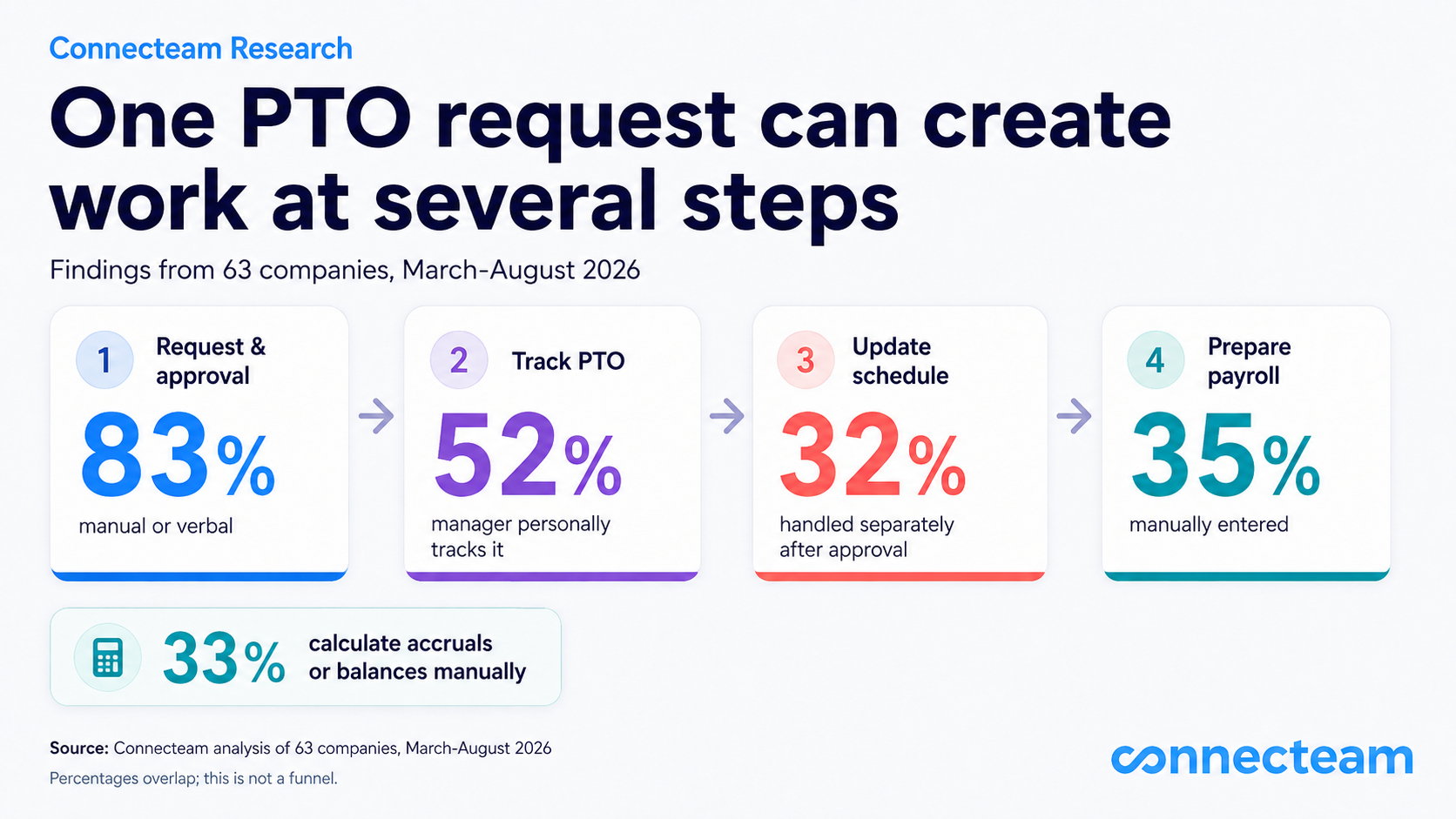
- 52% rely on an owner or manager to personally track PTO.
- 83% have manual or verbal PTO request and approval processes.
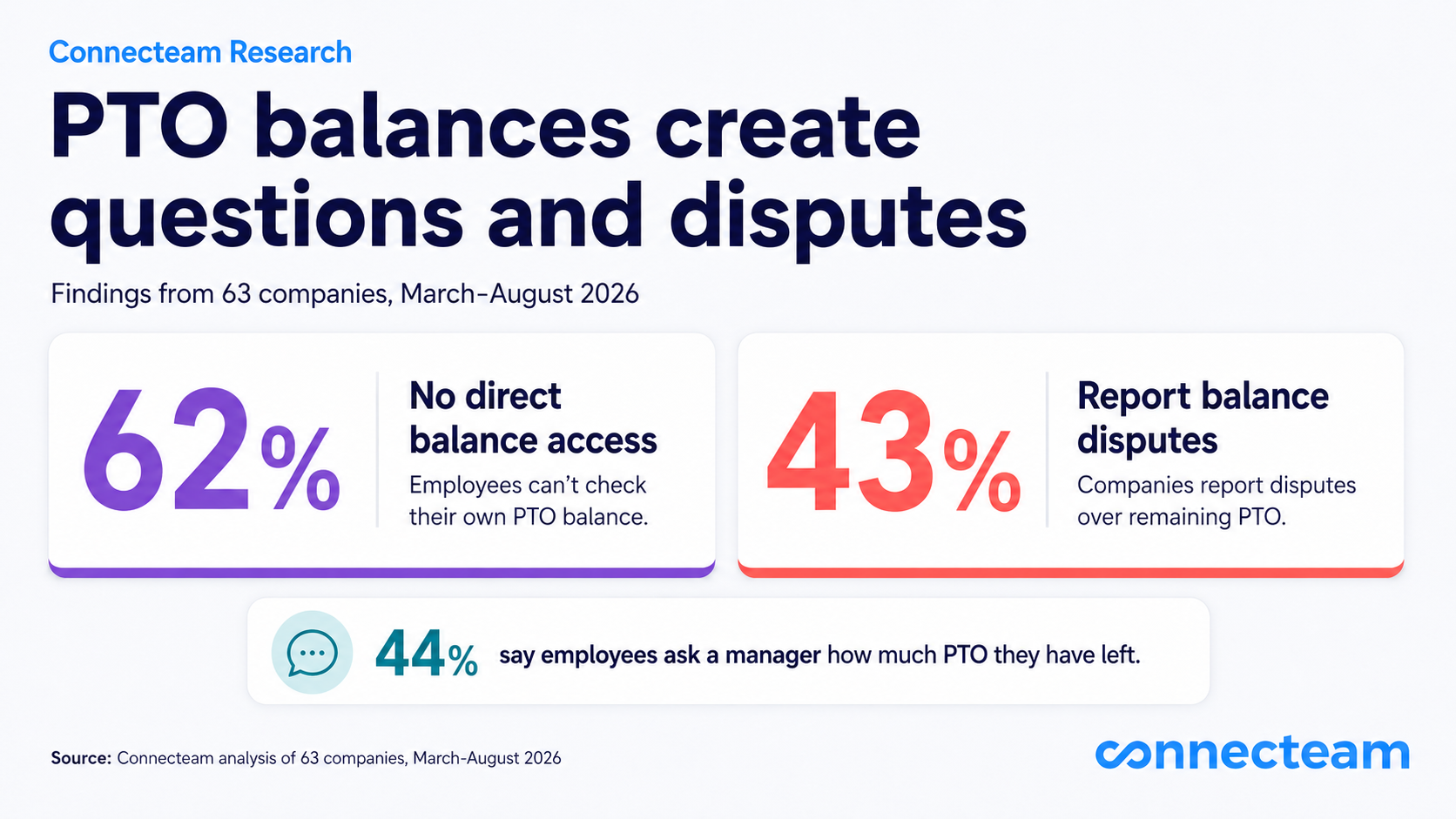
- 62% don’t give employees direct access to their PTO balances.
- 43% report disputes over remaining PTO days or balances.
- 32% handle the schedule separately after approving PTO.
- 35% manually enter PTO into payroll.
- 33% calculate PTO accruals or balances manually.
PTO Management Statistics From 63 Companies
52% rely on an owner or manager to personally track PTO
More than half of the companies we analyzed rely on an owner or manager to personally keep track of employee PTO.
Managers keep records in spreadsheets, paper files, calendars, payroll systems, or their own records. They check balances, make calculations, and piece together PTO information when employees have questions.
That puts a large part of the PTO process in one person’s hands. The manager maintaining the record also becomes the person employees depend on when they need a balance, correction, or answer about a request.
83% have manual or verbal PTO request and approval processes
83% have manual or verbal PTO request and approval processes.
Employees ask managers directly, send requests through informal channels, or submit requests that someone still needs to manually review and record.
Across the conversations, managers describe PTO requests arriving through conversations, messages, calendars, forms, and other processes that depend on someone remembering what was requested and making sure it reaches the right record.
The approval itself is only one step. After managers approve time off, they may still need to update a balance, change the schedule, or prepare the absence for payroll.
62% don’t give employees direct access to their PTO balances
62% don’t give employees a direct way to check their own PTO balance.
In 44% of companies, employees ask a manager how much time they have left. Another 17% don’t give employees access to their balance at all.
Managers describe repeatedly answering balance questions themselves. In some cases, getting the answer means opening another system, checking past time off, doing the math, and then passing the balance back to the employee.
A simple question such as “How many days do I have left?” becomes another admin task.
43% report disputes over remaining PTO
43% report disputes over employees’ remaining PTO days or balances.
Companies describe employees and managers having different understandings of how much PTO remains, what has already been used, or how an accrual should have been calculated.
The study doesn’t establish that limited employee visibility causes these disputes. It does show the same underlying gap on both sides: employees often depend on managers for their balance, while managers are frequently responsible for maintaining that balance themselves.
32% handle the schedule separately after approving PTO
32% have another scheduling step after approving an employee’s time off.
Managers describe approving PTO and then separately going into the schedule to deal with the employee’s existing shift or absence.
For a shift-based business, an approved request and a staffed schedule are closely connected. When those records live separately, approval doesn’t finish the job.
The manager still needs to make sure the schedule reflects the absence and that the employee isn’t left on a shift they’re no longer available to work.
35% manually enter PTO into payroll
35% manually enter PTO information into payroll.
Managers describe gathering PTO information from separate records and then entering or sending it to the payroll system.
This creates another handoff for the same absence. The PTO request may already have been recorded and approved, but the information still needs to reach payroll separately.
33% calculate PTO accruals or balances manually
33% calculate PTO accruals or balances manually.
That can mean keeping track of how much PTO an employee earns, subtracting time already taken, or working through rules that change with hours worked or tenure.
The process gets harder when employees don’t all follow the same accrual rules. Managers need the current policy, the employee’s history, and the correct balance to agree.
Together, the findings show the path one PTO request can take:
Request → approval → balance → schedule → payroll
In many of the companies we analyzed, several of those steps still depend on a manager manually carrying the information forward.
Manage PTO Requests, Balances, and Approvals With Connecteam
Our research shows that PTO work often lands on one manager: employees ask them for balances, requests need manual approval, and approved time off still has to reach schedules and payroll.
Connecteam’s Time Off feature keeps those steps connected in one workflow.
Give employees direct access to PTO
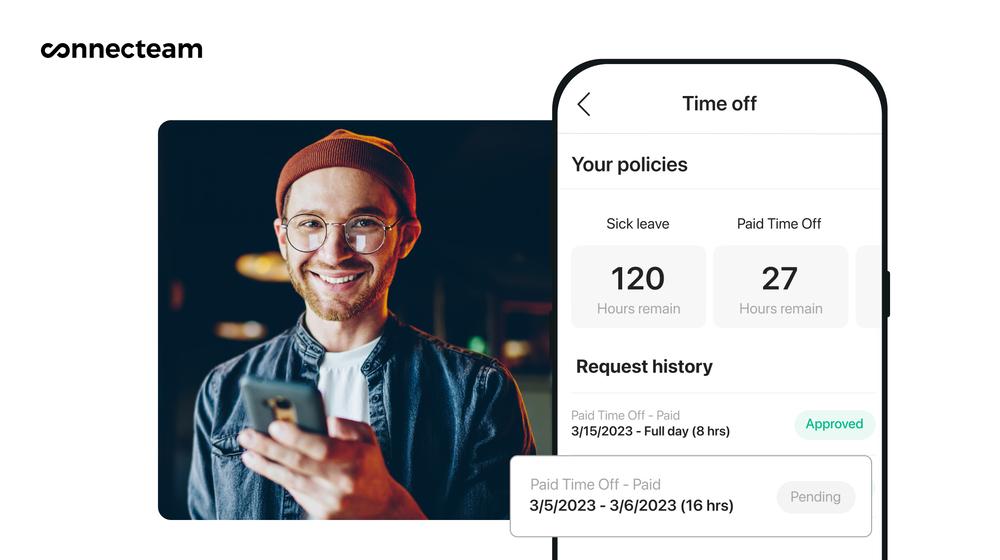
Employees can submit time-off requests from the mobile app, check their current and projected balances, and see whether a request is pending or approved.
That removes the need for employees to ask a manager every time they want to know how much PTO they have left.
Keep requests, policies, and balances together
Managers can approve or decline requests and manage paid and unpaid leave policies in the same place.
Connecteam supports fixed and hourly accruals, tenure-based changes, carryover rules, and manual grants. PTO balances stay tied to the employee record instead of living in a separate spreadsheet or manual calculation.
Connect approved PTO with schedules and time records
Approved time off appears in Time Clock timesheets and flags a conflict when an employee has a same-day shift in the Job Scheduler.
For payroll preparation, approved leave stays with employee time records and can feed supported payroll exports and integrations. Connecteam supports payroll preparation rather than processing payroll itself.
Methodology
We analyzed anonymized customer and prospect conversations from 63 companies between March and August 2026. Each company in the study discussed its current process for managing planned PTO, vacation, or other scheduled time off.
We analyzed customer statements only and excluded hypothetical feature discussions, future plans, and unplanned sick callouts. Each company counted once, even if the conversation contained multiple PTO-related examples.
We coded the conversations for recurring PTO-management practices and problems, including request and approval processes, balance visibility, tracking methods, accruals, scheduling handoffs, payroll entry, and disputes. Categories can overlap because one company may experience several of these issues at the same time.
Most percentages use all 63 companies as the denominator. When a finding could only be determined for a smaller group, we use that relevant subset instead. For example, the tracking-method finding is based on the 50 companies where the current tracking method was clear.
These findings describe the companies in our analysis, not all U.S. employers. Because the source conversations involve businesses discussing workforce-management needs, they are more likely to surface processes that companies want to improve.
Frequently Asked Questions
Manual PTO management is common. Connecteam research found that 52% of companies rely on an owner or manager to personally track PTO, while 83% use manual or verbal request and approval processes.
No. Connecteam research found that 62% of companies don’t give employees direct access to their PTO balances. In 44% of companies, employees ask a manager how much PTO they have left.
Connecteam research found that 43% of companies report disputes over remaining PTO days or balances. These disputes can involve how much PTO an employee has left, what they have already used, or how their balance was calculated.
Connecteam research found that 32% of companies handle another scheduling step after approving PTO. Managers may approve the time off and then separately update the schedule to reflect the employee’s absence.
Connecteam research found that 35% of companies manually enter PTO information into payroll. This means approved time off still has to be transferred into the payroll process instead of flowing through automatically.
Connecteam research found that 33% of companies calculate PTO accruals or balances manually. This can include tracking earned time, subtracting used PTO, and applying different accrual rules based on hours worked or tenure.
