


When you’re on a budget, training is usually one of the first things to go. It’s not cheap, but neither is turnover, low performance, or customer retention.
Measuring ROI helps you see training as an investment in your business, not just another cost. It shows you the value you get back for the time and money you spend, so you can make smarter decisions.
In this guide, I’ll break down how to measure the ROI of employee training. We’ll cover what it means, why it matters, and how to turn training into a powerful tool to support your business growth.
Key Takeaways
- ROI shows whether employee training is an investment or just a cost. Measuring it helps you make better business decisions.
- You don’t need perfect data to get started. Even simple measures like retention, productivity, and error reduction can show real impact.
- Strong onboarding delivers fast ROI by reducing early turnover and getting new hires productive sooner.
- Tracking results consistently helps you refine programs and improve outcomes.
- The right tools make ROI easier to measure by lowering training costs and connecting learning to real business results.
What is Employee Training ROI?
Return on investment, or ROI, is a basic way to understand whether something is worth what (money, time, effort, etc.) you spend on it. It asks, “What did this cost, and what did I get back?” When the return is higher than the cost, your ROI is positive; when it’s not, it’s a sign something needs to change.
The ROI of employee training works the same way. It shows you the value you get from investing in your team. Think of it like this: for every dollar you spend on training, how much does your business gain in return?
Here’s what you need to look at to figure it out:
The Return
Your return is the benefit created by the training, translated into dollars. It could be higher sales, better productivity, fewer errors, or lower employee turnover.
The Investment
Your investment is everything that goes into running the training. Think: instructor fees, materials, tools, resources spent creating the training, and the time employees spend away from their day-to-day work.
How to Calculate the ROI of Employee Training
Ultimately, ROI is a calculation. You take your benefits and measure them against the cost to get a percentage.
The formula is straightforward:
((Monetary Benefits – Total Costs) / Total Costs) × 100 = ROI (%)
Let’s try it out:
Taylor invested $10,000 on an HVAC training program focusing on proper installation, diagnostics, and safety. The cost included the trainer, materials, and paid time for the techs.
After the training, technicians started to complete jobs faster, install errors dropped, and callback visits declined, resulting in lower labor and fuel costs. Over time, the improvements added up to $15,000 in savings.
Here’s how to calculate the exact ROI of the employee training:
(($15,000 – $10,000) / 10,000) × 100 = 50% ROI
In short, the training more than paid for itself. That’s how training becomes an investment, not just an expense.
Ready to try it for yourself? Use our free training ROI calculator below. Enter your returns (benefits) and investments (costs), assign a dollar value to each, and click “Calculate ROI” to see your results.
Training ROI Calculator
List your training costs and benefits to calculate the ROI.
Returns
Investments
Did You Know?
In 2025, businesses spent an average of 40 hours and $874 per employee on training. That’s a serious investment of both time and money.
Why Does Calculating Employee Training ROI Matter?
Measuring the ROI of employee training is all about making smarter business decisions. Tracking ROI helps you identify what really works so you can get the most out of it.
If you’re still on the fence, here’s how assessing employee training ROI can help you:
- Justify your spend: When you can show that training pays for itself, it’s easier to defend your budget and even ask for more resources down the line.
- Connect to goals: Measuring ROI pushes you to ask the right questions, such as, “Is this training helping us grow? Reduce costs? Retain talent?” It keeps training focused on the outcomes, not the activity.
- Improve over time: By tracking results you can see what’s delivering value and what’s not moving the needle. Having that insight lets you change your programs before you repeat the same mistakes.
The impact of training is strong: lower turnover, better retention, and higher returns per dollar spent. SHRM reports that 76% of employees are more likely to remain at a company that offers ongoing training opportunities. When training is measured, it drives growth.
3 Ways to Measure Employee Training ROI
In the 1950s, Dr. Don Kirkpatrick introduced a four-level model to evaluate training, looking at reaction, learning, behavior, and results. Dr. Jack J. Phillips later expanded on that work by adding a fifth level: return on investment.
It moved the focus from “Did training work?” to “Did it pay off?”
These models give you a good framework, but the real work comes in turning training into dollars.
This Might Interest You
Check out this article to learn more about these frameworks and How to Measure Training Effectiveness in the Workplace!
Here are a few practical ways to measure and calculate the ROI of employee training:
Put a value on better onboarding
Onboarding is one of the most common forms of employee training, and it directly impacts retention, productivity, and cost. Strong onboarding reduces early exits and cuts the need for expensive rehires.
New hires take time to get into the swing of things, and many start looking elsewhere within their first six months. When onboarding is weak, costs quickly add up. You pay to hire them, and then pay again for lost productivity.
Improved onboarding drives value in measurable ways that directly contribute to your training ROI, including:
- Faster time-to-productivity: New hires spend fewer days onboarding and can contribute sooner.
- Lower early churn: Employees have positive onboarding experiences and stick around, reducing rehiring and retraining costs.
- Lower onboarding costs: More effective onboarding means less spend on trainer time, travel, and materials.
Measure the cost of employee turnover
Turnover is expensive, and replacing an employee usually costs far more than their salary once you factor in recruiting, training, and lost productivity.
Training plays a major role here, since it can improve confidence, performance, and employee engagement, all of which reduce turnover.
If training reduces turnover even slightly it can translate into meaningful ROI. To calculate the impact, look at these four cost areas:
- Covering the vacant role: Include what you’ll spend on overtime from existing employees or lost output if you can’t fill the position.
- Hiring costs: This would be recruiters, job ads, and interview time.
- Onboarding costs: How much will you spend on the replacement employee.
- Lost productivity: The time it takes until the replacement is fully trained and can work independently.
This Might Interest You
Want to learn how much employee turnover is costing your business? Use our free calculator to find out.
Calculate the cost of fewer errors
Mistakes aren’t cheap, especially when they mean rework, refunds, compliance issues, warranty claims, or lost customers.
Training reduces errors by helping employees do the job right the first time.
To measure this:
- Identify the most common and costly errors
- Estimate the average cost of each error
- Track error rates before and after training
The drop in errors, multiplied by the cost per error, gives you a clear dollar value tied directly to training. Here’s the formula:
(Errors Before Training − Errors After Training) × Cost per Error = Cost Savings from Fewer Errors
Here’s how it works:
Kyle manages a hotel. Front desk mistakes, like incorrect room assignments, billing errors, or missed special requests, lead to guest complaints, refunds, and comped stays.
Before training, Kyle’s team averages 40 errors per month, at a cost of $75 per error. After a targeted training, errors drop to 25 per month.
40 Errors – 25 Errors = 15 Errors
15 Errors × $75 = $1,125 in Monthly Savings
Over the year, that adds up to $13,500 in cost savings tied directly to training ROI.
Best Practices for Calculating Employee Training ROI
To get useful results, it helps to follow a few best practices when calculating the ROI of employee training. Here are some key do’s and don’ts to keep you on track:
| Do | Don’t |
| Align training with clear business goals | Train without a clear purpose |
| Use both data and employee feedback | Rely only on numbers and ignore feedback |
| Track results over time | Measure once and stop |
| Get buy-in from employees and leadership | Try to do it all on your own |
| Start with one program and expand | Measure everything at once |
| Use realistic timelines for results | Expect immediate ROI from all training |
Following these guidelines helps training ROI become clearer, more credible, and easier to act on.
Measure the ROI of Employee Training with Connecteam
Measuring training ROI doesn’t have to be complicated. With the right tools, you can create training, deliver it, and track results in one place. That’s where Connecteam’s all-in-one employee training app comes in.
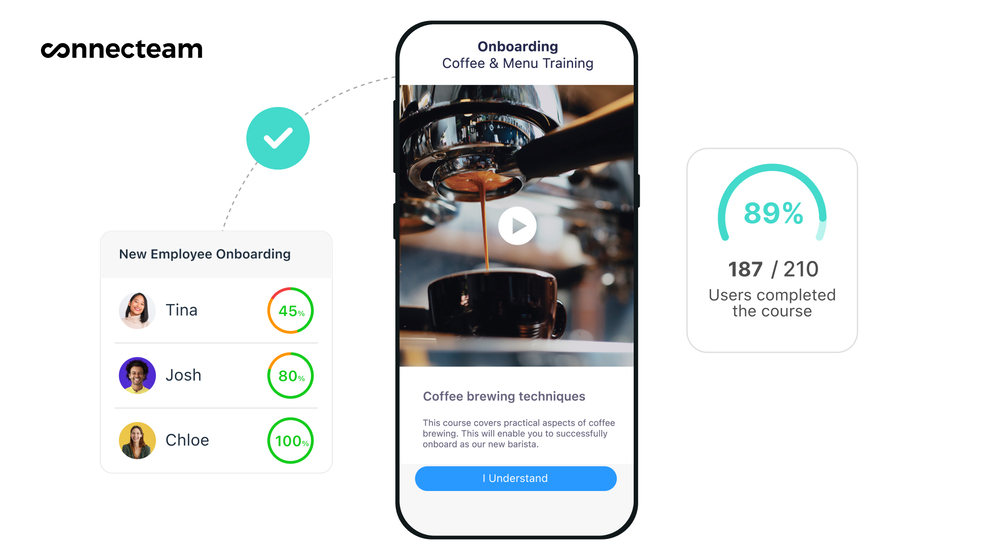
Connecteam helps you link training directly to business impact, from cost control to measurable results. Here’s how:
- Course creation: Use ready-made templates or the AI Course Creator to build complete training in minutes.
- Mobile-first training: Deliver bite-sized courses employees can complete on the job or on the go, right from their phones.
- Multi-media content: Add videos, audio, images, and files to keep training practical and engaging.
- Built-in quizzes: Measure learning and knowledge retention directly inside each course.
- Quick surveys: Gather quick feedback to understand how employees respond to training in real-time.
- Analytics dashboards: Track completions, scores, and participation at a glance, and filter results by role, team, or department.
- Automatic reminders: Notify employees about ongoing training and reinforce learning with short refreshers over time.
Value from day one
Training doesn’t have to be expensive. You don’t need long in-person sessions, venue rentals, travel costs, and hours spent developing materials.
With Connecteam, you move from a costly, resource-heavy process to a streamlined, lightweight solution.
The best part? Connecteam is designed to deliver maximum value without breaking the bank. The Small Business Plan is completely free for up to 10 users. As your business grows, paid plans start at just $29 per month for up to 30 users.
Ready to see the value for yourself? Try Connecteam for free today!
The Bottom Line
Employee training is one of the most valuable investments you can make into your business, but only if you treat it like one. Measuring training ROI gives you clarity on what’s working, what’s not, and where to focus your time and budget.
By tracking practical outcomes like retention, time to productivity, and fewer errors, you can connect training directly to real business results. Over time, those insights help you enhance your programs, reduce waste, and increase impact.
When training is measured, it stops being a question mark on the budget and becomes a tool for growth.