


Once you’ve launched a cleaning business, the hard part isn’t just finding your first clients. It’s keeping everything running smoothly as your company grows and the day-to-day gets more complex.
Many cleaning businesses start out strong. But as you grow, it gets harder to juggle staff, clients, and logistics. Quality can slip, employees can burn out, and growth can stall.
Below, we cover how to run a successful cleaning business with smarter scheduling, better hiring and training, and systems that support steady growth and lasting customer satisfaction.
Key Takeaways
- Great cleaning is the baseline. Loyalty comes from the full experience, with thoughtful touches and fast follow-ups that build trust.
- Hire for character, train for skill, and build consistency through clear instructions and regular training. You’ll get reliable results, no matter who’s assigned to the job.
- Use quick, daily check-ins to reinforce expectations and catch issues early.
- Stay organized with the right app for scheduling, invoicing, routes, and more. You’ll reduce confusion, improve accountability, and save time.
- Track a few key numbers and only scale when your team and systems can handle it.
A Step-by-Step Guide on How To Run a Successful Cleaning Business
Whether you’re trying to run a successful home cleaning business, a commercial cleaning business, or a niche cleaning business, these strategies can help.
Deliver more than a clean space
When you start a cleaning business, spotless results are the baseline. What keeps clients coming back is how you make them feel throughout the process. Thoughtful gestures can turn one-time jobs into long-term contracts.
Eli Barker, Director of Sales & Marketing at Smart Cleaning LLC, emphasizes the power of personal actions: “At the end of the student housing turnover season, the owner of the company hand-makes tres leches cakes for every single property that we work with and brings them as a thank you for continuing to use us for their cleaning needs.”
Thoughtful actions like these can take many forms:
- Seasonal touches: Holiday cards, small treats, or a small plant in the spring.
- Handwritten thank-you notes: Quick, personal messages after major cleans or contract renewals.
- Complimentary extras: Small surprises for loyal clients, like organizing a fridge or watering their plants during a visit.
Such gestures cost little but signal that your cleaning company treats relationships as seriously as revenue.
That same care matters when something goes wrong. “If the cleaning is not up to the client’s needs,” Barker adds, “We go back and redo the cleaning within 24 hours at the most, if not the same day. We don’t charge anything extra for this.” When clients know you’ll stand by your work, they stop worrying about mistakes and start trusting your commitment.
Over time, this mix of personal connection and professional accountability becomes your biggest competitive edge.
This Might Interest You
Discover our guides to getting leads for a cleaning business and selling cleaning services.
Hire for character, train for skill
When you’re running a cleaning business, cleaning tools and supplies matter, but your team is what clients remember.
This means hiring for character is essential. You can train someone to follow a cleaning checklist, but it’s a lot harder to teach integrity, accountability, or care.
Barker explains, “You are entering other people’s spaces, so you need to know that the worker is going to respect those spaces and respect the clients themselves.”
Brian Davis, CEO of Handy Rubbish, agrees: “Skills can be taught, but you can’t be taught mindset and work ethic.”
To spot character in candidates:
- Ask behavioral questions in interviews: For example, “Tell me about a time you had to choose between doing a job quickly and doing it right,” or “Describe how you handled a client who questioned your work even though you knew you’d done it properly.” Listen for honesty, professionalism, and sound judgment.
- Use situational assessments: Tools like TestGorilla or Harver offer short and customizable tests candidates can take that include questions about real-world scenarios (e.g., a client changing instructions mid-job). These can reveal reliability and judgment.
- Check references for behavior, not just skills: Ask previous employers about punctuality, client interactions, and respect for property.
- Start with a trial period: Assign new hires a few supervised visits to see how they communicate and uphold standards.
- Hire through referrals: Existing team members can recommend people who share their work ethic. Barker notes, “We’ve found that our workers tend to be great at finding other top talent. We’ve come to trust our team, and they trust us in return.”
Hiring for character builds a team that clients trust and competitors can’t easily copy.
Create consistency through training and rewards
When every cleaner works differently, quality wavers and client trust weakens. You can’t rely on one “star cleaner” to set the standard. Instead, you need to invest in proper training.
Effective training turns your way of working into a repeatable, reliable process, showing your team how to clean your way, every time.
Great training doesn’t need to feel like “training.” The best approach is bite-sized lessons delivered quickly and on the go, so cleaners can learn on the job in a way that feels comfortable and familiar. And if they forget something, the info should be easy to pull up right when they need it.
- Bite-size, step-by-step instructions: Break your process into short, clear steps cleaners can check during a job, not just during onboarding. For example: “Check all horizontal surfaces,” “Use the approved disinfectant on high-touch areas,” and “Sanitize handles before mopping.”
- Show it with photos and short videos: Some things are hard to explain, but easy to show. Add quick photos and short videos of the “right” way to clean a tricky surface, restock a closet, or do a final walkthrough. The best part: a supervisor or top cleaner can film these on the go during a real job, so they feel practical and easy to follow.
- Learn by doing (with fast feedback): Have new hires shadow experienced cleaners for a few jobs. Then switch roles and do a quick check at the end so feedback happens right away, while the job is still fresh.
- Quick refreshers that fit the workday: Use short refreshers that cleaners can complete between jobs or at the start of a shift, like a quick check-in, a simple checklist review, or a fast spot check. These work well after a new client request, a process change, or a recent mistake you want to prevent from happening again.
- Recognition for consistency: Reward cleaners who follow procedures and earn positive feedback. This could mean an employee recognition gift card, an extra day off, or a public acknowledgment, like a “Cleaner of the Month” post on your company’s social media.
The goal isn’t to create perfect cleaners but to make high-quality work your default. When everyone operates within the same structure, quality no longer depends on who’s assigned to the job. Clients can always rely on the same level of care.
Did You Know?
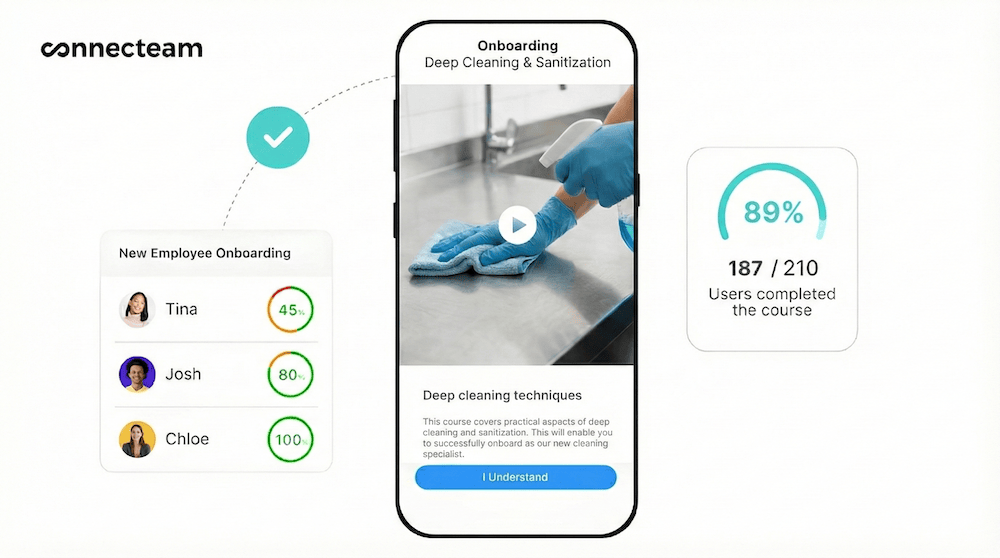
You can use Connecteam’s employee training software to create everything from quick trainings to in-depth courses, using short videos, PDFs, quizzes, and more—all accessible from your team’s phones. You can also store manuals and key “how we do it” notes in one place, so information is easy to find when someone needs a reminder. This can help you reinforce standards without scheduling extra in-person training. And the best part: you can do it on the go, without a lot of planning, production work, or extra cost.
Start each day with structure
Martha Gonzalez, owner of Sparkly Maid San Diego, swears by setting clear expectations at the beginning of each day: “Daily briefings at the onset of each shift or workday help establish mutual expectations and an overview of the clients for the day.”
Whether in-person or online, these short meetings:
- Set priorities: Review the day’s schedule and highlight clients with special requests.
- Assign roles: Confirm who’s cleaning where, who’s handling supplies, and who’s checking completed jobs.
- Clarify jobs: Discuss the order in which cleaning tasks should be done (e.g., dusting before vacuuming), products to use, and any client instructions.
- Share reminders: Cover safety notes, updated protocols, or client-specific preferences.
- End with alignment: Check in with cleaners to confirm everyone’s clear on expectations, whether in person or through an app.
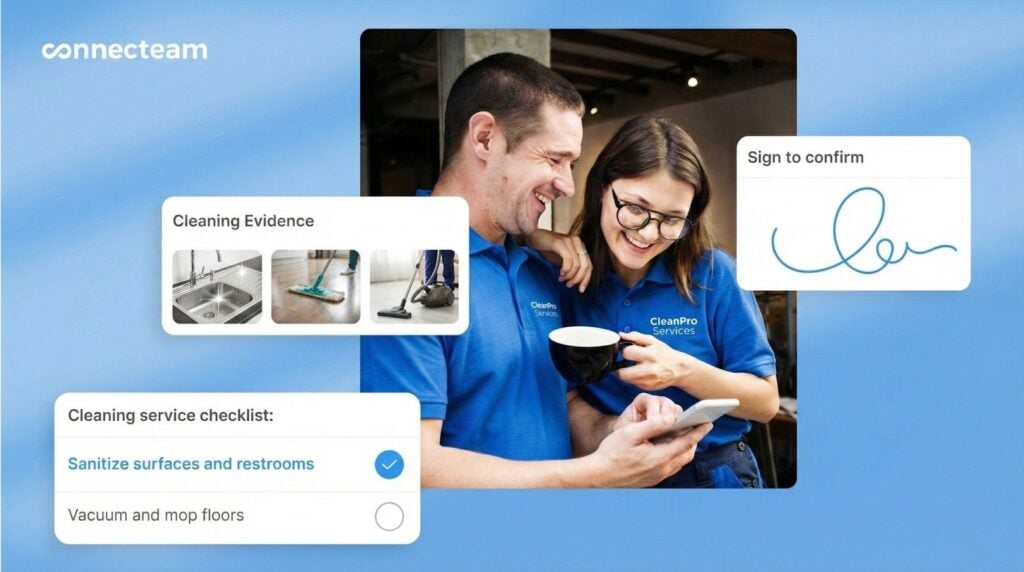
Gonzalez recommends using “digital checklists or mobile app info, such as Connecteam,” to keep teams accountable and consistent.
The more you systemize each shift, the fewer fires you’ll have to put out later.
Pro Tip
Connecteam is great for starting each day with structure without the need for meetings. You can share client notes, tasks, and digital forms (including checklists) for every job or shift in one place, and cleaners can access these from their phones. Cleaners can also message you using the online team chat if they’re unclear on expectations.
Use the right apps to stay organized
As your business grows, managing teams, tracking appointments, and staying on top of cleaning service invoices gets harder, and even small inefficiencies can snowball into lost time and frustrated clients. Strong digital systems give you the structure to scale without losing control.
Axel Avery, Professional Cleaner at Oakville Maids, states, “It’s 2025. You absolutely need to have a computer-based system for scheduling, with all the details from your clients, specific instructions, payments, etc.”
Take scheduling, for instance. Good scheduling keeps every moving part of your operation in sync, while poor scheduling can lead to job overlap, delays, and inconsistencies. Scheduling software makes this process a lot easier, and you’re far less likely to make mistakes than doing so manually.
A good scheduling app lets you:
- Create and adjust shifts quickly with drag-and-drop tools instead of spreadsheets.
- See conflicts instantly, so you never double-book cleaners or overextend your team.
- Share updates automatically, keeping cleaners informed without endless calls.
- Centralize everything (client instructions, addresses, and task notes) so everyone shows up prepared.
Connecteam’s employee scheduler, for example, makes this simple. Cleaners can access shift details, task lists, and client instructions from their phones while you manage everything in one dashboard.
And scheduling is just one example. The right app can also:
- Automate communications: Send reminders, follow-ups, and feedback requests.
- Streamline invoicing: Generate and track invoices automatically so nothing gets missed or delayed.
- Store customer details: Store notes, preferences, and job history in one place so every cleaner knows exactly what each client expects.
- Track performance and hours: Log work hours and completed tasks automatically, giving you visibility into team productivity.
When your systems handle the busywork, you get back time to focus on what really matters: growing your business, giving your team a stellar employee experience, and keeping clients happy.
Use route optimization to save time and costs
Extra travel time cuts into productivity. Plus, it costs more in fuel and can cause delays, resulting in unhappy customers. Well-planned daily routes, on the other hand, make every shift more efficient and every team member more effective.
Davis says that proper route optimization “has cut travel time and fuel consumption and lessened costs and carbon emissions at the same time.”
The key is to group jobs that are close to one another and schedule them in logical order. Instead of sending one cleaner from one side of town to another, cluster nearby clients together so travel becomes a straight line, not a zigzag.
Here’s how to do it:
- Map your regular clients: Use a simple tool like Google Maps, MapQuest, or route-planning software, such as OptimoRoute or Spoke, to pin each address.
- Identify natural clusters: Look for neighborhoods or zones where you serve multiple clients.
- Assign cleaners by area: Give each cleaner a consistent service area so they can build familiarity and reduce driving time.
- Review routes weekly: As new clients come in, adjust clusters and schedules to maintain efficiency.
Even small adjustments to routing can lead to major savings in time, fuel, and costs, while keeping your cleaners and clients happier.
Track what matters (and fix what’s breaking early)
Many cleaning businesses only realize a system is slipping once a client complains or a team member burns out. By then, trust has already taken a hit. The best operators spot patterns early and fix them before they become visible problems.
Track a few simple indicators weekly using basic tools:
- Time per job vs. expected time: Use a time tracking app to see how long jobs take compared to how long they’re supposed to take. If jobs keep running long, your checklists may need simplifying or your team may need support.
- Rework or callback frequency: Keep a simple note file or spreadsheet of complaints or jobs that must be redone. If your team is missing tasks or redoing work often, that’s a sign to improve training.
- Client feedback trends: Ask for quick feedback through follow-up texts or online forms, and keep an eye on your online reviews. Look for patterns in what clients mention most.
- Attendance and punctuality patterns: Have staff clock in using a time clock to spot lateness or signs of fatigue before these affect your company’s performance.
- Delays tied to certain routes or locations: Use Google Maps or your scheduling software to check if some routes cause consistent delays.
Once your operation becomes predictable through data, you earn the confidence to scale, because you can see, in real time, that your systems are holding strong.
Did You Know?
With the Connecteam cleaning services app, your team can clock in, complete checklists, track time against jobs, and more, right from their phones. The app automatically organizes that information into simple reports showing whether anyone ran late, how long each job took, and more, so you can fix small issues before they grow.
Know when (and when not) to scale
Scaling doesn’t just mean growing. It means being able to handle that growth without losing quality or burning out your team. It’s about building capacity first so the business can take on more work smoothly.
Barker explains, “We have had this happen a couple times[…] We needed to address if we could handle continuing to take on more work and what we would need to change about the business to ensure nothing else suffered for it.”
Scaling wisely also depends on strong systems. Davis learned this while expanding his eco-friendly cleaning business: “Surviving this taught us that environmental responsibility is not at odds with profitability when you design efficiency into every system.”
Before saying yes to opportunities, review your capacity. Look at:
- Staffing: Are jobs consistently finished on time without employees feeling rushed or stretched? If overtime or rework is common, your team’s already at capacity.
- Scheduling: Do you have backup cleaners who can fill gaps when new clients come on board?
- Technology: Are your tools (for scheduling, communication, payroll, or client management) running smoothly, or are manual steps already slowing you down?
- Cash flow: Can you cover added payroll or supplies for a few months before new contracts pay off?
- Client experience: Are your reviews and feedback consistently positive, or do you notice small signs of strain, such as delays or missed details?
If you’re consistently hitting targets with resources to spare, you’re ready. But if your systems only hold together when you personally step in, you should strengthen them first (for example, by using the strategies above, especially #5: using smarter systems).
Turn great service into a repeatable system
Great cleaning service isn’t just about the work itself. It’s about consistency, follow-through, and trust. That’s what turns first-time clients into long-term customers.
Running a successful cleaning business comes down to one thing: making great service repeatable. With the right systems in place, your team stays aligned, issues get caught early, and clients get the same experience every time.
When the business runs on clear routines instead of last-minute fixes, you can grow without burning out.
Connecteam helps you put those systems in one place, so it’s easier to keep your team aligned and your service consistent as you grow. You can try it free for 14 days, and companies with up to 10 users get all premium features free forever.
FAQs
Commercial and recurring contract-based cleaning typically earns the highest revenue. Office buildings, medical facilities, and property management contracts provide long-term, predictable income with higher ticket sizes than one-time jobs.
Cleaning businesses that fail often struggle with operations. Poor scheduling, inconsistent quality, weak hiring, and a lack of systems eventually overwhelm the owner and erode client trust.
Cleaning companies suffer from high staff turnover. Cleaning work is physically demanding, and without strong hiring, training, and incentives, it’s hard to retain reliable cleaners.
Most cleaning businesses need a general business license and local registration. Some states or cities also require sales tax permits or special licenses for commercial or medical cleaning. Requirements vary by location, so always check local regulations.
A cleaning business typically makes between $3,000 and $20,000 per month, and mid-sized businesses can reach $50,000 or more. Income depends on pricing, number of clients, recurring contracts, and whether the business focuses on residential or commercial cleaning.
You get clients for a cleaning business through referrals, online listings, local SEO, and repeat contracts. Word of mouth, Google reviews, partnerships with property managers, and consistent follow-ups drive the most reliable growth.
You can run a successful cleaning business with little or no money by keeping overhead low, starting with basic supplies, and focusing on recurring clients. Use free or low-cost tools to stay organized, and reinvest profits into better equipment as you grow. Starting a small cleaning business is one of the most accessible ways to build a company with very little upfront investment.
You keep a cleaning business organized by keeping schedules, client notes, job checklists, and team messages in one place. Many successful cleaning companies use a cleaning services app like Connecteam to keep things running smoothly.