

A great construction website can be a lead magnet, but it’s hard to know what works without becoming an expert.
Your company website is your number one sales asset. Obviously, it should outline what services you offer, the markets you serve, and how clients can reach you. But what turns websites into great marketing materials is how they structure, present, and align this information with their construction business type and stage (i.e., starting a construction business vs. growing it).
I researched dozens of American construction businesses and shortlisted 8 of the best construction company websites, so you can see what works best. I’ve also compiled top tips to apply to your own website and stay ahead of the competition.
Key Takeaways
- A strong construction website shows what services you offer, where you operate, and proof of past quality work.
- The best construction websites align their features with the companies’ services and target audiences. For example, luxury residential contractors lean heavily on stunning photography, while large-scale industrial construction businesses outline frameworks and staff credentials.
- Clear and compelling written content is only part of the puzzle. Your website should also include high-quality project photos, an easy-to-use inquiry form, and client testimonials that highlight your unique selling points.
Real-World Businesses: 8 Best Construction Company Website Examples
Large companies
DPR Construction
Company overview: DPR Construction is a large construction company that specializes in large-scale design-to-build for multiple verticals, including commercial, higher education, and healthcare.
Website key features:
- Carousel-like homepage
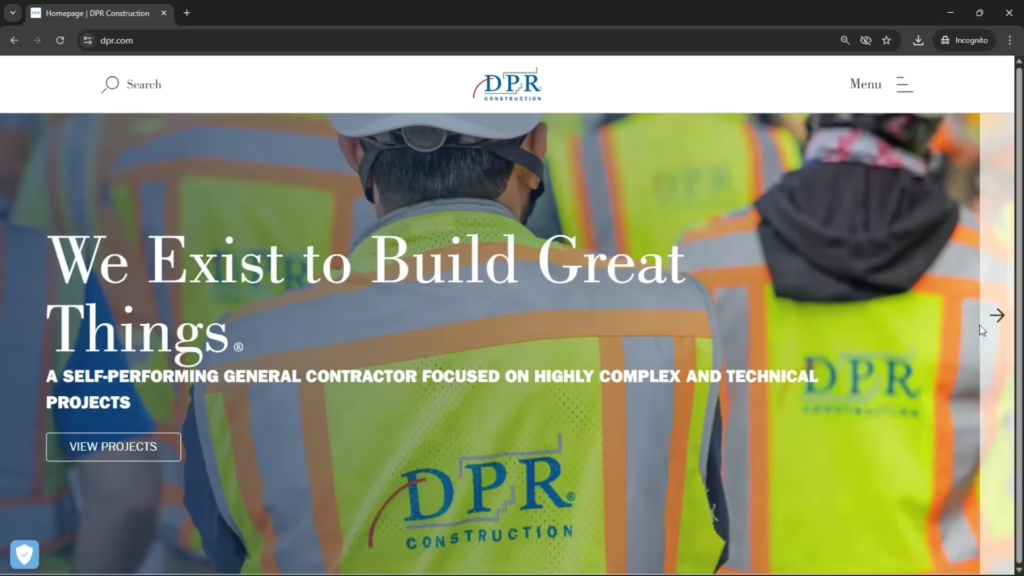
- High-quality images featuring DPR Construction branding
- Website search bar
- Comprehensive services, approach, and client verticals pages
- Project case studies and company news
Why I like the website:
- The sideways scrolling homepage is colorful and engaging, and the first call to action button leads to the webpage high-quality leads care most about: DPR’s projects showcase page. Photos of workers in high-vis vests include the DPR logo, and DPR’s tagline (We Exist to Build Great Things.®) features multiple times.
- The site has a handy search bar. I tested it with keywords such as “large scale” and got a relevant list of DPR webpages and projects. For large companies (or those with many services and online resources), this tool speeds up a leads’ journey to a “yes.”
- The content is comprehensive, making it very effective for the detail-minded leads in commercial real estate. For example, “How we build’ pages (such as “Design-to-build”) include high-level frameworks and approaches, project examples, and what the vendor does differently.
- DPR provides educational content across its blog, news, and vertical-specific market reports. This way, leads can learn about its past projects and achievements, and gain trust in DPR’s understanding of their market and unique needs.
- Most pages have a call to action (CTA) button for lead generation. Depending on the vertical or service, the website encourages readers to contact specific team members via a short inquiry form.
Suffolk
Company overview: Suffolk is a construction business operating in states including New York, Florida, and Texas. It delivers large-scale projects across aviation, hospitality, logistics, healthcare, and other sectors.
Website key features:
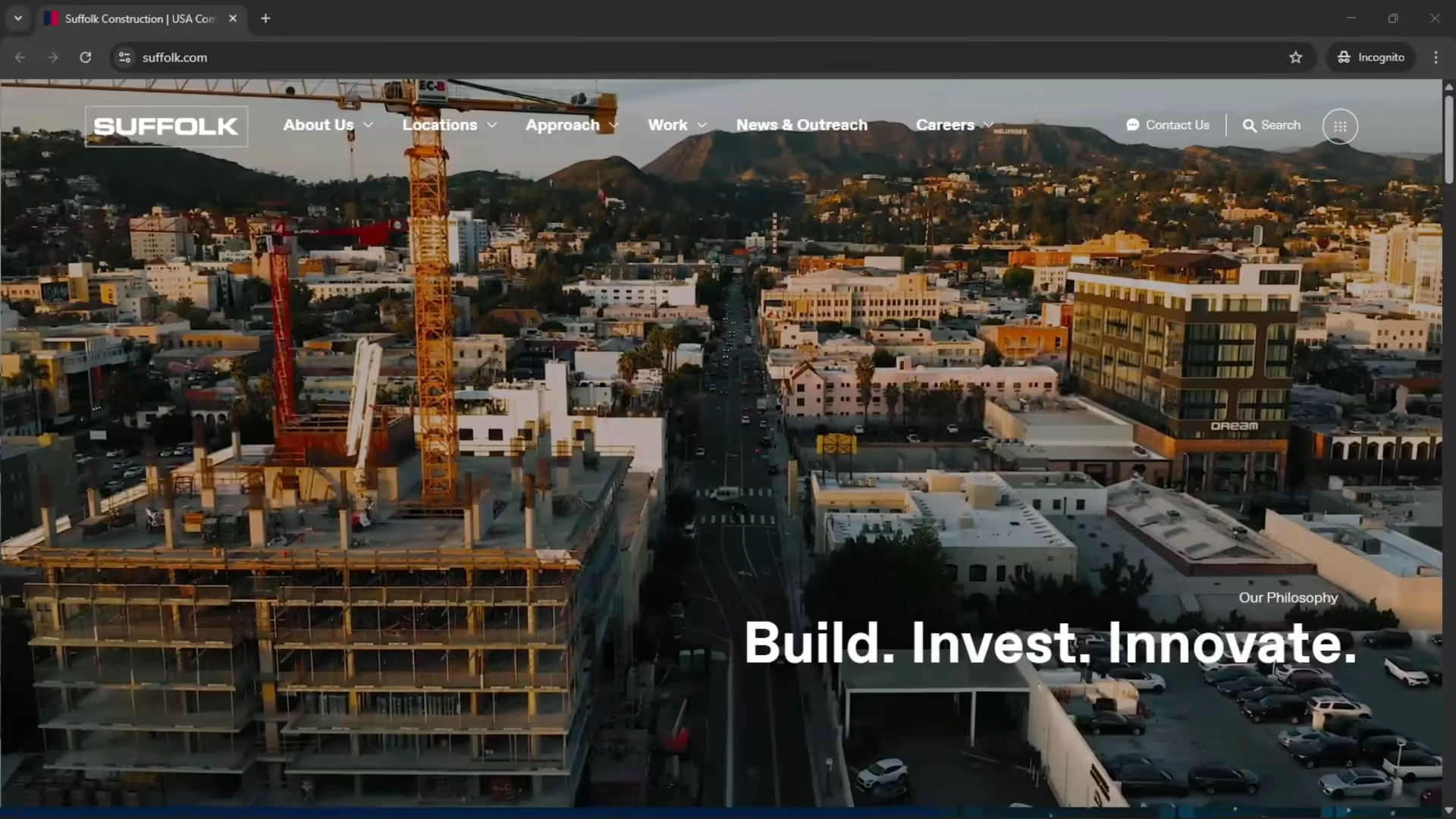
- Homepage with eye-catching videos playing in the background
- Location-specific services and case studies
- Industry and company insights, including the annual Impact Report
- Contact details for location- and service-specific representatives
Why I like the website:
- It’s both comprehensive and easy to navigate. For example, viewers select or scroll through specific locations, sectors, or projects to learn more.
- The imagery is high-quality and text descriptions include plenty of white space for readability.
- The homepage opens with a slow-motion aerial video that communicates Suffolk’s large-scale, skyline-changing construction work. The overlay elegantly states its philosophy: “Build. Invest. Innovate.”
- Rather than services, Suffolk categorizes its capabilities by its 10+ locations. This ensures leads receive localized project examples and sectors where the team specializes.
- The “Approach” section goes through aspects that matter to leads,, such as innovation, safety, and design management. Individual pages also include related projects, testimonials, stats and awards, and senior staff for that topic.
- Each Suffolk location page suggests a local business development rep for leads to contact (by phone or email). There’s also a general “Contact us” form.
This Might Interest You
Although you may not be as large as these big conglomerates now, you can learn how to grow and scale a construction business with Connecteam’s handy guide.
Local businesses
The Harmony Developer
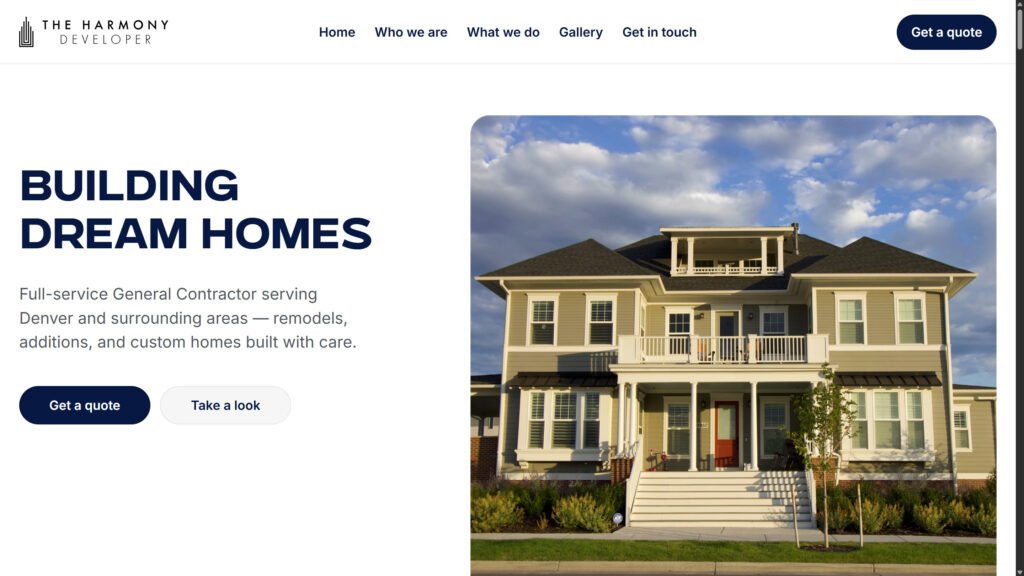
Company overview: The Harmony Developer is a family-run, Denver-based construction company specializing in home remodeling and interior design.
Website key features:
- Always-visible “Get a quote” button
- Services listed with professional photography
- Informal and friendly web copy
Why I like the website:
- It’s a single-page scrollable website—super easy to navigate.
- The homepage contains the “Who we are” and “What we do” website sections, plus testimonials, a photo gallery, and FAQs. This is a great choice for small construction businesses, as it keeps information simple and accessible for leads. (Project and service examples, however, open on separate pages.)
- The web copy is catchy and expressive. For example, it mentions that the Harmony Developer’s work has “a bit of European influence” and “occasionally save[s] marriages.” Likewise, the company describes itself as “the people who actually give a damn.” This makes the company more relatable and memorable to leads.
- The “Gallery” section has high-quality photography of indoor and outdoor work, both finished and in progress. It’s a mix of modern and traditional styles, appealing to a wide range of potential customers.
- Submitting a quote request is easy, no matter where you are on the website. The “Get a quote” button is always in the top corner, under the homepage’s title heading. The short inquiry form is located at the bottom of the screen, and leads can also reach out by phone or email.
Paint Tigers
Company overview: Paint Tigers is a California-based interior and exterior painting company.
Website key features:
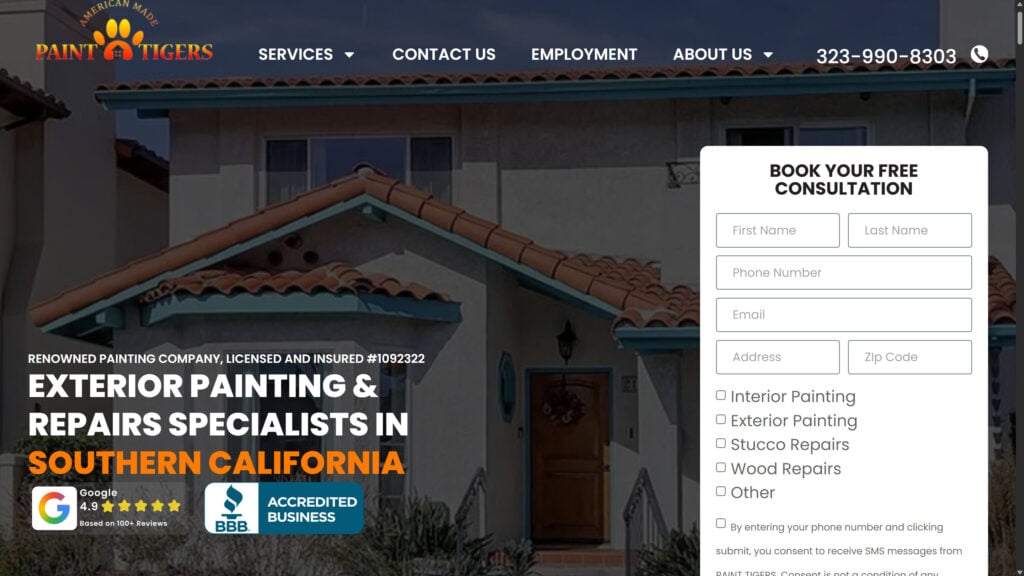
- Contact form at the top of the homepage
- Accreditations and customer reviews
- Snappy videos with team members and clients
- Service-specific pages with case studies
- 3rd-party paint visualizer tool
Why I like the website
- It’s a stellar example of what you can do with limited construction company web design experience and budget. It isn’t flashy, but it sells well by centering the contact form, reviews and certifications, testimonials from satisfied clients, and snappy videos.
- A short video (under 1 minute) with an actual employee explains the company’s decorating approach. Below that, a few other shorts feature happy clients in their homes.
- The vendor breaks down its competitive advantages with no fluff. For instance, its “Why choose us?” section includes punctuality, a 12-month warranty, licenses and insurance, and the types of high-grade paint it uses.
- The website features a cool AI-powered paint visualizer tool that enables leads to upload a photo of their home and generate an image of their home repainted in a new color.. This is an interactive and useful tool that inspires leads to request a quote.
This Might Interest You
Read Connecteam’s expert guide on how to run a successful construction business.
General contractors
Cann Construction
Company overview: Cann Construction is a luxury design-and-build firm creating innovative and inspiring homes, businesses, and public spaces in the Washington, DC area.
Website key features:
- Stunning images and videos backing the luxury construction brand
- Side-scroll construction values list with slow-motion videos
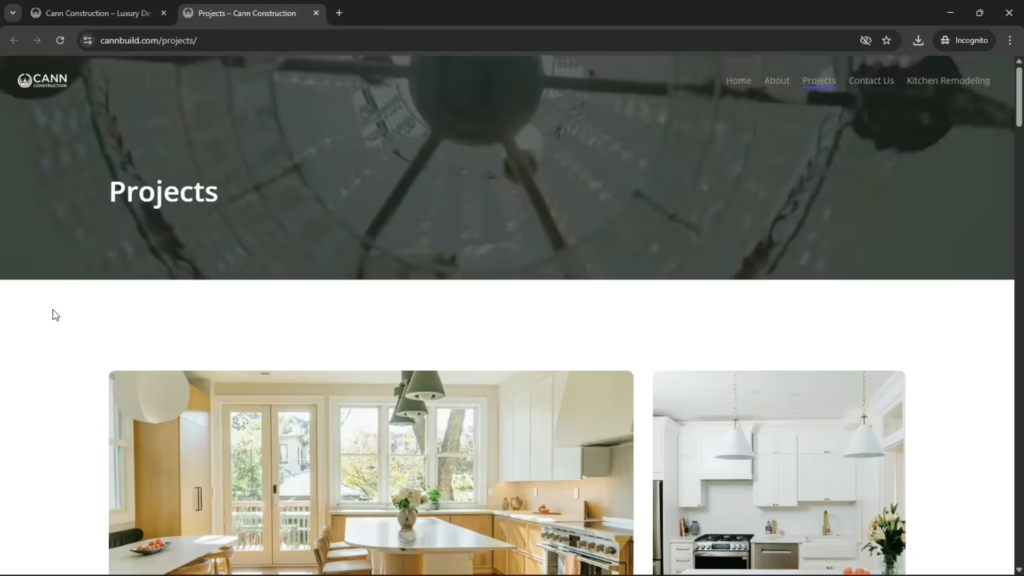
- “Projects” page only; no “Services” or “Approach”
- Consultation booking form and testimonials on one page
Why I like the website:
- The homepage displays dynamic imagery. For example, some photos zoom in, in slow-motion, or feature round cursors that prompt you to click and view specific projects. Viewers’ first impression is of style, elegance, and luxury, which is what Cann sells.
- Its unusual graphics, such as oversized cursors on images only, are eye-catching and memorable.
- Cann Construction skips the typical multi-page layout outlining its services and philosophy. Only “Kitchen Remodeling” gets a dedicated page, with all other work displayed in a beautiful “Projects” page. It’s a bold move that suggests refinement and shows that Cann aims to win leads over with the quality of its work alone. Individual project pages feature short snippets and loads of flattering photos.
- The website doesn’t have any CTA buttons, and the only contact form is short, straightforward, and tucked away on the “Contact Us” page. All this gives Cann Construction an additional air of exclusivity.
- Keeping with the minimalist theme, the website features a selection of detailed testimonials from former clients. These cover project requirements, team skills, and what makes the vendor special.
Blue Star
Company overview: Blue Star is a design-build general contractor serving the Washington, DC residential market.
Website key features:
- Snappy client outcomes overlaid on residential project images
- Website colors matching Blue Star’s logo colors (gray and white)
- Services page with pricing guidelines
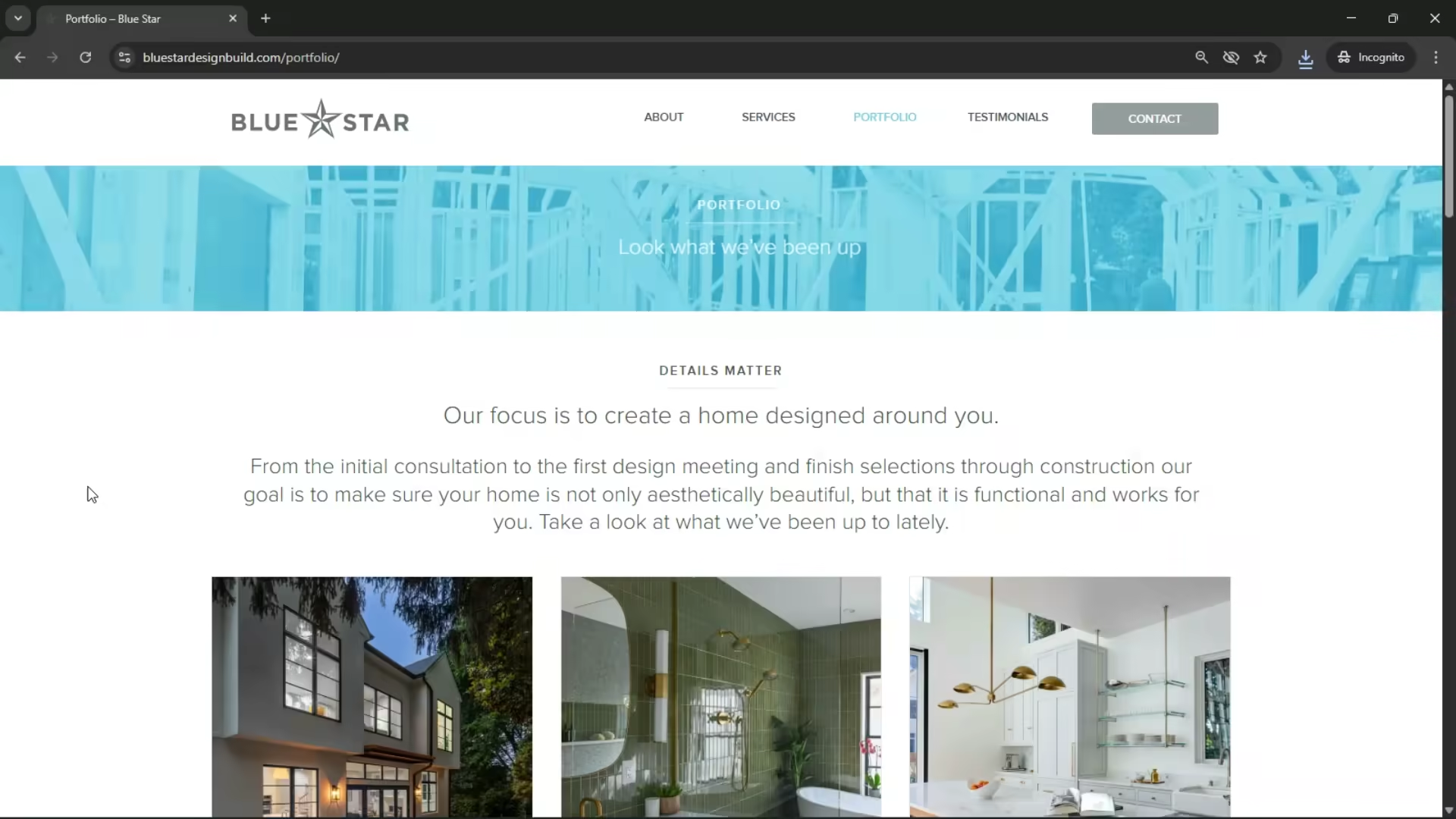
- Comprehensive portfolio list with professional photography
Why I like the website:
- It combines an accessible white background with minimal color accents, uncluttered text, stylish imagery, and clear calls-to-action.
- The top of the homepage features an automated carousel showcasing residential project photography, accompanied by emotive captions like “Fine craftsmanship: A home doesn’t need to be large to be a showstopper.”
- The site features 30+ testimonials, nudging leads to request quotes. Some are several paragraphs deep, containing project specifications and differentiators such as “Blue Star really does take a ‘long view’ approach to their business.”
- The portfolio webpage features more than twenty case studies. Viewers click on the professionally photographed graphics to read the project descriptions on separate pages. Each project then features at least 8–10 photos and detailed overviews, satisfying potential customers’ emotional and cognitive needs.
- Blue Star has a detailed contact form that requests leads’ zip codes, project times, and desired start dates. This helps improve lead qualification and quote accuracy. All fields other than contact details are optional, reducing the chance that leads quit in frustration.
Did You Know?
Once you’ve landed a new client, using construction apps is the smoothest way to dispatch and manage your workforce. For example, Connecteam lets you schedule jobs, train workers, communicate with teams and clients in real-time, and more.
Niche services
Imperial Wood Floors
Company overview: Imperial Wood Floors is a family-run Wisconsin-based construction firm specializing in wooden flooring.
Website key features:
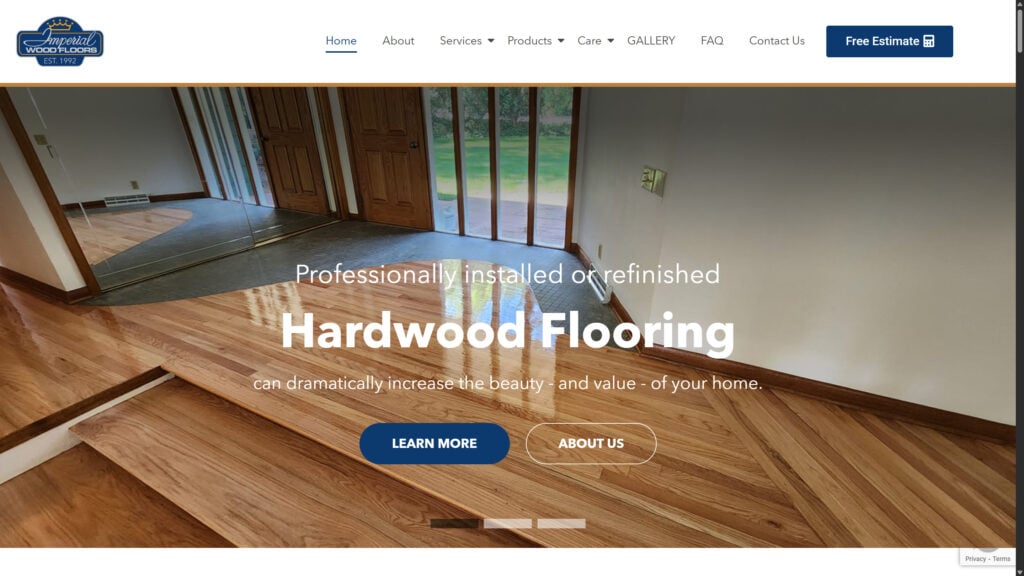
- Eye-grabbing hardwood floor photo opening the homepage
- Service and speciality summary immediately below
- Categorized gallery images
- Separate “Services” and “Products” pages
- Detailed “Free estimate” form
Why I like the website:
- It’s image-centric but doesn’t sacrifice key information about the company’s services.
- The homepage provides a bird’s eye view of Imperial Wood Floors’ services and previous results. For example, it spotlights its wood floor installation and sanding services, then links to its full services webpage, inviting leads to explore more.
- Services such as sanding and finishing, custom inlays, and maintenance are separate from wood floor products (e.g., Oshkosh Floor Designs) in the website menu. This makes it easy for leads to choose services and products they want.
- A separate “Care” section breaks down maintenance best practices, including cleaning methods, misting, and recoating. This educational approach gives leads real value and provides the vendor with opportunities to upsell.
Lang Custom Cabinet Design
Company overview: Lang Custom Cabinet Design is a Missouri-based custom cabinetry business serving residential clients.
Website key features:
- Imagery matching brand colors (gold and black)
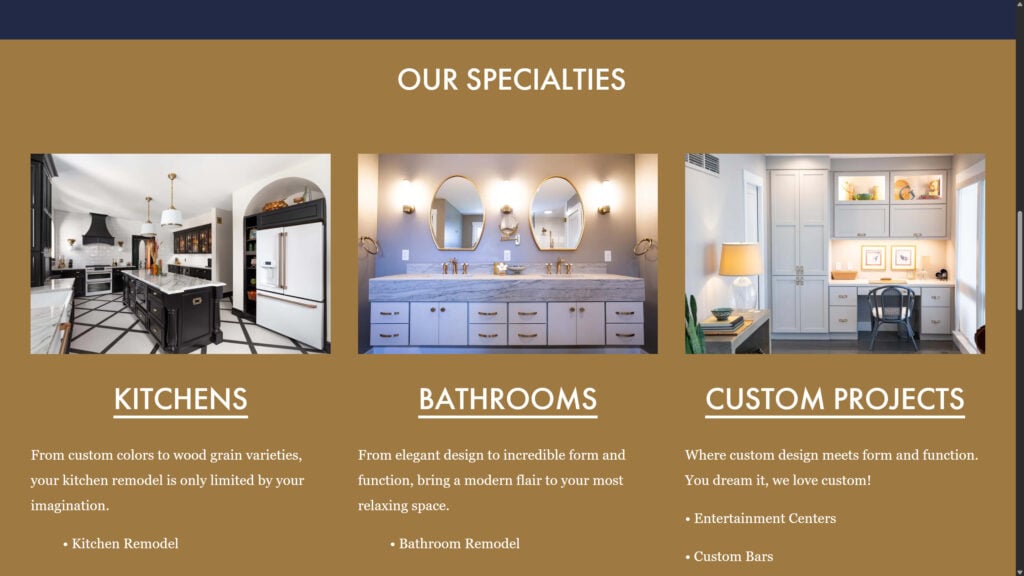
- Separate menu sections for kitchen, bathroom, and custom cabinetry
- Cabinet examples, with images, on the service pages
- Contact form on a separate page and on the service pages
Why I like the website:
- The homepage makes a great first impression through images of stunning cabinetry.
- The top of the homepage features a stylized menu and a full-width project image matching the firm’s brand colors (white, black, and gold).
- Its services are categorized into “Kitchen,” “Bathroom,” and “Custom projects,” which are also separate menu items. Each service page includes examples and photos, along with calls to action to request a free estimate.
- The gallery features a handful of cabinetry close-ups. Lang Custom Cabinet Design chose to invest in eye-grabbing design, showcasing their quality craftsmanship.
- The free estimate form lets leads book in-house meetings to get more accurate quotes. Plus, contact details for in-person drop-ins, email, and phone are easily accessible.
How to Build a Construction Website That Converts
“Easier said than done,” you may think after seeing those polished website examples. Fair, but marketing your construction business via website isn’t as challenging as you may believe.
Below are the key features of a construction website across content, design, and lead generation, as well as how to make each one pop.
Construction website content
The information you give potential customers must be clear, concise, and compelling. Provide the minimum amount of information that makes viewers go, “yes, please.” They should be able to quickly understand:
- Whether you provide the service they need, where they need it.
- Whether you have qualified staff and equipment on hand.
- To what standard you’ve done similar work in the past.
Here are some best practices for construction company websites:
Homepage
- Services summary: List your main services (e.g., general contracting, roofing, painting) in a scannable way, and link to your full service breakdown page.
- Business differentiators: Clarify what sets your trade business apart, under a heading such as “Who we are” or “Our promise.” Examples of differentiators include a commitment to innovation, being family-run, and working collaboratively.
- Licenses and certifications: Display trade certifications, licenses, insurance, and review scores. Ideally, place next to a call to action such as “Contact us” or “See our projects.”
- Service areas: State your geographic coverage (states, cities, counties, or ZIP codes).
About
Your “About” page should reflect your company’s personality and brand, so be comprehensive yet creative. For example, a collaborative firm might publish a 1-minute video featuring its staff and clients, whereas a large-scale industrial vendor may include short executive bios and headshots.
You can cover:
- Where and when your business started (e.g., in 1995 in San Diego, California).
- How and why you ensure top-quality services (e.g., carefully sourcing materials and workers).
- Other values your team upholds, such as site safety and clear customer communication.
Services
For each of your services, list the following:
- Heading: State the service and scope clearly (e.g., kitchen remodeling, hardwood flooring, exterior painting).
- What it involves: Outline the process or approach in plain language so non-technical visitors can follow. For example, describe the process you use in your general contracting service.
- Why it matters: Break down the main client benefits, such as durability, esthetics, long-term cost savings, compliance, or convenience.
- Your differentiators: Highlight what makes your delivery competitive (e.g., use of premium materials, warranties, fast turnaround, eco-friendly methods).
Portfolio/Projects
In your “Portfolio” or “Projects” page, include:
- Strong project title: Summarize the project type while using emotive language (e.g., “Remodeling a modern kitchen for a growing family”)
- Client goals: Pinpoint 1–2 critical aims, such as sustainability or improved design.
- Your solution: Explain how your team approached the project, including methods, materials, or unique techniques. Keep this to 1–2 paragraphs.
- Results: Provide measurable or descriptive outcomes where relevant (e.g., “Reduced commercial energy costs by 20%”, “Created additional living space for a growing family”).
- Follow-up: Recommend further reading, such as related projects, services pages, or staff members to contact.
Photo gallery
A stunning image gallery works especially well for niche construction businesses such as those specializing in design-to-build, painting and finishing, or luxury remodeling.
You can’t go wrong with a large image gallery, but be selective. Only pick photos that:
- Show off your best work.
- Promote safety and quality control (if showing in-progress work).
- Showcase services or verticals your team can currently deliver.
This Might Interest You
Photos are a key marketing tool for your construction business. Learn more about building an in-depth construction marketing plan with Connecteam’s comprehensive guide.
Construction website design
While your website’s content should answer viewers’ questions, its design should capture their imagination. Here are some construction company website design best practices to follow:
Imagery and visual design
Your site’s imagery should help viewers imagine what their dream home, office, warehouse, etc., will look like. Bonus points if your photos give them ideas they haven’t thought of themselves, like unconventional layouts or color accents.
Ideally, you’ll hire a professional real estate photographer who understands composition, lighting, and framing to take these photos. That said, if you’re short on time or budget, you can take high-resolution, well-lit photos with a smartphone.
You’ll also want a visual design that aligns with your branding and helps your viewers connect emotionally. For example, you can:
- Invest in a professional logo to appear at the top of every page (you can find a good, affordable freelance designer on Fiverr).
- Select a couple of complementary brand colors (say, green and beige) and prioritize these across website graphics such as banners and buttons.
- Summarize your construction approach through an infographic or diagram, as a way to engage viewers’ creativity.
Interactive flow
When visitors can interact with your website easily, they feel like part of your story. An intuitive, interactive flow is key.
For example, you could add a carousel of project images, which users click or scroll through horizontally. Similarly, you could enable users to click or slide between before-and-after remodeling project photos to see the transformation in action.
Interactive tools can also help encourage visitors to convert into customers. For instance, you could add 3rd-party plug-ins for cost savings and quote calculators or for paint color visualizers. These can speed up decision-making.
Flawless user experience
Great design is nothing without a great user experience. To nail this aspect of your website, consider these factors:
- Mobile-responsive design: Mobile websites see higher traffic than desktop ones. Mobile users also spend less time and view fewer pages than desktop users. So, your website must be lag-free and display pages correctly on mobile.
- Performance: Aim for almost-instant page loading by compressing images, limiting videos, and enabling browser caching.
- Minimal animations: Fancy effects (such as fades and auto-play videos) often distract users and slow down pages. Use sparingly and only if they run smoothly across devices.
- Accessibility: Use legible font sizes, clear contrast, and alt text for images so all users can navigate easily, including those with disabilities.
- Testing: Regularly check the site on different devices, browsers, and internet connection speeds.
Construction website lead generation
Finally, don’t let all that hard work in your website content and design go to waste. Create opportunities to generate construction leads! Give users compelling reasons to reach out to you, and provide an easy way to do so (for example, through an online form, email, or phone).
Here are 3 tools to capture web leads:
Social proof
Before they convert into customers, leads need social proof: evidence from a relatable, reliable community. This is especially important if leads are unfamiliar with your business.
You can provide social proof on your website in a few ways:
- Testimonials: Add short client quotes that mention the project type, location, or result. Encourage happy customers to be specific (“Finished on time despite winter delays”).
- Client reviews: Display reviews and ratings from sites such as Google, Yelp, or Houzz directly on your site. Include star scores and a link to full reviews.
- Social media: Include links to your most active social channels (e.g., Facebook, Instagram, YouTube) or embed some of your best posts. This lets leads see how you interact with your community.
Contact form
Using your website builder, add a contact form (which you can also name an “consultation form” or “free quote request”) to your homepage or a separate “Contact us” page.
At a minimum, your form should ask for the customer’s name, company (if commercial), city, zip code, email address, phone number, list of construction services required, and message.
Keep your form short unless you offer:
- Very niche services, and need to quickly qualify requests.
- Lots of services and/or service areas, and need to direct queries to specific staff members.
Downloadable content
Growing construction businesses can also offer “lead magnet” content, especially when attracting new customer verticals (say, commercial clients for a mostly-residential-targeting firm).
Lead magnets are materials such as brochures, construction flyers, industry or research reports, written tutorials, and guides that users download in exchange for their contact details. The type of material they download can also tell you a lot about their intent and how you should approach them for a sale.
For example, you could create a PDF brochure that details your services, plus case studies, photos, and testimonials from people who have received those services. Or, you might offer multi-page how-to guides (e.g., “10 Questions to Ask Before a Home Remodel, “Flooring Maintenance Checklist”). You may even commission thought leadership articles or market analysis for your target verticals, such as healthcare, higher education, or logistics.
A strong website is the best way to attract leads and convert them to paying customers. Making a high-performing website isn’t rocket science, but it does require some thought and a good eye. Make sure to combine good visuals, authentic writing, and a strong offering, and you’ll build a strong presence that will drive customers to your business.
FAQs
Great website builders for construction companies include WordPress, Wix, and Squarespace. WordPress gives larger firms with multiple services and locations extra flexibility. Meanwhile, Wix and Squarespace suit smaller contractors needing fast setup, templates, and drag-and-drop design.
The best domain for a construction company is one that matches its business name. For example, Fulham Builders should pick the domain fulhambuilders.com, if available. Also, while a “dot com” is easy to remember, companies may also go for custom domains, such as fulham.builders.
You need a website as a contractor if you want to grow your construction business. A website lets potential customers find you online, check if you offer specific services, and contact you (without those costly lead-generation website fees).