


Choosing a PEO for health insurance means looking beyond the monthly premium. Your employees need access to doctors and hospitals where they live, and you need a plan your business can keep affording when renewal comes around.
I compared seven PEOs on the health-insurance factors that matter most when you are choosing a provider: carrier and network reach, plan availability, flexibility, renewal transparency, benefits support, and company fit. ADP TotalSource is my top pick for multi-state employers. Justworks is especially strong for smaller businesses that want clearer pricing and carrier information.
Connecteam is not a PEO, so it is not included in the ranking. I based this comparison on current provider documentation and public pricing where available. Once you have a shortlist, compare the plans and networks each PEO can actually offer your workforce.
| App | Best for | Starting Price | Key Considerations |
| ADP TotalSource | Multi-state employers | Custom quote | Plans and pricing are quote-dependent |
| Justworks PEO | Small businesses that want transparency | $79/employee/month | Carrier and network availability varies by state |
| TriNet PEO | Industry-specific benefits support | Custom quote | Carrier and pricing details are mostly quote-based |
| Sequoia One | VC-backed tech startups | Custom quote | Narrow target market; public pricing and carrier detail are limited |
| Rippling | Benefits and HR tech integration | Contact vendor for custom quote | Public carrier and state-plan detail is limited |
| Insperity PEO | High-touch benefits support | Custom quote | Limited public carrier and pricing detail |
| Paychex PEO | SMBs seeking dedicated payroll and benefits specialists | Custom quote | Medical plan specifics depend on the quote |
Our Top Picks
-
1
Best for multi-state employers
-
2

Best for small businesses that want transparency
-
3
Best for industry-specific benefits support
Why trust us?
Our team of unbiased software reviewers follows strict editorial guidelines, and our methodology is clear and open to everyone.
See our complete methodology
How I Ranked the Best PEOs for Health Insurance
I focused the ranking on the health-insurance experience each PEO can offer a real business. I reviewed current provider websites, help centers, benefits documentation, and public pricing where available.
I paid closest attention to:
- Carrier and provider network reach
- Health-plan availability across states
- Plan choice and flexibility
- Renewal and cost transparency
- Benefits administration and employee support
- Fit for the provider’s target company size, industry, and workforce
- Clarity of the benefits information available before you request a quote
I did not use numerical scores because PEO health insurance depends heavily on your workforce and the plans available to your company. These rankings reflect publicly documented services and my editorial assessment of fit, rather than testing each provider’s private insurance quotes. Actual eligibility, premiums, carriers, networks, and renewal terms can change which provider makes the most sense for your company.
Because health plans vary by employer, I ranked providers on the strength of their documented offerings and how well those offerings fit different types of businesses, rather than on premiums or plan quality I couldn’t independently compare.
7 Best PEOs for Health Insurance in 2026
-
ADP TotalSource — Best for multi-state employers
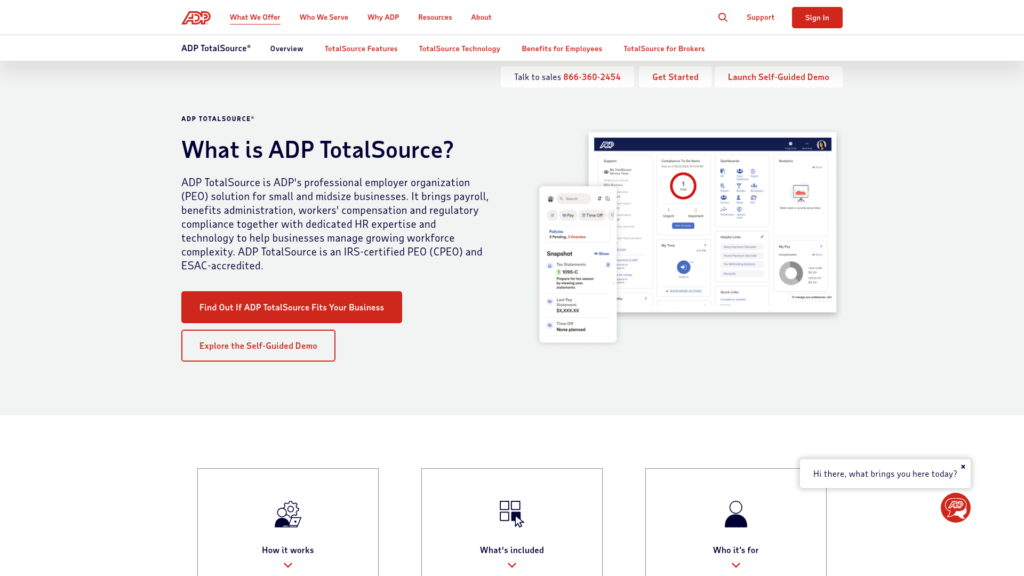
ADP TotalSource is a strong fit when your workforce spans several states and network reach is a major concern. Its PEO benefits offering has broad geographic coverage and relationships with several major national and regional carriers.
Why I picked ADP TotalSource: ADP gives multi-state employers one of the clearest starting points for broad plan access. Its current PEO materials name major carriers and state that TotalSource benefits are available across all 50 states.
Nationwide Carrier and Network Access
ADP lists Aetna, Anthem Regional, Kaiser, and UnitedHealthcare among its TotalSource benefits partners. That does not mean every carrier or network is available to every employer, but it gives companies with employees in several states more options to work with.
For a multi-state employer, I would start with the actual network. The carrier logo alone does not tell you which doctors and hospitals employees can use.
Employee Enrollment and Benefits Support
ADP combines benefits enrollment with the rest of the PEO relationship. Employees can enroll digitally and use ADP MyLife Advisors for help with benefits questions.
I like this because a health plan is only as useful as the support employees get when they need to understand enrollment, coverage, or where to go for help.
Broader Benefits Package
Beyond medical insurance, ADP TotalSource can include dental, vision, HSA and FSA options, disability, accident, and other voluntary benefits.
That makes it a good fit for employers that want to build a broader benefits package without managing several separate vendors.
Pricing
ADP does not publish standard TotalSource PEO pricing. You need a custom quote, and health insurance premiums are priced separately from the PEO service fee.
Key Features
- Major national and regional health carrier relationships
- Benefits availability across all 50 states
- Dental, vision, HSA, FSA, disability, and voluntary benefits
- Digital enrollment and employee benefits support
Pros
- Strong fit for multi-state employers
- Broad carrier and benefits footprint
Cons
- PEO pricing is not publicly listed
- Exact plans and networks depend on the employer and employee locations
Pricing
Custom quote Trial: No Free Plan: No
-
Justworks PEO — Best for small businesses that want transparency
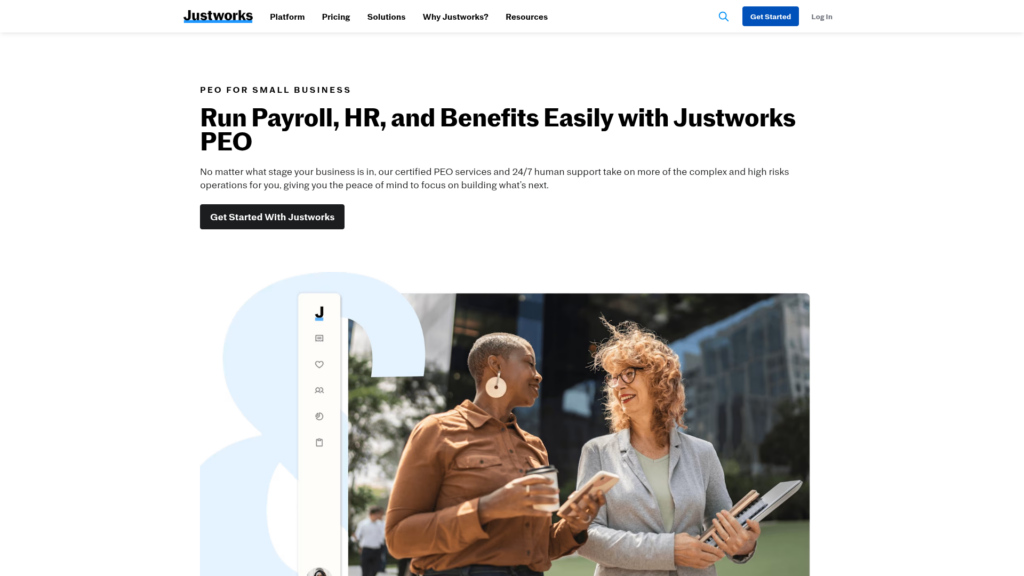
Justworks makes it unusually easy to understand the likely fit before you talk to sales. It publishes its PEO fees and provides detailed health-plan documentation, which helps smaller companies narrow the field quickly.
Why I picked Justworks: Its combination of public administrative pricing and detailed carrier information makes the early comparison process much easier. You can get a useful sense of fit before starting a full quote process.
Clear Carrier Documentation
Justworks documents medical insurance options from Aetna, UnitedHealthcare, and Kaiser Permanente, plus dental and vision coverage through providers including MetLife. Available plans and networks depend on employee location and company eligibility.
Its help center also explains where certain carrier options are and are not available. I found that level of detail useful because PEO health insurance can look much more uniform from the outside than it really is.
Large-Group and Small-Group Options
Justworks explains that its PEO clients can have access to both large-group and small-group medical options depending on the company and location.
That can give smaller employers more flexibility, but it does not mean every company gets the same plan structure. Carrier availability, participation requirements, and underwriting can still affect the final offer.
Straightforward Employee Experience
Justworks handles benefits enrollment and administration through its platform, and employees can access plan information and support without routing every question through an internal HR person.
For a small business with a lean admin team, that simplicity is a big part of the appeal.
Pricing
Justworks lists PEO Basic at $79 per employee per month and PEO Plus at $124 per employee per month, with no base fee. PEO Plus includes medical, dental, and vision administration. Insurance premiums are separate.
Key Features
- Medical options from major national and regional carriers
- Large-group and small-group plan options
- Benefits enrollment and employee self-service
- Public PEO administrative pricing
Pros
- More pricing and carrier transparency than most PEOs
- Good fit for small businesses with lean HR teams
Cons
- Carrier and network availability varies by state
- Per-employee service costs rise directly with headcount
Pricing
$79/employee/month Trial: No Free Plan: No
-
TriNet PEO — Best for industry-specific benefits support
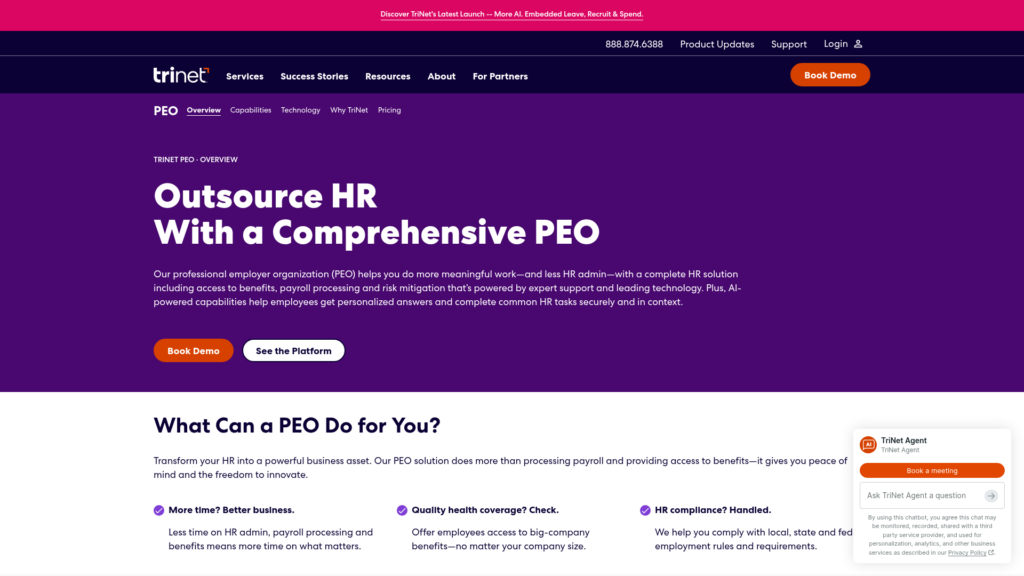
TriNet is worth a close look if your industry has specific recruiting and benefits expectations. Its PEO offering combines sponsored health benefits with industry-focused HR and benefits support.
Why I picked TriNet: Its industry-focused service can be useful when benefits play an important role in recruiting and retention. TriNet also offers PEO-Sponsored Large-Group Benefits, which gives it a clear place in this comparison.
PEO-Sponsored Large-Group Benefits
TriNet says PEO clients can access TriNet-sponsored large-group medical, dental, and vision plans, along with life, disability, and voluntary benefits.
This can give smaller employers access to plan structures they may not be able to buy in the same way on their own, although the exact offering still depends on the group and location.
TriNet also lets employers keep company-sponsored benefits, with or without their existing broker, rather than requiring them to use TriNet-sponsored plans.
Industry-Focused Benefits Guidance
TriNet organizes much of its PEO service around industry verticals. I like this approach for employers whose recruiting market has clear benefits expectations, such as technology or life sciences.
The main benefit is working with a provider that understands what similar employers tend to offer. Industry specialization does not guarantee a special health plan, so compare the actual options available to your group.
Enrollment and Employee Self-Service
Employees can use TriNet’s platform for benefits enrollment and ongoing access to benefits information. TriNet also provides benefits specialists who can help clients navigate the available options.
Pricing
TriNet prices its PEO service on a per-employee-per-month basis, but it does not publish a standard rate. Employee benefits, workers’ compensation, payroll taxes, and add-ons are priced separately.
Key Features
- TriNet-sponsored large-group benefits
- Medical, dental, vision, life, disability, and voluntary benefits
- Industry-focused HR and benefits support
- Digital enrollment and employee self-service
Pros
- Strong fit for businesses in TriNet’s focus industries
- Broad benefits package with specialist support
Cons
- Medical carrier and network details are not clearly published by state
- Pricing and health-plan rates require a quote
Pricing
Custom quote Trial: No Free Plan: No
-
Sequoia One — Best for VC-backed tech startups
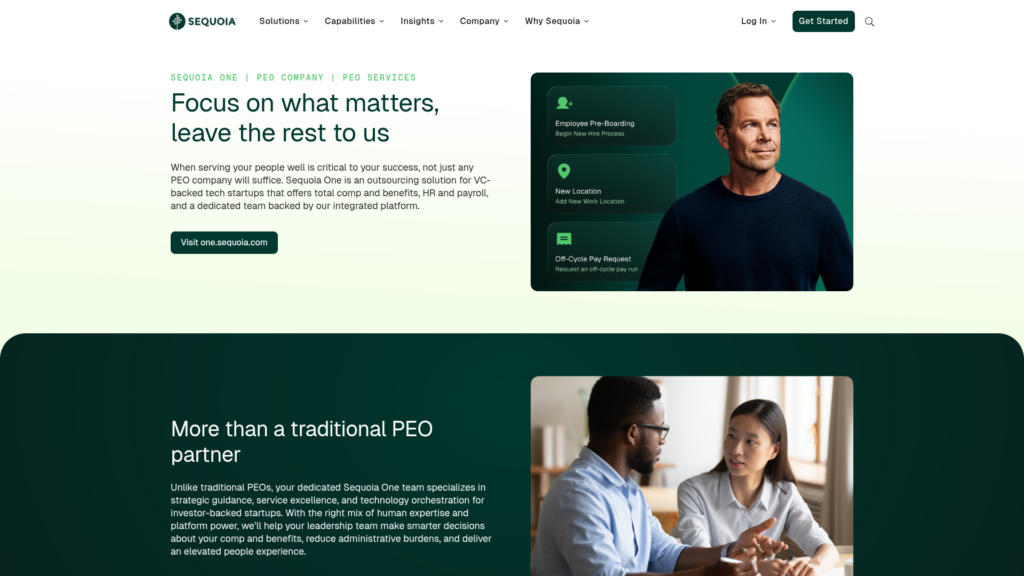
Sequoia One is built primarily for venture-backed technology companies that use benefits as part of their recruiting and retention strategy. Its offering connects medical coverage with a broader health, wellbeing, and total-rewards experience.
Why I picked Sequoia One: Its narrow focus makes it especially relevant for VC-backed tech companies. The employee-support model and broader wellbeing package are useful for startups competing for talent.
Health and Wellbeing Benefits
Sequoia One’s current benefits offering includes medical, dental, and vision coverage, HSAs and FSAs, and additional services such as One Medical, Rightway, Spring Health, and Origin Financial Wellness.
The package is designed to feel closer to what employees may expect from a larger technology employer.
Employee Advocates
Sequoia One provides dedicated employee advocates who can help employees with enrollment and benefits questions.
I like this model for startups without a large internal people team because it gives employees somewhere to go without turning every benefits issue into an HR ticket.
Total Rewards Focus
Sequoia One connects benefits with compensation and broader people-spend strategy. That gives startups a clearer view of the total value of the package they are offering employees.
The trade-off is focus. If you are not a venture-backed technology company, a more general PEO may be a better fit.
Pricing
Sequoia One does not publish standard PEO pricing. You need a custom quote.
Key Features
- Medical, dental, and vision benefits
- HSA and FSA options
- Mental health, primary care, and financial-wellness programs
- Dedicated employee advocates
Pros
- Strong benefits proposition for VC-backed tech companies
- Useful employee support and total-rewards focus
Cons
- Narrower target market than generalist PEOs
- Public pricing and detailed carrier-by-state information are limited
Pricing
Custom quote Trial: No Free Plan: No
-

Rippling — Best for benefits and HR tech integration
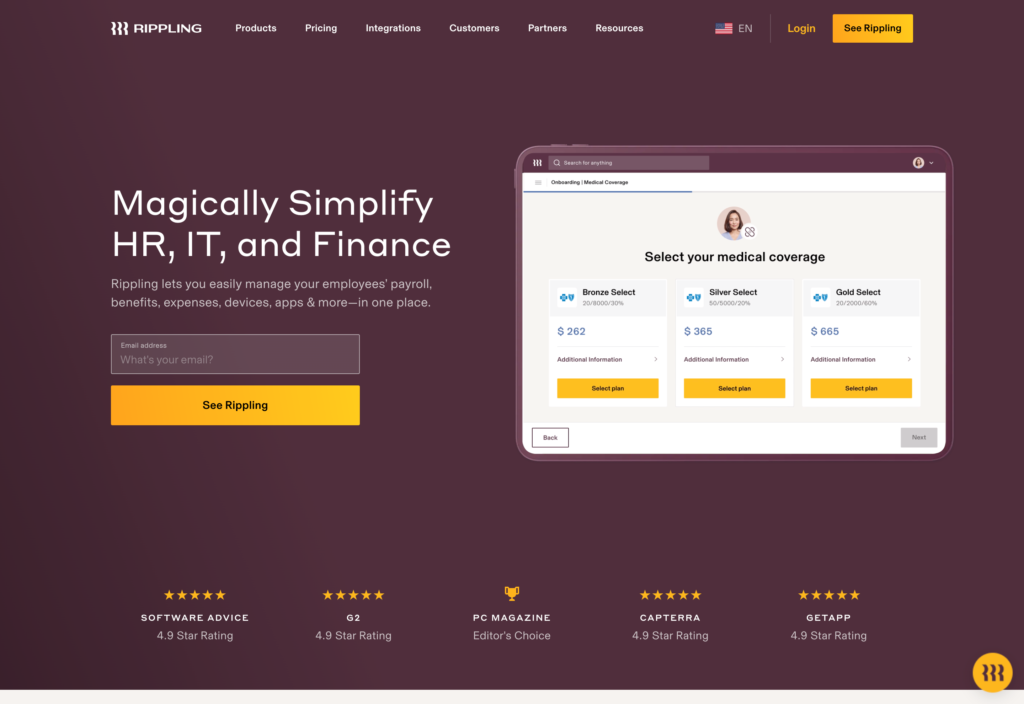
Rippling PEO is a good fit for businesses that want benefits administration tied closely to payroll, HR, and employee data. Changes can flow through the same platform with fewer manual handoffs.
Why I picked Rippling PEO: Rippling combines benefits administration technology with real-time support through Rightway. It also gives businesses a simpler path to leave the PEO later while keeping the core Rippling HR platform.
Benefits and Payroll on One Platform
When an employee enrolls in benefits or changes coverage, the same employee data can flow into payroll and HR workflows.
That matters because many benefits problems are really data problems. A late hire update, wrong deduction, or missed eligibility change can create a lot of cleanup.
Real-Time Benefits Support
Rippling provides benefits support through Rightway, giving employees another route for help with plan questions and navigating care.
For employers with a lean HR team, this can reduce the number of benefits questions that have to be answered internally.
Renewal Visibility and an Easier Path Off the PEO
Rippling publishes historical PEO health-plan renewal results. They are useful context, although they come from Rippling and cannot predict your company’s next renewal. Having renewal performance on the table gives you another useful question to raise during the quote process.
Rippling also lets businesses leave the PEO while staying on the core Rippling HR platform. That can make a future transition less disruptive.
Pricing
Rippling does not publish standard PEO pricing. You need a custom quote, and health insurance costs vary by the plans available to your company.
Key Features
- Integrated benefits, payroll, and HR administration
- Real-Time Benefits Support through Rightway
- PEO health-plan renewal reporting
- Ability to keep the Rippling platform after leaving the PEO
Pros
- Strong benefits administration technology
- Good fit for fast-growing, software-driven companies
Cons
- Public carrier and state-by-state plan details are limited
- Historical renewal results do not guarantee future rates
Pricing
Contact vendor for custom quote Trial: No Free Plan: No
-

Insperity PEO — Best for high-touch benefits support
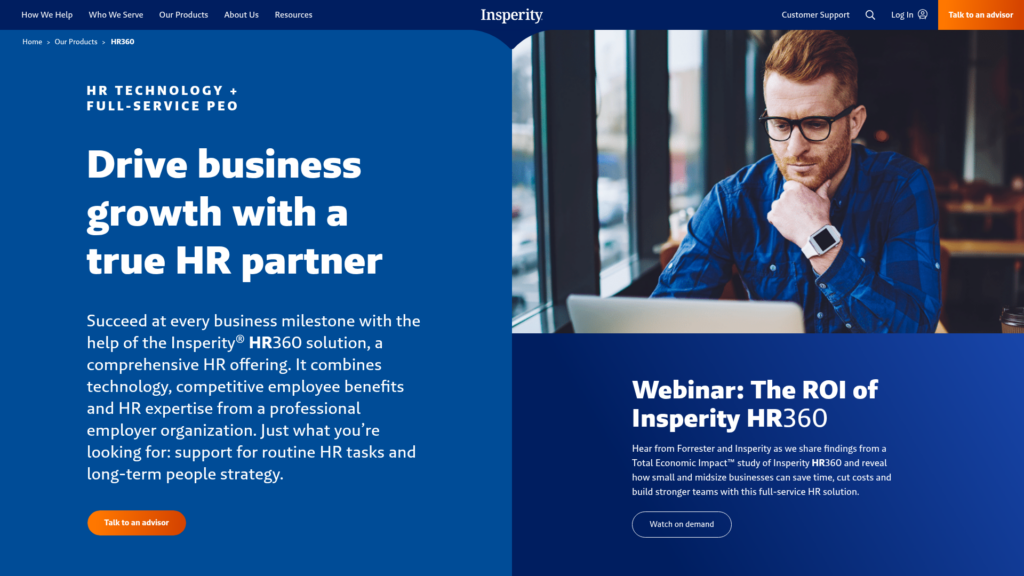
Insperity is a strong option for employers that put a high value on benefits support. Its PEO offering combines sponsored health benefits with benefits specialists and direct employee support.
Why I picked Insperity: The service model stands out. Employees have a clear place to go when they need help with enrollment or benefits questions, which can take pressure off a lean internal HR team.
PEO-Sponsored Health Benefits
Insperity offers PEO-sponsored medical, dental, and vision benefits, plus additional programs such as life and disability coverage.
The exact medical options vary, so you still need to compare the carrier and network offered to your group.
Benefits Specialists and Employee Support
Insperity handles enrollment administration and gives employees access to a contact center for benefits questions.
I like this for employers who want a more human service model. Employees and managers have somewhere to go when self-service tools are not enough.
Broader HR Service
Health insurance sits inside a wider PEO relationship that includes payroll, HR support, workers’ compensation, and other employer services.
That can be useful when you want one service team helping with several HR functions across the PEO relationship.
Pricing
Insperity does not publish standard PEO pricing. You need a custom quote.
Key Features
- PEO-sponsored medical, dental, and vision benefits
- HSA, FSA, life, and disability options
- Employee benefits contact-center support
- High-touch HR service model
Pros
- Strong employee and employer support
- Broad benefits offering
Cons
- Limited public carrier and network detail
- Pricing and plan availability require a quote
Pricing
Custom quote Trial: No Free Plan: No
-

Paychex PEO — Best for SMBs seeking dedicated payroll and benefits specialists
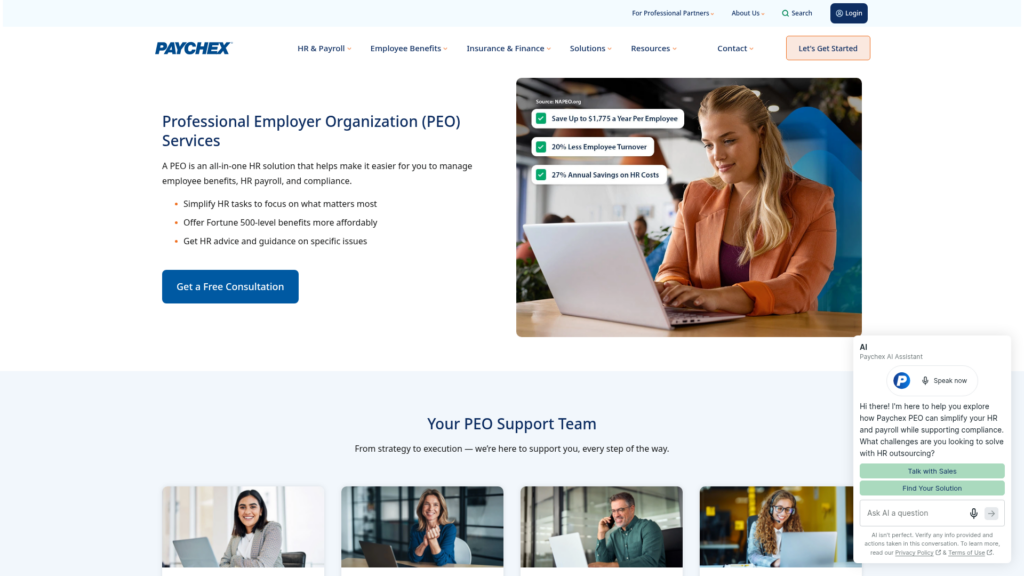
Paychex PEO is a practical option for SMBs that want benefits, payroll, and HR support under the same service relationship. It pairs a broad benefits offering with established payroll infrastructure and dedicated specialists.
Why I picked Paychex PEO: It makes sense for businesses that want benefits administration closely connected to payroll. The dedicated payroll and HR support also gives smaller teams another layer of help.
Broad Employee Benefits
That gives employers room to build a broader package around medical coverage.
Payroll and Benefits Coordination
Because Paychex handles payroll as part of the same PEO relationship, employee deductions and benefits administration can stay closely connected to payroll.
For hourly employers, that coordination can be useful when the same team is also managing time data, PTO, and employee changes.
Dedicated Support
Paychex pairs the technology with dedicated payroll and HR specialists. That makes it a better fit for employers that want service support alongside the platform.
Pricing
Paychex does not publish standard PEO pricing. Ask for the PEO service fee and insurance premiums as separate line items so you can compare the quote fairly.
Key Features
- Health, dental, vision, life, disability, and retirement benefits
- Integrated payroll and benefits administration
- Dedicated payroll and HR specialists
- Broader PEO HR and compliance services
Pros
- Strong fit for SMBs that value payroll support
- Broad benefits offering
Cons
- Medical carrier and network details are not publicly clear enough for a full comparison
- Pricing and plan specifics require a quote
Pricing
Custom quote Trial: No Free Plan: No
Compare the Best PEO for Health Insurances
| Topic |
|
|
|
|
|
|
|
|---|---|---|---|---|---|---|---|
| Reviews |
  |
|
 |
|
|
|
|
| Pricing |
Custom quote
|
$79/employee/month
|
Custom quote
|
Custom quote
|
Contact vendor for custom quote
|
Custom quote
|
Custom quote
|
| Free Trial |
no
|
no
|
no
|
no
|
no
|
no
|
no
|
| Free Plan |
no
|
no
|
no
|
no
|
no
|
no
|
no
|
| Use cases |
Best for multi-state employers
|
Best for small businesses that want transparency
|
Best for industry-specific benefits support
|
Best for VC-backed tech startups
|
Best for benefits and HR tech integration
|
Best for high-touch benefits support
|
Best for SMBs seeking dedicated payroll and benefits specialists
|
| Available on |
How to Choose the Right PEO for Health Insurance
Start with the two or three providers that best match your workforce, then compare their actual quotes.
- ADP TotalSource is a strong starting point for multi-state employers that need broad carrier and network reach.
- Justworks fits smaller businesses that value public pricing and clear carrier documentation.
- TriNet suits businesses that want industry-focused benefits support.
- Sequoia One is designed for VC-backed tech startups using benefits to compete for talent.
- Rippling is worth considering when benefits administration and HR technology need to work closely together.
- Insperity fits employers that want more hands-on employee benefits support.
- Paychex is a good fit for SMBs that want health benefits closely connected to payroll and HR support.
Your quotes should have the final say. A lower-ranked provider may give your employees a stronger local network, a more manageable renewal, or a lower total cost.
What to Compare Before You Sign
Once you have two or three finalists, compare the actual plans side by side:
- Carrier and provider network in every employee location
- Employer and employee premium contributions
- Deductible, coinsurance, copays, and out-of-pocket maximum
- Plan types and prescription coverage
- Eligibility and participation requirements
- Renewal timing and how renewal rates are determined
- Employee benefits support and escalation process
- What happens to coverage if you later leave the PEO
Our guide to comparing PEO health plans covers that plan-level decision in more detail. If you need help separating insurance premiums from the PEO’s administrative charges, see our PEO health insurance cost and rates guide.
How Connecteam Complements a PEO
Connecteam is not a PEO and does not provide health insurance. It can sit alongside a PEO as the day-to-day workforce management layer for hourly and deskless teams.
For hourly and deskless teams, Connecteam can handle scheduling, time tracking, PTO workflows, employee communication, and payroll-ready timesheets. Your PEO continues to handle the services defined in your agreement.
Connecteam supports payroll integrations including ADP Workforce Now and ADP TotalSource, Paychex Flex, and PrismHR. These integrations can reduce manual payroll handoffs when your PEO or payroll provider uses a supported system.
The Bottom Line
ADP TotalSource is my top pick for employers that need broad health-plan access across a multi-state workforce. Justworks is a strong alternative for smaller companies that value transparent PEO pricing and detailed carrier information. The other providers on this list serve more specific business profiles.
Treat the ranking as a shortlist. Before signing, compare the plans available to your company, check provider networks where your employees live, and review the renewal terms. Our PEO health-plan comparison guide can help with the next step.
FAQs
There is no universal winner because PEO health plans vary by state, employee location, carrier, network, company size, and underwriting. ADP TotalSource is our top overall pick for broad nationwide access, while Justworks is particularly strong for smaller companies that value transparent pricing and carrier documentation.
No. A PEO may give a small employer access to different plans or large-group pricing, but it does not guarantee lower premiums. Compare the full employer cost, employee cost, plan design, network, and renewal terms against your current coverage.
Sometimes. Some PEOs can support company-specific or outside coverage, while others structure their service around PEO-sponsored benefits. Confirm this before signing because keeping your existing plan can change the service model and economics.
Start with network availability. A national carrier name does not guarantee that every employee has the same provider access in every state. Ask the PEO to map the actual plan and network to each employee location before you compare premiums.
No. The first-year rate matters, but so do renewal history, plan changes, network stability, participation rules, and the cost of switching later. A slightly higher initial quote can be the better deal if the plan is more usable and the renewal structure is clearer.
Not necessarily. Health insurance may be your highest-priority criterion, but you still need to evaluate payroll, HR support, workers’ compensation, compliance services, technology, contract terms, and implementation. Our guide to choosing a PEO covers the broader provider decision.
