




Cleaning companies can attract clients in many ways, from flyers and referrals to online ads and even TikTok videos.
But trying to do every marketing tactic at once isn’t the answer, especially if you’ve just started your cleaning business. You need to focus on lead-generation (lead-gen) methods that work for your brand, target market, and available resources.
In this guide, we walk you through how to get clients for a cleaning business, with 10 expert tactics, examples, and tools to make your life easier.
Key Takeaways
- Start with low-cost strategies such as building repeat business, generating referrals, and forming local partnerships.
- Update (or create) your company website, improve your Google rankings, and join platforms and marketplaces to boost your online visibility.
- Post on-brand content on social media and use targeted ads to build a community and attract leads.
- Try traditional marketing tactics such as physical flyers, event sponsorships, client referrals, and creative promos and discounts to reach new communities.
- Use cleaning management software like Connecteam to stay organized, deliver great service, and keep customers coming back.
Prep Steps: Map Out Your “Marketing Mix”
Your lead generation will be most effective when you define a few key factors known as the 5 Ps of the “marketing mix”: Product, Price, Place, Promotion, and People.
Whether you’re just starting your cleaning business or updating your marketing plan, it’s worth taking time to define Place, Product, Price, and People first.
These 4 Ps will shape the 5th: Promotion, how you market your business to attract new customers. When you’re clear on what you offer, who it’s for, and what makes you different, marketing your business gets a whole lot easier.
Here’s how to outline your Ps before diving into lead generation:
Schedule a strategy session
Aim to spend 1–4 hours chatting about your Place, Product, Price, and People.
If you have a team, dedicate 1 full day to this, and invite everyone to attend. If you’re a solo operation, set aside a few hours to think things through.
Use our expert chart below to guide your discussion.
| What it is | What to consider | |
|---|---|---|
| Place | Where you offer your services, including the geographic area and types of properties you clean |
|
| Product | The cleaning services you provide and what makes them valuable |
|
| Price | How you price your services and position them in the market |
|
| People | The staff or contractors who deliver your services and represent your brand |
|
Turn your insights into action
The ideas you and your team discussed about Place, Product, Price, and People should provide insights for your 5th P: Promotion.
Spend about 30 minutes reviewing the top insights from your meeting and decide how each one can shape your marketing.
For example, say your team agrees that customers love your business’s friendly staff who always go the extra mile (People). You could highlight that on your company website and in social media posts, such as “Meet the Team” videos or behind-the-scenes clips that show your crew in action.
Or, maybe you offer mid-range residential cleaning services (Product) within a 20-mile radius of your office (Place) and charge slightly less than your competitors (Price). You could promote your business locally by partnering with nearby non-competing businesses or handing out flyers that highlight your unbeatable prices and dependable service.
How to Attract Leads and Land Clients for Your Cleaning Company
Below is a comprehensive approach to scoring leads and clients for your cleaning business. Remember, you don’t need to use every method. Choose what feels right for your company; let the 4 Ps guide you, and consider what’s doable with your budget.
Start with new business, not new clients
Before spending $$$ on marketing, start with the folks that appreciate you the most: your existing clients. Not only do returning clients cost 5–10x less to win than brand-new ones, but they also spend 67% more on average.
Here are some top tips to keep customers with you:
- Advertise a distinct “Recurring cleaning” package on your website and other promo materials (such as flyers).
- Offer a discount (e.g., 10–20%) on related services after completing a job (for instance, a deep clean after a standard clean job).
- Send regular (but not intrusive) promos by email or text to clients who booked one-off services.
- Offer freebies like a free fridge clean or a premium cleaning product at key milestones, such as a client’s 5th or 10th clean.
- Always offer 5/5 service, exceeding clients’ expectations. (For inspiration, Connecteam’s guide on selling your cleaning services offers great tips to go above and beyond.)
Set up a referral system
In the competitive cleaning industry, word-of-mouth marketing can be one of the most powerful and cost-effective ways to attract clients. Customer referrals occur when existing clients recommend your services to family, friends, or other businesses.
While referrals are valuable in every type of cleaning business, they’re especially great for residential cleaning. Because clients are letting others into their homes, they’re more likely to use cleaning companies recommended by a trusted source than paid advertising.
It’s the same reason that customer referrals are great for school, hospital, and hotel cleaning. In these spaces, decision-makers look for businesses that can be trusted around vulnerable people and valuable belongings.
Here’s how you can make the most of customer referrals:
- Give existing customers a quick, easy way to recommend you to others. This can be through a referral card, a link on your website, or a promo code of their own.
- Reward referrers with discounts, complementary add-on services, gift cards, or even free products if their referral brings you a new client.
- Ask customers for referrals when they give positive feedback. This is likely the time when they’re most impressed with your company’s work.
- Always thank customers for making a referral, regardless of the outcome. A simple thank-you note or phone call goes a long way in making them feel appreciated.
- Closely track referrals using a spreadsheet, app, or analytics tool so you can see who your biggest advocates are and go above and beyond in your interactions with them.
Did You Know?
With Connecteam’s digital forms, you can create surveys to ask clients for feedback and consent to share their reviews on your marketing materials. You can create referral forms, too.
Form industry partnerships
You could also partner with businesses that deal with similar clients (but don’t compete with you) and refer customers to each other. Partnerships offer great exposure for your brand and build credibility by association, especially if the partner is well-reputed.
Ideal partners for cleaning businesses can include real estate agencies, builders, property management companies, hardware stores, event companies, or interior design studios. For instance, the builder of a new shopping center could recommend a large-scale commercial cleaner to the shopping center.
If you don’t already have industry connections, here’s how to start building them:
- Search on Google Maps and Yelp for businesses in your service area(s) that make sense to partner with. You can also drive or walk around your service area(s) and note places that catch your attention.
- Write down their contact details, such as email addresses, phone numbers, and physical addresses.
- Reach out directly via email or the contact form on their website. Send a short, friendly message explaining who you are, what your business does, and why you’re interested in partnering with their business.
Once a business is interested, suggest a deal that benefits both of you. For example, you could offer your partner’s clients an exclusive discount, give your partner a commission, or simply agree to recommend each other to customers.
After you secure a partnership, be sure to:
- Create a simple contract that includes fair terms and conditions—for example, either party can end the partnership at any time.
- Stay in touch regularly, even (and especially) during slow periods. Check in once a month for 15–20 minutes, and send occasional emails with news or contacts they may find useful.
Go old school with physical marketing
Don’t discount physical marketing methods—some of them are still powerful ways to get cleaning clients. Here’s what to try:
Create flyers
Flyers are single-page leaflets that provide information about a company’s services, contact details, special offers, etc. They’re a great way to reach a local audience since they can be easily distributed to specific communities.
You can create your cleaning company flyers using tools like Canva or by hiring a graphic designer through sites like Behance or Fiverr.
Flyers should include all key information, such as your company name, contact details, services, service area(s), and any special offers, such as coupons. Make sure they’re readable, too; use a clear, large font, and avoid overcrowding the text. It’s also a good idea to add high-quality photos of your team or past work to enhance trust.
Additionally, make your flyers unique to your target customers. For example, if you target busy working families, you could add text like, “We handle your cleaning so you can focus on what matters most.” Or, if you’re in the green commercial cleaning space, make sure your flyer shows that you use green products and can handle large-scale jobs.
Put flyers anywhere your target customers will regularly see them: neighborhoods, libraries, gyms, community centers, coffee shops, etc.
Before placing them in a location, always ask for permission. Call or email the local venue (or public authority), or get in-person confirmation from a representative. This’ll help you stay professional and keep your flyers up longer.
Likewise, place your flyers in approved spots, such as a library’s community bulletin board, rather than unauthorized or intrusive ones, like a retailer’s display window.
You could also send flyers directly to potential customers through the mail. One way to do this is to use the USPS Every Door Direct Mail ® tool to send your flyers to properties in specific ZIP codes.
Sponsor local fundraisers
Cleaning teams go into clients’ homes and business spaces, so meeting your leads face-to-face establishes much-needed trust before potential jobs.
A great way to do this is by sponsoring local fundraisers: It gets your name out there while showing you care about your local community.
Katie Lambert, founder of Denver cleaning company Clean Queen, says sponsoring fundraisers has been “one of the best ways we have gotten our name out in town.” Her team offers “gift certificates for local fundraisers all year round.”
Lambert recommends setting up a booth at local community events and collecting contact details from visitors (either on paper or via an online form) for their chance to win prizes like a free deep clean. To find events, subscribe to community newsletters and search online for “community events near me” and “fundraisers in [your area].”
This Might Interest You
For more ideas, read Connecteam’s step-by-step guide on selling cleaning services like a pro.
Strengthen your website and searchability
“The most effective strategy for consistently getting new clients is having a website and ranking on Google,” Lambert tells Connecteam.
Why? Because people trust Google. They’ll likely go there to search for options when they need cleaning services, so you need to make sure your company pops up when they do.
Here’s where to start:
Create a Google Business Profile
Google Business Profile is a free tool that helps put your business on the map—literally. Follow these steps to set up your profile:
- Visit the Google Business website and create an account.
- Add your business by entering its name, location, and category (for instance, residential cleaning services).
- Verify your business by phone, email, or mail.
- Complete your profile by adding a description of your business, your operating hours, customer testimonials (including positive reviews from family and friends), and photos of your team and past jobs.
Pro Tip
First-hand feedback from satisfied customers is the best kind of testimonial. Getting that starts with making sure you’re providing excellent service, and a cleaning management app like Connecteam can help.
It has tools to schedule and manage jobs, as well as train and engage your staff, so your work is always top-notch. You can then use Connecteam to gather feedback and add it to your Google Business Profile.
Hire a local SEO expert
You also need your business and website to rank high in Google search results, because most people don’t look past the first few.
Specifically, All Star Cleaning Services co-owner Derek Christian emphasizes ranking in the Google Map Pack (aka the Local Pack or 3-Pack). This is a list of 3 businesses Google recommends in results for searches such as “cleaning company near me.”
To help you achieve this, consider hiring a local search engine optimization (SEO) expert. These professionals specialize in helping companies rank high in local search results.
They typically do this in 3 ways:
- Updating text on your cleaning business website and online profiles so you rank for certain key phrases, such as “carpet shampooing in Plano, Texas” or “commercial cleaning for schools in Topeka, Kansas.”
- Checking that your business information is current and accurate across all platforms. This boosts your credibility with Google, which helps you rank higher in search results.
- Getting other trusted businesses to link to your website, content on your site, or online profiles. This is known as backlinking. (To learn more, check out Mailchimp’s guide on how backlinking helps you show up in search results.)
Pro Tip
A website with all the right keywords and up-to-date details still won’t land you new clients if people can’t find what they’re looking for ASAP. Make sure your site is neatly organized, has minimal copy to prevent reader overwhelm, and includes an easy-to-find quote request or contact form. (Both Lambert and Christian say those last two are non-negotiable!)
You can hire an expert through a local SEO agency, which typically charges between $100 and $3,000 depending on your business’s needs. Choose an agency with solid reviews or a money-back guarantee.
If you’re in a smaller town, aim to appear in the top 5 local listings on Google (this is more challenging in bigger cities). You can start monitoring results (such as page views and clicks) a few days after your SEO partner makes changes, but wait 3–6 months to judge the full results. If you’re still not ranking well after that, it may be time to switch agencies.
Pro Tip
Don’t have the budget to hire an expert? Consider using SEO websites like Semrush and running your own SEO strategies.
Create brand-aligned social media content
Facebook, Instagram, and TikTok are among the most-used social media apps in the US. With the right strategy, you can generate a steady stream of cleaning leads from these platforms (and others). In fact, Christian from All Star Cleaning Services tells us that about 25% of his leads come through Instagram and TikTok alone.
Here’s a look at what types of content are best suited to popular social media apps:
- Instagram: Great for visual content. You could post before-and-after cleaning photos, “Stories” featuring your team, short promos, and quick video testimonials.
- Facebook: Best for local engagement. Tag nearby businesses in posts, join local groups, or engage followers with fun polls like “Which area is toughest to clean: kitchen, bathroom, or garage?”
- TikTok: Perfect for attention-grabbing videos. Try time-lapse videos of cleaning jobs, funny “cleaner reacts” clips, or videos sharing cleaning hacks, using hashtags like #CleanTok.
- LinkedIn: Ideal for non-residential leads. You could share professional tips and updates aimed at commercial and institutional audiences, including property managers, office managers, and operations directors.
You don’t need to be (or even hire) a social media expert to create and post content that attracts leads. Here’s all you need to do:
- Choose your platforms. Focus on the ones that align with your business goals and customer base.
- Create your accounts. Use a company or brand account (like an Instagram Business account) rather than a personal account. Include your logo, contact info, and a clear service description on your profile.
- Define your brand voice. Decide how you want to sound in text and videos (e.g., quirky, friendly, professional, or something else) and stick with it.
- Assign your social team. Pick 1 or more staff members to create, post, and manage social content (including replying to followers’ comments and messages).
- Use the equipment you have. A smartphone with a high-resolution camera and simple photo and video editing apps like CapCut or Canva is enough to get you started.
- Plan ahead. Create batches of photos and videos in advance, and write out captions for each, so you can post consistently.
- Post at the right times. Otherwise, your posts won’t get seen by as many people. A quick Google search will tell you the best posting times for each platform. Certain platforms, including Instagram, even have business account analytics so you can see when your followers are most active.
Once you’ve set up your social media accounts and started posting, focus on consistency, but don’t commit to too much too soon. Content takes time, so start with 1 post per week that says something important about your business, like a pro cleaning tip, a customer story, or a behind-the-scenes moment. Between posts, engage with your audience by liking and replying to comments and messages.
As leads start coming in from social media, you can begin posting more frequently if you have the staff to support it. Daily posting, for example, is great because it keeps you visible and helps you hop on the latest trends to boost your chances of getting even more leads.
No matter what you post or how often, make sure your content always fits your brand. For example:
- Brand: You treat clients’ homes as if they were your own.
- Content idea: Post a weekly video series where you or an employee tackles a cleaning challenge (such as a carpet stain their child made) in their own home, in a wholesome, family-friendly way.
Pro Tip
To reach even more potential leads, try social media keyword tools like Hootsuite, X Pro (formerly TweetDeck), and Mention. Track terms like “house party,” “fundraiser,” or “birthday bash.”
If the post is public, leave a comment or direct message with a friendly offer like: “Hope your event goes great! If you need help with post-party cleanup, we’d love to help (and give you 15% off).” These tools can cost up to $100/month, but they can be excellent for connecting with potential new clients.
Engage in free online communities
Many homeowners, renters, and business owners look for services on platforms like Nextdoor and Facebook. These spaces are free to join and great for building trust and visibility in your local area.
Ask a team member to spend a few hours a week checking, posting, and responding in relevant communities. Here’s how to make the most of each platform:
Nextdoor
Nextdoor connects people and businesses in the same area, making it a great place to find potential customers nearby. To use Nextdoor:
- Create a business page to showcase your services, post updates, and share special offers.
- Respond to local posts and questions to build trust and keep your company top of mind for customers looking for cleaning services.
- Encourage customers to post positive reviews to make your business look more credible.
- Use Nextdoor’s paid advertising options to increase your visibility in your area.
- Look for posts where users ask for cleaning recommendations, and respond with a friendly, helpful pitch.
Facebook groups
You can also join local community or interest-based groups on Facebook relevant to your business, such as “Busy Parents in [Your Town]” (for residential cleaning) or “Keeping [City] Clean” (for commercial cleaning).
Once you’ve joined:
- Participate meaningfully in group discussions, e.g., by sharing quick cleaning tips or best practices.
- Mention your services naturally when relevant, and include photos.
- Reply promptly to group members who ask for cleaning advice or recommendations for cleaning services.
Facebook Marketplace
Another option is to list your cleaning services on Facebook Marketplace. Here’s what to do:
- Target users who are likely to need the cleaning services your business provides. For example, you might look for posts from people selling furniture, since that could indicate they’re moving or redecorating and may benefit from a deep cleaning.
- Comment on posts or send sellers direct messages with a note such as, “Good luck with your move! If you need a professional cleaning service to help with your move-out, feel free to message us.”
If you focus on commercial, janitorial, or specialized cleaning, use LinkedIn to connect with local businesses and professionals who may need regular, extensive cleaning services.
You can:
- Post short articles, cleaning insights, or company updates.
- Join or comment in industry groups to get noticed.
- Use LinkedIn Sales Navigator to pitch services directly to relevant decision-makers, such as property or facilities managers.
Industry-specific forums
If you serve niche sectors (like construction), join online forums such as construction.com and BuilderOnline. You can network with industry professionals, answer questions, and pitch your services where appropriate.
Pro Tip
Online community engagement is a long-term strategy. Meaningful results can take anywhere from 1 month to a year, so stay consistent and don’t give up.
Use cleaning marketplaces for lead generation
Cleaning marketplaces are online platforms where customers can find and book cleaning services based on their needs and location, customer service reviews, and more. Many platforms also handle their own marketing, giving your company free additional exposure.
To score leads through cleaning marketplaces, follow these steps:
- Find 1 or more marketplaces that cater to your type of cleaning and are highly rated in your area. For example, you could explore these:
- Thumbtack, Angi, and TaskRabbit, which are great for residential, commercial, and specialized cleaning services, such as carpet or upholstery cleaning.
- Coverall and Buildingstars, which help customers find commercial and health-based cleaning companies that provide thorough sanitization for establishments like clinics, hospitals, schools, and restaurants.
- Make sure the platform(s) you choose fit your budget. Fees vary by platform. Some charge an annual membership fee, while others charge a flat fee per lead. And some charge a commission based on your quote or invoice. For example, Janitorial Leads Pro’s pricing starts at $150 per lead appointment.
- Sign up via the marketplace’s website or mobile app.
- Create a compelling business profile with high-quality images and descriptions of past jobs, detailed descriptions of your services, customer testimonials, and your operating hours and contact details.
- Add positive reviews to your profile by encouraging customers to rate your services and share comments on each platform.
- Regularly update your profile with your current hours, cleaning methods, and products. This helps potential clients trust your business and complete their quote requests.
- Respond quickly and professionally to booking requests or messages. Many customers go with the first company that replies.
Try targeted ad strategies
Consider running paid online ads if you have some extra budget or want to reach more people beyond your local network.
You can advertise on platforms like Google, Facebook, Instagram, and YouTube. You’ll likely pay per click (PPC) or per 1,000 impressions (pay-per-mille, or PPM).
Here’s how it generally works:
- Set a budget (you can start from as little as $10/day).
- Choose your audience (for example, women over 40 in a certain ZIP code).
- Upload your marketing materials (e.g., images and videos for different services, such as residential versus commercial).
- Track ad performance. Monitor clicks, impressions, and the number of visitors to your website who request a quote.
Pro Tip
Use platforms like Microsoft Excel, Google Analytics, or Meta Ads Manager to track which ads perform better than others, and keep refining your marketing strategy.
Provide creative promotional offers
Targeting clients actively looking for cleaning services is super effective. But you can also encourage people who haven’t considered cleaning to book your service.
A great way to do this is through creative promotional offers. Try these ideas:
- Give a discount to first-time customers—say, 10–25%. This encourages new people to try your services and hopefully turns them into repeat customers.
- Create package deals that save customers money when they commit to multiple cleaning sessions at once.
For example, you could provide 20% off a deep cleaning service if customers book 4 sessions in advance. Or offer window cleaning at 30% off when customers book it alongside general office cleaning.
Alternatively, consider offers like “buy 9 cleaning services, get the 10th free.”
- Pinpoint times of year when people will likely need cleaning and use it in your marketing. Saying “Contact us for spring cleaning” reminds customers it’s time to clean and that they can reach out to you for services.
- Pitch your sales around specific events associated with cleaning. For instance, it’s a tradition for Indian families to clean before the festival of Diwali. Offering event-based discounts shows that you take a personalized approach to clients’ needs.
Conclusion
Most cleaning businesses face tough competition, so you need to go beyond generic marketing techniques to attract new clients.
You can encourage current clients to book repeat business, meet potential customers face-to-face by attending community events, posting physical flyers in public spaces, and more. You can also attract leads online by improving your website, Google search ranking, marketplace profiles, and social media presence.
Finally, use cleaning company software like Connecteam. It gives you the tools to be confident that you’re providing exceptional service so you can get word-of-mouth referrals and repeat business.
FAQs
How do I get customers to start a cleaning business?
Focus on discounts, special offers, and free trials to get new clients to try your cleaning services. Additionally, build a strong online presence through social media to foster a community of followers willing to book your services.
How do you schedule cleaning clients?
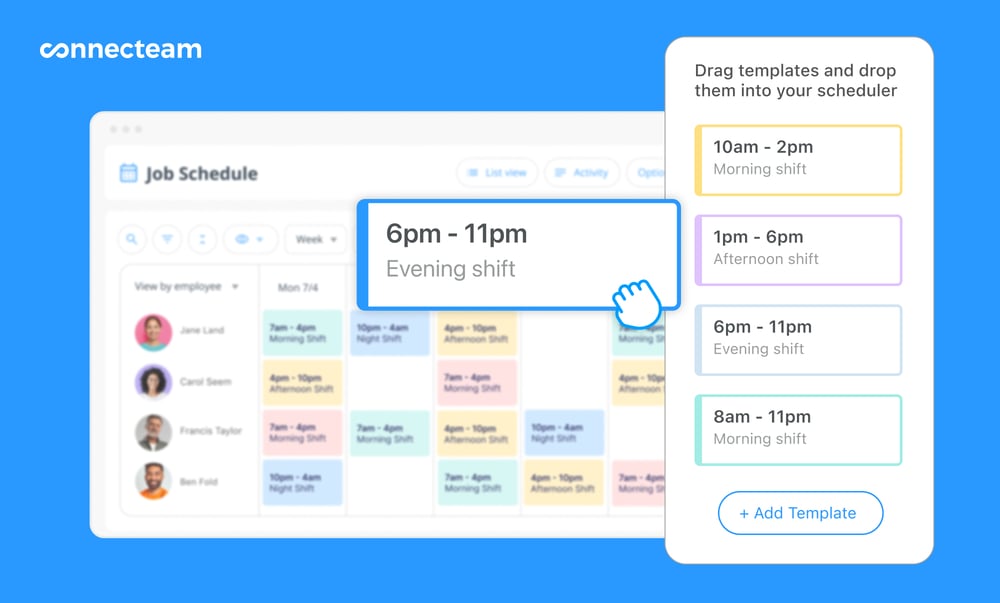
Once customers book their slots online or via phone or messaging, use a job scheduling software like Connecteam to create weekly schedules and assign available, qualified staff members. The best tools give you complete visibility in a calendar format, and some tools even prevent double bookings, staffing issues, and other scheduling errors.
What are the best scheduling software options for cleaning businesses?
Connecteam is the best scheduling software for cleaning businesses. It offers simple shift planning, real-time updates, and mobile access for teams on the go. With built-in communication, time tracking, and task management, Connecteam streamlines operations, reduces manual errors, and keeps cleaners informed to save you time and boost productivity.
What are the legal requirements for running a cleaning business?
Legal requirements for running a cleaning business include registering your business, obtaining necessary state or local licenses, and complying with OSHA health and safety standards. Employers must also comply with federal and state labor laws.
How much should I charge for my cleaning services?
Charge for your cleaning services by calculating labor costs, overhead, and your desired profit margin. Rates vary by location, service type, and frequency, but the average hourly rate for cleaning companies is around $25–$75 per cleaner.
What kind of insurance do I need for my cleaning business?
Cleaning businesses usually need general liability, workers’ compensation, and property damage insurance. You might consider additional coverage like business interruption or bonding to offer extra protection and increase client trust.
